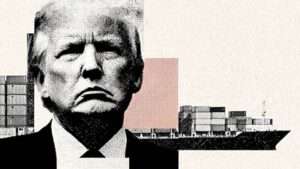
Today, I took part in a National Constitution Center podcast on the Supreme Court's recent tariff decision. The other participants were Zach Shemtob (SCOTUSblog) and Julie SIlverbrook (NCC). In addition to considering the big-picture implications of the tariff ruling, we also discussed all seven of the majority, concurring, and dissenting opinions! The audio and a more detailed description of the podcast are available here. I have also embedded it below:
The NCC site linked above also contains a list of links to various articles and court decisions relevant to our discussion. I repost that list here:
On March 27, 2025, the President signed Executive Order 14,251, invoking his authority under 5 U.S.C. § 7103(b)(1) to exclude various federal agencies and subdivisions from collective bargaining requirements based on national security considerations. The district court preliminarily enjoined the Executive Order after concluding that the President issued it to retaliate against federal employee unions, in violation of the First Amendment. We stayed the district court's injunction pending appeal. Consistent with the reasoning in our prior stay order, we now vacate the preliminary injunction….
[T]he Federal Service Labor-Management Relations Statute (FSLMRS) … "expressly protects the rights of federal employees 'to form, join, or assist any labor organization, or to refrain from any such activity,' and imposes on federal agencies and labor organizations a duty to bargain collectively in good faith." The FSLMRS exempts several federal agencies from coverage, including the FBI, the Government Accountability Office, and the CIA…. [And the statute adds that]
The President may issue an order excluding any agency or subdivision thereof from coverage under this chapter if the President determines that—
(A) the agency or subdivision has as a primary function intelligence, counterintelligence, investigative, or national security work, and
(B) the provisions of this chapter cannot be applied to that agency or subdivision in a manner consistent with national security requirements and considerations.
Since the FSLMRS was enacted in 1978, every President other than President Biden has signed executive orders that exclude designated agency subdivisions from the FSLMRS under § 7103(b)(1).
On March 27, 2025, President Trump signed Executive Order 14,251. Invoking § 7103(b)(1), the President determined that certain agencies "have as a primary function intelligence, counterintelligence, investigative, or national security work," and that the FSLMRS "cannot be applied to these agencies and agency subdivisions in a manner consistent with national security requirements and considerations."
Under EO 14,251, the agencies designated for exclusion include, inter alia, the Departments of State, Justice, and Veterans Affairs, the EPA, nearly all of the Departments of Energy, Defense, and Treasury, and various subdivisions of the Departments of Agriculture, Homeland Security, and Health and Human Services. The Executive Order exempted from exclusion "local employing offices of any agency police officers, security guards, or firefighters, provided that this exclusion does not apply to the Bureau of Prisons." It appears that EO 14,251 is the largest single effort to date to exclude agencies and subdivisions from collective bargaining on national security grounds.
Upon issuing the Executive Order, the White House posted a "Fact Sheet" to the White House website…. It described how the various excluded agencies were involved in national security functions relating to national defense, border security, foreign relations, energy security, cybersecurity, and so on. The Fact Sheet further explained that collective bargaining agreements and "hostile Federal unions" were impeding national security, including by hamstringing agencies in their ability to address poor performance and employee misconduct.
I did a Society for the Rule of Law podcast about the Supreme Court's ruling in our tariff case. Gregg Nunziata, Executive Director of the Society, interviewed me. We covered all major aspects of the decision, its implications for the future, and also potential litigation over Trump's new Section 122 tariffs. The video is embedded below:
I have also written several articles and blog posts about these issues, in recent days:
On paper, the program seems unobjectionable. Students are asked to wear clothes from their ancestral homeland. Students can also prepare posters with pictures and other symbols from that nation. And parents can bring in food from their local cuisines. Students then group together by region: Europe, Asia, the Middle East, Africa, and South America. They parade down the hallway, which was festooned with flags from around the globe. At some level, the day was enjoyable. I saw kids smiling as they celebrated the culture that mattered most to them. Parents also cheered when their home country was represented. What could be wrong?
Lots can be wrong.
From the conclusion:
Multicultural Day is a gateway drug to DEI. It acculturates students at the earliest age to focus on differences between races and nationalities rather than on what unites us. Efforts to allow students to represent their own cultures necessarily separate them on that very basis. Shortly after Multicultural Day ended, African American History Month began. Unsurprisingly, there was no representation of Justice Clarence Thomas, one of the most influential black people in American history.
From Lucey v. Kinnon, decided Dec. 15 by the Massachusetts Appeals Court, in an opinion by Justice John Englander, joined by Judges Eric Neyman and Joseph Ditkoff (affirming a decision I blogged about here in 2024):
The defendant Neil Kinnon insulted the plaintiff, Scott Lucey, on the webpage for a Facebook group known as "Malden (MA) Politics." {Kinnon is a former Malden city councillor, and Lucey, an attorney, had been a frequent participant in Malden political discussions.} Specifically, in responding to a comment that Lucey had posted on June 7, 2023, Kinnon stated,
"I'm beginning to wonder if you are capable of reading. Might want to read again and anybody who would hire you to be their attorney God Bless them, because someone must have taken the Bar exam for you" (emphasis added)….
"Statements that are merely 'rhetorical hyperbole,' or that express a 'subjective view,' are not statements of actual fact." … Here, the statement at issue is rhetorical hyperbole, and would not be understood otherwise by a reasonable person reading the statement in context. The context itself is banter, between two persons whose statements indicate that they had bantered previously.
Various laws are described as providing higher punishment for hate crimes, but they generally don't focus on whether the defendant hated people with a particular identity. Rather, they focus on whether the defendant committed the crime at least in part because of the target's identity. Often that will stem from hatred or other identity-based hostility, but not always. An excerpt from the long U.S. v. Ritter, decided last week by the Fourth Circuit (in an opinion by Judge Julius Richardson, joined by Judges Robert King and Pamela Harris), offers a good illustration:
Defendant Daqua Ritter grew up in rural Allendale, South Carolina. Though he later moved away, he often returned there during summers. During his visits, he maintained a sexual relationship with victim Ernest "Dime" Doe—a "biological male" who "presented as a female."
While Doe openly referred to Ritter as Doe's "man" or "boyfriend," Ritter tried to keep the relationship secret. He often told Doe to delete their messages. And Ritter became angry whenever people brought up his relationship with Doe, stating on several occasions that he would beat Doe when others brought up their sexual relationship. Though Doe feared Ritter, their relationship continued.
When Doe was found shot dead in a car beside a rural road, rumors implicating Ritter quickly surfaced. Just hours earlier, Doe had been pulled over for speeding while Ritter was in the passenger seat. That stop was the last time that Doe was seen alive. Hours later, Doe was dead. And Ritter then showed up at his uncle's house—blocks away from the crime scene—asking for a ride into town. Before long, Ritter asked friends to dispose of his gun and burned his clothes in a barrel. This initiated a years-long investigation conducted by state and federal law enforcement.
A federal grand jury eventually indicted Ritter for [among other things] willfully causing bodily injury to Doe because of Doe's gender identity …. A jury convicted Ritter on all counts, and the district court sentenced him to life in prison….
Ritter … argu[es] that the evidence was insufficient to prove that he killed Doe "because of" Doe's "actual or perceived … gender identity." … [W]hat does it mean for somebody to act "because of" a given trait? … "[B]ecause of" incorporates "the traditional but-for causation standard." … So the government had to show that Ritter would not have killed Doe but for Doe's "actual or perceived … gender identity." The statute defines "gender identity" as "actual or perceived gender-related characteristics." …
[T]he evidence—viewed in the light most favorable to the government—was sufficient to lead a rational juror to conclude that Ritter killed Doe because of one of Doe's perceived gender-related characteristics: Doe's biological sex.
The evidence showed that the broader Allendale community knew that Doe was a biological male who presented as a woman. Ritter was very sensitive about people finding out that he was in a relationship with Doe, because Ritter didn't want people questioning his sexuality. So Ritter pressured Doe to keep their relationship secret, including by asking Doe to delete the messages they exchanged.
Most of the discussion was focused on the wrong issue. What matters under the Takings Clause is not the "fairness" of the process by which the owner's house was taken, but whether he got adequate "just compensation."
Today the Supreme Court held oral argument in Pung v. Isabella County, an important takings case in which I filed an amicus brief on behalf of the Cato Institute, myself, and a group of prominent takings scholars. Frustratingly, much of the oral argument focused on the wrong issue.
This is a case about home equity theft. Isabella County, Michigan seized the late Timothy Pung's house because he supposedly failed to pay some $2200 in taxes and fees (his estate claims he didn't actually owe anything). They then sold the property at auction for about $76,000; the County kept the $2200 it thought was owed and transferred the remaining funds (about $73,800) to Pung's estate.
The usual standard for takings compensation, according to longstanding Supreme Court precedent, is "fair market value" - the price a property would fetch if sold on the open market. Pung's estate argues the fair market value here is actually $194,400 (the amount at which the county itself assessed that value for property tax purposes).
If a seizure of home equity after foreclosure is a taking - as the Supreme Court's unanimous decision in Tyler v. Hennepin County (2023) rightly held - then the estate is obviously right. The property taken is the residual value of the home (after delinquent taxes are repaid). And that can be more than the government got from the highest bidder at the auction.
Here, it seems clear the auction price was indeed far too low. We know that because the winning bidder quickly resold the property for $195,000 (very close to the Pung estate's estimate of the fair market value).
When the Court took the case and after I saw the impressively broad cross-ideological array of amicus briefs supporting Pung, I thought it highly likely that the justices would simply rule that fair market value compensation is required. Our amicus brief explains why that follows from basic Takings Clause principles. But, sadly, most of today's argument wasn't actually focused on the amount of compensation required, but rather on the "fairness" of the foreclosure and auction process to which the property owner was subjected. That's not the right issue! The Takings Clause is a substantive standard, not a procedural one. It requires payment of "just compensation" when the government takes property. And, in this case, both sides agree that a taking has occurred (counsel for the County admitted as much during the argument). Thus, the focus should be on whether the amount of compensation the Pung estate got was adequate, not on the process that got to that point.
And, in this case, it is very obvious that the compensation was grossly insufficient. The government's own valuation of the property shows that, as does the fact that the winner of the auction soon turned around and sold the house for almost exactly what the government had valued it at.
Justice Neil Gorsuch got it right when he said that "I would have thought that when I lose all the bundle of sticks in my property, and the state takes them, that's a taking… for the purposes of the U.S. Constitution." Exactly so! The County took the house, and therefore must pay the owner its full value.
Justice Ketanji Brown Jackson suggested "the thought that all of the fairness questions that are coming up in this case could actually be taken care of in the due process realm," and thus better dealt with under the Due Process Clause of the Fifth Amendment, rather than the Takings Clause. She's largely right about that, I think. But she draws the wrong conclusion for this case (that the County should likely win). The right conclusion is that the requirements of the Takings Clause cannot be satisfied by mere procedural fairness. The government must pay fully adequate compensation, which in most cases requires at least fair market value. In our amicus brief, we point out that fair market value compensation often may actually be insufficient, because it sometimes fails to account for the "subjective value" may people attach to their homes and other property. But, at the very least, compensation far below fair market value is not enough.
Perhaps the focus on procedural fairness was dictated by a fear that simply ruling that fair market value compensation is required would destroy the tax foreclosure system. The Trump Justice Department lawyer who intervened today claimed that such a requirement "would spell the end of tax sales in America. Every tax sale is necessarily going to yield less than fair market value." That claim is false. As detailed in our amicus brief (pg. 18), and others, states have a variety of options for structuring foreclosure auctions in ways that avoid that problem. For example, they could simply mandate a minimum auction bid equal to fair market value, or close to it. Justice Alito noted various such alternatives in the oral argument.
That said, it is true (as also noted in our brief) that tax foreclosure auctions often lead to inadequate compensation for property owners. We point out that poor, elderly, disabled, and minority owners are particularly at risk of home equity theft. The Court would do well to put an end to these blatant violations of constitutional property rights. If the price of ending it is that states must find some other way to deal with tax delinquencies, so be it.
Several justices, including Amy Coney Barrett and Sonia Sotomayor, highlighted the unfairness of the County's seizure of a home worth over $194,000 to pay off a tax delinquency of just $2200, especially since it was far from clear that Pung really was delinquent. As Barrett put it, "it sounds to me like this tax assessor was like Inspector Javert, but it was even worse because [in this case] Jean Valjean hadn't stolen the bread." Such vast disproportions between the tax delinquency amount and the value of the property taken often occur in tax foreclosure cases. That's yet another reason to mandate full fair market value compensation.
Justice Thomas raised the issue of why, if fair market value compensation is the standard, so many states have traditionally gotten away with paying much less. The answer is that it was only in 2023 (in the Tyler case) that the Supreme Court finally ruled on the issue of whether home equity theft qualifies as a taking at all. Until then, there was little federal judicial scrutiny of tax foreclosure auction prices, though some state courts did curb these practices under their state constitutions.
At this point, I am not sure what will ultimately happen in this case. Several justices suggested the Court might vacate the Sixth Circuit decision in favor of the County and remand the case for further consideration of the "fairness" of the foreclosure auction process. In that event, much will depend on what standards the Court sets down for evaluating how "fair" the process is. There may also be some chance that the Court will still require fair market value compensation, or at least some degree of presumption in favor of such. I cannot entirely rule out the possibility that Court will affirm the badly misguided Sixth Circuit ruling. But I suspect there are not five votes for that.
Finally, it's worth noting that the Trump administration's intervention against property rights here is of a piece with this administration's general hostility to constitutional property rights. Trump had a terrible record on property rights during his first term, and the second seems to be just as bad.
In sum, it's hard to tell what will happen here. But it's frustrating that the justices may end up making a clear and simple issue unduly complicated, and in the process mucking it up. The government took the Pung estate's property here, and they have to pay full compensation for it, minus the delinquent taxes Pung owed (assuming he did in fact owe them). That should be enough to settle this case and all others like it.
NOTE: The Pung estate is represented by the Pacific Legal Foundation, a public interest law firm which is also my wife's employer. She, however, is not one of the attorneys on the case. The estate is also represented by other attorneys.
From Judge Kurt Engelhardt, joined by Judge Leslie Southwick in today's Woodlands Pride, Inc. v. Paxton (Judge James Dennis, who had been a member of the original panel and had dissented in part, retired from service since then and thus didn't participate):
A Texas law regulates sexually oriented performances on public property and in the presence of minors. A drag performer and others in the drag industry brought a pre-enforcement challenge, alleging that the law facially violates the First Amendment and is unconstitutionally void for vagueness. After a two-day bench trial, the district court agreed with the plaintiffs and permanently enjoined the appellants from enforcing the law. We vacate that injunction and remand….
Texas Senate Bill 12 ("S.B. 12") regulates "sexually oriented performances" on public property and in the presence of minors. A "sexually oriented performance" is "a visual performance" that (1) features a performer who "is nude" or "engages in sexual conduct," and (2) "appeals to the prurient interest in sex" [which means that the] {material, at a minimum, must be "in some sense erotic"}….
"Queers stay away from our children. You're ruining America." That was one of several messages Wattenbarger displayed on banners affixed to his truck and horse trailer as he drove through a pride festival in Crossville, Tennessee in June 2023. Others included "Stop Sexualizing Our Children," "What is a Woman," and "Make Noise For A Queer Free America."
Whatever one thinks of that sentiment, the First Amendment protects speech on matters of public concern. Wattenbarger had the right to express it. The question … is whether the City violated that right when it arrested Wattenbarger, not for that expression, but for parallel parking his pickup truck and horse trailer across multiple spaces in front of the courthouse where the festival was being held….
A very interesting article by my Hoover Institution colleague Philip Zelikow, who is an emeritus history professor (mostly specializing in the history of American foreign affairs) at the University of Virginia, but also a lawyer; here are the introductory paragraphs:
On February 20, the Supreme Court ruled that President Trump's tariffs imposed under an emergency powers law were unlawful. After raging at the court, the president imposed a new set of global tariffs using a different statutory authority. I participated in the tariff litigation from the start and argued, both to the court and in this Substack, that those tariffs were unlawful.
The new 10 or 15 percent global tariffs, claiming authority from a 1974 law, are also unlawful. When courts look into this, I think they will find that this is not a close case.
In 1976, two years after that law was passed, the US government formally decided that the relevant statutory term, "balance of payments," had become obsolete after the end of fixed exchange rates and the demise of the Bretton Woods system. The US government would therefore no longer report a "balance of payments" in its statistics. That may be one reason why the old 1974 authorities had never been used. There are better laws available to achieve more sustainable results.
Even though the 1974 law allows the tariffs to be imposed only temporarily, for a maximum of 150 days, the matter may be worth litigating for two reasons. First, the costs, almost all paid by Americans, would run at least into tens of billions of dollars. Second, a number of lawyers fear that the White House may attempt to "rinse and repeat" the temporary tariffs again and again. Sadly, given presidential behavior in some other settings, including the appointment of interim US attorneys, these are not idle fears.
Why the 1974 authorities (section 122) are obsolete
Prof. Alan Rozenshtein (Minnesota) has a very interesting item on this today at Lawfare; I'm not an expert on the subject, so I can't offer an independent evaluation, but I thought it was worth passing along. (Let me know, please, if you can suggest some contrary views that are also credible and worth passing along.) An excerpt, but you should read the whole thing:
On Tuesday, Feb. 24, Defense Secretary Pete Hegseth met with Anthropic CEO Dario Amodei and threatened to invoke the Defense Production Act (DPA) if Anthropic doesn't agree to the Pentagon's terms by Friday. The DPA, Hegseth warned, would let the government compel Anthropic to provide its technology on the Pentagon's terms. Anthropic is resisting allowing its artificial intelligence (AI) to be used for autonomous weapons or mass surveillance—two red lines that the company has maintained since entering the defense market.
I argued last week that Congress—not the Pentagon or Anthropic—should set the rules for military AI. The DPA threat makes that case stronger. But first, it's worth understanding what the DPA can actually do here, because the answer depends entirely on what the government is demanding. The legal analysis is genuinely complicated: Different demands raise very different legal questions, and a statute whose core compulsion powers were designed for steel mills and tank factories maps awkwardly onto a dispute about AI safety guardrails….
The DPA is a Korean War-era statute that gives the president broad authority to direct private industry in the name of national defense. It has been extended many times since its enactment, most recently through September 2026.
The DPA already applies to AI. The Biden administration's since-rescinded Executive Order 14110, Section 4.2, invoked the DPA to require AI companies to report on training activities, red-team results, and model weights. But President Biden used Title VII, which contains the DPA's information-gathering authority. Based on the available reporting, Hegseth is likely threatening Title I—the statute's core compulsion power. That's an enormous escalation.
Biden's precedent cuts both ways for Anthropic. It makes it harder for the company to argue the DPA doesn't reach AI at all. But establishing that AI falls within the statute's scope doesn't mean every demand is lawful. The range of possible demands under Title I is enormous, and the legal analysis is different for each….
It's been a busy twenty-four hours. Yesterday evening, Steve Vladeck and I chatted about the emergency/shadow docket at the Georgetown Federalist Society. There was more agreement than you might expect. Remember, social media is not the real world.
After dinner with the students, where we talked about the new GULC Dean, I braced myself to watch the State of the Union address. In the past, my favorite part of the SOTU is when the Justices entered. Last night, the drama was about which Justices would attend. In the end, four showed up: Chief Justice Roberts, and Justices Kagan, Kavanaugh, and Barrett. Justice Gorsuch, who has attended in recent years, was absent. Justices Thomas and Alito have not attended in years. Justice Sotomayor who has usually attended was not there. Justice Jackson attended when Biden was in office, but was not there last night. (All of the Justices made it to the bench this morning, so none were out of town; it was a choice to not attend.)
When the President entered the chamber, each of the Justices greeted him cordially. I couldn't make out anything that was said. If the Justices were bothered by Trump's remarks--as they should have been--they didn't show it. I give special extra credit to Justice Barrett, who displayed some serious self-control by pleasantly smiling when she talked to the President, and held that pose even as the camera lingered on her for a bit longer.
Once Trump started, I waited with despair for him to talk about the Supreme Court. The baseline was President Obama's remarks during the 2010 State of the Union following Citizen's United.
With all due deference to separation of powers, last week the Supreme Court reversed a century of law that I believe will open the floodgates for special interests –- including foreign corporations –- to spend without limit in our elections. (Applause.) I don't think American elections should be bankrolled by America's most powerful interests, or worse, by foreign entities. (Applause.) They should be decided by the American people. And I'd urge Democrats and Republicans to pass a bill that helps to correct some of these problems.
I suspected that President Trump would go lower than President Obama, but I didn't know by how much. Here are the remarks as delivered:
One of the primary reasons for our country's stunning economic turnaround — the biggest in history, where the Dow Jones broke 50,000, four years ahead of schedule, and the S&P hit 7,000, where it wasn't supposed to do it for many years — were tariffs. I use these tariffs, took in hundreds of billions of dollars to make great deals for our country, both economically and on a national security basis.
Everything was working well. Countries that were ripping us off for decades are now paying us hundreds of billions of dollars. They were ripping us so badly. You all know that. Everybody knows it. Even Democrats know it. They just don't want to say it. And yet these countries are now happy, and so are we. We made deals. The deals are all done. And they're happy. They're not making money like they used to, but we're making a lot of money.
There was no inflation, tremendous growth. And the big story was how Donald Trump called the economy correctly, and 22 Nobel Prize winners in economics didn't. They got it totally wrong. They got it really wrong.
And then just four days ago an unfortunate ruling from the United States Supreme Court, it just came down, came down. Very unfortunate ruling. But the good news is that almost all countries and corporations want to keep the deal that they already made, right, Scott? Knowing that the legal power that I as president have to make a new deal could be far worse for them. And therefore they will continue to work along the same successful path that we had negotiated before the Supreme Court's unfortunate involvement.
So despite the disappointing ruling, these powerful, country-saving — it's saving our country, the kind of money we're taking in — peace protecting — many of the wars I settled was because of the threat of tariffs. I wouldn't have been able to settle them without — will remain in place under fully approved and tested alternative legal statutes, and they've been tested for a long time. They're a little more complex, but they're actually probably better. Leading to a solution that will be even stronger than before.
Congressional action will not be necessary. It's already time-tested and approved. And as time goes by, I believe the tariffs, paid for by foreign countries, will, like in the past, substantially replace the modern-day system of income tax, taking a great financial burden off the people that I love.
Right? Moving forward, factories, jobs, investment and trillions and trillions of dollars will continue pouring into the United States of America. Because we finally have a president who puts America first. I put America first. I love America.
For decades, before I came along, we had the exact opposite. From trade to health care, from energy to immigration, everything was stolen and rigged in order to drain the wealth out of the productive and hard-working people who make our country great, who make our country run.
The President said the ruling was "unfortunate" and "disappointing." Honestly, I was expecting much, much worse. What made Trump's press conference so problematic was that he did not only criticize the decision, which I think is within bounds, but he targeted specific Justices. At the State of the Union, he reserved his criticism for the ruling, and not the Justices.
There is a long line of Presidents who criticized rulings from the Supreme Court. President Lincoln was not a fan of Dred Scott and Chief Justice Taney. President Theodore Roosevelt said that "I could carve a judge with more backbone out of a banana" than Oliver Wendell Holmes. President Franklin D. Roosevelt wanted to expand the Supreme Court in response to their rulings. But "disappointing" seems a plausible word to use. Indeed, the language that President Trump used should sound familiar. In 2013, President Obama said he was "deeply disappointed" with Shelby County. I recall President George W. Bush used similar language after Boumediene. I'm okay with "deeply disappointed."
I did notice that the Justices quickly exited the chamber before Trump made his way down. I think they made the same exit last year. In the past, the Justices would wait until the President made his way out. I suppose the Chief Justice felt the need to get out of there.
Speaking of the Chief Justice, today was a special day for me. For the first time, I moved for admissions at the Supreme Court. Way back in 2016, my good friend Ilya Shapiro moved for my admission on the day Zubick v. Burwell (better known as Little Sisters of the Poor) was argued. I sat a few seats away from Paul Clement. It was pretty cool. Since then, I have signed admission papers for several lawyers, but have never done the process in open court.
From today's order by Chief Judge Reed O'Connor (N.D. Tex.) in Doe v. X Corp.:
[The federal] Non-Consensual Intimate Image ("NCII") disclosure prohibition, colloquially known as the "revenge porn statute[,]" … prohibits anyone from recklessly or knowingly disclosing another's "intimate visual depiction … without the consent of the individual" and imposes statutory damages of $150,000 for violations. It excludes from liability those disclosures containing "commercial pornographic content, unless that content was produced by force, fraud, misrepresentation, or coercion of the depicted individual." …
Plaintiff John Doe ("Plaintiff") creates posts on OnlyFans containing sexually explicit content. OnlyFans is a subscription-based platform on which creators post content for subscribers to view. The OnlyFans terms of service prohibit any user from taking and republishing, or otherwise reproducing, content from its site without permission. Plaintiff has also created pornography produced by Falcon Studios, SayUncle, Pride Studios, and ASG Max. Each of these studios grants viewers of its commercial pornography a limited license for viewing that does not permit republishing or otherwise reproducing images on a website or social media platform….
A third party copied commercial pornographic content from Plaintiff's OnlyFans and studio-based productions and uploaded it to X without his consent, violating the OnlyFans terms and conditions and the studios' licensing agreements. Plaintiff contends that the person who copied his images off these accounts "misrepresented [his or her] willingness to comply with the acceptable use policy and terms of service" on his platforms and thus "fraudulently gained access to [his] intimate visual depictions." He alleges that the third party reposted the content to X and that X disclosed it to xAI. Accordingly, Plaintiff asserts the third party "produced" the stolen images by fraud and misrepresentation. He also alleges he informed X that "he did not consent to disclosure of his intimate images" on X, including by X to xAI. Therefore, he claims X has disclosed his commercial pornographic content which was "produced by fraud" or "misrepresentation" without his consent in violation of Section 6851….
Here's the heart of the analysis (though the full opinion also deals with some other complicated statutory arguments):
Plaintiff also asserts a First Amendment claim based on an incident in which a park ranger told him to stop filming a family barbecue held by Marco Hernandez, a retired HARD employee.
The Ninth Circuit has "recognized that there is a First Amendment right to film matters of public interest." A well-established application of this right is recording the official conduct of police and other public officials in public spaces.
Here, Plaintiff alleges that he noticed Mr. Hernandez, a retired HARD employee who lives in the caretaker's house in the park, hosting a family and friends barbecue in a public area next to the caretaker's house. Plaintiff alleges that Mr. Hernandez and his guests were violating numerous park ordinances, including having a fire, drinking and serving alcohol, and using a fenced-off yard for his guests. Plaintiff started filming from 150 yards away. Ten minutes later, Ranger Oliver arrived and ordered Plaintiff to stop filming. When Plaintiff refused to stop videotaping, Ranger Oliver called the Alameda County Sheriffs and told them there had been an altercation. Plaintiff does not allege that he was arrested.
Plaintiff fails to satisfy the first prong of First Amendment retaliation—that he was engaged in protected First Amendment conduct. While the First Amendment protects filming public officials in the exercise of their duties, Mr. Hernandez was not a public official and was not engaged in any public duty. As to the more general rule that the First Amendment protects filming matters of public interest, Plaintiff provides no authority that a family barbecue in a public park is a matter of public interest, whether or not Plaintiff suspects that barbecue violates park ordinances. The Court does not find that the barbecue, as alleged by Plaintiff, constitutes a matter of public interest….
How significant is the Supreme Court's decision striking down Trump's massive IEEPA tariffs in Learning Resources v. Trump? Only time will truly tell. It's often hard to fully appreciate the importance (or lack thereof) of a decision until we have some historical perspective on it, and see how it impacts future cases. But there is good reason to believe it will have at least some substantial impact, perhaps in multiple ways.
Certainly, a good many prominent observers seem to think so. Conservative New York Times columnist David French (who is also a well-known lawyer and legal commentator) wrote that the ruling "may prove to be the most important Supreme Court decision this century" and that "it may have saved the republic." Harvard law Prof. Jack Goldsmith - a former high-ranking Bush Administration official and leading expert on executive power and foreign affairs issues - describes it as "a massive defeat for the president" and a "blockbuster on many levels." After initially downplaying its significance, my co-blogger Josh Blackman now says the decision is "the Worst Judicial Defeat in Presidential History." He adds that "I think we are already seeing that Trump's efforts to use alternative statutory authorities will not work."
I rarely agree with Josh, in recent years. But I hope he turns out to be right about these two points. And I certainly believe the effort to use "alternative statutory authorities" deserves to be rejected by courts. See my recent article about why Trump's new Section 122 tariffs are illegal.
For my part, I think it is hard to make definitive judgments about the ruling's significance at this point. And it is particularly hard for me to be objective about it; I was one of the attorneys on the case, and it had its origins in a blog post I wrote at this very website. An impartial observer of this case I am not.
That said, I doubt that it is either the most important decision of the century, or the biggest judicial defeat a president has ever experienced. Those are very high bars! In addition, it is difficult to compare the impact of decisions in very different fields of law. But I do think the ruling is likely to prove significant in various ways.
First, the Court rejected Trump's effort to use the International Emergency Economic Powers Act (IEEPA) to claim virtually unlimited presidential authority to impose tariffs - what Chief Justice John Roberts, in his majority opinion, called the power to "impose tariffs on imports from any country, of any product, at any rate, for any amount of time." That's significant even if it has little or no broader doctrinal impact. The consequences of a decision the other way would have been devastating to the American economy and the rule of law. Ditto for the consequences of simply letting the IEEPA tariffs stand without challenging them.
Moreover, as discussed in my Atlantic article about the decision, all six justices in the majority - in different ways - expressed general skepticism of the idea that the president could ever wield such sweeping tariff authority. That point goes beyond the specifics of IEEPA and implies a general willingness to rule against future presidential power grabs in this important field.
A second important aspect of the decision is that the three conservative justices in the majority - Roberts, Neil Gorsuch, and Amy Coney Barrett - held that the "major questions doctrine" (which requires Congress to "speak clearly" when authorizing the executive to make "decisions of vast economic and political significance") applies to tariffs and possibly to other delegations of congressional power related to "foreign affairs." That further limits future presidential power grabs. These three justices also signaled their willingness to apply the major questions doctrine to power grabs by Republican presidents, as much as Democratic ones. Many observers previously doubted they would do that.
To be sure, the opinions of three justices are not a binding precedent of the majority of the Court. But, as Jack Goldsmith notes, these three justices are likely to be crucial swing votes in future cases involving executive power, and will have a lot of leverage:
A very significant aspect of the Chief Justice's MQD analysis is that three conservative justices embraced it to rule against President Trump's signature policy. And they did so in the most difficult possible context, with an issue involving national security and foreign affairs. This is a rebuttal to those who have claimed that the Court, or at least those three justices, invoke the doctrine opportunistically and politically to hurt Democratic presidents. And I think it signals more clearly than ever that, going forward, this Court is going to view broad delegations of statutory authority to a president to act, and/or extravagant presidential interpretations of authorizations to act, with skepticism. The three justices firmly committed here to the MQD can (if they wish) ensure that outcome in a case of just about any political configuration.
Finally, the case is a further demonstration of the potential effectiveness of combining litigation and political action as a strategy for resisting abuses of government power. I summarized the advantages (as well as some limitations) of this approach in a May 2025 UnPopulist article, where I built in part on my and others' previous academic work. I think it worked here.
We prevailed in part because we developed strong legal arguments, and because our team had outstanding lawyers like famed Supreme Court litigators Neal Katyal and Michael McConnell, and Jeff Schwab of the Liberty Justice Center (all vastly better litigators than me!). But it also helped that we were effective in waging the "war of ideas" in the public arena outside the courtroom, influencing the climate of elite and public opinion. The climate of opinion can matter in high-profile litigation.
The fact that the tariffs became highly unpopular also likely helped at the margin, perhaps making it easier for judges to rule against the president's signature policy initiative. A YouGov poll taken soon after the decision found that 60% of Americans approve of the result, while only 23% disapprove.
I highly doubt that any lower-court judge or Supreme Court justice ruled against the tariffs primarily because of their unpopularity. But, for judges inclined to conclude the tariffs were illegal, that unpopularity may have made it easier for them to stand up to the president on a high-profile issue than might otherwise have been the case. The tariffs' unpopularity was at least in part due to effective political advocacy against them (almost entirely that of people outside our legal team), emphasizing how they were increasing prices. As I explained in a 2024 post, focusing on price increases is a time-honored effective strategy for turning public opinion against protectionism.
Just as I tried to learn from the experience of previous efforts to protect constitutional rights and enforce limits on government power, so future public interest litigators and activists might learn from ours. I may have more to say about the "war of ideas" aspect of the case in future writings. Here, I merely suggest it is a noteworthy part of the story, and one that may be of use in efforts to combat future abuses of government power.