Freed from prison in an exchange with the PFLP, Odeh made no effort to hide her involvement in the Supersol bombing—until she decided to immigrate to the United States.
Rasmea Odeh's PFLP comrades made numerous attempts to coerce her freedom through hijackings and hostage taking. In 1970, the quadruple airplane hijackings of "Black September" were carried out in the name of "Task Force Rasmea Odeh." Her freedom was again sought in a foiled hijacking in May 1972, and her name was on the list of prisoners whose release was demanded by the guerrillas who carried out the massacre at the 1972 Munich Olympics. The PFLP was finally successful in March 1979, when the Israelis released 76 prisoners, Odeh among them, in exchange for an IDF soldier captured in Lebanon.
Odeh's release was celebrated by a full-page poem in the PFLP magazine, which praised her for having joined "the troops of the revolution" with "a prophecy of the gun." She settled in Amman, Jordan, where she obtained a law degree and worked as a university researcher, calling it "the best period in my life."
There was no reason for Odeh to deny the Jerusalem bombing while living in Amman. She was admired as among first four Palestinian women to be "an active guerrilla," and she freely discussed her PFLP "military work" with interviewers from Lebanon and the U.S., as well as on Jordanian television.
Everything changed in 1996 when Odeh's family asked her to move to the U.S., to help her brother care for their cancer-stricken father, both of whom had become U.S. citizens. Odeh fraudulently obtained a family unification visa by lying on the application. She falsely denied ever having committed a crime, claimed she had never belonged to any organizations, and denied ever having been arrested, convicted, or imprisoned.
The theme is just what the title suggests—that admissions policies that give preferential treatment to under-represented minorities have not been good for colleges and universities (or indeed for anyone, very much including the policies' intended beneficiaries). The book contains eight fact-filled essays. Among the authors are John Ellis, Lance Izumi & Rowena Itchon, Peter Kirsanow, Heather Mac Donald, Maimon Schwarzschild, and Peter Wood. I have two essays in it. One is mine alone. The other was co-authored by Carissa Mulder.
The title comes from one of my favorite left-of-center jurists—Stanley Mosk. He wrote the majority opinion in the California Supreme Court's decision in Bakke v. Regents of the University of California(1976), which (unlike the U.S. Supreme Court's fractured 1978 decision in the same case) was unequivocal in holding race-preferential admissions to be a violation of the law. As Mosk put it in 1976, "To uphold the [argument for race-preferential admissions] would call for the sacrifice of principle for the sake of dubious expediency and would represent a retreat in the struggle to assure that each man and woman shall be judged on the basis of individual merit alone, a struggle which has only lately achieved success in removing legal barriers to racial equality."
Mosk's credentials as a liberal and a civil libertarian were impeccable. He'd been an effective advocate for civil rights long before it became fashionable and stuck his neck out for them several times. Yet beginning with the Bakke case, he lost favor with the Left. It's funny how that works.
With the Supreme Court's decision to review Students for Fair Admissions v. President and Fellows of Harvard College (No. 20-1199) and Students for Fair Admissions v. University of North Carolina (No. 21-707), the book is getting some additional attention.
Amicus briefs in those cases in support of the petitioner (or in support of neither party) are due in early May. If you are so inclined, there is still plenty of time to write one. And A Dubious Expediency will give you food for thought if you're not yet sure exactly what you'd like to cover. Don't be shy. What the country needs now is more lawyers with at least half the civil courage that Stanley Mosk had.
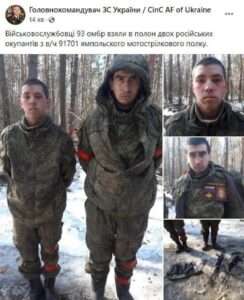
Russian soldiers captured in Ukraine (Ukrainian Armed Forces).
Economist Timur Kuran has an excellent idea for how the US and its European allies can help Ukraine resist Russia at little cost to ourselves:
Don't assume Russian soldiers and officers like what they are doing. Some—we can't know many, because preference falsification is inherently invisible—must be willing to break ranks, if only they have options. Let EU and NATO countries offer asylum to Russian military defectors.
Kuran, author of Private Truths, Public Lies: The Social Consequences of Preference Falsification, is the world's leading expert on "preference falsification" - the effects of situations where people have incentives to misrepresent their true beliefs. And there is good reason to believe that many Russian soldiers indeed would prefer not to be fighting Ukrainians. Political scientist Jason Lyall, an expert on defense issues, has a helpful summary:
Russia's invasion of Ukraine has stumbled out of the starting gate. Gambling on rapid marches to force a quick surrender in Kyiv, the Russian army appears shocked by Ukrainian resistance. While still grinding forward, Russian operations have been plagued by poor coordination, snarled logistics lines and a curious reluctance to deploy all elements of Russian military power, including air power…..
Why has Russia struggled? While analysts have mostly focused on hardware and doctrine, many of Russia's problems can be traced to a single source: low morale….
Evidence is mounting that many Russian soldiers are reluctant to fight.
Social media is littered with videos of lost and hungry soldiers looting, begging for food or ditching their tanks and trucks. Captured soldiers have expressed confusion about the war's purpose and have surrendered once they discovered they were not on a training exercise. Hundreds of armored vehicles have been abandoned or captured by Ukrainian forces and, in at least one case, by a local farmer.
Many of Russian equipment losses have been because of abandonment and capture, not destruction. Indeed, dozens of videos of lines of stranded military equipment can be found on TikTok. Russian military authorities have threatened physical abuse or worse to enforce discipline in some units.
The rest of Lyall's article details the causes of many Russian troops' low motivation, and describes ways in which morale problems impede the Russian military's effectiveness.
A shift in incentives from a situation where surrender is likely to mean eventual repatriation to Russia (where they may face disgrace and possible punishment) to one where it means a life of vastly greater freedom and prosperity in the West could significantly increase the number of Russian soldiers who decide to give up. Fear that their subordinates are angling for an opportunity to defect might also sow doubt and distrust in the minds of Russian commanders, thus further undermining morale and effectiveness.
The US and other NATO allies should take up Kuran's idea. And they should publicize the offer of asylum as much as possible, using social media, leaflets dispersed by Ukrainian forces, and any other possible methods of communication. Every Russian soldier should be made aware that surrender means a better life for them in the West.
Yes, there is always the risk that a Russian who surrenders and clams asylum might turn out to be some sort of spy or saboteur planted by the Kremlin. But people given access to classified information or jobs requiring security clearances, must undergo extensive screening, whether they are immigrants or not. And if Vladimir Putin wants to insinuate spies or saboteurs into the US whose job it is to find openly available information or target facilities open to the public, realistically he has many other ways of doing so.
There are several other ways in which the US and its allies can use immigration and refugee policy to combat Putin and and ease the suffering caused by Russia's war of aggression. I plan to write about them in detail soon. For now check out these articles by Robert Zubrin in National Review, and Reason's Fiona Harrigan (here and here).
UPDATE: The Ukrainian government has offered "amnesty" and a payment of five million rubles each (about $48,000) to any Russian soldiers who surrender and turn over their weapons and equipment. Economist Bryan Caplan suggests some ways the European Union can improve this policy, along lines similar to the ones I described above:
On the surface, this sounds like a sweet deal, but on reflection, it's anything but. Put yourself in the shoes of a Russian soldier. First, you have to elude the [Russian] Army, knowing you could be shot for desertion. Then, you have to surrender without getting killed by Ukrainians. After that, you're stuck in prison; maybe they'll deposit you in a regular POW camp, complete with Russian loyalists ready to kill you when the guard's not looking. Wherever you languish, you know your fate hinges on the outcome of the war…
I admire the creativity of the Ukrainian proposal. Enticement to desert should be a standard part of military strategy, but hardly ever is. But let me propose a Version 2.0 to better fulfill the intent of the original offer.
Version 2.0: The EU, in cooperation with Ukraine, offers $100,000 plus EU citizenship to any Russian deserter. Russians can either go directly to the EU, or surrender to Ukrainian forces for speedy transport to the EU border.
The key gain: Deserters no longer have to gamble on Ukrainian success. As long as they escape from the Red Army's zone of control, they survive. A much better gamble.
Extra benefits: Instead of going to a Ukrainian prison or POW camp, you get to enjoy freedom in the EU. And the EU is far more likely to swiftly hand over the promised monetary bounty.
How much of a burden is this on the EU? Chump change, really. Even in a magical scenario where all of the roughly 200,000 Russian troops in the vicinity take the deal, $100,000 per soldier is a mere $20 billion. That's less than one-fifth of what Germany now plans to spend on defense in 2022 alone. It wouldn't be crazy to go up to $1,000,000 per deserter. You could even do a classic multi-tier offer, where the first 10,000 deserters get a million bucks each to compensate for the high initial risk, followed by lower payments for late-leavers who get to desert in comparative safety.
The Ukrainian offer is actually a bit better than Bryan suggests. It includes "amnesty" for those who surrender, which suggests they will not have to languish in a prison or POW camp. Still, their ultimate fate could easily include repatriation to Russia, where they might face punishment. Alternatively, they would stay in Ukraine, where they could potentially be captured by Russian forces, depending on how the war goes. Bryan's idea improves on the Ukrainian policy. And the payment idea - as developed by the Ukrainians and Bryan - improves on my own and Timur Kuran's proposal for asylum, but without payments.
Here's the introduction (the whole opinion is 68 pages long):
At trial, plaintiff Sarah Palin wholly failed to prove her case even to the minimum standard required by law. Accordingly, defendants the New York Times Company (the "Times") and James Bennet moved to dismiss the case prior to the start of jury deliberations. After hearing extensive argument, the Court granted the motion shortly after the jury had begun its deliberations. This Opinion sets forth the reasons for that decision, as well as the reasons for how the Court then dealt with the deliberating jury.
From U.S. Navy Seals 1-26 v. Biden, decided yesterday by the Fifth Circuit (by Judges Edith Jones, Kyle Duncan, and Kurt Engelhardt):
The district court preliminarily enjoined the Department of Defense … from enforcing certain COVID-19 vaccination requirements against 35 Navy special warfare personnel and prohibited any adverse actions based on their religious accommodation requests. It later declined to stay the injunction. Defendants now seek a partial stay pending appeal insofar as the injunction precludes them from considering Plaintiffs' vaccination statuses "in making deployment, assignment and other operational decisions." The Navy has granted hundreds of medical exemptions from vaccination requirements, allowing those service members to seek medical waivers and become deployable. But it has not accommodated any religious objection to any vaccine in seven years, preventing those seeking such accommodations from even being considered for medical waivers. We DENY Defendants' motion….
Rasmea Odeh organized the bombing of a Jerusalem supermarket that killed two university students. It did not take the Israeli authorities long to track her down.
Jerusalem's Supersol was crowded on Friday morning, February 21, 1969, as shoppers hurried to get ready for the coming Sabbath. At about 11:00 a.m., a bomb exploded near the meat counter, ripping through the shelves and ceiling and sending debris flying across the store. Two botany students were killed—immigrant roommates, from South Africa and Uruguay—who were buying supplies for a coming field trip. Dozens were injured, including an Auschwitz survivor and a U.N. attache.
Israel had already been on edge, following a series of bombings and international terror attacks, and the police were reasonably fearful that "private vengeance" might be carried out against Jerusalem's Palestinian population. Roadblocks were set up outside Palestinian neighborhoods, more or less successfully preventing angry mobs from attacking their Palestinian neighbors.
There can be something a little distasteful about Western onlookers (myself included) cheering on Ukrainians for a cause that our countries are not willing to join, a stance that risks raising the price of a peace that will be paid only with Ukrainian blood. Nevertheless, it is possible to recognize this, to be inspired by what Zelensky represents, and then to be shamed by his example.
Here is a nation and a leader willing to sacrifice so much for the principle of independence and the right to join the Western world. And yet, much of the West is jaded and cynical, apparently devoid of any such mission, cause, or sense of idealism anymore. What is it that the West believes in now? When you think of the great liberal heroes of our age, Angela Merkel and Barack Obama, say, they are actually deeply pragmatic conservatives, constantly hedging, calculating, and balancing interests with little grand vision or cause to pull their policies together. There is much to be said for this type of governance: As Helmut Schmidt, the former chancellor of West Germany, once quipped, "Whoever has visions should go to the doctor." Visions led to the Iraq War, for example. Yet conservative pragmatism is also deeply limited, allowing adversaries like Vladimir Putin to take advantage, exploiting caution and shortsighted selfishness….
In standing up to [Putin], Ukraine is articulating a certain idea of itself that is righteous and dignified and heroic: virtues we long ago dismissed as old-fashioned. How tragic it is that Zelensky's idea has to be attacked for us to be reminded of ours.
Schulz is active speaker and writer for public audiences on issues associated with the Lutheran Church, with which Concordia University Wisconsin is affiliated. Earlier this month, he published an online article, "Woke Dysphoria at Concordia," critical of the rise of "wokeism" in American society, in the Lutheran Church, and at Concordia University Wisconsin and criticized in particular how the presidential search was conducted at the university. In apparent response to that public criticism of the university, Schulz was suspended and barred from entering the campus as the university contemplated the future of his employment there.
This controversy is all too familiar. Professor writes something for a public audience that is critical of university administrators, and university administrators respond by retaliating against the professor. From a traditional academic freedom perspective, this sort of thing is a cut-and-dried violation of the professor's academic freedom under the American Association of University Professors standards. This sort of retaliation against "extramural speech" would also be a First Amendment problem for a public university.
The situation here is unusual, however, in that Concordia University Wisconsin is an explicitly religious institution. As such, it has not adopted traditional academic freedom protections and imposes some unusual restrictions on faculty speech. Even so, Concordia does have an academic freedom policy, and the university's action in this case goes well beyond the bounds of what the university has reserved to itself when it comes to professorial speech.
Schulz is not challenging accepted Lutheran doctrine or subverting the mission of the university as a Christian institution. He is criticizing the policy decisions of the university administration and whether the administration's actions should be regarded as consistent with Lutheran commitments properly understood. For the university to punish and suppress speech of that sort would be to dramatically limit professorial speech and call into question whether Concordia is capable of operating as a recognizable institution of higher education.
From the letter:
If robust criticism of university governance and policies is understood in itself to be a hindrance to the mission of the university or that participating in an ongoing public debate over the social commitments of the Lutheran church and Lutheran educational institutions is inconsistent with responsibilities of members of the faculty, then the university will have dramatically departed from ordinary understandings of the duties and responsibilities of professors in American universities, including American universities dedicated to a Christian mission. Of course, Professor Schulz has a responsibility not to "advocate a position contrary to that of the Synod," but here he is participating in a public debate on what the implications of the Synod's positions might be for the university. If faculty at the university must refrain from speaking in public about the future of the university and the fidelity of the university's activities to the positions of the Synod, then the university's commitment to the faculty to value their individuality and to engage in intellectual inquiry will be an empty promise.
Speech on such controversial social and political topics can sometimes be heated and disruptive, but universities should be places where scholars can in good faith engage in a robust debate over the principles and commitments of the community. If university leaders are willing to sanction faculty members for such speech, particularly when such speech involves criticisms of university administration, then free intellectual inquiry will be stifled rather than encouraged and the university will not be able to perform its charge of supplying "the higher education services needed to accomplish the mission of the church."
Much of this episode is devoted to how modern networks and media are influencing what has become a major shooting war between Russia and Ukraine. Dmitri Alperovitch gives us a sweeping overview. Ukraine and its President, Volodymyr Zelensky, clearly won the initial stages of the war in cyberspace, turning broad Western sympathy into a deeper commitment using short videos from downtown Kyiv at a time when Zelensky was expected to be racing for the border. The narrative of determined Ukrainian resistance and hapless Russian arrogance was set in cement by the end of the week, and Zelensky's ability to casually dial in to EU ministers' meetings (and just as casually say that this might be the last time the ministers saw him alive) changed official Europe's view of the conflict permanently. Putin's failure to seize Ukraine's capital and telecom facilities in the first day of the fight thus may guarantee a long, grinding conflict.
Russia is doing its best to control the narrative on Russian networks by throttling Facebook, Twitter, and other Western media. And it's essentially telling those companies that they need to distribute pro-Russian media in the West if they want a future in Russia. Dmitri doesn't believe that's a price Silicon Valley will pay for access to a country where every third bank and company is already off-limits due to Western sanctions. Jane Bambauer weighs in with the details of Russia's narrative-control efforts -- and their failure.
And what about the cyber-attacks that press coverage led us to expect in this conflict between two technically capable adversaries? Nate Jones and Dmitri agree that, while network wiping and ransomware have occurred, their impact on the battle has not been obvious. Russia seems not to have sent its A-team to take down any of Ukraine's critical infrastructure. Meanwhile, as Western nations pledge more weapons and more sanctions, Russian cyber reprisals have been scarce, perhaps because Western counter-reprisals are clearly being held in reserve.
All that said, and despite unprecedented financial sanctions and export control measures, the initiative in the conflict remains with Putin, and none of the panel is looking forward to finding out how Putin will react to Russia's early humiliations in cyberspace and on the battlefield.
In other tech news, the EU has not exactly turned over a new leaf when it comes to milking national security for competitive advantage over U.S. industry. Nate and Jane unpack the proposed European Data Act, best described as an effort to write a GDPR (General Data Protection Regulation) for nonpersonal data. And, as always, it's chasing the dream that Europe can regulate a European tech industry into existence.
Nate and I dig into a Foreign Affairs op-ed by Chris Inglis, the Biden administration's National Cyber Director. It calls for a new Cyber Social Contract between government and industry. I hit CTRL-F and "regulation" but don't find the word, likely thanks to White House copy editors, but the op-ed clearly thinks that more regulation is the key to ensuring public-private cooperation.
Jane reprises a story from the estimable "Rest of World" tech site. It turns out that corrupt and abusive companies and governments have better tools for controlling their image than Vladimir Putin – all thanks to the European Parliament and the U.S. Congress, which approved GDPR and the Digital Millennium Copyright Act respectively. These turn out to be great laws for suppressing stories that make third-world big shots uncomfortable. I remind the audience about another of Baker's Law: "Privacy Law Principally Protects the Privileged and the Powerful."
Announcement: We're thinking about having a live recording of episode 400, maybe on the web and maybe in person here in Washington. That would be March 28, 2022. If you want to attend, please send us a message to that effect at CyberlawPodcast@steptoe.com.
The views expressed in this podcast are those of the speakers and do not reflect the opinions of their institutions, clients, friends, families, or pets.
From U.S. v. Joseph, decided today by the First Circuit (Judge William Kayatta, joined by Judges Sandra Lynch and Rogeriee Thompson):
These appeals concern the pending federal prosecution of Massachusetts state district court judge Shelley Joseph and her courtroom deputy Wesley MacGregor for actions that allegedly interfered with the enforcement of federal immigration law. The defendants request that we step in now and review the ttrial court's refusal to dismiss their indictments prior to trial based on (1) Judge Joseph's claim of absolute judicial immunity and (2) both defendants' contention that their prosecution offends various provisions of the United States Constitution.
We must reject the defendants' request for pre-trial review of the denial of their motions to dismiss because their appeals are premature…
They can be banned, so long as the ban is content-neutral, and so long as people remain free to generally march through the neighborhood (as opposed to protesting right outside the target's home).
This matter is in the news again, because of a proposal in Boston to limit residential picketing so that it can only happen from 9 am to 9 pm. (This appears to have been prompted by residential picketing outside Mayor Michelle Wu's home.) I therefore thought I'd repost an item of mine that answers the question: Is this sort of targeted residential picketing protected by the First Amendment?
The short answer: No, but any restrictions on such picketing have to be imposed through content-neutral statutes or ordinances (or, in some situations, injunctions); and they have to leave people free to demonstrate in the same neighborhood:
In Carey v. Brown (1980), the Court struck down a ban on residential picketing that had an exemption for labor picketing.
In Frisby v. Schultz (1988), the Court upheld a ban (not just a time limitation but a total ban) that had no exemption, on the grounds that it was (a) content-neutral, (b) narrowly tailored to serving an important interest in protecting residential privacy, and (c) left people free to engage in "[g]eneral marching through residential neighborhoods, or even walking a route in front of an entire block of houses.".
In Madsen v. Women's Health Center, Inc. (1994), the Court struck down an injunction that barred residential picketing within 300 feet of clinic employees' homes, because it was too broad.
Carey involved a pro-busing group picketing the home of a mayor, while Frisby and Madsen involved anti-abortion groups picketing the homes of clinic employees. Indeed, most of the residential picketing cases I've seen have involved anti-abortion protesters; at least in the 1980s and 1990s, such residential picketing seemed to be a favored tactic of at least some parts of that movement.
But the Court of course didn't draw distinctions based on the content of the speech or based on whether the picketing was aimed at a public official. For instance, Justice Scalia, who had often faulted the Court in free speech cases where he thought anti-abortion speech was being treated unfairly, was in the majority in Frisby; Justices Brennan and Marshall, strong supporters of abortion rights, dissented; none of them seemed swayed by the speakers' ideology. Rather, as I note above, the Court expressly forbade such distinctions.
So a city or a state could ban picketing or allow it. But the rules would apply equally to anti-racism protesters, antifa protesters, anti-abortion protesters, alt.right protesters, and any other protesters.
To my knowledge, residential picketing is banned on a statewide basis only in Arizona, Colorado, Illinois, and Minnesota, though the statutes operate somewhat differently. (The Arizona ban is limited to picketing conducted "with intent to harass, annoy or alarm"; the Minnesota law allows injunctions to be issued based on targeted residential picketing that happens "on more than one occasion," rather than banning such picketing outright.) But various cities ban it as well.
Finally, even when there is no ordinance banning residential picketing, particular kinds of behavior while picketing—especially loud noise at night (cf. the August 2020 Washington protest outside the Postmaster General's home)—may be banned by content-neutral restrictions. See Kovacs v. Cooper (1949). Of course, those restrictions must be enforced in a content-neutral manner as well: A city can't deliberately ignore loud protests that express certain views but then punish loud protests that express others.
A conversation with my father Vladimir (who coincidentally shares the name of both the Russian and Ukrainian leaders) reminded me of the opening stanza of the Soviet National Anthem:
Союз нерушимый республик свободных
Сплотила навеки Великая Русь.
Да здравствует созданный волей народов
Единый, могучий Советский Союз!
An indestructible union of free republics,
Great Russia has joined forever.
Long live, created by the will of the peoples,
The united, mighty Soviet Union!
And that reminded me of the famous line that "the Holy Roman Empire was neither"; hard to think of a stanza that has a higher density of total falsehood, at least in its first three lines. (To be fair, the Soviet Union was indeed united and quite mighty for 70-odd years, though ultimately not mighty enough to endure beyond that.)
On Thursday, March 3, the Honorable Neomi Rao will deliver the Sumner Canary Lecture on "Textualism's Political Morality" at the Case Western Reserve University School of Law. In this lecture, Judge Rao will focus on the political and moral foundations of the positive law and explore how textualism as a method of statutory interpretation reflects and incorporates these foundations. The event, at 4:30pm, will be live, in-person at the law school. It will also be webcast. 1-hour of CLE for in-person attendance is pending approval. Registration information is here.
Judge Rao currently serves on the U.S. Court of Appeals for the D.C. Circuit. She previously served as the Administrator of the White House Office of Information and Regulatory Affairs, and has worked for both the White House Counsel's Office and Senate Judiciary Committee. She was also a tenured professor at the George Mason University Antonin Scalia Law School, where she founded the Boyden Gray Center for the Study of the Administrative State. She also clerked for Judge J. Harvie Wilkinson on the U.S. Court of Appeals for the Fourth Circuit and Justice Clarence Thomas on the Supreme Court.
Judge Rao is the latest in a long line of distinguished jurists to have given the Sumner Canary Memorial lecture. Other recent lecturers have included Judge Don Willett, Neal Katyal, and then-judges Neil Gorsuch, Brett Kavanaugh, and Amy Coney Barrett. A full list of prior Canary lecturers (with links to video when available) is here.
[1.] When possible, quote instead of paraphrasing. Say, for instance, that you want to argue that the obscenity exception doesn't cover ordinary vulgarities (even ones that are sometimes labeled "obscenities" in ordinary language). Cohen v. California (the "Fuck the Draft" case) has some great language:
This is not, for example, an obscenity case. Whatever else may be necessary to give rise to the States' broader power to prohibit obscene expression, such expression must be, in some significant way, erotic. It cannot plausibly be maintained that this vulgar allusion to the Selective Service System would conjure up such psychic stimulation in anyone likely to be confronted with Cohen's crudely defaced jacket.
So quote it directly, e.g.,
To be "obscene," "expression must be in some significant way, erotic"; mere "vulgar" words do not qualify. Cohen v. California, 403 U.S. 15, 20 (1971).
A paraphrase, such as
The obscenity exception only covers erotic material, and not just vulgarities.
is less effective; quotations have a verisimilitude and thus a persuasive force (despite readers' recognition that quotations are sometimes out of context) that mere paraphrases don't have.
From a Call for Papers from Verge: Studies in Global Asias Issue 10.1; Special Issue: brown/ness(es):
We consider race and ethnicity as co-constitutive logics and forms of difference across different geohistories, including the ways in which these logics form, transform, transfer, congeal -- or not. We ask after brown, black, yellow, red, and white (and bright) as codes for difference, as metaphors of color made to matter through the matter of different bodies. We prompt reflection on how race, religion, ethnicity, and caste overlap and congeal into one another, troubling normative vocabularies of difference and relation.
At today's oral argument, the justices explored Section 111 of the Clean Air Act, the major questions doctrine, justiciability and the regulation of advertising for four-foot cigars smoked through hookahs.
Today the Supreme Court heard oral argument in West Virginia v. Environmental Protection Agency, the most important environmental law case the Supreme Court is hearing this term. While some warned this case could be a Waterloo for the administrative state, most of the oral argument focused narrowly on how to interpret the relevant provisions of the Clean Air Act -- at least that is my preliminary reaction to today's argument.
The focus of the case is the scope of the EPA's authority to regulate greenhouse gases from the power sector. This matters because power plants are responsible for nearly a third of domestic greenhouse gas emissions. In advance of the case, many have raised concerns that the case could have broader impacts on federal agency regulation, particularly if the Court relies upon the major questions doctrine or nondelegation concerns to narrow the scope of the agency's authority. I previewed the case here (and in the posts linked therein).
Over the two-plus hours of argument, the justices seemed most interested in how to interpret the language of Section 111 of the Clean Air Act (42 U.S.C. Section 7411), which is the statutory source of authority to regulate greenhouse gas emissions from power plants. The Obama Administration's Clean Power Plan embodied a broad view of this language, that would justify regulating emissions on a system-wide basis, so as to induce fuel shifting and generation shifting. The petitioner states and coal companies, on the other hand, prefer the narrower reading adopted by the Trump Administration, under which Section 111 only allows the imposition of requirements at individual plants. As Section 111 refers to both the "best system of emission reduction" and the imposition of controls at each "existing source," there was jousting over how the language should be read.
The major questions doctrine was raised repeatedly throughout the argument, largely as an input to the statutory interpretation inquiry, rather than as a stalking horse for the nondelegation doctrine. No justice put forward the argument that Congress lacked the constitutional authority to delegate to the EPA the authority to set emission standards for greenhouse gases. Rather, the focus was on whether Congress has delegated such authority, and whether (due to the major questions doctrine) the Court should disfavor an interpretation that would substantially broaden the EPA's authority, such as by allowing the EPA to require system-wide emission reductions as opposed to focusing on the emission reductions that could be achieved at each plant.
The questioning also revealed that there is no clear consensus on what the major questions doctrine requires, specifically whether it is merely an aid to resolving ambiguity or whether it should operate as a broader presumption against the delegation of regulatory authority. How the Court addresses this point will be important in the ultimate opinion for the Court, as it could determine how much effect this decision has on other regulatory programs. I am still inclined to believe that the petitioners will prevail in this case, but there is some reason to believe this case will produce a narrower opinion than some had thought.
The Solicitor General and some respondents had sought to convince the Court that this case is not justiciable, either because the petitioners lack standing to challenge the lower court judgment or because the case is moot because the EPA is not currently enforcing any regulations against the petitioners. The justices did not seem particularly receptive to these arguments, however. Justice Gorsuch was the first to raise the standing question, and there was relatively little questioning focused on this concern, and minimal pushback to the petitioners' arguments in defense of jurisdiction.
Justice Alito posed what is perhaps the key question to SG Prelogar: Is there any precedent saying that a stay moots a case? There is not. The Court's liberals did not seem meaningfully more receptive to the justiciability concern. Justice Breyer, for instance, challenged SG Prelogar's claim that the the D.C. Circuit's decision does not require reimposition of the Clean Power Plan. Prelogar could not identify any portion of the D.C. Circuit decision to contradict Justice Breyer's reading, and instead suggested he consult a subsequent EPA memorandum. West Virginia SG See hammered this point on rebuttal.
I had previously suggested that the Court should vacate the D.C. Circuit decision and remand to the agency to consider on a clean slate. This would address the petitioners' concerns about the lower court opinions' expansive language, while also avoiding the problem of trying to discern the precise limits of Section 111 without a regulation in place that the EPA wants to defend, but it did not appear there was substantial interest in taking this route.
Interestingly enough, the nondelegation doctrine received relatively little attention during the two-plus hours of argument, other than as a factor that might influence application of the major questions doctrine. This was not a surprise to me, as this case never presented a serious vehicle for a direct nondelegation holding. It seems most of the justices agree (though this would not preclude a separate Justice Gorsuch opinion on this point). Nondelegation may still lurk in the background inducing a narrower read of the statutory language, but it does not appear a majority of the Court plans to do more than that -- at least not in this case.
A few other observations:
Female advocates are (still) a rarity at the Supreme Court. Today, however, three of the four attorneys arguing were women -- West Virginia Solicitor General Lindsay See, U.S. Solicitor General Elizabeth Prelogar, and Covington & Burling's Beth Brinkmann (on behalf of respondent power companies).
Justice Sotomayor seemed to have difficulty keeping some of the technical details straight (which is a bit of occupational hazard for those of us who toil in environmental law). She referred to the "CWA," which is not at issue here (but will be in another big environmental case next fall) and to the ozone layer.
SG Prelogar suggested that because the Clean Power Plan's emission reduction goals have been met nationally, there are no costs to states that did not meet the state-specific goals (and thus no injury) because they could easily engage in trading and the like to meet any emission reduction obligations. In other words, she seemed to be claiming that trading is costless and frictionless, so there are no transaction costs. That is quite a claim.
Justice Breyer posed a hypothetical involving the regulation of advertising for "four foot cigars smoked through hookahs," prompting quite the chuckle from one of his colleagues (almost certainly Justice Thomas). Brinkmann said the hypothetical was "really helpful," prompting Justice Kagan to note that's not how advocates typically respond to Breyer's hypotheticals.
Asked when the EPA could be expected to put forward a new rule governing greenhouse gas emissions from power plants, SG Prelogar said the EPA was on track to release such a regulation "this calendar year."