The Volokh Conspiracy

Mostly law professors | Sometimes contrarian | Often libertarian | Always independent | Est. 2002

The Volokh Conspiracy

Miami Herald: "DeSantis Calls Out 'Fake News,' But His Campaign Used Fake News Site to Raise Cash"

|

That's the Miami Herald headline; the body says:

In messages to supporters, Florida Gov. Ron DeSantis isn't shy about labeling "fake news media" the enemy.

But when it comes to raising money for his reelection bid, the Republican governor's campaign and an associated political committee have sought help from a satire website with the tagline "Fake news you can trust."

The governor's campaign committee as well as the associated Friends of Ron DeSantis political action committee paid the conservative-leaning satire website The Babylon Bee a combined $15,000 last year for services related to online fundraising [apparently focused on renting donor or subscriber lists -EV], according to state campaign finance records.

Does it really make sense to call a satire site a "fake news site," and suggest that there's something inconsistent in condemning fake news but working with satire sites?

Or is it a joke that I'm missing? I must admit that I sometimes set up headlines as gags—for instance, though I can't find the post, I vaguely remember that at one point in 2003 or thereabouts a state judge with the last name O'Connor retired, and I posted a headline "Judge O'Connor Retires" with the main body of the article offering the explanation. But I assume the Herald article is supposed to be serious.

Thanks to InstaPundit for the pointer.

Guns

D.A.'s Office Letter That Opposed Parole for Man Now Arrested in Connection with Sacramento Killings of Six

The letter is dated April 29, 2021, when Martin was three years into a 10-year sentence for a brutal assault on his girlfriend; he was released in February.

|

The Parole Board initially denied Smiley Allen Martin parole but then released him in February—he has now been arrested (as have his brother Dandrae Martin and Daviyonne Dawson) in connection with the shootings that killed six and wounded twelve. Note that the letter's statement that the offense for which he was serving time was not "violent" simply reflects the definition of "violent felony" in a particular California sentencing enhancement statute, which generally doesn't include assault; in ordinary language, of course, the crime was highly violent. Here's the letter; the Sacramento Bee's Sam Stanton broke the story.

April 29, 2021
Non-Violent Parole Review Process
Board of Parole Hearings …

RE: Smiley Allen Martin CDC # AT8808 DOCKET # 17FE008296

Inmate Martin has, for his entire adult life, displayed a pattern of criminal behavior. While the current case on review may not be "violent" under the Penal Code, Inmate Martin's criminal conduct is violent and lengthy. Inmate Martin has committed several felony violations and clearly has little regard for human life and the law, which can be shown by his conduct in his prior felony convictions of robbery, possession of a firearm and prior misdemeanor conviction of providing false information to a peace officer.

Read More

Free Speech

Challenge to Prior Restraint on Critics of Police Officer Ends With a Whimper

|

From today's Ohio Supreme Court opinion in M.R. v. Niesen:

A common pleas court issued a temporary restraining order ("TRO") prohibiting Julie Niesen, Terhas White, and others from publishing the personal identifying information of Ryan Olthaus, a Cincinnati police officer. We are asked to decide whether a speech-restraining TRO is immediately appealable. But that issue must be left for another day because the TRO has expired and this appeal is moot….

Olthaus filed a civil complaint against Niesen, White, and several others in the Hamilton County Common Pleas Court. The complaint alleged that in the summer of 2020, Olthaus was providing security and crowd control for a public forum at a Cincinnati City Council committee meeting. At the meeting, a large crowd of citizens called for the city to defund the police. At one point Olthaus made the hand signal for "okay." Some in the crowd interpreted this gesture as a symbol of white supremacy. Among them were Niesen and White, who quickly posted on social media calling Olthaus a white supremacist.

After Niesen, White, and others accused Olthaus of being a white supremacist, Olthaus sued them for defamation, false-light invasion of privacy, and other claims. Olthaus sought to proceed under a pseudonym and to file an affidavit under seal. (In State ex rel. Cincinnati Enquirer v. Shanahan (2022), this court held that he could not proceed anonymously.) Olthaus also sought a TRO and a preliminary injunction compelling Niesen, White, and others to refrain from posting, and to remove, social-media posts referring to him as a white supremacist and restraining them from publishing his personal identifying information….

[The court issued] a TRO restraining Niesen, White, and another defendant from publicly disseminating Olthaus's personal identifying information. [The timing for the order, and the extension, is important but I'll quote it just in the body of the opinion. -EV] [Defendants appealed. -EV] The First District Court of Appeals, however, concluded that the TRO was not a final, appealable order. 2020-Ohio-4368, ¶ 13. Niesen and White appealed to this court, submitting that a court-imposed prior restraint on speech is immediately appealable, and this court accepted jurisdiction….

Read More

President Obama on the Twelfth Anniversary of the ACA

The namesake of Obamacare took a victory lap at the White House.

|

My first book, Unprecedented, told the story of the Affordable Care Act during President Obama's first term, culminating with NFIB v. Sebelius. My second book, Unraveled, recounted the ACA during Obama's second term, including Hobby Lobby, King v. Burwell, and Zubick. I am working on the third book in the trilogy, Undefeated, which recounts the ACA during President Trump's term, and into the Biden administration. This book will focus on Little Sisters of the Poor and California v. Texas, among other topics. From beginning to end, this twelve-year arc represents, I think, the complete debates over the ACA. To be sure, people still will object to Obamacare, but now the law has been woven into the fabric of our society.

Yesterday, former-President Obama visited the White House. And the namesake of the law took a victory lap. His light-hearted remarks offer a useful summary of Obamacare's many twists and turns since 2010.

I think it's been well documented just how difficult it was to pass the ACA.  (Laughter.)  There — there's — you can get a lot of testimony here, in case folks haven't heard.

As a country, we had been talking about reforming healthcare for 100 years.  Unlike almost every other advanced economy on Earth, we didn't have a system that guaranteed access to healthcare for all of its citizens.  Millions of people didn't have health insurance, often because their employers didn't provide it or because it was too expensive.

But despite the fact that our healthcare system didn't work well, it was hard to change.  Healthcare represents about one-fifth of our economy; that's trillions of dollars that are involved.  So there were a lot of different economic interests that were vying to maintain the status quo.

And because the majority of Americans did have healthcare, some people naturally worried that they'd lose what they had.  The media was skeptical of past failures.  There was a lot of misinformation, to say the least, flying around.  And it's fair to say that most Republicans showed little interest in working with us to get anything done.  (Laughter.)  That's fair to say.

But despite great odds, Joe and I were determined, because we'd met too many people on the campaign trail who'd shared their stories, and our own families had been touched by illness.

And as I said to our dear friend Harry Reid, who is missed — wish he was here today, because he took great pride in what we did — I intended to get healthcare passed even if it cost me reelection — which, for a while, it looked like it might.  (Laughter.)

But for all of us — for Joe, for Harry, for Nancy Pelosi, for others — the ACA was an example of why you run for office in the first place, why all of you sign up for doing jobs that pay you less than you can make someplace else; why you're away from home sometimes and you miss some soccer practices or some dance recitals.

Because we don't — we're not supposed to do this just to occupy a seat or to hang on to power.  We're supposed to do this because it's making a difference in the lives of the people who sent us here.

And because of so many people, including a lot of people who are here today, made enormous sacrifices; because members of Congress took courageous votes, including some who knew that their vote would likely cost them their seat; because of the incredible leadership of Nancy and Harry, we got the ACA across the finish line together.  (Applause.)

And the night we passed the ACA — I've said it before — it was a high point of my time here, because it reminded me and it reminded us of what is possible.

But, of course, our work was not finished.  Republicans tried to repeal what we had done — again, and again, and again.  (Laughter.)  And they filed lawsuits that went all the way to the Supreme Court three times.  I see Don Verrilli here who had to defend a couple of them.  (Applause.)

They tried explicitly to make it harder for people to sign up for coverage.

And let's face it: It didn't help that when we first rolled out the ACA, the website didn't work.  (Laughter.)  That was not one of my happiest moments.  (Laughter.)

So, given all the noise and the controversy and the skepticism, it took a while for the American people to understand what we had done.  But lo and behold, a little later than I'd expected, a lot of folks, including many who had initially opposed healthcare reform, came around.

And today, the ACA hasn't just survived; it's pretty darn popular.  And the reason is because it's done what it was supposed to do.  It's made a difference.

Read More

HELP WANTED

Special Assistant to Commissioner Gail Heriot at the U.S. Commission on Civil Rights

|

HELP WANTED:  Conservative or libertarian lawyer, 1 to 5 years experience, D.C. area.  Must be fearless, principled, and able to deal politely individuals with very different views of the world.  Must be able to talk about issues of race, ethnicity, religion, and sex without getting a deer in the headlights look and trying to hide under a table.  Sense of humor a plus for this job … and for everything else in life.

Supreme Court

Justice Barrett Says "Read the Opinion"

The Associated Press reports on the junior-most Justice's remarks at the Reagan library.

|

Yesterday Justice Amy Coney Barrett spoke at the Ronald Reagan Presidential Library in Simi Valley, California. According to this AP report, Justice Barrett cautioned against interpreting judicial decisions as political statements or assuming that judges are driven by policy results.

When controversial decisions are handed down, Justice Barrett noted, one should read the opinion before reaching conclusions about why the Court decided the case the way it did. From the story:

"Does (the decision) read like something that was purely results driven and designed to impose the policy preferences of the majority, or does this read like it actually is an honest effort and persuasive effort, even if one you ultimately don't agree with, to determine what the Constitution and precedent requires?" she asked.

Americans should judge the court — or any federal court — by its reasoning, she said. "Is its reasoning that of a political or legislative body, or is its reasoning judicial?" she asked.

Asked about the advice she would give a new justice (which seems like a timely question given she will almost certainly be joined by Justice Ketanji Brown Jackson this summer), she responded:

"I think one of the difficult things that I experienced that I wasn't really fully prepared for, was the shift into being a public figure," she said. "Also, security is much different now. … We all have security details and that's different."

The story also noted that Justice Barrett drew at least one heckler, who briefly interrupted her remarks, but this did not seem to faze the junior-most justice. "As a mother of seven, I am used to distractions and sometimes even outbursts," Justice Barrett said after the interruption. Justice Barrett also reportedly expressed some skepticism about allowing cameras into the courtroom.

Property Rights

Article on "Gun Rights, Property Rights, and Takings"

My Duke Center for Firearms Law piece on why laws forcing private property owners to allow guns on their premises violate property rights and often qualify as takings requiring compensation under the Fifth Amendment.

|

Jiri Hera / Dreamstime.com


The Duke Center for Firearms Law recently published my new essay on "Guns, Property Rights, and Takings." My piece is part of a symposium on "Privatizing the Gun Debate." Several additional contributions will be posted in the near future.

Here are some excerpts from my essay:

In recent years, some two dozen states have enacted laws requiring private property owners to allow employees, customers, and others to bring in guns or store them on their land and buildings. Variously known as "parking-lot laws" and "gun-at-work" laws, such regulations are a serious violation of property rights. In many cases, they may also qualify as a taking requiring compensation under the Supreme Court's 2021 ruling in Cedar Point Nursery v. Hassid.

I am a supporter of strong Second Amendment rights to keep and bear arms…. But laws forcing unwilling private property owners to accept the presence of guns do nothing to protect the Second Amendment, undermine individual autonomy, and – at least in many cases – are themselves unconstitutional….

[T]hese laws are often cloaked in the rhetoric of the Second Amendment. But, in fact, they do nothing to protect Second Amendment rights. Like most other constitutional rights, the Second Amendment constrains only the government. It does not require private individuals to possess guns or to accept their presence on their land. In that respect, it is similar to other provisions of the Bill of Rights. For example, the First Amendment does not require private owners to allow on their land every kind of speech protected against censorship by the state….

There are multiple good reasons to allow private owners to bar guns from their land, if they so choose. Those reasons dovetail with standard general accounts of the advantages of private property.

Perhaps the most fundamental of these is the link between private property rights and individual autonomy. One of the main advantages of being a property owner is the right to use your land as you see fit, even if other members of the community don't understand your reasons, or even disagree with them. Some people object to the presence of guns on their land for aesthetic or moral reasons (e.g. because they are staunch adherents of a philosophy of nonviolence). Such autonomy deserves respect, even if we disagree….

A closely related rationale for respecting property rights in this context is the danger of imposing a one-size-fits-all rule on a wide range of owners with very different situations and needs. Even owners who do not object to the presence of guns on principle may have good reasons for barring them in some situations….

It is also important to recognize that allowing owners to bar guns enhances not only the liberty of the owners themselves, but also that of customers and clients who, for whatever reason, prefer to patronize gun-free spaces. If a state law requires all private owners (or even only all businesses or employers) to allow the presence of guns, such gun-free options will be eliminated for everyone – owner and customer alike….

Sadly, the imposition of mandatory gun-access laws on property owners is part of a more general turn against private property rights by many conservatives, in recent years. Other examples of the same tendency include widespread right-wing support for the use of eminent domain to build Trump's border wall, advocacy of laws forcing social media firms to host speech they object to, and legislation barring private owners from imposing Covid-19 vaccination requirements as a condition of employment or entry on their land….

The political left, of course, has its own longstanding dubious anti-property tendencies. Among other things, many support "NIMBY" zoning restrictions, and harmful uses of eminent domain….. But that in no way excuses the growing bad behavior of the right….

In addition to unjustly undermining property, many mandatory gun-access laws also violate the Takings Clause of the Fifth Amendment, which requires the government to pay "just compensation" whenever it takes private property rights.

Before last year's ruling in the Cedar Point case, conventional wisdom assumed that, under Supreme Court precedent, only a "permanent physical occupation" of property qualifies as a per se taking automatically requiring compensation under the Takings Clause….

Cedar Point involved a challenge to a California law requiring agricultural growers to give union organizers access to their property for three hours per day, 120 days per year.

In a 6-3 decision…., the Supreme Court struck down the California law, and established the rule that "a physical appropriation is a taking whether it is permanent or temporary." Thus, the California law qualifies as a taking, even though the union organizers were given access to growers' land "only" 360 hours per year….

As Joseph Blocher explains in an insightful September 2021 post at the Duke Center for Firearms blog, the Court's reasoning in Cedar Point readily applies to parking-lot and gun-at-work laws. Here too, the government requires property owners to accept the presence of people (armed gun owners) and objects (guns themselves) the owners would prefer to keep out. In most cases, the presence of the guns and gun owners is only temporary (limited to working hours). But, under Cedar Point, that distinction no longer matters.

Indeed, depending on the hours the business or other regulated enterprise keeps, the amount of unwanted intrusion required by gun-access laws might be considerably greater than that at issue in the Cedar Point case…..

Even if property owners succeed in proving that parking-lot laws are takings, it is not clear how much compensation they would get…..

But even if property owners get only modest compensation, it might still be enough to deter state and local governments from adopting and enforcing parking-lot laws and other similar regulations. Even if liability is small on a per-hour basis, the costs may well mount up, over time, as courts assess liability for many thousands of hours of mandated gun storage and access each year. That is especially likely if the law does not limit the number of guns that must be accommodated.


Originalism

Judge Bill Pryor Challenges Common-Good Constitutionalism

A recent lecture defends Originalist judging against its upstart conservative rival.

|

Last Friday, Chief Judge William Pryor of the U.S. Court of Appeals for the Eleventh Circuit delivered a lecture responding to calls for "common-good constitutionalism" by some conservative pundits and legal scholars. This lecture, "Against Living Common Goodism," was the Keynote address at the Federalist Society's 2022 Ohio Chapters Conference and is now available online (including as a nicely formatted PDF).

Judge Pryor's lecture takes direct aim at the work of Harvard Law School's Adrian Vermeule, in particular, and argues that there is little to distinguish "common good constitutionalism" from progressive legal theories of a living constitution, other than its explicit political valence.

Here is a taste:

I want . . . to address a kind of results-oriented jurisprudence that is indistinguishable in everything but name from Justice Brennan's living constitutionalism: Harvard Law Professor Adrian Vermeule's so-called common-good constitutionalism—a variant of what I call living common goodism. Vermeule's approach, in his words, "take[s] as its starting point substantive moral principles that conduce to the common good, principles that [judges] . . . should read into the majestic generalities and ambiguities of the written Constitution." Replace "common good" with "human dignity" and Vermeule's living common goodism sounds a lot like Brennan's living constitutionalism. Indeed, the difference between Brennan's living constitutionalism and Vermeule's living common goodism consists mainly in their differing substantive moral beliefs; in practice, the methodologies are the same.

Although I disagree with Vermeule's view, it would be a mistake to dismiss it out of hand. To be sure, there is little evidence that many judges or lawyers have been persuaded by Vermeule but his view is being taken seriously by at least some law students. And because the history of the Federalist Society proves that minority views can become prevailing ones, we should take seriously even mistaken views like living common goodism. So I want to explain why Vermeule's view is mistaken.

The Constitution does not give judges the power to "read into" the text of the Constitution "substantive moral principles that conduce to the common good. And fashioning that kind of jurisprudence would conflict with natural law. As Professor Robert George has explained, when courts exceed their jurisdiction and usurp "legislative authority," whether for good or bad causes, "they violate the rule of law by seizing power authoritatively allocated by the framers and ratifiers of the Constitution to other branches of government."

And from Judge Pryor's conclusion:

I will close by quoting from Justice Benjamin Curtis's dissent in Dred Scott v. Sandford. I do so because Vermeule repeatedly invokes the living-constitutionalist myth that Dred Scott is "the most clearly proto-originalist decision." Justice Curtis, like the courts that later rejected Riggs, repudiated the approach that would allow judges to read unmentioned exceptions into unambiguous texts. When addressing whether the Supreme Court had the authority "to insert into . . . the Constitution an exception of the exclusion or allowance of slavery" to Congress's express "power to make all needful rules and regulations respecting" territories, Curtis rejected Chief Justice Taney's majority opinion as anti-textualist:

To engraft on [the Constitution] a substantive exception not found in it, . . . upon reasons purely political, renders its judicial interpretation impossible—because judicial tribunals, as such, cannot decide upon political considerations. Political reasons have not the requisite certainty to afford rules of judicial interpretation. They are different in different men. They are different in the same men at different times. And when a strict interpretation of the Constitution, according to the fixed rules which govern the interpretation of laws, is abandoned, and the theoretical opinions of individuals are allowed to control its meaning, we have no longer a Constitution; we are under the government of individual men, who for the time being have power to declare what the Constitution is, according to their own views of what it ought to mean.

Justice Curtis's textualist dissent in Dred Scott rejected living common goodism. So should you!

This is Judge Pryor's second recent lecture addressing challenges to originalism. Last fall, Judge Pryor delivered the Joseph Story Lecture at the Heritage Foundation on "Politics and the Rule of Law," in which he responded to calls for a "common good originalism." As one might suspect, Judge Pryor is not interested in these reformulations, and would prefer continued adherence to the real thing.

Free Speech

Prof. Michael McConnell, Jeff Rosen, and I on the Court's Recent Free Speech and Religious Freedom Cases

|

On a Constitution Center podcast:

Last week, the Supreme Court handed down two nearly unanimous decisions in cases involving the First Amendment. One was an 8-1 decision written by Chief Justice John Roberts in Ramirez v. Collier, in which the Court sided with a death row inmate who claimed he had the right to have the religious leader of his choice touch him and pray audibly for him in the execution chamber. The other opinion was 9-0 in Houston Community College v. Wilson, where the Court held that a legislative censure issued by a community college board did not violate the free speech rights of the respondent, another trustee on the board, in an opinion written by Justice Neil Gorsuch.

First Amendment experts Michael McConnell of Stanford Law School and Eugene Volokh of UCLA Law join host Jeffrey Rosen to discuss the opinions' impact on how we interpret and understand and religious freedom and freedom of speech in America.

Washington S. Ct. Reverses Attempted Child Rape Conviction, Remands for Retrial with Entrapment Instruction

An interesting illustration of the difference between the police merely providing an opportunity to commit an offense (in which case the offense is a crime, even if the intended victims don't exist) and the police inducing someone to commit a crime, which can give rise to an entrapment defense that the jury must consider.

|

From Thursday's opinion in State v. Arbogast, written by Justice Barbara Madsen:

Arbogast testified that his wife of 48 years underwent surgery, after which sex became painful. Consequently, Arbogast began looking online for casual sexual encounters with other women. He responded to numerous personal ads, eventually leading to no-strings-attached sex.

Shortly after a successful casual encounter, Arbogast responded to an online ad posted by "Brandi," an undercover Washington State Patrol officer. {The ad stated:

Mommy likes to watch—young family fun—420 friendly—w4m (Rich$land) Mommy luvs to watch family fun time. Looking for that special someone to play with. 100% I know this is a long shot but I have been looking for this for a long item [sic] and haven't had any luck. looking for something real and taboo. If this is still up then I am still looking. send me your name and your favorite color so I know you are not a bot. I like to watch ddlg daddy/dau, mommy/dau mommy/son.

The abbreviation "w4m" means woman for man, "420 friendly" relates to cannabis, and "ddlg" is the abbreviation for daddy, daughter, little girl.}

After initial introductions were made, Brandi e-mailed Arbogast that she was "single and looking for some one that is open and free to new ideas." Arbogast then asked Brandi specifically to tell him about herself. She explained that she started sleeping with her father when she was young, and that she wanted her "kids to experience the same closeness" and needed "a techer [sic] to help them with sex when they get older." Brandi clarified that she had "lost [her] attraction to men" and was instead interested in "young boys about [her] sons [sic] age." Arbogast responded that he was "probably a we [sic] bit older and … can be easy and exploring into everything you might desire. So if you want to try someone older, game on." Brandi also stated that her family already had experience with a sexual teacher who moved away due to military commitments.

At this point in the conversation, Arbogast texted that he reread Brandi's first e-mails and told her that he had not had sex with children and was interested in her.

Read More

Maritime cybersecurity: All at sea

Episode 401 of the Cyberlaw Podcast

|

Spurred by a Cyberspace Solarium op-ed, Nate Jones gives an overview of cybersecurity worries in the maritime sector, where there is certainly plenty to worry about. I critique the U.S. government's December 2020 National Maritime Cybersecurity Strategy, a 36-page tome that, once the intro and summary and appendices and blank pages are subtracted, boils down to eight pages of substance. Luckily, the Atlantic Council has filled the void with its own report on the topic.

Of course, the maritime sector isn't the only one we should be concerned about. Sultan Meghji points to the deeply troubling state of industrial control security, as illustrated by a "10 out of 10" vulnerability recently identified in a Rockwell Automation ICS system.

Still, sometimes software rot serves a good purpose. Maury Shenk tells us about decay in Russia's SORM – a site-blocking system that may be buckling under the weight of the Ukraine invasion. Talking about SORM allows me to trash a nothingburger story perpetrated by three New York Times reporters who ought to know better. Adam Satariano, Paul Mozur and Aaron Krolik should be ashamed of themselves for writing a long story suggesting that Nokia did something wrong by selling Russia telecom gear that enables wiretaps. Since the same wiretap features are required by Western governments as a matter of law, Nokia could hardly do anything else. SORM and its abuses were all carried out by Russian companies. I suspect that, after wading through a boatload of leaked documents, these three (three!) reporters just couldn't admit there was no there there.

Nate and I note the emergence of a new set of secondary sanctions targets as Treasury begins listing companies that it sees as part of a sanctions evasion network. We also puzzle over the surprising pushback on proposals to impose  sanctions on Kaspersky, If the WSJ is correct, and the reason is fear of cyberattacks if the Russian firm is sanctioned, isn't that reason enough to sanction them out of Western networks?

Sultan and Maury remind us that regulating cryptocurrency is wildly popular with some, including Sen. Elizabeth Warren and the EU Parliament. Sultan remains skeptical that sweeping regulation is in the cards. He is much more bullish on Apple's ability to upend the entire fintech field by plunging into financial services with enthusiasm. I point out that it's almost impossible for a financial services company to maintain a standoffish relationship with government, so Apple may have to change the tune it's been playing in the U.S. for the last decade.

Nate and I plumb some of the complexities of a story Brian Krebs broke about hackers exploiting the system by which online services provide subscriber information to law enforcement in an emergency.

Speaking of Krebs, we dig into Ubiquiti's defamation suit against him. The gist of the complaint is that Krebs relied on a "whistleblower" who turned out to be the perp, and that Krebs didn't quickly correct his scoop when that became apparent. My sympathies are with Krebs on this one, at least until Ubiquiti fills in a serious gap in its complaint – the lack of any allegation that the company told Krebs that he'd been misled and asked for a retraction. Without that, it's hard to say that Krebs was negligent (let alone malicious) in reporting allegations by an apparently well-informed insider.

As the episode draws to a close, Maury brings us up to speed on the (still half-formed) U.K. online harms bill and explains why the U.K. government was willing to let the subsidiary of a Chinese company buy the U.K.'s biggest chip foundry. Sultan finds several insights in an excellent CNN story about the Great Conti Leak.

And, finally, I express my qualms about the indictment (for disclosing classified information) of Mark Unkenholz, a highly competent NSA lifer whom I knew while in government. To my mind the prosecutors are going to have to establish that Unkenholz did something very different from the kind of disclosures that were a standard part of his job. You can't do the kind of commercial outreach he did without encountering tech companies that have no security clearances but plenty of capabilities valued by the intelligence community. You either give the companies' uncleared execs enough classified information to understand what you need or you get no help. In that milieu, it simply isn't enough for prosecutors to say, "He gave classified information to someone without a clearance; he should be in jail."

Download the 401 Episode (mp3)

You can subscribe to The Cyberlaw Podcast using iTunes, Google Play, Spotify, Pocket Casts, or our RSS feed.

Also, we're in the market.  We will have a part-time opening for someone who'd like to do cyberlaw substantive work as well as sound editing and production on the podcast.  If you're interested, send a cv to CyberlawPodcast@steptoe.com.

The War in Ukraine, III

The brutal attack on Ukraine, alas, continues

|

Alert readers will recall that about a month ago, a few days after the Russians invaded Ukraine, I predicted (and placed a $50 wager with a willing Commenter) [here] that the war would be over and the Russians on their way out of Ukraine by the first of April.

Obviously, I've lost my bet. Russian forces are still in Ukraine, and the war rages on.

I was optimistic last week, with the news that the Russians were pulling their forces from western Ukraine and the area around Kyiv, that the two sides appeared to be close to a negotiated settlement, and that Putin announced that he would be willing to meet with Zelensky once the terms of a completed draft agreement had been settled on. Unfortunately, those hopeful signs have not borne fruit - though I am still optimistic, or at least hopeful, that while my timing may have been off the ultimate outcome will nonetheless be as predicted, and that the end will come sooner rather than later.

Military

Military Federalism and State Sovereign Immunity

Reflections from Robert Leider on the oral argument in Torres v. Texas Department of Public Safety.

|

Last week the Supreme Court heard oral arguments in Torres v. Texas Department of Public Safety, a case on whether Congress can abrogate a state's sovereign immunity through legislation that is necessary and proper to its war powers. (Here, USERRA.) A major theme of that argument was that the military powers are especially and exclusively federal, which might or might not imply a special exception to sovereign immunity.

But according to a new post by Professor Robert Leider, the premise of that argument is false. Here's an excerpt of his argument:

At oral argument, some Justices and Torres's attorney, Andrew Tutt, contended that a "plan of the Convention" theory applies because of the exclusivity of federal war powers.  During questioning, Justice Kavanaugh emphasized that the Constitution gave the war powers entirely to the federal government.  For example, he asked Mr. Tutt, "[H]ow important is the text of Article I, Section 10, which explicitly divests the states of anything on the war powers?"  Justice Barrett asked Texas's Solicitor General Judd Stone, "if the states gave up all of this [i.e., their war powers] . . . does it make sense to think, oh, but they retained sovereign immunity?"  She called sovereign immunity "small potatoes when you think about everything else they relinquished in this area."  And on rebuttal, Mr. Tutt argued that "[t]he purpose of sovereign immunity is to protect liberty and the local autonomy of the states . . . .  But, in the area of war," he continued, "it is only by vesting the war powers exclusively in the federal government that liberty can [be] protected in the way that the Constitution intends."

This theory for abrogating sovereign immunity might have some plausibility if the Framers had actually vested all the war powers in the federal government.  But they did not.  Quite the contrary, the Framers feared giving any level of government an unchecked monopoly of force, so they divided the war powers between the federal government and the states.

The Constitution granted the federal government substantial power to form a professional military.  Congress could "raise and support Armies" and "provide and maintain a Navy."  The only limitation on Congress's power over the professional military was that it could not appropriate money for the army for more than two years.  (This limitation was designed to facilitate periodic debate in Congress about the necessity and size of the standing army.)  But Congress had much less power over the militia.  Congress could make uniform rules for "organizing, arming, and disciplining, the Militia" and it could "govern[] such Part of them as may be employed in the Service of the United States."  But Congress could not federalize the militia, except to "execute the Laws of the Union, suppress Insurrections[,] and repel Invasions."  Usual control of the militia remained with the states.  (I explain the federal-state division of military power in more depth in my article Federalism and the Military Power of the United States.)  During oral argument, Justice Breyer commented on how many different clauses in Article I, Section 8 concern the war powers, wondering whether this showed federal exclusivity.  But the Constitution has so many different provisions on the war powers because the Framers carefully divided the war powers between the federal government and the states, not because the Constitution gave plenary and unrestrained authority to the federal government (which the Framers could have accomplished in substantially fewer provisions).

Nor, as some Justices contended, did Article I, Section 10 of the Constitution completely divest states of their war powers. . . .

You can read the whole post here. And I recommend more generally Professor Leider's new blog: Standing His Ground, a "Legal blog on self-defense, gun control, and the Second Amendment."

Free Speech

Nevada S. Ct. Rejects Libel Plaintiff's Attempt to Dismiss a Case While an Anti-SLAPP Motion is Pending

|

From Willick v. Sanson, decided Thursday by the Nevada Supreme Court.

Petitioners Marshal S. Willick and Willick Law Group (collectively, Willick) filed a complaint against respondents Steve Sanson and Veterans in Politics International, Inc. (collectively, Sanson), alleging that they made defamatory statements against Willick online. In response, Sanson filed a special motion to dismiss the action pursuant to Nevada's anti-SLAPP (Strategic Lawsuits Against Public Participation) statute, NRS 41.660 [which provides for attorney fees if the defendant wins, but after a good deal of litigation and while a renewed anti-SLAPP motion was pending, Willick moved to voluntarily dismiss the case] …. The district court [rejected Willick's attempt] …. Willick … ask[s] us to vacate the district court's order….

Read More

Free to Move

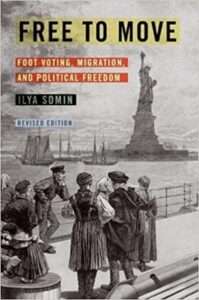
Video of American Enterprise Institute Event on my Book "Free to Move: Foot Voting, Migration, and Political Freedom"

It includes commentary by housing policy specialist Emily Hamilton (Mercatus Center), and economist Filipe Campante (Johns Hopkins University).

|

The American Enterprise Institute has posted a video of a recent event they hosted, at which I spoke about my book Free to Move: Foot Voting, Migration, and Political Freedom. The event included commentary by Emily Hamilton of the Mercatus Center (a leading expert on housing policy), and economist Filipe Campante of Johns Hopkins University. Economist  Stan Veuger of AEI moderated.

Unlike many of the other events I have done about the book, in this one the commentary and discussion focused primarily on the implications of my argument for internal freedom of movement, rather than international migration. For example, there was extensive discussion of the extent to which zoning reform can increase opportunities for foot voting and increase US economic growth, and whether private planned communities, such as HOAs, expand foot voting options or potentially constrict them.

The revised edition of Free to Move is now available on Amazon for a mere $9.35. Vote with your feet for this deal, while it lasts! Makes a great graduation present for students interested in migration policy, federalism, democracy, self-determination, and other topics covered in the book. As always, 50% of all royalties generated by Free to Move go to help refugees. With Russia's brutal war of aggression against Ukraine, the need is now greater than it has been in many years.

More