


The Volokh Conspiracy

Mostly law professors | Sometimes contrarian | Often libertarian | Always independent | Est. 2002

The Volokh Conspiracy

Hate Speech

A response to the latest vilification campaign against the NRA

David Kopel at the National Firearms Law Seminar

|

This morning I spoke at the NRA Foundation's annual National Firearms Law Seminar, a continuing legal education program. Below are my introductory remarks. In a future column, I will describe how mass murders at schools could be halted immediately, through multistate programs like FASTER—Faculty/Administrator Safety Training and Emergency Response. On Tuesday, the executive director of FASTER Colorado explained the program on the Jesse Watters show.

Good morning.

I'm here to tell you about how the legal protection of the right to keep and bear arms has changed in the 14 years since the U.S. Supreme Court's decision in District of Columbia v. Heller. And I will, with 71 slides that I guarantee will be completed by 10:10 a.m., on time.

But first, I'm going to address something that every one of us is thinking about: the heinous murders at Robb Elementary School in Uvalde, Texas.

Some of the speakers you will hear later today recently received demands from the media—specifically, from Reuters and from Law360—asking if they would cancel their presentations here today because of the Uvalde murderer.

As if the acts of a criminal made it wrongful for lawyers to become better-educated in the law.

I've gotten to know some of the victims and families of victims of mass shootings, including from the Luby's Cafeteria murders in Killeen, Texas (Suzanna Gratia Hupp); from Columbine High School (Evan Todd); from Parkland, Florida (Pollack family).

These people are among the many good and decent Americans who don't believe that the proper response to the crimes of evildoers is to punish the innocent.

Today, hate groups are demonstrating against us for even daring to gather. They have declared that they will shut us down. Certainly, they have the right to demonstrate as they wish, and they have no right to suppress the free speech and free association of other people.

The haters declare guilt by perversely imagined association. They operate by the same rule as the medieval malefactors who thought they were entitled to kill Jews because, supposedly, Jews from 1,500 years before had been responsible for the killing of Jesus.

This was the same evil thinking as people who used the acts of foreign terrorists on September 11 as a pretext to attack and persecute patriotic and law-abiding American Muslims.

The same malice that used an illegal alien's murder of Katie Steinle in San Francisco as a pretext to deny due process rights to peaceful persons who were accused of noncompliance with immigration laws.

Blood libels are used sooner or later against almost every civil rights group. For many decades, our Association has been libeled precisely because we are the oldest and most effective civil rights association in America.

Among other things, the NRA was virtually the only sporting organization in the early 20th century not to draw a color line against participants. Later, NRA-affiliated gun clubs became the arsenal of the Civil Rights Movement.

Ironically, none of the bigots whose lips drip with blood libel can point to a crime committed by an NRA member. Since 1871 the millions of members of our Association have among the most safe and responsibly-behaved people in human history.

Twenty-three years ago, and fewer than two weeks after the Columbine High School murders, the NRA canceled all its public events for its Annual Meeting in Denver. The hate groups construed this as an admission of guilt.

At the legally-required Members Meeting, we members entered that Hilton Hotel despite a bomb threat. Every cowardly politician who had been scheduled had canceled. But the surprise speaker at that meeting was Colorado Secretary of State Vikki Buckley, the first Black person elected to that office. She described her personal victimization by criminal gunshot wound, affirmed the importance of all constitutional rights, including the Second Amendment, and urged NRA members to join with her in fighting against what she called "New Age hate crimes"—that is, the irresponsible failure to teach children self-control and right from wrong.

So as we begin our day of studying the Law, we say to each and every hate group, we reject your sick and twisted lies against us, for exactly the same reason we reject the blood libels against every race, every religion, and every other group: We reject Satan and all his works.

Free Speech

Obscenity (Including as to Minors) and "the Work Taken as a Whole"

An isolated sexually themed passage, even a graphic one, doesn't make a work obscene.

|

The Court of Mist and Fury / Gender Queer controversy is a good opportunity to note an important legal principle: Under modern American law, a work can only be "obscene" and therefore constitutionally unprotected—or "obscene as to minors," and therefore constitutionally unprotected when distributed to minors—if it's basically pornographic taken as a whole.

"A quotation from Voltaire in the flyleaf of a book will not constitutionally redeem an otherwise obscene publication." The rule once seemed to be that, "to be smut, it must be ut- / terly without redeeming social importance," but that is no longer so.

But, conversely, a few sexual scenes in a work likewise don't make a publication obscene. The question is whether its dominant theme appeals to the "prurient interest," which is to say a "shameful or morbid" interest in sex. (The government must also show that the work is patently offensive under contemporary community standards, and that, taken as a whole, it lacks serious value.) Even Justice Scalia, who was open to pretty substantial restrictions on pornographic material, acknowledged this:

[In our obscenity precedents], we rejected the approach previously adopted by some courts, which would permit the banning of an entire literary work on the basis of one or several passages that in isolation could be considered obscene. Instead, we said, "the dominant theme of the material taken as a whole" must appeal to prurient interest.

(He in turn was quoting Roth v. United States (1957), which was modified in some measure by Miller v. California (1973); but, as Justice Scalia noted, Miller only added extra elements the government must show beyond this "dominant theme" constitutional requirement.) And the same applies to obscene-as-to-minors material.

Now this isn't so for all First Amendment exceptions. Someone can be prosecuted for possessing child pornography even if that's an isolated picture within a broader work. Likewise, someone can be sued (or prosecuted) for libel based on a libelous statement in a mostly nonlibelous work.

But when it comes to the obscenity exception, the law is settled: Isolated pornographic passages don't make a work unprotected.

UPDATE: A comment reminded me that I should elaborate a bit on the "dominant" point; in Ginzburg v. U.S. (1966) (not to be confused with Ginsberg v. N.Y. (1968), or Ginsburg, J. (1993-2020)), the Court noted that a work's dominant theme could be evaluated not just based on what's inside it but also based on how it's marketed: "[I]n close cases evidence of pandering may be probative with respect to the nature of the material in question and thus satisfy the [obscenity] test," with "pandering" defined as "the business of purveying textual or graphic matter openly advertised to appeal to the erotic interest of their customers."

But the Court stressed that in that case, "each of these publications was created or exploited entirely on the basis of its appeal to prurient interests"; again, the focus is on the dominant appeal of the work, not just one incidental feature. (Ginzburg doesn't seem to have been used much in recent years, but it has been cited favorably at times, so it still seems to be good law.)

Short Circuit: A Roundup of Recent Federal Court Decisions

Jury trials, bench trials, and prospective insurrections.

|

Please enjoy the latest edition of Short Circuit, a weekly feature from the Institute for Justice.

Friends, the right to criticize the government is surely one of the most important rights protected by the Constitution. So we're pleased to report that Mount Pleasant, Wisc. City Attorney Chris Smith's vexatious defamation suit against our client, Kelly Gallaher—a local activist and critic of the Foxconn land grab, as well as a critic of Chris Smith—was dismissed this week. Smith demanded that Kelly never publicly speak or write his name again, but . . . that's not going to happen, Chris Smith. Click here to learn more.

  • Rhode Island sued Shell, Chevron, and the other big oil companies on the theory that their role in global warming gives rise to claims under state law. The oil companies removed the suit to federal court, arguing for federal jurisdiction for a zillion different reasons. First Circuit: And all those zillion reasons are wrong. The federal judge was right to send you back to state court. [Ed. Note: Judge Thompson invokes "the mind-numbing complexities of federal removal jurisdiction," but we found her lively opinion quite engaging.]
  • Allegation: After working for a member of one of the ruling families in the United Arab Emirates, U.S. citizen runs afoul of a different family member, leading to citizen's being prosecuted on various spurious charges in the UAE. At the UAE's request, Interpol then issues a "red notice" for the man and declines to remove that designation when the man points out that he'd be wrongfully convicted for political reasons. Back stateside, the man sues Interpol in federal court. Second Circuit: "Similar concerns about nations abusing Interpol's notice system appear in the news with some regularity." But the man is out of luck: Interpol enjoys immunity under the International Organizations Immunities Act.
  • What's the difference between a bus advertisement that reads "Eat Mor Chikin" and one that reads "Eat More Chickpeas"? Fourth Circuit: Whatever it is, the test for figuring it out isn't subject to reasoned application. So Richmond, Va.'s prohibition on "political" content in bus ads is facially unconstitutional.
  • Ever wonder whether the 1872 Amnesty Act applies prospectively? Sorry if this changes your plans, but the Fourth Circuit says that congressional exercise under Section 3 of the Fourteenth Amendment only applied to past insurrections or rebellions.
  • Trying to serve notice is like walking through a minefield. But good news for the plaintiffs here, who have been trying to sue staffers at Baltimore County, Md. jail since 2016 over the death of their daughter: The Fourth Circuit says the district court could maybe let them walk through the field another time.
  • When the SEC accused a hedge fund manager of violating securities law he got a trial . . . in the agency's own in-house courts, before the agency's own in-house "judge." Consistent with statistics showing the SEC enjoys a far higher win rate before its own judges—as opposed to in real court—the agency judge found the defendant guilty and imposed a $300k fine (among other penalties). Fifth Circuit: The SEC's system of in-house judges violates the Seventh Amendment and the non-delegation doctrine, as well as the Article II removal power. (For more analysis of the opinion, read here.)
  • When the feds accused a Louisiana wastewater treatment facility of being responsible for an oil spill in the Mississippi River, the owners got a trial . . . in front of a judge (who found for the gov't). Fifth Circuit: Reversed. The Seventh Amendment guarantees a trial by jury here.
  • Fifth Circuit: Now for the third time in this age-discrimination case, we're going to tell the district court to allow the discovery our precedent requires. No need to send the this case to a different judge, though. [Ed.: Thanks commenter John F. Carr for spotting the error.]
  • Wikipedia describes the film Cuties as a "coming-of-age drama" about "a Senegalese-French girl . . . who is caught between traditional Muslim values and Internet culture when she joins a twerking dance crew." The district attorney of Tyler, Tex. describes it as child pornography. So he—and we stress that we are not making this up—indicted Netflix for distributing it. Read all about it in a tour de Fed Courts from the Fifth Circuit. There's habeas sought, mandamus denied, and abstention yet to be determined. The bottom line? Netflix is winning, but there's a lot of lawsuit left.
  • As the pandemic seems to wind down, in the Sixth Circuit another mask mandate case bites the mootness dust, this time en banc. Except the dissent says it's really hard to tell what's moot and what's not in a once-a-century health crisis. Plus, the least the court could have done is dismissed the preliminary injunction as moot but allowed the rest of the case to continue.
  • Seventh Circuit: In 2010, the Supreme Court failed to resolve the question of whether a state court decision could ever be a taking for purposes of the Fifth Amendment. Since then, other federal courts of appeals have carefully avoided the issue . . . which has been going great! Nobody here has standing! Case dismissed!
  • In 2017, the Ninth Circuit, applying strict scrutiny, found no First Amendment problems with FBI national security letters, which require phone and internet companies to turn over customer info without informing the customer (or anyone else). A few weeks ago, the court denied en banc review, and the panel issued an amended opinion with a short new concurrence. Ninth Circuit (this week): The district court doesn't need to schedule periodic reviews of whether the nondisclosure requirements continue to be justified. If providers want judicial review, they can ask for it. It's of no matter that most don't.
  • Does it violate the Fourth Amendment for the City of Los Angeles to require e-scooter companies to disclose to the government real-time location data for every one of their e-scooter devices? Ninth Circuit: Scooters (i.e., people who scoot, not the vehicles themselves) have no reasonable expectation of privacy over the location data collected by the e-scooter companies. No Fourth Amendment problem here.
  • Allegation: While helping mobility-impaired friend into a car, man is accosted by San Diego police officer, who grabs, yanks, and punches him "for no reason." The man flees. The officer tackles him and beats him unconscious. Excessive force? Ninth Circuit: Could be. No qualified immunity. Dissent: "Ironically, the only person to have suffered any serious injury here during the foot pursuit was not the plaintiff; it was the officer"—who fell as he was giving chase. Anyway, plaintiff could have had a gun in his waistband, so the "distraction strikes" were reasonable.
  • Allegation: Henderson, Nev. detectives in plainclothes tail an armed robbery suspect to a state courthouse, where they wait for him to exit. When he does, they tackle him without warning, breaking his hip. Excessive force? Ninth Circuit: The guy was acting calmly and had just been through a security screening. There was no reason to tackle him, and no qualified immunity for the cops.
  • Mexican police officer—over protest—is assigned to guard a cartel leader. After the Mexican Navy captures the cartel leader, the officer tries to flee, but is caught and threatened by the cartel with being burned alive. Later, his brother-in-law is beaten by men in paramilitary uniforms, kidnapped, and never seen again. (The family is told that if they file a police report, they will all be killed.) The officer makes his way to America and seeks withholding of removal under the Convention Against Torture. Tenth Circuit: Merely threatening to burn someone alive doesn't rise to the level of torture, and Mexico is a big country with lots of places to hide. He'll probably be fine.
  • Your humble editorial staff, no brown nosers on most days, does commend the Eleventh Circuit for Footnote 1 in this amended opinion, which makes gloriously clear what changed. (As opposed to the first Ninth Circuit opinion discussed above, which is merely clear.)
  • Joining seven other circuits, and with a long look at Founding-era sources, the Eleventh Circuit finds that a federal law banning illegal immigrants from possessing firearms doesn't offend the Second Amendment. So no need to reconsider the conviction of now-deported man who drunkenly brandished a firearm outside a Tampa, Fla. taco stand. Judge Newsom, self-concurring: But we ought to reconsider using balancing tests to adjudicate fundamental rights, lest legislatures and judges invent new, unjustifiable restrictions on those rights. "After all, the Constitution guarantees that the right to keep and bear arms 'shall not be infringed,' not that it 'shall not be infringed unless by restrictions that are substantially related to an important government interest.'"
  • Florida: Social media companies aren't entitled to First Amendment protection because their editorial practices—unlike those of newspapers—aren't protected activity and, in any event, they're common carriers, just like telegraph companies. Eleventh Circuit: That is not 100% accurate, so the preliminary injunction against Florida's new social media law is affirmed in substantial part.
  • New York: You can't seriously contend that the First Amendment applies to legal advice about responding to debt collection actions, can you? S.D.N.Y.: Well, the Supreme Court has held it applies to legal advice to designated foreign terrorist groups, so it sounds like a safe bet. Accordingly, the nonprofit Upsolve, whose non-lawyer volunteers assist low-income New Yorkers in responding to debt collection lawsuits, is entitled to a preliminary injunction against the state's unauthorized practice prohibition. (IJ filed an amicus brief in this case.)
  • And in amicus brief news, IJ is asking the Ninth Circuit to reverse the dismissal of a case against a TSA agent who digitally penetrated and fondled a traveler. Though the Federal Tort Claims Act specifically allows claims against "investigative or law enforcement officers," the district court ruled that TSA screeners are not "traditional" law enforcement officers—a limitation that does not appear in the text of the FTCA. (The court also dismissed the Fourth Amendment claims against the agent, holding that TSA agents simply can't be sued for violating the Constitution. That part of the ruling is not being appealed.) In short, according to the gov't, you may have a right not to be sexually assaulted by the TSA, but there's no remedy if you are.

As a young man, Joe Armstrong worked for WJBE, a radio station in Knoxville, Tenn., owned by musician James Brown. And 10 years ago, Armstrong revived the station after it had fallen on hard times. Today, it's the only Black-owned and Black community focused station in the area. But the FCC is trying to take away Joe's broadcast license because of an old, irrelevant tax conviction, for which Joe served his sentence and paid his fines. "One in three Americans has a criminal record and laws that impose permanent punishments go beyond the sentences handed down by judges and juries," says IJ Attorney Daniel Nelson. "People deserve the opportunity to make a fresh start by using their skills and talents." Click here to learn more about IJ's latest case.

Free Speech

Why Isn't Johnny Depp v. Amber Heard Foreclosed by Depp's Loss in an English Libel Case?

It's chiefly because Virginia doesn't recognize nonmutual collateral estoppel, of course!

|

Fairfax County Chief Judge Penney Azcarate dealt with this in an August 17, 2021 order; first, the facts:

In the underlying action for defamation, Plaintiff John C. Depp II … is suing Defendant Amber Laura Heard … for statements Defendant made in an op-ed published by The Washington Post in 2018. Plaintiff, believing that Defendant's statements falsely characterized him as a domestic abuser, filed his defamation claim on March 1, 2019.

Prior to the commencement of Plaintiff's suit in Fairfax County Circuit Court, Plaintiff brought suit in the United Kingdom … against News Group Newspapers, the publisher of The Sun newspaper, for claims of defamation regarding The Sun's publication of a 2018 column referring to Plaintiff as a "wife beater." On November 2, 2020, the Judge in the UK litigation ruled against Plaintiff, finding The Sun's statements were substantially true and thus a defense to defamation. On March 25, 2021, the UK Court of Appeal upheld the trial court's ruling against Plaintiff and denied his application for permission to appeal. Plaintiff's litigation in the UK against The Sun became final on April 6, 2021, and Defendant subsequently moved for leave to amend her plea in bar to dismiss Plaintiff's Complaint based on collateral estoppel, res judicata, comity, and the Uniform Foreign-Country Money Judgments Recognition Act.

Ultimately, Defendant argues the UK's finding that Plaintiff is a "wife beater" should be given preclusive effect in this Court given Plaintiff's previous opportunity to fully and fairly adjudicate such issue….

Judge Azcarate held generally that, under Virginia law, the decision against Depp in (1) his lawsuit against one defendant (The Sun) for its statements wasn't binding in (2) a case by Depp against another defendant (Heard) for her statements—even if the gist of the statements (that Depp had beaten Heard) was similar. The law in other states might lead to a different result, under a doctrine called "nonmutual collateral estoppel," under which it would be enough that the English case was resolved against Depp, even if it hadn't been resolved in favor of Heard. But Virginia has rejected that doctrine. Here are the details:

Collateral estoppel

"Collateral estoppel is the preclusive effect impacting a subsequent action based on a collateral and different cause of action. In the subsequent action, the parties to the first action and their privies are precluded from litigating any issue of fact actually litigated and essential to a valid and final personal judgment in the first action." Accordingly, the following requirements must be met for the doctrine of collateral estoppel to apply [under Virginia law]:

(1) the parties to the two proceedings must be the same; (2) the issue of fact sought to be litigated must have been actually litigated in the prior proceeding; (3) the issue of fact must have been essential to the prior judgment; and (4) the prior proceeding must have resulted in a valid, final judgment against the party against whom the doctrine is sought to be applied.

Read More

Coronavirus

Sixth Circuit Concludes Challenge to Michigan Mask Mandate Is Moot

The en banc Sixth Circuit concludes that the lawsuit seeking an injunction against Michigan's mask mandate is now moot.

|

On Wednesday, the en banc U.S. Court of Appeals for the Sixth Circuit rejected an appeal filed by a private religious school and some school parents seeking an injunction against Michigan's statewide mask mandate. In Resurrection School v. Hertel, the court split 12-1-3, concluding that both the plaintiffs' interlocutory appeal and underlying appeal were both moot, as the state had already repealed the mandate.

Judge Kethledge wrote the opinion for the court. The opinion is short, direct, and clear. (Seven pages is quite short for an en banc opinion.) It points out that cases typically become moot if circumstances change during the pendency of litigation such that a favorable judgment would have no practical effect. There are potential exceptions to the mootness bar, such as when there are reasons to believe the controversy could repeat while also evading judicial review, but Judge Kethledge explained why none of these exceptions apply here.

Judge Kethledge's opinion was joined by Chief Judge Sutton and Judges Moore, Cole, Clay Gibbons, White, Stranch, Donald, Thapar, Larsen, Nalbandian, and Murphy. Judge Readler joined in part, and wrote a separate opinion concurring in part and dissenting in part. Judge Moore concurred, joined by Judges White, Stranch and Donald. Judge Bush dissented, joined by Judges Siler and Griffin.

Judge Moore's concurrence highlights some of the reasons the case had become moot:

Three facts convince me that this claim is moot. First, in the months since the State lifted the mask mandate, the Centers for Disease Control has approved a vaccine for school-age children. . . . Second, the State declined to reimpose a mask mandate during the spikes in COVID-19 cases caused by the Delta and Omicron variants. . . . Third, and relatedly, the State has now gone close to a year without reimposing a similar mask mandate. Therefore, I concur in the majority opinion.

Judge Readler agreed with the majority opinion that the preliminary injunction appeal was moot, but not the appeal seeking declaratory relief and a permanent injunction. On the latter question. Judge Readler noted his agreement with many of the arguments made by Judge Bush in dissent.

Judge Bush's dissent is the longest opinion in the case; indeed at 31 pages it is longer than all of the other opinions combined. In Judge Bush's view, the case is not moot. His opinion begins:

"Article III judges should not be in the business of declaring an end to the COVID-19 pandemic[.]" Memphis A. Philip Randolph Inst. v. Hargett, 2 F.4th 548, 572 (6th Cir. 2021) (Moore, J., dissenting). Rather, we should be willing to acknowledge "the thing about a once-in-a-century crisis"—that "it is hard to know how it will develop over the coming months and years, particularly when COVID-19 has defied expectations to this point[,] with new variants and seasonal surges threatening to undo hard-won progress." Id. at 573 (cleaned up). In this case, however, it appears that these principles will not carry the day. A court majority instead deems moot not merely plaintiffs' preliminary-injunction request, but their entire case. Thus extinguished is plaintiffs' opportunity to litigate their claims on the merits under a proper interpretation of the First Amendment. That unfortunate result rests, in my view, on a score of mistaken factual and legal premises. Our collective experience with two years of on-again-off-again masking mandates demonstrates that there is at least a reasonable possibility this dispute could recur. For that matter, the recent masking reimpositions in Ingham County itself show that this dispute could reasonably recur. . . .

And Judge Bush concludes:

I hope that I am eventually proven wrong. I would be quite pleased if COVID-19 were to permanently enter humanity's rear-view mirror. But the point is that I—just like the majority— have no basis upon which to proclaim that my hopes today will surely become realities tomorrow. Because I would hold that the present controversy is not moot, I respectfully dissent.

Free Speech

Excluding Public from Area of Homeless Encampment Sweeps Violates the First Amendment

So a district court held Tuesday.

|

From Martinez v. City of Fresno, decided Tuesday by Judge Dale Drozd (E.D. Cal.):

In their complaint, plaintiffs allege the following…. [Defendant City of Fresno sometimes engages in] routine [homeless] encampment sweeps.  These systematic sweeps and other abatement activities involve law enforcement and other city officials forcing unhoused residents to leave their resting and sleeping places by threatening criminal citation, arrest, and the destruction or seizure of their property….

Fresno Municipal Code § 10-616 … in pertinent part states as follows, with the underlined language being newly added:

(b) City employees or a contractor retained by the City may enter upon private or public property to abate the nuisance pursuant to the provisions of this article. No person shall obstruct, impede or interfere with any officer, employee, contractor or authorized representative of the city whenever such person is engaged in the work of abatement, pursuant to the provisions of this article, or in performing any necessary act preliminary to or incidental to such work or authorized or directed pursuant to this article.

(1) To protect the health and safety of the public and city employees while an abatement is in progress, city employees or a retained contractor may designate a restricted area by erecting a barrier or cordon off an area of public or private property where an abatement is taking place. No person shall enter the restricted area without express authorization from city employees or contractor on site conducting the abatement.

(2) Subject to particular restrictions mandated by safety concerns or emergency procedures, prior to any abatement taking place at an occupied location, those persons providing services to the occupants or advocating on their behalf shall be permitted a reasonable time to make contact with the occupants and assist prior to the area being secured as provided herein;

(3) Unauthorized entry into the restricted area or other violation of this section shall be punishable either as a misdemeanor for intentional violations, or as an administrative citation with administrative penalty of up to $250 pursuant to Section 1-308, at the election of the City Attorney; prior to any person being cited for either a misdemeanor or administrative citation, first a verbal warning shall be provided to vacate the area with opportunity to comply.

[A] narrowly tailored time, place, and manner content-neutral restriction on speech is one that does not burden substantially more speech than is necessary to achieve a substantial government interest. "It must 'target[] and eliminate[] no more than the exact source of the "evil" it seeks to remedy.'"

Section 10-616(b)(1) of the amended ordinance offers what appears to be a time, place, and manner restriction. Section (b)(1) states that during an abatement, city employees may designate a restricted area and "[n]o person shall enter the restricted area without express authorization from city employees" conducting the abatement. Section (b)(3) then adds that any unauthorized entry into the restricted area "shall be punishable either as a misdemeanor for intentional violations, or as an administrative citation with administrative penalty of up to $250."  On its face, this language may appear content-neutral….

[But d]efendant's justification for the amended ordinance is at best vague and at worst completely undefined. The ordinance itself states that the restrictions provided for therein are intended: "[t]o protect the health and safety of the public and city employees while an abatement is in progress." However, defendant has offered no examples of specific health or safety concerns placed at risk during abatement activities either currently or in the past. Rather, in its brief in opposition to the pending motion, defendant cites only to the allegations of plaintiffs' complaint in an attempt to identify a "substantial risk of harm" purportedly posed by its abatement actions.  Specifically, defendant merely repeats plaintiffs' allegations that the conditions at some abatement locations are unsanitary and unsafe; that the city sometimes uses heavy machinery to clear encampments while unhoused persons are nearby; and that the abatement process is "hectic and traumatic … like a tornado." Defendant sums up its conclusory assertion that a substantial government interest is at stake by pronouncing that the amended ordinance "seek[s] to address these safety risks by giving the City the discretion under certain circumstances to implement a 'buffer zone' during abatement proceedings to ensure the safety of all involved."

Read More

Volokh Conspiracy

The Volokh Conspiracy Merch You've Always Wanted

Or perhaps just a few items we thought readers might like.

|

As Eugene noted last month, The Volokh Conspiracy is twenty years old. Eugene fired things up in April 2002, and additional conspirators (including Juan Non-Volokh) joined soon thereafter.

Given we've been around for twenty years, it seems odd we don't have VC merchandise. So, we're going to experiment with offering some. A few initial offerings (mostly t-shirts and mugs) are available here, with more to come.

Feel free to provide recommendations and ideas for potential items in the comments. This is something of an experiment, and we welcome feedback.

Free Speech

Psst, Kids, "Court of Mist and Fury" Is Too Sexy for You!

You absolutely, positively shouldn't be allowed to read it. Definitely forbidden.

|

(This is apropos the case noted below.)

UPDATE: I thought this was clear, but a comment suggested that it wasn't, so I thought I'd make it clear: I'm not actually trying to create a Streisand effect (or a "Banned in Boston" effect, which is the historical antecedent here); I have no particular interest in having more people (or fewer people) read the book, plus of course I expect we have few teenage readers. Rather, I was suggesting that this is the effect that the attempt to suppress the books will have, given the publicity that it has given the book in sources with much larger circulation.

Due Process

Colorado Private Universities Have Contract & Tort Law Duties to Provide Fair Hearings to Accused Students

A "private educational institution owes a [tort law] duty, independent of any contractual promises, to adopt fair procedures and to implement those procedures with reasonable care when investigating and adjudicating claims of sexual misconduct by one student against another."

|

[UPDATE 5/27/2022: Prof. KC Johnson (Brooklyn College-CUNY), who has studied this area closely, reports to me that "this is the broadest state court" decision interpreting state law in favor of the expelled student in such cases.]

From today's decision in Doe v. Univ. of Denver, decided by the Colorado Court of Appeals (Judge Michael Berger, joined by Judges Jaclyn Casey Brown and Sueanna Johnson):

John Doe appeals the district court's summary judgment in favor of the University of Denver (DU) … that culminated in John's expulsion for non-consensual sexual contact with Jane Roe….

We hold that DU's OEO Procedures regarding student sexual misconduct investigations are sufficiently certain to be enforced under Colorado contract law. We also hold that a private educational institution owes a [tort law] duty, independent of any contractual promises, to adopt fair procedures and to implement those procedures with reasonable care when investigating and adjudicating claims of sexual misconduct by one student against another….

In fall 2015, John and Jane enrolled as undergraduate students at DU. In January 2016, they began a romantic relationship in which they sometimes spent the night with each other but did not engage in sexual intercourse. In February 2016, the relationship cooled, and they interacted with each other less often.

Read More

Immigration

A Double Standard Between Ukrainian and Afghan Refugees?

Critics allege, with some justice, that the Biden Administration is treating the former more favorably than the latter. If so, the right solution is to increase openness to Afghans and others fleeing war and repression, not bar more Ukrainians.

|

A U.S. Air Force Airman plays the ukulele for children from Afghanistan during Operation Allies Refuge at Ramstein Air Base, Germany, Aug. 24, 2021. (Lt. Col. William Powell/ZUMAPRESS/Newscom)


In April, the Biden Administration expanded opportunities for Ukrainian refugees fleeing Russia's brutal invasion, to enter the United States. Most notably, it has offered Ukrainians a limited form of private refugee sponsorship, under which they can enter the US if sponsored by a private individual or organization. But critics, including refugee advocates and a group of Democratic senators, argue that this policy treats Ukrainian refugees better than similarly situated Afghan refugees, fleeing the brutal oppression of the Taliban, which retook the country in the wake of the US withdrawal last year:

A group of Democratic senators on Thursday called on the Biden administration to account for what they said was "disparate" treatment of Afghans who have sought to flee their country since the U.S. withdrawal compared with Ukrainians fleeing the Russian invasion.

President Biden's recent creation of a program to ease a pathway to the United States for Ukrainian war refugees cast the administration's more restrictive policy toward Afghans and others into "stark" relief, Democratic Sens. Edward J. Markey (Mass.), Jeanne Shaheen (N.H.), Patrick J. Leahy (Vt.), Cory Booker (N.J.), Ron Wyden (Ore.) and Elizabeth Warren (Mass.) wrote in an open letter to Biden and the Department of Homeland Security on Thursday.

"While the U.S. response to the Ukrainian refugee crisis has been admirable, it is unfortunate that this welcoming and accommodating model is not the standard for all humanitarian crises, wherever they occur, whether in Haiti, throughout Central America, in Africa, the Pacific, and elsewhere," the senators wrote….

The Uniting for Ukraine (U4U) program, created last month, allows Ukrainians to apply for temporary refuge, known as humanitarian parole, in the United States if they meet certain basic criteria, including that they lived in Ukraine at the time of the Russian invasion and that they have a U.S.-based sponsor to vouch for them. The Russia invasion of Ukraine began in February.

Since the U4U program launched last month, "nearly 22,000 Ukrainian nationals have been authorized to travel to the United States to apply for parole," said Angelo Fernández Hernández, a spokesman for the Department of Homeland Security.

While refugee advocates have applauded the program for its humanitarian breadth, it has also been criticized by several American veterans groups, refugee resettlement organizations, and Afghan advocates, who say the administration has simultaneously hindered tens of thousands of Afghans from seeking refuge the same way….

Administration officials say the comparison is unfair. The Biden administration last year brought more than 76,000 Afghan evacuees to the United States, most as humanitarian parolees, after a chaotic August withdrawal ushered in the collapse of the U.S.-backed government and the return of Taliban control.

Two thousand more Afghans have followed in the months since, and Operation Allies Welcome, as the government has called the mass resettlement effort, represents its own "separate pipeline to welcome our Afghans allies," said a senior official….

The U4U program is far from a general open door to Ukrainian refugees. It has a variety of limitations, including the need for a US sponsor, and the fact that it offers only temporary residency and employment rights.

Nonetheless, the critics have a point. Ukrainian refugees eligible for U4U do have some advantages that are not extended to similarly situated Afghans:

DHS says that since July [2021], a few weeks before the Afghan government's collapse, it has received 45,000 applications for humanitarian parole from those unable to evacuate on a U.S. military flight. Because there is no dedicated resource like Uniting for Ukraine to facilitate Afghans' applications, their requests have flooded the government's general humanitarian parole program. The associated fee is $575 per applicant — or, as critics note, more than what the World Bank estimates an average Afghan earned annually before the U.S. withdrawal.

This process also requires applicants to prove they are under direct threat, advocates say. "You basically have to show that you, as an individual human being, are being targeted somehow by the Taliban. And that's obviously a very difficult thing to establish — you know, unless the Taliban sends you a letter or something," [Adam] Bates said.

In principle, both Afghans and Ukrainians can apply for admission under the conventional refugee system. But in addition to requiring proof of being specifically targeted for persecution by the government or other forces controlling the region in question, the refugee system is almost completely dysfunctional, thanks to its near-gutting under the Trump Administration and Biden's failure (so far, at least) to fix it. The program admitted only a record-low of 11,411 refugees from all countries combined, in fiscal year 2021.

Afghans and Ukrainians, of course, are not the only ones fleeing war and severe oppression. The same can be said of Syrian refugees and many others. They too do not have access to programs like U4U.

Some may assume that the reason for these double standards is racial: most Ukrainian refugees are white, while most Afghans, Syrians, and Africans, are not. While racial and ethnic bigotry probably does play a role in similar double standards in Europe, in the US case, I think the main factors are 1) Ukrainian refugees are far more visibly in the news right now, and 2) the US is supporting Ukraine in its struggle against Russian aggression, while the Biden Administration (like Trump's before it) clearly wants to wash its hands of Afghanistan.

Still, there is a degree of unjust discrimination here, even if the motive for it isn't racial. It is even arguable that the US has an especially great obligation to Afghan refugees, because their plight is in large part a result of failures of US policy in Afghanistan. By contrast, the US government has far less moral responsibility for the situation in Ukraine.

But, as I have explained in previous writings on this topic, the right way to address any double standards is not to bar more Ukrainians, but to open our doors to others fleeing comparable war and oppression. We should end discrimination here by "leveling up," not "leveling down." Doing so would simultaneously promote justice, serve US strategic interests by "draining" human capital from our adversaries, and bolster our economy by expanding growth and scientific innovation.

Private refugee sponsorship of the sort now made available to Ukrainians can and should be applied to other groups. Immigration policy experts have long advocated that approach. President Biden even issued an executive order promoting private sponsorship, early in his administration, though the administration does not appear to have done much to implement it.

Free Speech

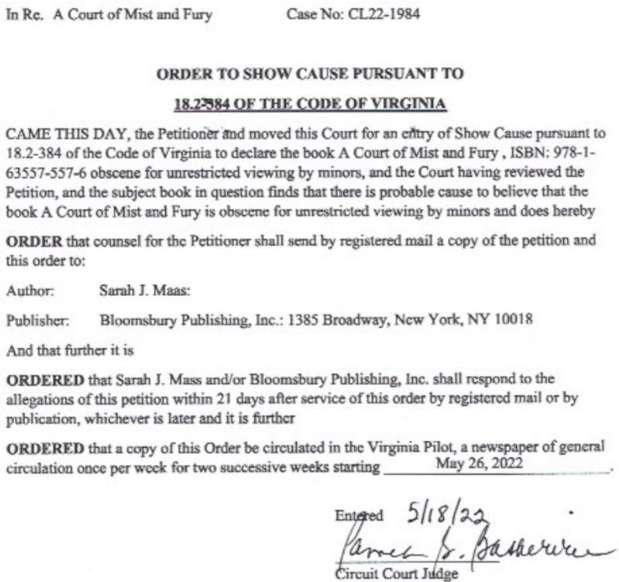
Va. Judge Finds Probable Cause That "Court of Mist and Fury" and "Gender Queer" Are "Obscene for … Minors"

This finding is now being used as a basis for seeking a restraining order banning Barnes & Noble from distributing the books to minors. Is that constitutional?

|

Here's the order for A Court of Mist and Fury (with the author's address redacted); the one for Gender Queer, A Memoir is similar, and is on p. 5 of this filing.

The orders were obtained by Virginia state legislator Tim Anderson and Tommy Altman, a congressional candidate; see here for Del. Anderson's post about this, which also includes excerpts of some of what he views as obscene-as-to-minors in the books. Anderson and Altman are now using the probable cause finding in seeking temporary restraining orders that would bar Barnes & Noble from engaging in "sale or distribution to minors" of the books. How would one analyze this under existing First Amendment rules (whatever one might think of them)?

Read More

Climate Change

Supreme Court Turns Away Red State Effort to Block Social Cost of Carbon

Without opinion the justices rejected Louisiana's application to vacate a lower court stay.

|

The effort by Louisiana and other states to prevent federal agencies from relying upon the Biden Administration's Social Cost of Carbon estimates has run aground in the Supreme Court. Today, without opinion, the justices denied the states' application to vacate a lower court stay. The Court's denial was not a surprise.

Louisiana's lawsuit had met with some initial success. In February, a federal district court in the Bayou State enjoined all federal agencies from relying upon the Social Cost of Carbon estimate. As I explained at the time, the district court's opinion made an absolute hash out of the relevant administrative law principles. Accordingly (and unsurprisingly) the U.S. Court of Appeals for the Fifth Circuit swiftly stayed the injunction. Louisiana then sought en banc review, without success, leading to their petition with the Supreme Court.

As I have noted in my prior posts, reasonable people may differ on the methodology used by the Biden Administration to calculate a Social Cost of Carbon, as well as on the extent to which incorporating such considerations into federal agency analyses and decision-making does much to mitigate the risks posted by climate change. The theory of the suit, however, was something else, and the initial district court order was wrong on multiple levels, merely as a matter of administrative law. Thus it is no surprise that not even a single judge on the Fifth Circuit or the Supreme Court was willing to note their opinion that the injunction should stand.

Abortion

Sherif Girgis on the Draft Dobbs Opinion and Its Critics

An assessment of claims that Justice Alito's draft opinion rests on historical error, provides no meaningful basis for distinguishing abortion from other unenumerated rights, and forecloses constitutional protection of the mother's life.

|

The unprecedented leak of a draft majority opinion in Dobbs v. Jackson Women's Health Organization has prompted substantial commentary, both on the leak and the substance of the opinion. Author David Garrow praised the opinion in the Wall Street Journal (prompting letters from Professor Steven Calabresi and Jennifer Mascott). Others have been far less complimentary.

Notre Dame Law School Professor Sherif Girgis has written extensively on Dobbs, and whether the Court can uphold the Mississippi statute in a principled way without overturning Roe v. Wade. He has also been active on Twitter responding to various criticism of the opinion. As I found Professor Girgis's points thoughtful and interesting, I asked him to summarize them for a post. His response is reproduced below.


Sherif Girgis: Crowd-critiquing Justice Alito's Draft:  Historical Claims, Other Rights, Life Exceptions

The leak of a draft opinion for the Court in Dobbs has enabled something remarkable:  the crowdsourced critique of a Supreme Court opinion before its release.  And it's done so in a case where the incentives and opportunities to expose the draft's flaws could not be greater—given the topic, the massive significance of the outcome for both sides, the possibility of forcing changes (or informing dissents), and the sheer number of the draft's historical claims and legal arguments.  Under these unprecedented circumstances, a feast for any law professor on social media, how has the draft fared?  I've discussed a few emerging criticisms with friends on all sides.  Here, at Prof. Adler's kind invitation, I'd like to elaborate, focusing on the objections that the opinion:

  • rests on a historical error,
  • offers only ad hoc ways to distinguish abortion from other unenumerated rights, and
  • forecloses even a narrow constitutional right to life-saving abortions.

Read More

Free Speech

"Judge Dismisses Bogus Defamation Lawsuit Against Foxconn Critic"

The Institute for Justice, which represented the critic, so reports.

|

There's no written decision, and no transcript of the hearing yet; but I've found IJ to be highly reliable in the past, so I thought I'd pass along its statement on the matter (from Tuesday):

This afternoon, Judge Jon E. Fredrickson of the Racine County Circuit Court granted the Institute for Justice's (IJ's) request to dismiss a defamation suit brought by Mount Pleasant Village Attorney Chris Smith against local political activist Kelly Gallaher from the bench. During a controversy over a proposed change to the term lengths of members of the Mount Pleasant village board, Smith told a local newspaper that the change had been discussed "since 2018." This struck Kelly as wrong, and she followed up by sending Smith a public-records request for all records of public discussions since 2018. Told there were no records dating that far back, Kelly went public, accusing Smith of lying in emails to reporters and in social media posts.

Smith responded promptly, telling Kelly he would sue her for defamation unless she publicly posted a retraction that he wrote himself and "refrain[ed] from publicly referencing [him] in any comment, regardless of whether such comment is written or spoken." Kelly, who is not a lawyer and was frightened by the cost of a potential lawsuit, posted the retraction he wrote for her. And Smith sued her anyway.

Read More

Free Speech

Interrupting Family Member's Work Video Meeting with "Humiliating Remarks" Isn't "Family Abuse"

|

From A.A.R. v. Rustad, decided yesterday by the Oregon Court of Appeals (Presiding Judge Douglas Tookey, joined by Judges Jacqueline Kamins and Joel DeVore):

Respondent appeals the trial court's continuation of a restraining order issued against him under the Family Abuse Prevention Act, ORS 107.700 to 107.735. While working from her marital home, petitioner was leading a video meeting with several colleagues when respondent, who was her father-in-law, interrupted the meeting by loudly making humiliating remarks about her at the screen and refusing to leave despite repeated requests from petitioner and her coworkers. Having reviewed the record, we conclude that while respondent's behavior was reprehensible, the evidence was insufficient to establish that he "represents a credible threat to the physical safety of the petitioner." ORS 107.716(3)(a)(C). Given that disposition, we need not reach respondent's argument concerning how the Supreme Court's jurisprudence relating to free speech, particularly, State v. Rangel (Or. 1999) applies, if at all, to the Family Abuse Prevention Act.

For those interested in pseudonymous litigation, note that A.A.R. isn't a true pseudonym; A.A.R.'s name is available in the court file, but the court didn't include it in its opinion (something that appears to be Oregon courts' practice in restraining order cases).

Free Speech

Tennessee Court Expresses Doubt About Whether Anti-Libel Injunctions Are Allowed Under Tennessee Law

The underlying lawsuit was brought by Mickell Lowery, a Commissioner for Shelby County (which contains Memphis)—and son of longtime Memphis City Councilman Myron Lowery, who had also briefly served as Mayor—over allegedly libelous statements during his election campaign.

|

From Lowery v Redmond, decided Monday by the Tennessee Court of Appeals, in an opinion by Judge J. Steven Stafford, joined by Judges Kenny Armstrong and Carma Dennis McGee:

According to Petitioner/Appellee Mickell Lowery …, Respondents/Appellants Cora and Michael Redmond … defamed his character in an attempt to ensure that he would not succeed in his bid for election to public office, by distributing defamatory information about him to prospective voters. [Lowery sued for defamation. -EV] On October 30, 2017, the trial court issued a temporary restraining order in Appellee's favor…. On December 8, 2017, the trial court entered a consent order granting a temporary injunction against Appellants, relying in part on the parties' agreement to continue the temporary restraining order already in place…. [Lowery was elected as Commissioner on August 2, 2018. -EV]

The trial court apparently entered another a temporary restraining order on November 4, 2019, which enjoined Appellants from distributing certain material about Appellee. The trial court then granted Appellee's requests for injunctive relief ….

The court concluded that the trial court (the Chancery Court) lacked jurisdiction, because its jurisdiction excluded, by statute, any claims "for unliquidated damages for injuries to person or character," and that meant that the accompanying claims for injunctive and declaratory relief couldn't be decided by the trial court, either. In the process, the court noted:

Read More

More



