The Volokh Conspiracy

Mostly law professors | Sometimes contrarian | Often libertarian | Always independent | Est. 2002

The Volokh Conspiracy

Bruen, Originalism, and Post-Enactment Practice

What role should liquidation play in originalism?

|

Justice Thomas's majority opinion in Bruen provides a roadmap of how to use originalism based on analogical reasoning--that is, how to look at practices from prior to ratification of the Second Amendment. The Court also discusses, at some length, how to consider post-enactment practice. This issue has been subject to debate in originalist circles for some time. In Heller, for example, Justice Scalia considered gun restrictions that were enforced following the ratification of the Second Amendment. Justice Stevens criticized Scalia with a charge of hypocrisy: why would an originalist look at history that came after the Second Amendment's adoption? Scalia replied that originalists can rely on post-ratification history that confirms pre-ratification history. That confirmation suggests a continuity, in which the meaning of the text did not change over time. By contrast, post-ratification history is less useful if there was no continuity--that is, there was some later-in-time break in practice that suggested a shift in meaning.

In Noel Canning, Justices Breyer and Scalia disagreed about this point. Breyer suggested that post-ratification practice could potentially trump original meaning--at least where the text was ambiguous. Scalia, by contrast, rejected this "adverse possession" approach to constitutional law, in which the executive branch can aggrandize its power by violating the Constitution for long periods of time.

This debate has continued to simmer. Thankfully, Justice Thomas brought some clarity to the issue in Bruen.

Thomas explains that for originalists, "not all history is created equal."

We categorize these historical sources because, when it comes to interpreting the Constitution, not all history is created equal. "Constitutional rights are enshrined with the scope they were understood to have when the people adopted them." Heller. The Second Amendment was adopted in 1791; the Fourteenth in 1868.

History that is too old may not be useful.

Historical evidence that long predates either date may not illuminate the scope of the right if linguistic or legal conventions changed in the intervening years. It is one thing for courts to "reac[h] back to the 14th century" for English practices that "prevailed up to the 'period immediately before and after the framing of the Constitution.' " Sprint Communications Co. v. APCC Services, Inc. (2008) (Roberts, C. J., dissenting). It is quite another to rely on an "ancient" practice that had become "obsolete in England at the time of the adoption of the Constitution" and never "was acted upon or accepted in the colonies." Dimick v. Schiedt (1935). . . . Sometimes, in interpreting our own Constitution, "it [is] better not to go too far back into antiquity for the best securities of our liberties," Funk v. United States (1933), unless evidence shows that medieval law survived to become our Founders' law. A long, unbroken line of common-law precedent stretching from Bracton to Blackstone is far more likely to be part of our law than a short-lived, 14th-century English practice.

Likewise, history that is too recent may also not be useful.

Similarly, we must also guard against giving postenactment history more weight than it can rightly bear. It is true that in Heller we reiterated that evidence of "how the Second Amendment was interpreted from immediately after its ratification through the end of the 19th century" represented a "critical tool of constitutional interpretation." We therefore examined "a variety of legal and other sources to determine the public understanding of [the Second Amendment] after its . . . ratification."

Next, Justice Thomas turns to a concept known as "liquidation." In some cases, post-enactment practice can settle the meaning of ambiguous texts. Here, the Court favorably cites Caleb Nelson and Will Baude, who have written on this topic.

And, in other contexts, we have explained that " 'a regular course of practice' can 'liquidate & settle the meaning of ' disputed or indeterminate 'terms & phrases' " in the Constitution. Chiafalo v. Washington (2020); see generally C. Nelson, Stare Decisis and Demonstrably Erroneous Precedents, 87 Va. L. Rev. 1, 10–21 (2001); W. Baude, Constitutional Liquidation, 71 Stan. L. Rev. 1 (2019). In other words, we recognize that "where a governmental practice has been open, widespread, and unchallenged since the early days of the Republic, the practice should guide our interpretation of an ambiguous constitutional provision." NLRB v. Noel Canning  (2014) (Scalia, J., concurring in judgment); see also Myers v. United States (1926); Printz v. United States (1997).

Still, Justice Thomas pour some cold water on liquidation. He relies on then-Circuit Judge Kavanaugh's opinion in Heller II:

But to the extent later history contradicts what the text says, the text controls. "'[L]iquidating' indeterminacies in written laws is far removed from expanding or altering them." Gamble v. United States, (2019) (Thomas, J., concurring); see also Letter from J. Madison to N. Trist (Dec. 1831), in 9 Writings of James Madison 477 (G. Hunt ed. 1910). Thus, "post-ratification adoption or acceptance of laws that are inconsistent with the original meaning of the constitutional text obviously cannot overcome or alter that text."  Heller (Kavanaugh, J., dissenting); see also Espinoza v. Montana Dept. of Revenue (2020).

Thomas and Kavanaugh are emphatically correct. And here, the Court rejects Justice Breyer's approach to liquidation, in which later-in-time practice can overcome clear text. Once again, the new conservative Court is clearing the brush of non-originalist doctrine.

Justice Barrett wrote a concurrence in Bruen. She has some concerns about liquidation:

I join the Court's opinion in full. I write separately to highlight two methodological points that the Court does not resolve. First, the Court does not conclusively determine the manner and circumstances in which postratification practice may bear on the original meaning of the Constitution. Scholars have proposed competing and potentially conflicting frameworks for this analysis, including liquidation, tradition, and precedent. See, e.g., Nelson, Originalism and Interpretive Conventions, 70 U. Chi. L. Rev. 519 (2003); McConnell, Time, Institutions, and Interpretation, 95 B. U. L. Rev. 1745 (2015). The limits on the permissible use of history may vary between these frameworks (and between different articulations of each one).

Like in Fulton, the former Professor pens a concurrence to raise some questions:

To name just a few unsettled questions: How long after ratification may subsequent practice illuminate original public meaning? Cf. McCulloch v. Maryland (1819) (citing practice "introduced at a very early period of our history"). What form must practice take to carry weight in constitutional analysis? See Myers v. United States (1926) (citing a "legislative exposition of the Constitution . . . acquiesced in for a long term of years"). And may practice settle the meaning of individual rights as well as structural provisions? See Baude, Constitutional Liquidation, 71 Stan. L. Rev. 1 (2019) (canvassing arguments). The historical inquiry presented in this case does not require us to answer such questions, which might make a difference in another case.

In the Emoluments Clauses litigation, Seth Barrett Tillman and I discussed the  methodology to consider post-ratification history. I wrote about our approach in an essay for the South Texas Law Review, titled Defiance and Surrender. Here is an excerpt:

President Washington and other Founders who were his successors during the Early Republic openly received, accepted, and kept diplomatic gifts and other gifts from foreign governments and their officials without seeking or receiving congressional consent. These early presidents acted as if they were not bound by the Foreign Emoluments Clause.5 However, Presidents Jackson, Tyler, Van Buren, and Lincoln declined to personally accept foreign gifts. These later presidents, other scholars contend, acted as if they were bound the Foreign Emoluments Clause. Courts might take the intuitive position that because all presidents have equal authority, the latter presidents ought to be preferred. The Supreme Court has taught a different lesson: modern practice does not automatically overcome earlier precedents. There is an additional principle that informs this inquiry. When considering competing streams of historical practice by the three branches, courts favor purported defiance over voluntary surrender. Disputed assertions of power by Washington and his successors in the Early Republic are more probative about the scope of the Foreign Emoluments Clause than voluntary acquiescence by Jackson and post-Jackson presidencies.

Seth and I will discuss this issue at some length in Part III of our ten-part series. And we will address some of Barrett's questions, at least indirectly.


Slippery Slope Arguments

Small Change Tolerance Slippery Slopes (Reposted)

[I originally erred in posting this, which kept comments from being available; I've therefore deleted the original and reposted it.]

|

[This month, I'm serializing my 2003 Harvard Law Review article, The Mechanisms of the Slippery Slope.]

Libertarians often tell the parable of the frog. If a frog is dropped into hot water, it supposedly jumps out. But if a frog is put into cold water that is then heated, the frog doesn't notice the gradual temperature change, and eventually dies. Likewise, the theory goes, with liberty: people resist attempts to take rights away outright, but not if the rights are eroded slowly.

{I have not checked this myself, nor do I intend to. Some sources suggest that real frogs don't behave this way. But consider the discussion as referring to the metaphorical frog—a creature much like the metaphorical ostrich, which (unlike a real ostrich) does bury its head in the sand when danger looms, and which is thus far more useful to us than a real ostrich could ever be.}

The frog doesn't notice the increase because of a sensory failure; it senses not absolute temperature but changes in temperature. Perhaps our decisionmaking skills suffer from an analogous cognitive feature. Maybe we underestimate the importance of gradual changes because our experience teaches us that we needn't worry much about small changes—but unfortunately this trait sometimes leads us to unwisely ignore a sequence of small changes that aggregate to a large one.

This theory suggests that we just don't pay much attention to the small change from 0 to A, the small change from A to B, and so on, even though we would have paid attention to the change from 0 all the way to E. This is not an attitude-altering slippery slope, or a multi- peaked preferences slippery slope: the small shifts don't necessarily persuade people to eventually support the next shift, and don't move the law to a politically unstable position. Rather, people simply don't pay much attention to each shift.

Consider, for instance, the following exchange:

[Peter] Jennings: And the effect of the assault rifle ban in Stockton? The price went up, gun stores sold out and police say that fewer than 20 were turned in. Still, some people in Stockton argue you cannot measure the effect that way. They believe there's value in making a statement that the implements of violence are unacceptable in our culture.

[Stockton, California] Mayor [Barbara] Fass [(a supporter of the ban)]: I think you have to do it a step at a time and I think that is what the NRA is most concerned about, is that it will happen one very small step at a time, so that by the time people have "woken up"—quote—to what's happened, it's gone farther than what they feel the consensus of American citizens would be. But it does have to go one step at a time and the beginning of the banning of semi-assault military weapons, that are military weapons, not "household" weapons, is the first step.

Did Mayor Fass have reason to believe that Americans might indeed take time to wake up to changes that "happen one very small step at a time," or was she mistaken?

Small Change Apathy, Small Change Deference, and Rational Apathy

Read More

The Limits of Bruen

The Constitutionality of "Shall Issue" Regimes After Bruen.

|

Bruen was a resounding triumph for originalism. But unlike Dobbs, Bruen will not lead to sweeping changes in gun laws nationwide. For starters, more than 40 states already employed some form of shall-issue carry. Depending on how you count, only 6 or 7 states will have to modify their regimes in the wake of Bruen. Much of the sturm und drang about Bruen is hyperbole.

And, no doubt, these states will try to push the boundaries of Bruen. Eugene already blogged about one such attempt from the California Attorney General. Here, I would like to flag the limits that Bruen identifies, as well as those recognized in the concurring opinions.

First, Footnote 9 of Justice Thomas's opinion blesses the 43-odd states that employ a "shall-issue regime."

To be clear, nothing in our analysis should be interpreted to suggest the unconstitutionality of the 43 States' "shall-issue" licensing regimes, under which "a general desire for self-defense is sufficient to obtain a [permit]." Drake v. Filko (CA3 2013) (Hardiman, J., dissenting). Because these licensing regimes do not require applicants to show an atypical need for armed self-defense, they do not necessarily prevent "law-abiding, responsible citizens" from exercising their Second Amendment right to public carry. District of Columbia v. Heller (2008).

And Thomas endorses the regimes in states that require applicants to pass a "background check" or "a firearms safety course."

Rather, it appears that these shall-issue regimes, which often require applicants to undergo a background check or pass a firearms safety course, are designed to ensure only that those bearing arms in the jurisdiction are, in fact, "law-abiding, responsible citizens." And they likewise appear to contain only "narrow, objective, and definite standards" guiding licensing officials, Shuttlesworth v. Birmingham (1969), rather than requiring the "appraisal of facts, the exercise of judgment, and the formation of an opinion," Cantwell v. Connecticut (1940)—features that typify proper-cause standards like New York's.

Of course, some of these states go far, far beyond requiring "background check" or "firearms safety course." Presumably, these burdens on the right to bear arms would be permissible under the majority's understanding, because there is no "subjective" standard about a person's need for the firearm.

Still, the Court flagged some limits on shall-issue regimes:

That said, because any permitting scheme can be put toward abusive ends, we do not rule out constitutional challenges to shall-issue regimes where, for example, lengthy wait times in processing license applications or exorbitant fees deny ordinary citizens their right to public carry.

How long is a "lengthy wait time"? Weeks? Months? Years? And how high is "exorbitant"? The District of Columbia, for example, imposes onerous requirements, high fees, excessively-long training classes, and many bureaucratic hoops. Litigation will no doubt test these issues. Randy Barnett wrote about his experiences in D.C. on SCOTUSBlog. (A petition is pending before the Court about D.C.'s carry law.)

Second, Justice Alito wrote a concurrence. He stressed that the Court only decided the narrow issue about carry permits. Other issues were not decided:

Our holding decides nothing about who may lawfully possess a firearm or the requirements that must be met to buy a gun. Nor does it decide anything about the kinds of weapons that people may possess. Nor have we disturbed anything that we said in Heller or McDonald v. Chicago (2010), about restrictions that may be imposed on the possession or carrying of guns.

Alito wrote this section in response to Breyer's litany of gun statistics. But in the process, he made clear that his opinion in McDonald stands, including the analysis about "longstanding prohibitions" and  "dangerous and unusual weapons." Do not expect Alito to be a lock on 922(g) cases, or challenges to assault weapon bans.

Third, we have Justice Kavanaugh's concurrence, which was joined by Chief Justice Roberts. Kavanaugh did not simply endorse"background checks" and "firearms safety course." He listed another criteria that "shall-issue" regimes can require:

By contrast, 43 States employ objective shall-issue licensing regimes. Those shall-issue regimes may require a license applicant to undergo fingerprinting, a background check, a mental health records check, and training in firearms handling and in laws regarding the use of force, among other possible requirements.

The requirement of a "mental health records check" was not at issue in this case. Yet, Kavanaugh reached out to decide that this requirement was constitutionally permissible. (More on Kavanaugh's reach in another post on Dobbs.)  I fear that this exception will be exploited by states to probe into a person's confidential medical history to deny carry licenses. Indeed, the California Attorney General's guidance specifically cited the Kavanaugh concurrence on this point:

Bruen recognizes that States may ensure that those carrying firearms in their jurisdiction are "'law-abiding, responsible citizens.'" See also id. (Kavanaugh, J., concurring) (States may "require a license applicant to undergo a background check, a mental health records check, and training in firearms handling and in laws regarding the use of force, among other possible requirements"). Accordingly, in assessing whether an applicant has established "good moral character," issuing authorities should recognize that Bruen does not eliminate the duty or authority of local officials to protect the communities that they know best by ensuring that licenses are only issued to individuals who—by virtue of their character and temperament—can be trusted to abide by the law and otherwise ensure the safety of themselves and others. The investigation into whether an applicant satisfies the "good moral character" requirement should go beyond the determination of whether any "firearms prohibiting categories" apply, such as a mental health prohibition or prior felony conviction. 

Later, Kavanaugh refers to the "mental health records check" as an "objective licensing requirement." Far from it.

Likewise, the 6 States including New York potentially affected by today's decision may continue to require licenses for carrying handguns for self-defense so long as those States employ objective licensing requirements like those used by the 43 shall-issue States.

Now, government bureaucrats who are hostile to guns will have vast discretion to abridge a person's constitutional right based on nebulous judgments about mental health. I have to think that Kavanaugh's dicta here was affected by the assassination attempt, in which a person with apparent mental health problems tried to kill the Justice.

Finally, Kavanaugh block-quotes the two paragraphs from Heller that the lower courts have treated as the only relevant portions of the case.

"Like most rights, the right secured by the Second Amendment is not unlimited. From Blackstone through the 19th-century cases, commentators and courts routinely explained that the right was not a right to keep and carry any weapon whatsoever in any manner whatsoever and for whatever purpose. . . . [N]othing in our opinion should be taken to cast doubt on longstanding prohibitions on the possession of firearms by felons and the mentally ill, or laws forbidding the carrying of firearms in sensitive places such as schools and government buildings, or laws imposing conditions and qualifications on the commercial sale of arms. [Footnote 26: We identify these presumptively lawful regulatory measures only as examples; our list does not purport to be exhaustive.]

"We also recognize another important limitation on the right to keep and carry arms. Miller said, as we have explained, that the sorts of weapons protected were those in common use at the time. We think that limitation is fairly supported by the historical tradition of prohibiting the carrying of dangerous and unusual weapons." Heller; see also McDonald.

Kavanaugh, Roberts, and Alito went out of their way to reiterate these limitations.

I fear Bruen may prove to be more of a symbolic victory for many people in these six states. I hope it takes less than a decade for the Court to take up another Second Amendment case regarding the issues Alito expressly declined to decide: the types of weapons that are permissible and who may possess arms.

Red Flag June Continues As Lemon Is Finally Interred

Justice Gorsuch stabs the final pencil into the Lemon Test.

|

We are in the midst of Red Flag June. On three consecutive session days, the Court has reversed old doctrine--and in the process, placed red precedential flags on many decisions. On Thursday, Bruen red-flagged dozens circuit decisions that followed the two-step approach for Second Amendment cases. On Friday, Dobbs red-flagged Roe, Casey, and countless other abortion cases. And today, Monday, Kennedy v. Beremerton School District red-flagged Lemon v. Kurtzman, and decades of precedents that relied on the infamous test.

Justice Gorsuch's majority opinion does not overrule Lemon in so many words, but the import of the ruling is clear--follow Town of Greece, not Lemon.

What the District and the Ninth Circuit overlooked, however, is that the "shortcomings" associated with this "ambitiou[s]," abstract, and ahistorical approach to the Establishment Clause became so "apparent" that this Court long ago abandoned Lemon and its endorsement test offshoot. American Legion; see also Town of Greece v. Galloway (2014) . . . 

In place of Lemon and the endorsement test, this Court has instructed that the Establishment Clause must be interpreted by "'reference to historical practices and understandings.'" Town of Greece.

Justice Sotomayor's dissent states the issue directly:

Today's decision goes beyond merely misreading the record. The Court overrules Lemon v. Kurtzman, 403 U. S. 602 (1971), and calls into question decades of subsequent precedents that it deems "offshoot[s]" of that decision.

Finally, at long last, Lemon has been interred. It is fitting to quote from Justice Scalia's Lamb's Chapel concurrence:

As to the Court's invocation of the Lemon test: Like some ghoul in a late night horror movie that repeatedly sits up in its grave and shuffles abroad, after being repeatedly killed and buried, Lemon stalks our Establishment Clause jurisprudence once again, frightening the little children and school attorneys of Center Moriches Union Free School District. Its most recent burial, only last Term, was, to be sure, not fully six feet under: our decision in Lee v. Weisman, conspicuously avoided using the supposed "test" but also declined the invitation to repudiate it. Over the years, however, no fewer than five of the currently sitting Justices have, in their own opinions, personally driven pencils through the creature's heart (the author of today's opinion repeatedly), and a sixth has joined an opinion doing so. The secret of the Lemon test's survival, I think, is that it is so easy to kill. It is there to scare us (and our audience) when we wish it to do so, but we can command it to return to the tomb at will. See, e.g., Lynch v. Donnelly (1984). When we wish to strike down a practice it forbids, we invoke it, see, e. g., Aguilar v. Felton, (1985); when we wish to uphold a practice it forbids, we ignore it entirely, see Marsh v. Chambers (1983). Sometimes, we take a middle course, calling its three prongs "no more than helpful signposts," Hunt v. McNair (1973). Such a docile and useful monster is worth keeping around, at least in a somnolent state; one never knows when one might need him.

Justice Gorsuch has stabbed the final pencil into the Lemon Test.

I have to imagine Justice Scalia is smiling from up high.

Abortion

The Next Abortion Battlegrounds

The Supreme Court may have overturned Roe v. Wade, but it has not ended legal battles over abortion.

|

The Supreme Court's decision in Dobbs v. Jackson Women's Health Organization overturned Roe v. Wade and concluded that the Fourteenth Amendment's Due Process clause does not protect a fundamental right to terminate a pregnancy. This will put an end to cases questioning whether a given set of abortion regulations constitute an "undue burden" on a woman's right to an abortion, but (as Ilya notes below) it will not put an end to abortion-related litigation.

One consequence of the Dobbs decision is that much abortion litigation will shift from federal to state court. Just because there is no right to abortion in the federal constitution does not mean there is no such right to be found under state constitutions. Just as (to take one example) the Ohio Supreme Court has concluded that the Ohio Constitution provides greater protection for private property against eminent domain than does the Fifth Amendment to the U.S. Constitution, state supreme courts may conclude that state constitutional provisions protect abortion rights through state-level rights to privacy (as in Montana) or other liberty-protecting provisions. Of course, such claims will not always be successful. The Iowa Supreme Court recently issued a state-level Dobbs decision, rejecting prior decisions that had recognized a state-level abortion right.

Many of the post-Dobbs legal fights over abortion will involve questions about the scope of federal and state power over abortion, such as whether states can limit the ability to cross state lines to obtain abortions or whether federal drug regulation constrains the ability of states to limit access to medication abortions.

A forthcoming article in the Columbia Law Review by Professors David S. Cohen, Greer Donley, and Rachel Rebouché surveys some of the new abortion "battlegrounds" we can expect to see. In this article they write:

In this post-Roe world, states will attempt to impose their local abortion policies as widely as possible, even across state lines, and will battle one another over these choices; at the same time, the federal government may intervene to thwart state attempts to control abortion law. In other words, the interjurisdictional abortion wars are coming. . . .

The article provides a useful overview of many of the legal issues that will arise in these "interjurisdictional abortion wars," in which the central legal questions will not concern substantive due process, but the scope of federal preemption, the autonomy of federal lands and enclaves, and the ability of states to limit interstate shipment of abortion medications, constrain interstate travel, or otherwise extraterritorialize their abortion laws. As I noted here, the White House has been consulting with academics to examine some of these questions, and I expect we will see the first rounds of litigation on some of these questions quite soon.

Perhaps anticipating some of these issues, it is notable that (as my co-bloggers have noted) Justice Kavanaugh made explicit reference to the constitutional right to interstate travel in his Dobbs concurrence. It may also be notable that Court's conservative justices tend to split on questions of federal preemption (as we saw in Virginia Uranium v. Warren in 2019).

One issue the article does not discuss is the extent to which the so-called "Comstock Laws" could constrain the interstate distribution of abortion medications.  18 U.S.C. Section 1461, for instance, makes it illegal to mail "obscene or crime-inciting matter," and defines such materials to include "Every paper, writing, advertisement, or representation that any article, instrument, substance, drug, medicine, or thing may, or can, be used or applied for producing abortion, or for any indecent or immoral purpose."

Much like state laws limiting or prohibiting abortion have come back into force after Dobbs, I saw some claim that this would be true of the Comstock Laws as well. As this would be quite a staggering result (about which I had seen little discussion), I asked Profs. Cohen, Donley, and Rebouché about this, and here was Prof. Cohen's response (which I repost with permission):

We didn't mention these laws because the circuit courts long ago declared that they only apply to unlawful items. So, since abortion is legal and the FDA has approved distribution of mifepristone as safe and effective, including by mail, these are lawful activities and items, thus the law, as interpreted by the courts, doesn't apply. Even now that some states have made abortion illegal, the pills still are legal under federal law. This is why no one in any of the litigation, regulatory comments, or other advocacy around medication abortion for the past decades has raised these laws, even the Trump administration in the litigation about mailing pills that went to the Supreme Court.

To put a finer point on it, any contrary interpretation than what I explained here would ban abortion everywhere because every device used to perform an abortion in a clinic (forceps, cannulas, etc.) would be banned from being shipped to the clinics (none of the clinics make their own!). These are lawful items for lawful procedures so they can be sent in the mail.

As Professor Cohen notes (and the paper discusses) there will be legal wrangling over whether states can impose restrictions on mifepristone above and beyond those restrictions the FDA has determined are necessary to ensure that it is safe and effective under the Food, Drug and Cosmetic Act, but he does not foresee the Comstock Laws constraining the FDA.

Supreme Court

Justice Thomas (Still) Wants Supreme Court to Revisit "Actual Malice"

Justice Thomas reiterates his desire to revisit the contours of defamation law and New York Times v. Sullivan.

|

The Supreme Court only granted certiorari in one case this morning, MOAC Mall Holdings LLC v. Transform Holdco LLC, concerning Section 363(m) of the Bankruptcy Code.

Among the cases in which the Supreme Court denied certiorari was Coral Ridge Ministries Media v. Southern Poverty Law Center, in which Coral Ridge sued SPLC for defamation for labeling the ministry a "hate group" due to its opposition to homosexuality. Coral Ridge maintained this was a defamatory claim, which had the consequence of preventing Coral Ridge from participating in the AmazonSmile program for charitable donations.

The district court concluded that SPLC's characterization of Coral Ridge was protected opinion, and that Coral Ridge could not demonstrate that SPLC had acted with "actual malice," as is required by New York Times Co. v. Sullivan. The Eleventh Circuit affirmed, relying solely on the "actual malice" standard, prompting the petition for certiorari.

The Supreme Court denied Coral Ridge's petition for certiorari, prompting a dissent from Justice Thomas, who reiterated his desire to reconsider NYT v. Sullivan. Justice Thomas wrote, in part:

I would grant certiorari in this case to revisit the "actual malice" standard. This case is one of many showing how New York Times and its progeny have allowed media  organizations and interest groups "to cast false aspersions on public figures with near impunity." . . . SPLC's "hate group" designation lumped Coral Ridge's Christian ministry with groups like the Ku Klux Klan and Neo-Nazis. It placed Coral Ridge on an interactive, online "Hate Map" and caused Coral Ridge concrete financial injury by excluding it from the AmazonSmile donation program. Nonetheless, unable to satisfy the "almost impossible" actual-malice standard this Court has imposed, Coral Ridge could not hold SPLC to account for what it maintains is a blatant falsehood. Dun & Bradstreet, Inc. v. Greenmoss Builders, Inc., 472 U. S. 749, 771 (1985) (White, J., concurring in judgment).

Because the Court should not "insulate those who perpetrate lies from traditional remedies like libel suits" unless "the First Amendment requires" us to do so, Berisha, 594 U. S., at ___ (opinion of THOMAS, J.) (slip op., at 3), I respectfully dissent from the denial of certiorari.

As the citation to his own prior opinion indicates, this is not the first time Justice Thomas has called for reconsidering NYT v. Sullivan, and I doubt it will be the last.

Slippery Slope Arguments

Slippery Slope Arguments in History: Socrates

|

From the Phaedrus dialogue:

Socrates…. Where is deception most likely to occur—regarding things that differ much or things that differ little from one another?

Phaedrus. Regarding those that differ little.

Socrates. At any rate, you are more likely to escape detection, as you shift from one thing to its opposite, if you proceed in small steps rather than in large ones.

Phaedrus. Without a doubt….

Education

My Deseret News Article on Carson v. Makin

The article explains why the Supreme Court was right to hold that state voucher programs can’t discriminate against “sectarian” religious schools and addresses various objections.

|

Yesterday, the Deseret News published my article on last week's Supreme Court decision in Carson v. Makin, which bars state school choice programs from discriminating against "sectarian" religious schools. This piece is a much-expanded version of some of the points made in my earlier NBC News article about the same case.

Thanks to the uproar over the Supreme Court's abortion ruling, the Deseret News piece was delayed by a couple days. This gave me a chance to go over other commentary on Carson, and address a number of criticisms of the ruling. Many thanks to the Deseret News for their generosity when it comes to space.

Here is an excerpt from the new article:

In its recent 6-3 decision in Carson v. Makin, the Supreme Court struck down a Maine law that prevented parents from using state-funded vouchers for their children's education at religious schools. In most ways, the decision is a modest extension of previous precedents barring government from discriminating on the basis of religion. The case does make clear that states cannot discriminate against religious institutions based on "religious use" of funds, as well their religious "status," thereby plugging a potential loophole states might have used to exclude religious entities and individuals from various government programs….

Still, many fear that Carson will have dire consequences. Critics have claimed it will exacerbate "religious strife," undermine the Establishment Clause of the First Amendment, destroy the separation of church and state, lead states to discriminate against Jewish and Muslim schools, and even empower Christian nationalists. Such concerns are misplaced….

As Chief Justice John Roberts put it in his majority opinion in Carson, "a State violates the Free Exercise Clause [of the First Amendment] when it excludes religious observers from otherwise available public bene­fits," merely because they are religious. Thus, a state may not reserve welfare benefits for Christians, while denying them to adherents of other religions, or to secularists….

In his dissenting opinion, Justice Stephen Breyer argued that the Maine situation is different, because the state discriminated on the basis of "religious use," not "status" alone…. Thus, it is claimed, Maine's program is constitutional because it bars the use of funds for religious purposes, not merely their distribution to institutions with a religious affiliation.

This "status-use" distinction makes little sense. Almost any religious school "promotes" its faith at least to some extent. Barring "sectarian" schools essentially means barring virtually all religious schools. The status-use theory would readily be rejected in virtually any other context. If, for example, the government denied welfare benefits to people who intend to use some of the money for religious purposes, that obviously would be unconstitutional discrimination. Ditto if the government decided to withhold police and fire department services from a church or synagogue because those services facilitate the use of the building for religious worship….

While the Establishment Clause does bar targeted government support of religion, it has never been interpreted as requiring categorical exclusion of religious institutions from otherwise generally available government programs. Virtually no one claims that the Establishment Clause is violated when the federal government awards Pell Grants to students attending religious universities such as Notre Dame and Brigham Young University, even though those schools use some of the tuition money for "specifically religious" activities.

The same point applies to Justice Sonia Sotomayor's insistence, in her dissenting opinion, that Carson will take the nation "to a place where the separation of church and state becomes a constitutional violation." No plausible interpretation of  "separation of church and state" requires the government to bar religious institutions from generally available government benefits and services. Otherwise, separation is undermined anytime a student uses federally subsidized loans to attend BYU, or a fire department puts out a fire at a mosque….

Washington Post columnist Jennifer Rubin claims Carson advances "the desires of Christian nationalists who seek to use the power of the state to impose their views." The truth is the exact opposite. Nothing in the court's ruling requires anyone to send their children to Christian schools or live by Christian views. To the contrary, Carson's nondiscrimination rule bars discrimination in favor of Christian institutions (or religious institutions generally) no less than discrimination against them….

Some nonetheless fear that school choice programs that include religious schools will bar Muslim and Jewish institutions, particularly in red states…..

There is indeed extensive Islamophobia in many quarters of the political right (recall Donald Trump's anti-Muslim travel bans), and antisemitism is also present in our society. Nonetheless, Jewish and Muslim schools have participated on an equal basis in school choice programs around the country, including in red states like Florida, Louisiana and Arizona. Perhaps for this reason, the Council of Islamic Schools of North America and the Union of Orthodox Jewish Congregations of America filed a joint amicus brief supporting the plaintiffs in Carson…

If some nonetheless worry that state governments will discriminate against minority groups, they should be wary of granting states a monopoly over education curricula for that very reason. Historically, state public education systems have indeed often discriminated against racial, ethnic and religious minorities. Broadly inclusive school choice programs can reduce that risk…. The less you trust conservative state governments (or liberal ones), the more reason you have to support school choice in those states.

Religion and the Law

Religious Accommodation Claim Over Objections to Having to Wear Multi-Colored Heart Symbol Can Go to Trial

|

From Judge Lee Rudofsky's opinion Thursday in EEOC v. Kroger Ltd. Partnership I (E.D. Ark. June 23, 2022):

This case arises from Kroger's termination of two employees. The Equal Employment Opportunity Commission alleges that these terminations amount to religious discrimination and retaliation in violation of Title VII of the Civil Rights Act of 1964. Kroger disagrees.

The two employees at issue—Brenda Lawson and Trudy Rickerd—worked at a Kroger store in Conway, Arkansas. They were fired after refusing to follow the new employee dress code established by Kroger. That new dress code required most store employees to wear an apron that prominently featured a multi-colored heart symbol [pictured above -EV]. Lawson and Rickerd felt that the multi-colored heart symbol supported and promoted the LGBTQ community. That was a problem for Lawson and Rickerd because they both have sincerely held religious beliefs that homosexuality is a sin and that they cannot support or promote it.

After being reprimanded for their refusal to follow the dress code, but before termination, Lawson and Rickerd each requested a religious accommodation from Kroger. Lawson requested that she be allowed to place her nametag over the multi-colored heart. Rickerd requested that she be allowed to purchase an apron without the multi-colored heart on it. They both told Kroger that the failure to allow such accommodations (and continued discipline regarding this dress-code issue) would be religious discrimination.

Kroger neither granted the requested accommodations nor suggested any other potential accommodations. Instead, Kroger attempted (on multiple occasions) to explain to Lawson and Rickerd that the multi-colored heart symbol had no relation to the LGBTQ community whatsoever. Lawson and Rickerd were unpersuaded and continued to refuse to display the symbol. After multiple rounds of discussions and discipline, Kroger fired both women for refusing to comply with the dress code. After Lawson and Rickerd complained to the EEOC, the EEOC brought suit against Kroger….

The lawsuit was chiefly premised on the statutory requirement that employers exempt employees even from neutral, generally applicable workplace rules if (to oversimplify slightly),

  1. "the employee's sincerely held religious belief conflicted with the employer's workplace rule" and
  2. the employer can't "show that accommodating the religious observance or practice would have created an 'undue hardship on the conduct of the employer's business.'"

The court began by noting that the sincere belief requirement could be satisfied, under the Court's precedents, even if the employer says the heart symbols were unrelated to gay pride, so long as the employee sincerely believed they were; and here, "Kroger concedes that Lawson and Rickerd sincerely believe that wearing the Our Promise symbol violates their religion." And the court added,

Read More

Bruen's Originalist Analogical Reasoning Applies A Presumption of Liberty

A new framework for originalist judging.

|

Justice Thomas's majority opinion in New York State Rifle & Pistol Association v. Bruen may be the most important originalist opinion of all time. Its significance surpasses Heller, Crawford, and any other decision that came before it. Rather than trying to cram originalism into pre-existing standards--such as the tiers of scrutiny or a two-step test--Thomas starts from first principles. He employs originalist analogical reasoning. The Court instructs lower courts to determine the validity of a modern-day gun restriction by considering analogous restrictions in the past. But this mode of reasoning is weighted against the government, and follows a presumption of liberty. The state has the burden to justify that its restriction has historical analogues. And more importantly, the government cannot rely on sparse or attenuated historical analogues to meet its burden. Even if the evidence is at equipoise, the tie goes to freedom.

The majority opinion in Bruen methodically walks through this framework, illustrating how to apply it in different contexts.

First, the court must determine if a modern-day regulation is "relevantly similar" to some historical regulations.

Much like we use history to determine which modern "arms" are protected by the Second Amendment, so too does history guide our consideration of modern regulations that were unimaginable at the founding. When confronting such present-day firearm regulations, this historical inquiry that courts must conduct will often involve reasoning by analogy—a commonplace task for any lawyer or judge. Like all analogical reasoning, determining whether a historical regulation is a proper analogue for a distinctly modern firearm regulation requires a determination of whether the two regulations are "relevantly similar." C. Sunstein, On Analogical Reasoning, 106 Harv. L. Rev. 741 (1993).

Second, Thomas highlights two questions that can be used to perform this analogical reasoning:

While we do not now provide an exhaustive survey of the features that render regulations relevantly similar under the Second Amendment, we do think that Heller and McDonald point toward at least two metrics: how and why the regulations burden a law-abiding citizen's right to armed self-defense. As we stated in Heller and repeated in McDonald, "individual self-defense is 'the central component' of the Second Amendment right." Therefore, whether modern and historical regulations impose a comparable burden on the right of armed self-defense [i.e., the how] and whether that burden is comparably justified [i.e., the why] are "'central'" considerations when engaging in an analogical inquiry. McDonald.

Third, in Footnote 7, Justice Thomas clarifies that the originalist analogical inquiry is distinct from means-ends scrutiny:

This does not mean that courts may engage in independent means-end scrutiny under the guise of an analogical inquiry. Again, the Second Amendment is the "product of an interest balancing by the people," not the evolving product of federal judges. Analogical reasoning requires judges to apply faithfully the balance struck by the founding generation to modern circumstances, and contrary to the dissent's assertion, there is nothing "[i]roni[c]" about that undertaking. It is not an invitation to revise that balance through means-end scrutiny.

Fourth, the Court explains how similar the modern regulation must be to the historical analogues:

To be clear, analogical reasoning under the Second Amendment is neither a regulatory straightjacket nor a regulatory blank check. On the one hand, courts should not "uphold every modern law that remotely resembles a historical analogue," because doing so "risk[s] endorsing outliers that our ancestors would never have accepted." Drummond v. Robinson (CA3 2021). On the other hand, analogical reasoning requires only that the government identify a well-established and representative historical analogue, not a historical twin. So even if a modern-day regulation is not a dead ringer for historical precursors, it still may be analogous enough to pass constitutional muster.

Fifth, as an example, the Court justifies the "sensitive places" analysis from Heller:

Consider, for example, Heller's discussion of "longstanding" "laws forbidding the carrying of firearms in sensitive places such as schools and government buildings." Although the historical record yields relatively few 18th- and 19th-century "sensitive places" where weapons were altogether prohibited—e.g., legislative assemblies, polling places, and courthouses—we are also aware of no disputes regarding the lawfulness of such prohibitions. See D. Kopel & J. Greenlee, The "Sensitive Places" Doctrine, 13 Charleston L. Rev. 205, 229–236 (2018); see also Brief for Independent Institute as Amicus Curiae. We therefore can assume it settled that these locations were "sensitive places" where arms carrying could be prohibited consistent with the Second Amendment. And courts can use analogies to those historical regulations of "sensitive places" to determine that modern regulations prohibiting the carry of firearms in new and analogous sensitive places are constitutionally permissible.

Sixth, the Court places the burden squarely on the government.

To support that claim, the burden falls on respondents to show that New York's proper-cause requirement is consistent with this Nation's historical tradition of firearm regulation. Only if respondents carry that burden can they show that the pre-existing right codified in the Second Amendment, and made applicable to the States through the Fourteenth, does not protect petitioners' proposed course of conduct.

And the Court will not do the government's homework:

Of course, we are not obliged to sift the historical materials for evidence to sustain New York's statute. That is respondents' burden. Nevertheless, we think a short review of the public discourse surrounding Reconstruction is useful in demonstrating how public carry for self-defense remained a central component of the protection that the Fourteenth Amendment secured for all citizens.

The individual seeking to vindicate his Second Amendment right does not have the burden. And in this case, New York failed to meet that burden.

We conclude that respondents have failed to meet their burden to identify an American tradition justifying New York's proper-cause requirement. Under Heller's text-and-history standard, the proper-cause requirement is therefore unconstitutional. . . .

At the end of this long journey through the Anglo-American history of public carry, we conclude that respondents have not met their burden to identify an American tradition justifying the State's proper-cause requirement.

In constitutional litigation, the assignment of the burden is perhaps the most important choice a court will make. I explored this theme in my article, The Burden of Judging in the NYU Journal of Law & Liberty: "Instead of chiseling out the so-called tiers of scrutiny, accounting for these burdens serves as a more accurate descriptor of the manner in which governments and individuals have their constitutional rights either vindicated or vitiated."

Seventh, the government needs to point to more than some isolated historical analogues to support a restriction. The evidence must be substantial. And if the record is at equipoise, the presumption of liberty breaks the tie.

For example, there is some doubt about how best to read the record in Sir John Knight's Case. In that case, the Court favors the reading that protects a right to keep and bear arms.

The dissent discounts Sir John Knight's Case, because it only "arguably" supports the view that an evil-intent requirement attached to the Statute of Northampton by the late 1600s and early 1700s. But again, because the Second Amendment's bare text covers petitioners' public carry, the respondents here shoulder the burden of demonstrating that New York's proper-cause requirement is consistent with the Second Amendment's text and historical scope. To the extent there are multiple plausible interpretations of Sir John Knight's Case, we will favor the one that is more consistent with the Second Amendment's command.

There was also some debate about how to understand the surety laws. Given that conflicting record, the tie goes to freedom.

The dissent speculates that the absence of recorded cases involving surety laws may simply "show that these laws were normally followed." Perhaps. But again, the burden rests with the government to establish the relevant tradition of regulation, and, given all of the other features of surety laws that make them poor analogues to New York's proper-cause standard, we consider the barren record of enforcement to be simply one additional reason to discount their relevance.

These seven principles effect a foundational shift in how courts should decide Second Amendment cases. To understand why this shift is so significant, it is helpful to review how the lower courts have decided cases in the exact opposite fashion. Consider United States v. Skoien, an en banc decision from the Seventh Circuit. Judge Easterbrook wrote the majority opinion in 2010. He expressly rejected the need to find a close analogue between a modern-day restriction on guns and framing-era restrictions of arms:

So although the Justices have not established that any particular statute is valid, we do take from Heller the message that exclusions need not mirror limits that were on the books in 1791.

And at every juncture, Easterbrook placed the burden on the defendant to justify the unreasonableness of the law. Indeed, the court supplied additional evidence that the government did not cite to defend the law. Judge Sykes dissented. She faulted the majority for giving the government a "decisive assist."

This approach fell far short of the legal heavy lifting normally required to justify criminally punishing the exercise of an enumerated constitutional right. . . . When it comes to applying this standard, they give the government a decisive assist; most of the empirical data cited to sustain § 922(g)(9) has been supplied by the court. This is an odd way to put the government to its burden of justifying a law that prohibits the exercise of a constitutional right. With respect, I cannot join the en banc opinion. The court declines to be explicit about its decision method, sends doctrinal signals that confuse rather than clarify, and develops its own record to support the government's application of § 922(g)(9) to this defendant.

Easterbrook's approach to judging has predominated across the circuits. Many judges have followed Easterbrook's lead. They used loose reasoning, and always gave the benefit of the doubt to the government. I wrote about Skoien way back in 2013, yet the precedent has survived. Indeed, I don't know if there is any Judge who more flagrantly dared the Supreme Court to reverse him on guns than Easterbrook. No more. Put a red flag on Skoien.

Under the approach in Bruen, courts are required to use tight analogical reasoning between a modern restriction and history, and if there is any doubt, the tie goes to freedom.

Still, there is a single paragraph in Justice Thomas's majority opinion that could undermine--even ruin--Bruen:

While the historical analogies here and in Heller are relatively simple to draw, other cases implicating unprecedented societal concerns or dramatic technological changes may require a more nuanced approach. The regulatory challenges posed by firearms today are not always the same as those that preoccupied the Founders in 1791 or the Reconstruction generation in 1868. Fortunately, the Founders created a Constitution—and a Second Amendment—"intended to endure for ages to come, and consequently, to be adapted to the various crises of human affairs." McCulloch v. Maryland (1819). Although its meaning is fixed according to the understandings of those who ratified it, the Constitution can, and must, apply to circumstances beyond those the Founders specifically anticipated.

It will be very easy for the Ninth Circuit to deem mass shootings an "unprecedented societal concerns" or designate so-called assault weapons as the byproducts of "dramatic technological change." These two categories, buttressed by the original Heller discussion of "sensitive places" and "dangerous and unusual weapons," will provide judges with an escape hatch from analogical reasoning. Plus, combined with the limitations from Justice Kavanaugh's concurrence--much more on that concurrence later--the Ninth Circuit will have everything it needs to keep business as usual. If I had to guess, Justice Kavanaugh proposed this paragraph. If ever the price of the fifth vote, as the saying goes.

Abortion

Dobbs Won't End the Legal Battle Over Abortion

Liberals won't reconcile themselves to Dobbs, any more than conservatives accepted Roe v. Wade and Casey.

|

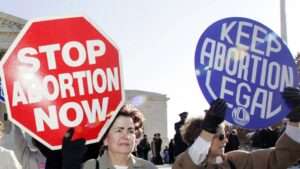
In this Nov. 30, 2005 file photo, an anti-abortion supporter stands next to a pro-choice demonstrator outside the U.S. Supreme Court in Washington. (AP Photo/Manuel Balce Ceneta).


In a famous passage in his dissent in Planned Parenthood v. Casey, the 1992 case that (mostly) reaffirmed Roe v. Wade, Justice Antonin Scalia chided the majority for believing "they are bringing to an end a troublesome era in the history of our Nation and of our Court."  He predicted - correctly as it turned out - that the Court's ruling would actually "prolong and intensif[y]" conflict over the issue of abortion.

Today, knowledgeable conservatives probably recognize that the reversal of Casey and Roe in Dobbs won't put an end to the political struggle over abortion. At least in the short to medium term, it is likely to actually intensify it. But they may hope it will at least put an end to legal battles over abortion's status under the Constitution. If so, they are likely to be disappointed on that front.

It is obvious that Dobbs is likely to open up legal battles over such issues as whether states can bar residents from getting abortions in other states, and whether the federal government can adopt nationwide abortion bans (or nationwide laws protecting abortion rights). But Dobbs is also unlikely to definitively settle the central question it set out to consider: whether there is a constitutional right to abortion.

Just as most conservatives never accepted the legitimacy of Roe v. Wade, and waged a fifty year struggle to overturn it, so the vast majority of progressives are unlikely to accept Dobbs, and would be happy to reverse it as soon as they get a chance to do so. This is clear both from the left-liberal reaction to Dobbs since it came down, and from the development of the abortion issue over the last several decades, as well. Neither side in this constitutional debate is willing to give much, if any, credence to the legitimacy of the other.

If a future liberal Supreme Court majority reverses Dobbs, conservatives might cite the Dobbs' dissent's paeans to the value of precedent. But liberals could easily respond by citing the conservatives' own willingness to reverse precedent in Dobbs itself. Moreover, the Dobbs dissent does acknowledge that "we are not saying that a decision can never be overruled just because it is terribly wrong." Most progressives no doubt believe that Dobbs is one such "terribly wrong" ruling, perhaps even a paradigmatic example thereof.

It may seem as if a liberal Supreme court majority is a long way off. But it may not be. Dobbs is backed by a 6-3 majority (or possibly only 5-4, if you don't count Chief Justice Roberts, who would have preserved large elements of Roe). A shift of two seats (one if Roberts isn't included) would change the balance of the Court on abortion. Two of the justices in the Dobbs majority - Alito and Thomas - are well into their seventies.

They might try to time their departures from the Court to allow a GOP president to replace them. But vagaries of illness and death don't always allow such timing. Just ask Thurgood Marshall, Antonin Scalia, and Ruth Bader Ginsburg, among others! If Democrats win enough presidential elections over the next 10-15 years (or just win them at the right time), they could well shift the majority on the Court.

A liberal Supreme Court majority could potentially be secured faster than that through court-packing, an idea that has entered the political mainstream in recent years, and may get further momentum on the left, as a result of Dobbs. The political odds are still against it happening. But the possibility can't be ruled out.

If the Democrats reverse Dobbs by packing the Court, I think it will ultimately be self-defeating. Republicans will just respond by packing the Court with their own jurists, the next time they get the chance, and the newly conservative Court would then once again rule against a constitutional right to abortion. Indeed, one of the main reasons why I have consistently opposed both left and right-wing court-packing plans is that the end result is likely to be the destruction of judicial review as an effective check on the power of government. Still, Democrats could potentially try court-packing regardless. It wouldn't be the first time politicians sacrificed long-term institutional values for short-term political gain.

Even aside from court-packing, Dobbs is far from secure against reversal. In trying to get rid of it, liberals are in a stronger position than conservatives were in the wake of Roe v. Wade in 1973. They need only "flip" a 6-3 (or possibly 5-4) majority, as opposed to the 7-2 one that decided Roe. In addition, they have a robust pipeline of high-quality potential nominees who can be depended on to vote the right (or perhaps, really, the "left") way on abortion. By contrast, conservatives in the 1970s and 80s had to cope with a GOP legal establishment that still had a relatively thin bench of pro-life jurists, which contributed to the nomination of several Republican Supreme Court justices (O'Connor, Kennedy, and Souter) who ended up voting to reaffirm Roe.

Stare decisis is an important influence on judicial decision-making. But it is at its weakest when it comes to decisions Supreme Court justices believe are profoundly harmful and wrong. That's what led conservative justices to reverse Roe and Casey. And it could well lead future liberal justices to reverse Dobbs, in turn.

Could anything ever end the legal struggle over abortion? Yes. The fight could end if American society reaches a broad consensus on the issue (similar to that which exists in many European countries, which have rules more restrictive than the Roe regime was, but less so than demanded by US pro-lifers). The 14-week limits that exist in France and Germany are good examples. If US public opinion reaches a similar consensus, few people would care about the details of abortion jurisprudence, so long as it doesn't bar the policies favored by that consensus. Alternatively, legal elites could reach a consensus on constitutional methodology that clearly resolves the abortion issue one way or the other.

But neither voters nor legal elites are likely to develop a broad consensus on  this matter anytime soon. Unless and until they do, the struggle over the constitutional status of abortion is likely to continue.

Bruen Bids Farewell To The Two-Step Test

The Court abrogated a decade of circuit court precedent, and vitiated mountains of Second Amendment scholarship.

|

If you have paid attention to Second Amendment litigation over the past decade, you have become familiar with the two-step framework. Under this framework, those challenging gun control laws usually prevail at step one, and lose at step two. The specifics are largely unimportant for the reasons that Judge VanDyke explained. And, over the past decade, there has been a mountain of scholarship that have endorsed the two-step test. During this time, the Supreme Court was asked over and over again to clarify the proper standard under Heller. And time and again, the answer was "cert denied."

Now, New York State Rifle & Pistol v. Bruen has bid farewell to the two-step test. And it did so very, very briskly:

In the years since, the Courts of Appeals have coalesced around a "two-step" framework for analyzing Second Amendment challenges that combines history with means-end scrutiny. Today, we decline to adopt that two-part approach. . . .  Despite the popularity of this two-step approach, it is one step too many. Step one of the predominant framework is broadly consistent with Heller, which demands a test rooted in the Second Amendment's text, as informed by history. But Heller and McDonald do not support applying means-end scrutiny in the Second Amendment context. Instead, the government must affirmatively prove that its firearms regulation is part of the historical tradition that delimits the outer bounds of the right to keep and bear arms.

I haven't checked Westlaw, but this paragraph probably placed red flags on dozens of circuit court cases. And almost all Second Amendment scholarship that was premised on the two-factor test has now been vitiated.

The lower courts are going to scramble, and try to find language in the majority, and in Justice Kavanaugh's concurrence, to stick to their old ways. But it will be much tougher.

Guns

N.J. Attorney General Acknowledges N.J. Must Now Go "Shall-Issue" on Concealed Carry Permits

|

AG's Enforcement Directive No. 22-07, issued Friday, makes clear that (effective immediately) applicants no longer need to submit a "written certification of justifiable need to carry a handgun." As with California, it appears that no further legislative change is required for New Jersey's may-issue system to switch to, effectively, shall-issue.

The law still continues to require, though, that the applicant "be endorsed by three reputable persons who have known the applicant for at least three years preceding the date of application, and who shall also certify thereon that the applicant is a person of good moral character and behavior." As I mentioned in my post about the California AG's letter, it's not clear to me that such a character-reference requirement is a permissible condition for exercising what the Court has said is a constitutional right. The Court has made clear that objective disqualifications for things such as felony conviction or mental illness are constitutionally permissible, but requiring character references as to "good moral character and behavior" strikes me as much harder to justify.

I understand why people might think that someone who can't round up even three people who can speak highly of him is likely to be an odd duck. (Note that the people needn't be New Jersey residents, so this shouldn't be a huge burden even to people who have just moved to New Jersey.) Still, it seems to me that a constitutional right can't be a right at the sufferance of one's friends or acquaintances.

Edited Version of Dobbs for Barnett/Blackman 2022 Supplement

I distilled the 213-page decision down to about 50 pages.

|

I would like to share an edited version of Dobbs v. Jackson Women's Health Organization, which I prepared for the 2022 Barnett/Blackman supplement. I distilled the 213-page decision down to about 50 pages. For the casebook, I'll probably whittle away another 10-15 pages. I need some time to digest the case some more, and decide what to keep and what to remove.

I found this case easier to edit than Bruen. For starters, both the majority and dissent had lengthy appendices, which padded the page count. Moreover, Bruen established an entire new framework for originalist decision-making. I erred on the side of over-inclusion. Dobbs, by contrast, mostly sparred over Casey. And the dissent played the same notes over and over and over and over again: what about Griswold, Lawrence, Obergefell? After a while, I started deleting those repetitive arguments.

Now that I've finished reading both opinions--nearly 350 pages in two days!--I can start to write about them. Stay tuned.

Free Speech

State Attorney General Suggests Considering Applicants' Ideological Viewpoints in Denying Carry Licenses

The California AG endorses denying licenses based on the applicant's "hatred" or "racism."

|

Friday, the day after the New York State Rifle & Pistol Ass'n v. Bruen Supreme Court decision, the California Attorney General wrote a letter to California law enforcement and government lawyers, expressing "the Attorney General's view that the Court's decision renders California's 'good cause' standard to secure a permit to carry a concealed weapon in most public places unconstitutional." California thus seems ready to promptly shift to a fundamentally shall-issue regime, in which pretty much all law-abiding adults can get licenses to carry concealed weapons. Nor will this require legislative action, I think; California already has a may-issue regime in place for licensing, so—as the AG's office notes—licensing authorities ("sheriffs and chiefs of police") can just use that regime but essentially without applying a good-cause requirement.

But the AG's office concludes that the existing statutory requirement "that a public-carry license applicant provide proof of 'good moral character' remains constitutional," and that this requirement isn't limited to disqualifying felons, certain violent misdemeanants, and the like. And in particular the AG's office suggests that people who hold certain ideological viewpoints should be disqualified:

Existing public-carry policies of local law enforcement agencies across the state provide helpful examples of how to apply the "good moral character" requirement. The Sacramento County Sheriff's Office, for example, currently identifies several potential reasons why a public-carry license may be denied (or revoked), which include "[a]ny arrest in the last 5 years, regardless of the disposition" or "[a]ny conviction in the last 7 years." It is reasonable to consider such factors in evaluating an applicant's proof of the requisite moral character to safely carry firearms in public. See, e.g., Bruen (referencing "law-abiding citizens").

Other jurisdictions list the personal characteristics one reasonably expects of candidates for a public-carry license who do not pose a danger to themselves or others. The Riverside County Sheriff's Department's policy, for example, currently provides as follows: "Legal judgments of good moral character can include consideration of honesty, trustworthiness, diligence, reliability, respect for the law, integrity, candor, discretion, observance of fiduciary duty, respect for the rights of others, absence of hatred and racism, fiscal stability, profession-specific criteria such as pledging to honor the constitution and uphold the law, and the absence of criminal conviction." [Emphasis added.]

As to how law enforcement is to figure out such matters, the AG's office has some advice: Among other things,

Read More

Supreme Court

On Justice Thomas, Dobbs, Precedent, and Substantive Due Process

In his Dobbs concurrence, the senior associate justice reiterates his outlying views on precedent and his belief that all substantive due process decisions were "demonstrably erroneous."

|

The concurring opinion by Justice Clarence Thomas in Dobbs v. Jackson Women's Health Organization is certainly turning heads. In that solo opinion, Justice Thomas calls for revisiting all of the Supreme Court's prior decisions holding that unenumerated rights are protected by substantive due process. It is a striking opinion, but it is also not anything new.

Justice Thomas wrote separately in Dobbs to reiterate two positions he has long held: 1) There are no substantive, unenumerated rights protected by the Due Process Clause of the Fourteenth Amendment; and 2) the Supreme Court should reconsider and overturn any prior constitutional decision that is "demonstrably erroneous." These are positions Justice Thomas has expressed before and, as before, these are positions that his colleagues on the Court have refused to embrace.

First, on the Due Process Clause, Justice Thomas has long argued (consistent with much academic commentary) that insofar as the Fourteenth Amendment incorporates enumerated rights against the states and protects unenumerated rights, this work is done by the Privileges or Immunities Clause, and not the Due Process Clause. From his Dobbs concurrence:

Considerable historical evidence indicates that "due process of law" merely required executive and judicial actors to comply with legislative enactments and the common law when depriving a person of life, liberty, or property. See, e.g., Johnson v. United States, 576 U. S. 591, 623 (2015) (THOMAS, J., concurring in judgment). Other sources, by contrast, suggest that "due process of law" prohibited legislatures "from authorizing the deprivation of a person's life, liberty, or property without providing him the customary procedures to which freemen were entitled by the old law of England." United States v. Vaello Madero, 596 U. S. ___, ____ (2022) (THOMAS, J., concurring) (slip op., at 3) (internal quotation marks omitted). Either way, the Due Process Clause at most guarantees process. It does not, as the Court's substantive due process cases suppose, "forbi[d] the government to infringe certain 'fundamental' liberty interests at all, no matter what process is provided." Reno v. Flores, 507 U. S. 292, 302 (1993); see also, e.g., Collins v. Harker Heights, 503 U. S. 115, 125 (1992).

As I have previously explained, "substantive due process" is an oxymoron that "lack[s] any basis in the Constitution." Johnson, 576 U. S., at 607–608 (opinion of THOMAS, J.); see also, e.g., Vaello Madero, 596 U. S., at ___ (THOMAS, J., concurring) (slip op., at 3) ("[T]ext and history provide little support for modern substantive due process doctrine"). "The notion that a constitutional provision that guarantees only 'process' before a person is deprived of life, liberty, or property could define the substance of those rights strains credulity for even the most casual user of words." McDonald v. Chicago, 561 U. S. 742, 811 (2010) (THOMAS, J., concurring in part and concurring in judgment); see also United States v. Carlton, 512 U. S. 26, 40 (1994) (Scalia, J., concurring in judgment). The resolution of this case is thus straightforward. Because the Due Process Clause does not secure any substantive rights, it does not secure a right to abortion.

As the repeated citations to his own prior opinions indicate, this is not a new view, and Justice Thomas did not say anything about substantive due process in Dobbs that he had not said before. (He also reiterated that some unenumerated rights may be protected by the Fourteenth Amendment's Privileges or Immunities Clause, while also reiterating his view that the right to terminate a pregnancy would not be among any such rights.)

Second, on precedent, Justice Thomas reiterates his long-held view that the Supreme Court should overturn any "demonstrably erroneous" constitutional decision, and that overturning prior precedent does not require consideration of the other stare decisis factors identified by the Court's majority opinion (or in Justice Kavanaugh's concurrence). Here is what Thomas said in Dobbs:

Because any substantive due process decision is "demonstrably erroneous," Ramos v. Louisiana, 590 U. S. ___, ___ (2020) (THOMAS, J., concurring in judgment) (slip op., at 7), we have a duty to "correct the error" established in those precedents, Gamble v. United States, 587 U. S. ___, ___ (2019) (THOMAS, J., concurring) (slip op., at 9).

For a fuller explication of his view of precedent, it is worth looking at Justice Thomas's concurring opinion in Gamble v. United States, where he made clear his disagreement with the Court's current approach to stare decisis.

In my view, the Court's typical formulation of the stare decisis standard does not comport with our judicial duty under Article III because it elevates demonstrably erroneous decisions—meaning decisions outside the realm of permissible interpretation—over the text of the Constitution and other duly enacted federal law. It is always "tempting for judges to confuse our own preferences with the requirements of the law," Obergefell v. Hodges, 576 U. S. ___, ___ (2015) (ROBERTS, C. J., dissenting) (slip op., at 3), and the Court's stare decisis doctrine exacerbates that temptation by giving the veneer of respectability to our continued application of demonstrably incorrect precedents. By applying demonstrably erroneous precedent instead of the relevant law's text—as the Court is particularly prone to do when expanding federal power or crafting new individual rights—the Court exercises "force" and "will," two attributes the People did not give it. The Federalist No. 78, p. 465 (C. Rossiter ed. 1961) (capitalization omitted).

Justice Thomas went on in Gamble to explain why he believes this approach in constitutional cases is compelled by the nature of the federal judicial power and the text of the Constitution. In short, he argued that a judge's duty in a constitutional case is different from the judge's duty in the common law context.

Given that the primary role of federal courts today is to interpret legal texts with ascertainable meanings, precedent plays a different role in our exercise of the "judicial Power" than it did at common law. In my view, if the Court encounters a decision that is demonstrably erroneous—i.e., one that is not a permissible interpretation of the text—the Court should correct the error, regardless of whether other factors support overruling the precedent. Federal courts may (but need not) adhere to an incorrect decision as precedent, but only when traditional tools of legal interpretation show that the earlier decision adopted a textually permissible interpretation of the law. A demonstrably incorrect judicial decision, by contrast, is tantamount to making law, and adhering to it both disregards the supremacy of the Constitution and perpetuates a usurpation of the legislative power.

And he concludes:

Our judicial duty to interpret the law requires adherence to the original meaning of the text. For that reason, we should not invoke stare decisis to uphold precedents that are demonstrably erroneous.

Of note, Justice Thomas wrote for himself in Gamble, just as he wrote for himself in Dobbs. Whatever sympathy some other justices may have for Justice Thomas's views of substantive due process, there is no indication that any of his colleagues share his view on stare decisis. Indeed, both Justice Alito's majority opinion, and the concurring opinion by Justice Kavanaugh, expressly embrace the multi-factor stare decisis that Justice Thomas has long rejected.

All the above helps explain why I do not believe Dobbs portends any threat to decisions such as Griswold, Lawrence, or Obergefell. Rather, I agree with my co-blogger Dale Carpenter's assessment as to why these other decisions recognizing fundamental rights protected by the Due Process Clause are unlikely to be reconsidered, let alone overturned. I do not believe there are four votes to accept certiorari in a case presenting such questions, let alone the five that would be necessary to overturn any of these cases.

More