The Volokh Conspiracy

Mostly law professors | Sometimes contrarian | Often libertarian | Always independent | Est. 2002

The Volokh Conspiracy

American Revolution

Thoughts on the Declaration of Independence and the American Revolution

A compendium of some of my previous writings on these topics, which I hope remain relevant today.

|

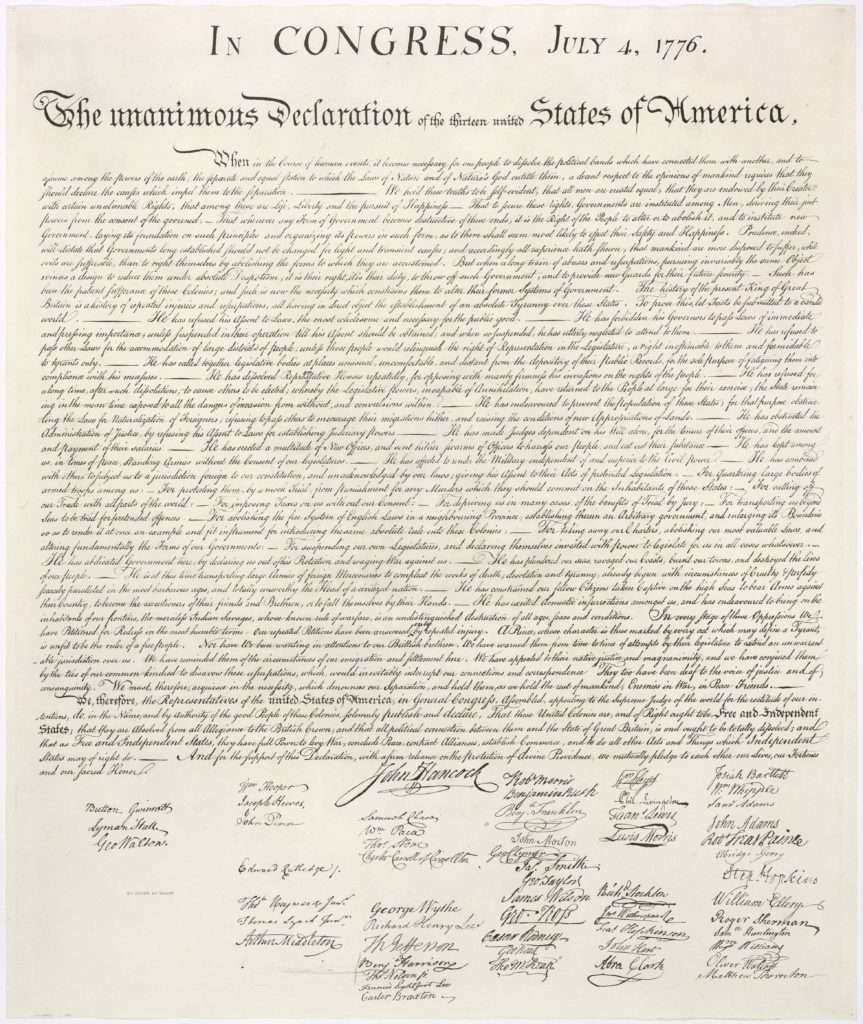
The Declaration of Independence. (National Archives.)


Over the years, I have written a number of Independence Day pieces. Some have obvious continuing relevance to such issues as identity politics, nationalism, immigration, the role of slavery in American history, and others.

In this post, I compile what I hope will be a useful list of links to those works. Enjoy!

"The Declaration of Independence and the Case for Non-Ethnic Secession," July 4, 2009.

"The Declaration of Independence and the Case for a Polity Based on Universal Principles," July 4, 2017.

"The Universalist Principles of the Declaration of Independence," July 4, 2019.

"The Case Against the Case Against the American Revolution," July 4, 2019. A rebuttal to longstanding claims - advanced by critics on both right and left - that the Revolution did more harm than good.

"Slavery, the Declaration of Independence and Frederick Douglass' 'What to the Slave is the Fourth of July?'", July 4, 2020. Douglass's famous speech sheds light on some of America's greatest evils - but also on the great good done by the Revolution and Founding.

"Juneteenth and the Universalist Principles of the American Revolution," June 19, 2021. Why there is no inconsistency in celebrating both July 4 and the abolition of slavery. Indeed, the two are mutually reinforcing.

"Immigration and the Principles of the Declaration of Independence," July 4, 2021.

What the Declaration of Independence Said and Meant

It officially adopted the American Theory of Government: First Come Rights; Then Comes Government to Secure These Rights

|

[This year, my annual post celebrating the Fourth of July is drawn from a chapter of Our Republican Constitution: Securing the Liberty and Sovereignty of We the People, and from a short essay on the same topic, The Declaration of Independence and the American Theory of Government: First Come Rights, and Then Comes Government." It also draws upon Sean Wilentz, No Property in Man: Slavery and Antislavery at the Nation's Founding]

The Declaration of Independence used to be read aloud at public gatherings every Fourth of July. Today, while all Americans have heard of it, all too few have read more than its second sentence. Yet the Declaration shows the natural rights foundation of the American Revolution, and provides important information about what the founders believed makes a constitution or government legitimate. It also raises the question of how these fundamental rights are reconciled with the idea of "the consent of the governed," another idea for which the Declaration is famous.

In 1776, there was slavery in every one of the 13 states. The adoption of the Declaration, and the public affirmation of its principles, led directly to the abolition of slavery in half of the United States by the time the Constitution was drafted just 11 years later. The Rhode Island gradual abolition law of 1784 read:

All men are entitled to Life, Liberty, and the Pursuit of Happiness, and the holding Mankind in a State of Slavery, as private property, which has gradually obtained by unrestrained Custom and the Permission of the Law, is repugnant to this Principle, and subversive of the Happiness of Mankind.

in 1787, during the same summer that the Constitution was being drafted in Philadelphia, the principles of the Declaration also inspired Congress to unanimously abolish slavery in the Northwest Territory from which the states of Ohio, Indiana, Michigan, Illinois, Wisconsin and part of Minnesota were formed. Even all the Southern states supported this.

Later, the Declaration also assumed increasing importance in the struggle to abolish slavery in the rest of the nation. It became a lynchpin of the moral and constitutional arguments of the nineteenth-century abolitionists. As one New Yorker opposed to slavery wrote in 1797:

The right of property which every man has to his personal liberty is paramount to all the laws of property…. All I contend for at present is, that no claims of property can ever justly interfere with, or be suffered to impede the operation of that noble and eternal principle, that "all men are endowed by their Creator with certain unalienable rights–and that among these are life, liberty, and the pursuit of happiness.

The Declaration was much relied upon by Abraham Lincoln and many others before him:

Without the Constitution and the Union, we could not have attained the result; but even these, are not the primary cause of our great prosperity. There is something back of these, entwining itself more closely about the human heart. That something, is the principle of "Liberty to all"–the principle that clears the path for all–gives hope to all–and, by consequence, enterprize, and industry to all.

The expression of that principle, in our Declaration of Independence, was most happy, and fortunate. Without this, as well as with it, we could have declared our independence of Great Britain; but without it, we could not, I think, have secured our free government, and consequent prosperity. No oppressed, people will fight, and endure, as our fathers did, without the promise of something better, than a mere change of masters.

The assertion of that principle, at that time, was the word, "fitly spoken" which has proved an "apple of gold" to us. The Union, and the Constitution, are the picture of silver, subsequently framed around it. The picture was made, not to conceal, or destroy the apple; but to adorn, and preserve it. The picture was made for the apple—not the apple for the picture.

The Declaration had to be explained away–quite unconvincingly–by the Supreme Court in Dred Scott. And eventually it was repudiated by some defenders of slavery in the South because of its inconsistency with that institution.

When reading the Declaration, it is worth keeping in mind two very important facts. The Declaration constituted high treason against the Crown. Every person who signed it would be executed as traitors should they be caught by the British. Second, the Declaration was considered to be a legal document by which the revolutionaries justified their actions and explained why they were not truly traitors. It represented, as it were, a literal indictment of the Crown and Parliament, in the very same way that criminals are now publicly indicted for their alleged crimes by grand juries representing "the People."

But to justify a revolution, it was not thought to be enough that officials of the government of England, the Parliament, or even the sovereign himself had violated the rights of the people. No government is perfect; all governments violate rights. This was well known. So the Americans had to allege more than mere violations of rights. They had to allege nothing short of a criminal conspiracy to violate their rights systematically. Hence, the famous reference to "a long train of abuses and usurpations" and the list that follows the first two paragraphs. In some cases, these specific complaints account for provisions eventually included in the Constitution and Bill of Rights.

In Our Republican Constitution: Securing the Liberty and Sovereignty of We the People, I explain how the Declaration encapsulated the political theory that lead the Constitution some eleven years later. To appreciate all that is packed into the two paragraphs that comprise the preamble to the list of grievances, it is useful to break down the Declaration into some of its key claims.

"When in the Course of human events, it becomes necessary for one people to dissolve the political bands which have connected them with another, and to assume among the powers of the earth, the separate and equal station to which the Laws of Nature and of Nature's God entitle them, a decent respect to the opinions of mankind requires that they should declare the causes which impel them to the separation."

This first sentence is often forgotten. It asserts that Americans as a whole (and not as members of their respective colonies) are a distinct "people." To "dissolve the political bands" revokes the "social compact" that existed between the Americans and the rest of "the People" of the British commonwealth, reinstates the "state of nature" between Americans and the government of Great Britain, and makes "the Laws of Nature" the standard by which this dissolution and whatever government is to follow are judged. "Declare the causes" indicates they are publicly stating the reasons and justifying their actions rather than acting as thieves in the night. The Declaration is like the indictment of a criminal that states the basis of his criminality. But the ultimate judge of the rightness of their cause will be God, which is why the revolutionaries spoke of an "appeal to heaven"—an expression commonly found on revolutionary banners and flags. As British political theorist John Locke wrote: "The people have no other remedy in this, as in all other cases where they have no judge on earth, but to appeal to heaven." The reference to a "decent respect to the opinions of mankind" might be viewed as a kind of an international public opinion test. Or perhaps the emphasis is on the word "respect," recognizing the obligation to provide the rest of the world with an explanation they can evaluate for themselves.

"We hold these truths to be self-evident, that all men are created equal, that they are endowed by their Creator with certain unalienable Rights, that among these are Life, Liberty and the pursuit of Happiness. "

The most famous line of the Declaration. On the one hand, this will become a great embarrassment to a people who permitted slavery. On the other hand, making public claims like this has consequences—that's why people make them publicly. To be held to account. This promise will provide the heart of the abolitionist case in the nineteenth century, which is why late defenders of slavery eventually came to reject the Declaration. And it forms the basis for Martin Luther King's metaphor of the civil rights movement as a promissory note that a later generation has come to collect.

Notice that the rights of "life," "liberty" and "the pursuit of happiness" are individual, not collective or group rights. They belong to "We the People"—each and every one. This is not to say that government may not create collective, positive rights; but only that the rights that the next sentence tells us are to be secured by government belong to us as individuals.

What are "unalienable," or more commonly, "inalienable rights"? Inalienable rights are those you cannot give up even if you want to and consent to do so, unlike other rights that you can agree to transfer or waive. Why the claim that they are inalienable rights? The Founders want to counter England's claim that, by accepting the colonial governance, the colonists had waived or alienated their rights. The Framers claimed that with inalienable rights, you always retain the ability to take back any right that has been given up.

A standard trilogy throughout this period was "life, liberty, and property." For example, the Declaration and Resolves of the First Continental Congress (1774) read: "That the inhabitants of the English colonies in North-America, by the immutable laws of nature, the principles of the English constitution, and the several charters or compacts, have the following RIGHTS: Resolved, 1. That they are entitled to life, liberty and property: and they have never ceded to any foreign power whatever, a right to dispose of either without their consent." Or, as John Locke wrote, "no one ought to harm another in his life, health, liberty, or possessions."

When drafting the Declaration in June of 1776, Jefferson based his formulation on a preliminary version of the Virginia Declaration of Rights that had been drafted by George Mason at the end of May for Virginia's provincial convention. Here is how Mason's draft read:

THAT all men are born equally free and independent, and have certain inherent natural rights, of which they cannot, by any compact, deprive or divest their posterity; among which are, the enjoyment of life and liberty, with the means of acquiring and possessing property, and pursuing and obtaining happiness and safety.

Notice how George Mason's oft-repeated formulation combines the right of property with the pursuit of happiness. And, in his draft, not only do all persons have "certain . . . natural rights" of life, liberty, and property, but these rights cannot be taken away "by any compact." Again, these rights each belong to individuals. And these inherent individual natural rights, of which the people—whether acting collectively or as individuals—cannot divest their posterity, are therefore retained by them, which is helpful in understanding the Ninth Amendment's reference to the "rights…retained by the people."

Interestingly, Mason's draft was slightly altered by the Virginia Convention in Williamsburg on June 11, 1776. After an extensive debate, the officially adopted version read (with the modifications in italics):

That all men are by nature equally free and independent, and have certain inherent rights, of which, when they enter into a state of society, they cannot, by any compact, deprive or divest their posterity; namely, the enjoyment of life and liberty, with the means of acquiring and possessing property, and pursuing and obtaining happiness and safety.

This version is still in effect today.

According to historian Pauline Meier, by changing "are born equally free" to "are by nature equally free," and "inherent natural rights" to "inherent rights," and then by adding "when they enter into a state of society," defenders of slavery in the Virginia convention could contend that slaves were not covered because they "had never entered Virginia's society, which was confined to whites." Yet it was the language of Mason's radical draft—rather than either Virginia's final wording or Jefferson's more succinct formulation—that became the canonical statement of first principles. Massachusetts, Pennsylvania, and Vermont adopted Mason's original references to "born equally free" and to "natural rights" into their declarations of rights while omitting the phrase "when they enter into a state of society." Indeed, it is remarkable that these states would have had Mason's draft language, rather than the version actually adopted by Virginia, from which to copy. Here is Massachusetts' version:

All men are born free and equal, and have certain natural, essential, and unalienable rights; among which may be reckoned the right of enjoying and defending their lives and liberties; that of acquiring, possessing, and protecting property; in fine, that of seeking and obtaining their safety and happiness.

Virginia slaveholders' concerns about Mason's formulation proved to be warranted. In 1783, the Massachusetts Supreme Judicial Court relied upon this more radical language to invalidate slavery in that state. And its influence continued. In 1823, it was incorporated into an influential circuit court opinion by Justice Bushrod Washington defining the "privileges and immunities" of citizens in the several states as "protection by the Government, the enjoyment of life and liberty, with the right to acquire and possess property of every kind, and to pursue and obtain happiness and safety."

Justice Washington's opinion in Corfield (to which we will return), with Mason's language at its core, was then repeatedly quoted by Republicans in the Thirty-Ninth Congress when they explained the meaning of the Privileges or Immunities Clause of the Fourteenth Amendment, which reads: "No state shall make or enforce any law which shall abridge the privileges or immunities of citizens of the United States." It was this constitutional language that Republicans aimed at the discriminatory Black Codes by which Southerners were seeking to perpetuate the subordination of blacks, even after slavery had been abolished.

"That to secure these rights, Governments are instituted among Men.… "

Another overlooked line, which is of greatest relevance to our discussion of the first underlying assumption of the Constitution: the assumption of natural rights. Here, even more clearly than in Mason's draft, the Declaration stipulates that the ultimate end or purpose of republican governments is "to secure these" preexisting natural rights that the previous sentence affirmed were the measure against which all government—whether of Great Britain or the United States—will be judged. This language identifies what is perhaps the central underlying "republican" assumption of the Constitution: that governments are instituted to secure the preexisting natural rights that are retained by the people. In short, that first come rights and then comes government.

"…deriving their just powers from the consent of the governed."

Today, there is a tendency to focus entirely on the second half of this sentence, referencing "the consent of the governed," to the exclusion of the first part, which refers to securing our natural rights. Then, by reading "the consent of the governed" as equivalent to "the will of the people," the second part of the sentence seems to support majoritarian rule by the people's "representatives." In this way, "consent of the governed" is read to mean "consent to majoritarian rule." Put another way, the people can consent to anything, including rule by a majority in the legislature who will then decide the scope of their rights as individuals.

But read carefully, one sees that in this passage the Declaration speaks of "just powers," suggesting that only some powers are "justly" held by government, while others are beyond its proper authority. And notice also that "the consent of the governed" assumes that the people do not themselves rule or govern, but are "governed" by those individual persons who make up the "governments" that "are instituted among men."

The Declaration stipulates that those who govern the people are supposed "to secure" their preexisting rights, not impose the will of a majority of the people on the minority. And, as the Virginia Declaration of Rights made explicit, these inalienable rights cannot be surrendered "by any compact." Therefore, the "consent of the governed," to which the second half of this sentence refers, cannot be used to override the inalienable rights of the sovereign people that are reaffirmed by the first half.

In modern political discourse, people tend to favor one of these concepts over the other—either preexistent natural rights or popular consent—which leads them to stress one part of this sentence in the Declaration over the other. The fact that rights can be uncertain and disputed leads some to emphasize the consent part of this sentence and the legitimacy of popularly enacted legislation. But the fact that there is never unanimous consent to any particular law, or even to the government itself, leads others to emphasize the rights part of this sentence and the legitimacy of judges protecting the "fundamental" or "human" rights of individuals and minorities.

If we take both parts of this sentence seriously, however, this apparent tension can be reconciled by distinguishing between (a) the ultimate end or purpose of legitimate governance and (b) how any particular government gains jurisdiction to rule. So, while the protection of natural rights or justice is the ultimate end of governance, particular governments only gain jurisdiction to achieve this end by the consent of those who are governed. In other words, the "consent of the governed" tells us which government gets to undertake the mission of "securing" the natural rights that are retained by the people. After all, justifying the independence of Americans from the British government was the whole purpose of the Declaration of Independence.

"That whenever any Form of Government becomes destructive of these ends, it is the Right of the People to alter or to abolish it, and to institute new Government, laying its foundation on such principles and organizing its powers in such form, as to them shall seem most likely to effect their Safety and Happiness."

People have the right to take back power from the government. Restates the end—human safety and happiness—and connects the principles and forms of government as means to this end.

"Prudence, indeed, will dictate that Governments long established should not be changed for light and transient causes; and accordingly all experience hath shewn, that mankind are more disposed to suffer, while evils are sufferable, than to right themselves by abolishing the forms to which they are accustomed."

Affirms at least two propositions: On the one hand, long-established government should not be changed for just any reason. The mere fact that rights are violated is not enough to justify revolution. All governments on earth will sometimes violate rights. But things have to become very bad before anyone is going to organize a resistance. Therefore, the very existence of this Declaration is evidence that things are very bad indeed.

"But when a long train of abuses and usurpations, pursuing invariably the same Object evinces a design to reduce them under absolute Despotism, it is their right, it is their duty, to throw off such Government, and to provide new Guards for their future security."

Revolution is justified only if there "is a long train of abuses and usurpations, pursuing invariably the same Object"—evidence of what amounts to an actual criminal conspiracy by the government against the rights of the people. The opposite of "light and transient causes," that is, the more ordinary violations of rights by government.

"Such has been the patient sufferance of these Colonies; and such is now the necessity which constrains them to alter their former Systems of Government. The history of the present King of Great Britain [George III—Eds.] is a history of repeated injuries and usurpations, all having in direct object the establishment of an absolute Tyranny over these States. To prove this, let Facts be submitted to a candid world."

What follows is a bill of indictment. Several of these items end up in the Bill of Rights. Others are addressed by the form of the government established—first by the Articles of Confederation, and ultimately by the Constitution.

The assumption of natural rights expressed in the Declaration of Independence can be summed up by the following proposition: "First comes rights, then comes government." According to this view: (1) the rights of individuals do not originate with any government, but preexist its formation; (2) the protection of these rights is the first duty of government; and (3) even after government is formed, these rights provide a standard by which its performance is measured and, in extreme cases, its systemic failure to protect rights—or its systematic violation of rights—can justify its alteration or abolition; (4) at least some of these rights are so fundamental that they are "inalienable," meaning they are so intimately connected to one's nature as a human being that they cannot be transferred to another even if one consents to do so. This is powerful stuff.

At the Founding, these ideas were considered so true as to be self-evident. However, today the idea of natural rights is obscure and controversial. Oftentimes, when the idea comes up, it is deemed to be archaic. Moreover, the discussion by many of natural rights, as reflected in the Declaration's claim that such rights "are endowed by their Creator," leads many to characterize natural rights as religiously based rather than secular. As I explain in The Structure of Liberty: Justice and the Rule of Law, I believe this is a mistake.

The political theory announced in the Declaration of Independence can be summed up in a single sentence: First come rights, and then comes government. This proposition is not, as some would say, a libertarian theory of government. The Declaration of Independence shows it to be the officially adopted American Theory of Government.

  • According to the American Theory of Government, the rights of individuals do not originate with any government but pre-exist its formation;
  • According to the American Theory of Government, the protection of these rights is both the purpose and first duty of government;
  • According to the American Theory of Government, at least some of these rights are so fundamental that they are inalienable, meaning that they are so intimately connected to one's nature as a human being that they cannot be transferred to another even if one consents to do so;
  • According to the American Theory of Government, because these rights are inalienable, even after a government is formed, they provide a standard by which its performance is measured; in extreme cases, a government's systemic violation of these rights or failure to protect them can justify its alteration and abolition. In the words of the Declaration, "whenever any Form of Government becomes destructive of these ends," that is the securing of these rights, "it is the Right of the People to alter or abolish it, and to institute new Government, laying its foundation on such principles and organizing its powers in such form, as to them shall seem most likely to effect their Safety and Happiness."

The original public meaning of the text of the Declaration of Independence is distinct from the original public meaning of the U.S. Constitution. The Constitution, however it is properly interpreted, does not justify itself. To be legitimate, it must be consistent with political principles that are capable of justifying it. Moreover, these same publicly identified original principles are needed inform how the original public meaning of the Constitution is to be faithfully to be applied when the text of
the Constitution is not alone specific enough to decide a case or controversy.

The original principles that the Founders thought underlie and justify the Constitution were neither shrouded in mystery nor to be found by parsing the writings of Locke, Montesquieu, or Machiavelli.

On July 2nd, 1776, the Congress of the United States voted for independence from Great Britain. On July 4th, 1776, it officially adopted the American Theory of Government, which was publicly articulated in the Declaration of Independence.

Happy Independence Day!

Immigration

Supreme Court Ruling in "Remain in Mexico" Case is a Win for Biden, Migrants - and Fans of Presidential Power

The ruling likely allows end of a cruel policy - but also reinforces broad presidential control over immigration.

|

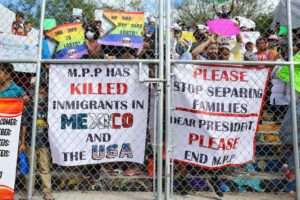
(ACLU)


In Biden v. Texas, the very last case of the just-concluded Supreme Court term, the Court rejected a legal challenge to President Biden's termination of Donald Trump's "Remain in Mexico Policy" (more formally known as the Migrant Protection Protocol). MPP forced many non-Mexican migrants to wait in Mexico for months at a time, as their asylum and removal cases were considered. The ruling was 5-4, with Chief Justice Roberts and Justice Kavanaugh agreeing with the three liberal justices. Justice Amy Coney Barrett dissented only on a procedural issue, and in fact agreed with the majority on the merits. In most years, this ruling might have attracted widespread attention. In 2022, it has attracted much less interest, because there have been so many high-profile rulings on other, more salient, issues.

Still, it's a significant case, both for its likely policy effects, and for its impact on presidential power over migration, more generally. While the decision likely allows Biden to end one of Trump's cruelest migration policies, it also reinforces sweeping presidential control over immigration policy. In combination with the Court's other rulings on immigration policy, Biden v. Texas  helps ensure there are now very few constraints on the president's power to bar, detain, or grant entry to almost any potential migrants who who are not already US citizens or permanent residents. While I think the ruling is largely correct on the specific issues it considers, it is nonetheless part of a troubling broader picture.

Adopted in 2019, MPP was one of many Trump administration policies intended to curb immigration - both legal and illegal - as much as possible. It required many non-Mexican migrants crossing from Mexico to be immediately deported back to Mexico and remain there until their asylum and removal cases were resolves (which often takes many months). Tens of thousands of migrants were affected by the policy, and many ended up detained under terrible conditions in Mexico, at grave risk of murder, rape, and assault.

Biden promised to terminate the policy, and in June 2021, his Department of Homeland Security issued a memorandum implementing that promise. When Texas and Missouri challenged the new policy in court, a district judge ruled that the memorandum was a violation of Section 1225 of the Immigration and Nationality Act (INA), and procedurally inadequate under the Administrative Procedure Act. The Biden administration then withdrew the June memo, and replaced it with a far more through analysis issued in October, even as the litigation continued.

The legal issues in the case are only moderately complicated. Section 1225(b)(2)(A) of the INA states that "[i]n the case of an alien . . . who is arriving on land… from a foreign territory contiguous to the United States, the Attorney General may return the alien to that territory pending a proceeding under section 1229a of this title." Note the word "may" here. As Chief Justice Roberts explains in his opinion from the Court, this clearly indicates that the executive can expel this category of migrants if he wants to, but is not required to do so.

But another provision of Section 1225 states that "an alien seeking admission is not clearly and beyond a doubt entitled to be admitted, the alien shall be detained for a proceeding under section 1229a of this title." All nine justices - both majority and dissenters - agree that it isn't actually possible to detain all the people in question, because the federal government has nowhere near enough detention facilities to do that. As the dissent by Justice Alito concedes, "no one suggests that DHS must do the impossible." This is just one of many situations where the vast scope of federal law makes it impossible to track down and detain more than a small fraction of violators. Thus, law enforcement must pick and choose.

But Alito - backed by Gorsuch and Thomas - also contends that the impossibility of carrying out the detention mandate requires the executive to deport the remaining migrants who would otherwise have to be detained. In their view, this essentially converts the "may" in Section 1225(b)(2)(A) into a "must."

To my mind, this argument makes little sense. Nothing in the statute indicates that expulsion is somehow a mandatory remedy for violations of the detention mandate. Roberts does a thorough job of addressing this point in the majority opinion, and I won't try to recapitulate it in detail here.

Roberts' conclusion is reinforced by the fact that 8 U.S. Code §1182(d)(5)(A) gives the president the power to "parole" otherwise inadmissible migrants into the United States on a "case-by-case" basis, if doing so is "for urgent humanitarian reasons or significant public benefit." That further suggests that detention is not the only legal alternative to expulsion. The Biden administration has in fact begun to parole many of the migrants who would previously have been forced into MPP, and the horrible conditions they would otherwise face surely qualify as "urgent humanitarian reasons."

Alito argues that such large-scale use of the parole power cannot really be "case by case." But unless it is going to be completely arbitrary or random, any use of case-by-case discretion must be guided by general rules. And the authority wielding such discretion can reasonably conclude that, as a general rule, all or most migrants covered by MPP would face grave dangers if forced to remain in Mexico. Thus, their admission is justified by "urgent humanitarian reasons." I discussed the relationship of case-by-case discretion and general rules in more detail in this 2016 article focusing on litigation over one of Barack Obama's immigration initiatives.

The plaintiff states and the lower court ruling also contend that Biden violated the Administrative Procedure Act. Among other things, they claim that the shift from the June memorandum to the October one was an improper post hoc rationalization, barred by the Supreme Court's 2020 ruling against the Trump administration's attempts to terminate the DACA program. Chief Justice Roberts explains (correctly, I think) that there is an important distinction between the two cases, because the Biden administration didn't just provide a new rationale for the June memorandum, but actually withdrew that memo and went back to square one and started the process over. And, unlike in the case of Trump's effort to terminate DACA, Biden's rationale for terminating MPP did not simply ignore the main considerations on the other side.

As I explained at the time it was issued, the Court's ruling in the DACA case was largely a response to the extremely poor handling of the rescission effort by the Trump Administration, and the majority made it clear a future administration could find ways to get rid of the program if it wanted to. The "Remain in Mexico" case reinforces that point.

In her dissenting opinion, Justice Barrett agrees with the majority on the above issues, but argues that the Supreme Court should simply have resolved the case on procedural grounds because Section 1252 of the INA states that "no court (other than the Supreme Court) shall have jurisdiction or authority to enjoin or restrain the operation" of specified immigration provisions (including, the ones at stake in this case) except as applied to "an individual alien against whom proceedings under [those provisions] have been initiated." The district judge had issued an injunction against Biden's reversal of MPP, which seems to be illegal under this provision.

Barrett suggests that, if the district court could not issue an injunction, then it also arguably lacked jurisdiction to hear the case at all. I think the majority has some good arguments against this theory, including that the Supreme Court exception to the anti-injunction rule suggests that lower federal courts must have at least some jurisdiction here (otherwise a case like this could never reach the Supreme Court). But I will leave this issue to those with greater expertise on remedies. Here, I just note that all nine justices seem to agree that lower federal courts' can't (in most cases) issue injunctions against executive branch actions here, even if the latter actions were actually illegal!

The most immediate bottom line here is that the Biden administration will likely succeed in ending MPP. The majority does remand the case to the lower courts for further consideration of whether Biden violated Section 706 of the APA, which among other things, bars policy changes that are  "arbitrary, capricious, an abuse of discretion, or otherwise not in accordance with law." But it seems unlikely the plaintiff states can prevail on this basis, given the thoroughness of the October memorandum, and the Court's apparent endorsement of its thoroughness.

But, while this is a victory for supporters of migration rights, it's also a win for executive power. Today's ruling indicates that the President has near-total discretion to decide whether most migrants crossing a land boundary must "remain in Mexico" (or Canada, if they came from there), detain them (at least if resources allow), or parole them into the United States (so long as there is a "humanitarian" or "public benefit" rationale for their admission).

The Court's 2018 travel ban ruling indicates he also has near-total discretion to exclude such migrants from the US entirely, even if his motive for doing is one that would be ruled unconstitutional in almost any other context. The Court has also ruled that habeas corpus constraints do not apply to the removal of immigrants, and more generally largely exempted immigration restrictions from a wide range of constitutional constraints that apply to other areas of government policy.

When you put it all together, the president ends up with sweeping power to exclude, detain, or parole the vast majority of potential migrants. Such massive discretionary power is at odds with the text and original meaning of the Constitution, and it's certainly inimical to the major questions and nondelegation principles the Court - especially its conservatives - have applied in other contexts. The Supreme Court has not yet considered a major question or nonedelegation case in the immigration field. But, when they do, I hope conservative justices resist any temptation they might feel to carve out an ad hoc exception for immigration.

In the meantime, presidential power over immigration keeps growing. Much can and should be done to curb it. But neither Congress nor the Supreme Court have - so far - made more than minimal efforts to step up to the challenge.

UPDATE: I have made a correction to my description of the Court's 2020 ruling in immigration and habeas corpus, noting it applies to removal, rather than detention. I apologize for the mistake.

"Oregon Health Officials Delayed a Meeting Because 'Urgency Is a White Supremacy Value'"

|

Robby Soave reports, here at Reason:

The Oregon Health Authority (OHA) is a government agency that coordinates medical care and social well-being in the Beaver State. During the pandemic, OHA was responsible for coordinating Oregon's vaccination drive and disseminating information about COVID-19—both vital tasks.

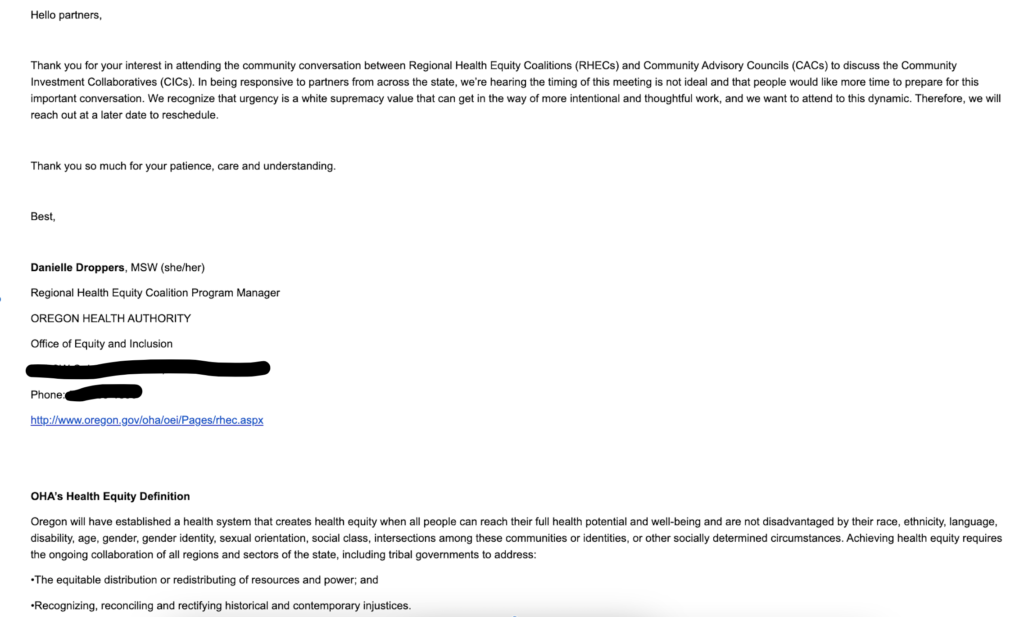
The agency's office for equity and inclusion, however, prefers not to rush the business of government. In fact, the office's program manager delayed a meeting with partner organizations on the stated grounds that "urgency is a white supremacy value." …

"Thank you for your interest in attending the community conversation between Regional Health Equity Coalitions (RHECs) and Community Advisory Councils (CACs) to discuss the Community Investment Collaboratives (CICs)," wrote [the Regional Health Equity Coalition Program Manager]. "We recognize that urgency is a white supremacy value that can get in the way of more intentional and thoughtful work, and we want to attend to this dynamic. Therefore, we will reach out at a later date to reschedule."

Oddly enough, there also other people who have long believed that whites are more likely than nonwhites to have particular character traits, such as (among other things) being willing to go along with requests to do things urgently. Indeed, I'd heard jokes those people tell reflecting that very perception. I just don't think highly of those people.

UPDATE: You can see a screenshot of the e-mail, which is also included in Soave's post, here.

SCOTUS Eliminates the Lemon Defense, and Smokes Joints With Play

A revolution in Establishment Clause jurisprudence from three Free Exercise and Free Speech cases.

|

Formally, at least, there were no Establishment Clause cases on the Court's docket this past term. But in three cases involving Free Exercise and Free Speech claims, the Court effected a revolution in Establishment Clause jurisprudence. The facts of the cases are very different, but they all involve a common thread.

First, in Shurtleff v. Boston, the city refused to fly a flag with a cross to avoid a potential Establishment Clause violation. Second, in Carson v. Makin, Maine excluded religious schools from its tuition policy to avoid a potential Establishment Clause violation. Third, in Kennedy v. Bremerton School District, the coach was disciplined to avoid a potential Establishment Clause violation. In each case, the government restricted the rights of free exercise and/or free speech to prevent an entanglement between church and state. Call it the Lemon defense.

In each of the three cases, the Supreme Court emphatically rejected the Lemon defense. In Shurtleff, raising the flag would not have violated the Establishment Clause. In Carson, providing funding for the religious schools would not have violated the Establishment Clause. In Kennedy, allowing the coach to pray at the 50-yard line would not have violated the Establishment Clause. Therefore, fears of entanglement would not justify infringements of speech and exercise rights.

Going forward, the government can no longer say, "Lemon made me do it."  Or, as Justice Gorsuch put it, the fears about "phantom constitutional violations" will not suffice.

In truth, there is no conflict between the constitutional commands before us. There is only the "mere shadow" of a conflict, a false choice premised on a misconstruction of the Establishment Clause. Schempp (Goldberg, J., concurring). And in no world may a government entity's concerns about phantom constitutional violations justify actual violations of an individual's First Amendment rights

Justice Breyer's dissent in Carson laments the elimination of the so-called "play in the joints" framework.

I have also previously explained why I believe that a "rigid, bright-line" approach to the Religion Clauses—an approach without any leeway or "play in the joints"—will too often work against the Clauses' underlying purposes.

And Sotomayor laments that not much is left of the doctrine:

Second, the consequences of the Court's rapid transformation of the Religion Clauses must not be understated. From a doctrinal perspective, the Court's failure to apply the play-in-the-joints principle here, leaves one to wonder what, if anything, is left of it.

As I read Shurtleff, Carson, and Kennedy, the Court has snapped the "play in the joints" doctrine. Locke v. Davey is abrogated. And, combined with the quasi-overruling of Lemon, the government can no longer use the Establishment Clause as a prophylactic. The state will have to err on the side of allowing more religion into the public square to avoid violating speech and exercise rights.

Four years ago, the Court could not muster this sort of change in American Legion.  But Red Flag June has brought a revolution to Establishment Clause jurisprudence, in three cases that did not actually raise Establishment Clause claims.

No Offense, But It's Just A Prayer

Kennedy tells people to get over prayer in public unless there is direct coercion.

|

In American Legion, Justice Gorsuch wrote a concurring opinion, joined by Justice Thomas. Gorsuch challenged the entire basis of Article III standing for Establishment Clause cases. In Gorsuch's view, merely taking "offense" at some public display of religion was insufficient to establish an Article III injury. (I too have long questioned standing in cases like Van Orden v. Perry.) Gorsuch wrote:

In a large and diverse country, offense can be easily found. Really, most every governmental action probably offends somebody. No doubt, too, that offense can be sincere, sometimes well taken, even wise. But recourse for disagreement and offense does not lie in federal litigation. Instead, in a society that holds among its most cherished ambitions mutual respect, tolerance, self-rule, and democratic responsibility, an "offended viewer" may "avert his eyes," Erznoznik v. Jacksonville (1975), or pursue a political solution. Today's decision represents a welcome step toward restoring this Court's recognition of these truths, and I respectfully concur in the judgment.

If this passage is correct, then why would someone suffering "offense" from a public display have a constitutional injury? Van Orden could have just have averted his eyes at the Ten Commandments display. (And don't get me started on Flast v. Cohen.)

At the time, Gorsuch's opinion garnered only two votes. Now, a majority of the Court implicitly endorsed Gorsuch's reasoning. Kennedy v. Bremerton includes this passage:

Naturally, Mr. Kennedy's proposal to pray quietly by himself on the field would have meant some people would have seen his religious exercise. Those close at hand might have heard him too. But learning how to tolerate speech or prayer of all kinds is "part of learning how to live in a pluralistic society," a trait of character essential to "a tolerant citizenry." Lee. This Court has long recognized as well that "secondary school students are mature enough … to understand that a school does not endorse," let alone coerce them to participate in, "speech that it merely permits on a nondiscriminatory basis." Mergens. Of course, some will take offense to certain forms of speech or prayer they are sure to encounter in a society where those activities enjoy such robust constitutional protection. But "[o]ffense … does not equate to coercion." Town of Greece.

If offense is not sufficient to trigger coercion, then what is the basis for an Article III injury? Moreover, the Court has sent a clear message: unless there is direct coercion, get over prayer in public. The government's attempt to avoid a person from feeling "offense" is not sufficient to violate the coach's Free Exercise and Free Speech rights.

Justice Sotomayor's dissent contends that Gorsuch read Lee v. Weisman out of context:

Today's Court quotes the Lee Court's remark that enduring others' speech is "part of learning how to live in a pluralistic society.'" The Lee Court, however, expressly concluded, in the very same paragraph, that "[t]his argument cannot prevail" in the school-prayer context because the notion that being subject to a "brief " prayer in school is acceptable "overlooks a fundamental dynamic of the Constitution": its "specific prohibition on … state intervention in religious affairs." [FN7]

FN7: The Court further claims that Lee is distinguishable because it involved prayer at an event in which the school had 'in every practical sense compelled attendance and participation in [a] religious exercise." The Court in Lee, however, recognized expressly that attendance at the graduation ceremony was not mandatory and that students who attended only had to remain silent during and after the prayers.

And Sotomayor challenges the majority's claim that "direct coercion" is needed under the Court's precedents:

The Court claims that the District "never raised coercion concerns" simply because the District conceded that there was "'no evidence that students [were] directly coerced to pray with Kennedy.'"  The Court's suggestion that coercion must be "direc[t]" to be cognizable under the Establishment Clause is contrary to long-established precedent. The Court repeatedly has recognized that indirect coercion may raise serious establishment concerns, and that "there are heightened concerns with protecting freedom of conscience from subtle coercive pressure in the elementary and secondary public schools." Lee. Tellingly, none of this Court's major cases involving school prayer concerned school practices that required students to do any more than listen silently to prayers, and some did not even formally require students to listen, instead providing that attendance was not mandatory. Nevertheless, the Court concluded that the practices were coercive as a constitutional matter.

Once again in Red Flag June, the Court has shifted doctrine. Lemon is gone. Plus cases involving coercion like Lee and Santa Fe have also been abrogated. The amount of doctrinal shifts this Term will take some time to digest.

Why Didn't Kennedy Formally Overrule Lemon?

There were no Establishment Clause claims present, and Kennedy did not ask the Court to reverse Lemon.

|

Shortly after Kennedy v. Bremerton School District was decided, I wrote that the Lemon test was finally interred. I observed that "Justice Gorsuch's majority opinion does not overrule Lemon in so many words, but the import of the ruling is clear--follow Town of Greece, not Lemon." Indeed, we do not get the magic words that we read in Dobbs:

Lemon was egregiously wrong from the start. Its reasoning was exceptionally weak, and the decision has had damaging consequences. We hold that Lemon must be overruled.

Instead, Justice Gorsuch mustered this passage, which acted as if that Lemon was already overruled--or something like that.

What the District and the Ninth Circuit overlooked, however, is that the "shortcomings" associated with this "ambitiou[s]," abstract, and ahistorical approach to the Establishment Clause became so "apparent" that this Court long ago abandoned Lemon and its endorsement test offshoot. American Legion; see also Town of Greece v. Galloway (2014) . . . 

In place of Lemon and the endorsement test, this Court has instructed that the Establishment Clause must be interpreted by "'reference to historical practices and understandings.'" Town of Greece.

Not quite. Town of Greece did not overrule Lemon. And American Legion, which Justices Breyer and Kagan joined, did not formally overrule the precedent. Justice Sotomayor points out the obvious:

Despite all of this authority, the Court claims that it "long ago abandoned" both the "endorsement test" and this Court's decision in Lemon. The Court chiefly cites the plurality opinion in American Legion v. American Humanist Assn. (2019) to support this contention. That plurality opinion, to be sure, criticized Lemon's effort at establishing a "grand unified theory of the Establishment Clause" as poorly suited to the broad "array" of diverse establishment claims. All the Court in American Legion ultimately held, however, was that application of the Lemon test to "longstanding monuments, symbols, and practices" was ill-advised for reasons specific to those contexts. The only categorical rejection of Lemon in American Legion appeared in separate writings. See (KAVANAUGH, J., concurring); (THOMAS, J., concurring in judgment); (GORSUCH, J., concurring in judgment). [FN6] The Court now goes much further, overruling Lemon entirely and in all contexts. It is wrong to do so. . . .  It is true "that rigid application of the Lemon test does not solve every Establishment Clause problem," but that does not mean that the test has no value. American Legion (KAGAN, J., concurring in part).

Ditto for Shurtleff, which did not overrule Lemon:

FN6: The Court also cites Shurtleff v. Boston (2022), as evidence that the Lemon test has been rejected. Again, while separate writings in Shurtleff criticized Lemon, the Court did not. The opinion of the Court simply applied the longstanding rule that, when the government does not speak for itself, it cannot exclude speech based on the speech's "'religious viewpoint.'" Shurtleff. The Court further infers Lemon's implicit overruling from recent decisions that do not apply its test. As explained above, however, not applying a test in a given case is a different matter from overruling it entirely and, moreover, the Court has never before questioned the relevance of endorsement in the school-prayer context.

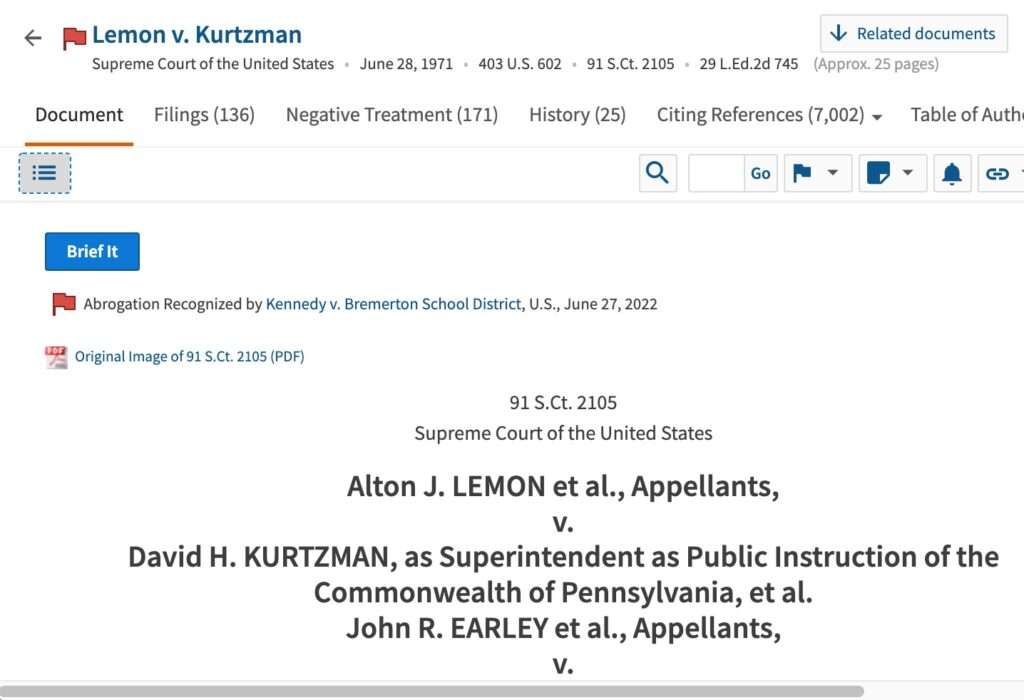
Lemon was never actually overruled. And I'm not exactly sure what "abandoned" even means in this context. Does this statement really count as a red flag? According to WestLaw, the "abrogation" of Lemon was recognized by Kennedy.

So why did the Court not formally overrule Lemon? For starters, Coach Kennedy never made such a request. Indeed, he couldn't have, as he did not bring claims under the Establishment Clause. Of course, the lower courts invoked Lemon to rule against Kennedy's Free Exercise and Free Speech claims, but the Establishment Clause was not at issue directly.

Still, going forward the lower courts have "instructions" from the Supreme Court.

In place of Lemon and the endorsement test, this Court has instructed that the Establishment Clause must be interpreted by "'reference to historical practices and understandings.'" Town of Greece.

Though, I'm sure some district court judge, somewhere will write, "Unless a majority of the Supreme Court formally overrules Lemon, I will continue to follow it." Old precedents die hard.

Speaking of "text and history," Justice Sotomayor included one of the first citations of Dobbs and Bruen in a judicial opinion.

The Court reserves any meaningful explanation of its history-and-tradition test for another day, content for now to disguise it as established law and move on. It should not escape notice, however, that the effects of the majority's new rule could be profound. The problems with elevating history and tradition over purpose and precedent are well documented. See Dobbs (BREYER, SOTOMAYOR, and KAGAN, JJ., dissenting) (explaining that the Framers "defined rights in general terms to permit future evolution in their scope and meaning"); New York State Rifle & Pistol Assn., Inc. v. Bruen (2022) (BREYER, J., dissenting) (explaining the pitfalls of a "near-exclusive reliance on history" and offering examples of when this Court has "misread" history in the past); Brown v. Davenport (2022) (KAGAN, J., dissenting) (noting the inaccuracies risked when courts "play amateur historian").

It is true that Lemon was not at issue in Carson. But the Court discussed it at some length. I will explain why in another post.

Farewell to Footnote 3 of Trinity Lutheran

In Carson v. Makin, the Chief Justice stealthily eliminated the status/use distinction.

|

Trinity Lutheran v. Comer was decided in June 2017. At the time, Justice Kennedy was still the Court's swing vote, and Justice Gorsuch was the junior justice. And Roberts made a decision. He included Footnote 3 in his opinion:

This case involves express discrimination based on religious identity with respect to playground resurfacing. We do not address religious uses of funding or other forms of discrimination.

Footnote 3 crafted some sort of distinction between "religious identity" and "religious uses." That is, Trinity Lutheran only involved a case where the state excluded an institution because of its religious identity, or status. But the funding would buy tire scraps for a playground, which was not a religious use.

Justice Kennedy, as well as Justice Kagan joined Roberts's opinion, including Footnote 3. But Justices Gorsuch and Thomas refused to join Footnote 3, thus depriving the Court of a majority opinion on that point. Gorsuch wrote a concurrence that cast doubt on the dichotomy in Footnote 3:

Second and for similar reasons, I am unable to join the footnoted observation, n. 3, that "[t]his case involves express discrimination based on religious identity with respect to playground resurfacing." Of course the footnote is entirely correct, but I worry that some might mistakenly read it to suggest that only "playground resurfacing" cases, or only those with some association with children's safety or health, or perhaps some other social good we find sufficiently worthy, are governed by the legal rules recounted in and faithfully applied by the Court's opinion.

Justice Sotomayor dissented in Trinity Lutheran, joined by Justice Ginsburg. She observed that the status/use line will not hold up:

In the end, the soundness of today's decision may matter less than what it might enable tomorrow. The principle it establishes can be manipulated to call for a similar fate for lines drawn on the basis of religious use. See ante, at 1–3 (GORSUCH, J., concurring in part); see also ante, at 1–2 (THOMAS, J., concurring in part) (going further and suggesting that lines drawn on the basis of religious status amount to per se unconstitutional discrimination on the basis of religious belief).

Five years later, with Carson v. Makin, Footnote 3 is gone. Since it was never actually the opinion of the Court, technically, there was no need to overrule any precedent. But Chief Justice Roberts's majority opinion stealthily eliminates the status/use distinction:

In Trinity Lutheran, the Missouri Constitution banned the use of public funds in aid of "any church, sect or denomination of religion." We noted that the case involved "express discrimination based on religious identity," which was sufficient unto the day in deciding it, and that our opinion did "not address religious uses of funding." . . . Maine's argument, however—along with the decision below and Justice Breyer's dissent—is premised on precisely such a distinction.

That premise, however, misreads our precedents. In Trinity Lutheran and Espinoza, we held that the Free Exercise Clause forbids discrimination on the basis of religious status. But those decisions never suggested that use-based discrimination is any less offensive to the Free Exercise Clause. This case illustrates why. "[E]ducating young people in their faith, inculcating its teachings, and training them to live their faith are responsibilities that lie at the very core of the mission of a private religious school." Our Lady of Guadalupe School v. Morrissey-Berru (2020).

Farewell to Footnote 3. Roberts does it so effortlessly. Blink and you'll miss it.

In the very next paragraph, Roberts endorses the reasoning from Gorsuch's concurrence--that the distinction between status and use was always illusory:

Any attempt to give effect to such a distinction by scrutinizing whether and how a religious school pursues its educational mission would also raise serious concerns about state entanglement with religion and denominational favoritism. Indeed, Maine concedes that the Department barely engages in any such scrutiny when enforcing the "nonsectarian" requirement. That suggests that any status-use distinction lacks a meaningful application not only in theory, but in practice as well.In short, the prohibition on status-based discrimination under the Free Exercise Clause is not a permission to engage in use-based discrimination.

Justice Sotomayor dissented in Carson. And she has a see-I-told-you-so moment:

As Justice Breyer explains, this status-use distinction readily distinguishes this case from Trinity Lutheran and Espinoza. I warned in Trinity Lutheran, however, that the Court's analysis could "be manipulated to call for a similar fate for lines drawn on the basis of religious use." That fear has come to fruition: The Court now holds for the first time that "any status-use distinction" is immaterial in both "theory" and "practice." It reaches that conclusion by embracing arguments from prior separate writings and ignoring decades of precedent affording governments flexibility in navigating the tension between the Religion Clauses. As a result, in just a few years, the Court has upended constitutional doctrine, shifting from a rule that permits States to decline to fund religious organizations to one that requires States in many circumstances to subsidize religious indoctrination with taxpayer dollars.

And I have to think that Justice Kagan had some buyer's remorse. She joined the Trinity Lutheran majority, including Footnote 3, perhaps in the hopes of forestalling a bigger defeat. Five years later, we get Carson v. Makin.

So many precedents have been overruled this term that the demise of Footnote 3 has flown under the radar. Red Flag June was one for the ages.

Free Speech

Another Decision Against Sealing Records in Libel Cases

Litigating defamation claims "in secrecy to avoid any potential embarrassment to" their subjects "directly contradicts the presumptive right of public access to pleadings and judicial proceedings."

|

From Reich v. Fairleigh Dickinson Univ., decided Friday by Magistrate Judge Jessica S. Allen (D.N.J.):

This lawsuit arises from Plaintiff's enrollment in the Yeshiva Program at the Petrocelli College of Continuing Studies at FDU and a dispute over FDU's tuition charge for a class and Plaintiff's failing grade from a professor's alleged false accusations of plagiarism…. [O]n December 15, 2021, FDU sought leave to file the instant motion to assert counterclaims, stating that it had recently learned of Plaintiff's allegedly defamatory online communications and postings about FDU and some of its employees.

The court (among other things) allows FDU to assert its defamation counterclaims, because "Plaintiff's online statements amount to defamatory communications beyond mere statements of opinion given the context of these statements"; the statements are:

Read More

Free Speech

Residential Picketing and Abortion

|

I've seen some people argue that the Supreme Court's objection to the picketing of Justices' homes about abortion is inconsistent with the Court's upholding the right to picket outside abortion clinics, or stressing the right to protest more broadly.

It's worth noting, though, that bans on residential picketing have been particularly useful to, among other people, abortion providers. Frisby v. Schultz (1988), upheld a content-neutral ban on targeted picketing that was prompted by picketing "outside the … residence of a doctor who apparently performs abortions." That opinion was written by Justice O'Connor, and joined by Chief Justice Rehnquist and Justices Blackmun, Kennedy, and Scalia; Justice White concurred as to the principle. Justices Brennan, Marshall, and Stevens dissented.

Read More

Free Speech

S. Ct. Marshal Asks for Enforcement of Va. Residential Picketing Ban; Can That Ban Be Rendered Constitutional?

|

I wrote a few minutes ago that the Maryland residential picketing ban, mentioned in the Marshal of the Supreme Court's letter to Maryland enforcement authorities, is unconstitutional under Carey v. Brown (1980), because it has an exception for labor picketing. I've just learned from Josh Gerstein of Politico (thanks!) that the Marshal also sent similar letters to the Virginia Governor and the Fairfax County Chief of Police, urging them to enforce the Virginia residential picketing ban.

Now the Virginia law also has the same labor picketing exception that the Court has said makes a residential ban unconstitutionally content-based; but the letter cites to a 1989 Virginia Attorney General's opinion that argues that the labor picketing exception could just be struck down, and the rest of the statute could be upheld:

Read More

Free Speech

S. Ct. Marshal Asks for Enforcement of Md. Residential Picketing Ban; but that Ban Is Likely Unconstitutional

But the Montgomery County residential picketing ordinance, also mentioned in the marshal's letter, is likely fine.

|

The Marshal of the Supreme Court has asked the Governor of Maryland and the Montgomery County Chief Executive to enforce Maryland's and Montgomery County's residential picketing bans "outside of the homes of Supreme Court Justices who live in" those jurisdictions. And content-neutral restrictions on residential picketing are generally constitutional (see item 2 below).

[1.] But the Maryland law appears to be unconstitutional under the Supreme Court's decision in Carey v. Brown (1980), because it's not content-neutral. The law (which bans assemblies conducted "in a manner that disrupts a person's right to tranquility in the person's home") has an exception for "picketing or assembly in connection with a labor dispute," and Carey held that a similar exception in an Illinois statute for "picketing of a place of employment involved in a labor dispute" made the statute unconstitutionally content-based.

As with the Illinois statute in Carey, the Maryland statute "accords preferential treatment to the expression of views on one particular subject; information about labor disputes may be freely disseminated, but discussion of all other issues is restricted:

Read More

Politics

Most and Second Most Populous Jurisdictions in Each of the 11 Numbered Federal Circuits

|

For each of the federal circuits from the 1st to the 11th, list the most and second most populous jurisdictions (states or territories) in the circuit. Bonus question: What are the two circuits that have two jurisdictions that are among the 10 most populous in the U.S.?

UPDATE: I erroneously first asked just about one circuit with two jurisdictions among the 10 most populous; it appears there are two.

Forget Carson! Remember the Maine Human Rights Act.

Maine finds a way to undercut Carson v. Maikin.

|

On its face, Carson v. Maikin seems to be a resounding victory for religious liberty and school choice in Maine. The Supreme Court held that the state cannot exclude two Christian schools from a tuition payment program. Open up the coffers for Bangor Christian and Temple Academy? Not so fast.

Justice Breyer observed in his dissent that there may be another conflict between the state and the Christian schools.

Legislators also recognized that these private schools make religiously based enrollment and hiring decisions. Bangor Christian and Temple Academy, for example, have admissions policies that allow them to deny enrollment to students based on gender, gender-identity, sexual orientation, and religion, and both schools require their teachers to be Born Again Christians. Legislators did not want Maine taxpayers to pay for these religiously based practices—practices not universally endorsed by all citizens of the State—for fear that doing so would cause a significant number of Maine citizens discomfort or displeasure. The nonsectarian requirement helped avoid this conflict—the precise kind of social conflict that the Religion Clauses themselves sought to avoid.

Unsurprisingly, Maine found another way to avoid that "social conflict." Last year, the legislature revised the Maine Human Rights Act. Now, all private schools that choose to accept public funds must comply with the non-discrimination law. Specifically, the schools will be barred from discriminating on the basis of sexual orientation and gender identity. The legislature knew quite well that this change would force the two Christian schools to opt-out of any public financing.

Justice Breyer alluded to this fact in his dissent:

Nor do the schools want Maine in this role. Bangor Christian asserted that it would only consider accepting public funds if it "did not have to make any changes in how it operates." Temple Academy similarly stated that it would only accept state money if it had "in writing that the school would not have to alter its admissions standards, hiring standards, or curriculum." The nonsectarian requirement ensures that Maine is not pitted against private religious schools in these battles over curriculum or operations, thereby avoiding the social strife resulting from this state-versus-religion confrontation. By invalidating the nonsectarian requirement, the majority today subjects the State, the schools, and the people of Maine to social conflict of a kind that they, and the Religion Clauses, sought to prevent

Shortly after Carson was decided, the Maine Attorney General put out a press release citing this new legislation.

"I am terribly disappointed and disheartened by today's decision," said AG Frey.  "Public education should expose children to a variety of viewpoints, promote tolerance and understanding, and prepare children for life in a diverse society.   The education provided by the schools at issue here is inimical to a public education.  They promote a single religion to the exclusion of all others, refuse to admit gay and transgender children, and openly discriminate in hiring teachers and staff.  One school teaches children that the husband is to be the leader of the household.   While parents have the right to send their children to such schools, it is disturbing that the Supreme Court found that parents also have the right to force the public to pay for an education that is fundamentally at odds with values we hold dear.  I intend to explore with Governor Mills' administration and members of the Legislature statutory amendments to address the Court's decision and ensure that public money is not used to promote discrimination, intolerance, and bigotry."

While the Court's decision paves the way for religious schools to apply to receive public funds, it is not clear whether any religious schools will do so.   Educational facilities that accept public funds must comply with anti-discrimination provisions of the Maine Human Rights Act, and this would require some religious schools to eliminate their current discriminatory practices.

In the New York Times, Aaron Tang observed that this statute provides a workaround to Carson.

"The legislative fix made by Maine lawmakers offers a model for lawmakers elsewhere who are alarmed by the court's aggressive swing to the right. Maine's example shows that those on the losing end of a case can often outmaneuver the court and avoid the consequences of a ruling."

And other states may follow suit.

Other states should follow Maine's lead. A handful of blue states — including Illinois, Maryland, Nevada and Vermont — provide vouchers or similar tax-credit scholarships to low-income students to enroll in private schools. None of them, however, enacted a statute prohibiting funds-receiving private schools from discriminating against L.G.B.T.Q. students. Legislation that would do so is pending in Maryland's legislature, the General Assembly. Lawmakers there should quickly enact it. Other states should also prohibit such discrimination.

There still may be more litigation:

Michael Bindas, senior attorney for the Institute for Justice, said the attorney general isn't paying close attention to the Supreme Court's commitment to religious liberty in recent years.

"It was an erroneous opinion of the Maine attorney general that embroiled the state in five lawsuits spanning three decades and that culminated in the Supreme Court's ruling against the state," Bindas said Thursday in a statement. "The current attorney general seems to not have learned any lessons from that experience."

If the state truly intends to use the state law to create another obstacle, then more litigation will be inevitable, said Carroll Conley, executive director of the Christian Civic League of Maine.

The effect of this ruling may be limited in the context of school tuition programs for Maine. But the elimination of the status/use distinction (which I will discuss in another post) was huge.

What does the New York Conceal Carry Law Require?

A lot.

|

Earlier this evening, I shared a guest post from Professor Rob Leider, who explained that New Yorkers in rural areas may be worse off under the recently-enacted legislation. Here, I'd like to flag some changes made to the permitting process.

Let's start with the good news. New York struck the provision requiring "good cause." The rest of the statute is not-so-good news for gun owners.

First, the bill offers this definition of "good moral character"

good moral character, which, for the purposes of this article, shall mean having the essential character, temperament and judgement necessary to be entrusted with a weapon and to use it only in a manner that does not endanger oneself or others.

"Good moral character" is defined as "essential character." That's super helpful. Neither Justice Thomas nor Justice Kavanaugh identified "moral character" as a permissible ground for a "shall-issue" jurisdiction. This standard may not be much different than the subjective "good cause" standard. And in some regards, "moral character" is worse, because it is subject to such vast discretion.

Second, the bill requires that applicants meet in person with the licensing office for an interview. And the applicant must provide a host of information to the government:

(i) names and contact information for the applicant's current spouse, or domestic partner, any other adults residing in the applicant's home, including any adult children of the applicant, and whether or not there are minors residing, full time or part time, in the applicant's home;

(ii) names and contact information of no less than four character references who can attest to the applicant's good moral character and that such applicant has not engaged in any acts, or made any statements that suggest they are likely to engage in conduct that would result in harm to themselves or others;

Presumably, the references will have to sign a sworn affidavit to this effect.

(iii) certification of completion of the training required in subdivision nineteen of this section;

(iv) a list of former and current social media accounts of the applicant from the past three years to confirm the information regarding the applicants character and conduct as required in subparagraph (ii) of this paragraph; and

(v) such other information required by the licensing officer that is reasonably necessary and related to the review of the licensing application.

To be clear, even if four character witnesses attest that the applicant has "good moral character," the government can use a person's social media account to "confirm" the person in fact does have "good moral character." I am fairly certain that social media, in general, brings out the absolute worst in a person. Plus, the government can request any other information that is "reasonably necessary and related" to the process, which means any information.  Here, there is such vast discretion for official to deny a person's applicant. Eugene already commented on the First Amendment implications of California scrutinizing ideological viewpoints. Here, New York is performing a similar role under the guise of "good moral character."

Third, there is extensive classroom training requirement (16 hours):

An applicant shall complete an in-person live firearms safety course conducted by a duly authorized instructor with curriculum approved by the division of criminal justice services and the superintendent of state police, and meeting the following requirements:

(a) a minimum of sixteen hours of in-person live curriculum approved by the division of criminal justice services and the superintendent of state police, conducted by a duly authorized instructor approved by the division of criminal justice services, and shall include but not be limited to the following topics:

(i) general firearm safety;

(ii) safe storage requirements and general secure storage best practices;

(iii) state and federal gun laws;

(iv) situational awareness;

(v) conflict de-escalation;

(vi) best practices when encountering law enforcement;

(vii) the statutorily defined sensitive places in subdivision two of section 265.01-e of this chapter and the restrictions on possession on restricted places under section 265.01-d of this chapter;

(viii) conflict management;

(ix) use of deadly force;

(x) suicide prevention; and

(xi) the basic principles of marksmanship;

Plus, the applicant will need two hours in a live-fire range. And the applicant must score 80% on a written exam:

(b) a minimum of two hours of a live-fire range training course. The applicant shall be required to demonstrate proficiency by scoring a minimum of eighty percent correct answers on a written test.

Fourth, the government will audit records every month to determine if there is some reason to revoke the permit:

All records containing granted license applications from all licensing authorities shall be [periodically] monthly checked by the division of criminal justice services in conjunction with the division of state police against criminal conviction, criminal indictment, mental health, extreme risk protection orders, orders of protection, and all other records as are necessary to determine their continued accuracy well as whether an individual is no longer a valid license holder.

And as I read the statute, the permit shall be revoked immediately if a problem is found.

Fifth, it is a felony to possess a gun in a "sensitive location." Where is a sensitive location? Just about anywhere, unless the place expressly welcomes guns. (Such a business would immediately be boycotted and cancelled in the Empire State.) I'll provide commentary along the way.

For the purposes of this section, a sensitive location shall mean:

(a) any place owned or under the control of federal, state or local government, for the purpose of government administration, including courts;

(b) any location providing health, behavioral health, or chemical dependance care or services;

(c) any place of worship or religious observation;

Some houses of worship may wish parishioners to carry. But under the law, they cannot.

(d) libraries, public playgrounds, public parks, and zoos;

(e) the location of any program licensed, regulated, certified, funded, or approved by the office of children and family services that provides services to children, youth, or young adults…

(f) nursery schools, preschools, and summer camps;

(g) the location of any program licensed, regulated, certified, operated, or funded by the office for people with developmental disabilities;

(h) the location of any program licensed, regulated, certified, operated, or funded by office of addiction services and supports;

(i) the location of any program licensed, regulated, certified, operated, or funded by the office of mental health;

(j) the location of any program licensed, regulated, certified, operated, or funded by the office of temporary and disability assistance;

(k) homeless shelters, runaway homeless youth shelters, family shelters, shelters for adults, domestic violence shelters, and emergency shelters, and residential programs for victims of domestic violence;

(l) residential settings licensed, certified, regulated, funded, or operated by the department of health;

(m) in or upon any building or grounds, owned or leased, of any educational institutions, colleges and universities, licensed private career schools, school districts, public schools, private schools licensed under article one hundred one of the education law, charter schools, non-public schools, board of cooperative educational services, special act schools, preschool special education programs, private residential or non-residential schools for the education of students with disabilities, and any state-operated or state-supported schools;

No carrying in any school. Anywhere. The hypothetical from Bruen comes to life. Is the "campus" of NYU--that is, much of Greenwich Village--a "ground" owned or leased by the institution?

(n) any place, conveyance, or vehicle used for public transportation or public transit, subway cars, train cars, buses, ferries, railroad, omnibus, marine or aviation transportation; or any facility used for or in connection with service in the transportation of passengers, airports, train stations, subway and rail stations, and bus terminals;

All public transit is out. And streets with bus routes may also be out. Those are most streets in Manhattan.

(o) any establishment issued a license for on-premise consumption pursuant to article four, four-A, five, or six of the alcoholic beverage control law where alcohol is consumed and any establishment licensed under article four of the cannabis law for on-premise consumption;

(p) any place used for the performance, art entertainment, gaming, or sporting events such as theaters, stadiums, racetracks, museums, amusement parks, performance venues, concerts, exhibits, conference centers, banquet halls, and gaming facilities and video lottery terminal facilities as licensed by the gaming commission;

Just about all indoor places of public gathering are out.

(q) any location being used as a polling place;

(r) any public sidewalk or other public area restricted from general public access for a limited time or special event that has been issued a permit for such time or event by a governmental entity, or subject to specific, heightened law enforcement protection, or has otherwise had such access restricted by a governmental entity, provided such location is identified as such by clear and conspicuous signage;

Presumably, any street which is authorized for a parade, or other gathering, will not permit carry.

(s) any gathering of individuals to collectively express their constitutional rights to protest or assemble;

My goodness. This exception can swallow the entirety of New York state. Any place where two or more people gather to express their constitutional right becomes a "sensitive place."

(t) the area commonly known as Times Square, as such area is determined and identified by the city of New York; provided such area shall be clearly and conspicuously identified with signage.

And Times Square will become a 24/7 sensitive place. I'm sure New York City will stretch Times Square from Heralds Square to Central Park.

Sixth, a person has the burden to know he is in a sensitive location, even if there is no sign indicating that it is a sensitive location.

A person is guilty of criminal possession of a firearm, rifle or shotgun in a sensitive location when such person possesses a firearm, rifle or shotgun in or upon a sensitive location, and such person knows or reasonably should know such location is a sensitive location.

As if the categories above were not broad enough. Now, people have the extra obligation to know a place is "sensitive."

Seventh, you may think that it is safe to leave a gun in your car. Not exactly.

No person shall store or otherwise leave a rifle, shotgun, or firearm out of his or her immediate possession or control inside a vehicle without first removing the ammunition from and securely locking such rifle, shotgun, or firearm in an appropriate safe storage depository out of sight from outside of the vehicle.

The glove box will not suffice. You must use a "safe storage depository" with a key, keypad, or some other locking mechanism. Yes, to keep the gun in your car, you must unload it, and lock it. Then put it in a safe. And you have to keep the gun out of sight. Retrieving the gun in a timely fashion from your car is now extremely difficult.

Eighth, licenses are only valid for three years. Applicants will be required to jump through all of these hoops on a regular basis.

Ninth, there is now a database to record the sale of ammunition! As I read the statute, in order to purchase ammunition, a person will have to go through the national instant criminal background check system. Every trip to the range will now require a background check.

If I made any errors with this statute, please email me. I'm happy to post corrections.

More