The Volokh Conspiracy

Mostly law professors | Sometimes contrarian | Often libertarian | Always independent | Est. 2002

The Volokh Conspiracy

Federalism

Federalism and the Respect for Marriage Act

Does the bipartisan act protecting same-sex marriage run afoul of constitutional federalism principles? The answer is definitely not with respect to one of its provisions, and probably not with respect to the other.

|

Yesterday, the House of Representatives passed the Respect for Marriage Act. The broad bipartisan support it got (47 Republicans joining all the Democrats) suggests it might well pass the Senate, too. The bill is primarily motivated by fears that the Supreme Court's reversal of Roe v. Wade in the Dobbs case also presages a reversal of Obergefell v. Hodges, the 2015 ruling striking down state laws barring same-sex marriage. For reasons I summarized here,  I think that is highly unlikely to happen. See also co-blogger Dale Carpenter's analysis of that issue.

But let's assume Dale and I are wrong, and the Court does indeed go on to overrule Obergefell. In that event, the Respect for Marriage Act might face constitutional challenges on the grounds that it exceeds the scope of Congress' authority and intrudes into areas left to the control of state governments. Indeed, Dale and I (along with several other federalism scholars, including VC bloggers Randy Barnett and Jonathan Adler) filed an amicus brief in Windsor v. United States (2013) arguing that the earlier Defense of Marriage Act (DOMA) - which enacted a federal definition of marriage limited to opposite-sex couples - exceeded the scope of congressional power. The Court's majority opinion in Windsor prominently cited our brief, though it adopted our argument only in part.

Could not similar federalism objections be successfully raised against the Respect for Marriage Act? It's an entirely legitimate question. The answer is "definitely not" with respect to the act's provisions that apply to the definition of marriage used in federal law, and "probably not" when it comes to the provision requiring states to recognize same-sex marriages contracted in other states.

Here is the key provision of Section 4 of the Act, establishing a new definition of marriage with respect to eligibility for various federal tax benefits and programs:

Our federalism objection to Section 3 of DOMA was that it sought to use federal power to push for a uniform nationwide definition of marriage, thereby undermining the autonomy of the states, and pursuing an objective beyond the enumerated powers of Congress. By contrast, Section 4 of the Respect for Marriage Act does the exact opposite. It gives total  deference to states' definition of marriage. If state law says that a given relationship qualifies as a marriage, that's good enough for Uncle Sam! Call it state autonomy on steroids.

If anything, Section 4 could be criticized for deferring to the states too much. Imagine if Utah or some other state decides to grant legal recognition to polygamous marriages. Section 4 would require the federal government to do the same. If a person has multiple spouses under state law, all of them could potentially be eligible for various federal tax deductions and other benefits that are reserved for married people (though they would also all be subject to the marriage "tax penalty"). Such hypotheticals don't much bother me. But I could imagine social conservatives and some feminists worrying about them (the latter because they might fear legal recognition of polygamy would lead to the subordination of women). Regardless, this slippery slope concern is not a constitutional federalism problem. It's a matter of policy.

It's worth emphasizing that Section 4 avoids federalism problems in large part because it does not actually compel states to recognize same-sex marriages, or indeed any other kind of marriages. It just says that if a state does recognize them, the federal government will, as well. In that respect, it falls short of offering the degree of protection for same-sex marriage that currently exists under Obergefell. It's also worth noting that state laws banning same-sex marriage can violate individual constitutional rights, even if the federal government lacks any general power to legislate on the definition of marriage. There is no contradiction between these two positions and I in fact hold both.

The federalism implications of the other key provision of the Respect for Marriage Act are more debatable. Section 3 requires states to recognize various types of marriages contracted in other jurisdictions, even if it doesn't itself allow people to enter into them:

New in Newsweek: Dobbs "nullified Justice Souter's linkage of stare decisis and legitimacy"

"A new generation of law students, lawyers, and judges must internalize the Dobbs conception of "legitimacy."

|

Newsweek has published my new op-ed on Dobbs and legitimacy. In short, Dobbs overruled Casey's linkage of stare decisis and legitimacy, and indeed redefined legitimacy altogether. Finally, the Supreme Court can escape David Souter's shadow.

Here is the introduction:

Three decades ago, three Republican Supreme Court appointees reaffirmed Roe v. Wade because of three words: "stare decisis" and "legitimacy." In Planned Parenthood v. Casey, Justices Sandra Day O'Connor, Anthony Kennedy, and David Souter saved the landmark abortion precedent to ensure that people would not view the Court as a political institution.

Three decades later, in Dobbs v. Jackson Women's Health Organization, five Republican Supreme Court appointees found that stare decisis did not justify saving Roe v. Wade. But equally significant was that the majority rejected Casey's conception of "legitimacy." No longer would the Court's legitimacy be tied to public opinion. To the contrary, a legitimate Court must decide, and even overrule cases without regard for popular sentiments. This monumental shift—far more than any new jurisprudence on abortion—will define how far this new conservative Court will have the fortitude to go.

And the conclusion:

This redefined conception of legitimacy upsets long-standing views about the Court. But more importantly, Dobbs compels a recalibration by the Court's critics. In the past, progressives repeatedly warned that overruling a precedent like Roe would undermine the Court's legitimacy. If Dobbs is any indication, these barbs will be met with a collective yawn. Indeed, if Dobbs was unable to trigger a critical mass of support for Court "reform"—a euphemism for imposing term limits or expanding the number of seats—it is doubtful that anything would.

Justice Alito's opinion makes clear that public attacks will have no effect. Future precedents will turn on this emboldened conservative Court looking inward, not outward. Now, a new generation of law students, lawyers, and judges must internalize the Dobbs conception of "legitimacy."

The concept of "legitimacy" is not monolithic. The Supreme Court has now adopted a new conception  of "legitimacy." And critics will have to internalize this concept, whether they like it or not. Alternatively, the Souter-esque notion of legitimacy, like Casey itself, can be relegated to what I'm calling the living Constitution in exile. Yes, conservatives (apparently) had a Constitution in exile for generations. Progressives, it's your turn.

Free Speech

#TheyLied (or #TheyWereNegligent) Libel Claim Based on Allegations of Rape of Third Party Student Can Proceed

Among other things, "A jury could reasonably conclude that, before making so weighty an accusation as rape based on nothing more than hearsay evidence, the prudent person would, at a minimum, want to hear the other person's side of the story."

|

From Boye v. McCarthy, decided yesterday by the Pennsylvania Superior Court, in an opinion by Judge Deborah Kunselman, joined by President Judge Jack Panella and Judge James Gardner Colins:

According to the complaint, Ms. McCarthy sent a false e-mail to an administrator at Mr. Boye's college. She alleged that Mr. Boye raped a third party in his dorm room.

(The trial court concluded that the third party, labeled Ms. Roe, was "Ms. McCarthy's daughter," though the appellate court didn't rely on this, because "[t]he complaint did not state that Ms. Roe and Ms. McCarthy are daughter and mother," and thus "the fact that Ms. Roe is Ms. McCarthy's daughter was outside the trial court's scope of review, and it is outside ours, as well.")

Boye sued for defamation, and the trial court rejected the claim on the grounds that the allegation was subject to a conditional privilege, which covers reports of alleged misconduct such as this. But the appellate court concluded that Boye had adequately alleged that the conditional privilege was defeated by McCarthy's malice or even negligence:

[W]hen the plaintiff alleges an abuse of conditional privilege through malice, "the jury has to find that the defendant made the defamatory communication intentionally, with the knowledge that it was false, recklessly, without regard to whether it was true or false …." Here, Mr. Boye alleged facts that, if true, would establish Ms. McCarthy acted with a reckless disregard for whether her e-mail was true or false. To begin with, Ms. McCarthy was not an eyewitness to any of the events that she reported to the administrator. Her e-mail related no details of Ms. Roe's encounter with Mr. Boye on the date at issue.

Read More

Free Speech

Constitutionally Protected and Unprotected Lies: What's the Difference?

|

[I'm working on a draft article called When Are Lies Constitutionally Protected?, and I thought I'd serialize it here, since I still have plenty of time to improve it; I'd love to hear your thoughts on it! I began with a brief discussion of constitutionally unprotected lies, and turn here to constitutionally protected ones. (All the posts about it will go into this thread.)] [UPDATE: The final paper has now been published by the Knight Institute.]

[A.] Alvarez

Why then are some lies punishable and others not? The dissent in Alvarez gave a sketch of the argument, and it seems likely the concurrence and the plurality would have agreed. Let's look at the passage in which the "philosophy, religion, history, the social sciences, the arts, and other matters of public concern" passage appears:

[T]here are broad areas in which any attempt by the state to penalize purportedly false speech would present a grave and unacceptable danger of suppressing truthful speech. Laws restricting false statements about philosophy, religion, history, the social sciences, the arts, and other matters of public concern would present such a threat. The point is not that there is no such thing as truth or falsity in these areas or that the truth is always impossible to ascertain, but rather that it is perilous to permit the state to be the arbiter of truth.

Even where there is a wide scholarly consensus concerning a particular matter, the truth is served by allowing that consensus to be challenged without fear of reprisal. Today's accepted wisdom sometimes turns out to be mistaken. And in these contexts, "[e]ven a false statement may be deemed to make a valuable contribution to public debate, since it brings about 'the clearer perception and livelier impression of truth, produced by its collision with error.'"

Allowing the state to proscribe false statements in these areas also opens the door for the state to use its power for political ends. Statements about history illustrate this point. If some false statements about historical events may be banned, how certain must it be that a statement is false before the ban may be upheld? And who should make that calculation? While our cases prohibiting viewpoint discrimination would fetter the state's power to some degree, see R.A.V. v. St. Paul, 505 U.S. 377, 384-390 (1992) (explaining that the First Amendment does not permit the government to engage in viewpoint discrimination under the guise of regulating unprotected speech), the potential for abuse of power in these areas is simply too great.

There are two different arguments working together here:

  1. It's especially "perilous" for the government—and it is especially accompanied by a "potential for abuse of power"—to decide the truth as to certain topics, because it "opens the door for the state to use its power for political ends." But such decisionmaking is presumably less perilous when individual libel lawsuits are involved, or when someone is prosecuted for, for instance, perjury or fundraising fraud.
  2. It's especially valuable to allow constant challenges to received wisdom as to certain topics, because that's the way knowledge in that field progresses. But it is presumably less valuable to allow constant "challenge[]" to the "consensus" about what some particular individual (even a public official) has done.

Yet while these concerns are doubtless relevant, it seems to me that the reason they are relevant is tied to a matter that was only implicit in the Alvarez opinions: the importance of alternative truthfinding institutions beyond the legal system, and the relative advantages of relying on those institutions in certain situations.

Read More

Who Knew That The Public Readiness and Emergency Preparedness Act Protects A Right To Abortion?

The Biden Administration is about to walk into another eviction moratorium debacle.

|

Politico reports that the Biden Administration has potentially settled on an executive-action response to Dobbs:

White House officials plotting the administration's post-Roe response are weighing a narrow public health directive aimed at safeguarding nationwide access to abortion pills, three people familiar with the discussions told POLITICO.

The Biden team has zeroed in on that authority in recent days. They consider it the most feasible of the White House's limited options for protecting abortion rights, and have concluded that it could have the most immediate on-the-ground impact while also quelling Democrats' demands for stronger action. . . .

The proposal would rely on powers under the Public Readiness and Emergency Preparedness (PREP) Act reserved for public health emergencies to shield doctors, pharmacies and others from liability for providing abortion pills to people across the country — even those who live in states that have outlawed or severely restricted the procedure. . . .

Abortion pills can be used up to the (roughly) ten-week mark. According to the Guttmacher Institute, more than half of all American abortions were performed with pills.

Politico observes that some members of the administration are nervous:

Yet such a move still faces deep skepticism from senior aides who are unconvinced it would survive the inevitable legal challenges, and who worry conservative judges will seize on any opportunity to further limit President Joe Biden's executive power.

"It's the only one that's had a reasonably decent amount of support [internally]," one of the people familiar with the discussions said of a PREP Act declaration. "But there's no one that's gung ho."

Rightfully so! Who knew that Public Readiness and Emergency Preparedness Act of 2005 gave the President the power to establish a federal right to abortion at the ten-week mark.

This move is very risky.

First, the Court already signaled in the eviction moratorium litigation that it would not allow the President to leverage "emergency" powers to accomplish controversial domestic policy goals. While the pandemic may credibly be called an emergency--at least in its early stages--the aftermath of Dobbs would not meet that standard. Indeed, almost a month has elapsed since Dobbs. Every day that passes, the case for an emergency fades.

Second, since the eviction moratorium case, the Court decided West Virginia v. EPA. This case seems to be yet another major question that should be resolved by Congress, and not the executive branch unilaterally. Really, is there any question that is more major than abortion!? The Dobbs case has fractured the nation--far more than some mundane climate change regulations. Has Congress ever even hinted that it would regulate abortion in this fashion?

Third, this proposed order is a transparent effort to flout Dobbs. I suspect even the Chief Justice would blanche at this stratagem.

I suspect that career attorneys in the federal government are worried that this order would further weaken the executive branch's toolkit to manage actual emergencies. Will the Biden Administration be able to resist the temptation? Or will they look for "better" lawyers?

Election 2020

Pioneer Institute Hubwonk Podcast on "Lost, Not Stolen: The Conservative Case that Trump Lost and Biden Won the 2020 Presidential Election"

Joe Selvaggi of the Pioneer Instituted interviewed about the report on the 2020 election, authored by a group of conservative legal luminaries.

|

Brian Prahl / MEGA / Newscom

Joe Selvaggi of the Pioneer Institute for Public Policy recently interviewed me about "Lost, Not Stolen: The Conservative Case that Trump Lost and Biden Won the 2020 Presidential Election." The podcast of the interview is now available here. I previously wrote about "Lost, Not Stolen" here. In the interview, I expand on some of the points made in my earlier post, and add some additional ones.

Cybersecurity's First Crash Report

Episode 417 of the Cyberlaw Podcast

|

Kicking off a packed episode, the Cyberlaw Podcast calls on Megan Stifel to cover the first Cyber Safety Review Board (CSRB) Report. The CSRB does exactly what those of us who supported the idea hoped it would do – provide an authoritative view of how the Log4J incident unfolded along with some practical advice for cybersecurity executives and government officials.

Jamil Jaffer tees up the second blockbuster report of the week, a Council on Foreign Relations study called "Confronting Reality in Cyberspace Foreign Policy for a Fragmented Internet." I think the study's best contribution is its demolition of the industry-led claim that we must have a single global internet. That has not been a realistic prospect for a decade, and pursuing that vision has kept the U.S. from fully defending its own interests in cyberspace, so CFR's realism is welcome. Less welcome is its utterly wrong claim that the U.S. can resolve its transatlantic dispute with Europe by adopting a European-style privacy law. Europe has no real remaining beef with us on privacy regulation of industry (we surrendered); now the fight is over Europe's demand that we rewrite our intelligence and counterterrorism laws, a demand that new privacy legislation won't satisfy. Jamil Jaffer and I debate both propositions.

Megan discloses the top cybersecurity provisions added to the House defense authorization bill – notably the five year term for the head of Cybersecurity and Infrastructure Security Agency (CISA) and a cybersecurity regulatory regime for systemically critical industry. The Senate hasn't weighed in yet, but both provisions now look more likely than not to become law.

Regulatory cybersecurity measures are the flavor of the month in Washington. The latest evidence: The Biden White House is developing a cybersecurity strategy that is expected to encourage more regulation. Jamil reports on the development but is clearly hoping that my prediction of more regulation does not come true.

Speaking of cybersecurity regulation, Megan kicks off a discussion of Department of Homeland Security's CISA weighing in to encourage new regulation from the Federal Communication Commission (FCC) to incentivize a shoring up of the Border Gateway Protocol's security. Jamil thinks the FCC would do better looking for incentives than punishments.

Tatyana Bolton and I try to unpack a recent smart contract hack and the confused debate about whether "Code is Law" in web3. Answer: it is not, and never was, but that does not turn the hacking of a smart contract into a violation of the Computer Fraud and Abuse Act.

Megan covers North Korea's tactic for earning dollars while trying to infiltrate U.S. crypto firms – getting remote work employment at the firms as coders. I wonder why LinkedIn is not doing more to stop scammers like this, given the company's rich trove of data about job applicants using the site.

Not to be outdone, other ransomware gangs are now adding to the threat of doxing their victims by making it easier to search their stolen data. Jamil and I debate the best way to counter the tactic.

Tatyana reports on Sen. Mark Warner's (D-Va) effort to strongarm the intelligence community into supporting Sen. Amy Klobuchar's (D-MN) antitrust law aimed at the biggest tech platforms – despite its inadequate protections for national security.

Jamil discounts as old news the Uber leak. I agree; we didn't learn much from the orgy of coverage that we didn't already know about Uber's highhanded approach in the teens to taxi monopolies and government.

Jamil and I endorse the efforts of a Utah startup devoted to following China's IP theft using China's surprisingly open information. Why Utah, you ask? We've got the answer.

In quick hits and updates:

Download the 417th Episode (mp3)

You can subscribe to The Cyberlaw Podcast using iTunes, Google Play, Spotify, Pocket Casts, or our RSS feed. As always, The Cyberlaw Podcast is open to feedback. Be sure to engage with @stewartbaker on Twitter. Send your questions, comments, and suggestions for topics or interviewees to CyberlawPodcast@steptoe.com. Remember: If your suggested guest appears on the show, we will send you a highly coveted Cyberlaw Podcast mug!

The views expressed in this podcast are those of the speakers and do not reflect the opinions of their institutions, clients, friends, families, or pets.

Guns

The Good Samaritan With A Gun In Indiana Serves To Refute Four Common Gun Control Myths

|

On Monday, a good samaritan with a gun averted a catastrophe at an Indiana mall. Douglas Sapirman, a 20-year old man brought more than 100 rounds of ammunition and three rifles: a Sig Sauer M400 rifle he bought in March 2022; an M&P15 rifle that was found in the mall bathroom and bought in March 2021; and a Glock 33 pistol discovered on his body. In the span of a few minutes, Sapirman fired 24 rounds, killed three people, and injured two others.

But Elisjsha Dicken, a 22-year old man, was shopping at the mall with this girlfriend. And he was carrying a concealed pistol. The New York Times describes his heroics:

Chief Jim Ison of the Greenwood Police Department called the bystander's actions "nothing short of heroic," identifying him as Elisjsha Dicken of Seymour, Ind.

He engaged the gunman from quite a distance with a handgun, was very proficient in that, very tactically sound, and, as he moved to close in on the suspect, he was also motioning for people to exit behind him," Chief Ison said at a news conference where he described surveillance video footage of the shooting. . . .

All the victims were shot by Mr. Sapirman, who fired 24 rounds, Chief Ison said. Mr. Dicken fired 10 rounds, killing the gunman as he tried to retreat to a mall bathroom where he had spent an hour apparently preparing for the attack. . . . .

Over the past two years, the relatives told the police, the gunman had frequently practiced shooting at a range in Greenwood, which is roughly 15 miles south of Indianapolis. . . .

When the police arrived, they handcuffed Mr. Dicken and took him to a station for questioning, where security camera footage confirmed his description of the events. Chief Ison said that the police could not determine whether Mr. Dicken had a gun permit, but that he was carrying his Glock 9-millimeter handgun legally under the state's constitutional carry law.

"This young man, Greenwood's good Samaritan, acted within seconds, stopping the shooter and saving countless lives," Mayor Mark Myers said on Monday.

This amazing story is simply one data point, but it serves to refute four myths about gun control.

First, a good guy with a gun can stop a bad guy with a gun. Recently, Eugene catalogued other similar instances of defensive gun use.

Second, constitutional carry ensures that good samaritans can carry, even if they do not satisfy onerous carry regimes. I imagine that if this incident happened in New York, the good samaritan would be indicted for illegal possession of a firearm.

Third, a common argument in favor of "high capacity" magazine bans is that defensive gun use never needs more than a few bullets. Here, the good samaritan used ten bullets, and he could have needed even more. In California, for example, magazines are limited to ten rounds. Had the good samaritan needed one more bullet to drop the assailant, he would have been out of luck in California.

Fourth, it is commonly argued that a person armed with a handgun cannot take down a person armed with larger rifles. This incident proves that myth is wrong.

It is difficult to generalize from a single incident, but the situation in Indiana serves to push back against many of the common gun control myths.

Update: I didn't realize that Indiana's constitutional carry went into effect on July 1, 2022. Had this event happened a month earlier, the good samaritan may have been in violation of the state's carry law. The NY Times has some more details:

Mike Wright, manager of the Luca Pizza di Roma in the mall's food court, remembers taking shelter when the firing started and then emerging when it stopped to see the bystander behind a low-slung wall with his handgun trained on the assailant he had shot to death.

"He stood there maybe 25 or 30 feet from the body and held that pistol pointed at him until law enforcement arrived," Mr. Wright remembered on Tuesday. "The good Samaritan guy seemed poised and under control. He appeared to be very disciplined." Jim Ison, the local police chief, went further, saying that his engagement with the gunman, who had killed three people, was "nothing short of heroic."

But along with the horror, drama and acclaim came a roaring and rekindled controversy in a country united in revulsion over its ceaseless plague of gun violence, yet bitterly divided over a loosening of gun restrictions like the Indiana law, passed this year, that allowed the bystander, Elisjsha Dicken, 22, to carry his 9-millimeter handgun in the first place. . . .

Chief Ison said the police found no indication that Mr. Dicken had a permit for the handgun. But the chief said he was carrying it legally under the new law. In a brief interview, Mr. Dicken's lawyer, Guy A. Relford, described his client as an "all-American Indiana boy," and declined to provide any specific information about him or the mall encounter.

Update 2: The Greenwood Police now report that the Good Samaritan acted quickly. In the span of 15 seconds (not 2 minutes), he fired 10 rounds, eight of which hit the assailant. And his first shot hit the assailant from 40 yards!

That is some top-level accuracy.

Two Kinds of Laws: Clear and Ambiguous

|

From David Daube, the renowned scholar of biblical and Roman law, who was a professor at Oxford and Berkeley among other places:

"As regards interpretation, the author of the Rhetoric to Alexander distinguishes between laws which are clear and laws which are ambiguous. I have never come across any of the former kind."

(The quote is from Daube's collected works, volume 4, page 186.)

Ukraine War Music

"They Want to Take Your Soul / Don't Give It Away / … Don't Surrender, So Long as You Have the Strength"

|

A new song by Belarusian musician Max Korzh—in Russian but with pretty accurate English subtitles—with over 1.7M views on YouTube and Instagram since July 15; I take it that it's addressed to other Russians and Belarusians. The song's title is "protect her," and the "her" refers to one's soul (as in the lines that I quote in the title of the post); here's the full stanza in which this line is contained (for more, see the subtitles of the song itself, or if you know Russian, the Russian lyrics):

Тhe beasts аre raging on the screen
Brother, don't take someone else's—it's not yours
In front of you flashes someone's life
We didn't give it, and it's not for us to destroy
Youngster, this time everything is serious
They want to take your soul, don't give it away
Remember what I taught you
Don't surrender, so long as you have the strength

As I noted in my earlier post about Korzh's "he is right who is defending his home" song, I thought Korzh's anti-war position was especially noteworthy given that he apparently still lives in Belarus, and has had extensive plans to continue performing in Russia (though who knows whether that will still happen).

Free Speech

When Are Lies Constitutionally Protected?: Unpunishable Lies

|

[I'm working on a draft article called When Are Lies Constitutionally Protected?, and I thought I'd serialize it here, since I still have plenty of time to improve it; I'd love to hear your thoughts on it! I began with a brief discussion of constitutionally unprotected lies, and turn here to constitutionally protected ones. (All the posts about it will go into this thread.)] [UPDATE: The final paper has now been published by the Knight Institute.]

But some lies, the Court told us, are indeed constitutionally protected—again, not just when they are said without "actual malice," but even if the speaker knows the statements are false. This includes "false statements about philosophy, religion, history, the social sciences, the arts, and the like," at least "in many contexts." (I assume physical sciences would be covered as well.[2]) More broadly, this may include lies about any matters that are not "easily verifiable," or where "it is perilous to permit the state to be the arbiter of truth."

Five of the Justices in United States v. Alvarez took this view: Justices Breyer and Kagan in the concurrence and Justices Alito, Scalia, and Thomas in the dissent. And it seems likely that the four Justices in the plurality, who generally took a more speech-protective view than the concurrence or the dissent, would have agreed.

When it came to the lies prohibited by the statute involved in Alvarez itself—lies about having been awarded military decorations—the Justices, put together, appeared to apply intermediate scrutiny. The four-Justice plurality would have applied strict scrutiny, but the swing votes in the concurrence applied intermediate scrutiny, and the three dissenters would have found those lies to be categorically unprotected. But as to lies about philosophy, history, science, and the like, a majority of Justices endorsed categorical protection.

And of course in New York Times v. Sullivan the Court held that "prosecutions for libel on government"—in context, including civil liability for such libel—"have [no] place in the American system of jurisprudence."[5] That included quite specific allegations, such as claims that the police have arrested Martin Luther King, Jr. seven times. The allegations were not a libel of Sullivan, the Court held, because they weren't sufficiently "of and concerning him"; and they couldn't be a libel of the city, because that would constitute an unconstitutional seditious libel claim.

Read More

Politics

Publication Day for Classified, and a Special Offer for Our Readers

Get a special gift if you buy Classified: The Untold Story of Racial Classification in America today.

|

As regular VC readers know, I wrote an article on the modern history of government racial classification, which I expanded into a much longer book, Classified: The Untold Story of Racial Classification in America. Readers have gotten a preview of the book in a series of blog posts I wrote arising out of my research, but if you have been waiting for the book itself, well, wait no more! Today is release day.

To celebrate, if you buy the book today and email me the receipt (dbernste at gmu dot edu) and your address, I will send you a signed copy of one of my previous books, either Rehabilitating Lochner or You Can't Say That! I have many more copies of the latter than the former, so if you want a copy of the Lochner book, act fast. (Please note that I have a busy travel schedule coming up, so you may not receive your book until mid-August.)

And just so those of you who preordered the book don't feel left out, if you preordered send me your receipt, your address, and which book you want, and I will send you a  signed copy.

Will you like Classified? Well, I'm not objective, but here from the left, is liberal University of Texas law professor Sandy Levinson:

David Bernstein has written an illuminating, thoughtful, and often troubling book about the history of racial classifications in American law. This history underscores the validity of Oliver Wendell Holmes's dictum that 'experience,' rather than 'logic,' dictates the actual development of law, for Bernstein demonstrates the extent to which the adoption of racial (or, more commonly 'ethnic') classifications has been responsive far more to systematic political pressures rather than the application of a coherent overarching theory. Even (or especially) supporters of 'affirmative action,' as I ambivalently continue to be, will benefit enormously from confronting the material that Bernstein carefully presents. It truly deserves a wide readership and, just as importantly, respectful discussion.

And from the right, George Will:

The nation urgently needs what David E. Bernstein here provides: a lucid explanation of the long and tangled intersection of racial classifications and the law. With the intellectual boldness and clarity that he brought to Rehabilitating Lochner, he points to a path from today's tensions to a less angry, more sophisticated future.

And from more or less the center, Stuart Taylor:

David E. Bernstein proves ably and conclusively that the familiar legal classifications for racial and ethnic groups used by the federal and state governments, census-takers, medical regulators, racial-preference dispensers, and others are arbitrary to an extreme. The standard classifications -- Hispanic, American Indian, black, white, and Asian or Pacific Islander -- combine hundreds of vastly disparate ethnic groups into a handful of sprawling categories. They are not based on science, biology, genetics, or anthropology. They are divisive. And they are exploited by "identity entrepreneurs," who claim a minority identity for economic gain.

Guns

Second Amendment Rights of People Briefly Hospitalized for Mental Health Reasons Long Ago?

|

From Judge Dale Drozd's opinion in Clifton v. U.S. DOJ (E.D. Cal.), filed Friday:

In 2001, plaintiff was in eighth grade at Mt. Vernon Middle School in Los Angeles, California. He was thirteen years old at the time. Because plaintiff's mother had passed away and he never knew his father, plaintiff then lived with his grandmother. His grandmother's husband—plaintiff's step-grandfather—was physically and mentally abusive toward both plaintiff and his grandmother. One day in June of 2001, while at an after-school program, plaintiff made comments about "what he would like to do toward his step-grandfather in order to protect himself and his grandmother."

Plaintiff never directly threatened anyone nor took any action to harm his step-grandfather. Nevertheless, the school called a Psychiatric Emergency Team ("PET"), which consisted of licensed mental health clinicians approved by the County of Los Angeles Department of Mental Health to provide Welfare and Institutions Code §§ 5150 and 5585 evaluations. Upon evaluation by the PET, plaintiff was hospitalized for mental health treatment at Gateways Hospital and Mental Health Center in Los Angeles, California for 15 days—from June 12 through June 27, 2001. Although plaintiff was initially hospitalized for only 72 hours pursuant to § 5150, his hospitalization was extended by 14 days for intensive treatment pursuant to § 5250.

Upon his release from the hospital, plaintiff was not prescribed any continuing medication, nor was he required to receive any further psychiatric treatment, including therapy or counselling. Plaintiff alleges that he was never notified of his right to seek judicial review of an involuntary hold and that he was never informed of any long-term repercussions as a result of his psychiatric hold. Nevertheless, plaintiff lost his private capacity to own a firearm as a result of 18 U.S.C. § 922(g), which prohibits an individual who has been involuntarily committed to a mental institution from owning, possessing, using, or purchasing a firearm or ammunition. Notably, 18 U.S.C. § 925(a)(1) provides an exception to this firearms ban under federal law for state actors acting in their official capacity.

Plaintiff went on to graduate from high school and enlist in the United States Marine Corps in 2005. Under § 925(a)(1), plaintiff was permitted to handle a firearm during his time with the marines. Plaintiff completed three combat deployments before leaving active duty in 2013 and received an Honorable Discharge as a Sergeant. Subsequently, plaintiff was hired by the Federal Bureau of Prisons as a corrections officer in 2015. He remained in that position until April 2019, when he resigned in good standing. Plaintiff is informed and believes that both his service in the marines and his employment as a federal correctional officer required a complete background investigation that would have revealed his past hospitalization.

On April 8, 2019, the Fresno County Sheriff's Office hired plaintiff as a correctional officer at the Fresno County Jail. Prior to being hired in this role, plaintiff underwent and passed a full psychological evaluation that confirmed he is mentally fit to possess and use a firearm. Then, in 2020, plaintiff applied for a "Deputy Sheriff I" position in the Fresno County Sheriff's Office. This time, when Fresno County ran a background check, the California Department of Justice statewide telecommunications system reported plaintiff's prior hospitalization implicating his lifetime firearms ban under federal law.

Read More

Immigration

My New Washington Post Article Making Case for US Adoption of Canadian-Style System of Private Refugee Sponsorship

We can adapt the and improve the Canadian program, which is far better than current sclerotic US system. Coauthored with Sabine El-Chidiac.

|

This morning, the Washington Post published my article making the case for adopting a system of private refugee sponsorship, modeled on Canada's. It is coauthored with Canadian refugee policy expert Sabine El-Chidiac. Here is an excerpt:

The war in Ukraine has created one of the biggest refugee crises since World War II, with about 7 million people fleeing the country. While some have since returned, and some have settled elsewhere in Europe, there are still many in need of a permanent haven. Unfortunately, the American refugee system is proving to be of comparatively little help.

Even before President Donald Trump, the refugee resettlement process was slow and cumbersome, but Trump made things much worse by slashing the annual refugee quotas to a low of 18,000 for fiscal 2020 and 15,000 for fiscal 2021…. which in turn led many resettlement organizations to shut down or scale back. President Biden raised the 2021 cap to 62,500 in May of that year — and set a cap of 125,000 for 2022 — but has not been able to restore the resettlement infrastructure that Trump undercut. As a result, the higher quotas remain largely unfilled, with a record-low 11,411 refugees admitted in 2021, even though many more would love to come. Even in the current fiscal year, the administration expects to fall far short of its target…

Since 1979… Canada's Private Sponsorship of Refugees program has allowed ordinary people and community groups to support refugees financially and otherwise for 12 months (or until the refugee is self-sufficient, whichever comes first). Sponsors can include private citizens working together (a "Group of Five") or a group that holds a sponsorship agreement with the Canadian government, such as a religious institution or cultural organization. In an important contrast with the U.S. [Uniting for Ukraine] program, the refugees can stay permanently after the sponsorship period, and the program is not limited to people from specific nations….

The Canadian program is superior to America's Uniting for Ukraine in part because it offers refugees a permanent solution. How many Ukrainians admitted under the U.S. program will be able to go home in two years?….

Opening sponsored resettlement to people facing a multitude of dangers across the globe, as Canada does, makes more sense than a temporary program targeting one nationality. To take just one example, the United States should open its doors to Russians fleeing the intensifying oppression of Vladimir Putin's regime. We should welcome people fleeing war and repression, regardless of race, ethnicity or nationality…..

Creating a program more like Canada's could help the United States meet the moral imperative of helping Ukrainians and other refugees (permanently, not just temporarily). It would also help advance American economic and strategic interests. Studies find that migrants bolster the U.S. economy and disproportionately contribute to scientific and technological innovation, and that even refugees are net contributors to the public treasury. In addition, accepting them deprives hostile governments of valuable human resources and bolsters our position in the international war of ideas against Putin and other authoritarians….

Given all these advantages, we contend that there should be no cap on the number of privately sponsored refugees…

Later in the article, we explain how the US can improve on the Canadian program. Sabine and I previously coauthored an article on the Canadian migration policy response to the Ukraine war in the Toronto Globe and Mail.

Free Speech

When Are Lies Constitutionally Protected?: Punishable Lies

|

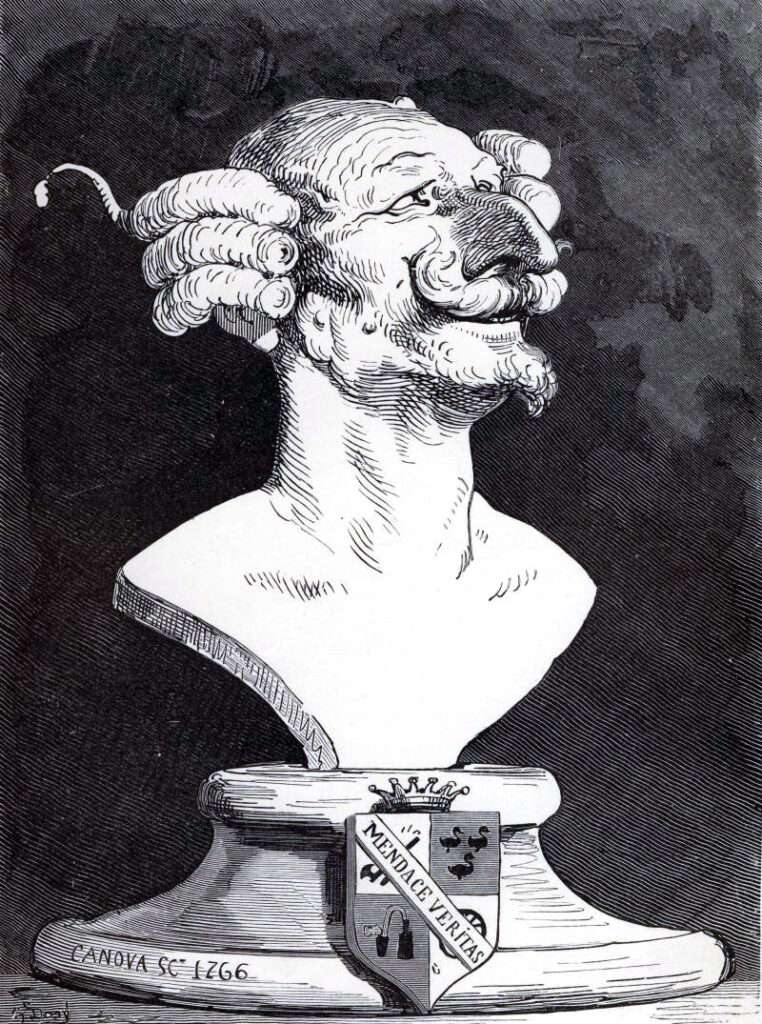
Baron Munchausen. by Gustave Dore (thanks to Wikipedia).


I'm working on a draft article with this title, and I thought I'd serialize it here, since I still have plenty of time to improve it; I'd love to hear your thoughts on it! (All the posts about it will go into this thread.) [UPDATE: The final paper has now been published by the Knight Institute.]

[* * *]

Sometimes lies are constitutionally punishable: consider libel, false state­ments to government investigators, fraudulent charitable fundraising, and more. (I speak here of lies in the sense of knowing or reckless falsehoods, rather than honest mistakes.) But sometimes even deliberate lies are constitutionally protected. In New York Times v. Sullivan, the Court held that even deliberate lies (said with "actual malice") about the government are constitutionally protected. And in United States v. Alvarez, five of the Justices agreed that lies about "about philosophy, religion, history, the social sciences, the arts, and the like" are generally protected.

The Supreme Court hasn't explained where the line is drawn, and that leaves unclear where important areas of controversy—such as laws punishing lies in election campaigns—should fall. In this short article, I hope to offer an account that makes sense of the precedents, and offers a framework for making future decisions.

[I.] Punishable Lies

The Supreme Court has held that defamation, perjury, fraudulent attempts to get money, speech actionable under the false light tort, and lies that inflict severe emotional distress are all constitutionally unprotected.[3]

Read More

Free Speech

Lewd Statements to Woman in Front of Her Boyfriend Can Be Unprotected "Fighting Words"

|

The "fighting words" First Amendment exception generally allows the punishment of personal face-to-face insults that are likely to provoke a fight; usually, they involve a risk that the target would throw a punch (or worse), but the risk could also stem from third parties connected to the target, and from statements that are seen as personally offensive even if they aren't literal insults. State v. Riley, decided in 2017 by the Wisconsin Court of Appeals (by Presiding Judge Paul Lundsten and Judges Brian Blanchard and Michael Fitzpatrick) but for some reason just posted on Westlaw, illustrates this well:

Riley was charged with disorderly conduct, substantial battery, and two counts of felony bail jumping, all as a repeater, after a fight that originated in a tavern. According to the complaint, Riley made "inappropriate" comments about the victim's girlfriend, which led to an altercation in the tavern. After the fight broke up, Riley and an associate subsequently attacked the victim outside the tavern. At trial, witnesses testified to the comments made by Riley while still inside the tavern that were directed at the victim's girlfriend, who was a bartender at the tavern.

The victim's girlfriend testified that Riley is related to her former boyfriend and that Riley's friend had asked her if she was dating the victim. She testified that Riley later approached her at the bar and made a vulgar comment about her vagina. Riley then stated loudly, while looking directly at her, that he was planning to "take that bartender home and fuck her that night." The victim testified that he heard Riley announce that he was "going to fuck the shit out of the bartender tonight," which he interpreted as referring to his girlfriend because Riley was standing face to face with her at the time. Two other witnesses testified that they heard Riley making similar comments, with lewd terms that we need not repeat, in which he loudly announced what he intended to do to the victim's girlfriend….

Riley was convicted, and the court held that his comments qualified as "fighting words" for First Amendment purposes:

Read More

More