The Volokh Conspiracy

Mostly law professors | Sometimes contrarian | Often libertarian | Always independent | Est. 2002

The Volokh Conspiracy

Free Speech

UNC Chapel Hill Student Gov't President Cuts Off Funding & Contracting to Anyone Who "Advocates" for Limits on Abortion

|

The student government president's executive order provides, among other things,

That it shall be prohibited for the Undergraduate Student Government Executive Branch to contract or expend funds to any individual, business, or organization which actively advocates to further limit by law access to reproductive healthcare, including, though not limited to, contraception and induced abortions.

This seems to me a clear violation of the First Amendment:

  1. Under Board of Regents v. Southworth (2000), public university student government are generally subject to the same First Amendment limits imposed on public entities more generally.
  2. When it comes to generally available student group funding, Southworth and Rosenberger v. Rector (1995) make clear that the government can't discriminate based on the student group's viewpoint.
  3. And when it comes to contracting, Board of Comm'rs v. Umbehr (1996) holds that the government generally can't discriminate based on contractors' ideological expression, either.

Read More

Justice Alito Speaks On Religious Liberty

"It is hard to convince people that religious liberty is worth defending, if they don't think that religion is a good thing that deserves protection."

|

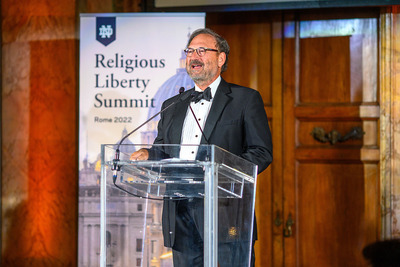
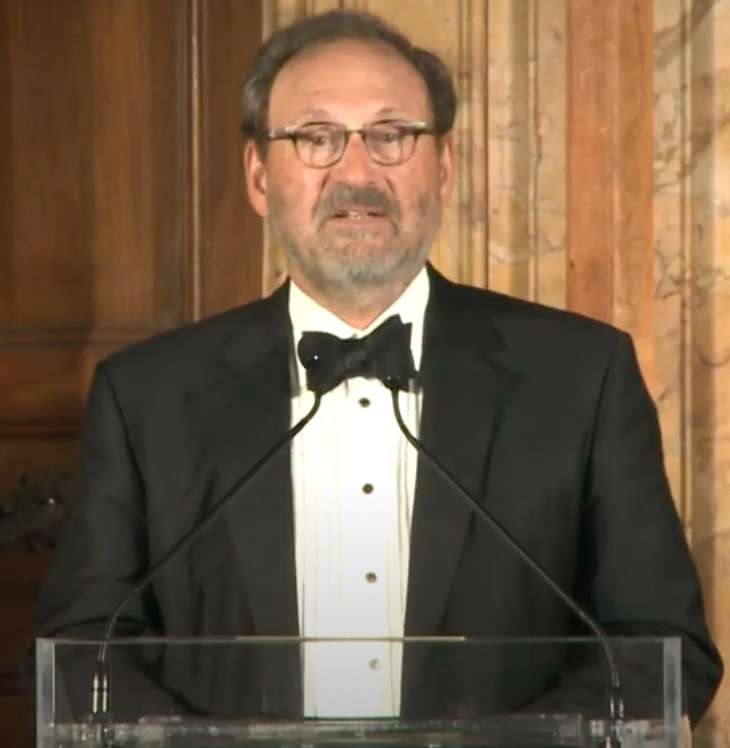
In an earlier post, I commented on Justice Alito's new beard. Here, I will highlight his remarks at the Notre Dame Religious Liberty Summit. You can watch them on YouTube, and I've transcribed them here.

Alito stated that religious liberty is under attack, and people must learn that religious liberty is a good thing that warrants protection.

Religious liberty is under attack in many places, because it is dangerous to those who want to hold complete power. It also probably grows out of something dark and deep in the human DNA. A tendency to distrust and dislike people who are not like ourselves. I'm not very well positioned to talk about religious liberty outside the United States, Europe, and other economically advanced countries. But in those places, religious liberty is facing a different challenge. And Professor Glendon has referred to that. This challenge stems from a turn away from religion. Polls show a significant increase in the percentage of the population that rejects religion or thinks it's just not all that important. And this has a very important impact on religious liberty, because it is hard to convince people that religious liberty is worth defending, if they don't think that religion is a good thing that deserves protection. I'm reminded of an experience I had a number of years ago in a museum in, in Berlin. One of the exhibits was a rustic wooden cross. A young, an affluent woman, a well dressed woman and the young boy, were looking at this exhibit. And the young boy turns to the woman, presumably his mother, and said, "Who is that man?" That memory has stuck in my mind as a harbinger of what may lie ahead for our culture. And the problem that looms is not just indifference to religion, it's not just ignorance about religion. There's also growing hostility to religion, or at least the traditional religious beliefs that are contrary to the new moral code that is ascendant in some sectors. The challenge for those who want to protect religious liberty in the United States, Europe and other similar places, is to convince people who are not religious, that religious liberty is worth special protection. And that will not be easy to do. As most of you know, I think a dominant view among legal academics is that religion doesn't merit special protection. It doesn't merit special treatment. A liberal society, they say, should be value neutral, and therefore it should treat religion, just like any other passionate personal attachment, say rooting for a favorite sports team, pursuing a hobby or following a popular artist or group. Now, I think we would all agree that in a free society, people should be free to pursue those avocations. But do they really merit the same protection as the exercise of religion? The support for a sports team, for example, really merit the same protection as religious devotion In posing that question, I put aside the question of support for the Notre Dame football team, which I understand has a quasi religious significance.

Justice Alito also remarked on his Dobbs opinion:

Over the last few weeks since I had the honor this term of writing, I think, the only Supreme Court decision in the history of that institution that has been lambasted by a whole string of foreign leaders who felt perfectly fine commenting on American law. One of these was former Prime Minister Boris Johnson, but he paid the price. Post hoc ergo propter hoc, right.

LOL. And a dig at Prince Harry:

Post hoc ergo propter hoc right. But others are still are still in office, President Macron and Prime Minister Trudeau I believe are two. But what really wounded me what really wounded me was when the Duke of Sussex [Prince Harry] address the United Nations and seemed to compare the decision whose names may not be spoken with the Russian attack on Ukraine. Well, despite this temptation, I'm not going to talk about cases from other countries. All I'm going to say is that ultimately, if we are going to win the battle to protect religious freedom, in an increasingly secular society, we will need more than positive law.

Read the entire remarks.

Justices With Facial Hair

Justice Alito joins Justice Scalia as the only modern Justice with a beard.

|

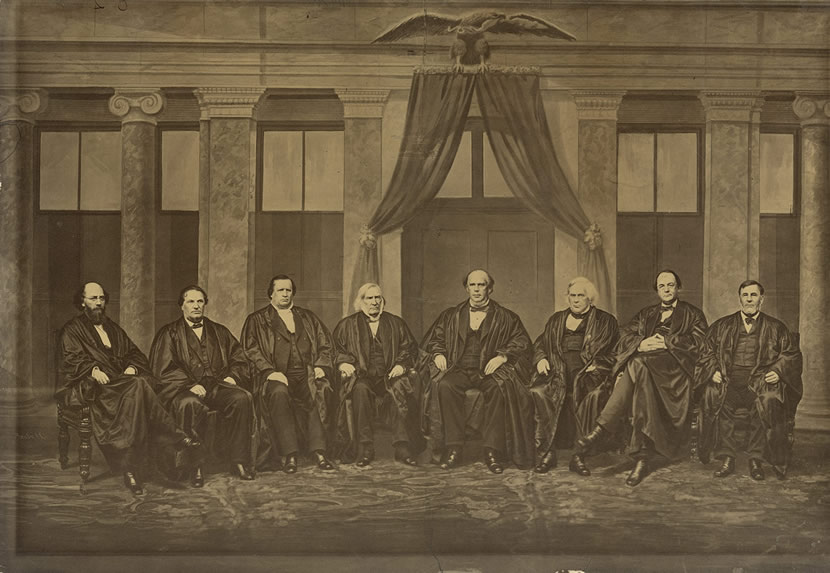
There was a time when multiple members of the Supreme Court had beards or mustaches. By my count, the Court hit peak-facial hair in 1868, when seven of the nine Justices had some form of facial hair. Only Chief Justice Chase and Justice Nathan Clifford bucked the trend.

The Chase Court Court (1868). Seated, from left to right: Stephen J. Field, Samuel F. Miller, Nathan Clifford, Samuel Nelson, Chief Justice Salmon P. Chase, Robert C. Grier, Noah Swayne, and David Davis. Studio of Mathew Brady (1823-1896), Collection of the Supreme Court of the United States.

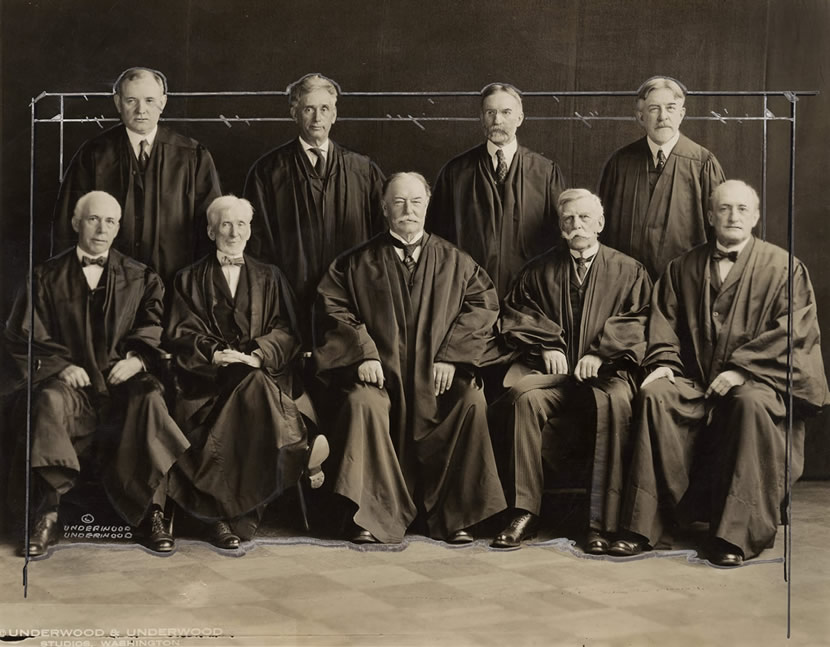
A close runner-up is the Taft Court in 1923. I count five members with facial hair. Chief Justice Taft gave Justice Holmes a run for his mustache.

The Taft Court (1923-1925). Seated, from left to right: Justices Willis Van Devanter, Joseph McKenna, Chief Justice William Howard Taft, and Justices Oliver Wendell Holmes, Jr. and James C. McReynolds. Standing, from left to right: Pierce Butler, Louis D. Brandeis, George Sutherland, and Edward Sanford. Underwood & Underwood (active 1880-1955), Collection of the Supreme Court of the United States.

In the modern era, facial hair has largely faded. Looking through the group photos of the Warren Court, and on, I see mostly bare faces. Justices Marshall and Thomas had mustaches. And, for a period, Justice Rehnquist had forgettable sideburns. (As they say, if you remember the 70s you weren't there!)

According to my non-scientific research, only one Justice in the modern era had a beard on the bench--Justice Scalia circa 1996. This was big news in the day. The Associated Press published the story titled, "To beard or not to beard: That's [the] question. Scalia causes a stir when he shows up on first day of term with facial hair."

It wasn't doctor-assisted suicide or the future of affirmative action that caught the attention of Supreme Court watchers on the opening of the 1996-97 term Monday. It was the beard adorning Justice Antonin Scalia's normally clean-shaven face, and it left them wondering, will he shave it?

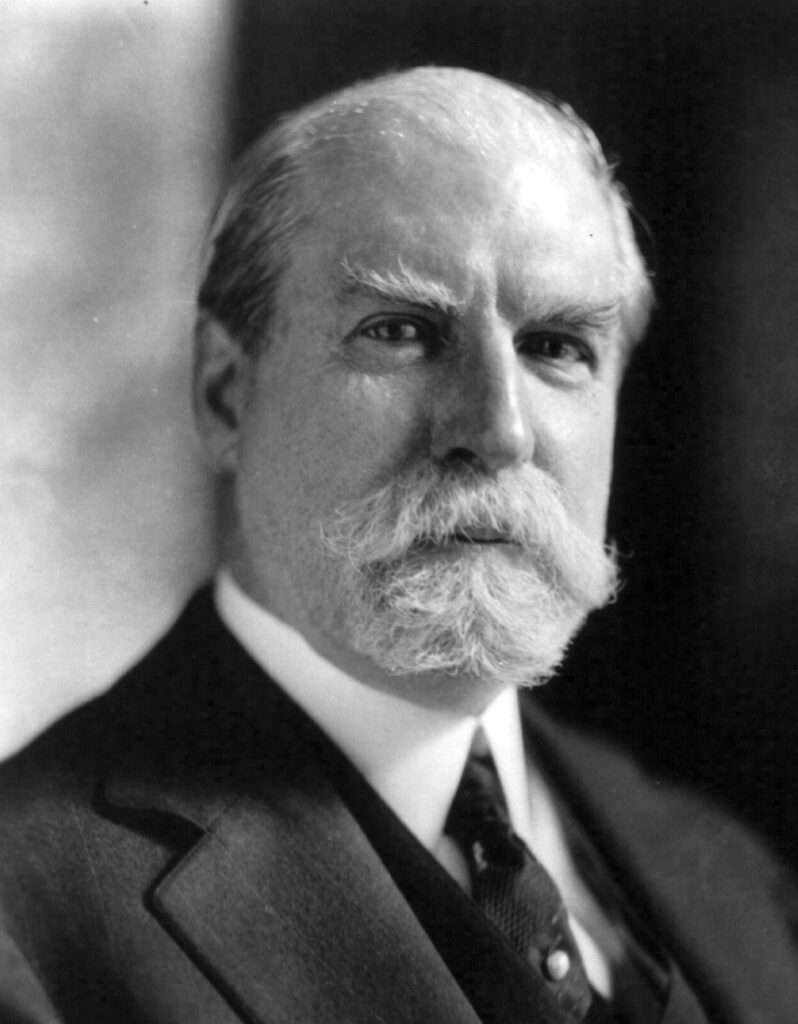
Promptly at 10 a.m. when the nine Justices walked through the backdrop curtains and took their seats, all eyes were upon Scalia. Over the summer recess, he grew a beard. He became the first justice since Charles Evans Hughes, the chief justice from 1930 to 1941, to sport a beard.

And a beaut it is. Not vaguely 1920s like Hughes' dropping mustache and parted beard and not a full Paul Bunyan, like some others in the old days.

This was a beard, black-and-white speckled, that came down from the sideburns, across the chin and up the other side.

To beard or not to beard, that was the question.

It's the hottest question in the building, Maryellen Toughill, Scalia's longtime secretary, said with a laugh.

Two bearded federal judges nominated to the Supreme Court never made it through the Senate confirmation process. Robert Bork's nomination was voted down by the Senate in 1987, and Douglas Ginsburg asked that his nomination be withdrawn that year following reports that he had smoked marijuana while a law professor. [JB: Technically, Ginsburg was never formally nominated, so there was nothing to withdraw.]

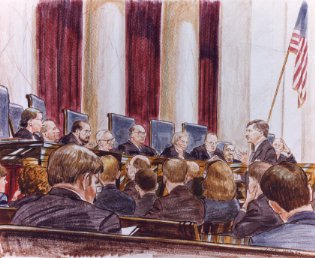
In 2013, I blogged a court sketch of Scalia with a beard. This drawing is from oral arguments in Printz v. United States, courtesy of Stephen Hallbrook:

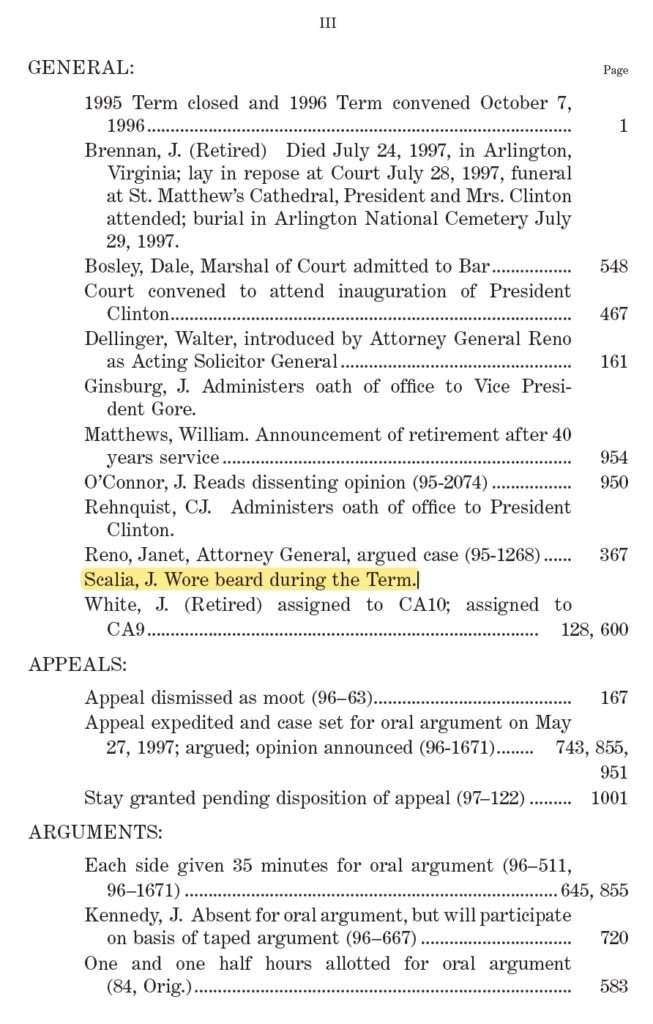
In 2015, the Green Bag published a letter from Ira Brad Matetsky of New York, that highlighted a remarkable fact--the Supreme Court journal recorded Scalia's beard!

The fact that someone, even a Supreme Court justice, varied his personal appearance for a year or less might ordinarily pass unnoticed. But in this instance, the most official of the Court's records decree that attention must be paid. For more than a century, the Supreme Court has maintained a Journal as its official record of the business of each term, including a prefatory table of contents listing significant events of the term. For many years, preparing these Journal entries was the responsibility of the late Deputy Clerk Francis Lorson, who "included what he call[ed] 'discretionary' items that people will want to remember in the future."13 And in the Journal for October Term 1996, it is memorialized for posterity: "Scalia, J. Wore beard during the Term."14 A listing of bearded justices that omits this fact is, I fear, subject to a facial challenge.

Yes, it is really in the OT 1996 Journal at page iii. Brennan died, Clinton was inaugurated, and Scalia had a beard--the important stuff!

Scalia lost the beard at the start of the October 1997 term.

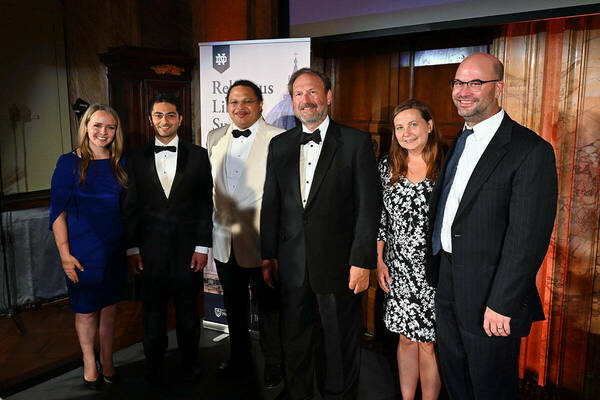
A quarter century later, another Justice has joined the bearded club--at least during the Sumer recess. As Howard Bashman pointed out, Justice Alito has grown a beard. Alito spoke at the Notre Dame Religious Liberty Summit in Rome. I think the inchoate beard can best be described as a work-in-progress. But who am I to give follicular advice? (I am getting a new headshot next week.)

Here are a few different angles of Justice Alito's scraggly scruff.

Neither Alito nor Scalia (Scalito?) can hold a candle to Chief Justice Hughes.

For those interested, I transcribed Alito's remarks here.

Update: Howard Bashman pointed out that Justice Gorsuch grew a pandemic beard in 2020!

That fact did not make the Supreme Court journal, as no oral arguments were in person.

Also, in 2015, Chief Justice Roberts promised he would not grow a beard:

He also made two lighthearted promises. He will not run for president, he said, and he will not grow a beard.

His subject was Chief Justice Charles Evans Hughes, who rejoined the court in 1930 after a glittering career in public life. Hughes had been governor of New York, an associate justice of the court, the Republican nominee for president (losing narrowly to Woodrow Wilson), secretary of state and a Wall Street lawyer who argued more than 50 cases in the court.

"He was an important public figure," Chief Justice Roberts said. "The beard helped. He looked like God."

…


He did make one concluding commitment. "I'm not going to grow a beard," he said.

Supreme Court

John Roberts' Wicked Good Year

The Chief Justice has been the focus of widespread criticism during the last Supreme Court term. But he deserves credit for getting virtually every single major case right.

|

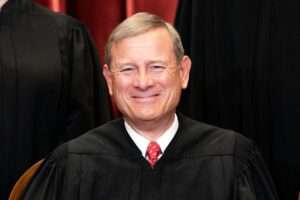
Chief Justice John Roberts. (CNP/AdMedia/Sipa)


As most commentators see things, Chief Justice John Roberts had a terrible year during the 2021-22 Supreme Court term. Media accounts claim he has lost control of the Court (a narrative that, I think, greatly overstates the extent to which he - or any one justice - could ever control it in the first place). Liberal New York Times columnist Pamela Paul has called on Roberts to resign, a cause my co-blogger Josh Blackman has long advocated from the right. Whether on the right or the left, the poor Chief can't get any love.

Except from me!  I've had my differences with Roberts over the years, most notably on NFIB v. Sebelius and the travel ban case. But during the 2021-22 term, he achieved the impressive distinction of voting what I think is the correct way in every major case on which I have a view. Every. Single. Case. Wow, just wow!

That includes both those cases where he voted with the other conservatives and those where he broke with them. Let's take a look at this long and impressive list.  I include links to my analyses of each case, where relevant:

1. The eviction moratorium case. Roberts leads the Court in striking down a dangerous power grab initiated by Trump and revived by Biden.

2. Whole Woman's Health v. Jackson, the SB 8 case. Yes, absolutely the Court should have ruled that people can sue state court clerks, as Roberts advocated (though I would have gone slightly further and said they could just sue the courts themselves).

3. Trump v. Thompson: Rejecting Trump's attempt to use executive privilege to block release of documents to the January 6 Commission.

4. Carson v. Makin - barring states from discriminating against religious schools in voucher programs. In the process, Roberts' opinion for the Court eviscerated the dangerous "status-use" distinction, which might have opened the door to large-scale religious discrimination in a wide range of government programs.

5. West Virginia v. EPA. It was indeed a major question that Congress didn't clearly delegate! The fact that  "common good constitutionalism" maven Adrian Vermeule hated the ruling is icing on the cake.  One of my rules of thumb in constitutional theory is that there's a high likelihood that anything CGC advocates are against is likely to be good! On  a slightly more serious note, I haven't written about this case specifically. But, elsewhere, I have argued for strong enforcement of major questions and nondelegation limits on executive power. The fact that the likes of Vermeule want to gut those limits should perhaps lead progressives to reconsider their own suspicion of them.

6. Netchoice v. Paxton - blocking implementation of Texas' repressive social media law.

7. Both vaccine mandate cases: NFIB v. OSHA (striking down the OSHA large employer mandate), and Biden v. Missouri (upholding the mandate for health care workers working in facilities receiving federal Medicare and Medicaid funds). Roberts was right in both cases - one of only two justices who can claim that distinction (Kavanaugh is the other).

8. Biden v. Texas - the "Remain in Mexico" case.

9. NYSPA v. Bruen (gun control/Second Amendment case). The right to bear arms means you can in fact actually bear them! Though I have some reservations about the majority's reasoning in this case.

10. Dobbs - I am almost the only person other than Roberts himself who supports his concurring opinion (though I would have reasoned it somewhat differently). I haven't outlined my reasoning in full, and probably won't try to do so, given that abortion isn't a major focus of my work. But, in brief, I think Roberts' approach of maintaining abortion rights up to 15 weeks into a pregnancy strikes a reasonable balance between cutting back on Roe v. Wade (a flawed ruling), and recognizing the important reliance interests engendered by it, which I think were underestimated by the majority.

I don't have any strong view on the Coach Kennedy case (except perhaps that its significance is overblown). So I don't count that one. And I probably differ with Roberts on several second-tier cases from this term. But he got all the biggest ones right. Indeed, he's the only justice with whom I agree on all of the above. No one else even came close! By my count, no one else got more than seven or eight of them right.

How could this have happened? Cynics will say I have trimmed my sails to curry favor with the Chief. But anyone who knows my writings well could easily have predicted my views on nearly all of these cases in advance (with the possible exception of Dobbs). On many of them, I publicly expressed those views before the decision came down.

So maybe it's Roberts who has moved closer to me, rather than the reverse! Before ruling on every big case, perhaps he now asks "What would Ilya do?" And he knows to avoid #IlyaConfusion! The "other" Ilya and I differ on at least a couple of the above decisions.

Of course the real explanation is almost certainly that it's all just a big coincidence - a function of the cases the Court heard this term. Perhaps next year, I will again be at odds with the Chief on at least a few big rulings. Still, I'm going to enjoy his great work while I can - and give him credit for it! He certainly isn't getting much credit from anyone else.

And maybe, just maybe, Chief Justice Roberts has decided that the best way to bolster the Court's standing with the public is to seek the sensible center. And what better guide than a legal scholar officially certified as a centrist by no less an authority than the New York Times? If you doubt my centrist credentials, well that just shows what a dangerous extremist you are.

Free Speech

Libel! I Wasn't Accused of Killing Anyone in April -- Only in May

From a libel case filed by accused triple murderer Brice Rhodes

|

From Magistrate Judge Lanny King's Report and Recommendation recommending dismissal of plaintiff's libel claim in Rhodes v. Buccieri, just adopted today by Judge Greg Stivers (W.D. Ky.):

Plaintiff claims that the [A & E Court Cam] episode's statement that he was facing "CHARGES" for an "April 2016 Murder" was false and defamatory. The statement was, indeed, false because Plaintiff was charged with one murder occurring on May 4, 2016, and two murders occurring on May 22, 2016…. [But] the statement was not defamatory. Substantial truth is present if, notwithstanding a minor inaccuracy, the substance, gist, or sting of the allegedly defamatory statement remains the same minus the inaccuracy.

Here, the substance of the allegedly defamatory statement is that Plaintiff was charged with committing three murders in 2016. The gist remains justified even if the first murder occurred in April as opposed to May of 2016. In other words, the "humiliation, public ridicule, loss of personal reputation" about which Plaintiff complains is because he is facing three murder charges, not because Defendants misidentified the date of the first murder.

"We Expect Better from an Attorney Representing the United States"

|

From U.S. v. Khatallah, decided Tuesday by the D.C. Circuit (Judges Patricia Millett, Gregory Katsas, and Neomi Rao):

Ahmed Abu Khatallah … was convicted on several counts related to his involvement in the September 11, 2012, terrorist attack on the United States' diplomatic outpost in Benghazi, Libya. He was sentenced to 22 years of imprisonment and five years of supervised release.

The court concluded that the sentence was "substantively unreasonably low in light of the gravity of his crimes of terrorism," but also added this condemnation of the prosecutor's statements in closing argument (while concluding that they were unlikely to have affected the verdict, and the verdict thus needn't be set aside):

Reviewing the record, we agree with Khatallah that the prosecutor's remarks were plainly improper and unbefitting a federal prosecutor. But because the misconduct did not substantially prejudice Khatallah, the district court did not abuse its discretion in denying the motion for a new trial….

The government does not contest, nor could it on this record, that the prosecutor's statements in her closing rebuttal crossed the line.

It is settled law that "a prosecutor may not use the bully-pulpit of a closing argument to inflame the passions or prejudices of the jury or to argue facts not in evidence." So during closing arguments, prosecutors may not sensationalize the facts or seek to turn jurors' perceived prejudices or favoritism against a defendant. Nor may the government weaponize a jury's allegiance to their Nation or incite jurors to protect their community or act as its conscience. The law also "universally condemn[s]" arguments that ask jurors to identify themselves with victims "because [they] encourage[ ] the jury to depart from neutrality and to decide the case on the basis of personal interest and bias rather than on evidence." When a prosecutor presses such an us-versus-them narrative in closing remarks to the jury, she walks a perilous legal line.

Read More

Justice George Sutherland and Women's Rights; Intro to Classified

Two new postings of my work on SSRN

|

For those who want to try before they buy, I've posted the Introduction to Classified: The Untold Story of Racial Classification in America at SSRN. Here are the final few sentences of the Intro:

This book explores that status quo and how we came to our current equilibrium. The book addresses the classifications' history, definitions, boundaries, enforcement, and application. Readers should consider whether and to what extent the results are sensible, and to what extent the United States should abolish its official racial classifications and move toward a separation of race and state.

I've also posted Revisiting Justice George Sutherland, the Nineteenth Amendment, and Equal Rights for Women. Here is the abstract:

Justice George Sutherland was a strong supporter of women's rights. Among other things, as a Senator from Utah he was Congress' leading supporter of the Nineteenth Amendment. But Sutherland's record on women's rights has long been obscured by his undeserved reputation as a reactionary. Part I of this Article discusses Sutherland's argument in Adkins v. Children's Hospital that, in light of passage of the Nineteenth Amendment, women were entitled to the same level of liberty of contract as men, including the liberty to bargain for wages. Part II of this Article reviews the dismissive attitude historians have taken towards Sutherland's egalitarian reasoning and rhetoric in Adkins. As discussed in Part II, this dismissiveness neglects Sutherland's pre-judicial record of support for women's rights. Part III of this Article reviews several speeches Sutherland gave in support of the Nineteenth Amendment, with the purpose of trying to better understand his support for women's rights. Among other contributions made by this Article, it is the first to note that Justice Sutherland's wife, Rosamond Lee Sutherland, was a strong public supporter of women's suffrage. Mrs. Sutherland may have influenced her husband's perspective regarding women's rights.

Panel-Packing in the Massachusetts Appeals Court

Legit, but odd.

|

Intermediate appellate courts (state and federal) generally have many members, but sit in more-or-less-randomly assigned panels, usually of three judges. This of course means that sometimes the views of a three-judge panel won't represent the views of the whole court, and courts generally have means of dealing with that.

In federal courts, this is of course done through en banc rehearing of a three-judge panel opinion by the entire court (or, for the 29-judge Ninth Circuit, by an 11-judge panel of that court). But in Massachusetts, there's a "long-standing practice of the Appeals Court, designed to ensure that published opinions reflect the view of a majority of the Justices":

[P]ublished opinions are considered by the entire court [which now consists of 25 Justices -EV] prior to release. In the case of a dissent, if a majority of all the Justices agrees with the majority of the panel, the decision is published as a two to one decision of the original panel.

If a majority of all the Justices agrees with the dissent, the panel is enlarged to reflect the view of the majority of the court, generally by adding to the panel the two senior Justices who are part of the full court majority. The masthead, in such case, shows the panel as five members, but in effect the decision is that of the entire court.

I just noticed this in a case decided yesterday, so the practice is alive and well. If any Massachusetts lawyers have any extra details on this, I'd love to hear them.

Politics

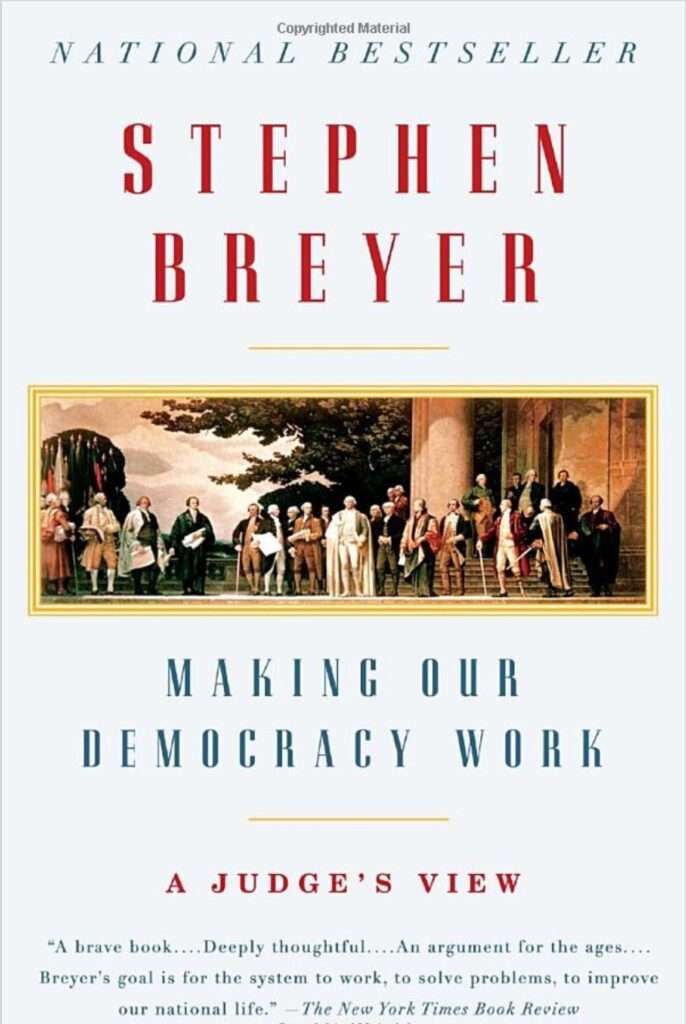
Dobbs Is Making Our Democracy Work

Justice Breyer, whether he admits it or not, should recognize how Dobbs reinvigorated the legislative process on abortion.

|

Dobbs and Bruen were in tension. In Dobbs, the conservatives said that the people should decide the abortion question, while the progressives said the courts should decide the abortion question. In Bruen, the conservatives said the courts should decide the gun question, while the progressives said the people should decide the gun question. As Justice Sutton asks us, who should decide? Deep down, I hoped that Justice Breyer would be consistent on both questions: let the people decide on guns and on abortion. Such a vote pairing would have been a momentous capstone for his democratic (lowercase "d") philosophy. But, instead Breyer followed his Democratic (capital "D") philosophy. Breyer was so intent on saving Roe that he could not practice what he preaches: making our democracy work.

In the wake of Dobbs, we are already seeing the democratic process at work. And critically, legislatures in red states are forced to confront issues they simply never had to decide before. The absence of Roe is requiring elected representatives to cast difficult votes on abortion. The New York Times distills the process with the headline: "With Roe Gone, Republicans Quarrel Over How Far to Push Abortion Bans." Read through the article. At every juncture, I see government in action.

Abortion opponents, especially in conservative states, had hoped to swiftly pass a new wave of restrictions after Roe v. Wade was overturned. But so far, most Republican lawmakers have moved cautiously or done nothing at all, even in statehouses where they hold overwhelming majorities. A debate playing out in Indiana this week is showing why. Though Republican legislators support the broad idea of restricting abortion, they have clashing views on how far to go. Should there be an outright ban? If so, should there be exceptions for rape and incest? And what if a woman's health is threatened by a pregnancy but doctors do not believe she will die?

One member of the Indiana Senate explained there was never any need to consider these questions before. After all, the "judges of wisdom" "called the contending sides of a national controversy to end their national division by accepting a common mandate rooted in the Constitution." But now, three-hundred million Americans, rather than three lawyers, can discern their own wisdom.

"Those are all questions that are really difficult," said State Senator Rodric Bray, an Indiana Republican whose caucus, which has long worked to limit abortions, has divided over a bill that would ban abortion with some exceptions. Before Roe was overturned this year, Mr. Bray said, lawmakers had not "spent enough time on those issues, because you knew it was an issue you didn't have to really get into the granular level in. But we're now there, and we're recognizing that this is pretty hard work."

To quote George Washington in Hamilton, "Ah, winning was easy, young man, governing's harder." Yes, indeed, legislating is "pretty hard work." Reversing Roe gave that task back to the legislature. Indeed, I see a parallel with West Virginia v. EPA. The major question doctrine restores the legislative issue to the Congress. Writing bills about abortion, and climate change is "pretty hard work." (Ask Joe Manchin.) But this task that belongs to legislators, and not to courts or bureaucrats.

Indiana is not an outlier. Many Republican Governors, several of whom may be presidential or vice presidential candidates, are approaching this issue deliberately:

Leaders in many Republican-led states seem to be biding their time. An exception has been West Virginia, where lawmakers advanced a near-total ban this week after a court blocked enforcement of an 1849 abortion ban in that state. But in Nebraska, where an effort to pass a trigger ban narrowly failed early this year, Gov. Pete Ricketts has discussed the possibility of a special session but has yet to call one. In Florida, Gov. Ron DeSantis has largely avoided questions about whether he would take immediate steps to pass new restrictions. In South Dakota, where a ban went into effect after Roe was struck down, Gov. Kristi Noem backed away from an initial pledge to call lawmakers to the Capitol to consider more abortion bills. And in Iowa, Gov. Kim Reynolds has said she was focused on getting the courts to allow for enforcement of existing restrictions that had been blocked. "Right now it wouldn't do any good to call a special session," Ms. Reynolds, a Republican, told local reporters last month.

The Times focuses at some length on Indiana, which has a unified Republican government:

But even in a state where Democrats have little political power, Indiana Republican leaders find themselves in a political bind. Some Republican legislators, and many of the party's most outspoken supporters, want to ban abortion with few or no exceptions. But one Republican state senator, Kyle Walker, said he wanted abortion to remain legal during the first trimester of pregnancy. And many in the party have raised questions about whether and how to include exceptions for rape, incest and a pregnant woman's health.

"This is one of the most complex issues any of us will ever try to tackle in our lifetime, and this just demonstrates the near impossibility of threading the perfect needle" in a short session, said State Senator Mark Messmer, the Republican who voted against the measure in committee.

Again, by decree "judges of wisdom" stole this "complex issue" from the democratic process, because they knew better. They didn't. Now, the elected representatives of the states will wrestle with where to draw the line. And they will draw the line somewhere between an absolute ban, and what Casey permitted. No longer can legislators simply pass absolute bans on abortion, knowing that the laws will never go into effect because of Roe. Now, the rubber meets the road. Some states may start with very strict bans that, over time, prove too draconian, and will be revised. With the zero-sum game of Roe over, there will be more space to negotiate and compromise. Fittingly, states may wind up somewhere around the fifteen-week line Mississippi crafted, and Chief Justice Roberts approved.

Justice Scalia's clarion call in Casey rings true three decades later:

Quite to the contrary, by foreclosing all democratic outlet for the deep passions this issue arouses, by banishing the issue from the political forum that gives all participants, even the losers, the satisfaction of a fair hearing and an honest fight, by continuing the imposition of a rigid national rule instead of allowing for regional differences, the Court merely prolongs and intensifies the anguish. We should get out of this area, where we have no right to be, and where we do neither ourselves nor the country any good by remaining.

The Court got out of this area, and to paraphrase Lord Mansfield, democracy is working itself pure.

Administrative Law

West Virginia v. EPA: Questions About "Major Questions"

The major questions doctrine inverts the Chevron doctrine, is indeterminate, and, as a practical matter, will encourage courts to engage in something more akin to political punditry than law.

|

West Virginia v. EPA is clearly designed to impose new limits on federal agencies insofar as they seek to rewrite the scope of their authority. The Supreme Court's attention to the scope of agency authority is welcome. As noted in the immediately prior post (the third in this five-post guest series, here being the first and second), the Court held in City of Arlington v. FCC (2013) that federal courts must give Chevron deference to an agency's interpretation of the scope of its authority. This would effectively give agencies the power to determine the dimensions of their regulatory mandate unless it is clear that Congress has not conferred authority on the agency to act.

West Virginia turns this Chevron doctrine principle on its head: At least with respect to "major questions," an agency will be presumed to have no authority to act unless the court finds that Congress "clearly" has conferred authority on the agency to decide the matter in question.

West Virginia thus establishes a "two-step" standard of review very different from the "two-step" standard commonly associated with Chevron. As formulated in West Virginia, a court is supposed to ask, first, whether the agency is seeking to regulate in a manner that presents a "major question" of "economic and political significance." If the answer is yes, the court asks, second, whether there is a "clear statement" by Congress conferring such authority. In the absence of a clear statement, the agency will be held to have exceeded the scope of its authority. (West Virginia does not say what happens if the answer to the first question is that the question is "minor.")

Before considering the workability of the major questions doctrine, it is worth asking whether, as Justice Gorsuch suggested in his concurring opinion, West Virginia is a way station on the road to the revival of the nondelegation doctrine, i.e., the idea that under the Constitution only Congress has the power to legislate. It helps here to distinguish between two nondelegation doctrines.

Read More

Nicholas Roske Used Reddit and Discord To Plan Assassination of Kavanaugh And Potentially Two Other Justices

Chilling information revealed from the search warrant affidavit.

|

The Department of Justice recently disclosed an affidavit in support of a search warrant for Nicholas Roske, who was charged with attempted murder of Justice Kavanaugh. The Daily Beast provides an overview of the document. Here, I will focus on the primary claims.

First, the search warrant seeks records from Discord, Google, and Reddit. Roske's handles include the email address helenkiller1969@gmail.com. Charming. He used these tools to plan the assassination.

ROSKE also stated that he used Reddit, Google, and other online forums to learn the skills he thought were necessary to complete his plan. . . . ROSKE further stated he had a Discord account but that he deleted the account on Sunday, June 5, 2022. ROSKE said that he used his Reddit account to ask individuals, who were unknown to him, questions in order to refine his plan to kill the Justice. ROSKE also stated that on Monday, June 6, 2022, he attempted to use the settings menu on the Acer laptop to conduct a data wipe of the device because ROSKE did not want anyone he conversed with to be implicated as a result of his actions.

Second, the affidavit explains that Roske started to perform the searches on May 5. You may recall that the Politico leak report came out on May 2. I don't think that timing is coincidental.

Between May 5, 2022 and June 8, 2022, the search history on ROSKE's cell phone included the following terms or phrases: "quietest semi auto rifle," "Reagan assassination attempt," "most effective place to stab someone," "assassin skills," "assassin equipment," "assassinations," "supreme court," "how to be stealthy," "gun lubricant," and "supreme court" among other things.

Roske also visited the Supreme Court's web site to figure out who the current members are:

A review of the web history on ROSKE's phone revealed visits to the "Current Members" page of the Supreme Court of the United States' website ("https://www.supremecourt.gov/about/biographies.aspx"), and the "List of assassinations" page on Wikipedia ("https://en.m.wikipedia.org/wiki/List_of_assassinations").

These searches are particularly telling. He was intent on assassinating a Justice, and saving Roe v. Wade, yet he had to look up the biographies to know who he wanted to murder. It is a sad fact that most Americans cannot even name a single Justice--apparently, including those who plan to assassinate them.

Third, Roske posted on the "TwoXChromomes" subreddit, which is "intended for women's perspectives."

On May 10, 2022, under the Reddit page r/TwoXChromosomes, TARGET REDDIT-4 posted the text "Would Kavanaugh being removed from the SC help women long term?"

Fourth, Roske posted on the United States Marine Corps subreddit:

On June 6, 2022, TARGET EMAIL-4 received an email from Reddit that showed Reddit user u/xxxx [Redacted by JB] replied to TARGET REDDIT-4's comment on the Reddit page r/USMC. According to that email, 34 minutes earlier, TARGET REDDIT-4 had posted the following: "How difficult is it to covertly take out an HVT?" Based on my training, knowledge, and experience, I believe "HVT" to refer to "High Value Target."

I was very curious to see how people responded to Roske, but I could not locate any of these postings on Reddit. And the Internet Archive did not capture them.

Fifth, Roske engaged in a Discord chat with another person. Roske said "im gona stop roe v. wade from being overturned." And he would "remove some people from the supreme court." Plural. Yes, it seems like Roske was intent on assassinating as many as three Justices--he was "shooting for 3." We can guess which three. Roske reasons if there are "more liberal than conservative judges, they will have the power."

In reviewing those Discord communications, FBI agents discovered the following exchange, dated May 25, 2022, between Person #1 and Sophie 42 (ROSKE): 

ROSKE: im gonna stop roe v wade from being overturned 

Person #1: what u tryna do 

ROSKE: remove some people from the supreme court 

Person #1: u gonna Tun? Run? 

ROSKE: after you mean? 

Person #1: oh haha good one 

Two dead judges ain't gonna do nothing 

The whole government is fucked 

There's no fixing that 

You would die before you killed them all 

ROSKE: yeah but I could get at least one, which would change the votes for decades to come, and I am shooting for 3 

all of the major decisions for the past 10 years have been along party lines 

so if there are more liberal than conservative judges, they will have the power 

This new information is absolutely chilling. I pray that in the wake of Dobbs, these threats against the Justices subside. And I remain shocked at how little attention this story is getting. A person tried to murder a Supreme Court Justice to prevent him from casting a vote in a landmark case. Two months later, crickets from the media.

Free Speech

Nicholas Sandmann's Libel Lawsuits Against Several Media Outlets Dismissed

All the lawsuits stem from the media's quoting Nathan Phillips' claims that Sandmann was "block[ing Phillips'] way" at a demonstration by the Lincoln Memorial.

|

From Sandmann v. N.Y. Times, CBS News, ABC News, Gannett & Rolling Stone, decided yesterday by Judge William Bertelsman (E.D. Ky.):

These five libel cases arise out of events that occurred in Washington, D.C. on January 18, 2019 and the ensuing extensive media coverage of plaintiff Nicholas Sandmann's encounter with Nathan Phillips. [Factual details quoted below. -EV] …

All parties agree that whether "a statement is fact or opinion is a question of law for the court to decide." … "[A] statement of opinion relating to matters of public concern which does not contain a provably false factual connotation will receive full constitutional protection." …

The Sixth Circuit has also emphasized that it is important for the court to consider what a reasonable reader would take away from allegedly defamatory statements. A recent Sixth Circuit case, Croce v. Sanders (6th Cir. 2021), illustrates this principle well. The case involved a biologist who contacted the New York Times and other newspapers about statistical inaccuracies in scientific articles authored by a celebrated cancer researcher. The cancer researcher sued the biologist for defamation. The Sixth Circuit held that his statement that the researcher "knowingly engag[ed] in scientific misconduct and fraud" was protected opinion.

Judge Thapar, who authored the opinion, focused on what a reasonable reader would take away from the letter that the biologist wrote. He concluded that "reasonable readers would see there is ample room for a different interpretation of the evidence [the biologist] presented." He further explained that "whether a set of facts amounts to misconduct" is subjective and "we would expect people to have different opinions on the question." The biologist's statement was "neither an assertion of fact nor a conclusion that follows incontrovertibly from asserted facts as a matter of logic. It is instead a subjective take that is up for debate." See also Seaton v. TripAdvisor (6th Cir. 2013) ("Readers would, instead, understand the list [of dirtiest hotels in America] to be communicating subjective opinions of travelers who use Trip Advisor."); Macineirghe v. Cty. of Suffolk (E.D.N.Y. 2015) (finding that a statement from an eyewitness who recounted the entirety of a police chase and said that he saw someone "block" a police car was opinion, and a reasonable reader would not understand his words to imply undisclosed facts)….

In sum, the Court must ask whether a reasonable reader, in reading the entire article, would understand that the statement in question is someone's opinion or interpretation of an event or situation. See, e.g., Partington v. Bugliosi (9th Cir. 1995) ("When an author outlines the facts available to him, thus making it clear that the challenged statements represent his own interpretation of those facts and leaving the reader free to draw his own conclusions, those statements are generally protected by the First Amendment."); Hayes v. Alfred A. Knopf, Inc. (7th Cir. 1993) ("If it is plain that the speaker is expressing a subjective view, an interpretation, a theory, conjecture, or surmise, rather than claiming to be in possession of objectively verifiable facts, the statement is not actionable); Phantom Touring, Inc. v. Affiliated Publ'ns (1st Cir. 1992) ("The sum effect of the format, tone, and entire content of the articles is to make it unmistakably clear that [the author] was expressing a point of view only.").

Finally, if an allegedly defamatory statement is a statement of opinion, it is actionable under Kentucky law "only if it implies the allegation of undisclosed defamatory facts." …

The allegedly defamatory Blocking Statements at issue are the following:

Read More

Free Speech

9th Cir.: Political Officials' Blocking of Social Media Comments May Violate the First Amendment

|

From today's decision in Garnier v. O'Connor-Ratcliff, written by Judge Marsha Berzon and joined by Judges Richard Tallman and Michelle Friedland:

Today, social media websites like Facebook and Twitter are, for many, "the principal sources for knowing current events, checking ads for employment, speaking and listening in the modern public square, and otherwise exploring the vast realms of human thought and knowledge." Packingham v. N.C. (2017). Accordingly, social media sites "can provide perhaps the most powerful mechanisms available to a private citizen to make his or her voice heard.".

Unsurprisingly, social media's capacity for facilitating communication and stirring public debate has not been lost on public officials. From local county supervisors and state representatives to the President of the United States, elected officials across the country increasingly rely on social media both to promote their campaigns and, after election, to communicate with constituents and seek their input in carrying out their duties as public officials.

This case concerns a dispute arising from two public officials' use of social media to communicate with constituents about public issues. Beginning around 2014, two members of the Poway Unified School District ("PUSD" or the "District") Board of Trustees, Michelle O'Connor-Ratcliff and T.J. Zane (together, "the Trustees"), created public Facebook and Twitter pages to promote their campaigns for office. After they won and assumed office, the two used their public social media pages to inform constituents about goings-on at the School District and on the PUSD Board, to invite the public to Board meetings, to solicit input about important Board decisions, and to communicate with parents about safety and security issues at the District's schools.

But public engagement with their social media pages was not all [thumbs-up emoji]s and [heart emoji]s. Two parents of children in the School District, Christopher and Kimberly Garnier, frequently left comments critical of the Trustees and the Board on the Trustees' pages, sometimes posting the same long criticisms repeatedly. After deleting or hiding the Garniers' repetitive comments for a time, the Trustees eventually blocked the Garniers entirely from their social media pages. The Garniers sued, asserting that the Trustees violated their First Amendment rights by ejecting them from the social media pages. After a bench trial, the district court agreed with the Garniers that their First Amendment rights had been violated. Both parties appeal….

We have never addressed whether a public official acts under color of state law by blocking a constituent from a social media page. Doing so now, we conclude that, given the close nexus between the Trustees' use of their social media pages and their official positions, the Trustees in this case were acting under color of state law when they blocked the Garniers.

The Trustees' use of their social media accounts was directly connected to, although not required by, their official positions…. [T]he line of precedent most similar to this case concerns whether off-duty governmental employees are acting under color of state law. As here, the focus in such cases is on whether the public official's conduct, even if "seemingly private," is sufficiently related to the performance of his or her official duties to create "a close nexus between the State and the challenged action," or whether the public official is instead "pursu[ing] private goals via private actions." …

Read More

Free Speech

"Liar, Liar: False Statements and the Freedom of Speech"

|

I much enjoyed participating in this Federalist Society webinar, which has just been posted; here's the summary:

What can the government do to counter "disinformation" or other statements that it believes to be false? The Supreme Court famously protected some false defamatory statements in New York Times Co. v. Sullivan and extended that holding, in United States v. Alvarez, that the First Amendment prevented the government from punishing a speaker from falsely claiming to have won military honors. Yet other false statements, such as fraud and perjury, may be punished, and recently the question of the government's power to limit false speech has assumed more prominence.

In response to the Capitol attack of January 6, 2021 and President Trump's claims that the 2020 election was stolen, the governor of Washington State proposed a law punishing false speech that was likely to lead to violence. Elsewhere controversies surrounding the truth of COVID-related information have arisen and the Biden Administration's Department of Homeland Security had planned to create a board to counter disinformation. Amid free-speech outcries, the proposal was set aside, but the Administration remains focused on combating disinformation. This program will feature panelists with contrasting views of the government's authority in this field and whether efforts to limit false speech represent a threat to First Amendment values.

Featuring:
Harmeet K. Dhillon, Founding Partner, Dhillon Law Group Inc.
Catherine Ross, Lyle T. Alverson Professor of Law, The George Washington University Law School
Eugene Volokh, Gary T. Schwartz Distinguished Professor of Law, UCLA School of Law
Moderator: Hon. Donald Palmer, Commissioner, U.S. Election Assistance Commission

Kelley v. Becerra, the Preventive Care Mandate and the Major Questions Doctrine

SCOTUS dodged this issue in Little Sisters of the Poor, but W.V. v. EPA invigorated the claim.

|

For nearly a decade, the courts have been hearing challenges to the Affordable Care Act's contraceptive mandate. But, if you read the bill, there is no actual "contraceptive mandate." (Nor is there any provision called the "individual mandate.") Rather, the bill requires insurers to provide "preventive care." The ACA did not actually define what "prevent care" consists of. Rather, that decision was delegated to an agency.

I have long argued that this delegation is suspect. In 2020, I advanced a related position before the Supreme Court in Little Sisters of The Poor v. United States. We argued that the ACA did not delegate the authority to create the Obama Administration's initial "accommodation." Our brief was premised on the non-delegation doctrine, as well as the major question doctrine. Here is an excerpt from the introduction:

At base, the ACA did not delegate the authority to draw that arbitrary distinction and resolve this "major question." The fact that the rulemaking here was premised not on health, financial, or labor-related criteria, but on subjective determinations of which employees more closely adhere to their employers' religious views, "confirms that the authority claimed by" the agencies "is beyond [their] expertise and incongruous with the statutory purposes and design." Gonzales v. Oregon, 546 U.S. 243, 267 (2006). If "Congress wished to assign that question to an agency, it surely would have done so expressly." Id.

Had Congress intended to give the Departments discretion to decide which religious institutions should be subject to the mandate, it would have legislated to that effect. "It is especially unlikely that Congress would have delegated this decision to" the agencies, "which ha[ve] no expertise in crafting"religious accommodations "of this sort" without clear statutory guidance. King v. Burwell, 135 S. Ct. 2480, 2489 (2015) (citing Gonzales, 546 U.S. at 266–67). In the light of the narrow "breadth of the authority" that Congress has given to the executive branch over this controversial issue of religious liberty, the Court is not "obliged to defer . . . to the agency's expansive construction of the statute." FDA v. Brown & Williamson Tobacco Corp., 529 U.S. 120, 160 (2000).

I discussed the legislative history of the contraceptive mandate and exemptions in pages 29-66 of Unraveled. In particular on page 43-49, I discuss the legislative debates underlying the "preventive care" mandate. Here is a snippet:

Had there been any discussion that this provision would be used to force employers, including religious nonprofits, to cover contraceptives that can prevent the implantation of a fertilized egg, there would have been an uproar. Such a bill was unlikely to have secured the vote of Senator Nelson and others in the fragile sixty-member caucus. It is not clear that anyone in the House understood the Amendment would operate in this broad fashion. Representative Stupak explained that the "[t]he principal tenet of [his the pro-life] Caucus members is their belief that the fertilized embryo is a human life and that any man-made disturbance of the embryo is a form of abortion." 126 FDA-approved contraceptives may have the effect of "preventing the implantation of a fertilized egg." 127 Under no circumstance could the pro-life caucus have supported a mandate that was contrary to their mission statement – even with the president's executive order, which would have no impact on the mandate. I could not locate a single contemporaneous statements from Stupak or anyone else in the House suggesting that they realized the "preventive care" mandate could be used to force religious employers to cover such contraceptive methods that his caucus opposed.

And here, I alluded to what we now call the Major Questions Doctrine.

This is the proverbial dog that didn't bark , a legal principle derived from Sir Arthur Conan Doyle's classic story "Silver Blaze." 129 In the story, an officer from Scotland Yard is investigating a night-time robbery of a racehorse. He asks Detective Sherlock Holmes, "Is there any other point to which you would wish to draw my attention?" Holmes replies, "To the curious incident of the dog in the night-time." The officer is confused. "The dog did nothing in the night-time." Holmes deduces, "That was the curious incident … Obviously the midnight visitor was someone whom the dog knew well." The dog that did not bark was the clue. That no one objected to a mandate requiring all employers – with no exceptions for any religious groups – to provide contraceptives was itself the "curious incident." This issue is even more extreme than the Hyde Amendment debate, as the issue was not about federal funding for abortions, but forcing religious organizations to pay directly for these contraceptives. Amid the debates over the individual mandate, funding for abortion, and the issue of state-run exchanges, this pivotal detail went entirely unnoticed.

Ultimately, the Supreme Court did not reach the delegation issue in Little Sisters of the Poor. Justice Thomas's majority opinion observed that the question was waived:

No party has pressed a constitutional challenge to the breadth of the delegation involved here. Cf. Gundy v. United States, 588 U. S. ___ (2019). The only question we face today is what the plain language of the statute authorizes. And the plain language of the statute clearly allows the Departments to create the preventive care standards as well as the religious and moral exemptions.

Now, in the wake of West Virginia v. EPA, this issue of delegation has been re-invigorated.

Yesterday, oral arguments were held in the Northern District of Texas in Kelley v. Becerra. The case is very complex, but squarely presents the delegation issue. And the Plaintiffs are represented by Jonathan Mitchell, the genius.

Free Speech

No Pseudonymity in Disability Discrimination Lawsuit Over State Bar Character & Fitness Inquiry

"[H]arm to one's reputation or injury to one's standing in the community does not warrant a deviation from the strong presumption of public access[.]"

|

From Doe v. Tenn. Bd. of Law Examiners, decided Monday by Magistrate Judge Jill McCook (E.D. Tenn.) (to learn more about the case itself, see the Complaint):

Parties desiring to proceed using a pseudonym have a "heavy burden." … Plaintiff's privacy interests do not outweigh the presumption of open judicial proceedings in this case… Plaintiff asserts that the litigation reveals information of the utmost intimacy, including his mental and physical health in confidential records, accusations against his character, and his acrimonious divorce.

Plaintiff seeks to protect his name from public disclosure for fear of embarrassment and harm to his reputation in the community…. [B]ut "Plaintiff has not advanced any facts or circumstances that distinguish [this] case from routine discrimination cases alleging the same or similar medical conditions that plaintiff claims, nor has [Plaintiff] indicated why the confidentiality of [Plaintiff's] medical information cannot be maintained through a standard protective order." Plaintiff also states that this lawsuit reveals accusations regarding his character and his acrimonious divorce, but he likewise fails to explain how these subjects involve information of the utmost privacy that cannot be protected through a protective order.

Several courts have explained that information of the utmost privacy concern "matters of a sensitive and highly personal nature, such as birth control, abortion, homosexuality or the welfare rights of illegitimate children or abandoned families." The subjects Plaintiff sets forth in his motion do not fall within any of those identified categories.

Read More

Politics

The Proposed New MENA "Racial" Classification and the Jews

Arab and Iranian activist groups are trying to get the Biden administration to impose a new MENA classification; it would have some surprising effects on American Jews.

|

[Cross-posted from my blog at The Times of Israel]

The Biden administration is considering adding a new "Middle Eastern and North African" racial classification to the US Census. If this classification gets written into law, it will inevitably spread to college applications, civil rights forms, and other documents that ask Americans to indicate their race.

What would this mean for the American Jewish community? Will Israeli Americans be part of the MENA classification? Mizrahi Jews? Ashkenazi Jews who feel closer ties to their Middle Eastern heritage than to their more recent European places of origin? Why add a new classification to begin with?

As discussed in my new book, Classified: The Untold Story of Racial Classification in America, through the late twentieth century, most immigrants to the United States from Arab countries were Christians from Lebanon, along with a smaller number of Muslims and Jews. After some uncertainty early in the early twentieth century, American law and custom ultimately treated these immigrants and descendants as "whites." For example, actors such as Danny Thomas played "white" roles and co-starred with white leading ladies without controversy–something that would have been unthinkable for black or east Asian Americans.

In the late 1970s, when the federal government created our modern racial classification scheme, Arab Americans were placed in the white classification, along with Iranians, Afghans, Berbers, Jews, Chaldeans, Armenians, and others. This decision attracted no controversy, as the overwhelming majority of Arab Americans self-identified as white.

Nevertheless, in the 1980s, Arab American organizations lobbying for the US census to recognize a new Arab or Middle Eastern racial category. They hoped enumerating the Arab American population would increase its visibility and political clout, and perhaps plant the seeds for eligibility for affirmative action. Samer Khalaf, national president of the American-Arab Anti-Discrimination Committee, explained, "The MENA category was a bit of a compromise for us. In a perfect world we'd have an Arab category."

The lobbying efforts were unsuccessful, in part because of an unresolved debate over whether Israeli Americans would be included in the MENA classification.

In the meantime, more Muslims from Arab countries began immigrating to the US. A new generation of Muslim Arab American progressive political activists self-identified as "people of color." The media generally accepted this designation. For example, Congresswoman Rashida Tlaib and activist Linda Sarsour, both Muslims of Palestinian Arab descent, have been widely described, and describe themselves, as "women of color."

In Sarsour's case she attributes her "person of color status" despite her pale complexion to the fact that she wears a hijab, which causes others to see her an outsider to mainstream America. This raises the question of why Haredi Jews do not get "people of color" status based on their more dramatically non-mainstream religious garb.

In the early 2010s, the Census Bureau again began studying whether it should add a MENA category to the 2020 census. The proposed MENA classification would apply to "a person having origins in any of the original peoples of the Middle East and North Africa. This includes, for example, Lebanese, Iranian, Egyptian, Syrian, Moroccan, Israeli, Iraqi, Algerian, and Kurdish."

Census Bureau researchers reported that Israeli American and Jewish organizations told them that American Jews did not want to be included in the MENA category because they identify their ethnicity as Jewish, not Middle Eastern. The latter response, however, is beside the point, because there is no "Jewish" category on census and other forms; most Jews would have the choice between identifying themselves as white or as MENA. Many Mizrahi Jews (Jews of recent Middle Eastern and North African descent) would check the MENA box, as would many Israeli immigrants.

At least some Ashkenazim consider themselves to be descendants of a group indigenous to the Middle East. And if the MENA classification developed into an affirmative action category, Jews would have an incentive to identify themselves as MENA.

The Trump administration ultimately killed the new MENA classification. The failure to adopt a new MENA category resulted in part from lobbying by conservative political activists opposed to what they saw as further balkanization of the population. Another factor was the relative lack of enthusiasm from the grassroots for a new MENA racial category. Some Middle Eastern Americans were content being categorized as white; others thought any new category should be ethnic, not racial.

Arab American groups and their Iranian American allies are trying again in the Biden administration. American Jews should oppose this change, for several reasons. First, the groups pushing this change are, to say the least, not friends of the American Jewish community. They want a MENA classification primarily so that Americans of Middle Eastern Muslim descent can get official victim status, including eligibility for affirmative action. They also hope for a certain immunity from criticism. Already, when people criticize the likes of Sarsour and Tlaib for antisemitic and anti-Israel statements, the latter's defenders question how critics indulge in "white privilege" and dare attack "women of color."

Relatedly, as noted above many American Jews will adopt the MENA classification, leading to communal tensions with other MENA Americans as Jews take a share of whatever gains the others believe are "supposed" to go to them.

Finally, our current classification scheme is already incoherent, arbitrary, and divisive. An additional "racial" classification, especially for a group that is internally very diverse and fits no sensible definition of a "race," will just make matters worse.


More