[Jack Goldsmith and I will have this article out in the Texas Law Review early next year, and I'm serializing it here. There is still plenty of time for editing, so we'd love to hear any recommendations you folks might have; in the meantime, you can read the entire PDF of the latest draft (though with some formatting glitches stemming from the editing process) here.]
Many state laws apply to internet communications. Indeed, we take many of them for granted. If you publish an online magazine or a blog that comments on people from all fifty states, you might be subjected to the libel law of each state.[1] If you sell online images of famous people (or, to be au courant, NFTs), you might be subjected to each state's right of publicity law.[2] Likewise as to the torts of disclosure of private facts, false light, and more. To be sure, the First Amendment uniformly protects much of this speech. But if you go beyond the First Amendment's protections, you could in principle be subject to many different state laws.
When, if ever, must courts reject such laws as unduly burdening interstate commerce in violation of the Dormant Commerce Clause? Courts in the 1990s and early 2000s often invalidated some internet-related state statutes under this Clause—especially ones that restricted "harmful to minors" material.[3] But more recently, and increasingly, courts have upheld state laws regulating various internet transactions.[4]
The issue has been most notably implicated by recent state statutes that limit platforms' ability to block user posts based on the posts' viewpoint.[5] The Florida and Texas social media platform viewpoint-neutrality statutes were indeed challenged under the Dormant Commerce Clause—and though the courts didn't reach the challenges, because they struck down the statutes on other grounds,[6] the question will doubtless recur as states increasingly seek to regulate social media platforms.[7] The Court's decision returning abortion regulation to the states may also lead to statutes limiting abortion advertising that is targeted to states where abortion is illegal, and to Dormant Commerce Clause (as well as First Amendment) challenges to those statutes.[8]
Andy Warhol Foundation v. Goldsmith promises to be an important precedent on fair use in copyright (itself an important area of the law), but I'm sorry to say I haven't been following it closely. Fortunately, Prof. Pam Samuelson (Berkeley), one of the leading senior scholars of copyright law in the country, and her colleague Prof. Mark Gergen put together this very interesting analysis, which I'm delighted to be able to pass along:
The Solicitor General (SG) of the U.S. has long had a reputation for excellent advocacy, considerable influence, and a high success rate with the Supreme Court when it files amicus curiae briefs in private litigant cases, so much so that the holder of this position is often said to be "the Tenth Justice."
One of us (Samuelson) has a work-in-progress about the mixed record of success that the SG has had in copyright cases, especially when it comes to substantive interpretations of that law's provisions. In last year's Google v. Oracle case, for example, the Supreme Court decided that Google's reimplementation of parts of the Java API was fair use as a matter of law, which was a strikingly different conclusion than the SG offered in its amicus briefs in support of Oracle. The same has been true for the SG's record in several other copyright cases in recent decades.
It wasn't clear until August 15, 2022, whether the SG would file an amicus brief in the most recent copyright case to come before the Court, Andy Warhol Foundation v. Goldsmith. Since the mid-1980s, the SG has filed amicus briefs in 16 of the 27 (60%) private litigant cases, so it wasn't a given that the Goldsmith case would attract an SG brief.
The Solicitor General (SG) Elizabeth Prelogar did, however, file an amicus brief asserting that the Foundation's commercial licensing of a colorful Warhol print of the singer Prince for the cover of a special issue of a Conde Nast magazine was not a fair use of Lynn Goldsmith's copyrighted photograph of the singer.
After reading this brief and talking over the issues in the Goldsmith case, we decided that the Volokh Conspiracy readership would find it interesting to get our take on the SG's arguments. We find the SG's brief troubling in several respects. One has to do with the SG's effort to reframe the question presented in Goldsmith. A second relates to the SG's inattention to a license that existed when Warhol created a series of works based on Goldsmith's photograph. A third concerns the SG's failure to explore the consequences likely to flow from rejecting the Foundation's fair use defense. Fourth, the compromise the SG proposes—allowing the Foundation to retain copyright but denying it the right to license certain uses—is infeasible as a matter of law. For these reasons, we think the SG's brief is unlikely to be persuasive with the Justices in Goldsmith.
Eugene has graciously invited me to write a few posts about my new article, Traditionalism Rising (forthcoming in the Journal of Contemporary Legal Studies and part of a symposium this fall at the University of San Diego School of Law). The piece builds on and extends a larger project about constitutional traditionalism developed in earlier papers (here and here), as well as in a broader research program, The Tradition Project, that my colleague (and Volokh co-conspirator) Mark Movsesian and I have pursued over several years at our Center for Law and Religion. I've been a dedicated reader of the Volokh Conspiracy since I was a law prof pup, so it is a pleasure for me to contribute something.
My posts will: (1) define traditionalism and locate it in the Supreme Court's work this past term; (2) compare traditionalism and originalism, particularly what the paper calls "liquidated originalism"; (3) address traditionalism's "level of generality" problem, the problem how to select the operative tradition; (4) offer several justifications for traditionalism; (5) consider the problem of traditionalism's politics. Most of the material is excerpted or summarized from the article, but I invite readers to look at the piece for the full-dress argument. I welcome reactions to the paper, which is still a draft.
What is traditionalism? When people hear the word tradition connected to law, they sometimes think of judicial restraint, or deference, or minimalism (or "Burkeanism"), or some vaguer injunction to "go slow" or respect stare decisis and the interests served by it. Or they may think of approaches to particular clauses or parts of the Constitution—to the Due Process Clause, for example, or to Justice Frankfurter's "tradition" approach to inherent executive power.
Traditionalism is different from all of these. Traditionalism is a unified approach to determining constitutional meaning and constitutional law with two central elements: (1) concrete practices, rather than principles, ideas, judicial precedents, legal rules, and so on, as the determinants of constitutional meaning and law; and (2) the endurance of those practices as a composite of their age, longevity, and density, evidence for which includes the practice's use before, during, and after enactment of a constitutional provision.
9/6/1983: The City of Richmond solicited bids for installing plumbing fixtures at the city jail. The J.A. Croson Company's bid was denied because it did not meet the "set-aside requirement" for minority contractors. The Supreme Court declared this decision unconstitutional in City of Richmond v. J.A. Croson Co. (1989).
In text, the authors suggest that my argument is opposed to Chief Justice Marshall's, because he treats each term as having "independent significance," while if the phrase is a hendiadys that would not be true. (I'm not sure Chief Justice Marshall actually argues that, but let's leave that aside for now.) The authors then drop this footnote:
An assessment of Professor Bray's argument is beyond the scope of this article. But because the argument, if correct, calls into question the lifetime project of one of us to ascertain the original meaning of "proper," see Lawson & Seidman, supra note 36, Lawson, supra note 9; Lawson & Granger, supra note 23, and because a number of modern Supreme Court decisions have attached distinct significance to the word "proper," see National Federation of Independent Business v. Sebelius, 567 U.S. 519, 559 (2012); Printz v. United States, 521 U.S. 898, 923-24 (1997); a few comments are appropriate. First, most of the many examples of hendiadys that Professor Bray provides, see Bray, supra note 139, at 696-706, are drawn from literature or colloquial speech. Legal documents in general and the Constitution in particular are neither of those things. See John O. McGinnis & Michael B. Rappaport, The Constitution and the Language of the Law, 59 WM. & MARY L. REV. 1321 (2018), Just as one would be more likely to look for metaphors in a poem than in a power of attorney (and probably more likely to look for technical words of art in the latter than in the former), perhaps it makes more sense to look for a hendiadys in a play or lunchtime conversation than in a formal legal document. Second, intratextually, the terms "necessary" and "proper" show up in other constitutional clauses, sometimes singly and sometimes in combination with other terms (e.g., "absolutely necessary"), which seems to cut in favor of assigning meaning to each. Third, and finally, even if Professor Bray is ultimately right, the hendiadys label only has bite if the unitary meaning of "necessary and proper" refers only to causal means-ends connection. That is surely not right. Once one identifies the Necessary and Proper Clause as an incidental powers clause, then the central question becomes which interpretative principles flow from that identification. If there was an established set of background rules for interpreting incidental powers clauses in agency instruments in the eighteenth century (and there was), and if the phrase "necessary and proper" was a commonly-used phrase in agency law at that time (and it was), and if all of the above would have been well known to the four agency lawyers and the agency-employing businessman on the Committee of Detail that drafted the clause (and it would have been), then it probably does not matter whether one parses "necessary" and "proper" in sequence to yield those interpretative principles or if one simply takes the phrase as a hendiadys that represents those principles. The principles are the principles. And if those principles went beyond a straightforward means-ends relationship and instead incorporate agency-law ideas such as a fiduciary duty of care, a duty of loyalty and a requirement not to exceed the scope of the granted agency (and they did), then little of consequence turns on whether one classifies the clause as a hendiadys or treats "necessary" and "proper" as distinct component parts of a set of fiduciary principles. In other words, perhaps we are dealing not so much with a hendiadys, in the literary sense of that term, as with a legal term of art.
There are three different arguments here, and I'll give the briefest of responses with pointers for anyone who wants to read more.
The first argument is that we shouldn't expect a figure of speech like hendiadys to appear in a legal document. I agree that a play, to give a form of expression the authors mention, is more likely to have a hendiadys (at least if Shakespeare is writing it). But all kinds of formal texts use this figure of speech (and others), not as a way to show off, but as a way to communicate. I give other examples of hendiadys in legal texts, ancient and modern, at pages 700-701 of Hendiadys in the Constitution. Among the examples in U.S. law are "open and notorious," "arbitrary and capricious," and "cruel and unusual."
The second argument is that "necessary" and "proper" show up in other places in the Constitution separately. But I don't see why this would negate an argument they are used in one place as a hendiadys. Every word in a hendiadys is used independently somewhere.
The third argument is that the hendiadic reading of "necessary and proper" matters only if the phrase is about causality (means-end connection) and not about incidental powers. This is an odd response, since I expressly argue that the phrase is about incidental powers. I never argue it is only about causation, and I'm not sure why my argument would not matter if it is about incidental powers. But note that the authors equate the idea that the Necessary and Proper Clause authorizes incidental powers with the idea that it imparts a fiduciary duty of care. I do not agree with that equation, and for readers who want to read at length why the U.S. Constitution does not establish legally enforceable fiduciary duties for government actors, you can see Against Fiduciary Constitutionalism (with Paul Miller).
I'm sure this short post will not be the last word on McCulloch and hendiadys, but my aim is to highlight the authors' response to the hendiadic reading and encourage readers of the Volokh Conspiracy to dig into these questions.
From Myles v. U.S., decided Friday by the Ninth Circuit (Judge Marsha Berzon, joined by Judge Carlos Bea and District Judge Richard Bennett), here is the court's summary of the procedural history and of plaintiff's allegations:
After she was discharged from her position as an Immigration and Customs Enforcement … agent, plaintiff Kui Z. Myles brought national origin discrimination and retaliation charges before the Equal Employment Opportunity Commission …. Following a multi-day trial, the EEOC upheld the charges and ordered that Myles be reinstated with backpay. Myles then worked at ICE for several years without incident. In 2013, however, she reported to ICE that she was again experiencing harassment. In response, she alleges, Department of Homeland Security … agents—including ICE officers, DHS special agents, and other high-ranking DHS officials—invented baseless criminal wage theft charges against her….
Myles is a naturalized United States citizen born in China. In 2005, she applied for and accepted a position as an Immigration Enforcement Agent at ICE, an agency within DHS. Before beginning her official work duties, Myles attended a mandatory federal training program. During the program, she was subjected to a hostile work environment by her co-workers and instructors on account of her Chinese national origin. After raising concerns about this treatment, Myles was denied access to certain computer systems, was not issued pepper spray, was not permitted to work in the field, was denied bus driving training, was erroneously charged with "absence without leave," and was ultimately terminated. After a multi-day trial, Administrative Law Judge … Kathleen Mulligan found DHS liable for discriminatory and retaliatory conduct against Myles based on her Chinese national origin, and ordered Myles reinstated with an award of back pay and benefits, compensatory damages, compensation for emotional distress, and attorneys' fees and costs.
Following her reinstatement, Myles consistently received "[e]xcellent" and "[o]utstanding" performance evaluations. But, after several years of uneventful service, Myles reported to ICE that she was again experiencing harassment, this time at the hands of her direct supervisor Armando Lares. As a result, Lares was subject to disciplinary action, including "being placed on administrative duty status" and temporarily losing overtime privileges and the "right to carry a firearm."
About one month after Lares' disciplinary action went into effect, he falsely reported to DHS that Myles was illegally housing undocumented Chinese nationals. A team of at least five DHS agents—including David Gassmann and Steven Lovett, both defendants in this case—surveilled Myles for eight months, taking extensive video footage of Myles and her family. When the surveillance revealed that Myles was not illegally housing any undocumented individuals, Gassmann was encouraged by Lovett and other DHS officers, including defendants Brian DeMore, Francis Jackson, and David Marin, to manufacture evidence that would support a criminal case against Myles for wage theft and presented the manufactured evidence to federal law enforcement officials.
In previous posts, I criticized both the Biden administration's legal rationale for the president's massive student loan debt cancellation policy and a possible alternative justification for it. But many experts think these issues will never get their day in court, because no one will have standing to file a lawsuit challenging debt cancellation. Perhaps the administration sees this procedural issue as their ace in the hole: it doesn't matter if the legal justification for your program is weak if no one can get into court to challenge it!
The problem of standing is a genuine challenge for opponents of the debt cancellation policy. But it need not be an insuperable one. There are at least three types of litigants who can plausibly get standing: one or both houses of Congress, student loan servicers, and colleges that do not accept federally backed student loans, but compete with those that do.
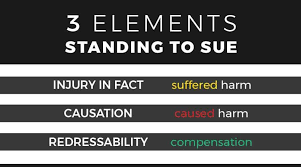
Under current Supreme Court precedent, plaintiffs have to meet three requirements to get standing to file a lawsuit in federal court: They must 1) have suffered an "injury in fact," 2) the injury in question must be caused by the allegedly illegal conduct they are challenging, and 3) a court decision should be able to redress the injury.
In my view, the entire doctrine of standing is not a genuine constitutional requirement, and the Supreme Court should abolish it. But that's highly unlikely to happen. So, for present purposes, I will assume the validity of current precedent. Whether it's right or not, litigants will have to work within it.
The main potential stumbling block in this case is the requirement of "injury in fact." It may be difficult to prove that student loan cancellation injures anybody, in the sense required by Supreme Court precedent. Cancelling some of A's student loan debt doesn't necessarily injure B and C. The others may believe it is unfair they had to pay off all their loans themselves, while A doesn't. But, with rare exceptions, current precedent requires some sort of tangible injury. Unfairness, by itself, isn't enough.
It may be that taxpayers suffer a tangible injury, because loan forgiveness denies funds to the federal treasury, thereby forcing them to bear more of the burden of public expenditures. Any illegal expenditure of public funds necessarily diverts taxpayer resources away from duly authorized purposes. But the Supreme Court has long denied such taxpayer standing, in all but a few unusual circumstances, which aren't relevant here.
I think taxpayers should have broad standing to challenge any unconstitutional expenditure of public funds. But this is another issue on which the Supreme Court is unlikely to go my way, anytime soon.
But while taxpayers generally do not have standing to challenge illegal uses of public funds by the executive, the Senate and the House of Representatives do! The US Court of Appeals for the DC Circuit so held in a 2020 case where the Democratic-controlled House of Representatives filed a lawsuit challenging Donald Trump's attempt to divert military funds to build his border wall (a case which has many parallels to the present situation). The decision was written by prominent conservative Judge David Sentelle, who reasoned as follows:
[T]he House is suing to remedy an institutional injury to its own institutional power to prevent the expenditure of funds not authorized. Taking the allegations of the complaint as true and assuming at this stage that the House is correct on the merits of its legal position, the House is individually and distinctly injured because the Executive Branch has allegedly cut the House out of its constitutionally indispensable legislative role. More specifically, by spending funds that the House refused to allow, the Executive Branch has defied an express constitutional prohibition that protects each congressional chamber's unilateral authority to prevent expenditures….
To put it simply, the Appropriations Clause [of Article I of the Constitution] requires two keys to unlock the Treasury, and the House holds one of those keys. The Executive Branch has, in a word, snatched the House's key out of its hands. That is the injury over which the House is suing…
To hold that the House is not injured or that courts cannot recognize that injury would rewrite the Appropriations Clause. That Clause has long been understood to check the power of the Executive Branch by allowing it to expend funds only as specifically authorized…
Sentelle's reasoning is compelling, and pretty obviously applies to Biden's loan forgiveness plan, no less than Trump's border wall diversion. Under this approach, either the House or the Senate would have standing to sue, even if the other house chose not to. The DC Circuit decision was later vacated by the Supreme Court when the case became moot, after Biden terminated Trump's efforts to divert the border wall funds. But the DC Circuit and other lower courts are likely to adopt its approach in any future case on the same issue.
Of course neither house is likely to sue so long as Democrats control both of them. But that could change after the November election, when Republicans could potentially retake one or both of them (the House far more likely than the Senate). If so, they could rely on the border wall precedent to get the standing they need for a lawsuit.
Unfortunately, the House or Senate would likely have to file as an institution in order to get standing. The Supreme Court has ruled that individual members of Congress lack standing to sue the executive over fiscal issues.
A second type of entity that could get standing to sue is student loan servicers. These firms collect student loan payments on behalf of the government, and the size of the fees they get depends in part on how much money is owed, whether the loan is delinquent, and how long the borrower takes to repay it. If loan forgiveness reduces delinquency rates, enables some borrowers to repay faster, or otherwise affects the amount servicing firms get paid, they pretty obviously suffer an injury in fact, and would have standing to sue. Fordham law Prof. Jed Shugerman has reached much the same conclusion.
It's possible loan servicers will be afraid to sue, because they don't want to antagonize the federal Department of Education. A good relationship with the feds may be necessary to ensure their continued profitability. But if any are willing to sue, standing shouldn't be much of a problem. And one plaintiff is enough to get the issue to court. Even if most loan servicers prefer to stay out of it, one may be willing to take the risk. Alternatively, they could band together and sue jointly, thereby making it harder for the Department of Education to retaliate against them (since the Department may be reluctant to cut them all off).
A final category of plaintiffs who could get standing is colleges that refuse federal funding (including federal student loans), but compete with those who accept it. These mostly conservative-leaning institutions reject federal funds because they do not want to be subject to the regulations that come with them. Examples include Grove City College, and Hillsdale College. For obvious reasons, loan cancellation makes colleges that accept federal student loans more competitive relative to those that do not. The latter become relatively cheaper alternatives for students.
Courts have long recognized "competitor standing" to sue to challenge policies that strengthen the competitive market position of the plaintiff's rivals. Perhaps the competitive injury here is small. Maybe only a few students are likely to forego attending Grove City College or Hillsdale as a result of Biden's actions. But even a small financial loss, such as nominal damages, is enough to qualify as an "injury in fact" under standing doctrine.
These three possibilities aren't necessarily exhaustive. They are just the ones that most readily occur to me, and I admit I am far from being an expert on student loans. There may be other types of litigants who can also get standing to challenge Biden's student debt cancellation plan. But these examples do suggest that standing need not be a show-stopper here. More likely than not, courts will eventually have to rule on the legal merits of the policy.
UPDATE: I have revised this point to note that the DC Circuit case was later vacated as moot.
Fetterman supports taxpayer-funded drug dens and the complete decriminalization of illegal drugs, including heroin, cocaine, crystal meth, and ultra lethal fentanyl. By the way, he takes them himself.
The clip included above seems to support that. If the "he takes them himself" statement is false, could Fetterman (a public official) win a defamation lawsuit against Trump?
Currently pending before the Supreme Court is an emergency application from Yeshiva University. The case concerns whether the Jewish university can be required to recognize an LGBT student organization. The application for a stay was filed on August 29. That day, Circuit Justice Sotomayor called for a response by September 2. And the response was filed that on date. Between August 30 and September 2, ten amicus briefs were filed in support of Petitioner, including from the Jewish Coalition for Religious Liberty. (Disclosure: I am a director of that organization, and reviewed an earlier iteration of the brief in the lower courts.) However, zero amicus briefs were filed in support of Respondents.
The Respondents pointed out this fact in their response brief:
The sheer volume of amici who have filed briefs in support of Applicants demonstrates the national and even international interest in Applicants' First Amendment claims. Respondents will not be able to respond to those briefs in this application, nor will they have time to line up amici who might support their position, since unlike Applicants, Respondents did not have the opportunity to coordinate these filings in advance. Depending on what issues there are for review, many additional friends of the Court may wish to weigh in. The gravity of the questions Applicants want this Court to resolve would certainly suggest providing a more robust opportunity for amicus participation on both sides.
I am not persuaded by this claim for several reasons.
First, this case has been going on for some time. Recently, the New York courts declined Yeshiva University's request for a stay. Specifically, the New York Court of Appeals (the highest court in New York) denied relief on August 25. Yeshiva University's application came four days later on August 29. Justice Sotomayor gave the Respondents five days to file a reply, but they had (at least) four advance days of notice in advance that an application was imminent. Thus, there were at least nine total days of notice. And as a practical matter, there was even more time. It was not hard to predict that the counsel for the University, the Becket Fund For Religious Liberty, would seek this relief. Becket has done so many, many times before. The playbook isn't exactly novel. YUPride Alliance is represented by sophisticated counsel. They surely knew what would happen.
Second, given the fact that everyone knew where this case was headed, there was in fact time to line up amicus briefs for the shadow docket. Amicus briefs were filed in the lower court on both sides by the usual suspects. It would not have been difficult for counsel to give the repeat players a heads up that an emergency application would probably be filed. And unlike many of the COVID cases, here there is a substantial litigation record, as this case has been pending for more than a year. The "fuse" is quite lengthy here. It is straightforward for counsel to repurpose an amicus brief in the lower court for a Supreme Court brief. (JCRL did just that.)
Third, I am incredulous that big law firms, who routinely boast about their advocacy to promote LGBT causes, were unable to muster pro bono representation in a timely fashion. These firms are well equipped to slap together a Supreme Court brief in a few days. This task was routinely done during the Trump years. To take a more recent example, Steve Vladeck, a chronic critic of the shadow docket, filed an amicus brief in one of the many United States v. Texas cases five days after the application was filed. He was joined by Jenner & Block and the National Immigration Law Center. It can be done. By contrast, big law firms will refuse to file any amicus briefs that are on the opposite side of LGBT rights. Take a look at counsel who filed amicus briefs in support of Yeshiva University. None are from prestigious big law firms. And these smaller outlets have far fewer resources to turn around briefs on short timelines. But they managed.
Ultimately, the Respondents used their lack of friends as a reason for the Court to deny emergency relief. I'm not buying it. If amici chose not to file in this case, it was more likely a strategic decision. For example, it is rare to file briefs in opposition to certiorari. Doing so draws undue attention to the petition. Maybe the new strategy is to refuse to file amicus briefs in opposition to emergency stay applications as a way of saying "nothing to see here, just deny." I don't think this strategy will work.
On Labor Day last year, I wrote a post explaining how breaking down barriers to labor mobility can help many millions of workers around the world. Virtually everything in that post is just as relevant today. So I am reprinting it with only minor modifications:
Today is Labor Day. As usual, there is much discussion of what can be done to help workers. But few focus on the one type of reform that is likely to help more poor and disadvantaged workers than virtually anything else: increasing labor mobility. In the United States and around the world, far too many workers are trapped in places where it is difficult or impossible for them to ever escape poverty. They could better their lot if allowed to "vote with their feet" by moving to locations where there are better job opportunities. That would also be an enormous boon to the rest of society.
Internationally, the biggest barriers condemning millions to lives of poverty and oppression are immigration restrictions. Economists estimate that eliminating legal barriers to migration throughout the world would roughly double world GDP - in other words, making the world twice as productive as it is now. A person who has the misfortune of being born in Cuba or Venezuela, Zimbabwe or Afghanistan, is likely condemned to lifelong poverty, no matter how talented or hardworking he or she may be. If he is allowed to move to a freer society with better economic institutions, he can almost immediately double or triple his income and productivity. And that doesn't consider the possibility of improving his job skills, which is also likely to be more feasible in his new home than in his country of origin.
The vast new wealth created by breaking down migration barriers would obviously benefit migrants themselves. But it also creates enormous advantages for receiving-country natives, as well. They benefit from cheaper and better products, increased innovation, and the establishment of new businesses (which immigrants create at higher rates than natives). Immigrants also contribute disproportionately to scientific and medical innovation, such as the MRNA Covid-19 vaccines, that have already saved many thousands of lives around the world.
As with lowering immigration restrictions, breaking down domestic barriers to labor mobility would create enormous benefits for society as a whole, as well as the migrants themselves. Economists estimate that cutting back on exclusionary zoning would greatly increase economic growth. Like international migrants, domestic ones can be more productive and innovative if given the opportunity to move to places where they can make better use of their talents.
Many proposals to help workers have a zero-sum quality. They involve attempts to forcibly redistribute wealth from employers, investors, consumers, or some combination of all three. Breaking down barriers to labor mobility, by contrast, creates massive benefits for both workers and society as a whole.
Some on the left point out that, if investors are allowed to move capital freely, workers should be equally free to move, as well. It is indeed true that, thanks to government policies restricting labor mobility, investment capital is generally more mobile than labor. It is also true that the restrictions on labor mobility are deeply unjust. In many cases, they trap people in poverty simply because of arbitrary circumstances of birth, much as racial segregation and feudalism once did. The inequality between labor and capital, and the parallels with segregation and feudalism should lead progressives to put a higher priority on increasing labor mobility.
At the same time, it is worth recognizing, that investors and employers, as a class, are likely to benefit from increased labor mobility, too. Increased productivity and innovation create new investment opportunities. The biggest enemies of both workers and capitalists are not each other, but the combination of nationalists and NIMBYs who erect barriers to freedom of movement, thereby needlessly impoverishing labor and capital alike. Despite conventional wisdom to the contrary, even current homeowners often have much to gain from curbing exclusionary zoning policies that block the construction of housing needed by workers seeking to move to the region.
Obviously, there are those who argue against increasing labor mobility, either on the grounds that existing communities have an inherent right to exclude newcomers, or because allowing them to come would have various negative side-effects. I address these types of arguments here, and in much greater detail in Chapters 5 and 6 of my book Free to Move: Foot Voting, Migration, and Political Freedom. As I explain in those earlier publications, nearly all such objections are wrong, overblown, or can be ameliorated by "keyhole solutions" that are less draconian than exclusion. In addition, the vast new wealth created by breaking down barriers to mobility can itself be used to help address any potential negative effects. In the book, I also push back against claims that mobility should be restricted for the benefit of those "left behind" in migrants' communities of origin.
Workers of the world, unite to demand more freedom of movement!
Last week, my co-host Michelle Lange and I released part 1 (Apple Podcasts link here) of our "Strangers on the Internet" podcast conversation with catfishing victims Anna Rowe and (academic) Jennifer. By popular demand, we decided not to wait the usual two weeks until the next episode.
Hence, today, we make available part 2 (Apple Podcasts link here) of their breathtaking stories. At the end of part 1, Anna Rowe was jumping in her car after collecting enough clues to locate her catfish at his workplace near a local airport. In this episode, we hear more about her multi-year (and ongoing) pursuit of legal and extralegal consequences against him.
Meanwhile our other guest Jennifer bonds with the other mother of her catfish's kids and goes after him for child support - but is it enough? We discuss post-catfishing life for the two women and share our dating safety advice with everyone.
In other recent Internet dating news, don't miss CNN's coverage of the heartbreaking search for Irene Gakwa, who disappeared after moving to Wyoming to be with Nathan Hightman, the boyfriend she met on Craigslist. The evidence against Hightman, who allegedly broke into her bank and email accounts, seems to be mounting.
I'm delighted to report that Prof. Marc DeGirolami (St. John's) will be guest-blogging from Tuesday until next Monday on his new article, "Traditionalism Rising," forthcoming in the Journal of Contemporary Legal Issues. Here's the abstract:
Constitutional traditionalism is rising. From due process to free speech, religious liberty, the right to keep and bear arms, and more, the Court made clear in its 2021 term that it will follow a method that is guided by "tradition."
This paper is in part an exercise in naming: the Court's 2021 body of work is, in fact, thoroughly traditionalist. It is therefore a propitious moment to explain just what traditionalism entails. After summarizing the basic features of traditionalism in some of my prior work and identifying them in the Court's 2021 term decisions, this paper situates these recent examples of traditionalism within this larger, longstanding interpretive method. Contrary to many claims, there is little that is entirely new or unexpected, other than the Court's more explicit embrace of traditionalism this term than in the past. The paper then distinguishes traditionalism from originalism, focusing especially on what some originalists have called "liquidation."
Finally, it raises and considers one comparatively straightforward and two more difficult problems for traditionalism: (a) the problem of selecting the operative "level of generality" for any tradition; (b) the problem of tradition's moral justification, offering possibilities based on the connection between enduring practices and (1) human desires, (2) virtues or legal excellences, or (3) natural law determinations; and (c) the problem of traditionalism's politics.
I very much look forward to Prof. DeGirolami's posts!
A New York Times article yesterday ("A Second Constitutional Convention? Some Republicans Want to Force One") discusses conservative attempts to get a constitutional convention that would propose a constitutional amendment (it takes 2/3 of the states to call for one, and one question is how many have already done so), and criticisms of those attempts. After two paragraphs discussing the pro-convention views of "Jodey Arrington, a conservative Texas Republican," it goes on thus:
To Russ Feingold, the former Democratic senator from Wisconsin and president of the American Constitution Society, a liberal judicial group, that is a terrible idea. Mr. Feingold sees the prospect of a constitutional convention as an exceptionally dangerous threat from the right and suggests it is closer to reality than most people realize as Republicans push to retake control of Congress in November's midterm elections.
"We are very concerned that the Congress, if it becomes Republican, will call a convention," said Mr. Feingold, the co-author of a new book warning of the risks of a convention called "The Constitution in Jeopardy."
"This could gut our Constitution," Mr. Feingold said in an interview. "There needs to be real concern and attention about what they might do. We are putting out the alert."
Relying on Section 432(a) of the Higher Education Act of 1965, as some propose, has many of the same flaws as the Administration's emergency powers theory.
In my last post about President Biden's plan to cancel hundreds of billions of dollars in student loan debt, I criticized the administration's claims that the policy is authorized by an emergency power provision of the 2003 HEROES Act. But there is an alternative potential legal justification for the policy: Section 432(a) of the Higher Education Act of 1965, (now codified as 20 U.S.C. Section 1082(a)(6), which authorizes the Secretary of Education to "enforce, pay, compromise, waive, or release any right, title, claim, lien, or demand, however acquired, including any equity or any right of redemption" related to loans authorized by the Federal Direct Loan Program.
Fordham law Professor Jed Shugerman, who is highly critical of the administration's HEROES Act theory, argues that the Higher Education Act (HEA) provides a much stronger rationale for Biden's plan. Earlier, Sen. Elizabeth Warren and others argued that Section 432(a) could even justify a much larger debt cancellation program. Last year, the administration viewed this theory with skepticism. But should Biden's plan be challenged in court, they could potentially still resort to it.
In some ways, the HEA argument is indeed superior to the HEROES Act theory. Taken in in isolation from the rest of the Act, Section 432(a) does appear to grant the executive the power to cancel as much student loan debt as it wants. That can be extrapolated from the power to "waive…or release any right, title, claim, lien, or demand" (emphasis added). Moreover, unlike the HEROES Act theory, the HEA justification isn't confined to emergency situations or to borrowers who can plausibly claim that an emergency or disaster has made it more difficult for them to pay their debts. If the argument is correct, the administration can cancel any amount of federal student loan debt, at any time, for virtually any reason.
But a closer look suggests that the HEA theory is flawed for may of the same reasons as the HEROES Act rationale. Indeed, its breath-taking scope contributes to its undoing.
The HEA rationale was examined in some detail in a January 2021 memorandum written by then-Education Department Deputy General Counsel Reed Rubinstein, for outgoing Trump Administration Education Secretary Betsy DeVos (Secretary DeVos actually resigned in protest of Trump's role in the January 6, 2021 attack on the Capitol, a few days before the memo was officially submitted to her; but I don't think this changes its status). I don't agree with everything Rubinstein says. But he does make several strong points against the idea that Section 432(c) gives the Secretary of Education a blank check to cancel student loan debt.
As Rubinstein points out, "reading 20 U.S.C. § 1082(a)(6) to permit the Secretary [of Education], on a blanket or mass basis, to cancel, compromise, discharge, or forgive student loan principal balances" would render superfluous various other provisions of the HEA and later statutes, which give the Secretary the power to cancel or limit debt in more limited circumstances. And, as he rightly explains, there is a longstanding presumption against interpreting statutes in a way that renders parts of them superfluous. The Supreme Court has repeatedly reaffirmed this principle.
To avoid this and other problems, Rubinstein suggests that it makes more sense to construe Section 432(c) as only giving the Secretary the authority to waive or release student loan debt "on a case-by-case basis and then only under those circumstances specified by Congress." In such situations, the provision serves to eliminate any ambiguity about the Education Department's ability to forego any rights in question and to do so in whatever way the Department sees fit.
Like the HEROES Act theory, the HEA rationale for Biden's plan is vulnerable to attack under the "major questions" and nondelegation doctrines. The former requires Congress to "speak clearly when authorizing an [executive branch] agency to exercise powers of vast economic and political significance." If a statute is ambiguous, courts must presume that Congress has not given the agency the power in question.
Jed Shugerman rightly argues that the HEROES Act argument runs afoul of the Supreme Court's recent major questions rulings. The authority to forgive hundreds of billions of dollars in student loan debt under an expansive definition of what qualifies as an "emergency" surely qualifies as a power of "vast economic and political significance." But that's even more true of the HEA theory, which would give the executive the power to cancel any amount of student loan debt at any time, for any reason.
Under the HEA approach, there would essentially be no limit to the executive's power to cancel student loan debt. If the major questions doctrine applies anywhere, it surely does here. And Rubinstein's analysis suggests there is at least some significant ambiguity about whether Section 432(c) - read in conjunction with the rest of the Higher Education Act - actually gives the administration such vast power. If so, the major questions doctrine requires federal courts to rule against the executive.
What is true of the major questions doctrine is also true of nondelegation. In my earlier post, I explained why, if there are meaningful constitutional limits to Congress' power to delegate its authority to the executive, the HEROES Act theory likely runs afoul of them. That reasoning applies with even greater force to the HEA rationale, which would give the executive still greater discretionary authority. The Constitution gives Congress, not the president, the power to allocate federal funds. Giving the president unfettered authority to deprive the treasury of hundreds of billions of dollars in student loan debt is a truly enormous delegation.
At the very least, as the Rubinstein Memorandum points out, courts must apply the Supreme Court's longstanding canon against interpreting federal statutes in ways that raise constitutional problems. In his controlling opinion in NFIB v. Sebelius (2012), Chief Justice John Roberts famously emphasized that this rule requires courts to reject "the most natural" reading of a statute if there is any "fairly possible" interpretation that would avoid the risk of rendering it unconstitutional. Rubinstein's interpretation of Section 432(c) is at least a "fairly possible" one, and it would enable courts to avoid confronting a massive constitutional nondelegation problem.
I'm no great fan of the constitutional avoidance canon, especially Roberts' very broad view of it. But the Supreme Court doesn't seem likely to curb it anytime soon, and lower courts are required to follow it.
In sum, the HEA rationale for Biden loan cancellation plan has some advantages over the HEROES Act theory advanced by the administration. But the enormous scope of the power the theory gives the executive should lead courts to reject it.
UPDATE: I plan to write one more post in this series, addressing the question of whether anyone has standing to sue to challenge the loan debt cancellation policy.
A good article today by Jeff Jacoby, about Gorbachev's complex life and legacy; not terribly new to those who followed the last years of the Soviet Union, but still well put. An excerpt:
Even if he could never bring himself to acknowledge the inherent evil of communism, it was to Gorbachev's lasting credit that when Poland, East Germany, Czechoslovakia, Hungary, Romania, and Bulgaria chose to exit the Soviet orbit, he did not send in the tanks. That was the reason for all those prizes and awards, the reason he was so immensely popular in the West, the reason obituaries this past week have referred to him as a "liberator."
But he wasn't a liberator…. [C]hoosing not to commit mass murder or perpetuate slavery is not the same thing as choosing to save lives or free the enslaved.
And when it came to the former Soviet republics, Gorbachev's attitude was far less enlightened…. Gorbachev was not prepared to send tanks and troops to subdue Warsaw and Prague, but he had no such qualms—at least at first—closer to home [in the USSR's constituent "republics"].
"As early as 1986, nationalist protests in Almaty, Kazakhstan, were put down with a massive show of force," recalled Leonid Bershidsky in a Bloomberg essay. "In April 1991, the Soviet military killed 21 protesters and wounded hundreds more in the Georgian capital, Tbilisi…. People were killed as they protested in Dushanbe, Baku, and Riga," the capitals, respectively, of Tajikistan, Azerbaijan, and Latvia. In Vilnius, the Lithuanian capital, Soviet tanks and armored personnel carriers moved directly into crowds of civilians demonstrating for freedom. Hundreds of protesters were wounded and at least 14 people — two of them teenagers — were killed.
Fortunately for the former Soviet republics, Gorbachev's tolerance for slaughter was low. He was too decent to successfully rule an evil empire.
For those who know Russian, here's a young Andrey Makarevich's "Give Lithuania Back to the Lithuanians," from 1991, which addresses Gorbachev directly; Makarevich is now a leading critic of the Russian invasion of Ukraine (see, e.g., here, though there are many other songs from him on this as well); here's a loose translation:
Prof. Jack Goldsmith (Harvard) and I will have this article out in the Texas Law Review early next year, and I'll be serializing it here in the next couple of weeks, starting Tuesday. There is still plenty of time for editing, so we'd love to hear any recommendations you folks might have; in the meantime, you can read the entire PDF of the latest draft (though with some formatting glitches stemming from the editing process) here. Meantime, the Abstract:
When does the Dormant Commerce Clause preclude states from regulating internet activity—whether through state libel law or invasion of privacy law; through state laws requiring web sites to accommodate disabled users (for instance, by providing closed captioning); through state bans on discriminating based on sexual orientation, religion, or criminal record; or through state laws that ban social media platforms from discriminating based on the viewpoint of users' speech?
This essay argues that the constitutionality of such state regulation should generally turn on the feasibility of geolocation—the extent to which web sites or other internet services can determine, reliably and inexpensively, which states users are coming from, so that the sites can then apply the proper state law to each user (or, if need be, choose not to allow access to users from certain states). In recent years, geolocation has become feasible, and is routinely used by major web sites for ordinary business purposes. There is therefore more constitutional room for state regulation of internet services, including social media platforms, than often believed.
Note that the article is exclusively about the Dormant Commerce Clause questions, not the separate defenses internet services might have under either the First Amendment or 47 U.S.C. § 230 (for more on that, see this article of mine and this article by Adam Candeub and me).