On Tuesday night at 8pm ET, I have a Federalist Society event styled as a debate this with Harvard Law's Randall Kennedy on racial classifications. I'm sure we will disagree on some things, but I expect overall will be more of a discussion. Register here.
On Thursday at 3pm ET, I will be participating in a virtual discussion with economist Glenn Loury of Boston University and Washington University law school's Adrienne Davis. Register here.
I'm excited for these events because while I have done quite a few podcasts and radio interviews about my new book on racial classifications, these are among the first times I will get to publicly discuss the book with academic colleagues.
Yesterday, the US Court of Appeals for the Fifth Circuit upheld Texas' law banning major social media websites from using most forms of content moderation. The decision is at odds with a recent Eleventh Circuit ruling striking down Florida's similar (though somewhat less sweeping) law. The Eleventh Circuit ruling was written by prominent conservative Trump appointee Judge Kevin Newsom. In May, the Supreme Court signaled that at least five justices believe the law to be unconstitutional, when it overturned a previous Fifth Circuit ruling lifting a trial court injunction against implementation of the Texas law. For reasons I summarized here, I agree with the Eleventh Circuit's approach, and believe the Texas and Florida laws violate the First Amendment's guarantee of freedom of speech. In this post, I argue that these laws also violate the Takings Clause of the Fifth Amendment.
The Takings Clause bars government from taking "private property" without paying "just compensation." In its 2021 ruling in Cedar Point Nursery v. Hassid, the Supreme Court ruled (correctly, in my view) that even a temporary government-mandated "physical occupation" or invasion of private property counts as a per se taking, automatically requiring compensation. Thus, the Court struck down a California law requiring agricultural growers to grant access to their property to union organizers. The Court emphasized that "[t]he right to exclude is universally held to be a fundamental element of the property right," and that violations of that right presumptively qualify as takings.
The Florida and Texas social media laws are also blatant attacks on the right to exclude. No one doubts that the Twitter site and its various features are Twitter's private property. And the whole point of the Florida and Texas laws is to force Twitter and other social media firms to grant access to users and content the firms would prefer to exclude, particularly various right-wing users. Just as the plaintiffs in Cedar Point wanted to bar union organizers from their land, so Twitter wishes to bar some content it finds abhorrent (or that might offend or annoy other users).
To be sure, there are obvious differences between virtual property, such as a website, and more conventional physical property, like that involved in the Cedar Point case. But the Taking Clause nonetheless applies to both. If Texas decided to seize the Twitter site, bar current users, and instead fill it with content praising the state government's policies, that would pretty obviously be a taking, much like if California decided to seize the Cedar Point tree nursery's land. In the same way, requiring Twitter to host unwanted content qualifies as an occupation of its property, no less than requiring a landowner to give access to unwanted entrants. The Supreme Court has previously ruled that intellectual property is protected by the Takings Clause. Websites present similar issues.
One could argue that forcing a website owner to host unwanted users isn't really a "physical occupation," because the property is virtual in nature. But websites, including the big social media firms, use physical server space. Other things equal, a site with more user-generated content requires more such space than one with less. Even aside from the connection to physical infrastructure, it seems to me that occupation of virtual "real estate" is analogous to occupation of land. Both are valuable forms of private property from which the owner generally has a right to exclude.
In Cedar Point, the Supreme Court did note some exceptions to the rule that government-mandated occupations of property qualify as takings. The one most relevant to the social media case is that for locations "generally open to the public," such as shopping malls. In his majority opinion in Cedar Point, Chief Justice John Roberts used this theory to distinguish the Supreme Court's 1980 decision in Pruneyard Shopping Centerv.Robins,which held that a shopping mall could not bar people who wanted to leaflet on its property.
For reasons outlined in two articles by Prof. Gregory Sisk (see here and here), I think Pruneyard was a bad decision and should be overruled. But, in the meantime, it is readily distinguishable from the Texas and Florida social media laws. Despite appearances, sites like Twitter and Facebook are not "generally open to the public" in the sense that anyone who wants to can post content on the site. Rather, they are only open to those who agree to the sites' terms of services. As Twitter's terms of service, for example, make clear, "[y]ou may use the Services only if you agree to form a binding contract with Twitter and are not a person barred from receiving services under the laws of the applicable jurisdiction." The contract in question includes acceptance of Twitter's content moderation rules. Few if any shopping malls have similar access restrictions!
Cedar Point outlines a few other exceptions to the rule that physical occupations are per se takings. Examples include regulatory health and safety inspections. By similar logic, websites that, for example, sell potentially dangerous goods and services, might be required to post warnings about the possible risks. In addition, the "police power" sometimes creates a general exception to takings liability, as when police must enter a property to execute a search warrant. But none of these other exceptions even come close to justifying the Florida and Texas social media laws.
If government imposition of unwanted content on websites does not qualify as a taking, it would have dire implications for a wide range of websites, not just social media providers. The government could similarly force a wide range of other sites to accept unwanted content. Unscrupulous politicians and interest groups could take the opportunity to force all kinds of websites to promote their preferred content, or at least bar them from excluding content that the site owners disapprove of. Such a regime would be a serious menace to online property rights, though the consequences would be far less dire if the social media firms prevail in the current free speech litigation.
Unlike the Eleventh Circuit decision holding that the Florida social media law violates the First Amendment, a ruling that such a law violates the Takings Clause wouldn't necessarily bar states from enacting and enforcing such legislation. The could still do so, so long as they paid "just compensation," which usually means the "fair market value" of the property taken.
Calculating the amount of compensation due in a case like this might be complicated. In the case of many would-be users (those with few potential followers), the market value of a Twitter or Facebook account could be very low. But the aggregate compensation for forcing social media firms to accept large numbers of unwanted users could still be very large, perhaps large enough to deter states from passing such legislation in the first place.
The present litigation against the Florida and Texas laws does not involve Takings Clause claims. But such claims could potentially be filed in the future, especially in the Texas case, where the law seems likely to go into effect, unless and until the Supreme Court reverses the Fifth Circuit ruling on the First Amendment issue. If social media firms choose to pursue this issue, they could well prevail - and certainly deserve to do so.
I'm delighted to report that Prof. David Ardia (UNC) will be guest-blogging this week about this new article, which he cowrote with Evan Ringel (Park Doctoral Fellow at the UNC Hussman School of Journalism and Media). The abstract:
The last two presidential election cycles have brought increased attention to the extent of misinformation—and outright lies—peddled by political candidates, their surrogates, and others who seek to influence election outcomes. Given the ubiquity of this speech, especially online, one might assume that there are no laws against lying in politics. It turns out that the opposite is true. Although the federal government has largely stayed out of regulating the content of election-related speech, the states have been surprisingly active in passing laws that prohibit false statements associated with elections.
Prompted by concern about the impact of misinformation on the American electorate, we set out to assess the extent to which existing state and federal laws limit election misinformation and the prospect that these laws will survive First Amendment scrutiny. In doing so, we reviewed more than 125 state statutes that regulate the content of election-related speech, ranging from statutes that prohibit false and misleading factual statements about candidates to laws that indirectly regulate election-related speech by prohibiting fraud and intimidation concerning elections.
What we found is that state statutes regulating election misinformation vary widely in the types of speech they target and the level of fault they require, with many statutes suffering from serious constitutional deficiencies. Statutes that target defamatory speech or speech that harms the election process, is fraudulent, or that intimidates voters are likely to be permissible, while statutes that target other types of speech that have not traditionally been subject to government restriction, such as statutes that target merely derogatory speech, will face an uphill battle in demonstrating that they are constitutional. Furthermore, statutes that impose liability without regard to the speaker's knowledge of falsity or intent to interfere with an election are especially problematic.
Political speech has long been viewed as residing at the core of the First Amendment's protections for speech. Yet it has become increasingly clear that lies and other forms of misinformation associated with elections are corrosive to democracy. The challenge, of course, is in developing regulatory regimes that advance the interest in free and fair elections while at the same time ensuring that debate on public issues remains uninhibited, robust, and wide-open. This is no easy task. Regardless of whether individual statutes survive First Amendment scrutiny, it is useful to understand the breadth and depth of state attempts to deal with lies, misinformation, intimidation, and fraud in elections. As we point out, any legislative approach to combatting election misinformation must be part of a broader societal effort to reduce the prevalence of misinformation generally and to mitigate the harms that such speech creates.
From FIRE's Call for Proposals; go to that page for more details on just how to apply (and more on the terms of the program):
Summary: The Foundation for Individual Rights and Expression (FIRE), a nonpartisan 501(c)(3) organization, seeks research proposals related to freedom of expression and academic freedom.
Grant information: A total pool of $150,000 will be available in 2022, with a maximum of $50,000 per grant and no minimum size.
Just released, Netchoice v. Paxton; I'm traveling and likely won't have time to digest the 113 pages of opinions for a while, but here's the opening from Judge Andrew Oldham's opinion, which is a majority on most points:
A Texas statute named House Bill 20 generally prohibits large social media platforms from censoring speech based on the viewpoint of its speaker. The platforms urge us to hold that the statute is facially unconstitutional and hence cannot be applied to anyone at any time and under any circumstances.
In urging such sweeping relief, the platforms offer a rather odd inversion of the First Amendment. That Amendment, of course, protects every person's right to "the freedom of speech." But the platforms argue that buried somewhere in the person's enumerated right to free speech lies a corporation's unenumerated right to muzzle speech.
The implications of the platforms' argument are staggering. On the platforms' view, email providers, mobile phone companies, and banks could cancel the accounts of anyone who sends an email, makes a phone call, or spends money in support of a disfavored political party, candidate, or business. What's worse, the platforms argue that a business can acquire a dominant market position by holding itself out as open to everyone—as Twitter did in championing itself as "the free speech wing of the free speech party." Then, having cemented itself as the monopolist of "the modern public square," Packingham v. North Carolina (2017), Twitter unapologetically argues that it could turn around and ban all pro-LGBT speech for no other reason than its employees want to pick on members of that community, Oral Arg. at 22:39–22:52.
Today we reject the idea that corporations have a freewheeling First Amendment right to censor what people say. Because the district court held otherwise, we reverse its injunction and remand for further proceedings.
Judge Edith Jones joined this in large part; an excerpt:
Please enjoy the latest edition of Short Circuit, a weekly feature written by a bunch of people at the Institute for Justice.
New cert petition: In 2018, the Supreme Court unequivocally rejected the so-called "professional speech doctrine," under which lower courts had been giving mere rational basis review to restrictions on speech instead of the usual, robust scrutiny that the First Amendment demands. And yet! The Eleventh Circuit recently resurrected the doctrine in all but name to uphold a Florida law that makes it a crime for anyone but a licensed dietician to give dietary advice. That won't do. (And if you won't take our word for it maybe you'll find this amicus brief by several noted scholars, including Erwin Chemerinsky, persuasive.)
New on the Short Circuit podcast: The very best podcast episode on the Montana Supreme Court and the Montana Constitution that has ever been recorded this week.
Friends, last week we shared a ruling of the D.C. Circuit in a wrongful arrest case that contained some puzzling redactions. This week, the D.C. Circuit released an unredacted version of the opinion. Turns out the redactions were mostly about how compliant the victim was and how little cause there was for arresting her.
On April 24, 1996, Congress enacted the Mandatory Victims Restitution Act (MVRA), significantly extending the enforceability of restitution orders—from 20 years after entry of judgment to 20 years after release from imprisonment. Twelve days earlier, a New Jersey man commits an armed bank robbery. He's convicted in May the following year, ordered to pay $20k in restitution, and remains in prison today. Can the gov't seize his prison trust account to satisfy his outstanding restitution? Third Circuit: Nope. That would violate the Ex Post Facto Clause. Dissent: The Ex Post Facto Clause prohibits increasing someone's punishment, but because of the time value of money, extending the time to pay actually decreases the punishment.
Allegation: El Paso, Tex. officers are summoned to home by neighbor's report of a riot in progress. Instead, they find it's "just kids talking loudly" in the backyard. The teens decline to speak without an adult present and leave. The officers follow and, a block away, search a 16-year-old who lives at the home, finding a key to the house in her bra. The officers return to the house, enter, and find her mom helping to bathe two other daughters. Officers: We had to get into the home to see if anyone was having an emergency. Fifth Circuit (unpublished): No qualified immunity.
What's the difference between a short ton and a long ton? This Fifth Circuit opinion, finding no problem with the fees big ships must pay use the recently (and ongoingly) deepened and widened Sabine-Neches Waterway, answers that question (but steers clear of what kids these days mean by shit ton).
The right to travel internationally is not fundamental and thus restrictions on that right are not deserving of strict scrutiny, says the Fifth Circuit. Which is not good news for this gentleman who had his passport revoked over a seriously delinquent tax debt.
Service members sue the Air Force over its COVID-19 mandate, claiming it has given out thousands of waivers for health and administrative reasons but none for religious reasons, even though the regulations allow for all three kinds of waivers. District court: Looks fishy, here's a preliminary injunction. Sixth Circuit: Certainly does, and the emergency request for a stay is denied. We'll expedite the PI appeal, though.
Two Michigan state troopers make national news when they're arrested for stealing a bicycle during Mackinac Island bar crawl. One of the troopers: I had no idea the bike was stolen, which the officer who requested the arrest warrant knew and omitted. Sixth Circuit (unpublished): If true, could be malicious prosecution. No qualified immunity.
Between 1978 and 1998, an Ohio State University athletic team doctor sexually abused over a thousand students. District court: Because of the two-year statute of limitations none of these 110 victims can sue the university under Title IX. Sixth Circuit: The claims are timely if the victims didn't know Ohio State was responsible until a 2018 independent investigation revealed the extent of the abuse and cover-up. Dissent: The statute of limitations began to run when the victims knew they were injured, and the abuse alleged is so obscene that they plainly knew decades ago.
Police ultimately had probable cause to arrest a gentleman for impersonating an officer, but, says the Seventh Circuit, the Whitestown, Ind. officer who handcuffed him beforehand is not entitled to qualified immunity because you can't just go handcuffing folks willy-nilly during Terry stops. There's rules.
Sadly, however, the gentleman above, who, it turns out, did not impersonate an officer, gets no succor out of the Indiana Tort Claims Act for the damage to his car while it was in impound. Because, says the Seventh Circuit, police who engage in even egregious misconduct while carrying out legitimate law enforcement activity are exempted from liability under the Act.
You can't get your case into this humble little roundup unless you file a notice of appeal following final judgment from the trial court. Thankfully, the rules were amended last year to clarify that you don't have to specify every single ruling you're challenging—you just need to appeal the final judgment and all the other judgments can come along for the ride. Tenth Circuit: Unfortunately for this Colorado inmate, the change wasn't retroactive, so his failure to specifically note his appeal from a partial summary judgment earlier in his case lets those defendants off the hook.
A couple years ago a South Carolina circuit judge did something deeply reasonable and remarkably correct, holding that the state's civil forfeiture laws are unconstitutional because, among other reasons, property owners must prove their innocence (even when the gov't doesn't put forth any evidence of guilt) and are not given prompt post-seizure hearings, meaning owners must wait months or years for the return of improperly seized property. Sadly, this week the South Carolina Supreme Court reversed, holding that it is for the legislature and not the judiciary to rein in the state's well-documented forfeiture abuse. (This is an IJ case.)
And in en banc news, the Eighth Circuit will not reconsider its ruling granting qualified immunity to Des Moines, Iowa police who are alleged to have racially profiled a Black driver. Two judges dissent from denial, arguing that it's high time we set some clearly established law on the matter.
And in further en banc news, the Ninth Circuit will not reconsider its ruling that there's nothing unconstitutional about California banning prisoners who fought wildfires while incarcerated from becoming full-time firefighters upon release. (This is an IJ case.)
Earlier this year, Mauldin, S.C. officials rezoned their Main Street in hopes of promoting private development. The change means most of the businesses there (a mayonnaise factory, auto repair shops, a swimming pool repair company, a rental car business) are now nonconforming but grandfathered uses that can continue operating indefinitely. Arbitrarily, however, officials singled out one type of business for special mistreatment: The ordinance requires U-Haul rental businesses to close by the end of the year. Which, in addition to being lowdown and nasty, and also violating due process and equal protection, is a taking of private property without any (much less just) compensation in violation of the South Carolina Constitution. Click here to learn more about IJ's latest lawsuit.
After John Doe was fully exonerated of horrendous and malicious false allegations, the University of Maryland repeatedly refused to protect his rights as a student. The University allowed Doe to be publicly defamed as a rapist by students who worked closely with the University's Title IX office. When Doe submitted his complaints to the University alleging violations of University policy, including retaliation and sexual harassment, the University ignored his complaints.
Doe sued the university under Title IX and the two students—who had then been co-Presidents (consuls?) of the UMD Preventing Sexual Assault group—for defamation and intentional infliction of emotional distress. But the defendant students then asked to be pseudonymized (which Doe agreed to, perhaps out of a desire to keep his own pseudonymous status):
Both Defendants take pride in their work on behalf of men and women victimized by conduct ranging from sexual assault to catcalling. They stand accused in this case of defamation committed with malice against the Plaintiff, a very serious allegation indeed.
Both Defendants just graduated from the University of Maryland, College Park. Defendant Two is still job hunting in her field. Defendant Three secured a job in her chosen field of public relations. Defendant Three, who has a less common name than many, was shocked to discover that a Google search of her name yields as the fifth entry, pleadings in this case. For Defendant Two, she shares her name with others with many online entries. Defendant Two is concerned that could change as the case progresses.
For both, however, searches on Google, PACER, Judiciary Case Search, etc. are all standard practices for many employers. They are at the beginning of their professional careers. They are greatly concerned about the potential impact on future employers because of these serious allegations which they absolutely reject. Defendant Two, in point of fact, defends these allegations in that she was simply uninvolved—distinct from Defendant Three who defends these allegations as simply wrong or grossly conflated.
And the court granted the motion, without a written opinion.
[Jack Goldsmith and I will have an article out about the Dormant Commerce Clause, geolocation, and state regulations of Internet transactions in the Texas Law Review early next year, and I'm serializing it here. There is still plenty of time for editing, so we'd love to hear any recommendations you folks might have; in the meantime, you can read the entire PDF of the latest draft (though with some formatting glitches stemming from the editing process) here.]
The same basic approach we laid out in the last several days, we think, should apply to bans on political discrimination. (Some California cases suggest that California law already bans such discrimination, and various cities, counties, and territories have explicit rules along those lines.[1]) If, say, Iowa law bans social media platforms from blocking Iowan-to-Iowan speech based on its viewpoint, whether religious, moral, or political, Iowa courts could, consistent with the Dormant Commerce Clause, apply that law to HitchedIn and, for that matter, to Facebook and Twitter—again, so long as those platforms could geolocate the communicating parties as being in Iowa. Likewise for common carrier statutes, which would ban social media platforms from blocking such communication more generally (perhaps with a few viewpoint-neutral exceptions, such as for spam or sexually themed material). This question was raised in the challenges to the Florida and Texas laws that banned social media platforms from discriminating based on political viewpoint, but those courts didn't reach it, because they struck those laws down on other grounds.[2]
To be sure, one element of the Pike balancing test is to ask whether "the burden imposed on such commerce is clearly excessive in relation to the putative local benefits,"[3] so courts will have to consider the local benefits. But those benefits are quite important.
In our HitchedIn and SafeBook hypos, the local benefits were the benefits of protecting local residents from discrimination based on sexual orientation, religion, and criminal history. And in the political discrimination ban, they are the benefits that the Court viewed as important in Turner, albeit as to the First Amendment—"assuring that the public has access to a multiplicity of information sources," "a governmental purpose of the highest order, for it promotes values central to the First Amendment."[4] "It has long been a basic tenet of national communications policy that the widest possible dissemination of information from diverse and antagonistic sources is essential to the welfare of the public."[5]
None of this tells us, of course, that applying such public accommodation laws or common carrier laws to social media platforms is a good idea. The only point is that the Dormant Commerce Clause doesn't categorically preclude these sorts of experiments.
Because this topic is so much in the news—with Florida and Texas enacting such statutes, and other states considering them—let's lay this out in some more detail, and in particular cover four possible categories of hypothetical Iowa statutes, and not just Options 1 and 2.
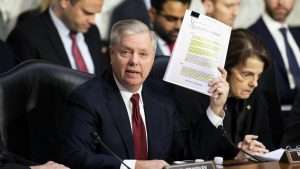
Sen. Lindsey Graham (R-South Carolina). (Michael Brochstein/ZUMA Press/Newscom)
GOP Sen. Lindsey Graham recently proposed a federal law banning most abortions more than 15 weeks into a pregnancy. The idea flies in the face of many years of Republican rhetoric to the effect that overruling Roe v. Wade (as the Court recently did in Dobbs v. Jackson Women's Health Organization) would return the issue of abortion to the states. If enacted, it would also be an unconstitutional extension of federal power. But it might nonetheless be upheld under the Supreme Court's overbroad interpretation of Congress' power to regulate interstate commerce.
Graham's proposed bill cites two possible sources of federal authority to restrict abortion: the Fourteenth Amendment, and the Commerce Clause. In a Washington Post op ed, prominent conservative legal scholar John Yoo argues that neither holds up. Yoo is absolutely right about the very weak Fourteenth Amendment theory. See also the more detailed analysis of this rationale for a federal abortion ban by co-blogger Jonathan Adler.
I also agree with Yoo that the Commerce Clause theory is wrong. But I fear he underrates the possibility that it could fly under the Supreme Court's current extremely broad interpretation of the Commerce Clause. I explained why in a previous post:
Under cases such as Gonzales v. Raich (2005), the Supreme Court has held that Congress' power to regulate interstate commerce includes the authority to restrict almost any "economic activity," so long as it has a "substantial effect" on interstate trade. And [in Raich] "economic activity" is defined very broadly to include anything that involves the "production, distribution, and consumption of commodities." That definition allowed the Court to use the Commerce Clause to uphold a federal ban on the possession of marijuana that had never crossed state lines or been sold in any market (even an intrastate one). Nearly all abortions involve the "consumption" and "distribution" of commodities, such as medical supplies. In addition, most abortions qualify as "economic" transactions because doctors, nurses, and others are paid to perform them.
One could argue that a federal law banning or severely restricting abortions isn't "really" aimed at regulating interstate commerce. The true motive would be to restrict abortion regardless of whether it involved interstate transactions or not. But much the same can be said for the marijuana ban upheld in Raich, and other federal laws enforcing the War on Drugs. They go far beyond targeting actual interstate trade in drugs, and instead forbid even in-state distribution and possession of illegal narcotics.
If, as is likely, the interstate abortion market expands in the wake of a Supreme Court decision overruling Roe, Congress could claim that suppression of intrastate abortions is necessary in order to enforce restrictions on those that involve crossing state lines. If abortion is banned in State A, but legal in neighboring State B, that creates an incentive for residents of A to cross into B in order to get abortions - even if the feds enact a ban on such crossing. That ban might be more effectively enforced if abortion were illegal in B as well as A…..
The Commerce Clause rationale for abortion restrictions might not apply to abortions that are performed on a noncommercial basis by staff who provide their services for free. But such cases are only a small percentage of the total. Moreover, in Raich, the Court upheld the ban on Angel Raich's possession of marijuana even though the producers had in fact provided it to her for free. The theory was that even such completely noncommercial production and distribution of an illegal drug could impact the interstate market.
These kinds of Commerce Clause arguments may strike some readers as the kind of sophistry that gives lawyers a bad name. I sympathize with that reaction! I hate these arguments myself, and have long argued that Raich is a terrible decision that should be overruled. But this is exactly the sort of reasoning that prevailed in Raich, and provides a constitutional rationale for much of the federal War on Drugs.
It is true, as Yoo points out, that the Supreme Court has limited the commerce power in several cases since 1995:
A 1995 ruling struck down a law that had prohibited guns in school zones, and in 2000 the court barred a federal statute making illegal gender-motivated violence that crossed state lines. In both cases, the court found that the federal government could not use the commerce clause to intrude into the states' prerogatives over criminal law. Graham's bill would represent another unconstitutional invasion of the state authority to regulate crime or the professions.
But the Court decided these cases the way it did because the activity regulated by the laws in question (gun possession in school zones and gender-based violence) did not qualify as "economic activity" even under a fairly expansive definition of that concept. For reasons outlined above, most, if not all, abortions probably are "economic activities" in the Court's sense of that term.
We can't be certain that courts would uphold Graham's bill based on Raich and other similar precedents. The relevant precedent is fuzzy enough that perhaps clever lawyers and judges will find a way to distinguish abortion from marijuana possession. But there is at least a strong likelihood that they won't.
However, as also explained in my previous posts on this subject (see here and here), the Supreme Court could potentially narrow or overrule Raich and thereby open the door to striking down federal abortion bans - thanks, in large part to that unlikely champion of abortion rights, Clarence Thomas:
In Gonzales v. Carhart (2007), the Supreme Court upheld a federal restriction on late-term "partial birth" against individual rights challenges. Justice Clarence Thomas wrote a concurring opinion emphasizing the possibility that the law in question exceeds the scope of congressional power under the Commerce Clause. Thomas previously wrote a forceful dissent in Gonzales v. Raich. [In 2021], he reiterated key elements of his critique of that decision, and urged the Supreme Court to reconsider and limit it.
Back in 2018, I explained why Thomas' position could well lead him to vote to strike down federal abortion restrictions. I built on an earlier post on this subject by Cornell Law Professor Michael Dorf. It's possible that one or more other conservative justices could join Thomas's reasoning.
One can then envision federal abortion restrictions getting invalidated by a coalition of conservative justices who believe they are beyond the power of the federal government, and liberal justices who object on individual-rights grounds. It is also possible (though less likely) that some liberal jurists could endorse the federalism argument against these restrictions. Liberal thinking on constitutional federalism shifted a good deal in recent years, and some of that shift may go beyond "fair weather federalism" brought on by opposition to Trump's policies. It's also possible that either liberal or conservative judges will think of clever ways to limit the scope of Raich, even if it doesn't get overruled completely.
All of the above applies to Democratic proposals for federal laws preempting state abortion restrictions, no less than to federal legislation banning various types of abortions, like the Graham proposal. They too almost certainly won't fly under the Fourteenth Amendment (at least so long as the Supreme Court stands by its reversal of Roe v. Wade), but might squeeze through under the Court's current Commerce Clause precedent.
For the moment, this issue remains primarily theoretical. Graham's proposal is highly unlikely to get enacted anytime soon. The Republicans do not have a majority in either house of Congress, and may well not control both even after the November election. President Biden would surely veto this law if it did get enacted at a time when he is still in office. In addition, some Republican senators are clearly unenthusiastic about the idea, in part because they fear it would be a political liability.
But the Graham bill - like Democratic proposals for federal laws protecting abortion against state restrictions - is a reminder that key elements of both parties' bases would be happy to enact a federal takeover of abortion law, if given the chance. If either party manages to get strong majorities in both houses plus control of the presidency, it could potentially happen.
At that point, the courts would have to consider whether the Constitution really gives Washington such sweeping authority. The reasoning needed to uphold a federal abortion law would also allow Congress to forbid virtually any other medical procedure, and a vast range of other activities, as well.
The NY Post today makes a troubling claim, attributed to FBI whistleblowers -- that without probable cause Facebook has given the FBI the private posts of conservatives upset about the 2020 election, triggering numerous investigations.
The Post article offers some compelling details. My favorite is the agents' complaint that the project produced a very large volume of data about people who weren't really threats, thus wasting investigative resources. If you want to inspire FBI agents to discover their inner civil libertarian and blow the whistle on a surveillance program, nothing does the job better than giving them lots of intrusive but unproductive make-work.
But as the story is written, it has one big problem. The conduct it describes would violate the law in a way that neither the FBI nor Facebook would likely be comfortable doing. Federal law mostly prohibits electronic service providers from voluntarily supplying customer data to the government.
What's more, Facebook has issued a denial. A very careful denial. It says that "the suggestion we seek out peoples' private messages for anti-government language or questions about the validity of past elections and then proactively supply those to the FBI is plainly inaccurate and there is zero evidence to support it."
A compound denial like that often means that portions or slight variations of the statement are true. Thus, if Facebook is screening for something just a bit more alarming than "anti-government language or questions about the validity of past elections," the denial is inoperative.
The Post tries to square the denial with its story by suggesting that the FBI has recruited a Facebook employee as a confidential human source (CHS). I doubt that. Being a CHS doesn't mean you can do things with your employer's data that your employer can't do. And I doubt the FBI would feel free to evade a limit on its investigative power by using a CHS this way.
But there is a provision of federal law that allows electronic service providers to volunteer information to law enforcement. To do so, they need to believe "in good faith … that an emergency involving danger of death or serious physical injury to any person requires disclosure without delay of communications relating to the emergency." 18 USC 2702(c).
So, Facebook and other Silicon Valley companies could have developed an AI engine to search for strings of words that its legal department has precleared -- in good faith -- as evidence of an emergency involving a danger of death or serious injury. (And after the fact, the injuries that occurred in the January 6 riot could be used to predict such a danger from a lot of antigovernment and "rigged election" talk.)
These passages could be excerpted by social media platforms, along with identifying information, and sent to Justice, under the "danger of death or injury" exception. Justice could then use them to subpoena all of the less inflammatory posts by the same people and then farm out the results to local FBI offices for investigation across the country.
Important caveat: I have no way of knowing whether any of this is happening. I'm just trying to find a legal way in which the troubling facts in the Post story could be true. The program I've sketched above would better fit the facts in the story, including the Facebook denial and the improbability that FBI and Justice are flouting the law.
But just because something is legal doesn't mean it's a good idea. Any mass effort to find "bad" speech on a big social media platform is bound to make a lot of mistakes, as all students of content moderation know.
And, as with content moderation, no one would be surprised if mass Silicon Valley criminal referrals were biased against conservatives. (That bias would be built in if Justice is using an existing grand jury tied to January 6 to generate the subpoenas.)
So, assuming I'm right, it's fair to ask how any such effort was designed, how aggressively conservative complaints were turned into emergency threats to life and limb, who's overseeing the process to prevent overbroad seizures of legitimate speech, and whether the same thing could be done to Black Lives Matter, environmental groups, animal rights campaigners, and any other movement whose more extreme followers have sometimes lapsed into violence.
Edited to fix broken link and make clear that the allegation in the story relates to private messages.
In this episode, I talk with Mitch Daniels about the state of campus free speech, some initiatives at Purdue University, and the growing Republican hostility to universities. Daniels is the outgoing president of Purdue University. He previously served as a Republican governor of Indiana and the director of the Office of Management of Budget in the second Bush administration. Given Daniels' serious experience in both university leadership and Republican Party politics, I was particularly happy to get his views on higher education as a target in the culture wars.
Purdue has an impressive record on free speech. The university clocked in at number three in the latest FIRE rankings. During Daniels' presidency, Purdue launched a free speech component as part of its orientation for first-year students. Purdue was an early adopter of the University of Chicago statement on free expression.
In our conversation, Daniels talks not only about his efforts on this issue at Purdue, but also about the value of tenure for university faculty, the problem with legislative efforts to restrict the discussion of controversial ideas on college campuses, the risks of activists boards of trustees intervening in faculty hiring and promotion decisions, and the political problem created by the lack of ideological diversity on university faculties.
[Jack Goldsmith and I will have an article out about the Dormant Commerce Clause, geolocation, and state regulations of Internet transactions in the Texas Law Review early next year, and I'm serializing it here. There is still plenty of time for editing, so we'd love to hear any recommendations you folks might have; in the meantime, you can read the entire PDF of the latest draft (though with some formatting glitches stemming from the editing process) here.]
So far, we focused on platforms discriminating, in violation of state law, against users based on their status. But antidiscrimination laws can also reach discrimination based on the content of users' speech.
Imagine HitchedIn, a hypothetical web site that lets users put up pages for their weddings, complete with a place for guests to RSVP, a gift registry, video streaming for people who can't be physically present at the event, and a space for friends to have conversations about the wedding before or after (or even during). But HitchedIn decides not to allow (a) pages for same-sex weddings, and (b) pages or comments containing pagan religious messages.
Assume California courts conclude that:
The California Unruh Civil Rights Act—which bans discrimination based on sexual orientation "in all business establishments of every kind whatsoever"[1]—covers websites, both with respect to users who are posting on the websites and users who are reading them.
Such discrimination based on the same-sex-wedding-related content or pagan content constitutes discrimination based on sexual orientation or religion—much like discrimination against same-sex weddings has been held to be sexual orientation discrimination when done by bakers, florists, and other wedding service providers.[2]
This nondiscrimination rule doesn't violate the First Amendment,[3] and isn't preempted by § 230.[4]
Here too, the Dormant Commerce Clause shouldn't preempt a reading of California law that would require platforms not to discriminate as to posts by users who are posting from California, when their posts are read by people in California (again, Option 1), so long as the platforms can use geolocation technology to determine who is in California. A hotel in Los Angeles can't refuse to host same-sex weddings or pagan weddings, or so we can assume under the hypothesized interpretation of the Unruh Act. Likewise, a social media company—whether the California-based Facebook or Twitter, or the Tennessee-based Parler—operating a page that's used by Californians to talk to Californians couldn't refuse to let Californians use that page to convey similar religious views. And the same more difficult and uncertain analysis as above would apply to an Option 2, under which California law would protect Californians from such discrimination even when they're corresponding with out-of-staters.
This tees things up well to the most controversial item: statutes banning platforms from discriminating based on post content or viewpoint. More on that in the next post.
[1]. Cal. Civ. Code § 51(b). The Act is very broad, covering, for instance, discrimination based on "medical condition, genetic information, marital status, sexual orientation, citizenship, primary language, or immigration status" as well as the more familiar categories. Id.
[2]. See Elane Photography, LLC v. Willock, 309 P.3d 53, 61–63 (N.M. 2013).
Justice Kagan was interviewed today at Northwestern Law School, and she addressed the national injunction. Here's the account by Josh Gerstein of Politico, which leaves no doubt about where she stands:
During her remarks on Wednesday in a conversation with Northwestern Law Dean Hari Osofsky, Kagan took a notably hostile and forceful stand against a practice that hasn't generated much public debate but has roiled the legal community in recent years: individual U.S. District Court judges blocking federal government policies nationwide.
Executive branch officials from the Biden, Trump and Obama administrations have all complained about their major policy initiatives often being hamstrung by a single judge.
"This has no political tilt to it," Kagan said, taking aim not only at the sweeping injunctions but at the transparent "forum shopping" by litigants filing cases in courts they think will be friendliest to them.
"You look at something like that and you think, that can't be right," Kagan said. "In the Trump years, people used to go to the Northern District of California, and in the Biden years, they go to Texas. It just can't be right that one district judge can stop a nationwide policy in its tracks and leave it stopped for the years that it takes to go through the normal process."