The snail darter, the small freshwater fish made famous by Tennessee Valley Authority v. Hill, is no longer in danger of becoming endangered and has been removed from the list of "threatened" species under the Endangered Species Act (ESA), the Department of Interior announced yesterday.
The snail darter was initially listed as an "endangered" species in 1975, shortly after it was first discovered. The darter's discovery, and rarity, was seized upon by opponents of the TVA's proposed Tellico Dam as a way to stop the Tennessee project. The resulting litigation went all the way up to the Supreme Court, which declared that the ESA barred completion of the dam if doing so would modify or destroy the snail darter's habitat.
After the Court's decision in TVA v. Hill, Congress created a potential work-around for important projects--the creation of a committee known as the "God Squad" that could exempt projects from the ESA's strictures. And when no exemption for the Tellico Dam was forthcoming, Congress acted directly at the urging of a then-junior Congressman from Tennessee to mandate the dam's completion. That Congressman was Al Gore.
It turned out that the darter may not have been in as much jeopardy of extinction as was originally thought, as it was soon discovered in other parts of the southeastern United States. These discoveries, and successful efforts to transfer and build darter populations in other waterways, led the FWS to downgrade the fish from from "endangered" to "threatened" in 1984. Subsequent conservation efforts helped lead to the darter's eventual recovery, according to the FWS.
Former President Trump has now appealed the recent ruling by the 11th Circuit in the Mar-a-Lago Seizure Case to the Supreme Court. [His "Application to Vacate" the 11th Circuit ruling is here.] The application now goes to Justice Thomas - the designated Circuit Justice for the 11th Circuit - who will almost certainly refer it to the full Court for disposition.
The emergency appeal is based on some VERY gnarly and complicated jurisdictional and procedural rules, about which I am no expert. But it doesn't look to me like the ex-president's case is a terribly strong one.
Here are the basics. Judge Cannon, you will recall, issued an "Order" this past August, "authorizing the appointment of a special master" to review the seized documents, and "temporarily enjoining the Government from reviewing and using the seized materials for investigative purposes pending completion of the special master review."
The DOJ appealed to the 11th Circuit, arguing, among other things, that the District Court lacked jurisdiction over any seized documents "bearing classification markings" - i.e., labeled "Classified," "Top Secret," or the like - because those documents belong to the Government, and that the portion of the District Court's Order restricting the Government's access to and use of thosedocuments was therefore invalid. The 11th Circuit agreed, and vacated the District Court's Order "to the extent it enjoins the government's use of the classified documents and requires the government to submit the classified documents to the special master for review."
Trump's argument to the Supreme Court is that the 11th Circuit "lacked jurisdiction to review, much less stay, an interlocutory order of the District Court providing for the Special Master to review materials seized from President Trump's home."
Here's why that argument will fail. It is true that a district court's appointment of a special master is an "interlocutory order" that is unappealable while the case is ongoing. But Judge Cannon's Order did more than just authorize the appointment of a special master; it also explicitly enjoined the Government from taking certain actions. And 28 U.S.C.§ 1292(a)(1) specifically gives the courts of appeals jurisdiction over interlocutory orders granting injunctions. As the 11th Circuit put it:
Plaintiff argues that we "lack[] jurisdiction to review the special master's authority." But our order does not address the special master's authority; it addresses the district court's orders as they require the United States to act and to refrain from acting.
The DOJ appeal wasn't challenging the appointment of the special master, nor was it challenging any of the district court's orders directed to the special master concerning the scope and conduct of his review; rather, it was challenging those parts of Judge Cannon's Order that were directed specifically to them - the government - orders which just happen to be included in the same document in which she appointed the special master. And it assuredly had jurisdiction to hear an interlocutory challenge to those.
This Court has - so far - been very good about dealing even-handedly with Trump's legal arguments when they have had occasion to review them, and rebuffing them when the law was not on his side, and I'm pretty certain it will do so again here.
"Plaintiff has sought to avail herself of the protections of anonymity (without prior Court order), all the while single-handedly precluding the Named Defendant from the ability to avail himself of similar protections."
Plaintiff has sued Liberty University and another student at Liberty, alleging that student raped her and, when Plaintiff reported it to the Title IX office, Liberty was deliberately indifferent to her sexual assault claim and later retaliated against her. She also sued the other student for assault and battery.
This decision concerns Plaintiff's request to proceed anonymously as "Jane Doe," at the same time she has repeatedly, publicly identified the accused student-defendant—whom she alleges is a "rapist." Thus, on account of Plaintiff's drafting of her complaint, the student-defendant cannot be afforded privacy in defending against this suit.
While Title IX and sexual assault cases often proceed with anonymous litigants, typically both the alleged accuser and alleged accused are afforded those privacy protections. The Court finds, upon consideration of the relevant factors, that Plaintiff has not established her request for anonymity that would only apply as to her while the student defendant would be publicly named. The Court will deny Plaintiff's ability to proceed under a pseudonym but will afford her the opportunity to amend her complaint to include her name….
Recent events have led many people to vote with their feet against their nations' governments, most notably Russia and China. Washington Post columnist Keith Richburg, who is also a highly experienced foreign correspondent, has a thoughtful article exploring some of the implications:
It has long been a truism that if you want to know how people feel about a government and its policies, just open the borders. Then see whether people flood in or flee out.
Russians started fleeing in droves after President Vladimir Putin launched his invasion of Ukraine on Feb. 24. Now, his order of a partial military mobilization to help prop up his flagging military has prompted another surge of departures. More than 260,000 Russians, mostly men, have fled to neighboring Finland, Georgia and Kazakhstan by almost any means of transport, to avoid having to fight in an increasingly unpopular war. Some estimate the total outflow since the start of the war at 400,000.
In China, Beijing's Communist authorities have imposed some of the most stringent travel controls in years to prevent its citizens from fleeing. Citing the "great security risk" of the covid-19 pandemic, China has stopped issuing passports for "non-essential" travel outside China, essentially banning all leisure travel. Chinese hoping to flee the country's draconian pandemic controls and lockdowns have resorted to using shady online agents offering fake overseas job offers or bogus university acceptance letters.
China's financial hub, Shanghai, has also been seeing an exodus, with many citizens and expats fleeing after the city finally lifted its harsh two-month spring lockdown…
So many people are looking to leave that the phenomenon even has an internet name, "run xue," or run philosophy in English….
Besides the anti-pandemic regime, the other major reason people are leaving is the imposition of the national security law in 2020 and Beijing's tightening grip on this once freewheeling city.
Public schools have been ordered to scrap "liberal studies," which are blamed for leading to Western-style free thinking and fomenting the 2019 protests. Instead, the government is instilling more mainland-style patriotic education in classrooms…. Many families with children say the school changes are their main motivation to leave….
Whether it's Russians, Chinese or Hong Kongers, the numbers don't lie. People tend to vote with their feet. And it's hard to see the trends reversing before the governments' policies do.
What is true in Russia itself is also true in the parts of Ukraine Russia is seeking to annex on the pretext that the Russian-speaking populations there prefer Russian rule. Foot voting evidence tells a very different story: when Russian forces take over, hundreds of thousands flee. When the Ukrainians retake territory, only small groups of collaborators run in the other direction.
Russia and China aren't the only governments facing large-scale rejection through foot voting. The socialist governments of Cuba and Venezuela have also generated massive refugee outflows. The 6 million people who have fled Venezuela in recent years are the largest refugee exodus in the entire history of the Western Hemisphere. Cuban outmigration falls short mainly because Cuba had a much smaller population to begin with.
By contrast, very few people are beating down the doors to enter Russia, China, Cuba, or Venezuela. Vladimir Putin's regime has little appeal even to the millions of ethnic Russians who currently live outside its borders, and might be thought of as potential backers of Putin's Russian nationalism. Similarly, few overseas Chinese are eager to return to the homeland to live under the rule of Xi Jinping. Cuban and Venezuelan socialism has little appeal to potential migrants from other Latin American nations, despite cultural and linguistic affinities. To the contrary, millions of Venezuelans have fled to Colombia, which is far from ideal, but still vastly preferable to life under socialism.
Foot voters generally make better-informed and more carefully reasoned choices than people voting at the ballot box. For that reason, their decisions are particularly strong indicators of the relative quality of different governments, and foot voting itself is an especially valuable mechanism of political choice.
Some European and American right-wingers have praised Vladimir Putin's nationalism as a compelling alternative to Western liberal democracy. China's more technocratic form of authoritarian nationalism - including its Zero-Covid policy - also has Western admirers. The same, of course, is true of Cuban and Venezuelan socialism. Even now, Fidel Castro and Hugo Chavez (founders of Cuba's and Venezuela's socialist states) are heroes to some on the left.
The evidence of people voting with their feet gives the lie to such narratives. Foot voters overwhelmingly reject these kinds of regimes. And many more would do so if the US and other liberal democracies were more open to accepting them.
Elsewhere, I have argued for opening Western doors to Russian and Chinese migrants fleeing their respective oppressive governments. It's the right thing to do for a combination of moral, economic, and strategic reasons. Many of the same points also apply to Cuban and Venezuelan refugees, though the strategic rationale is somewhat weaker, because these two states are less significant geopolitical rivals than Russia and China.
During the Cold War, many Westerners came to understand that the eagerness of people to flee communist regimes was a sign of their inferiority. The same is true of today's nationalist and socialist alternatives to liberalism.
The justices wrestled with the problem of identifying a clear, coherent, and administrable definition to constrain federal regulatory jurisdiction under the Clean Water Act.
If oral argument was any indication, the justices recognize the need for greater regulatory certainty, but also recognize the difficulty in drawing a clear line to demarcate where "waters of the United States" end and non-federal waters or lands begin. Much of the argument focused on precisely this question, causing the justices to explore the meaning of the word "adjacent," as the Court previously upheld the EPA and Army Corps' authority over wetlands adjacent to navigable waters in United States v. Riverside Bayview Homes, perhaps the high-water mark of Court acquiescence to broad assertions of federal regulatory power under the CWA. Accordingly, the justices considered whether "adjacent wetlands" must be physically connected to navigable waters, must be neighboring to such waters, or must merely be nearby, and most seemed unconvinced with the answers they received from the advocates.
Over the course of the argument it became rather clear that a majority of the Court is unwilling to embrace Justice Kennedy's "significant nexus" test for federal regulatory jurisdiction. This is significant because the federal government sought to defend this test, as opposed to the more expansive tests urged by the EPA, Army Corps, and Justice Department in prior CWA jurisdiction cases. It seems the "significant nexus" test is simply too malleable and uncertain to constrain federal regulatory authority and provide landowners with sufficient regulatory certainty.
While the justices seemed unlikely to reaffirm "significant nexus" as the relevant test, it was not clear many were sold on the petitioners' proposed alternative, a variant of the test Justice Scalia proposed in his Rapanos plurality, which would generally require a continuous surface connection between wetlands-to-be-regulated and navigable waters. Chief Justice Roberts, in particular, seems surprised that the petitioners would advance a test that would effectively eliminate federal regulatory authority over wetlands with seasonal hydrological connections to navigable waters.
Perhaps recognizing an opportunity to forge a compromise, Justice Kagan (followed by Justice Sotomayor) asked whether there was an alternative formulation that could provide landowners with greater certainty without unduly constraining the federal government's regulatory authority. Neither attorney before the Court offered such an alternative, but it may well be that the justices are looking for such an alternative. In this regard, it seems Justice Kagan was trying to replicate the Court's compromise decision in the Court's last Clean Water Act case, County of Maui v. Hawai'i Wildlife Federation, in which a compromise position captured a six-justice majority.
A few other tidbits:
In questioning, Deputy SG Brian Fletcher asserted that Congress did not seek to utilize the full extent of its Commerce Clause authority in the CWA, and could have regulated even more expansively. This was a striking claim to make for several reasons. First, in SWANCC, and again in Rapanos, a majority of justices concluded that the scope of CWA jurisdiction had to be construed narrowly so as to avoid raising difficult questions about the scope of the federal commerce power. Moreover, the district court decision that caused the Army Corps to assert authority over wetlands in the first instance, NRDC v. Callaway, said the exact opposite in reaching the conclusion that wetlands are within WOTUS, as have multiple courts since.
Some of the justices seemed inclined to read CWA Section 404 (g) [42 U.S.C. 1344(g)] as a provision that preempts state regulatory authority. I believe this is a gross misread. 404(g) and the accompanying provisions set up the sort of cooperative federalism structure common to environmental law in which states can obtain authorization to administer a federal regulatory or permitting program under state law (so as to, among other things, reduce local regulatory burdens by avoiding the need for duplicative federal and state permits). As I read it, the relevant language of 404(g) precludes authorizing states to administer a Section 404 program for navigable waters and "adjacent" wetlands. It does not preempt states from exercising such authority on their own.
Justice Ketanji Brown Jackson did not sound anything like a rookie justice. She dove right into the questioning in her first oral argument and her questions were clear, focused, and sharp. If an unknowing listener had been asked to identify which justice was the newbie, that listener would not have flagged Justice Jackson.
Justice Sotomayor was not in top form at oral argument. As occurred in West Virginia v. EPA, she misstated things and made confident claims (such as that Congress used the word "abutting" in the CWA) that just are not so. As I noted here, Justice Sotomayor also made some mistakes in the West Virginia v. EPA oral argument.
Although this was the first case heard in this Supreme Court term, I doubt it will be the term's first opinion. The justices have quite a bit to sort out, and this is unlikely to be a unanimous opinion.
My mother, Dolores Kopel, passed away in August, age 91. In this post, I'd like to share some of the speeches from her Celebration of Life, which was held on September 25. The post includes excerpts from remarks by Colorado First Lady Dottie Lamm, by U.S. Rep. Diana DeGette, and by me. As Rep. DeGette said in a 2008 congressional tribute to Dolores and my late father Jerry (an 11-term State Representative), "They were the original 'power couple' long before dual careers were more outwardly prevalent or socially acceptable." Cong. Rec. E1229 (June 12, 2008).
The full video of the Celebration and the program for the Celebration (with newspaper clips from Dolores's career) are available at jerrykopel.com. The site also contains much more about Jerry and Dolores Kopel, including an archive of Jerry's award-winning columns for the Colorado Statesman, in the years after he retired from the Colorado House of Representatives.
All the transcripts below are edited for clarity, accuracy, and concision.
Vladimir Putin's annexation plan is indefensible on both legal and moral grounds. Some of the reasons why have broader implications for normative theories of secession and self-determination.
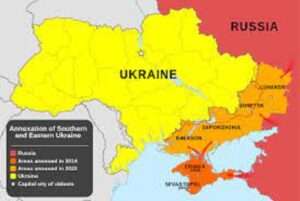
Vladimir Putin's regime is today in the process of trying to annex four regions of Ukraine: Luhansk, Donetsk, Zaporizhzhia and Kherson. Like the previous conquest and annexation of Crimea in 2014, this move is both illegal and deeply unjust. Russia's use of "referendums" to legitimate its land grap cannot change that. Many of the reasons why are blatantly obvious. But they do have some not entirely obvious broader implications.
Legally speaking, Russia's attempt to annex the four regions is a gross violation of one of the most basic principles of international law: the ban on waging wars of aggression for purposes of seizing another state's territory.The United Nations Charter specifically forbids "the threat or use of force against the territorial integrity or political independence of any State." The Nuremberg tribunal ruled that starting a war of aggression is "the supreme international crime." No referendum - even a completely fair and honest one - can cure that illegality.
Some might still argue that a regional majority has a moral right to secede and join another state, even if doing so is illegal. But that, too, cannot justify Russia's annexation plan. The referenda were rife with coercion and fraud to the point where people have been literally forced to vote for annexation at gunpoint. On top of that, Russia has forcibly deported some 1 million or more people from the occupied territories, killed or detained opponents of its policies, and led hundreds of thousands of others to flee, as refugees. Obviously, all these people had no say in the "referendums." If they had a choice, they almost certainly would not opt to join Russia. In sum, the annexation referenda were even more bogus than the 2014 Crimean referendum was.
As in the case of Crimea, even a truly fair majority vote in favor of annexation would not be enough to justify the imposition of a regime that is as repressive as that which Russia has imposed on the parts of Ukraine it has seized. In a post written at the start of the current Russian invasion in February, I summarized the oppressive nature of Russian rule in Crimea and the Donbass. Things have gotten even worse since then, as Russian forces have committed large-scale atrocities, and engaged in mass deportation of civilian populations. No majority vote can legitimize a regime like that. Being in the majority does not create a right to violate basic human rights of others.
Ukrainian rule in these areas is far from perfect. The Ukrainian government's human rights record has flaws of its own. But it is incomparably superior to annexation by a brutal tyranny.
Russia's claims to these regions are harder to reject if you believe that people have a right to be ruled by governments controlled by the same ethnic and linguistic group as they belong to themselves. Like in Crimea, many of the people in these four regions - perhaps even a majority - are either ethnic Russians, Russian-speaking Ukrainians, or some combination of both. Culturally, many may have more in common with Russians than with western Ukrainians, who primarily speak Ukrainian.
But the fact that people speak Russian and embrace various aspects of Russian culture doesn't necessarily mean they want to be ruled by the Kremlin. Available survey data and other evidence suggests most Russian-speaking Ukrainian citizens in fact do not want to be ruled by Vladimir Putin's regime. This data is reinforced by the even more powerful testimony of people voting with their feet. When Russia seized parts of these regions in 2014, and more at the start of the broader invasion earlier this year, millions fled west. By contrast, when Ukrainian forces recaptured parts of these areas in recent weeks, there was no such mass exodus. Only small numbers of collaborators chose to flee with the retreating Russian forces. Just as, historically, many English-speakers decided they did not want to be ruled by Britain, so today many Russian-speakers in Ukraine (and perhaps elsewhere) do not want to be ruled by Russia.
Even if ethno-nationalist considerations can justify annexation when the population of the region in question wants to be united with its supposed co-ethnics, in this case it pretty clearly does not. To justify Russia's annexation plans, nationalists have to argue that annexation of territories populated by co-ethnics is justified even if most of the population subject to the takeover is opposed to it.
For reasons in Chapter 5 of my book Free to Move: Foot Voting, Migration, and Political Freedom (see also this article), I reject, on principle, the theory that governments have a right to rule particular territories based on ties of race, ethnicity, or culture. Along the same lines, I also reject the view that regional ethnic majorities have a right to insist on being ruled by a state controlled by their own group. Governments should be judged by how well they respect human rights and promote the freedom and happiness of the populations they rule, not by their racial or ethnic composition. Thus, Moscow has no special right to rule people who speak Russian or affiliate with Russian culture. And ethnic Russians in other states do not have a special right to insist on annexation by the Kremlin, even if they happen to be a majority in a given region.
But if you accept the conventional wisdom that ethno-nationalist territorial claims have a measure of validity, then Russia's annexations become somewhat harder to condemn. That may especially be true of Crimea, where ethnic Russians were actually a majority of the population, when Russian forces seized the territory in 2014. Even then, ethno-nationalist considerations should give way in situations where the government with the seemingly stronger ethnic claim is vastly more oppressive - as is surely true when we compare Russia to Ukraine.
But defenders of ethno-nationalism might have to accept at least some degree of repression and human rights violations in cases where that is the only way to ensure that the "right" ethnic group rules the region in question. To my mind, that is yet another reason to simply reject ethno-nationalism entirely. Even a relatively small amount of oppression is too much to accept merely so that ethnic or racial Group A gets to control the government of a region rather than Group B. Race and ethnicity are morally arbitrary characteristics that do not justify sacrificing even one innocent person's life or liberty. If you think otherwise (and I admit many, perhaps even most, people do), you should at least consider how much sacrifice of this sort is morally defensible. Russia's aggression against Ukraine highlights the awful reality that such trade-offs are stark and real.
UPDATE: I have made a few modest changes and additions to this post.
We open today's episode with early news of the Supreme Court's decision to review whether section 230 protects platforms from liability for materially assisting terror groups whose speech they distribute (or even recommend). I predict that this is the beginning of the end of the house of cards that aggressive lawyering and good press have built for the platforms on the back of section 230. Why? Because Big Tech stayed out of the Supreme Court too long. Now, when section 230 finally gets to the Court, everyone hates Silicon Valley and its entitled content moderators. Jane Bambauer, Gus Hurwitz, and Mark MacCarthy weigh in admirably, despite the unfairness of having to comment on a cert grant that is less than two hours old.
Just to remind us why everyone hates Big Tech's content practices, we do a quick review of the week's news in content suppression.
A couple of conservative provocateurs prepared a video consisting of Democrats embracing "election denial." The purpose was to highlight the hypocrisy of those who criticize the GOP for a trope that belonged mainly to Dems until two years ago. And it worked all too well: YouTube did a manual review of the video before it was even released and demonetized it because, well, who knows? An outcry led to reinstatement, but too late for YouTube's reputation. Jane has the story.
YouTube also steps in the same mess by first suppressing then restoring a video by Giorgia Meloni, the big winner of Italy's recent election. She's on the right, but you already knew that from how YouTube dealt with her.
Mark covers an even more troubling story, in which government officials flag online posts about election security that they don't like for NGOs that the government will soon be funding, the NGOs take those complaints to the platforms, and the platforms take a lot of the posts down. Really, what could possibly go wrong?
Note: After the podcast went live, I heard from the head of one of the NGOs in question, excoriating the source (JustTheNews.com) as unreliable in general and in connection with this story. The project's detailed critique of the story is here.
Jane asks why Facebook is "moderating" private messages sent by the wife of an FBI whistleblower. I suspect that this is not so much content moderation as part of the government and big tech's hyperaggressive joint pursuit of anything related to January 6. But it definitely deserves investigation.
Across the Atlantic, Jane notes, the Brits are hating Facebook for the content it let 14-year-old Molly Russell read before her suicide. Exactly what was wrong with the content is a little obscure, but we agree that material served to minors is ripe for more regulation, especially outside the US.
For a change of pace, Mark has some largely unalloyed good news. The ITU will not be run by a Russian; instead it has elected an American, Doreen Bodan-Martin to lead it.
I also note a large privacy flap Down Under, where the exposure of lots of personal data from a telco database seems likely to cost the carrier, and its parent dearly.
You can subscribe to The Cyberlaw Podcast using iTunes, Google Play, Spotify, Pocket Casts, or our RSS feed. As always, The Cyberlaw Podcast is open to feedback. Be sure to engage with @stewartbaker on Twitter. Send your questions, comments, and suggestions for topics or interviewees to CyberlawPodcast@steptoe.com. Remember: If your suggested guest appears on the show, we will send you a highly coveted Cyberlaw Podcast mug!
The views expressed in this podcast are those of the speakers and do not reflect the opinions of their institutions, clients, friends, families, or pets
Updated to reflect a response to the story about NGOs influencing content moderation. More to come.
Thought I'd pass it along, though I expect many of you have already read it; it is pretty funny. It's written by Stephen J. van Stempvoort & D. Andrew Portinga (Miller Johnson).
Seems quite sound to me; here's the introduction and some examples, but read the whole thing:
The issue: Online payment processors like Venmo and PayPal often deny Americans access to these vital services based on their speech or viewpoints.
The concern: When these companies appoint themselves the arbiters of what speech and views are acceptable, shutting people and organizations out of the online financial ecosystem for wrongthink, they seriously undermine our culture of free expression.
Imagine you could no longer use PayPal, Venmo, or another online payment processor because you run an organization that defends free speech for controversial speakers, operate an independent media outlet that challenges mainstream narratives, sell erotic fiction or "occult" materials, or … tried to submit an article about Syrian refugees into a newspaper awards competition.
These are not hypotheticals. They're real, and they illustrate why online payment service providers should stay out of the business of policing their users' speech and views.
Access to online payment systems is crucial for the innumerable individuals and organizations that rely on financial support for their expressive activity. It's essential to content creators' ability to earn a living, to websites' and other businesses' ability to raise revenue, to fundraising by political candidates and nonprofit organizations, and to everyday Americans' ability to consume content and support causes they believe in. When payment processing services act as political hall monitors or moral arbiters deciding what speech and viewpoints are out of bounds, they present a grave threat to free expression.
A small number of companies dominate the space, allowing them to wield significant control over the speech environment by denying service to users who express disfavored views or wade into controversial subject matter. PayPal (which owns Venmo), for instance, has 325 million active users. Merchants and individuals put on payment processors' blacklists may find themselves in a financially precarious situation….
I posted the eighth episode of my podcast "Strangers on the Internet" (the direct link for Apple Podcasts is here). In this installment, my co-host, psychologist Michelle Lange and I pick apart dating advice from the Interwebs, (in)famous listicles, and popular tropes such as Hollywood's dating plot lines from the last two decades.
One of the recent reads about online dating worth checking out is the NY Times' retrospective on 10 years of Tinder.
I've blogged a lot recently about limits on pseudonymous litigation, and readers will have gathered that I think such litigation should generally not be allowed. But "generally" isn't "always" (much more on that here), nor do I think that it should be always. (I explained in my post about Doe v. Volokhwhy I thought the underlying case I wrote about there was rightly depseudonymized, but that had to do with particular features of that case.)
And of course we've heard of plenty of pseudonymous cases: Roe v. Wade, Doe v. Reed, Santa Fe Indep. School Dist. v. Doe, Plyer v. Doe, and more. None of those Supreme Court opinions discuss pseudonymity at length, but they're obviously open to it. What justifies pseudonymity there, where the legal rule is usually strongly against pseudonymity in other cases?
The chief distinction has to do with the key function of identifying parties' names: the ability of the public to supervise the judicial process, and to monitor whether the factfinding related to the parties is sound. And that's why courts are generally more open to pseudonymity in cases that "present[]" "purely legal … issues"—chiefly the legal validity or invalidity of a such statute (as in Roe). In such cases, the courts conclude, "there is an atypically weak public interest in knowing the litigants' identities." (That's from the Second Circuit's leading pseudonymity case, fittingly titled Sealed Plaintiff v. Sealed Defendant, as well as from the Third Circuit's Doe v. Megless.)
Likewise, to quote Publius v. Boyer-Vine(where I was one of the lawyers representing the pseudonymous Publius, though several years before I started actually focusing on pseudonymity as a topic for scholarship, blogging, or litigation),
At Slate, Mark Joseph Stern writes that constitutional law professors are "giving up on the Supreme Court:"
The problem, it's worth emphasizing, is not that the Supreme Court is issuing decisions with which left-leaning professors disagree. It's that the court seems to be reaching many of these conclusions in defiance of centuries of standards, rejecting precedent and moderation in favor of aggressive, partisan-tinged motivated reasoning. Plenty of progressive professors have long viewed the court with skepticism, and many professors, right- and left-leaning, have criticized the reasoning behind certain opinions for decades. But it's only in recent years—with the manipulation of the justice selection process combined with clear, results-oriented cynicism in decisions—that the problem has seemed so acute that they feel it affects their ability to teach constitutional law.
Actually, the fact that the Court is solidly conservative, and the constitutional law professoriate overwhelmingly liberal or further left, is exactly the problem. In the past, the left could count on the Court for sporadic big victories: same-sex marriage, affirmative action, abortion. Now they can't, so they have turned against the Court. We all know that left-learning lawprofs would be dancing in the streets if SCOTUS were equally aggressive to the left. And indeed, while Stern portrays discontent with the Court as a question of professional standards rather than ideology, he does not manage to find a single right-leaning professor to quote in his article.
The Harlan Institute and Ashbrook are pleased to announce the Eleventh Annual Virtual Supreme Court Competition. This competition offers teams of two high school students the opportunity to research cutting-edge constitutional law, write persuasive appellate briefs, argue against other students through video chats, and try to persuade a panel of esteemed attorneys during oral argument that their side is correct. This year the competition focuses on Students for Fair Admission v. University of North Carolina.
The Virtual Supreme Court Competition helps students gain the skills they need to understand, synthesize, and advocate for reasoned legal positions on timely and relevant constitutional issues, and in doing so deepens their commitment to the rule of law. The program directly supports the highest goals of the Center for Civic Education to develop enlightened and responsible members of our society, and it is a privilege to be a part of this important work. Christopher R. Riano President, The Center for Civic Education Member Board of Advisors, The Harlan Institute
Using historical materials related to the Fourteenth Amendment, and the precedents of the United States Supreme Court, teams of two high-school students will write an appellate brief, and present oral arguments, addressing this question:
Is race conscious affirmative action consistent with the Fourteenth Amendment to the United States Constitution?
Petitioners will argue that the Fourteenth Amendment prohibits state universities from using race conscious affirmative action.
Respondents will argue that the Fourteenth Amendment does not prohibit states universities from using race conscious affirmative action.
Phase 1 - Research and Write Your Brief
Coaches can register their teams at the Institute for Competition Sciences. After registering, teachers should contact the Harlan Institute and Ashbrook at info@HarlanInstitute.org. We will assign teams to argue on behalf of the Petitioners or the Respondents.
Teams will research and write their briefs. The brief must be a minimum of 2,000 words. Please download this template. The brief should have the following sections:
Table of Cited Authorities: List all of the original sources, and other documents you cite in your brief.
Summary of Argument: State your position succinctly in 250 words or less.
Argument: Structure your argument based on at least five primary historical sources and at least three Supreme Court precedents. The more authorities you cite, the stronger your argument will be–and the more likely your team will advance.
Conclusion: Summarize your argument, and argue how the Supreme Court should decide this issue.
Be sure to proofread your work. The work must be yours, and you may not seek help from anyone else–including attorneys or law students. Students who submit plagiarized briefs will be disqualified.
Please review the winning submissions from previous years:
Teams that register before November 1, 2022 will be invited to participate in a virtual mentoring session. These sessions will be hosted during the week of November 14, 2022. The Harlan Institute will match each class with a mentor from our network. These sessions will be helpful to finalize your briefs and prepare your preliminary round arguments.
Phase 3 - Preliminary Round
For the preliminary round, each team must prepare a YouTube video. The argument must be at least 15 minutes in length. Coaches will ask their students the following ten questions:
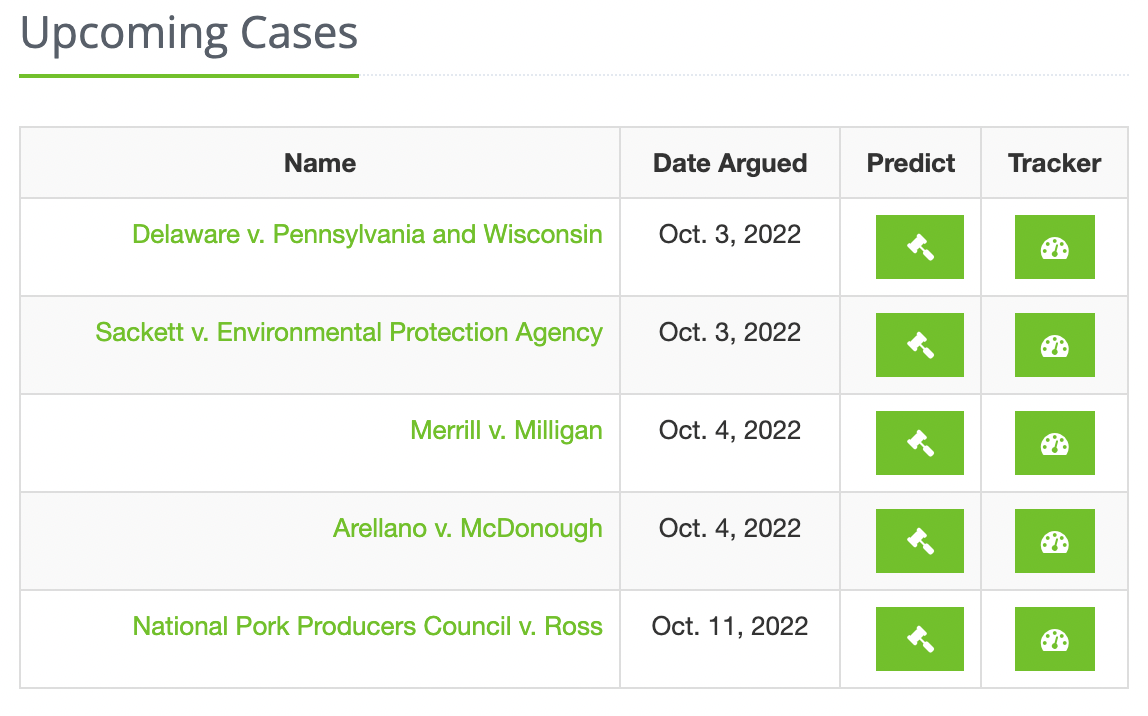
I am honored to open up the 14th Season of FantasySCOTUS. I launched the site back in 2009 when I was still clerking. Now, more than decade later, thousands of Court watchers have made their predictions. Sign up today at FantasySCOTUS.net to predict the outcome of all the blockbusters this term, including Sackett, Merrill, Students for Fair Admission, Moore, 303 Creative, and others.
From U.S. v. Harper, decided Friday by Judge Leonard Strand (N.D. Iowa):
[Harper is being prosecuted for] possession of a firearm by a felon and unlawful drug user in violation of 18 U.S.C. §§ 922(g)(1) and (3) and § 924(a)(2)…. Harper argues that [he is entitled to a religious exemption from these laws because] he is a Muslim who practices "Sharia Law and its adherence to armed self-defense (including the possession of a firearm.)." …
"Congress enacted RFRA in order to provide greater protection for religious exercise than is available under the First Amendment." RFRA provides that "Government shall not substantially burden a person's exercise of religion even if the burden results from a rule of general applicability," unless the Government "demonstrates that application of the burden to the person (1) is in furtherance of a compelling governmental interest and (2) is the least restrictive means of furthering that compelling governmental interest." "RFRA requires the Government to demonstrate that the compelling interest test is satisfied through application of the challenged law 'to the person'—the particular claimant whose sincere exercise of religion is being substantially burdened." …
I will assume without deciding that Harper's practice of possessing a firearm for self-defense was a sincerely held religious belief and that prosecution substantially burdened his exercise of religion. Therefore, it is the Government's burden to prove that prosecution of Harper is in furtherance of a compelling government interest and that it is the least restrictive means of furthering that interest. The Government argues "the gun control regime of the United States is a compelling governmental interest and can only be maintained by a systematic and uniform application."





 I am honored to open up the 14th Season of