Our peer-reviewed Journal of Free Speech Law, which is now two years old, has published dozens of articles, including by Jack Balkin (Yale), Mark Lemley (Stanford), Jeremy Waldron (NYU), Cynthia Estlund (NYU, forthcoming within a week or so), Christopher Yoo (Penn), Danielle Citron (Virginia), and many others—both prominent figures in the field and emerging young scholars (including ones who didn't have a tenure-track academic appointment).
I expect that many authors are planning to submit articles on free speech to the usual law reviews when the submission cycle begins in February. But if you submit exclusively to us before that, we will give you an answer within 14 days (our guarantee, which we have so far never broken); and then if you'd like to have it published quickly, we can publish it in within several weeks, if it's sufficiently clean and cite-checked by your research assistant. (We can also have it cite-checked for you by one of our student staffers, but that takes a bit longer.) This means your article can be published by us, if it's accepted, almost a year (or more) before it would be published by the law journals.
Of course, also please pass this along to friends or colleagues who you think might be interested. Note that the submissions don't compete for a limited number of slots in an issue or volume; we'll publish articles that satisfy our quality standards whenever we get them.
All submissions must be exclusive to us, but, again, you'll have an answer within 14 days, so you'll be able to submit elsewhere if we say no. Please submit an anonymized draft, together with at https://freespeechlaw.scholasticahq.com/. A few guidelines:
Senator Ben Sasse (R-NE), who will soon take leave of the Senate to become President of the University of Florida, has an op-ed in the Wall Street Journal on "America's True Divide: Pluralists vs. Zealots." It begins:
The most important divide in American politics isn't red versus blue. It's civic pluralists versus political zealots. This is the truth no one in Washington acknowledges but Americans must realize if we're going to recover.
Civic pluralists understand that ideas move the world more than power does, which is why pluralists value debate and persuasion. We believe America is great because it is good, and America is good because the country is committed to human dignity, even for those with whom we disagree. A continental nation of 330 million souls couldn't possibly agree on everything, but we can hash out our disagreements in the communities where we live and the institutions we build. The small but important role of government, for the civic pluralist, is a framework for ordered liberty. Government doesn't give us rights, or meaning, or purpose or permission. It exists to protect us from the whims of mobs and majorities.
Political zealots reject this, holding that society starts and ends with power. Government in their view isn't to protect from the powerful or the popular. More than anything else, zealots—on the right and the left—seek total victory in the public square. They believe that the center of life is government power. They preach jeremiads of victimhood and decline. On the left, they want a powerful bureaucracy. On the right, they want a strongman. But they agree on a central tenet: Americans are too weak to solve problems with persuasion. They need the state to do it.
Sen. Sasse identifies how te zealots have made Congress dysfunctional and drive tribal divisions.
The stupidity of tribalism has made politics primarily about partisan identities, not persuasion or policy. The screamers on the right and left fuel one another. In a nation as big as ours, there is always someone somewhere saying something stupid—but tribalism takes this fact as its lifeblood. And it's the excuse for otherwise civic-minded Americans to ignore the nuts in their own party and obsess only over the nuts in the other party. We're tempted to think that the enemy of my enemy is my friend. It takes a genuine leader to remind us that most of the time, the enemy of our enemy is still a jackass.
In the past, Sen. Sasse notes, the U.S. Senate was a bit of a calming force against such pressures, a place where tempers could cool and political leadership could flourish. In recent years, however, Sasse believes the Senate has been AWOL. (And let's not even talk about the House, where the zealots are making the election of a Speaker into a farce.)
While Sasse focuses on how these divides affect politics, his experience becoming the next President of the University of Florida highlights the fact that zealots are not confined to the political sphere, and the divide that concerns him is alive and well in academia. (Indeed, the dynamic we see in the House Speaker contest, in which a few extremists seek to hold an entire institution hostage, is a familiar scene in academia, albeit with a different political valence.)
Although he is leaving the Senate, Sen. Sasse believes the institution has a role in solving this problem (though he apparently sees no role for himself in driving this change).
if recovery is to come, here's what it will look like: Senators will have to acknowledge that a politicized echo chamber is unworthy of the world's greatest deliberative body. Citizens will have to see that recovery means resisting the temptation to reduce fellow Americans to caricatures of their political affiliations. Recovery requires investment in things that will outlast partisan preferences. We must steward the present age, and play our small but vital parts in the work of self-government.
Rapper DaBaby was found not liable for breach of contract or battery in this case two weeks ago as to one plaintiff (Carey) and for $100 in damages as to another (Anyadike), apparently conveniently offset by $100 that DaBaby would get from the two in a counterclaim invasion of privacy and unauthorized use of name or likeness counterclaim. But the defamation claims against DaBaby had been thrown out in September, in an opinion (Carey v. Kirk) by Judge Jose Martinez (S.D. Fla.) that was just posted on Westlaw in the last couple of days:
Sometimes being a Rockstar, or simply acting like one, has consequences. Plaintiffs' case arises out of a physical altercation between Defendant Jonathan Kirk, a/k/a DaBaby, and Plaintiffs Kenneth Carey and Steve Anyadike….
The incident giving rise to this lawsuit can best be described as a Big Business deal gone wrong. Kirk entered into a written agreement with Anyadike to make a "social media drop" and event walkthrough at a show scheduled to take place on January 2, 2020, at a nightclub in Pembroke Pines, Florida. In exchange, Anyadike agreed to pay Kirk a $20,000 engagement fee. What actually happened on January 2, 2020 is in much dispute. But one thing is clear: Kirk hit Anyadike. His reasons for doing so, however, are hotly contested by the parties. Premised on this background, Plaintiffs filed suit against Kirk ….
[T]he Court finds that the only claims that survive summary judgment are Anyadike's claim against Kirk for breach of contract (Count I), and Carey's claims against Kirk for assault (Count II) and battery (Count III). Further, because the Court finds Kirk liable for assault (Count II) and battery (Count III) as to Anyadike, this claim also proceeds to trial for a determination of Anyadike's damages….
The parties cross-move for summary judgment on the defamation claims (Count VI). For the following reasons, the Court grants Kirk's motion for summary judgment on this claim….
A common law claim for defamation in Florida requires the following elements: "(1) publication; (2) falsity; (3) actor must act with knowledge or reckless disregard as to the falsity on a matter concerning a public official, or at least negligently on a matter concerning a private person; (4) actual damages; and (5) statement must be defamatory." A "defamatory" communication is one that "tends to harm the reputation of another as to lower him or her in estimation of community or deter third persons from associating or dealing with the defamed party."
Plaintiffs bring both a per se and per quod defamation action. Defamation per se must be "actionable on its face" and does not "require[] additional explanation of the words used to show that they have a defamatory meaning and that the person defamed is the plaintiff." Defamation per quod, on the other hand, "requires additional explanation of, or an interpretation of innuendo suggested by the words used to demonstrate the defamatory meaning or that the plaintiff is the subject of the statement." The critical distinction between the two is that in per se cases, the Court may only consider the "'four corners' of the publication and 'the injurious nature of the statement' must be apparent from the words of the publication itself."
On this special first episode of season 2, (Apple Podcasts link here and Spotify link here) of Strangers on the Internet with co-host and psychologist Michelle Lange, we welcome bestselling author, award-winning journalist, filmmaker and producer Nancy Jo Sales. A long-time critic of online dating and social media--her viral piece on how Tinder destroyed dating is here--Nancy Jo talks in part 1 of this interview about why dating app operators consider her such a thorn in their side, how dating apps are intentionally addictive, and why we see so much victim-blaming when apps lead to nefarious encounters. What does evolutionary biology have to do with dating apps? And why does Nancy Jo think that these apps have deep cultural effects such as turning men callous? Come listen to one of the most distinctive voices on all matters dating apps - things are about to get salty!
Nancy Jo's book "Nothing Personal: My Secret Life in the Dating App Inferno" is available here and her book "American Girls: Social Media and the Secret Lives of Teenagers" is available here. Her documentary "Swiped: Hooking up in the Digital Age" can be found here. Her latest piece in the Guardian about how women have started calling out toxic online dates in social media groups is here.
Some helpful previous podcast episodes to check out are our review of ten years of Tinder and our exclusive interview with Tinder Swindler victim Cecilie Fjellhøy (part 1 and part 2).
Don't forget to hit "Follow" here so you can automatically get part 2 of our Nancy Jo Sales interview and our future episodes on your preferred platform!
AI tools like ChatGPT can generate essays. And, as my little thought experiment demonstrated, many people cannot distinguish the words that I put together from the words assembled by ChatGPT. (I assure you, this is Josh typing--or is it?) But did you know that similar technology can also answer multiple choice questions?
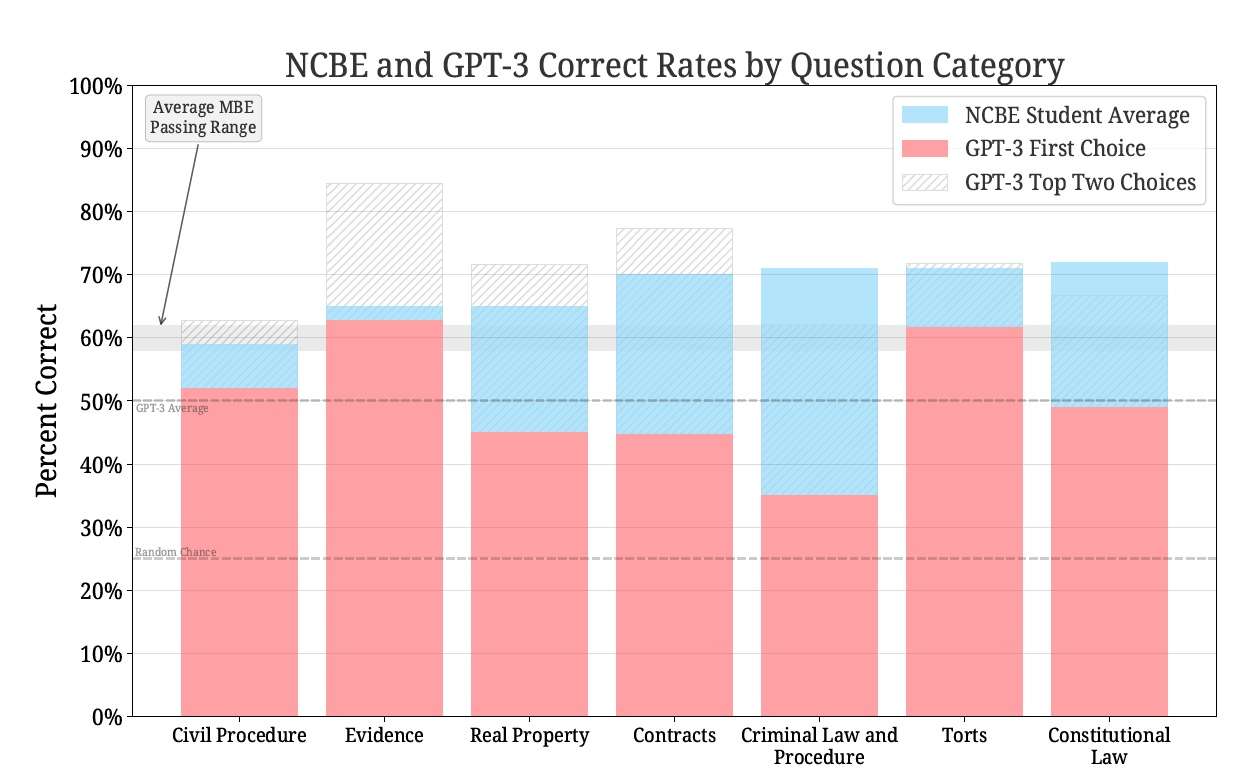
My frequent co-authors, Mike Bommarito and Dan Katz utilized a different software tool from OpenAI, known as GPT-3.5, to answer the multiple choice questions on the Multistate Bar Examination (MBE). If there are four choices, the "baseline guessing rate" would be 25%. With no specific training, GPT scored an overall accuracy rate of 50.3%. That's better than what many law school graduates can achieve. And in particular, GPT reached the average passing rate for two topics: Evidence and Torts. (I'll let Evidence or Torts scholars speculate about why those topics may be easier for AI.) Here is a summary of the results from their paper:
The table and figure clearly show that GPT is not yet passing the overall multiple choice exam. However, GPT is significantly exceeding the baseline random chance rate of 25%. Furthermore, GPT has reached the average passing rate for at least two categories, Evidence and Torts. On average across all categories, GPT is trailing human test-takers by approximately 17%. In the case of Evidence, Torts, and Civil Procedure, this gap is negligible or in the single digits; at 1.5 times the standard error of the mean across our test runs, GPT is already at parity with humans for Evidence questions. However, for the remaining categories of Constitutional Law, Real Property, Contracts, and Criminal Law, the gap is much more material, rising as high as 36% in the case of Criminal Law.
In this graphic, the blue area indicates the NCBE student average, and the red area indicates the top choice generated by GPT. As you can see, for Evidence in particular, the machine is just about ready to beat man. Objection overruled. Resistance is futile.
The authors, who are leaders in this field, were extremely surprised by their results. They expect a similar tool to be able to pass the MBE somewhere between 18 months from now, and tomorrow:
Overall, we find that GPT-3.5 significantly exceeds our expectations for performance on this task. Despite thousands of hours on related tasks over the last two decades between the authors, we did not expect GPT-3.5 to demonstrate such proficiency in a zero-shot settings with minimal modeling and optimization effort. While our ability to interpret how or why GPT-3.5 chooses between candidate answers is limited by understanding of LLMs and the proprietary nature of GPT, the history of similar problems strongly suggests that an LLM may soon pass the Bar. Based on anecdotal evidence related to GPT-4 and LAION's Bloom family of models, it is quite possible that this will occur within the next 0-18 months.
As Jonathan Adler points out, the Wall Street Journal has an article on how US News and World Report is planning to make changes to its influential law school rankings system:
In a letter sent Monday to deans of the 188 law schools it currently ranks, U.S. News said it would give less weight in its next release to reputational surveys completed by deans, faculty, lawyers and judges and won't take into account per-student expenditures that favor the wealthiest schools. The new ranking also will count graduates with school-funded public-interest legal fellowships or who go on to additional graduate programs the same as they would other employed graduates.
The motive for the changes may well be the revolt against US News undertaken by numerous high-ranking schools which have announced they will no longer cooperate with the rankings by providing information used in the rankings. The elements downgraded or eliminated are mainly ones US News depends on schools to provide. Faculty and deans at non-participating schools may now be less likely to fill out the reputational surveys (though, as far as I can tell, no law school has actually forbidden such participation by its faculty). And US News relies on schools to provide expenditure data.
But, whatever the motive, these are changes for the better. I have long criticized the use of expenditure data because it effectively rewards wasteful spending. As I explained way back in 2006:
[I]f School A and School B are exactly equal in the quality of their students, faculty, facilities, etc., but School A spends twice as much money per student to get this result as School B, then A will come out well ahead in the US News rankings. A is actually rewarded for being far less efficient in getting educational value for its money than B! Thus, the US News system gives schools an incentive to engage in wasteful expenditures. This is particularly unfortunate in the case of public law schools, where some of the funds expended are taxpayer money. And even private law schools receive many direct and indirect government subsidies as well.
There is no reason to believe that including expenditures provides useful information to applicants or others interested in the school's quality. To the extent that the money the school spends translates into real improvements in quality, these can be measured directly by including ratings for the quality of the faculty, student body, and facilities. Many of these factors are already included in the US News formula and the rest certainly can and should be….
Good riddance to this perverse incentive!
The reputational surveys - which are currently the most heavily weighted components of the US News system (25% for the law school faculty survey and 15% for the survey of lawyers and judges) are also badly flawed. The problem is that most of those surveyed have little idea of what goes on at most schools.
There are currently some 190 American Bar Association-accredited law schools in the US. Most legal scholars don't have time to keep close track of more than a small fraction of them. The same is even more true of most lawyers and judges.
I'm a law professor myself. If I tried to keep track of various indicators of student and faculty quality at more than a small fraction of all the law schools in the United States, it would be almost a full-time job. At the very least, it would divert much valuable time and energy away from teaching and scholarship. That would obviously be a poor trade-off for my career prospects. But it would also be bad for my institution (which is why schools don't usually reward faculty for developing expertise about other law schools). I keep track of scholarship in my fields, and therefore have a fairly good idea of which schools have faculty doing important work on issues I write about myself. But I don't know much about what happens at most other schools beyond that.
In effect, I am "rationally ignorant" about most of what goes on at the vast majority of law schools. That is also true of most other legal scholars, and also most lawyers and judges. They too have competing demands on their time that (in most cases) preclude keeping close track of the strengths and weaknesses of 190 law schools. At best, lawyers and judges have incentives to have some knowledge of a few top national schools, plus a few in their region whose graduates they regularly encounter.
Because most US News survey respondents are rationally ignorant about most of the schools they are supposed to rate, the rankings they give are heavily influenced by crude shortcuts and stereotypes, such as rating schools based on the general prestige of the universities they are attached to. The system also discriminates against relatively new schools and those whose quality has improved rapidly in ways poorly informed observers are likely to miss. By contrast, it benefits declining institutions who are living off of old reputational capital.
My only potential reservation about this change is that it's not clear how much the reputational ratings will be downgraded. Ideally, they should be abolished entirely. But even a moderate reduction in their significance will be an improvement.
I am a bit more tentative in my assessment of the third change US News plans to make: counting graduates with public-interest fellowships as employed, and doing the same for those who go on to additional graduate education. On balance, this seems a good change. However, during the 2008-09 recession and its aftermath, some schools tried to game the system by giving graduates fellowships of questionable career value, in order to boost their employment numbers. This seems like a self-limiting problem, because most schools can't afford to hand out more than a relatively small number of such Potemkin Village fellowships. But it's still an issue US News should consider.
Whether the changes made by US News placate any of the rebelling schools remains to be seen. There is only modest overlap between the changes and the complaints raised by Yale Law School Dean Heather Gerken in her letter that kicked off the revolt against the US News rankings.
In addition to raising the fellowship issue (on which US News has now moved in her direction), she also urged downgrading of the role of LSAT scores. US News' decision to instead downgrade reputational surveys and eliminate per-student expenditures is likely to actually make LSAT scores a bigger component of the ranking system.
While I am far from the biggest fan of the LSAT, on balance I think it plays a useful role in rankings and law school admissions. Schools need some objective metric to compare students from hundreds of different undergraduate institutions. Absent the LSAT (or some other standardized test), this is extremely difficult to do.
Moreover, removing standardized tests from the equation (or greatly downgrading them) will actually favor graduates of more elite undergraduate institutions. How can an applicant from, say, the University of Idaho, prove he or she is as good as one from Harvard? Even if she has a similar or better GPA, many admissions officers will be skeptical of that metric, because it's hard to say whether the classes she took were as rigorous. Plus, she might have been competing against weaker classmates than the Harvard grad. The LSAT helps level that playing field. And it is a strong predictor of academic success in law school (though admittedly still far from perfect).
In principle, the LSAT can be replaced with some other, better, standardized test (I don't doubt it has significant flaws). Alternatively, law schools could develop better ways to compare GPAs across undergraduate schools that take account of the differences between them. But the latter is likely to require costly research and data collection that - so far, at least - no one has been willing to do.
In sum, US News' changes are a step in the right direction. That's true regardless of their motives, and regardless of whether they succeed in placating rebel law schools. Ultimately, US News (and other ranking producers) don't need law schools' endorsement to do rankings based on publicly available data. And applicants don't need that endorsement to use the rankings to help make their decisions.
And that's a good thing! The law school industry (myself included!) should no more enjoy veto power over law school rankings systems than the auto industry should have veto power over institutions that rank the quality of various types of cars. In both cases, there is an obvious conflict of interest.
Of course, that doesn't mean applicants should rely solely on US News. Other rankings - most notably the Leiter ranking of student and faculty quality - also have useful information (faculty quality continues to be a notable omission in the US News system). And there are some factors relevant to applicant decision-making that no existing ranking system covers well, such as the ways in which going to a particular school can advance your career in a particular region (as opposed to nationally). If you really want to practice law in Montana, it may well make sense to choose the University of Montana - with its many connections to influential lawyers and judges in the state - over many schools with higher national ratings.
The US News system still has flaws and limitations. But the changes revealed today will likely make it better than before.
NOTE: As legal scholar Derek Muller points out in his analysis of the US News changes, my own institution (George Mason University, currently ranked no. 30), is likely to be among the biggest beneficiaries of the downgrading of reputation scores relative to other metrics. I think we will also benefit, at the margin, from the exclusion of per-student expenditures. If readers believe this makes me a biased observer, I can understand that. Ultimately, few if any law professors can be completely unbiased about law school rankings systems. I will only say that the merit (or lack thereof) of my arguments can and should be assessed independently of my motives for making them.
From Michigan Supreme Court Justice Bridget McCormack's majority opinion (for four of the seven Justices) delivered Thursday in People v. Gafken:
[W]hile fleeing from police, Theresa Gafken ran a red light at speeds topping 100 miles per hour and collided with other vehicles, killing one person and causing severe injuries to several others; Gafken was also injured. The prosecution charged her with second-degree murder, and two counts of operating a vehicle while intoxicated (OWI) causing serious impairment of a body function.
Before trial, Gafken moved to allow certain testimony. Specifically, she asked to be allowed to testify that she intended to pull over when the police officer activated his overheard [sic] lights and that she didn't do so because Michael Scandalito, who was sitting behind her, then thrust a gun into her ribs and threatened to kill her if she stopped the car. She also wanted to testify that Scandalito was on parole and being sought for a parole-violation warrant and had committed aggravated assault against his mother while in a methamphetamine rage….
The majority held that the testimony should have been admitted, and Gafken should have been able to use the duress defense based on that testimony. Here's the heart of the short majority opinion, though there is also an interesting and much more detailed concurrence, plus three detailed dissents.
"The elements of second-degree murder are: (1) a death, (2) caused by an act of the defendant, (3) with malice, and (4) without justification or excuse." Malice may be established in three ways: by showing (1) the intent to kill, (2) the intent to cause great bodily harm, or (3) the intent to do an act in wanton and willful disregard of the likelihood that the natural tendency of such behavior is to cause death or great bodily harm…. The prosecution charged Gafken only under the third theory of malice, commonly referred to as depraved-heart murder.
"Duress is a common-law affirmative defense." … "The rationale of the defense of duress is that, for reasons of social policy, it is better that the defendant, faced with a choice of evils, choose to do the lesser evil (violate the criminal law) in order to avoid the greater evil threatened by the other person." …
Today the Wall Street Journal reports that U.S. News & World Report is making some dramatic changes to the formula it uses to rank law schools, partially in response to complaints from law schools that objected to aspects of the rankings.
In a letter sent Monday to deans of the 188 law schools it currently ranks, U.S. News said it would give less weight in its next release to reputational surveys completed by deans, faculty, lawyers and judges and won't take into account per-student expenditures that favor the wealthiest schools. The new ranking also will count graduates with school-funded public-interest legal fellowships or who go on to additional graduate programs the same as they would other employed graduates.
U.S. News said its rankings team held meetings with more than 100 deans and other law-school administrators in recent weeks. They embarked on the listening tour after Yale Law School—perennially ranked at No. 1—said it would no longer provide information to help U.S. News compile its list. . . .
The shift in methodology may be due in part to necessity. Though U.S. News pulls much of its data from the American Bar Association and said it would rank schools whether or not they cooperated, it relies on schools to provide the spending figures and to complete peer-review surveys. . . .
Mr. Morse and Ms. Salmon said they also heard concerns in their meetings about how U.S. News considers diversity and loan forgiveness and potentially encourages awarding scholarships based on LSAT scores rather than on financial need. They wrote in the Monday letter that those issues "will require additional time and collaboration to address" so won't be overhauled now.
At his Excess of Democracy blog, Professor Derek Muller has some preliminary analysis of how these changes could affect the rankings, naming schools he expects to win and lose from the new formula. He concludes:
I feel fairly confident that a handful of the schools identified above as winners in several categories, including Alabama, BYU, Georgia, and Texas A&M, will benefit significantly in the end, but one never knows for sure. It also has the potential to disrupt some of the more "entrenched" schools from their positions, as the more "legacy"-oriented factors, including spending and the echo chamber of reputational surveys, will receive less value. Law schools must increasingly face the value proposition for students (e.g., lower debt, better employment outcomes), with some other potential factors in the mix, in the years ahead.
In November, Ruth Marcus's column opened with this anecdote:
On the final day of oral arguments last term, the chief justice's voice cracked with emotion as he bade farewell to the retiring Justice Stephen G. Breyer. It was a striking moment for the normally buttoned-up John G. Roberts Jr., and one that seemed to signify more than sorrow at the departure of a longtime colleague. It is not far-fetched to imagine that Roberts was mourning the decisive end of his vision of presiding over an institution seen as operating above the partisan fray. "I've lost my only friend on the court," Roberts told someone afterward.
Roberts told someone who told Ruth Marcus, or something like that. My initial reaction was, what about Justice Kavanaugh? Roberts and Kavanaugh vote like two peas in a moderate pod. Yet, apparently, Robert does not consider his fellow Chevy Chaser a friend. Ouch.
Now, we have a column from Josh Gerstein at Politico about Justice Kagan. Her friends are also talking to the press.
In interviews, friends and allies of the 62-year-old justice suggest she is at a major crossroads — mulling whether the breakdown in the broader American political scene has rendered her decadelong effort to find compromise and consensus on the nation's highest court obsolete, while sowing doubts about her future.
The fact that her comments seem to have prompted equally unusual public retorts by some of her conservative colleagues — principally Justice Samuel Alito — only underscored the sense of brewing discontent.
"She's clearly not very happy," said one longtime associate, who like many interviewed for this story asked to speak anonymously due to the sensitivity of the issues involved and due to concern about impact on cases pending at the court.
Many saw her comments as a profound warning that all is not well on the court, both in terms of relations between the justices and in terms of its historic reputation.
…
"Elena is very intentional and personable," one Kagan associate said when asked about the liberal justice's unusual public criticism of her colleagues. "She tried the other route, right? … She went skeet shooting with Scalia. She traveled with Gorsuch to Iceland … She's tried everything. She was going to be the bridge builder."
In June 2020, Chief Justice Roberts and Justice Kagan were at the top of the world. In virtually every case, Roberts and Kagan were able to reach some compromise to get to five. Really, every compromise went to the left. The dirty secret is that "compromise" always serves the left. Show me a single "compromise" decision that advances conservative jurisprudence. But whatever, Roberts thought he was in charge. I jokingly referred to Kagan as the real Chief Justice.
What a difference two years makes. With Justice Ginsburg's passing, the Chief's fifth vote is no longer needed. And Justice Kagan is done trying to build bridges. No wonder she is "not happy." Kagan joined the Court with the goal of tempering the rightward lurch. Remember Laurence Tribe's infamous letter to President Obama, which said that Kagan, rather than Sotomayor, would be able to build bridges to Justice Kennedy? But now she can only stand by and watch. All those years of carefully discussing stare decisis went out the window in Dobbs.
Today the en banc U.S. Court of Appeals for the Eleventh Circuit rejected a transgender student's statutory and constitutional challenge to a school-district policy barring students from using single-sex bathrooms that do not correspond with the student's biological sex (or, as it appears from the facts of the case, the student's sex when initially enrolled). Specifically, the court concluded that the policy neither violates the Equal Protection Clause nor the requirements of Title IX. Insofar as this decision disagrees with that of the U.S. Court of Appeals for the Fourth Circuit in G.G. v. Gloucester County, it would seem a strong candidate for certiorari—assuming that Adams seeks Supreme Court review.
The court split 7-4. Judge Lagoa wrote the majority opinion in Adams v. School Board of St. Johns County, joined by Chief Judge Bill Pryor and Judges Newsom, Branch, Grant, Luck, and Brasher. Judge Lagoa also wrote a separate concurring opinion with additional views. Judges Wilson, Jordan, Rosenbaum, and Jill Pryor dissented, each writing an opinion. (Judges Wilson and Rosenbaum joined Judge Jordan's dissent, and Judge Rosenbaum joined Judge Pryor's dissent in part.) The opinions together span 150 pages.
Excerpts from some of the opinions are below the jump.
So Judge John L. Sinatra Jr. (W.D.N.Y.) held yesterday in Spencer v. Nigrelli:
Plaintiffs argue that, by "prohibiting the exercise of a fundamental constitutional right in places of worship while permitting its exercise on other private property—and by denying to religious leaders the authority it reserves to other private property owners to permit firearms," the State "treats comparable secular activity more favorably than religious exercise and discriminates on the basis of religion." For this reason, and as set forth below, the houses of worship exclusion violates Plaintiffs' right to free exercise of religion guaranteed by the First Amendment. …
"[A] plaintiff may carry the burden of proving a free exercise violation" by "showing that a government entity has burdened his sincere religious practice pursuant to a policy that is not 'neutral' or 'generally applicable.'" Should a plaintiff make such a showing, the Court must find a First Amendment violation "unless the government can satisfy 'strict scrutiny' by demonstrating its course was justified by a compelling state interest and was narrowly tailored in pursuit of that interest." {The Court need not resolve the issue of whether a threshold showing of a burden on a sincerely held religious belief is required [for religious discrimination claims -EV]. As discussed below, that requirement—if it exists—is met because the houses of worship exclusion does burden Plaintiffs' sincerely held religious practices.} Plaintiffs are likely to succeed on the merits of their Free Exercise Clause claims….
2022 will come to a close without the Supreme Court issuing a single opinion in an argued case during October Term 2022. Nor has the Court issued a per curiam merits opinion. This is unusual, particularly considering the (relatively) small size of the Court's docket.
While the Supreme Court does not usually issue many Fall opinions, it typically issues a few opinions in argued cases, along with the occasional merits opinion in a case summarily reversing the opinion below. The late Justice Ruth Bader Ginsburg was often the first justice to issue an opinion in an argued case each term, but she was rarely alone in getting an opinion out the door before the New Year.
While the justices may not be writing much yet (other than in opinions related to orders) they are certanly talking. The Court's oral arguments have become substnatially longer this term, owing in part to the new format in which traditional, free-for-all argument is supplemented by seriatim questioning by the justices.
Over at SCOTUSBlog, Jake S. Truscott and Adam Feldman examine the 27 oral arguments the Court has held thus far this term and find that arguments are longer, the justices are speaking more, and the Court's newest justice, Ketanji Brown Jackson, is speaking most of all (and it is not particularly close).
In the first three months of the 2022-23 term, the Supreme Court's newest member, Justice Ketanji Brown Jackson, was by far the most active participant in oral arguments, according to an analysis of the written transcripts for the 27 cases the court has heard so far.
Jackson has spoken, on average, nearly 1,350 words per argument. The court's next most-talkative members — Justices Elena Kagan, Sonia Sotomayor, and Neil Gorsuch, in that order — each have spoken, on average, between 800 and 900 words per argument. . . .
Truscott and Feldman also find that Justice Jackson does not speak more often than her colleagues. Rather, when she speaks she tends to speak longer.
Whether these trends will continue into the spring is anyone's guess. Presumably we will start to get opinions in January. I doubt, however, we will see significantly shorter arguments, particularly given some of the difficult and high profile questions on the Court's docket in the coming months.
The EPA and Army Corps have finalized a revised definition of "waters of the United States," which defines the scope of federal regulatory jurisdiction under the Clean Water Act.
Today the U.S. Environmental Protection Agency and U.S. Army Corps of Engineers released their released a final rule revising the federal definition of "waters of the United States"(aka "WOTUS"), which defines the scope of federal regulation under the Clean Water Act. This rule is less expansive than the WOTUS definition promulgated by the Obama Administration, but more expansive than adopted by the Trump Administration.
The CWA prohibits the discharge of pollutants in the navigable waters of the United States. The CWA further defines "navigable waters" as "the waters of the United States." This new rule, in turn, adopts a regulatory definition of "waters of the United States."
The new rule covers all waters and wetlands with a continuous surface connections with navigable waters, as well as those waters and wetlands which, "either alone or in combination with similarly situated waters in the region, significantly affect the chemical, physical, or biological integrity" of navigable waters. The legal question is whether this definition extends the agencies' authority beyond that which is auhtorized by the CWA, or extends beyond the scope of Congress' power under the Commerce Clause, which (combined with the Necessary and Proper Clause) allows the federal government to regulate that which "subtantially affects" interstate commerce.
The EPA and Army Corps will argue that those waters and wetlands which "significantly affect the chemical, physical, or biological integrity" have a significant affect on interstate commerce. At least as applied to some lands, I expect this assertion to be challenged in federal court. However much it make sense to the agencies to regulate all waters with a significant hydrological connection to navigable waters, the federal governent's regulatory authority is not defined in such terms.
This is the third WOTUS definition issued in the past eight years, and the third attempt to adopt a definition that is consistent with the Surpeme Court's SWANCC and Rapanos decisions, each of which concluded the two agencies had adopted unduly expansive interpretations of their own jurisdiction. The rule also purports to provide additional guidance as to the extent to which (in view of the two agencies) wetlands near or adjacent to navigable waters are subject to regulation as part of the "waters of the United States," a question currently before the Court in Sackett v. EPA.
The rule will take effect 60 days after it is published in the Federal Register.
I wrote about the unsealing order in 2020; the order was then affirmed earlier this year, and just today Judge Jed Rakoff (S.D.N.Y.) unsealed "the minimally redacted version" of the letter. (Judge Rakoff's opinion starts with, "Time to close the books.") You can see that redacted version, which is too inside baseball for me to comment on, at pp. 3-4 of this PDF.