The Volokh Conspiracy

Mostly law professors | Sometimes contrarian | Often libertarian | Always independent | Est. 2002

The Volokh Conspiracy

Politics

"The Duration of This Divorce Action and Post-Judgment Proceedings Is Approaching the Quarter Century Mark"

|

From New York trial judge Ariel Chesler's opinion last month in Z.U. v. F.U., just the introduction:

The duration of this divorce action and post-judgment proceedings is approaching the quarter century mark. But, neither that length of time nor the fact that this is the 50th motion sequence fully captures the Jarndyce-like history that has transpired between these parties and in this courthouse. Like that fictional case imagined by Dickens in "Bleak House," this litigation has seen "processions" of jurists and "great bundles of papers." It too is "so complicated that no [person] alive knows what it means," and the case "still drags its dreary length before the court, perennially hopeless."

Prior jurists who have handled this matter have described it as "long," "tortuous," "convoluted," involving "scores of motions," "endless," and "seemingly interminable." It has been noted that "much of the history involves the bad conduct of the parties, particularly that of defendant, which has created needless problems for the judges and staff of New York County Supreme Court and caused a constant and unconscionable drain on precious judicial resources." Indeed, Justice Saralee Evans (retired) presided over the case until she felt compelled to recuse herself.

This conduct has included that on October 25, 2012, the day on which a prior hearing was scheduled to begin before a Referee, Defendant was arrested for striking "her ex-husband with an open hand across the face while both were seated in the 6th Floor Lobby [at 60 Centre Street] awaiting their court appearance," according to the summons issued to her. This incident, coupled with prior incidents where Defendant had threatened to bring a gun to court, led to a decision by the prior jurist assigned to this matter that all proceedings needed to take place in a judge's courtroom where extra court officers could be assigned.

In prior proceedings before Justice Matthew F. Cooper (retired), Defendant did not deny but instead almost gleefully admitted, that she "forged plaintiff's signature, stole documents from him, and obtained copies of plaintiff's tax returns in violation of this court's directive." Ultimately, such behavior led Judge Cooper to direct that any of Plaintiff's tax returns only be examined by Defendant in the courtroom. Thereafter, as Justice Cooper set forth in a March 1, 2016 order, Plaintiff was to provide only redacted copies of his tax returns, leaving only the gross income reported visible. And, later, such returns were to be provided only to the Court for in camera inspection to prevent further harassing or illegal conduct from Defendant.

Before this Court, Defendant admitted on the record, to calling the CIA and FBI to locate Plaintiff because she did not know where he lived and needed assistance in serving him process in this litigation. This is yet another example of her misuse of Court and law enforcement resources in her quest to harm Plaintiff.
Read More

In January, ChatGPT Failed The Bar. In March, GPT-4 Exceeds The Nationwide Student Average

We are now witnessing a remarkable growth in ability in a very short period of time.

|

In 2011, Apple introduced Siri. This voice recognition system was designed as an ever-present digital assistant, that could help you with anything, anytime, anywhere. In 2014, Amazon introduced Alexa, which was designed to serve a similar purpose. Nearly a decade later, neither product has ever reached its potential. They are mostly niche tools that are used for very discrete purposes. Today's New York Times explains how Siri, Alexa, as well as Google Assistant lost the A.I. race to tools like GPT. Now, we have another notch in the belt of OpenAI's groundbreaking technology.

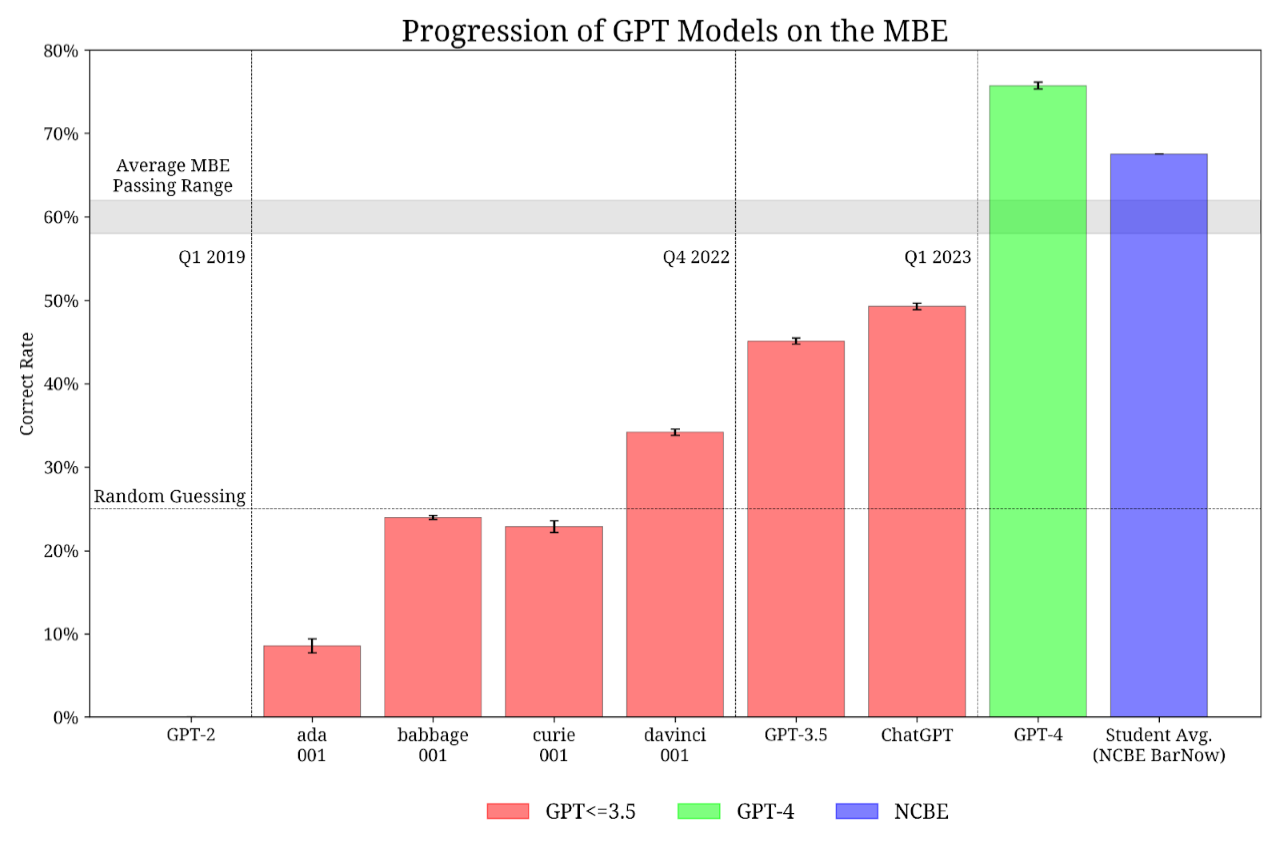
Yesterday, OpenAI released GPT-4. To demonstrate how powerful this tool is, the company allowed a number of experts to take the system for a spin. In the legal corner were Daniel Martin Katz, Mike Bommarito, Shang Gao, and Pablo Arredondo. In January 2023, Katz and Bommarito studied whether GPT-3.5 could pass the bar. At that time, the AI tech achieved an overall accuracy rate of about 50%.

In their paper, the authors concluded that GPT-4 may pass the bar "within the next 0-18 months." The low-end of their estimate proved to be accurate.

Fast-forward to today. Beware the Ides of March. Katz, Bommarito, Gao, and Arredondo posted a new paper to SSRN, titled "GPT-4 Passes the Bar Exam." Here is the abstract:

In this paper, we experimentally evaluate the zero-shot performance of a preliminary version of GPT-4 against prior generations of GPT on the entire Uniform Bar Examination (UBE), including not only the multiple-choice Multistate Bar Examination (MBE), but also the open-ended Multistate Essay Exam (MEE) and Multistate Performance Test (MPT) components. On the MBE, GPT-4 significantly outperforms both human test-takers and prior models, demonstrating a 26% increase over ChatGPT and beating humans in five of seven subject areas. On the MEE and MPT, which have not previously been evaluated by scholars, GPT-4 scores an average of 4.2/6.0 as compared to much lower scores for ChatGPT. Graded across the UBE components, in the manner in which a human tast-taker would be, GPT-4 scores approximately 297 points, significantly in excess of the passing threshold for all UBE jurisdictions. These findings document not just the rapid and remarkable advance of large language model performance generally, but also the potential for such models to support the delivery of legal services in society.

Figure 1 puts this revolution in stark contrast:

Two months ago, an earlier version of GPT was at the 50% mark. Now, GPT-4 exceeded the 75% mark, and exceeds the student average performance nationwide. GPT-4 would place in the 90th percentile of bar takers nationwide!

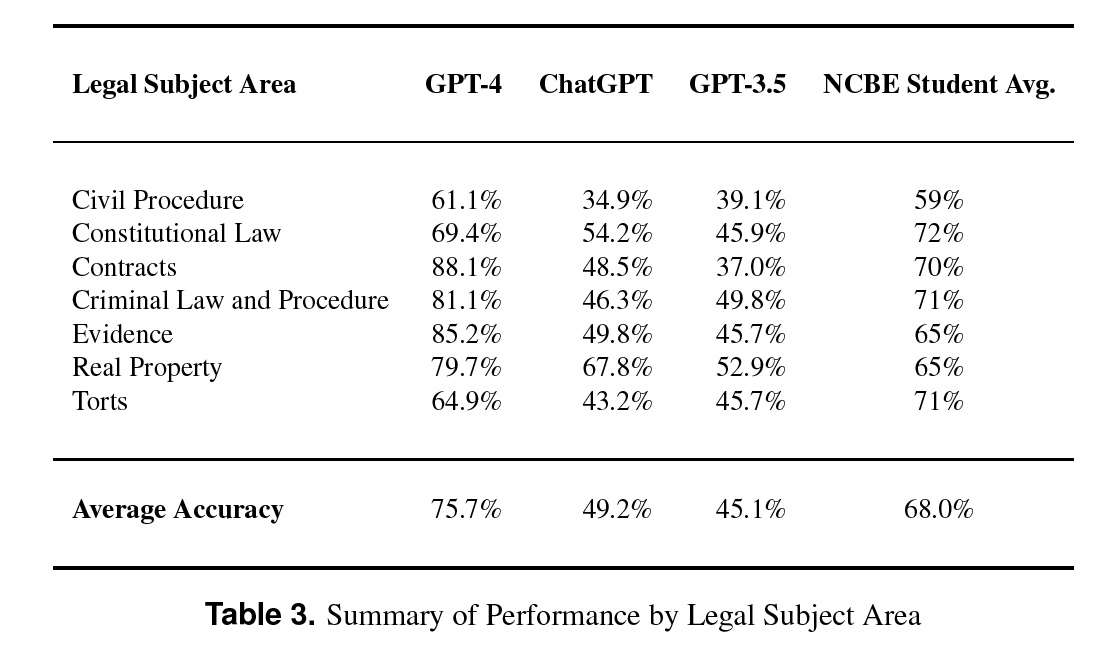
And GPT scored well across the board. Evidence is north of 85%, and GPT-4 scored nearly 70% in ConLaw!

We should all think very carefully how this tool will affect the future of legal services, and what we are teaching to our students.


ChatGPT-4 Aces the Bar Exam

More for the "When Will They Replace Humans?" File

|

A new paper, by Daniel Martin Katz, Michael James Bonnarito, Shang Gao, and Pablo Arrendondo. posted here on SSRN, report on the outstanding performance of ChatGPT-4 on the Bar Exam (Multistate Essay and Multistate Performance).  Congratulations, ChatGPT!

From the Abstract:

In this paper, we experimentally evaluate the zero-shot performance of a preliminary version of GPT-4 against prior generations of GPT on the entire Uniform Bar Examination (UBE), including not only the multiple-choice Multistate Bar Examination (MBE), but also the open-ended Multistate Essay Exam (MEE) and Multistate Performance Test (MPT) components. On the MBE, GPT-4 significantly outperforms both human test-takers and prior models, demonstrating a 26% increase over ChatGPT and beating humans in five of seven subject areas. On the MEE and MPT, which have not previously been evaluated by scholars, GPT-4 scores an average of 4.2/6.0 as compared to much lower scores for ChatGPT. Graded across the UBE components, in the manner in which a human tast-taker would be, GPT-4 scores approximately 297 points, significantly in excess of the passing threshold for all UBE jurisdictions. These findings document not just the rapid and remarkable advance of large language model performance generally, but also the potential for such models to support the delivery of legal services in society.

Immigration

US Accepted 271,000 Ukrainians Over the Last Year - But Can Do Much Better

It's an impressive achievement. But we can do much more. Canada's much greater openness to immigration is an indication of what's possible.

|

Ukrainian refugees. Przemsyl, Poland.


Over the last year, the United States has accepted some 271,000 Ukrainians fleeing Vladimir Putin's brutal invasion. As Reason immigration expert Fiona Harrigan points out in a recent article, this is a very impressive figure. As she notes, some 117,000 entered through the innovative Uniting for Ukraine private sponsorship program, and the rest by other means. To give some context, pre-pandemic the total annual amount of net legal migration in to the US was about 1 million per year (a figure only recently regained in fiscal year 2022). Thus, the Ukrainian influx is about a 25% increase from pre-pandemic "normal" migration levels.

On top of that, in January, the Biden Administration expanded the Uniting for Ukraine private sponsorship system to include migrants from four Latin American nations. By mid-February, this resulted in 36,500 new migrants from these countries entering the US, and another 24,000 getting authorization.

This sudden large increase in migration has not resulted in any of the harms predicted by immigration restrictionists, such as dangerous culture-clash, violence, or significant added burdens to the welfare state. To the contrary, most of the Ukrainians and others are on their way to becoming productive members of society. By letting in these people, we saved hundreds of thousands from war, poverty, and oppression, while also bolstering our economy, and America's image in the international war of ideas against authoritarians like Russia's Vladimir Putin.

But, as Harrigan explains, the US can do a lot better. The approach taken with Ukrainians (and a few others) can be expanded to more groups. To the extent it is unfair that Ukrainians are getting access denied to many others fleeing comparable evil elsewhere, the appropriate solution is "leveling up." That especially applies to Russians fleeing Vladimir Putin's increasingly repressive regime, to whom the US has been far less welcoming.

Some indication of what is possible comes from Canada, the nation usually considered most similar to the US. During roughly the same period in which the US took in 271,000 Ukrainians, Canada admitted 132,000. The Canadian population (about 39 million) is a little over one-ninth the size of the US (some 334 million). On a per capita basis, Canada has admitted some four times more Ukrainians than we have.

The same is true of Canadian immigration generally. During the 2021-22 fiscal year, Canada admitted over 430,000 immigrants in total. Next year, the government plans to take 465,000, rising to 500,000 by 2025.  Canada's current immigration level is the per capita equivalent of the US admitting some 3.8 million people per year. The figure of 500,000 is comparable to the US admitting almost 4.3 million. Estimates of illegal migration into the US (which is obviously greater than into Canada) vary, but are nowhere near great enough to offset this huge difference, especially when you factor in that many illegal migrants are denied entry or deported.

While these migration targets came under the Liberal Party government led by Prime Minister Justin Trudeau, their main opponents - the Conservatives - have not opposed them. Conservative Party leader Pierre Poilievre has put forward proposals to make it easier for immigrants to get job licenses and housing.

Perhaps more to the point, Canada, too, hasn't suffered anything like the adverse consequences posited by restrictionists. That doesn't by itself prove the US can adopt a full "open borders" policy. The latter requires a more extensive defense. But it does strongly suggest we can have much higher immigration levels than we do now.

One can argue that Canada (which is much less densely populated than the US) has more space for additional migrants. But this overlooks the reality that 90% of Canadians live within 100 miles of the US border, and that is where most immigrants settle, as well. For obvious reasons, few people want to live in the Arctic climate of Canada's northern regions.

The purely political obstacles to increased immigration are obviously much greater in the US than in Canada, as can be seen from the very different stances of the political right in the two countries. But Canada's record does undercut many standard policy objections, and shows what is potentially possible for us.

Meanwhile, many of the new immigrants brought in under Uniting for Ukraine and other similar policies may lose their rights to work and residency in the US unless Congress and the White House act to give them permanent status. The expansion of the Uniting for Ukraine model to include four additional countries faces a lawsuit brought by various GOP-controlled state governments. While the lawsuit is based on weak arguments, it could potentially prevail - at least initially - with a sympathetic district judge. That issue, too, can potentially be fixed by legislation, though I am not optimistic it will happen.

In sum, America's recent openness to Ukrainians fleeing is a major step in the right direction. But we can and should do much better.


Separating the Juice From the Pulp At Stanford

How should SLS squeeze out students who violated the code of conduct?

|


The DEI Dean at Stanford Law did not think Judge Duncan's juice was worth the squeeze. I pose a related question: are all of Stanford's graduates worth the squeeze? Without question, these students have excellent academic credentials, and performed very well on various forms of testing. But at least some of them exercised terrible judgment. They decided that it was appropriate to shout down and heckle a sitting federal judge. They yelled vulgar slurs about parts of the human anatomy. Now, to be fair, these students have been inculcated in DEIdeology. They were taught by Dean Steinbach and others that this sort of behavior is not only appropriate, but is a necessary response to a harmful presence on campus. So perhaps the students should not bear all of the blame here. Stanford is at least responsible in part; plus their undergraduate institutions; and their K-12 teachers (current 1Ls were born circa 2000); don't forget coaches that handed out participation prize trophies; and so on.

Thankfully, Stanford can help fix this mess. To paraphrase Dean Steinbach, Stanford can separate the juice from the pulp. But how? The first step would be to identify the students who violated the code of conduct. The joint statement from the President and the Dean seems to suggest that at least some students crossed the line. The event was recorded from multiple camera angles. It would not require Zapruder-level scrutiny to figure out who was at fault. Now, Stanford may not really want to identify the assailants. We never did find out who placed black tape on the faculty photos at Harvard Law School.

I do find it telling that the protestors stood outside Dean Martinez's class while wearing custom-printed-masks. These non-N-95 masks did not provide much COVID protection, but were very effective at concealing identifies. I heard from a colleague that the masks would allow more students to participate who feared potential repercussions.

After the relevant students are identified, Stanford would have several options. I'll list them in order of increasing severity. First, the college could simply issue a warning to those who violated the code of conduct. There would be a recognition that they transgressed, but no consequences at the moment. However, if they were to violate the code again, there would be some distinct consequences. A one-bite rule, so to speak, would perversely incentivize every student to have one, and only one, moment in the sun. I imagine that students who are unfortunate enough to get a mere warning would let all other students engage in future risky conduct.

Second, Stanford could impose some form of extracurricular punishment. For example, students cannot participate in organizations like moot court or law journals, or serve as research assistants for professors. These consequences would deprive elite students of that which they hold most dear--credentials for their resume and recommenders for clerkships. And, in a way, these sanctions would signal to prospective employers that something was amiss. A student was on law review for 2L, but not 3L? Still, there would be no official imprimatur of misconduct.

Third, Stanford could issue such an imprimatur. The college could convey a message to the character & fitness review board of the relevant state. Now, in California, asking Judge Duncan about the female anatomy may warrant some sort of special commendation from the health law section of the state bar. 51 imperfect solutions, and all. But for other, more sane jurisdictions, this sort of conduct should have repercussions. Still, these communications to the bar are not (as far as I know) publicized.

Fourth, Stanford could make things public. It could issue a press release naming and shaming all of the students who violated the code of conduct. Presumably, any law firm or judge who hired or is planning to hire a SLS grad would check this list, and may proceed accordingly. Judges Ho and Branch offer a similar recommendation in National Review.

And if schools are unwilling to impose consequences themselves, at a minimum they should identify the disrupters so that future employers know who they are hiring.

Schools issue grades and graduation honors to help employers separate wheat from chaff. Likewise, schools should inform employers if they're injecting potentially disruptive forces into their organizations.

This move would send a signal to all of Palo Alto, and indeed, the entire country: there are actual consequences for such behavior. Then again, some firms may want to hire these students. Good for them! Hopefully they do not exercise such behavior in the John Minor Wisdom Courthouse. Some judges may also view such conduct as admirable. Professor Rory Little wrote that heckling is a new form of "principled civil disobedience"! Good for them! If judges accept this worldview, we're in big trouble.

Fifth, there is the option of expulsion. These students can forget about clerkships or summer associate gigs. They will not even be allowed to sit for the bar. Still, I think this option would be draconian, especially for a first-time offense.

Stanford has options. Let's see if it does anything about this situation, or if it will simply issue naked apologies.

"Strangers on the Internet" Podcast Episode 25: Exclusive Interview with Writer Aimee Lutkin

What happens when you earnestly tell your friends that you might remain single forever?

|

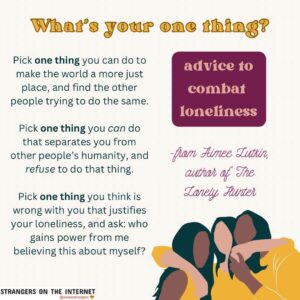
The twenty-fifth episode (Apple Podcasts link here and Spotify link here) of Strangers on the Internet with co-host and psychologist Michelle Lange is an exclusive interview with writer, director, and performer Aimee Lutkin.

Aimee had an article go viral that discussed her friends' reaction when she announced she may never date again and that analyzed singlehood in the aftermath of this event. She has also written about resuming dating if it's been a long time and about remaining single despite following her friends' advice.

Her memoir "The Lonely Hunter: How Our Search for Love Is Broken" has made waves through its poignant account of how society treats the perpetually single. Aimee talks about how society is structured around couples and how marriage has morphed over time in ways that can leave people feeling more isolated than ever.

What are some of the best and worst parts of being single? How have dating apps affected the ability to find love? Do many people who want to remain coupled engage in compromises that lead to unhappiness? Aimee shares her frank opinions in an episode you're not going to want to miss!

Should Scientists Use "Race" as a Proxy for Genetics?

|

Nature, last month (paywall):

The US Food and Drug Administration (FDA) will soon require [based on new federal legislation] researchers and companies seeking approval for late-stage clinical trials to submit a plan for ensuring diversity among trial participants…. The diversity requirement arrives in the wake of a 2022 report from the US National Academies of Sciences, Engineering and Medicine, which found that, although the representation of white women in clinical trials has improved, progress has "largely stalled" for minority racial and ethnic groups.

New York Times, yesterday:

Grappling with the deep history of racism in Western science, the National Academies of Science on Tuesday released guidelines recommending that scientists not use race as a category in genetic studies.

The guidelines, produced in response to a directive from the National Institutes of Health, noted that racial categories were poor proxies for genetic diversity and that social and environmental factors, like poverty and injustice, were often overlooked.

One possible distinction between these scenarios is that while everyone might agree that "race" is not a good proxy for genetics, it's important to have "representation" of minority groups in late-stage clinical trials so that so members of these groups have confidence in the results, while there is no similar concern in genetic studies. However, as I've pointed out before, there is no reason Americans should think that "Hispanic" or "Black" or "Asian" are medically significant classifications, but not much genetically "narrower" (because historically more genetically isolated) groups like "Ashkenazic Jews" or "Icelanders" unless the authorities told them to be worried about the former categories.

Indeed, even if one thinks that "race" correlates sufficiently with genetics to be medically significant, "Hispanics" can be of any race or any combination thereof, "Asian American" includes Austronesians, Caucasians, and East Asians, and "Black" Americans have a large admixture of European ancestry. In other words, the standard American "racial" categories that were adopted for entirely different purposes but are used by default in medical and scientific research are at odds with what racialists consider to be "race."

For more on related matters, including how FDA and NIH came to require many biomedical companies to use crude "racial" classifications to begin with, see chapter 6 of Classified.

Ukraine War Music

"But There Is Truth, There Is Pride, There Is Courage"

|

Last week Zemfira, a prominent Russian singer who has been labeled a foreign agent and driven into exile, released a song—"Motherland"—that I found quite striking, in a brutal way. It's about modern Russia, but it's really about forced patriotism more generally, and indeed about forced adherence more generally. It has 1M views on YouTube, and two videos, each with its own twist:

(The opening frame in each appears to be the officially required disclaimer that the video was created or is being distributed by someone who had been labeled a foreign agent by the Russian government.)  As usual, the translation, done with the help of my parents, Anne and Vladimir, offers our best guess as to the meaning, but we may have erred; please let me know if that is so.

Read More

New Law School "Mismatch" Data from UCLA Lawprof Richard Sander

Not surprisingly, low LSAT scores are strongly correlated with low bar passage rates.

|

In a new post, Sander recounts the history of his work on "mismatch" (the incoming academic qualifications gap between students who are favored in admission because they contribute to 'diversity' and the student body as a whole) in law schools. After noting that it's been extremely difficult to acquire additional data,

Robert Steinbuch (a colleague at the University of Arkansas, Little Rock) and I eventually secured the public release of data from 12 cohorts of law students at four law schools, covering about 6,500 students in all. And after a multi-year review process, the Journal of Legal Education—the official organ of the Association of American Law Schools—has now agreed to publish the first set of our results in its next issue.

Our findings indicate that mismatch can account for two-thirds to three-quarters of the Black-white gap.

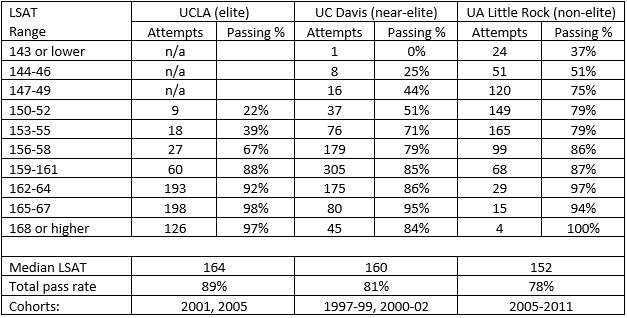
Our findings are even stronger than we expected. A student's degree of mismatch in law school is by far the strongest predictor of whether he or she will pass a bar exam on a first attempt. In 2005, I estimated that mismatch could account for half of the bar-passage gap between Blacks and whites, with the rest caused by lower average pre-law-school preparation levels among Black students. Our findings indicate, however, that mismatch can account for two-thirds to three-quarters of the Black-white gap, as well as more than half of the Hispanic-white gap. Importantly, we found that when one fully controls for mismatch, LSAT, and UGPA, race-specific effects completely disappear. Many critics of mismatch had argued, without evidence, that poor minority performance might be caused by "hostile" environments in law school or "stereotype threats" faced by underrepresented students. Our results flatly contradict such claims.
Most of our results are in regression analyses that can be hard for those without a technical background to interpret. But one of our tables, reproduced below, makes the basic pattern clear. It shows first-time bar-passage rates for several thousand law graduates, grouped by their LSAT score and whether they attended an elite, somewhat-elite, or non-elite law school. Unsurprisingly, students with high LSAT scores had high bar-passage rates at all schools and did particularly well at the elite school in question. But students at the elite school with LSAT scores 12 to 14 points below the median of their fellow students (i.e., LSAT scores of 150-152) had only a 22 percent first-time bar-passage rate, while students with the same LSAT score at the non-elite school in question had a 79 percent first-time bar-passage rate. In other words, lower mismatch translates into dramatically better performance.

I wrote an oped on a related subject almost twenty years ago, and I heard from several law school deans and administrators (none of whom wanted their names or schools identified, naturally). Each of them told me that there was a "cutoff," known at their law school, below which the odds of student bar passage plummet. You can see this effect in the mid-150s at UCLA, the low 150s at UC Davis, and the mid-140s at UA Little Rock.

They added that if they resisted accepting URM students with LSATs below that threshold, the ABA accreditation people threatened them with being placed on probation for having an insufficiently diverse student body--even though ABA rules required law schools not to admit students that they thought would not succeed academically.

In other words, the ABA prohibited them from taking white or Asian students with LSATs below a certain threshold, knowing that those students were unlikely to become lawyers, but required them to admit at least some Black or Hispanic students with those scores. Worse yet, no one informed the students admitted with those LSATs that their odds of ultimately passing the bar were low. (Indeed, Sander's chart understates the matter, because it excludes students who fail out or drop out of law school before they have a chance to take the bar.) Even worse, at a public hearing I participated in, an ABA official acknowledged that for accreditation purposes, the ABA only cares how many URM students matriculate, and does not care, or track, how many ultimately make it through law school and pass the bar!

Politics

Second Amendment Roundup: Should the Fifth Circuit Reconsider Rahimi En Banc?

|

The Fifth Circuit's decision in United States v. Rahimi, which held that the federal statute prohibiting possession of a firearm by a person subject to a domestic violence restraining order violates the Second Amendment, has managed to stay in the news for longer than most circuit court decisions. On March 2, a month after it initially released its decision, the Fifth Circuit panel withdraw its original opinion and substituted a revised version.

The end result is the same, and the updates to the controlling opinion appear to be modest, but Judge Ho significantly expanded his concurring opinion, in which he sets out to "explain how respect for the Second Amendment is entirely compatible with respect for our profound societal interest in protecting citizens from violent criminals." Judge Ho emphasizes that "[t]hose who commit violence, including domestic violence, shouldn't just be disarmed—they should be detained, prosecuted, convicted, and incarcerated." But because the law at issue in Rahimi "disarms individuals based on civil protective orders—not criminal proceedings," the panel found no "analogous historical tradition sufficient to support" it. That was especially true, given the way that civil protective orders are used (and abused) in our system, including by a common practice of issuing "mutual restraining orders" in domestic violence cases, a practice that results in the federal prohibition actually disarming domestic violence victims.

Judge Ho's concurrence also highlights the importance of the Fifth Circuit getting this case right. He notes that before Bruen, circuit courts routinely misapplied Heller despite frequent criticism from the members of the Supreme Court that they were "disfavoring the Second Amendment." And he correctly recognizes that Bruen was a response to the lower courts' intransigence: "The Supreme Court has now responded by setting forth a new legal framework in Bruen. It is incumbent on lower courts to implement Bruen in good faith and to the best of our ability."

Of course, the issue is fraught, so Rahimi has received a lot of attention. Given that it invalidated a federal statute, it seems like a likely candidate for catching the Supreme Court's attention too. In fact, it appears that the Justice Department views this as a particularly good vehicle to ask the Supreme Court immediately to consider (or reconsider) some of the effects of its decision in Bruen. Attorney General Merrick Garland made a statement over a month ago, vowing to "seek further review of the Fifth Circuit's … decision," but there is no indication he intends to seek that review from the Fifth Circuit.

Read More

Constitutional Interpretation

My Forthcoming Article on "The Case for Expanding the Anticanon of Constitutional Law"

It argues for increasing the number of cases in the Supreme Court's "Hall of Shame" and proposes three worthy additions.

|

Joe Ravi/Wikimedia/CC-BY-SA 3.0

Earlier today, I posted to SSRN my forthcoming article on "The Case for Expanding the Anticanon of Constitutional Law," part of a symposium published by the Wisconsin Law Review. Here's the abstract:

The "anticanon" of constitutional law is an underappreciated constraint on judicial discretion. Some past decisions are so reviled that no judge can issue analogous rulings today, without suffering massive damage to his or her reputation. This article argues for expanding the anti-canon, and proposes three worthy new candidates: The Chinese Exclusion Case, Euclid v. Ambler Realty, and Berman v. Parker. The three rulings all share in spades the main characteristics of other anti-canonical decisions: terrible legal reasoning, enormously harmful real-world effects, and facilitating racial and ethnic discrimination and oppression.

Part I outlines the nature of the anticanon and how cases can "qualify" for it. Part II makes the case for adding new cases to the list. Finally, Part III explains why The Chinese Exclusion Case, Berman, and Euclid would be worthy additions to the Supreme Court's Hall of Shame.

As noted in the article, the main point is to spark a dialogue over the idea of making additions to the anticanon. Others may suggest rulings that make even more worthy additions than my three candidates. Still, I think the latter are at least tough to beat.  The Chinese Exclusion Case, for example, combines terrible legal reasoning with more blatant racism than even Plessy v. Ferguson, and caused a comparable amount of harm (see Part III.A of the article for details). Berman and Euclid also combine awful reasoning with vast harm inflicted on millions of people, combined with facilitating large-scale racial exclusion and what James Baldwin called "Negro removal" (see Parts III.B-C).

Free Speech

Latest Journal of Free Speech Law Article Published 2 Months After It Was Submitted

|

One goal of our peer-reviewed Journal of Free Speech Law is to be able to publish quickly, when the author so prefers. We haven't always been as quick as we'd have liked, but it seems like we now have the proper staffing and procedures to be quite good about it.

Consider the article we just published today, Prof. Samantha Barbas's The Story of Beauharnais v. Illinois. It was submitted to us on Jan. 5, 2023. The article was blind-reviewed, and we accepted it on Jan. 16. (We tell people we will give them an answer within 14 days, and so far we have never departed from this commitment.)

The author took the time needed to do some edits and have the article cite-checked by a research assistant. (We prefer that, though if the author doesn't have access to research assistants, we can assign a student editor to do that.) One of our Executive Editors suggested some light edits, and sent it back to the author to accept or reject; we then had it proofread, and send those suggestions back to the author to accept or reject. There were a few e-mails following up on some of the proofreading questions, and, today, Mar. 14, the article was published, and we're submitting it to Westlaw and Lexis today. Indeed, if the author viewed the matter as more urgent, we could have published it more quickly still. (The article will be out in print in due course, but our sense is that fast electronic publication, including availability on Westlaw and Lexis, is much more important these days than fast print publication.)

In any event, this is just one of the advantages of publishing in our journal. So far (since Fall 2021), we've published 35 articles, and have 4 more accepted for publication and in the production process. These include articles by law professors from Yale, Stanford, NYU, Virginia, and Penn, as well as by law professors from many other U.S. schools, professors in other fields, foreign professors, think tank scholars, and practitioners. Some of the articles have argued for broader free speech protection and some for narrower protection (or just different protection). Some have been doctrinal, some theoretical, some historical. Some have focused on constitutional law, others on statutory speech protections, and others on broader free speech principles.

So submit your work to us; you'll get a quick answer, and, if we accept it, you'll get quick publication (if you want that).

Free Speech

Journal of Free Speech Law: "The Story of Beauharnais v. Illinois," by Prof. Samantha Barbas (Buffalo)

|

Just published as the first article in volume 2, issue 2 of the Journal of Free Speech Law, and available here; here's the Introduction:

What harms are caused by hate speech? How can we assess those harms? Does hate speech lead to violence? Do racial, ethnic, and religious groups have reputations that can be injured? Do the benefits of hate speech laws outweigh the harms that might be caused by restricting speech?

Americans grappled with these questions since the early twentieth century, which saw the first calls for "hate speech" laws. Advocates of those laws championed them as essential to promoting social order, civility, and civil rights, while critics denounced them as vague, ineffective, and possibly unconstitutional. The passage of hate speech laws in states and municipalities during the World War II era did little to resolve the debate.

The uncertain First Amendment status of hate speech laws loomed large in the late 1940s as the Supreme Court expanded protections for offensive speech in a series of landmark cases. The question of the constitutionality of hate speech laws finally came before the Court in 1952, in Beauharnais v. Illinois, involving the conviction of a white supremacist leader under an Illinois group defamation law. Beauharnais highlighted questions central to the hate speech law debate: Are hate speech laws valid prohibitions of insult and defamation, or are they unconstitutional restrictions on political speech? When can freedom of speech be limited in the interest of equality, civility, and dignity? The Supreme Court considered these issues against a contentious backdrop—the onset of the Cold War, the shadow of Nazi Germany, and violent race riots in the Midwest. In an opinion by Felix Frankfurter, a five-Justice majority upheld the Illinois statute, marking the first and only time that the Supreme Court validated a hate speech law.

Observers expected that Beauharnais would lead to the passage of hate speech or group libel laws nationwide, but that did not happen.

Read More

Free Speech

Beauty Pageants Have First Amendment Right to Limit Contestants to "Natural Born Females": No Rehearing En Banc

The Ninth Circuit has just decided not to rehear this case, so the panel opinion remains the law.

|

The order, which appears not to be accompanied by any dissents from denial of rehearing en banc (or concurrences in the denial) is here:

A judge of this court sua sponte requested a vote on whether to rehear this case en banc. A vote was taken, and the matter failed to receive a majority of the votes of the nonrecused active judges in favor of en banc consideration. See Fed. R. App. P. 35(f).  Judges Forrest and H.A. Thomas did not participate in the deliberations or vote in this case. Rehearing en banc is DENIED.

Here's the key part of the Nov. 2 panel majority opinion, in Green v. Miss United States of America LLC (Judge Lawrence VanDyke, joined by Judge Carlos Bea, with Judge Susan Graber dissenting):

Anita Green, who self-identifies as "an openly transgender female," sued the Miss United States of America pageant, alleging that the Pageant's "natural born female" eligibility requirement violates the Oregon Public Accommodations Act ("OPAA"). The district court granted the Pageant's motion for summary judgment, holding that the First Amendment protects the Pageant's expressive association rights to exclude a person who would impact the group's ability to express its views.

We conclude that the district court was correct to grant the Pageant's motion for summary judgment, but reach this conclusion not under the First Amendment's protection of freedom of association but rather under the First Amendment's protection against compelled speech….

As with theater, cinema, or the Super Bowl halftime show, beauty pageants combine speech with live performances such as music and dancing to express a message. And while the content of that message varies from pageant to pageant, it is commonly understood that beauty pageants are generally designed to express the "ideal vision of American womanhood." In doing so, pageants "provide communities with the opportunity to articulate the norms of appropriate femininity both for themselves and for spectators alike."

Read More

From My Commonplace Book, No. 6

Stefan Zweig on inflation in Central Europe in the 1920s

|

[Earlier posts in this series: Introduction/#2/#3/#4/#5]

The following is an excerpt from Stefan Zweig's "The World Of Yesterday," his magnificent tribute to life in the Austro-Hungarian empire in the first several decades of the 20th Century (and the utter destruction of that world in the aftermath of World War I), describing the hyper-inflation of the 1920s in Austria and Germany:

An economist who knew how to describe graphically all the phases of the inflation which spread from Austria to Germany, would find it unsurpassed material for an exciting novel, for the chaos took on ever more fantastic forms. Soon nobody knew what any article was worth. Prices shot up at random: a box of matches could cost twenty times more in a shop that had raised the price early than in another, where a shopkeeper was still selling his wares at yesterday's prices.… Standards and values disappeared during this melting and evaporation of money. There was but one merit: to be clever, shrewd, unscrupulous, and to mount the racing horse instead of be trampled by it…. The most grotesque discrepancy developed with respect to rents, the government having forbidden any rise; thus tenants, the great majority, were protected but property owners were the losers. Before long, a medium-size apartment in Austria cost its tenant less for the whole year than a single dinner….

The strangest thing is that I cannot recall, however I may try, how we kept house during that era, or in what manner the Austrians kept on raising the thousands and tens of thousands - and the Germans, in their turn, the millions - of kronen which were dally needed to keep body and soul together. Mysteriously enough, they did raise them. Habits are acquired and the chaos became normal to life. It stands to reason that one who was not a witness would imagine that, at a time when an egg cost what a fine motor-car used to cost (in Germany eggs went up to four billion marks, the approximate past value of all of the real estate in Greater Berlin), women must have been running wildly through the streets with tousled hair, that shops were deserted for lack of purchasing power and that theatres and amusement places were surely empty.

Astonishingly enough, just the opposite was the case. The will to pursue life was great enough to overcome the instability of the currency. Financial chaos prevailed, yet the daily round seemed little affected. There were widespread individual changes, such as those who had wealth in the form of cash in bank or government bonds becoming impoverished, speculators becoming rich. But the balance-wheel maintained its rhythm unconcerned with single fates, there was no standstill; bakers baked bread, cobblers made boots, authors wrote books, peasants sowed and reaped, trains ran on time, the morning newspaper never failed, and the places of entertainment, bars, and theatres were filled to capacity. The very fact that what once represented the greatest stability —money— was dwindling in value daily caused people to assess the true values of life-work, love, friendships, art, and Nature the more highly, and the whole nation lived more intensively and more buoyantly than ever despite the catastrophe; young people went on mountain tramps and returned healthily tanned, dance halls kept going until late at night, new factories and business enterprises sprang up. I don't think that I ever lived and worked with greater zest than in those years. Whatever had meant much to us in days gone by meant even more now; at no time had we ever been so devoted to art in Austria as in those years of chaos, because the collapse of money made us feel that nothing was enduring except the eternal within ourselves.

The One Key Question No Justice Asked in the Harvard/UNC Affirmative Action Case

Harvard and UNC's defense is based on the perceived need for racial diversity; but how do they justify treating "Hispanic" as a Racial Classification?

|

In October, the Supreme Court held several hours of oral argument in the Students for Fair Admissions case, challenging the constitutionality of affirmative action preferences for African Americans, Hispanics, and Native Americans at Harvard and the University of North Carolina.

The questions covered a wide range of issues, including, I believe for the first time, significant questions from the Justices about coherence of the classifications used by the universities.

The key issue in the cases is whether these classifications can be used by the universities to ensure racial diversity. The phrase "racial diversity" came up in oral argument thirty-eight times, with Justices Kagan and Sotomayor in particular pressing counsel on the issue.

The question no Justice asked is why the universities treat "Hispanic" as a "racial" classification. The Department of Education, consistent with OMB regulations that apply across the federal government, treats Hispanic as an "ethnic" classification; Hispanics can be of any race. The Common App, used by Harvard and UNC, follows the federal convention in asking students first whether they are Hispanic, and then about their race:

Are you Hispanic or Latino/a/x?

Which best describes your Hispanic or Latino/a/x background? (You may select one or more)

Regardless of your answer to the prior question, please indicate how you identify yourself. (You may select one or more)

In any event, despite Justice Sotomayor's protestations in her BAMN dissent that "race matters" with regard to Hispanics (but apparently not Asian Americans) in education, treating Hispanics as a race seems to violate federal law. (I have previously discussed how the Supreme Court wound up treating Hispanic as a racial classification, even though that's legally incorrect.) For example, I don't think that a university could legally prefer Greek American applicants over other applicants in the name of "racial diversity." Discrimination of this sort within the "white" classification would generally be considered illegal ethnic/national origin discrimination.

I expect if counsel for the universities had been asked how they can defend, contrary to federal law, treating "Hispanic" as a race, the first response would be stunned silence, because universities have never even thought about that issue. Once counsel recovered, the answer would be that the universities just use "racial diversity" as a shorthand for pursuing racial and ethnic diversity, and the latter includes Hispanics, including those who check the "white" box.

But that answer would raise serious constitutional problems of its own. If the universities are interested in ethnic diversity, why is Hispanic literally the only ethnic group that they keep track of to ensure such diversity? One could argue that Hispanic is a special classification, because many Hispanics are dark-complexioned, and thus have experiences not common to other ethnic groups. But then what of, e.g., Arab Americans, Armenian Americans, Persian Americans, or Berber Americans? Hispanics, one might argue, face discrimination that other ethnic groups do not. But can one plausibly argue that Arab and Iranian Americans, especially those who are identifiably Muslim, have not faced discrimination not common to those with whom they share the "white" classification?

The heart of the equal protection clause, which governs this case (including for Harvard, because that clause has been deemed coextensive with Title VI of the 1964 Civil Rights Act) has long been a prohibition on arbitrary classifications. An applicant who checks off "Hispanic," then "White," then "South America" who is of Italian-Argentine descent gets a racial diversity preference. An applicant who checks off "not Hispanic," then white, then Middle Eastern who is an Iraqi Yazidi survivor of genocide does not. Nor does a very-dark complexioned Egyptian Copt, a member of a group that has faced centuries of caste-like discrimination in their home country. Arbitrariness, anyone?

More