The Volokh Conspiracy

Mostly law professors | Sometimes contrarian | Often libertarian | Always independent | Est. 2002

The Volokh Conspiracy

Court Rejects School District's "Heckler's Veto" of The Satanic Temple's After-School Meeting Application

|

From The Satanic Temple, Inc. v. Saucon Valley School Dist., decided yesterday by Judge John M. Gallagher (E.D. Pa.):

[According to the Complaint,] Plaintiff, The Satanic Temple, Inc. ("TST") "is a non-theistic, religious not-for-profit corporation" that "has been recognized by the IRS as a church… and as a religious corporation." Plaintiff, TST, "does not worship Satan," but rather regards "Satan … as a literary figure who represents a metaphorical construct of rejecting tyranny, championing the human mind and spirit, and seeking justice and egalitarianism for all." TST "has more than 700,000 individual members" who believe in the "seven Satanic virtues: benevolence, empathy, critical thinking, creative expression, personal sovereignty, compassion, and the pursuit of justice." TST sponsors the After School Satan Club ("ASSC" or the "Club") at "a number of public schools across the country to provide young people with an alternative to other religious clubs that meet on campus after school." …

The District's process for approving individual and community group use of its facilities is governed by the District's Board Policy 707 ("Policy 707"). Policy 707 states: "It is the policy of the Board of School Directors of the Saucon Valley School District to make available the facilities of the school district to organizations, associations and individuals of the community for civic, cultural, educational and recreational activities when the scheduling of these activities does not interfere with the educational program of the district." …

Because the District sponsors some after-school activities and groups, such as "Girls on the Run," "the Boy Scouts," "the Joetta [Sports] & Beyond Camp," the "Saucon Valley Youth Sports Association," and "Saucon Valley Youth Basketball," groups approved for use of District facilities that are not sponsored by the District must abide by the following Policy 707 limitation, hereinafter referred to as the "Advertising Restriction":

When advertising or promoting activities held at school facilities, individuals and community groups shall clearly communicate that the activities are not being sponsored by the school district….

The Satanic Temple initially got District permission to hold four After School Satan Club meetings on campus in the afternoon after school dismissal, but this was rescinded after someone left a school shooting threat on the District's voicemail (which led to the District's closing the school for a day) and then the District "received over 40 phone calls and 50 emails or handwritten letters, daily, from concerned staff, parents, and community members." TST sued, claiming the District's actions violated the First Amendment, and the court allowed the case to go forward:

Read More

Libertarianism

My Cato Policy Report Article on "Three Constitutional Issues Libertarians Should Make their Own"

The article explains why libertarians should focus much more on constitutional issues arising from zoning, immigration restrictions and racial profiling.

|

I recently became the B. Kenneth Simon Chair in Constitutional Studies at the Cato Institute, a position I hold in addition to my primary job as a law professor at George Mason University. As one of my first acts in this new role, I have published an article in the Cato Policy Report outlining three constitutional issues that libertarians should focus on more, and make our own. Here is an excerpt:

Libertarian legal scholars, activists, and public interest lawyers have made valuable contributions on a range of important constitutional issues, including property rights, school choice, Second Amendment rights, free speech, religious liberties, and more. But we have largely ignored three significant constitutional issues, thereby passing up valuable opportunities to expand liberty: zoning, constitutional constraints on immigration restrictions, and racial profiling in law enforcement….

Exclusionary zoning is probably the greatest American property rights issue of our time. In many parts of the country, restrictions on the construction of new housing severely constrain property rights and cut off millions of people from housing and job opportunities….

Libertarians have not neglected zoning. Libertarian‐​leaning scholars…. have authored pioneering works on this issue. But libertarian legal scholars and litigators have mostly overlooked the constitutional dimensions of the issue, despite their successful focus on a wide range of other constitutional property rights questions….

Like exclusionary zoning, immigration restrictions massively restrict liberty and degrade human welfare. By barring entry to hundreds of thousands of people who seek freedom and opportunity in the United States, the federal government massively restricts the liberty of would‐​be immigrants and American citizens alike…..

Libertarian economists and political philosophers have played a leading role in highlighting the harm and injustice caused by immigration restrictions…. But…. most libertarian lawyers and legal scholars (myself included, for much of my career)—have largely ignored the constitutional dimensions of the problem….

It's far from clear that the original meaning of the Constitution even gives the federal government a general power to restrict immigration in the first place….

Whatever the merits of its reasoning, the Supreme Court is unlikely to overturn the Chinese Exclusion Case [ruling that the federal government has power over immigration] anytime soon. But libertarians would do well to take aim at extensions of that ruling that have largely immunized immigration restrictions from constitutional constraints that apply to virtually every type of government policy. For example, courts often uphold immigration restrictions that discriminate on the basis of speech, religion, race, ethnicity, and other characteristics that are presumptively forbidden in other areas of law. Immigration detention and deportation proceed with far weaker due process protections than other severe deprivations of liberty….

[R]acial profiling is a widespread problem. A 2019 Pew Research Center poll found that 59 percent of black men and 31 percent of black women say they have been unfairly stopped by police because of their race. Their perceptions are backed by numerous studies—including many that control for other variables—showing that police often treat blacks and (to a lesser degree) Hispanics more harshly than similarly situated whites….

Curbing racial profiling should be a priority for all who believe government should be colorblind. If we libertarians truly believe that it is wrong for government to discriminate on the basis of race, we cannot ignore that principle when it comes to those officials who carry guns and have the power to kill, injure, and arrest people….

In addition to being unjust, racial profiling is also unconstitutional. The original meaning of the equal protection clause of the Fourteenth Amendment was centrally focused on unequal enforcement of laws by state and local governments, including the police…..

Libertarians have achieved much on a variety of constitutional issues. But we have largely neglected three that cry out for our attention. It is, perhaps, no accident that two of them (immigration and racial profiling) tend to pit us against the political right. The third—zoning—cuts across ideological lines. The "fusionist" alliance between libertarians and conservatives has deteriorated in recent years, but remains stronger in the constitutional law field than elsewhere.

Libertarians should embrace useful collaboration with conservatives; however, we must also protect liberty across the board, regardless of whether the danger emanates from the left or the right.

In the article, I outline the significance of these issues more fully, and also describe how libertarians can help address their constitutional dimensions.


Guns

Second Amendment Roundup: Illinois Gun Ban Enjoined

The banned “assault weapon” features improve accuracy and reduce the risk of stray shots.

|

On April 28, Judge Stephen P. McGlynn of the Southern District of Illinois, in Barnett v. Raoul, issued a preliminary injunction against enforcement of the recently-passed Protect Illinois Communities Act (PICA), which bans "assault weapons" and standard-capacity magazines.

That morning, I had posted "A Judge Who Understands Firearms," describing the oral argument in which Judge McGlynn exhibited superior expertise about firearms and how they work, in contrast to the lack of such knowledge by too many judges.

At the beginning, the court stipulated the following proposition to which any court should agree: "no state may enact a law that denies its citizens rights that the Constitution guarantees them. Even legislation that may enjoy the support of a majority of its citizens must fail if it violates the constitutional rights of fellow citizens."

In finding that the plaintiffs are likely to prevail on the merits, the court brushed aside the argument that magazines holding more than the verboten number of cartridges are unnecessary to the functioning of a firearm and are thus not "arms."  It didn't help Illinois that its own expert called them "arms"!

Also rejected was the argument that the prohibition on pistols with arm braces don't interfere with Second Amendment rights.  Despite its recent attempt to restrict some braces, ATF itself recognizes that braces may be necessary for persons with disabilities to hold and fire certain pistols.  Again, braces are "arms."

Read More

Justice Stevens's Papers Will Be Released While Justices O'Connor, Kennedy, Souter, Thomas, and Breyer Are Still Alive

First stop for reporters: the Grutter and Gratz files.

|

Orin announced the big news: on Tuesday, May 2, the Library of Congress will release the papers of Justice Stevens through 2005. The finding aid provides the acquisition information:

The papers of John Paul Stevens, lawyer, judge, and associate justice of the United States Supreme Court, were deposited in the Library of Congress in 2005 and conveyed as a gift to the Library upon his retirement from the Supreme Court in 2010. A subsequent addition covered by Stevens's gift agreement was received in 2022 via the Supreme Court and his estate.

The bulk of the papers were deposited in 2005, which was the final full term that Chief Justice Rehnquist and Justice O'Connor served. In 2010, after Stevens retired, the remainder of his papers as a sitting Justice were deposited. Finally, the last tranche of papers was deposited in 2022, three years after his death.

Different justices have taken different approaches to releasing their papers. Chief Justice Rehnquist's papers will only be released after all of the Justices who served at that time have died--not just retired. For example, after Justice Stevens died, the Rehnquist collection would release the papers from 1976 through 1981, when Justice O'Connor joined the Court. Justice O'Connor is still alive, so all of the Rehnquist papers from 1981 to 2005 remain sealed. This policy was designed after the retirement of Justices Marshall and Blackmun. Their papers were released immediately, which revealed documents about pending cases.

Justice Stevens used some more discretion, but he will still release papers from the tenures of five still-living Justices (O'Connor, Kennedy, Souter, Thomas, and Breyer), and one still-serving Justice (Thomas). And, indirectly at least, we will gain a peek at the cert pool memos of several Justices who clerked on the Court before 2005: Chief Justice Roberts, Justice Kagan, Justice Gorsuch, Justice Kavanaugh, Justice Barrett, and Justice Jackson. Justice Stevens was not in the cert pool. But he likely has the memos from a majority of the Court. Really, the only person who has nothing to worry about here is Justice Alito, who never clerked on the Supreme Court.

The finding aid provides some insights into Stevens, including the well-known fact that he wrote his own first drafts:

The opinion files include slip opinions, correspondence with the other justices, drafts of opinions, Stevens's oral argument notes, his conference notes (recorded on the reverse side of docket sheets), and his clerk's certiorari memoranda. Additional docket sheets and certiorari memoranda for all other non-argued cases are filed in the Dockets subseries and the Certiorari Memoranda subseries. The opinion files do not include any bench memoranda. The files document Stevens's propensity for writing both dissents and concurrences and reflect that he usually wrote many of the first drafts of his opinions himself.

Though, we do learn that there was some decline in Stevens's output:

Beginning with the October 1996 term, Stevens's oral argument notes decrease and later terms contain almost none. The opinion files for Part II contain no bench memoranda.

The most relevant documents will be from a pair of cases decided during the October 2002 term: Grutter and Gratz. I'm sure enterprising reporters will mine through those documents to cast a light on the pending affirmative action cases. Hint: go to Boxes 887, 888, and 889. (This information will certainly be more fruitful than financial disclosure documents.) I'm sure we gain some insights into what Justice O'Connor really meant by the 25-year clock!

Meanwhile, Justice Souter's papers will not be released for fifty years after his death. With Souter's longevity, I may not live to see them. I doubt anyone will care in half a century.

Next up? RBG's papers, which will take us through 2020.

Why would the government need a warrant to warn me I'm about to be hacked?

Episode 455 of the Cyberlaw Podcast

|

We open this episode of the Cyberlaw Podcast with some actual news about the debate over renewing section 702 of FISA. That's the law that allows the government to target foreigners for a national security purpose and to intercept their communications in and out of the U.S. A lot of attention has been focused on what happens to those communications after they've been intercepted and stored, with some arguing that the FBI should get a second court authorization -- maybe even a warrant based on probable cause -- to search for records about an American. Michael J. Ellis reports that the Office of the Director of National Intelligence has released new data on such FBI searches. Turns out, they've dropped from almost 3 million last year to nearly 120 thousand this year. In large part the drop reflects the tougher restrictions imposed by the FBI on such searches.  Those restrictions were made public this week. It has also emerged that the government is using the database millions of times a year to identify the victims of cyberattacks. That's the kind of problem 702 is made for: some foreign hackers are a national security threat, and their whole business model is to use U.S. infrastructure to communicate (in a very special way) with U.S. networks. So it turns out that all those civil libertarians who want to make it hard for the government to search the 702 database for the names of Americans are actually proposing ways to slow down and complicate the process of warning hacking victims. Thanks a bunch, folks!

Justin Sherman covers China's plans to attack and even take over enemy (i.e., U.S.) satellites. The story is apparently drawn from the Discord leaks, and it has the ring of truth. I opine that DOD has gotten a little too comfortable waging war against people who don't really have an army, and that the Ukraine conflict shows how much tougher things get when there's an organized military on the other side. (Again, credit for our artwork goes to Bing Image Creator.)

Adam Candeub flags the next Supreme Court case to nibble away at the problem of social media and the law.  The Court will hear argument next year on the constitutionality of public officials blocking people who post mean comments on the officials' Facebook pages.

Justin and I break down a story about whether Twitter is complying with more government demands now that Elon Musk is in charge. The short answer is yes. This leads me to ask why we expect social media companies to spend large sums fighting government takedown and surveillance requests when it's so much cheaper just to comply. So far, the answer has been that mainstream media and Good People Everywhere will criticize companies that don't fight. But with criticism of Elon Musk's Twitter already turned up to 11, that's not likely to persuade him.

Adam and I are impressed by Citizen Labs' report on search censorship in China. We'd both like to see Citizen Lab do the same thing for U.S. censorship, which somehow gets less attention.  If you suspect that's because there's more U.S. censorship than U.S. companies want to admit, here's a bit of supporting evidence: Citizen Lab reports that the one American company still providing search services in China, Microsoft Bing, is actually more aggressive about stifling Chinese political speech than China's main search engine, Baidu. This jibes with my experience, when Bing's Image Creator refused to construct an image using Taiwan's flag. (It was OK using U.S. and German flags, but it also balked at China's.) To be fair, though, Microsoft has fixed that particular bit of overreach: You can now create images with both Taiwanese and Chinese flags.

Read More

Justice Stevens Papers Through 2005 To Be Made Available Starting Tomorrow

This should be interesting.

|

Today the Library of Congress announced that, tomorrow, it will be making available the papers of the late Justice John Paul Stevens through 2005.  The release of a Justice's papers is often pretty significant for Supreme Court nerds and historians alike, as the papers include drafts of opinions and memos among the Justices that shed light on the public opinions later released.  You need to be in DC to see the papers at the Library of Congress—they won't be posted online— but I assume particularly important documents will get out pretty quickly.  You can read the 299-page finding aid to the Stevens papers that will be available here.

Administrative Law

Chevron Matters— But Not as Much as You Might Think

Overruling Chevron won't gut the administrative state or even severely constrain it. But it could help strengthen the rule of law.

|

Today the Supreme Court decided to hear Loper Bright Enterprises v. Raimando, a case that raises the prospect that the Court might overrule  Chevron v. Natural Resources Defense Council, which requires federal judges to defer to administrative agencies' interpretations of federal laws, so long as Congress has not addressed the issue in question, and the agency's view is "reasonable." Some legal commentators are, depending on their ideology, excited or appalled by the prospect that Chevron might be overruled. Advocates of reversal hope and critics fear that the result would be severe constraints on the power of federal regulatory agencies, and perhaps the administrative state generally.

While I would be happy to see Chevron overturned, I am skeptical of claims it will make a huge difference to the future of federal regulation. I explained why in two previous posts, (see here and here). To briefly summarize, my reasons for skepticism are 1) we often forget that the US had a large and powerful federal administrative state even before Chevron was decided in 1984, 2) states that have abolished Chevron-like judicial deference to administrative agencies (or never had it in the first place) don't seem to have significantly weaker executive agencies or significantly lower levels of regulation, as a result, 3) a great deal of informal judicial deference to agencies is likely to continue, even in the absence of Chevron, and 4) Chevron sometimes protects deregulatory policies as well as those that increase regulation (it also sometimes protects various right-wing policies that increase regulation, in an age where pro-regulation  "national conservatives" are increasingly influential on the right); the Chevron decision itself protected a relatively deregulatory environmental policy by the Reagan administration.

Getting rid of Chevron is still worth doing, in my view. While it would impose only modest constraints on regulatory power, it could help protect the rule of law:

Ending Chevron deference would not gut the administrative state…. It would, however, have some important beneficial effects. It would put an end to what then-Judge—and future liberal Supreme Court justice—Stephen Breyer, writing in 1986, called an "abdication of judicial responsibility…."  The Constitution gives judges, not agency bureaucrats, the power to interpret federal law in cases that come before the courts….

The elimination of Chevron would also increase the stability of legal rules, and make it harder for administrations to play fast and loose with the law. As [Justice] Gorsuch pointed out in a well-known opinion he wrote as a lower court judge, Chevron deference often enables an agency to "reverse its current view 180 degrees anytime based merely on the shift of political winds and still prevail [in court]." When the meaning of federal law shifts with the political agendas of succeeding administrations, that makes a mockery of the rule of law and undermines the stability that businesses, state governments, and ordinary citizens depend on to organize their affairs.

Of course, reports of Chevron's demise might well prove premature. I am skeptical there really are five votes on the Court to overrule Chevron completely. Assuming none of the liberal justices will support the idea, pushing it through would require five conservative votes. That's true despite the fact that liberal Justice Ketanji Brown Jackson is recused from the case. A 4-4 split on the Court would not result in a binding precedent overturning Chevron, or - most likely - any kind of binding precedent at all.

I see little reason to think Chief Justice John Roberts leans towards reversal. The same goes for Justice Alito, who in 2018 chided the Court for failing to apply Chevron more rigorously. Justices Kavanaugh and Barrett might also prefer curbing Chevron to complete reversal. It's hard to know for sure. Only Gorsuch and Thomas are clearly committed to reversal, and they need to add three votes to make it happen.

On balance, I believe Jonathan Adler is probably right to think the Court is more likely to further limit Chevron than to reverse it completely. But if I'm wrong about that and Chevron does go on the chopping block, the impact will not be as great as many might think.

Adler is also right to point out that Chevron rarely constrains the Supreme Court itself in recent years. They routinely refuse to defer to agencies, or even just ignore Chevron entirely. But the Chevron doctrine still matters much more in the lower courts, which is where the overwhelming majority of cases get decided. While it isn't the key to the survival of the administrative state, it does give the executive branch incrementally broader discretion than it would enjoy otherwise.

Cert Grants With Recusals

Should the Justices choose a different petition where a Justice is recused?

|

Last week, the Supreme Court released a Statement of Ethics Principles and Practices. One of the rationales for not adopting the Conduct of Conduct, in its entirety, concerns recusals.

In regard to recusal, the Justices follow the same general principles and statutory standards as other federal judges, but the application of those principles can differ due to the unique institutional setting of the Court. In some instances the Justices' recusal standards are more restrictive than those in the lower court Code or the statute—for example, concluding that recusal is appropriate where family members served as lead counsel below. A recusal consideration uniquely present for Justices is the impairment of a full court in the event that one or more members withdraws from a case. Lower courts can freely substitute one district or circuit judge for another. The Supreme Court consists of nine Members who always sit together. Thus, Justices have a duty to sit that precludes withdrawal from a case as a matter of convenience or simply to avoid controversy.

I think this reasoning is persuasive, and explains why a different set of recusal rules should apply to the Supreme Court. There are only nine Justices, and the Court should decide cases with all members, where possible.

That principle brings me to today's order list. The Supreme Court granted cert in Loper Bright Enterprises v. Raimando. Jon Adler explained that this case may overrule, or at least narrow the Chevron doctrine. However, the Court will be shorthanded. Justice Jackson recused herself. She participated in oral argument in this case during her ever-so-brief stint on the D.C. Circuit.

This recusal raise an obvious question: why grant this case which would be decided by an eight-member Court? The Court has been deluged by petitions seeking to overrule Chevron. Maybe there are specific rationales to favor this petition. Paul Clement, super lawyer, is counsel of record. And perhaps Clement highlighted the second question presented in an artful way, that gives the Court space to operate:

Whether the Court should overrule Chevron or at least clarify that statutory silence concerning controversial powers expressly but narrowly granted elsewhere in the statute does not constitute an ambiguity requiring deference to the agency.

Moreover, this case has "good facts." Modest fisherman were required to pay the salaries of inspectors on their small boats. I love this quote from the cert petition:

The framing generation was vexed enough by being forced to quarter British soldiers, see U.S. Const. amend. III, but not even the British forced the unlucky homeowner to personally pay the redcoat's salary.

Perhaps these confluence of facts caused the Justices to grant this particular petition, knowing that Jackson was recused. Or, perhaps, the Justices who voted to grant did not care that Jackson would be excused. If the latter analysis is true, then the concerns in the Statement of Ethics Principles and Practices rings hollow. The Justices could have granted any other case calling to overrule Chevron and cribbed Clement's question presented. But they chose this case, where it will be very hard to count to five to keep Chevron in its current form.

New Column in ABA Journal: "Law schools face an inflection point with diversity, equity and inclusion"

"Universities and faculties in particular should take decisive action to prevent future Steinbachs and Eldiks from subverting the core principles of academic inquiry."

|

The reaction to my first ABA Journal column was, to my pleasant surprise, quite positive. I've heard from many current and former leaders in the organization who recognize the problem. I've also been invited to participate in a caucus looking to improve viewpoint diversity within the ABA. I'll report back on how that experience goes. And, also to my pleasant surprise, the ABA Journal allowed me to publish a second column.

The title of my column is Law schools face an inflection point with diversity, equity and inclusion. The piece was largely inspired by Judge Duncan's protest at Stanford, as well as the shenanigans at Yale Law School last year. I try to tie together why these debacles occurred with the rise of DEI on college campuses. I explain that DEI, as understood by officials at elite institutions, is inconsistent with the mission of higher education.

I offer five concrete suggestions of how deans and faculty can restore the proper balance of power between academic departments:

Universities and faculties in particular should take decisive action to prevent future Steinbachs and Eldiks from subverting the core principles of academic inquiry. At this inflection point, I propose a five-course action plan. First, every faculty should adopt, or reaffirm, a free speech policy that clearly spells out the university's commitment to a diversity of viewpoints. That policy also should delineate the consequences for heckling speakers. Students should be given a stern warning at orientation, so they are on clear notice about the rules.

Second, universities should restructure DEI departments. For starters, DEI deans should be tenured members of the faculty, rather than untenured staff. Faculty members generally have a long-term commitment to the institution and are attuned to how professors, students and other stakeholders approach sensitive issues. If the DEI dean is a faculty member, it is more likely that the faculty will have some visibility of the various DEI activities.

Moreover, the institution should define the jurisdiction of DEI departments and ensure that student-facing deans remain neutral and do not endorse any particular ideology. And yes, beliefs about "privilege," "anti-racism" and "unconscious bias" are not objective truths; they are contested ideologies. A law school administration could no more endorse critical race theory than it could endorse originalism. Educational institutions must remain neutral.

Third, faculty governance should assert oversight of DEI departments. For example, any DEI programming that students are required to attend should be approved by the faculty curriculum committee. Any diversity mandates imposed on hiring or admissions should be approved by the faculty committees on appointments and admissions. Academic institutions are faculty-governed. DEI should not issue edicts to the faculty; the faculty should provide approval to DEI.

Fourth, DEI staffers should be required to attend training on free speech and academic freedom. These classes can be provided by the constitutional law faculty or by outside groups like the Foundation for Individual Rights and Expression. The Duncan debacle should be a case study of what not to do. Employees like Steinbach who see free speech as subordinate to DEI values, should seek other employment. They have no place in an institution of higher education.

Fifth—and this one is key—universities should commit themselves to hiring ideologically-diverse professors. It is regrettable that Stanford has one right-of-center public law scholar—Judge McConnell. Yale has zero. Conservative students at Stanford and Yale are jurisprudential orphans. If more conservative scholars are hired, progressive students will invariably learn how to deal with those they disagree with—cross-cultural competency in modern lingo—and may realize that the divide between right and left isn't as large as they thought. Harvard, which has a handful of conservative faculty members, has unsurprisingly stayed out of the headlines. Other schools should follow the hiring practice started more than a decade ago by Dean Elena Kagan.

I look forward to engaging further on this topic. My next column, hopefully, will be about Supreme Court ethics.

The First Scalia Oral Argument Since 1976?

Will Eugene Scalia argue Murray v. UBS, after his father Antonin last argued in 1976?

|

Antonin Scalia heard hundreds of cases as an Associate Justice before the Supreme Court. But he argued one, and only one case, as a Supreme Court advocate: Alfred Dunhill Of London, Inc. v. Cuba in January 1976. You can listen to it here.

Today, the Supreme Court granted cert in Murray v. UBS Securities. Counsel of record for respondents is Eugene Scalia. For the longest time, Justice Scalia's son had recused himself from Gibson Dunn's Supreme Court practice. I believe the firm even had to exclude the partner from earning any proceeds from any SCOTUS litigation. But since Justice Scalia's death, Eugene Scalia has participated in Supreme Court advocacy. Will Eugene argue the case, his first before the high Court? If so, it would be the first Scalia at the podium since 1976.

In related news, Professor Jane Ginsburg of Columbia, RBG's daughter, is also filing amicus briefs now. Indeed, Lisa Blatt mentioned her brief by name during oral argument in Warhol v. Goldsmith. Such a move would have been forbidden while RBG was still on the bench.

Another Judicial Ethics Story About Judge Kacsmaryk Falls Apart

Editors should withdraw any unpublished stories about judicial ethics to get a grip on reality.

|

About two weeks ago, the Washington Post published yet another story about Judge Matthew Kacsmaryk. There were two primary claims. First, the Post charged that Kacsmaryk wrote an article for the Texas Review of Law & Politics (TROLP), but when he was under consideration for the federal bench, he asked the journal to take his name off the article. Second, the Post claimed that Kacsmaryk failed to disclose this article to the Senate, and this was a breach of ethical standards. As soon as I read this article, I knew both claims were either false, or at best, misleading.

TROLP accepts submissions, like most law reviews, but a substantial chunk of its book includes invited articles. That is, the journal asks an author to write on something. In other words, an offer is made before the article is actually written. I have published four articles in TROLP. Two of them were solicited. One was something I pitched largely on the basis of my blog posts and an amicus brief, which was accepted. For three articles, I was given a green-light to publish non-existent scholarship. This approach is fairly common for symposium issues of law reviews. TROLP publishes invited pieces in most issues. And based on my records, I never actually signed some sort of publication agreement or copyright assignment. At most, I received an email of approval from the journal. That's how TROLP works. Professors at the University of Texas, Austin, could have easily confirmed this regular process to the press.

Without knowing anything about Kacsmaryk's particular situation, I concluded with a high degree of confidence that either (a) TROLP invited lawyers from First Liberty to write on a specific topic or (b) lawyers from First Liberty pitched TROLP on writing a piece on a particular topic. In either case, there was nothing written when the article was accepted.

I also concluded that the second facet of the Post's reporting was a non-story. DOJ routinely tells potential-judicial nominees to stop writing anything during the process. It would not surprise me that DOJ told Kacsmaryk to not publish anything new. And that request would have been easy enough to follow, if he didn't actually write the article.

This background brings us to the latest reporting in the Washington Free Beacon from Aaron Sibarium. He confirms everything I suspected about the Post's story.

The Post made much of the fact that Kacsmaryk submitted an early draft of the article, titled "The Jurisprudence of the Body," in early 2017 under his own name. The byline switch came that April, when he informed the Texas Review of Law and Politics that, "for reasons I may discuss at a later date," First Liberty attorneys Stephanie Taub and Justin Butterfield would coauthor the piece instead. Their names weren't anywhere on the first draft, the Post stressed, and it was Kacsmaryk who'd been corresponding with the journal. He also provided some edits on later drafts, according to emails reviewed by the Post.

But Taub and Butterfield told the Washington Free Beacon that they wrote the first draft themselves. Kacsmaryk, they said, had been brainstorming ideas with Taub, who was his research assistant at the time. "When his schedule became too busy to write an article, or even to review my outline," Taub said, "I took the initiative of drafting an article. I listed [Kacsmaryk's] name as the author of this and subsequent drafts because I assumed I was ghostwriting it for him." . . .

Taub's drafts of the article were mainly edited by Butterfield, he said. Kacsmaryk's primary contribution was serving as a liaison to the Texas Review of Law and Politics, with which he had institutional ties.

Kacsmaryk did not actually write the article, but gave credit to his junior colleagues. (Good for him!) Kacsmaryk continued to serve as a liaison with the editors due to his institutional connection to the journal. That's it!

The Free Beacon does not get into the nuances of the submission process. But the chronology in the piece establishes that the article was written after there was an acceptance. Kacsmaryk did not submit an article that he did not write, because he did not actually submit an article. Kacsmaryk did not take his name off an article he wrote, because he did not write the article. Kacsmaryk did not fail to disclose an article he wrote, because he did not write the article.

The Free Beacon also quotes Bethany Pickett, who worked with judicial nominees during the Trump administration. DOJ's Office of Legal Policy (OLP) routinely tells nominees to not publish anything during the confirmation process.

The Senate Judiciary Committee requires nominees to disclose all "published material" they have written or edited, any excerpt of which can be used against them. That is why, when someone is about to be nominated, the Justice Department tells that person to shut up.

"Our advice to nominees was to wind down their practices and not publish or give speeches while they were being considered for a federal appointment, even if they had made plans to do so up to that point," said Bethany Pickett, who worked on hundreds of judicial nominations in the Justice Department's Office of Legal Policy under former president DonaldTrump. "It would be common for any nominee not to author or further engage with a publication once being considered for the federal bench."

The Biden Administration has tapped legal scholars to fill certain positions. I suspect these nominees were given the same advice, and they put a pause on any unpublished pieces. There is nothing to see here.

Once again, a media story about judicial ethics falls apart. At this point, you should pause at least twenty-four hours before reacting to any story about a conservative judge. The media is so fixated on finding ethical scandals. Yet, they have to invent stories that are all smoke, and no fire.

The media is embarrassing itself. To continue with the theme of the day, editors should withdraw any yet-unpublished stories. Or call me for a reality check. Stop talking to the regular stable of legal ethics experts who give predictable answers.


What Supreme Court Advocates Mean When We Say "Those Are Good Facts"

Usually, "good" facts for a cert petition represent unfortunate human suffering.

|

Recently, I was speaking to a group of high school students about Supreme Court advocacy. I referenced a recent cert grant, involving a veteran who was injured in war, and suffered a debilitating injury. I said, without thinking about it, "those are good facts." I immediately stopped myself, and realized that I just told a group of teenagers that it was "good" this poor veteran was in such pain. I then realized how perverse it is that Supreme Court advocates often have to fish around (to use a word for the day) for sympathetic plaintiffs who have been subject to unfair or harmful treatment. Bad facts make bad law. But sad facts can make a cert grant.

Supreme Court

Has the Supreme Court Put Chevron in the Crosshairs?

One of today's two cert grants comes in a case asking the justices to reconsider Chevron v. NRDC.

|

The Supreme Court granted certiorari in two cases today, Murray v. UBS Securities, LLC and and Loper Bright Enterprises v. Raimando. The first case concerns which party must demonstrate the existence of "retaliatory intent" (or lack thereof) for whistleblower claims under Sarbanes-Oxley, and the latter concerns the scope of the National Marine Fisheries Service's authority to impose requirements on fishing vessels. Yet it's the phrasing of the question presented in the second case that is of particular intersest.

The petition for certiorari in Loper Bright presented two questions to the Court:

  1. Whether, under a proper application of Chevron, the MSA [Magnuson-Stevens Act] implicitly grants NMFS the power to force domestic vessels to pay the salaries of the monitors they must carry.
  2. Whether the Court should overrule Chevron or at least clarify that statutory silence concerning controversial powers expressly but narrowly granted elsewhere in the statute does not constitute an ambiguity requiring deference to the agency.

Of note, the Court only granted certiorari on the second question, meaning that the briefing and argument will focus on whether the Court should "overrule" or "clarify" Chevron v. NRDC. To say this is significant is an understatement.

The prospect of overruling Chevron already has legal commentators in a tizzy, but it is important to note that the question presented is not limited to whether the Court should overturn Chevron. The QP asks the Court, in the alternative, to limit Chevron -- some would say, confine Chevron to its proper domain -- by making clear that a statutory silence does not constitute the sort of ambiguity that justifies deference to the agency. Put another way, the QP asks the Court to reinforce the principle that agencies only have that authority Congress has actually delegated to them or, if you prefer, that a statute grants what it grants, and the rest is silence.

The Court's cert grant in Loper Bright brings to mind the Court's 2013 grant in City of Arlington v. FCC, in which the Court also limited the grant to the underlying Chevron question (whether to grant deference to an agency's determination of its own jurisdiction), leaving out the request to consider the intricacies and application of the specific regulatory scheme at issue.

In Arlington the agency prevailed, over a forceful dissent from Chief Justice Roberts that stressed the foundational principle that federal agencies only have the authority delegated to them by Congress. While deference about some questions may be warranted, the Chief argued, it is abdication for courts to defer to agencies on the question of what authority the agencies have been given by Congress. Rather, he explained, it is the job of courts to determine what power an agency has been given before considering whether there is an ambiguity that might justify some degree of deference.

Though he was in dissent, the Chief has harkened back to this principle repeatedly in subsequent cases, including King v. Burwell and West Virginia v. EPA. This case presents another opportunity the Chief to build on those prior decisions (and vindicate his Arlington dissent) by emphasizing delegations of authority to federal agencies are a departure from the constitutional baseline, and thus agencies can only claim that authority which has been clearly and expressly delegated to them. (In effect, it's an argument for a more robust form of "Step Zero" analysis.) Of course, the Chief may not be in control here, and if there are five votes to overturn Chevron without him, that is what the Court will do, but I have my doubts.

It seems to me this is likely to be another case in which the Court narrows Chevron so as to limit its application. Note that the Supreme Court has not cast doubt on Chevron in recent years so much as it has ignored it (in some sense giving it the Lemon treatment). The Court has not relied upon the Chevron doctrine to decide a case since 2016, and just last term it resolved a major Chevron case without even citing the opinion. The Court has left Chevron in place for use by the lower courts, which continue to use the doctrine with some regularity, while also making clear that courts should defer less often than they have in the past. This is of a piece with the Court's decision to narrow Auer deference in Kisor v. Wilkie, as well as the elevation of the Major Questions doctrine. This is a way to curtail the ability of agencies to aggrandize their power, but without destabilizing judicial review of agency action.

While most calls for overturning Chevron today come from the political Right, it is worth remembering that the Chevron doctrine was initially embraced by a Republican adminsitration and conservative judges as a way to push back against broad, purposivist interpretations of regulatory statutes that compelled agencies to regulate more aggressively. Telling courts to resolve all statutory ambiguities themselves is not a particularly effective way to curtail or constrain the administrative state, at least not without greater guidance about how statutes should be interpreted in the first place. And if the Court were to provide greater guidance about how statutory grants of authority should be construed, Chevron would not do nearly so much to empower federal agencies.

So is the Court preparing to overturn Chevron? Perhaps it is, but I think it is more likely the Court merely takes the opportunity to narrow the doctrine and make clear that statutory silences and ambiguities should not be construed as grants of agency authority.

Communism

Victims of Communism Day - 2023

May Day should be a day to honor victims of an ideology that took tens of millions of lives. But we should also be open to alternative dates if they can attract broad enough support.

|

Bones of tortured prisoners. Kolyma Gulag, USSR (Nikolai Nikitin, Tass).


NOTE: This post largely reprints last year's Victims of Communism Day post, with some modifications.

Today is May Day. Since 2007, I have advocated using this date as an international Victims of Communism Day. I outlined the rationale for this proposal (which was not my original idea) in my very first post on the subject:

May Day began as a holiday for socialists and labor union activists, not just communists. But over time, the date was taken over by the Soviet Union and other communist regimes and used as a propaganda tool to prop up their [authority]. I suggest that we instead use it as a day to commemorate those regimes' millions of victims. The authoritative Black Book of Communism estimates the total at 80 to 100 million dead, greater than that caused by all other twentieth century tyrannies combined. We appropriately have a Holocaust Memorial Day. It is equally appropriate to commemorate the victims of the twentieth century's other great totalitarian tyranny. And May Day is the most fitting day to do so….

Our comparative neglect of communist crimes has serious costs. Victims of Communism Day can serve the dual purpose of appropriately commemorating the millions of victims, and diminishing the likelihood that such atrocities will recur. Just as Holocaust Memorial Day and other similar events promote awareness of the dangers of racism, anti-Semitism, and radical nationalism, so Victims of Communism Day can increase awareness of the dangers of left-wing forms of totalitarianism, and government domination of the economy and civil society.

While communism is most closely associated with Russia, where the first communist regime was established, it had comparably horrendous effects in other nations around the world. The highest death toll for a communist regime was not in Russia, but in China. Mao Zedong's Great Leap Forward was likely the biggest episode of mass murder in the entire history of the world.

November 7, 2017 was the 100th anniversary of the Bolshevik seizure of power in Russia, which led to the establishment of the first-ever communist regime. On that day, I put up a post outlining some of the lessons to be learned from a century of experience with communism.  The post explains why the lion's share of the horrors perpetrated by communist regimes were inherent flaws  of the system. For the most part, they cannot be ascribed to circumstantial factors, such as flawed individual leaders, peculiarities of Russian and Chinese culture, or the absence of democracy. Some of these other factors, especially the last, probably did make the situation worse than it might have been otherwise. But, for reasons I explained in the same post, some form of dictatorship or oligarchy is  virtually inevitable in a socialist economic system whire the government controls all or nearly all of the economy.

While the influence of communist ideology has declined since its mid-twentieth century peak, it is far from dead. Largely unreformed communist regimes remain in power in Cuba and North Korea. In Venezuela, the Marxist government's socialist policies have resulted in political repression, the starvation of children, and a massive refugee crisis - the biggest in the history of the Western hemisphere.

In Russia, the authoritarian regime of former KGB Colonel Vladimir Putin has embarked on a wholesale whitewashing of communism's historical record. Putin's brutal and indefensible invasion of Ukraine probably owes more to Russian nationalist ideology than communism. But it is nonetheless fed in part by his desire to recapture the supposed power and glory of the Soviet Union, and his long-held belief that the collapse of the USSR was "the greatest geopolitical catastrophe of the century." It is also telling that most communists in Russia and elsewhere have joined with far-right nationalists in largely backing Putin's line on the war.

In China, the Communist Party remains in power (albeit after having abandoned many of its previous socialist economic policies), and has recently become less tolerant of criticism of the mass murders of the Mao era (part of a more general turn towards greater repression).

The Chinese regime's repressive policies also played a major role in its initial attempts to cover up the coronavirus crisis, which probably forestalled any chance of containing it before it became a massive pandemic. The brutal mass lockdowns entailed by the government's "zero Covid" policies also had much in common with the communist totalitarian legacy.

Perhaps worst of all its recent atrocities, China's horrific repression of the Uighur minority is reminiscent of similar policies under Mao and Stalin, though it has not - so far - reached the level of actual mass murder. But imprisoning over 1 million people in horrific concentration camps is more than bad enough.

In a 2012 post, I explained why May 1 is a better date for Victims of Communism Day than the available alternatives, such as November 7 (the anniversary of the Bolshevik seizure of power in Russia) and August 23 (the anniversary of the Nazi-Soviet Pact). I also addressed various possible objections to using May Day, including claims that the date should be reserved for the celebration of labor unions.

But, as explained in my 2013 Victims of Communism Day post, I would be happy to support a different date if it turns out to be easier to build a consensus around it. If another date is chosen, I would prefer November 7; not out of any desire to diminish the significance of communist atrocities in other nations, but because it marks the establishment of the very first communist regime. November 7 has in fact been declared Victims of Communism Memorial Day by three state legislatures.

If this approach continues to spread, I would be happy to switch to November 7, even though May 1 would be still more appropriate. For that reason, I have adopted the practice of also commemorating the victims of communism on November 7.

I  would also be happy to back almost any other date that could command broad support. Unless and until that happens, however, May 1 will continue to be Victims of Communism Day at the Volokh Conspiracy.

Crime

Homicide Rates by Race, and the Mehdi Hasan Controversy

|

Mehdi Hasan, an MSNBC host, Tweeted:

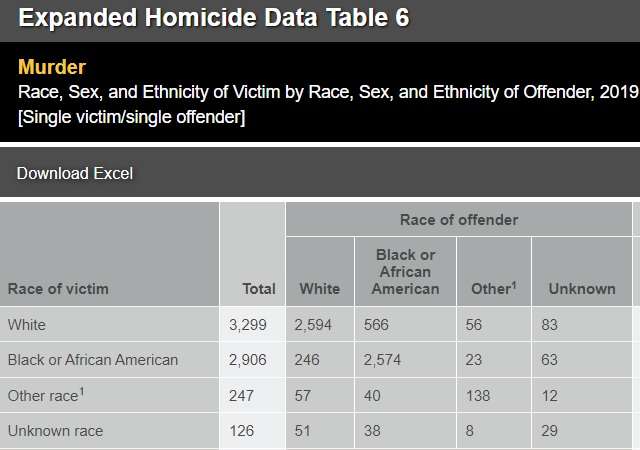
There's some controversy about the "reader context" reaction, but I think the reaction is factually correct and Hasan was mistaken. Here's a screenshot from the FBI statistics; they naturally have the usual set of imperfections, for instance excluding the many cases where "the offender age, sex, race, and ethnicity are all reported as unknown," but my sense is that they are the best data we have:

So while the numbers of white-on-white homicides and black-on-black homicides were virtually identical, the rate of black-on-black homicide was almost 5 times the rate of white-on-white homicide (since the black population in 2019 was indeed apparently about 1/5 that of the white population).

And of course it makes sense to compare rates (numbers divided by population) rather than raw numbers in this situation: If, for instance, someone told you that the city of Jonesville had 1/5 the population of the city of Smithville, but had the same number of homicides—saying nothing about race, but just transposing the numbers to geography—your reaction would probably and rightly be "Wow, Jonesville has a vastly more serious homicide problem than Smithville; if we care about saving lives, we should focus more on figuring out what's going wrong in Jonesville and how to fix it." The same logic applies to black-on-black homicide vs. white-on-white homicide.

Read More

Just How Bad was that New York Times Piece on Supreme Court Justices Teaching at Scalia Law?

|

This bad:

The documents show how Scalia Law has offered the justices a safe space in a polarized Washington — an academic cocoon filled with friends and former clerks, where their legal views are celebrated, they are given top pay and treated to teaching trips abroad, and their personal needs are anticipated, from lunch orders to, in Justice Gorsuch's case, house hunting.

Hmm, that sounds strange. I read this and was pretty confident that my law school does not, in fact, provide house hunting services to judges.

Not surprisingly, then, it turns out we don't. Forty paragraphs later:

As Judge Gorsuch moved to the top of the list for the court seat, he convened a war room of confidants to lobby for his nomination and help frame a confirmation strategy. Among them was Jamil N. Jaffer, a Scalia Law professor and founder of its new National Security Institute. Mr. Jaffer had clerked for the judge on the appeals court and counted him as a friend and mentor.

After the Supreme Court confirmation, Mr. Jaffer acted as the Gorsuches' unofficial relocation consultant, meeting with a real estate agent and touring at least one equestrian estate in Virginia. "Thanks, Jaffer ????," the justice's wife, Louise Gorsuch, wrote after he sent an aerial video of the property. The justice followed up by asking Mr. Jaffer to arrange a tour for his wife.

I laughed when I got to that. Either the Times reporters are too dumb to distinguish between "Scalia Law, catering to the justices' personal needs, helped Gorsuch with househunting" and "a friend of Gorsuch on the faculty of Scalia Law helped Gorsuch with househunting," or they are outright dishonest. I'm guessing it's a bit of both, but mostly the latter, given that they waited forty paragraphs to elaborate on the original claim.

For more on the story, see Josh Blackman's post from yesterday.

More