Dean John Wade, who replaced the great torts scholar William Prosser on the Restatement (Second) of Torts, put the finishing touches on the defamation sections in 1977. Apple Computer had been founded a year before, and Microsoft two, but relatively few people owned computers yet. The 24-hour news cycle was not yet a thing, and most Americans still trusted the press.
A lot has changed since 1977. Billions of people now publish their most profound, trivial, or scurrilous thoughts—unexpurgated—to mass audiences. Trying to compete with "cheap speech" has economically devastated large swaths of the news industry, stripping talent and expertise from newsrooms. Meanwhile, and perhaps unsurprisingly, public trust in news media has eroded dramatically. These developments pose the biggest challenge for defamation law since the invention of the printing press. Yet they have not inspired dramatic reform to the common law of defamation. Or at least not yet. As the American Law Institute begins a new Restatement of Defamation Law, it is important to consider what a successful program of reform might look like.
In this chapter, I examine some of the most important "reforms" to defamation law since 1977 and speculate about why those reforms have been predominantly constitutional and statutory, with common-law developments playing a less important role. I then evaluate recent critiques of defamation law's constitutional dimensions by two U.S. Supreme Court Justices, paying special attention to Justice Neil Gorsuch's argument that changed circumstances related to cheap speech justify reconsidering and perhaps eliminating some First Amendment constraints on the common law of defamation. I tally defamation law's scorecard in vindicating reputation and deterring disinformation, which leads me to concur with some of Justice Gorsuch's critiques. I nonetheless question his prescription. Merely rolling back constitutional protections will not deliver the proper balance between protecting individual reputation and safeguarding the types of speech that contribute to informed democratic decision-making, because powerful people will increasingly use defamation law to punish their critics. To achieve a proper balance, a more comprehensive approach to reform is needed. I offer the outlines of such an approach for untangling (rather than cutting) the inseverable interweaving of tort, constitutional, and statutory law.
Matthew Russell Lee (Inner City Press) has what appears to be a live-Tweet transcript of the hearing, as it progressed; I can't be certain that it's accurate, but it seems credible enough to link to. There should presumably be a decision soon from Judge Kevin Castel. For the backstory, see my earlier post (which is based on written court filings).
Today, I'm sure most Supreme Court watchers are cracking Allen v. Milligan or downing Jack Daniel's v. VIP. Fair enough. But the most significant writing to emanate from the Court today was Justice Thomas's dissent in Health and Hospital Corporation of Marion County v. Talevski. The facts are, well, boring: can a citizen sue a county-owned nursing home under 42 U.S.C. §1983 for violating the Federal Nursing Home Reform Act. Section 1983 provides a cause of action when a state actor deprives a person of "any rights . . . secured by the Constitution and laws." FNHRA is spending legislation, in which the federal government offers money to the states with certain conditions. Is FNHRA a "law" for purposes of Section 1983?
Eight members of the Court found that the FNHRA was a "law" for purposes of Section. Justice Gorsuch wrote a brief concurrence that questioned "whether legal rights provided for in spending power legislation like the [FNHRA] are 'secured' as against States." Gorsuch also questioned the relationship between such spending legislation and the Constitution's anti-commandeering doctrine. But Gorsuch found that the Petitioners "failed to develop fully" those arguments.
Justice Thomas, however, wrote a thirty-five page dissent that thoroughly addressed both issues. Here is Thomas's introduction, which sketches the argument:
Section 1983 provides a cause of action to redress only "the deprivation of any rights, privileges, or immunities secured by the Constitution and laws."But legislation enacted pursuant to Congress' spending power, like FNHRA, does not "secure" rights by "law."
For nearly all of our Nation's history, it was understood that there is a fundamental difference between the exercise of Congress' sovereign legislative powers, on the one hand, and the exercise of its power to spend money and to attach conditions to the receipt of that money, on the other. Only the former sort of legislation, which imposes obligations on regulated parties with the force of law, directly secures by law the rights corresponding to those obligations. By contrast, an exercise of Congress' spending power, whether it comes from the so-called Spending Clause or elsewhere in the Constitution, is no more than a disposition of funds. As such, a conditional exercise of the spending power is nothing more than a contractual offer; any "rights" that may flow from that offer are "secured" only by the offeree's acceptance and implementation, not federal law itself.
Since Maine v. Thiboutot, 448 U. S. 1 (1980), however, this Court has ignored that fundamental distinction, permitting third parties who benefit from spending conditions to enforce them in §1983 suits against state actors. In doing so, it has created a constitutional quandary: If spending conditions that benefit third parties are laws and secure rights in the same manner as ordinary lawmaking underCongress' sovereign legislative powers, then such conditions would contradict the bedrock constitutional prohibition against federal commandeering of the States. We escape this quandary only by recognizing spending conditions, not as rights-securing laws, but as the terms of possible contracts that secure rights only by virtue of an offeree's acceptance—the very conclusion compelled by the traditional understanding of the spending power. The choice between these alternatives is stark and unavoidable: Either spending conditions in statutes like FNHRA are not laws that secure rights cognizable under §1983, or they are unconstitutional direct regulations of States. The Court must, at some point, revisit its understanding of the spending power and its relation to §1983.
The dissent provides a careful analysis of the so-called Spending Clause from the Constitutional Convention, through the debates over the first Bank of the United States with Hamilton and Jefferson, through the vetoes by Presidents Madison and Monroe, through the Progressive Era, through the New Deal, and into the modern era. The opinion in scholarly, thorough, and persuasive. In addition to providing a torrent of primary sources, Justice Thomas cites scholarship by Robert Natelson, Phillip Hamburger, David Engdahl, Gary Lawson, and other prominent originalists. If you want to understand the genesis of the spending power, read Thomas's dissent.
This dissent reminds us, for the umpteenth time, that Justice Thomas is playing in a league of his own. The other Justices try their level best to apply longstanding doctrine to complicated cases. But Justice Thomas, at every opportunity, starts from first principles, and urges us to reconsider everything. And these opinions will ripple out for years to come.
Going forward, I am confident state actors will take note of Justice Thomas's dissent, and challenge whether Section 1983 provides a cause of action for violation of spending legislation. Thomas explains:
The line from Mellon and Butler, to Thiboutot, to this case amounts to a constitutional bait and switch that cannot continue to be glossed over or ignored. In holding that spending conditions are not merely contractual, but can directly impose obligations on the States with the force of federal law, the Court unravels the very rationale for their constitutionality. Either conditions in statutes enacted under the spending power are in the nature of contract terms and do not secure rights by federal law, or they are unconstitutional because they exceed the spending power and illicitly commandeer the States. The consequence of the majority's rejection of the contractual understanding is not that spending conditions are enforceable under §1983. Rather, it is that they are unconstitutional. It is well past time for this Court to re-examine Thiboutot and the nature of Congress' spending power.
Justice Brennan's decision in Maine v. Thiboutot (1980), which "discard[ed] nearly two centuries of settled spending-power doctrine," should not be long for this world.
Our peer-reviewed Journal of Free Speech Law, which is now two years old, has published over fifty articles, including by Jack Balkin (Yale), Mark Lemley (Stanford), Jeremy Waldron (NYU), Cynthia Estlund (NYU, forthcoming within a week or so), Christopher Yoo (Penn), Danielle Citron (Virginia), and many others—both prominent figures in the field and emerging young scholars (including ones who didn't have a tenure-track academic appointment).
I expect that many authors are planning to submit articles on free speech to the usual law reviews when the submission cycle restarts in August. But if you submit exclusively to us before that, we will give you an answer within 14 days (our guarantee, which we have so far never broken); and then if you'd like to have it published quickly, we can publish it in within several weeks, if it's sufficiently clean and cite-checked by your research assistant. (We can also have it cite-checked for you by one of our student staffers, but that takes a bit longer.) This means your article can be published by us, if it's accepted, almost a year (or more) before it would be published by the law journals.
Of course, also please pass this along to friends or colleagues who you think might be interested. Note that the submissions don't compete for a limited number of slots in an issue or volume; we'll publish articles that satisfy our quality standards whenever we get them.
All submissions must be exclusive to us, but, again, you'll have an answer within 14 days, so you'll be able to submit elsewhere if we say no. Please submit an anonymized draft, together with at https://freespeechlaw.scholasticahq.com/. A few guidelines:
An article on March 16 about a fatal shooting that involved members of the University of Alabama basketball team misidentified the person who was in the car with one player, Brandon Miller, when the shooting occurred.
Based on information from a person familiar with the case, the article erroneously identified that person as Kai Spears, a freshman basketball player. After the article was initially published, Alabama's athletic director and Spears's father denied that Spears was present. The Times included those responses and reviewed its reporting, but did not conclude that any other change to the article was warranted at that time.
On Wednesday, Spears filed a defamation suit against The Times that included new details about the incident. Based on that information, editors assigned further reporting, which determined that the other person at the scene was not Spears but Cooper Lee, a student manager for the team. The Times regrets the error in the initial report.
The online version of the article has been revised to remove the erroneous information; the latest updates appear today on Page B8.
You can also see the Complaint, and the supporting affidavit. Note that, under Alabama law (which may apply here, though the matter isn't certain),
The defendant in an action of slander or libel may prove under a general denial in mitigation of damages that the charge was made in good faith by mistake or through inadvertence or misapprehension, and that he has retracted the charge in the same medium of publication as the charge was originally promulgated and in a prominent position therein.
Nancy tells Irina and Michelle about her own life as an out bisexual and polyamorous person, as well as about about her public writings and advocacy on these topics. While bisexuality has increasingly become more accepted, the same is less true for the various forms of ethical non-monogamy.
Nancy discusses how to communicate about difficult issues such as jealousy in poly relationships, but also describes the legal battles that continue to plague the LGBTQIA+ community. Come find out how Nancy has found happiness in unexpected ways and continues fighting for the right of others to do the same!
[T]he District's stalking statute … makes it a criminal offense to engage in a course of conduct—including two or more "communicat[ions] to or about another individual"—that one knows or should know would reasonably cause another to suffer emotional distress. D.C. Code §§ 22-3132(8)(A), -3133. By its terms, it restricts all manner of speech, without regard to its truth or falsity, and without regard to whether it is of public or purely private concern. The constitutional problems with the statute are glaring. See Forsyth County, Ga. v. Nationalist Movement (1992) ("Listeners' reaction to speech is not a content- neutral basis for regulation."); R.A.V. v. City of St. Paul (1992) ("Content-based regulations are presumptively invalid."); Garrison v. Louisiana (1964) ("Truth may not be the subject of either civil or criminal sanctions where discussion of public affairs is concerned.").
People are generally allowed to say things that they know or should know will cause others emotional distress. Such speech is frequently socially valuable or, at the very least, accepted. Doctors tell patients that they likely have only months to live, or more distressing yet, that their children do. Spouses may knowingly inflict emotional distress by revealing a longstanding paramour and demanding a divorce. Police officers bring news of loved ones having been killed. Judges pronounce death sentences. All of those messages undoubtedly trigger extraordinary distress, and as a result, they are prohibited by the stalking statute's plain terms (at least if the messages need repeating). The statute is unconstitutional if read in that straightforward fashion, as "[s]peech may not be banned on the ground that it expresses ideas that offend."
But the stalking statute has a savings clause, and we granted en banc review in this case to resolve its meaning. The stalking statute provides that "[t]his section does not apply to constitutionally protected activity." D.C. Code § 22-3133(b). To save the District's stalking statute from unconstitutionality, we interpret this clause to mean that, when speech is at issue, the statute covers only speech that fits within the "well-defined and narrowly limited classes of speech, the prevention and punishment of which have never been thought to raise any Constitutional problem."
That includes threats, obscenity, defamation, fraud, incitement, and speech integral to criminal conduct. Outside of those narrow categories, speech is constitutionally protected activity that the statute does not apply to.
In this case, the Superior Court found that there was good cause to believe that Lauren Mashaud, a married man, stalked Christopher Boone when he truthfully revealed to Boone's family, friends, and colleagues that Boone had an affair with Mashaud's wife. Mashaud now appeals. Because Mashaud's speech was constitutionally protected activity—i.e., it does not fit within any of the categories outside of the First Amendment's protections—we conclude that he did not stalk Boone. We therefore reverse….
Quite right, I think. (Note that Schaerr | Jaffe's Gene Schaerr, Erik Jaffe, and Joshua Prince and I filed an amicus brief in the case, on behalf of Protect the 1st Foundation and myself, advocating for this result. Many thanks to UCLA First Amendment Amicus Brief Clinic law students Max Hyams, So-Young Kim, and Jason Lundry, who drafted the brief under my supervision; and to Scott & Cyan Banister, whose generosity makes the Clinic possible.)
It did so in today's Voting Rights Act ruling in Allen v. Milligan. This holding has implications for other cases where litigants attempt to overturn statutory precedents, especially longstanding ones.
In today's notable voting rights decision in Allen v. Milligan, the Supreme Court reasserted its longstanding rule that there is a strong presumption against overruling statutory precedents. The Court is more willing to reverse constitutional decisions. But potentially wrongheaded statutory precedent is largely left to Congress, especially if that precedent has been in place for a long time. Here's the relevant excerpt from Chief Justice John Roberts' majority opinion:
Alabama first argues that §2 [of the Voting Rights Act] does not apply to single-member redistricting…..
This understanding of §2 cannot be reconciled with our precedent. As recounted above, we have applied §2 to States' districting maps in an unbroken line of decisions stretching four decades…. In doing so, we have unanimously held that §2 and Gingles "[c]ertainly … apply" to claims challenging single-member districts. Growe, 507 U. S., at 40. And we have even invalidated portions of a State's single-district map under §2. See LULAC, 548 U. S., at 427–429. Alabama's approach would require "abandoning" this precedent, "overruling the interpretation of §2" as set out in nearly a dozen of our cases. Holder, 512 U. S., at 944 (opinion of THOMAS, J.). We decline to take that step. Congress is undoubtedly aware of our construing §2 to apply to districting challenges. It can change that if it likes. But until and unless it does, statutory stare decisis counsels our staying the course. See, e.g., Kimble v. Marvel Entertainment, LLC, 576 U. S. 446, 456 (2015).
In a crucial concurring opinion (he was the swing voter in this 5-4 decision) Justice Brett Kavanaugh reaffirms strong statutory stare decisis even more forcefully:
I agree with the Court that Alabama's redistricting plan violates §2 of the Voting Rights Act as interpreted in Thornburgv. Gingles, 478 U. S. 30 (1986). I write separately to emphasize four points.
First, the upshot of Alabama's argument is that the Court should overrule Gingles. But the stare decisis standard for this Court to overrule a statutory precedent, as distinct from a constitutional precedent, is comparatively strict. Unlike with constitutional precedents, Congress and the President may enact new legislation to alter statutory precedents such as Gingles. In the past 37 years, however, Congress and the President have not disturbed Gingles, even as they have made other changes to the Voting Rights Act. Although statutory stare decisis is not absolute, "the Court has ordinarily left the updating or correction of erroneous statutory precedents to the legislative process." Ramos v. Louisiana, 590 U. S. ___, ___ (2020) (Kavanaugh, J., concurring in part) (slip op., at 4); see also, e.g., Kimble v. Marvel Entertainment, LLC, 576 U. S. 446, 456 (2015); Patterson v. McLean Credit Union, 491 U. S. 164, 172–173 (1989); Flood v. Kuhn, 407 U. S. 258, 283–284 (1972); Burnet v. Coronado Oil & Gas Co., 285 U. S. 393, 406 (1932) (Brandeis, J., dissenting).
Both Roberts and Kavanaugh imply that the rule of statutory stare decisis is particularly strong when the precedent is longstanding and Congress has had many opportunities to change it, but didn't choose to do so.
Kavanaugh's favorable citation to Flood v. Kuhn (1972) is also notable. This is the famous case where the Court refused to overturn precedent exempting professional baseball leagues from the Sherman Anti-Trust Act, even though all of the justices agreed that the precedent in question was badly wrong, and that it made little sense to exempt Major League Baseball from antitrust rules, even as other professional sports leagues (such as the NFL) are covered by them. Flood is often considered a paradigmatic example of maintaining statutory precedent even when judges think the precedents in question are truly awful.
Roberts' and Kavanaugh's apparent commitment to strong statutory stare decisis has implications for other cases where litigants seek to overturn statutory precedents, especially longstanding ones. Notable examples include the Harvard and UNC racial preferences cases currently before the Court, where plaintiffs argue the Supreme Court should reverse longstanding precedent permitting "diversity"-promoting affirmative action policies under Title VI of the Civil Rights Act of 1964. I think it's still highly likely that the Court will rule against Harvard and UNC. But it is now more likely to do so by reaching the constitutional issue, rather than focusing on Title VI. As a private institution, Harvard is only bound by Title VI, not the Constitution. But a ruling on the latter will also affect the former, as the relevant precedent says that Title VI and constitutional standards are the same.
In my view, the Title VI precedents are so egregious that they might warrant overruling even under a strong presumption of stare decisis. But a majority of the Court might well believe otherwise.
Another challenge to longstanding statutory precedent currently before the Court is Groff v. DeJoy, a case where the plaintiff seeks to overrule a 1977 decision narrowly interpreting the scope of accommodations for employees' religious commitments that employers are required to grant under Title VII of the Civil Rights Act of 1964. Today's ruling makes it less likely that the Supreme Court majority will be willing to take that step.
The strong presumption of statutory stare decisis has many critics. I myself am not convinced that it's correct (though I do agree it should be stronger than in constitutional cases). The same goes for the related idea that congressional "acquiescence" to statutory precedents requires even greater judicial deference. But Roberts, Kavanaugh, and the three liberal justices seem committed to these ideas. Unless they shift, litigants seeking to overturn longstanding statutory precedents are likely to continue to have a tough time before the Supreme Court.
The memorandum of law, filed by the lawyer's counsel, is here. It seems quite well argued, though I don't agree with the backup argument (in Part II.E) that the lawyer's reliance on ChatGPT as a source for the supposed text of precedents was not just innocent but "reasonabl[e]." Here's the opening paragraph of the introduction:
In the Order, the Court describes this situation as "unprecedented." We agree. We can find no case where, as here, a lawyer using a new, highly-touted research tool obtained cases that the research tool itself completely made up. The lawyer, Mr. Schwartz, had no idea this was happening, even when opposing counsel brought their inability to locate the cases to his attention. ChatGPT even assured him the cases were real and could be found on Westlaw and LexisNexis, and continued to provide extended excerpts and favorable quotations. Now that Mr. Schwartz and the Firm know ChatGPT was simply making up cases, they are truly mortified; they had no intention of defrauding the Court, and the mere accusation – repeated in hundreds (if not thousands) of articles and online posts – has irreparably damaged their reputations. They have apologized to the Court in earlier submissions and do so again here.
An order governing filings before Magistrate Judge Gabriel A. Fuentes (N.D. Ill.), adopted May 31 (paragraph breaks added):
The Court has adopted a new requirement in the fast-growing and fast-changing area of generative artificial intelligence ("AI") and its use in the practice of law. The requirement is as follows:
Any party using any generative AI tool in the preparation or drafting of documents for filing with the Court must disclose in the filing that AI was used and the specific AI tool that was used to conduct legal research and/or to draft the document.
Further, Rule 11 of the Federal Rules of Civil Procedure continues to apply, and the Court will continue to construe all filings as a certification, by the person signing the filed document and after reasonable inquiry, of the matters set forth in the rule, including but not limited to those in Rule 11(b)(2). Parties should not assume that mere reliance on an AI tool will be presumed to constitute reasonable inquiry, because, to quote a phrase, "I'm sorry, Dave, I'm afraid I can't do that …. This mission is too important for me to allow you to jeopardize it." 2001: A SPACE ODYSSEY (MetroGoldwyn-Mayer 1968). One way to jeopardize the mission of federal courts is to use an AI tool to generate legal research that includes "bogus judicial decisions" cited for substantive propositions of law. See Mata v. Avianca, Inc., No. 22-cv-1461 (PKC), 2023 WL 3966209, at *1-2 (S.D.N.Y. May 4, 2023) (issuing show cause order where "[a] submission filed by plaintiff's counsel in opposition to a motion to dismiss is replete with citations to nonexistent cases."); Mata, supra, Attorney Affidavit (S.D.N.Y. May 25, 2023) (D.E. 32-1) (responding to show cause order by stating that the case authorities found by the district court to be nonexistent "were provided by Chat GPT which also provided its legal source and assured the reliability of its content.").
Just as the Court did before the advent of AI as a tool for legal research and drafting, the Court will continue to presume that the Rule 11 certification is a representation by filers, as living, breathing, thinking human beings, that they themselves have read and analyzed all cited authorities to ensure that such authorities actually exist and that the filings comply with Rule 11(b)(2). See Hon. Brantley Starr, "Mandatory Certification Regarding Generative Artificial Intelligence [Standing Order]," (N.D. Tex.) (stating that unlike attorneys, "generative artificial intelligence … hold[s] no allegiance to any client, the rule of law, or the laws and Constitution of the United States (or, as addressed above, the truth.")) (www.txnd.uscourts.gov/judge/judge-brantley-starr) (last visited May 31, 2023).
Legal scholar Julie Suk argues the answer is "yes." The idea has a solid basis in natural rights theory, but is at odds with longstanding legal doctrine. It also has potentially very broad libertarian implications.
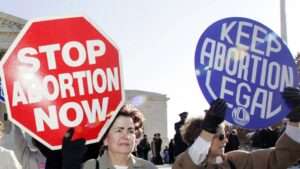
In this Nov. 30, 2005 file photo, an anti-abortion supporter stands next to a pro-choice demonstrator outside the U.S. Supreme Court in Washington. (AP Photo/Manuel Balce Ceneta).
Are laws restricting abortion takings of "private property" that require the government to pay "just compensation" under the Fifth Amendment? In a recent law review article on abortion rights (pp. 504-508) and in her important new book After Misogyny, Fordham law professor Julie Suk argues that the answer is "yes." Her argument is a fascinating example of a famous left-liberal law professor arguing for a major expansion of Takings Clause protection for property rights.
The position she advances has a strong basis in natural rights theories of property, including those advanced by James Madison, the principal framer of the Takings Clause. But it also cuts against centuries of legal precedent and practice. If accepted by the courts, it would have fairly radical libertarian implications that would make me happy, but might be less welcome to many left-of-center advocates of abortion rights. Suk's theory faces an uphill fight under US Supreme Court precedent. But it could perhaps fare better under some state constitutions. Her argument is also notable as one of several examples of left-liberals potentially rethinking their traditionally negative view of constitutional property rights.
The basic argument here is admirably clear and simple. People have property rights in their bodies. Laws banning abortion restrict those rights. Moreover, the imposition is a pretty severe one. To put it in more legalistic terms, the Supreme Court has ruled in Cedar Point Nursery v. Hassid(2021) that even a temporary physical occupation of property qualifies as a "per se" taking, automatically requiring compensation. By similar logic, abortion bans can be seen as compelling unwanted physical occupation of a woman's body by the fetus.
The idea that people have property rights in their bodies is far from a new one. John Locke famously defended such rights in the 17th century. So too did James Madison, the Founder principally responsible for drafting the Takings Clause and getting it included in the Bill of Rights. In his famous 1792 essay on "Property," Madison wrote that property includes not only "a man's land, or merchandize, or money," but also - among other things - "the safety and liberty of his person." He goes on to say "[t]hat is not a just government, nor is property secure under it, where the property which a man has in his personal safety and personal liberty, is violated by arbitrary seizures of one class of citizens for the service of the rest."
As an example of such "arbitrary seizures," Madison gives the case of "a magistrate issuing his warrants to a press gang" (referring to the then-common practice of governments seizing men for forced labor or military service). But it's not hard to see how coerced pregnancy can also be considered a seizure of "one class of citizens for the service of the rest." Locke's and Madison's arguments have been extended by modern libertarians (myself included), who have long argued for a broad notion of self-ownership. The idea of self-ownership was also central to the anti-slavery movement that inspired the Reconstruction-era amendments. And, of course, one of the major achievements of the feminist movement was the extension to women of bodily autonomy rights previously fully available only to men.
But despite this impressive historical pedigree, the idea of self-ownership property rights in the body has never played a meaningful role in takings doctrine. Takings jurisprudence has historically been confined to property in land and objects ("real property" and "personal property," in legal terminology), a limitation embodied in William Blackstone's famous definition of property as "that dominion which one man claims and exercises over the external things of the world, in exclusion of every other individual." Intellectual property also gets some protection. But, to my knowledge, federal and state courts have never ruled that a restriction on bodily autonomy violates the Takings Clause.
There is a long history of state and federal laws that impose severe restrictions of that type, and would be vulnerable to attack on takings grounds, if state and federal constitutional takings clauses had applied to them. Most obviously, military conscription literally seized men's bodies and forced them to be used for purposes against their will. The same goes (to a lesser extent) for mandatory jury service. Draftees and jurors usually get paid, but generally far less than the "fair market value" Supreme Court precedent requires as "just compensation" for takings.
In the 1916 case of Butler v. Perry, the Supreme Court upheld a Florida law forcing men between the ages of 21 and 45 to do road repair work, six days per year. The Court cited a long history of similar statutes. I think the justices were wrong to reject the Thirteenth Amendment argument against the constitutionality of these horrible forced-labor laws. But it's notable that no one seems to have tried to challenge them on Takings Clause grounds.
There is one major historical example of takings arguments being deployed to attack the seizure of property rights in human bodies. But it's not one likely to appeal to modern sensibilities. Before the enactment of the Thirteenth Amendment, defenders of slavery often argued that abolition should be considered a taking, thereby requiring compensation. On top of that, they also contended that it would be a taking not for a "public use," (as required by the Fifth Amendment), because the new owners of the "property" in question would not be the government, but private individuals (the freed slaves themselves). Abolitionists responded (correctly, in my view) that emancipation was not a taking because the ownership of slaves was not a "natural" property right, and therefore not one protected by the Takings Clause at all. I go over this debate and its implications for modern takings issues in Chapter 2 of my book The Grasping Hand.
For present purposes, the key takeaway is that takings arguments were used here because this was the one major situation in American history where mainstream legal thinkers (at least those supportive of slavery) thought that property in a person was essentially similar to property in objects or animals. For defenders of slavery, owning a slave was just another example of Blackstonian "dominion…. over the external things of the world."
I do not mean to suggest Suk's argument is somehow on the same moral plane as that of the slaveowners. There is an obvious moral chasm between claiming ownership of one's own body, and claiming a right to control the bodies of other people by force. But the paucity of other historical takings arguments of this type underscores the reality that takings doctrine has never been understood to protect bodily autonomy, as opposed to the ownership of "external things."
Suk cites a number of cases recognizing property rights in body parts, such as a spleen removed during an operation. But these weren't takings cases. Moreover, they mostly involved property rights in body parts that have already been removed from the body, thereby becoming external objects (standard "personal" property). The exception is cases involving surrogate parenthood, in which the surrogate carries and gives birth to a fetus on behalf of a couple unable to do so on their own. But, legally speaking, this is best understood as a contract for labor, similar to other situations where people commit to using their bodies to do work for pay (sometimes risking various dangers in the process). Government regulations restricting such labor contracts have never been held to be takings and the same applies to laws banning or restricting surrogacy.
A second doctrinal challenge for Suk's argument is the so-called "police power" exception to takings - the longstanding rule that restrictions on property rights that would otherwise be takings are exempt from the requirement of just compensation if they were adopted for the purpose of protecting public health and safety. For example, during the Covid pandemic, a number of court decisions rejected takings challenges to public health orders shutting down various businesses on the grounds that they fit within the police power exception. The scope of this exception has never been all that clear, and there is a long history of debates over how far it should go. But if you believe that abortion is akin to murder or manslaughter, you are also likely to conclude that abortion restrictions fall within the police power exception. You might even reach that conclusion if you think that the government just has a reasonably plausible claim that restricting abortion is needed to protect innocent life.
I don't myself hold that view (I am pro-choice with respect to the overwhelming majority of abortions), and I think the police power exception should be given a fairly narrow interpretation, more generally. But the issue is not an easy one. As with many other arguments about abortion, much depends on the extent to which you believe fetuses have a right to life comparable to that enjoyed by infants. The plausibility of the pro-life position on this point is one of the key factors that makes abortion a tougher issue than many other bodily autonomy issues.
More can be said about the police power question. For now, I just note this is a difficult issue that Suk doesn't address, but should consider taking up in the future.
Let's assume these doctrinal problems can be overcome, and courts must declare abortion restrictions to be takings. Such a conclusion would have major implications that go far beyond abortion. At the very least, the draft, mandatory jury service, and any other significant government-imposed forced labor would have to be considered takings as well. That includes various proposals for mandatory national service periodically propounded by advocates on both the right and the left.
All such policies involve the appropriation of a person's body to perform various types of work against his or her will. And, in many cases, especially the draft, the severity of the imposition is at least as great as that of an unwanted pregnancy. Draftees are generally required to serve longer than nine months, and - at least in wartime - they may face much greater risks to life and health than most pregnant women.
Some of these can potentially be distinguished on the grounds that they "merely" involve bans on the payment of money, rather than on the activity itself. For example, current law allows you to donate an organ for transplant, but not to be paid for it. Ditto for the legal distinction between prostitution and unpaid sexual encounters. But the vast majority of abortions are also performed by people who are paid for the service. I suspect Suk would not accept the idea that her takings argument doesn't apply to laws that "only" ban abortions performed for pay.
Current Supreme Court precedent does offer some protection against regulatory takings, but much less than against physical invasions and appropriations. The more you believe - as I do - that these two types of takings should be treated more equally, the broader the potential impact of expanding the Takings Clause to protect bodily autonomy.
Such protection would not be absolute. The Takings Clause is not a total bar on regulation, but merely a requirement that the state must pay just compensation (and that the seizure of property rights be for a "public use"). But the need to pay compensation might end up deterring many types of regulation, if maintaining them required payment of vast sums to large numbers of people. The War on Drugs probably wouldn't survive for long if government had to pay fair market value compensation to everyone who wants to sell, distribute, or use currently illegal narcotics. Many states might prefer to abolish mandatory jury service if they had to pay market wages to jurors (I would be happy to see such a shift). And the same goes for many other policies.
While I'm not - so far - convinced that our present Constitution requires it, I would be absolutely thrilled to have a constitutional system in which restrictions on bodily autonomy are generally considered takings, subject - perhaps - to a narrow police power exception. Even if that rule were limited to "physical" takings, it would still be a huge improvement over the status quo.
Obviously, people less libertarian than me might not be so happy to embrace these implications of the argument that abortion restrictions are takings. Some might even be horrified at the mere thought of them.
I urge Prof. Suk and other advocates of the argument that abortion restrictions are takings to carefully consider the implications of their reasoning for other issues. If they want to embrace the implications sketched out above, that's great! If not, they should spell out which ones they reject and why. A rationale narrowly confined to the abortion context risks being rejected as arbitrary special pleading; or at least that may happen unless it is accompanied by a compelling theory explaining why the same reasoning doesn't apply to other significant restrictions on bodily autonomy.
While Suk's argument faces tough sledding under US Supreme Court precedent, it could potentially fare better under at least some state constitutions. Virtually every one of the latter has a takings clause of its own. And many of them have different histories (and sometimes even different wording) from the federal one. State courts can and sometimes do interpret their takings clauses as providing more protection for property rights than the federal Supreme Court's interpretation of the Fifth Amendment. Moreover, many state constitutions are much easier to amend than the federal one. Perhaps a state could enact a Self-Ownership Amendment under which significant constraints on bodily autonomy are presumptively considered takings, or even just presumptively banned altogether. State constitutional law matters greatly here, because many constraints on bodily autonomy (including most abortion restrictions) are products of state law, not federal.
Finally, Suk's argument is notable as an example of the broader trend of left-liberals rethinking traditional left-wing hostility to expansive constitutional property rights. Since the Progressive and New Deal eras, the dominant left-wing view has been that property rights deserve little, if any, judicial protection, because they were seen as tools by which the rich exploit the poor and impediments to rational, scientific social planning.
These types of issues have gradually begun to shift left-liberal attitudes on property rights issues, albeit liberal constitutional law scholars have been more wary than economists and land-use specialists. I hope the trend will continue and - hopefully - pick up steam.
Putting aside Seattle U. lawprofs who are participating, for whom I'll give the law school a pass, every single one of the eleven invited participants is a supporter of racial preferences. There is ideological diversity, but only in the sense that some of the participants are "mainstream" liberals, and some are Critical Race Theorists. Several of the panelists are known for arguing that current affirmative action policies, especially under the diversity rationale, are too conservative.
It strikes me that regardless of one's ideology, or what one thinks of affirmative action, a webinar on a decision to be issued by a conservative Supreme Court, which very likely will significantly restrict affirmative action preferences, should include experts whose views align to some degree with the Court (and, as a matter of public policy, with around 75% or so of Americans…)
The panelists are certainly diverse in terms of complexion and continent-of-ancestral-origin. But for an academic institution, a panel on a Supreme Court affirmative action decision that ranges in views from something like the far fringes of the left to just-to-the-right-of-Bernie Sanders is embarrassing. (And note that the two types of diversity need not be in conflict; there are plenty of Asian, Hispanic, and African American experts who are skeptical of or hostile to affirmative action, on both constitutional and public policy grounds.)
Seattle U's choice of speakers, ironically, suggests why the "diversity" rationale for affirmative action is a sham. Academic institutions that purport to be pursuing diversity rarely care about having the sort of diversity most important for such an institution, a diversity of worldviews. If anything they tend to prefer what one might call the Seattle University version of ideological diversity, views that range from merely "progressive" to "far left."
The Academic Freedom Alliance released a public letter to the Mayo Clinic regarding the sanctions that it has imposed on Dr. Michael Joyner for his comments made in the media regarding transgender athletes and COVID. The Mayo Clinic claims to respect the academic freedom of its scholars but failed utterly in this case.
Dr. Joyner's comments included in a New York Times article on the controversy surrounding the transgender college swimmer Lia Thomas were completely anodyne and well within the bounds of what would be protected under any reasonable free expression policy at an academic institution. From the NYT article:
Michael J. Joyner, a doctor at the Mayo Clinic in Rochester, Minn., studies the physiology of male and female athletes. He sees in competitive swimming a petri dish. It is a century old, and the sexes follow similar practice and nutrition regimens.
Since prepubescent girls grow faster than boys, they have a competitive advantage early on. Puberty washes away that advantage. "You see the divergence immediately as the testosterone surges into the boys," Dr. Joyner said. "There are dramatic differences in performances."
. . . .
"There are social aspects to sport, but physiology and biology underpin it," Dr. Joyner noted. "Testosterone is the 800-pound gorilla."
For such comments, Dr. Joyner was suspended, denied an annual salary increase, and threatened with termination.
From the letter:
The AFA recognizes Mayo Clinic's reputational standing as one of the leading private institutions for scientific and medical research and we appreciate that such institutions may enact policies that public entities could not due to First Amendment constraints. But in 2022, Mayo Clinic secured identification as an educational institution for tax purposes in Mayo Clinic v. United States. Two years prior, in 2020, Mayo Clinic adopted its current 'Freedom of Expression and Academic Freedom Policy,' a policy that commits to the 'freedom of expression, which includes the right to discuss and present scholarly opinions and conclusions without fear of retribution or retaliation if those opinions and conclusions conflict with those of the faculty or institution.' The actions taken against Dr. Joyner are neither consistent with an educational institution's protection of academic freedom nor your own institution's policy.
In this putative class action, Plaintiff alleges that Defendant, a California agricultural corporation, misrepresented the environmental impact of its farming practices through its advertising and "Inaugural Report on Environmental, Social and Governance Actions" ("ESG Report"). Specifically, Plaintiff alleges that Defendant's statements about "regenerative farming"; its Environmental, Social, and Governance ("ESG") commitments; and "preserving natural resources" were "false, deceptive, and misleading." According to Plaintiff, Defendant's "method of growing its goods is causing severe harm to the ecosystem, and to its neighbors and communities." Plaintiff purports to represent a class of consumers who "would not have purchased (or would not have paid a premium [for])" Defendant's products had they known of Defendant's allegedly misleading statements. The FAC asserts three causes of action: (1) false advertising …; (2) "unlawful, unfair, or fraudulent" business practices …; and (3) violation of the Consumer Legal Remedies Act ….
Defendant argues that Plaintiff's three causes of action should be dismissed under California's anti-SLAPP statute because "(a) [they are] impermissibly predicated on Defendant Grimmway's exercise of its free speech rights (namely, political advocacy and statements of public interest), and (b) Plaintiff will fail to establish a probability of prevailing on the merits." Plaintiff counters that "all of the language at issue is 'commercial speech,' " which "does not receive [a]nti-SLAPP protections." …
[Under] § 425.17(c), the "commercial speech exemption[]" …, causes of action arising from commercial speech are exempt from the anti-SLAPP law when:
On Tuesday, in Nuziard v. Minority Business Development Agency (MBDA) federal district court judge Mark T. Pittman issued an injunction against the MBDA's Business Center Program. These Centers may give assistance only to businesses owned by socially or economically disadvantaged individuals. A Business owned by a "Black, African American, Hispanic, Latino, American Indian, Alaska Native, Asian, Native Hawaiian, Pacific Islander, Puerto-Rican, Eskimo, Hasidic Jew, Asian Indian, or a Spanish-speaking American," is presumptively considered to be owned by a socially or economically disadvantaged individual. According to the opinion, and unlike similar federal programs, no individual outside of the designated groups can be eligible, no matter how socially or economically disadvantaged.
Most interesting from my perspective, Judge Pittman focused on the arbitrariness of the relevant classifications:
[T]he Program is not narrowly tailored because it is underinclusive and overinclusive in its use of racial and ethnic classification… It is underinclusive because it arbitrarily excludes many minorityowned business owners—such as those from the Middle East, North Africa, and North Asia. For example, it excludes those who trace their ancestry to Afghanistan, Iran, Iraq, and Libya. But it includes those from China, Japan, Pakistan, and India. The Program is also underinclusive because it excludes every minority business owner who owns less than 51% of their business.
In researching my book Classified, I hoped and really expected to find cases involving two issues that have received very little attention in the relevant academic literature.
First, what happens when a government agency rejects someone's claim to be a member of a designated minority group eligible for affirmative action? The conventional wisdom is that only one such case existed, involving Irish-American firefighters who claimed to be black. That struck me as very unlikely. My intuition was correct. I found a couple of dozen or so additional modern cases in which a party's racial status was adjudicated.
Second, while the Supreme Court has never directly addressed the issue, I thought there must be a fair number of cases discussing whether the classifications a government entity has adopted for affirmative action cases pass constitutional muster under the strict scrutiny test, which requires both a compelling government interest and the law be narrowly tailored to serve that interest. In other words, discussion not simply of whether affirmative action preferences are constitutional in the abstract as serving a compelling government interest, but whether the groups that are included and excluded meet the narrow tailoring requirement.
I was disappointed on that one. Very few cases address the issue, except in passing. The leading case, such as it is, is Peightal v. Metropolitan Dade County, 940 F.2d 1394 (11th Cir. 1991). In that case, the Eleventh Circuit held that while the decision to classify people by race and provide an affirmative action benefit to certain groups is subject to strict scrutiny, once a court concludes that the program itself meets the compelling interest test, if challenged the classification scheme used by the government is subject only to the very forgiving rational basis test.
Peightal seems obviously wrong. It's entirely implausible to me to read the Supreme Court's binding jurisprudence on these matters as saying that once the government demonstrates a compelling interest in racial and ethnic preferences, it can allocate those preferences in almost any way it desires.
I suspect that one reason Peightal came out as it did is that it would be very difficult if not impossible for the government to create a classification scheme for affirmative action that would meet the strict scrutiny/narrow tailoring requirement. The court wasn't prepared to issue a ruling that would call almost all racial preference programs into question, so it punted.
Judge Pittman acknowledged the problem in a footnote: "Fashioning a racial or ethnicity-based policy that is not underinclusive or overinclusive is extremely difficult and almost impossible in a multiethnic country like the United States." The logical inference to draw from this fact is not that courts should ignore the narrow tailoring requirement, but that racial and ethnicity-based policies are almost always unconstitutional.
Judge Pittman's ruling Nuziard called to mind Judge Amul Thapar's opinion in Vitolo v. Guzman, 999 F.3d 353 (6th Cir. 2021),which came out just as I was finishing my book manuscript:
The government's policy is plagued with other forms of underinclusivity. Consider the requirement that a business must be at least 51% owned by women or minorities…
The dispositive presumption enjoyed by designated minorities bears strikingly little relation to the asserted problem the government is trying to fix. For example, the government attempts to defend its policy by citing a study showing it was harder for black business owners to obtain loans from Washington, D.C., banks. Gov't Resp. 15. Rather than simply designating those owners as the harmed group, the government relied on the Small Business Administration's 364*364 2016 regulation granting racial preferences to vast swaths of the population. For example, individuals who trace their ancestry to Pakistan and India qualify for special treatment. But those from Afghanistan, Iran, and Iraq do not. Those from China, Japan, and Hong Kong all qualify. But those from Tunisia, Libya, and Morocco do not. This scattershot approach does not conform to the narrow tailoring strict scrutiny requires.
The stark realities of the Small Business Administration's racial gerrymandering are inescapable. Imagine two childhood friends—one Indian, one Afghan. Both own restaurants, and both have suffered devastating losses during the pandemic. If both apply to the Restaurant Revitalization Fund, the Indian applicant will presumptively receive priority consideration over his Afghan friend. Why? Because of his ethnic heritage. It is indeed "a sordid business" to divide "us up by race."
Congratulations to the lawyers at the Wisconsin Institute for Law & Liberty, who represented the plaintiffs in both Nuziard and Vitolo.
It was 1971 and Los Angeles Times editor Nick Williams had what he called a "terribly uneasy feeling." In a letter to one of the paper's Washington correspondents, he wrote of his suspicion that journalism had "lost credibility … with an alarming percentage of the people." If the plummet continued, Williams fretted, journalists will have "destroyed or weakened a keystone of our Constitution."
Williams's assessment was not entirely wrong. Polling data from 1971 confirmed that a dismal 18% of Americans had a "great deal of confidence" in the press.
But he also wasn't quite right. Far from undermining American government's democratic foundations, the press was likely shoring them up, having already entered what has been called its "Glory Days." This era was brought about, in part, by the press's performance of its watchdog role, exposing political corruption and government cover-ups. It was also brought about by something else: law. The Supreme Court and legislatures boosted the press by celebrating this watchdog role and granting it tools to enhance this work.
Today, 1971 feels familiar. Polls again register dreadfully low levels of trust in the media. "Terribly uneasy" may be a generous description of how journalists feel about the public's perception of them and the press's ability to continue playing its democratic role.
"Dr. Cline inseminated many of his female patients with his own semen, ultimately, fathering approximately [94] children"; Netflix allegedly promised the Secret Children anonymity when making its film, but allegedly broke its promise.
From Doe v. Netflix, Inc., decided yesterday by Chief Judge Tanya Walton Pratt (S.D. Ind.):
Individuals hoping to one day have children, but who for whatever reasons could not naturally conceive them, entrusted fertility specialist Dr. Donald Cline with that task.. Unbeknown to anyone, Dr. Cline inseminated many of his female patients with his own semen, ultimately, fathering approximately ninety-four (94) children (the "Secret Children"). Dr. Cline's secret was not discovered until 2015 after some took at-home DNA tests through an online testing service. It was not until 2019 that the Plaintiffs made the same discovery after submitting their DNA samples to another online testing service. The Plaintiffs held this information in close confidence. Only, "[c]ertain of Plaintiff's biological half siblings were able to see [their] identit[ies] through the DNA website[s]. This information was kept secured to a limited number of persons, namely, certain of the biological half siblings, through passwords and other means."…
Some of the Secret Children were rightly eager for answers and wanted to expose Dr. Cline's fraud. They reported him to local news outlets, government agencies, and the like. Local news outlets investigated and reported on the story. Thereafter, national news outlets reported on Dr. Cline's fertility fraud. This created a media frenzy surrounding Dr. Cline's conduct. In 2020, the Defendants contacted some of the Secret Children, including Jacoba Ballard ("Ballard"). Defendants offered them "the opportunity to discuss being on camera for [a] documentary and to submit photos."
However, some of the Secret Children, including the Plaintiffs, expressed concerns with being included in the documentary. The "Defendants made clear to the [ ] Secret Children that no Secret Child would be identified in the documentary without his or her explicit consent." In April 2021, the Defendants sent a written statement to Doe and Roe, which read in part: "I know that some of you were more comfortable than others being involved…. You will not be identified (unless you've already given us explicit permission to do so…." (the 'Non-Identification Pledge')."
The three Plaintiffs communicated to Defendants that they did not have their permission to disclose their names in the documentary.
Approximately a year later, in April 2022, the Defendants shared a trailer of the documentary to millions on their social media accounts. The social media posts embedded links to segments of the documentary. The Plaintiffs' names were displayed, and they were identified as Secret Children. In May 2022, millions of people, including at least 250,000 Indiana residents were able to view "Our Father" on Netflix's streaming platform. The documentary depicts Ballard uncovering the truth of her biological parentage, the identities of her previously unknown siblings, the extent of Dr. Cline's fertility fraud, and Dr. Cline's subsequent conviction. At one point during "Our Father", Ballard is seen reviewing her DNA results and scrolling through the names of her half-siblings. It is at this moment that the Plaintiffs' names appear on the screen: "Coe's name appeared on screen for less than 1 second … and Doe's and Roe's names appeared on screen for approximately 9 seconds…."…