The Volokh Conspiracy

Mostly law professors | Sometimes contrarian | Often libertarian | Always independent | Est. 2002

The Volokh Conspiracy

The Anti-Textualist Decision Finding VP Covered by Speech or Debate Clause

"The Court declines to be the first in generations to force a literal reading of the Clause's text."

|

In February, there was a flurry of debate about whether the Vice President is covered by the Speech or Debate Clause. Recall that the text expressly applies to "Senators and Representatives." As a textualist matter, the Vice President is not a "Senator" or "Representative." Thus, he would not be covered. Alas, many of the precedents interpreting this provision were set in an era where textualism was subordinate to flexible, purposivist analyses. For example, Gravel v. United States (1972), per Justice White, includes this line:

It is true that the Clause itself mentions only 'Senators and Representatives,' but prior cases have plainly not taken a literalistic approach in applying the privilege.

In February,"I would hope[d] that the Scaliafied judiciary takes a literal approach to the Constitution." Judge Boasberg of the District Court for the District of Columbia declined, and found that Vice President Pence received some protections under the Speech or Debate Clause for his role on January 6.

Zoe Tillman obtained a redacted version Judge Boasberg's opinion. The court followed what it calls a "functionalist" analysis that focuses on the specific roles the Vice President plays during the vote-counting process. And, the court found, that these roles falls "beneath the legislative umbrella."

But what about the text of the Constitution--you know, the actual Supreme Law of the Land? It's often said that the text of the Constitution resolves few actual questions. I disagree with that shibboleth, but the textual argument here is really simple. The Vice President, whatever his "hybrid" status, is not a Senator or Representative. Yet, Towards the end of the analysis, Judge Boasberg dispatches the textualist argument in a few sentences:

The Government also contends that, textually, the Vice President is not a "Senator or Representative" within the meaning of the Clause. It concedes that Gravel has extended the Clause beyond its text to reach Members' staff because such staff act as the "agent or assistant of a sitting Senator," but it argues that because the Vice President is not such an agent, the Clause does not cover him. Gravel was not so limited. The Clause has subsequently been read to cover all manner of legislative actors, including those who work for committees or for the chamber as a whole. See, e.g., Eastland, 421 U.S. at 507. The Court declines to be the first in generations to force a literal reading of the Clause's text.

I appreciate Judge Boasberg's candor. He declines to follow the text of the Constitution, but instead follows Supreme Court precedent that disregards that text. Or, to be more precise, he extends Supreme Court precedent that disregards the text of the Constitution.

There was another way. I have written how lower-court judges can be originalist. In a case of first impression, lower court judges should decline to extend non-originalist precedents to new contexts. Here, there was no decision of the Supreme Court squarely holding that the Vice President is covered by the Speech or Debate Clause. And precedents following a "functionalist" approach to the Speech or Debate Clause are flatly inconsistent with constitutional text. Therefore, a judge, faithful to his constitutional oath, could decline to extend those precedents to the case of first impression.

Alas, Judge Boasberg did not take this path. And this decision was not appealed, so I do not think there will be a chance for appellate review. As a practical matter, this precedent will likely be followed by future Vice Presidents, who seek Speech-or-Debate protection in other contexts. Thus, courts will continue extending precedents that cannot possibly be squared with text. The perpetuation of anti-textualist decisions will proliferate.

When Government Uses Private Companies to Regulate Speech

Federal courts must up their game to handle the new symbiosis of government power and private businesses.

|

Columbia Law School Professor Philip Hamburger has an important essay this weekend on the Wall Street Journal opinion page: How the Government Justifies Its Social-Media Censorship. Hamburger heads the New Civil Liberties Alliance, which is challenging the federal government's use of privately-owned social media platforms to suppress the speech of Americans. [Disclosure: I am on the NCLA Board of Advisors.]

In Missouri v. Biden, NCLA is challenging the constitutionality of pressure that officials at the White House, the Federal Bureau of Investigation, the Department of Homeland Security, the Central Intelligence Agency and other agencies have brought to bear on tech companies to suppress so-called "misinformation." Recent examples include the suppression of speech on private platforms about the Hunter Biden laptop story, the lab-leak theory of COVID-19's origins, the efficacy of mask mandates and COVID-19 lockdowns, and election integrity and the security of voting by mail.

In his op-ed, Hamburger identifies five Supreme Court doctrines that, when combined, have facilitated the modern regime of stealthy government censorship of speech on these and other topics of which the government disapproves:

  1. An expansive understanding of Congress's power to regulate commerce;
  2. An overemphasis on coercion;
  3. Misunderstanding privatized censorship;
  4. The "government speech" doctrine; and
  5. Qualified immunity.

To appreciate how these five doctrines perniciously interact, you need to read the whole op-ed. But I will focus here on #3: misunderstanding "privatized" censorship. Read More

Free Speech

Journal of Free Speech Law: "Privacy Rights, Internet Mug Shots, and a Right to Be Forgotten," by Prof. Amy Gajda

Just published as part of the symposium on Media and Society After Technological Disruption, edited by Profs. Justin "Gus" Hurwitz & Kyle Langvardt.

|

The article is here; here is the Introduction and the start of Part I:

In the spring of 2022, visitors to the Smoking Gun website would find a challenging "game, where [one's] wasted time [was] well spent."

"For today's 'Friday Photo Fun,'" the website explained, "readers must examine five mug shots and match up the respective defendants with the crime for which they were arrested." There appeared five photos of sorry-looking individuals arrested for crimes both serious and not so much. A tattooed white man nabbed by police for narcotics possession; a Black woman arrested for speeding; three other individuals arrested for driving while intoxicated, assault and battery, and grand theft respectively. The match-the-mugshot-to-the-crime game appeared every Friday.

The Smoking Gun gathered those police booking photos through freedom-of-information laws, statutes designed to give the public access to important governmental information. For a long time in the United States, mug shots have been a part of such governmental openness: The thought was that the public should know who'd been arrested and on what grounds, and how they'd looked at the time of arrest in order to ensure that police had not battered them. Mug shots also helped to avoid mistaken identity, access proponents said. In the past, it was mainly journalists who were those proponents, who would receive the images from police and later assess them for newsworthiness, publishing only those they thought relevant for public view.

Read More

AI in Court

New Order on AI and Confidential Information from Court of International Trade Judge

|

Judge Stephen Alexander Vaden's Order on Artificial Intelligence, issued Thursday:

Parties must conform to many rules when they file briefs in a case before the Court of International Trade. For instance, briefs must state with particularity the grounds for seeking a desired order and make "the legal argument necessary to support it." USCIT Rule 7(b)(l)(B). They must follow certain requirements of form, including those that govern the use of captions, exhibits, and paragraphing. USCIT Rule 7(b)(2); USCIT Rule 10.

However, perhaps the most important of these rules are those that concern confidential or business proprietary information. The Court has taken special care to ensure that bringing a claim will not result in the disclosure of sensitive non-public information owned by any party before it. Accordingly, the Court requires that briefs containing confidential or business proprietary information "must identify that information by enclosing it in brackets," that parties must file a non-confidential version of such a brief and redact the bracketed information, and that recipients of the confidential brief may not disclose its contents to any party not authorized to receive such information. USCIT Rule 5(g). In particular, an attorney may only receive confidential or business proprietary information if he or she has filed a Business Proprietary Information Certification and received an order from the Court granting access to such information. USCIT Rule 73.2(c)(2).

Generative artificial intelligence programs that supply natural language answers to user prompts, such as ChatGPT or Google Bard, create novel risks to the security of confidential information. Users having "conversations" with these programs may include confidential information in their prompts, which in turn may result in the corporate owner of the program retaining access to the confidential information. Although the owners of generative artificial intelligence programs may make representations that they do not retain information supplied by users, their programs "learn" from every user conversation and cannot distinguish which conversations may contain confidential information. In recognition of this risk, corporations have prohibited their employees from using generative artificial intelligence programs. See, e.g., Samsung Bans Staff's AI Use After Spotting ChatGPT Data Leak, Bloomberg, https://www.bloomberg.com/news/articles/2023-05- 02/samsung-bans-chatgpt-and-other-generative-ai-use-by-staff-after-leak (last visited June 8, 2023).

Read More

Free Speech

"We the People" Podcast on AI Libel, with Prof. Lyrissa Lidsky, Prof. Jeff Rosen, and Me

|

The podcast is from the National Constitutional Center; Jeff Rosen, who's a professor at the George Washington University law school, is the NCC's head (and a noted author and journalist). Lyrissa Lidsky is a co-Reporter for the American Law Institute's Restatement (Third) of Torts: Defamation and Privacy, the former dean at the University of Missouri law school, and now a professor at the University of Florida law school. I very much enjoyed doing the podcast, and I hope you enjoy listening to it.

Free Speech

Private Employers May Not Fire Employees for Writing to the Legislature, Tennessee Court Holds

BlueCross BlueShield allegedly fired an employee for "email[ing] Tennessee state legislators with her concerns and grievances regarding vaccine mandates."

|

In Smith v. BlueCross BlueShield of Tenn., decided today by the Court of Appeals of Tennessee (in an opinion by Chief Judge Michael Swiney, joined by Judges John McClarty and Kristi Davis), Smith alleged that BlueCross had wrongly fired her for, among other things, "email[ing] Tennessee state legislators with her concerns and grievances regarding vaccine mandates." The court concluded that this stated a claim under Tennessee law:

This case implicates the doctrine of employment-at-will. Under this doctrine, "employment for an indefinite period of time may be terminated by either the employer or the employee at any time, for any reason, or for no reason at all." It is undisputed that Smith was an at-will employee of BlueCross when she was fired. However, there are certain exceptions to the doctrine, and an employee may bring a retaliatory discharge action if she is fired in violation of public policy. Here, Smith alleged just that.

Our Supreme Court set out the elements of a common law retaliatory discharge claim thusly:

In Tennessee, the elements of a typical common-law retaliatory discharge claim are as follows: (1) that an employment-at-will relationship existed; (2) that the employee was discharged, (3) that the reason for the discharge was that the employee attempted to exercise a statutory or constitutional right, or for any other reason which violates a clear public policy evidenced by an unambiguous constitutional, statutory, or regulatory provision; and (4) that a substantial factor in the employer's decision to discharge the employee was the employee's exercise of protected rights or compliance with clear public policy.

"[T]he exception cannot be permitted to consume or eliminate the general rule." To be liable, the employer must have violated a clear public policy, which usually is "evidenced by an unambiguous constitutional, statutory or regulatory provision." …

Article I, Section 23 of the Tennessee Constitution reads: "That the citizens have a right, in a peaceable manner, to assemble together for their common good, to instruct their representatives, and to apply to those invested with the powers of government for redress of grievances, or other proper purposes, by address or remonstrance." {[I]t is evident that [this] concerns the right to petition.}

"[T]he right of petition is … 'an ancient right' and 'the cornerstone of the Anglo-American constitutional system.'" "Parliament used the Petition of Right to 'gain popular rights from the king,' and the people eventually 'used petitioning as the means to secure their own rights against parliament.'" Indeed, "'[t]he development of petitioning is inextricably linked to the emergence of popular sovereignty.'"

Read More

Free Speech

Journal of Free Speech Law: "Defamation, Disinformation, and the Press Function," by Prof. RonNell Andersen Jones

Just published as part of the symposium on Media and Society After Technological Disruption, edited by Profs. Justin "Gus" Hurwitz & Kyle Langvardt.

|

The article is here; here is the Introduction:

Coordinated campaigns of falsehoods are poisoning public discourse. Amidst a torrent of social-media conspiracy theories and lies—on topics as central to the nation's wellbeing as elections and public health—scholars and jurists are turning their attention to the causes of this disinformation crisis and the potential solutions to it.

Justice Neil Gorsuch recently suggested that, in response to this challenge, the U.S. Supreme Court should take a case to reconsider New York Times v. Sullivan, the foundational First Amendment precedent in defamation law. A major premise of Justice Gorsuch's critique of Sullivan is that the changing social-media dynamics—and the disinformation crisis that has accompanied them—threaten the nation's democracy. He argues this changed terrain may call for less stringent constitutional protections in defamation actions. This chapter explores and challenges that critique. Justice Gorsuch is correct that rampant social-media disinformation poses a grave risk to our political and social stability, but there is a troubling disconnect between the anti-disinformation and pro-democracy concerns he articulates and the doctrinal revisions he considers. When the interrelationships between disinformation, defamation, and democracy are interrogated—and especially, when they are situated within the constitutional value of the press function that served as the backdrop for Sullivan—it becomes clear that unwinding the Sullivan doctrine would not be a productive tool for remedying the problem of rampant social-media lies. Indeed, doing so carries the very real risk of exacerbating the problem. Abandoning the Sullivan line of protections would impair those valuable press speakers who are actively prioritizing trustworthy newsgathering and corrective reporting, and it would do so with no meaningful payoff in solving the online-disinformation problem that seems to be driving this proposed reconsideration.

This inquiry matters. Sullivan is not exclusively a press-freedom case, but at this critical juncture, it is a centerpiece of protection for some core press functions (performed by both legacy media and others) that are crucial to healthy public discourse. A Sullivan scaleback harms those entities that are incentivized to get information right, to invest in careful newsgathering, and to engage in important journalistic investigations exposing those who peddle disinformation. At a moment of declining newsroom and press-litigation resources and of increased willingness of public people to weaponize defamation as a tool for silencing and deterring critics, the risks of self-censorship voiced by the unanimous Sullivan Court are especially grave.

Representative democracy needs the press function to survive and flourish. There is every reason to believe that a rollback of Sullivan would compound rather than alleviate the disinformation problem and would further imperil the fragile democracy.

Immigration

Upcoming Cato Institute Event on the Private Sponsorship Revolution in Immigration Policy

Participants include Prof. Adam Cox (NYU), David Bier (Cato), Kit Taintor (Welcome.US), and myself.

|

On June 30, 12-1 PM, the Cato Institute will be holding an event on "Private Sponsorship: Revolution in Immigration Policy." The participants include Prof. Adam Cox (NYU) (coauthor of the important book The President and Immigration Law), Kit Taintor (VP of Policy and Practice at Welcome.US, the leading organization connecting potential American sponsors with Ukrainian and other migrants eligible for sponsorship), David Bier (Cato Institute), and myself.

Attendance is free and open to the public. You can come in person or watch online. Free registration at the event website here. Here is a description of the event:

The Biden administration recently launched ambitious private sponsorship programs for Ukrainians, Venezuelans, Haitians, Cubans, and Nicaraguans, which could be the largest expansion of legal migration in decades. These initiatives create new legal opportunities for Americans to sponsor foreigners from these troubled countries for legal entry and residence in the United States. The new entry categories have already facilitated hundreds of thousands of legal entries and are helping reduce unlawful migration across the U.S.-Mexico border. What is the sponsorship experience like? How can the government improve upon these policies? What can be done to expand the program to immigrants from other countries? Explore these issues and others with Cato's panel of experts.

Current private sponsorship programs started with Uniting for Ukraine in April of last year, but have since been expanded to include migrants from four other nations beset by violence and oppression, and a pilot program for people who fit the legal definition of "refugee." I have previously written about Uniting for Ukraine and other private sponsorship programs here, here, here, and here. While these initiatives have some limitations (most notably, the lack of a provision for permanent residency and work permits in most of them), they are likely to be the largest expansion of legal immigration for many years. Anyone interested in immigration law and policy would do well to pay attention to their development.

Politics

Short Circuit: A Roundup of Recent Federal Court Decisions

Fake Instagram accounts, offensive Facebook comments, and pro se parents.

|

Please enjoy the latest edition of Short Circuit, a weekly feature written by a bunch of people at the Institute for Justice.

Friends, the Supreme Court has long held that the Fifth Amendment's Just Compensation clause is "designed to bar Government from forcing some people alone to bear public burdens which, in all fairness and justice, should be borne by the public as a whole." And yet last year the Fifth Circuit ruled that the owners of a fourth-generation family farm in Texas must bear alone the burdens of a public highway project that caused catastrophic flooding. Farm Journal Magazine has the latest on a pending IJ cert petition.

Read More

Slippery Slope Arguments

Freakonomics Podcast on Slippery Slope Arguments

|

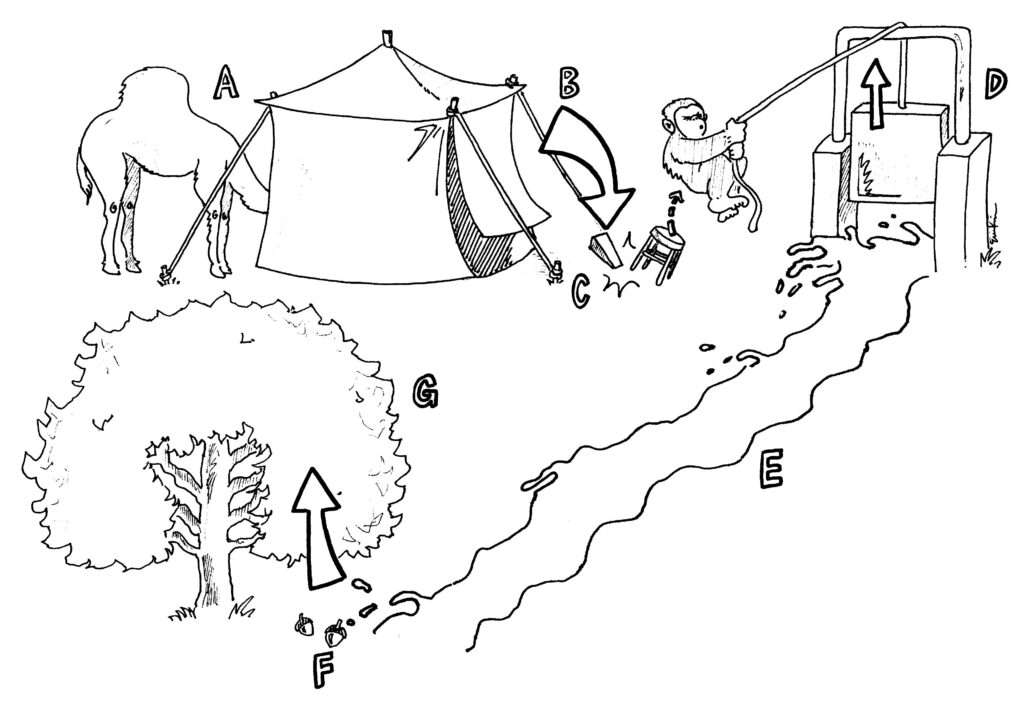
Camel (A) sticks his nose under the tent (B), which collapses, driving the thin end of the wedge (C) to cause monkey to open floodgates (D), letting water flow down the slippery slope (E) to irrigate acorn (F) which grows into oak (G). [Illustration by Eric Kim, from my idea.]

An interesting episode, with participants that include Dahlia Lithwick and me. The audio and transcript are here, and it's on Apple Podcasts, Spotify, Stitcher, and elsewhere. Check it out; in case you'd like to read more, here's my Mechanisms of the Slippery Slope article, a somewhat condensed version, a co-written 3-page magazine version, and the blog posts serializing the bulk of the article.

Free Speech

No Pseudonymity for Plaintiff in Medical Data Breach Case

"[A]n individual's name is not sensitive data in and of itself, and Plaintiff does not explain how publication of Plaintiff's name would place Plaintiff's data at further risk."

|

From A.S. v. Anthem Ins. Cos., Inc., decided Wednesday by Magistrate Judge Mario Garcia (S.D. Ind.):

Plaintiff's Motion asks to proceed semi-anonymously, using only his or her initials, "A.S." A.S. argues that proceeding under only initials is appropriate here because A.S. is an alleged victim of a healthcare data breach and is therefore concerned about "privacy and security should [A.S.'s] name be included in this action and made publicly available." A.S. contends that "[f]urther disclosure of [A.S.'s] name would permit the public, and perhaps additional criminals, to link [A.S.'s] name to the subject data breach and thereby link [A.S.] to the breach by name." Another reason to proceed semi-anonymously, says A.S., is because "the data breach involved [A.S.]'s current employer and [A.S.] desires to maintain … confidentiality as the Plaintiff in this matter on that basis as well." A.S. says Defendant "will suffer no undue prejudice" if the Court permits A.S. to proceed under initials.

"The use of fictitious names is disfavored, and the judge has an independent duty to determine whether exceptional circumstances justify such a departure from the normal method of proceeding in federal court." That is so because "judicial proceedings, civil as well as criminal, are to be conducted in public," and "[i]dentifying the parties to the proceeding is an important dimension of publicness" because "[t]he people have a right to know who is using their courts." There are narrow exceptions to the presumption of public proceedings that permit the use of fictitious names, such as "to protect the privacy of children, rape victims, and other particularly vulnerable parties or witnesses." …

Read More

Supreme Court

Justice Thomas Had No Majority Opinion from October Sitting, But Still Wrote More Than Any Other Justice

Justice Ketanji Brown Jackson may speak the most at oral argument, but Justice Thomas is writing more pages.

|

Allen v. Milligan was the last case to be decided from the Supreme Court's October sitting. There were only eight cases argued in that sitting, so only eight justices wrote majority opinions. Justice Thomas, the senior-most justice after Chief Justice Roberts, was the one justice left out.

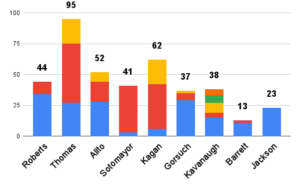
While Justice Thomas did not author a majority opinion from the October sitting, he authored more pages from that sitting than any other justice and it is not particularly close. Justice Thomas wrote three opinions that spanned 95 pages. The next most prolific justice, in terms of page count, was Justice Kagan, who wrote 62 pages, followed by Justice Alito who wrote 52 pages. The two newest justices -- Barrett and Jackson --wrote the fewest pages from the October sitting, 13 and 23 respectively. The totals are indicated in the table below.

Justice Kavanaugh did not write nearly as many pages as Thomas, Kagan or Alito -- only 38 pages -- but he wrote the most separate opinions of any justice in cases from the October sitting. Indeed, he was the only justice to write an opinion in more than half of the cases.

There are several possible explanations for Justice Thomas not having a majority opinion from the October sitting, despite his seniority. One possibility is that he anticipates having a substantial assignment from the November sitting, which includes the two affirmative action cases. Another possibility is that he had the majority opinion in Allen v. Milligan and lost the majority to the Chief. The extent to which Thomas responds to the Chief's opinion in his dissent is consistent with the idea that there was lots of back-and-forth trying to convince wavering justices, as is the fact that Justice Thomas' opinion does not make much effort to accommodate the views of other justices (as shown by the fact that only one of the other dissenters joins the whole opinion).

Whatever the reason Justice Thomas did not have a majority from the October sitting, it has not resulted in less writing from Justice Thomas. Indeed, measured in terms of pages and separate writings, Justice Thomas is usually one of the more prolific justices on the Court, and there's no reason not to expect that pattern to hold this term.

Politics

"The Court Reminds … Counsel of the Expectation … That Counsel Will Comport Themselves with Decency"

|

From Judge Paul Engelmayer (S.D.N.Y.) in Johnson v. Everyrealm, Inc. (Apr. 26, 2023):

The Court late last night received an urgent request by email from Shane Seppinni, Esq., counsel for plaintiff Tevo Johnson, seeking, on account of a medical emergency, an adjournment of the Friday, April 28, 2023 deadline for filing of his opposition to defendants' partial motion to dismiss.

Mr. Seppinni explains, inter alia, that his wife unexpectedly went into labor and delivered their child yesterday. Mr. Seppinni's email also attaches an email chain in which counsel for defendants Everyrealm, Inc., Julia Schwartz, Janine Yorio, and William Kerr state that they are "only willing" to consent to the three-week adjournment requested by Mr. Seppinni if Mr. Seppinni meets five demands, only two of which relate to this litigation; the others relate to three separate lawsuits, now in arbitration, which Mr. Seppinni brought against Everyrealm on behalf of other clients. Defendants' demands, verbatim, are:

Read More

Politics

Stalking Protective Order Against Grandmother Vacated

|

From Golias v. Boyce (Ga. Ct. App. 2023) (opinion by Chief Judge Brian Rickman, joined by Judges Stephen Dillard and John Pipkin):

… Boyce, the mother of two minor children, sought a stalking twelve-month protective order precluding Golias, the children's paternal grandmother, from contacting Boyce or her children. The events leading up to the filing of Boyce's petition began in 2021, when the children's father was charged with aggravated child molestation, incest, and child molestation involving the older child and was subsequently incarcerated. At the time, the father had physical custody of the older child, and a safety plan was created to place both children in Boyce's custody.

When the safety plan was implemented, Boyce asked Golias to bring the older child to her, and Golias responded that she wanted to run away with the child. Boyce asserted that Golias' response caused her concern about Golias having contact with the children and, at some point after that, Boyce insisted that any visitation between Golias and her children be supervised and that certain rules be followed, such as no discussion of the criminal case against the father.

Boyce again became concerned in September 2021, when Golias served as a character witness for the father at his bond hearing and sought to obtain his release. After the hearing, Golias contacted Boyce and asked to have a FaceTime call with the younger child. Boyce responded, "No. Even better your visitation is cancelled. Please don't contact me, my husband, or my kids."

According to Boyce, Golias ignored her instructions and continued to make efforts to contact her and her children, but there is no evidence that any contact was actually made until December 2021, when Golias emailed Boyce from the father's email address and requested visitation with the younger child. In that email, Golias stated that if a visitation agreement could not be reached, she would petition the court. Shortly thereafter, Boyce was granted sole legal and physical custody of the minor children and thereby given the sole right and responsibility to make decisions regarding their health, education, religious upbringing, extracurricular activities, and welfare. {The father was denied any contact with either child.}

Golias and her husband subsequently petitioned the court to allow them visitation with both children, but their petition was denied in an order issued in March 2022. In that order, the court found that Golias had made multiple statements indicating that she wanted to run away with the older child and that she supported the father. The court noted that the older child's counselor recommended against Golias exercising visitation with the minor children because Golias had questioned the veracity of the allegations of child molestation and incest against her son, causing the older child "great emotional distress and harm."

In May 2022, Golias went to field day at the school the younger child attended and, while there, spoke to the child and gave her snacks, money, and a purse. When Boyce found out about the visit, she contacted the Pike County Sheriff's Office and reported the incident. Boyce then filed a petition seeking a stalking temporary protective order, and following an evidentiary hearing, the trial court issued a stalking twelve-month protective order. The order prohibited Golias from, inter alia, contacting Boyce or her children or coming within 300 yards of Boyce or her immediate family….

Read More

Trademarks

SCOTUS Decides Jack Daniel's v. VIP Products

Jack Daniel's prevails against dog toy maker.

|

The Supreme Court, with Justice Kagan writing for the unanimous Court, issued its decision in Jack Daniel's v. VIP Products today, and VIP is likely barking mad. The dispute revolved around a squeaky, chewable dog toy made to look like a bottle of Jack Daniel's whiskey, but with the name "Bad Spaniels" rather than Jack Daniel's printed on it. The toy also contained the phrase "The Old No. 2 on your Tennessee Carpet" rather than the Jack Daniel's phrase "Old No. 7 Brand Tennessee Sour Mash Whiskey." Jack Daniel's sued for both trademark infringement (due to the similarity between the trade dresses) and dilution by tarnishment (due to potential association between Jack Daniel's and feces).

The Ninth Circuit had held for VIP Products on both counts, and the Supreme Court vacated the decision based on its disagreement on both of these counts. On the trademark infringement, meaning likelihood of confusion, claim the Supreme Court disagreed with the notion that Jack Daniel's had to make it past "any threshold First Amendment filter" (including the so-called Rogers v. Grimaldi threshold test) just because the work contained expressive content. The Court stated that no such threshold inquiries could apply "when an alleged infringer uses a trademark in the way the Lanham Act most cares about: as a designation of source for the infringer's own goods."

The Court distinguished the case at bar from cases employing a First Amendment filter where a term was used in the title of a movie such as "Ginger and Fred" (where the Rogers test originated) or that of a song such as "Barbie Girl" (Mattel, Inc. v. MCA Records, Inc.). Justice Kagan emphasized that Rogers "has always been a cabined doctrine" but "has no proper role" when use as a source identifier is in play. Noting that many trademarks contain expressive content

few cases would even get to the likelihood-of-confusion inquiry if all expressive content triggered the Rogers filter. In that event, the Rogers exception would become the general rule, in conflict with courts' longstanding view of trademark law.

Of course, skeptics wonder on the flip side where Rogers is relevant at this stage (meaning, which cases would otherwise be considered to have met the likelihood of confusion standard that are non-confusing based on a First Amendment filter).

There are a few possible answers here. One is that there may or may not be any such cases, but that it is not quite the right inquiry because Rogers could still be valuable in a defendant not having to spend resources on defending the likelihood of confusion claim (such as by having to run its own survey) including if the final outcome would be a finding of non-infringement either way. Another possible answer is that the Supreme Court is not sure it would uphold the use of Rogers at all if push came to shove even if it punted on the question here (see Justice Kagan's non-flattering language about "whatever you make of Rogers" and Justice Gorsuch's concurrence--joined by Justices Thomas and Barrett--expressing general skepticism about "where the Rogers test comes from" and recommending that lower courts not lose sight of its difficulties).

Justice Kagan disposed of the dilution by tarnishment claim more quickly and dismissed VIP Products' argument (which the Ninth Circuit had accepted) that parody or humorous commentary counts as "noncommercial use" that can never constitute tarnishment. Justice Kagan pointed to the statutory language in the Lanham Act indicating that the fair-use exception has an exclusion for source-indicating use and concluded: "The problem with the Ninth Circuit's approach is that it reverses the statutorily directed result" in cases such as this one and would "nullify Congress's express limit on the fair-use exclusion for parody."

Justice Sotomayor issued a concurrence in which Justice Alito joined in which she cautioned about careless use of trademark infringement surveys in cases involving First Amendment concerns such as parodies. She noted that in the parody context "there is particular risk in giving uncritical or undue weight to surveys." Survey construction is an issue near and dear to my heart, having written my first trademark law review article on that topic back in the day, and it will certainly be interesting to see how the Court addresses questions regarding methodology should they make their way up.

More