The Volokh Conspiracy

Mostly law professors | Sometimes contrarian | Often libertarian | Always independent | Est. 2002

The Volokh Conspiracy

Free Speech

No Pseudonymity for College Student Alleging Racist Mistreatment by Baseball Coach

"There is an inherent inequality in allowing an accuser to proceed pseudonymously while the defendant is forced to defend himself publicly."

|

From Chief Judge Michael Urbanski's opinion today in Doe v. Kuhn (W.D. Va.), the allegations from the Complaint:

John Doe was recruited to play baseball for Radford University … by Radford's former baseball coach, Joe Raccuia, who was replaced by Kuhn prior to Doe's matriculation. Doe found many of Kuhn's actions objectionable, such as: grouping the lockers of minority players, such as Doe, together; informing all players that they were required to stand during the national anthem in order to remain in good standing; directing only the players of color to get haircuts prior to team pictures; prohibiting players from attending a racial justice rally on campus; referring to an Asian American player on the team as "Kim Chi," rather than by his name; and assisting white players in finding summer league placements, but not assisting Doe. Kuhn did not play Doe in any baseball games during the 2020-2021 season.

Doe was directed to inform Kuhn of his ongoing mental health concerns and believed Kuhn responded inappropriately to his disclosure. Doe then reported this and the previous incidents to Radford's athletic department. Kuhn subsequently asked Doe whether Doe had lodged a complaint against him. When Doe's parents became involved, Kuhn urged them to disenroll Doe from Radford and stated, in front of others, that "these parents want me fired." Several days later, Kuhn took the players out of earshot of other athletic staff members to "curse them out."

Despite assurance from Radford's athletic director that Doe would not face retaliation for raising concerns about Kuhn, Doe was taken off the active lineup, prohibited from participating in live at-back [sic] practice, and prevented from traveling with the team.

Read More

Textualism

"Textualism's Political Morality" by the Honorable Neomi Rao

Judge Rao's 2022 Canary lecture has now been published in the Case Western Reserve Law Review.

|

In March 2022, the Honorable Neomi Rao of the U.S. Court of Appeals for the D.C. Circuit delivered the Sumner Canary Memorial Lecture on "Textualism's Political Morality." The Case Western Reserve Law Review has published her lecture. It is available for download here.

The lecture begins:

My lecture is about textualism's political morality. Let me begin with a parable, courtesy of David Foster Wallace:

There are these two young fish swimming along, and they happen to meet an older fish swimming the other way, who nods at them and says, "Morning, boys. How's the water?"

And the two young fish swim on for a bit, and then eventually one of them looks over at the other and goes, "What the hell is water?"

Today I'd like to talk about the "water" that textualists, perhaps unconsciously, swim in.

Specifically, my lecture will explore the political morality that undergirds and informs a textualist approach to statutory interpretation. I will endeavor to explain why formal approaches to legal interpretation, such as textualism, are an outgrowth of political morality and how they carry political morality into practice.

This way of thinking about textualism may seem surprising. After all, textualism is a kind of formalism, and it generally draws a sharp line between the law's objective meaning and the judge's moral preferences. Textualists hold fast to the principle that the law is the words enacted by the people's democratically elected representatives. It follows that in deciding individual cases, judges must give effect to the law as it is, not as they believe it should be. This textualist approach is often juxtaposed with methods of interpretation that rely on the judge's abstract normative values about justice or fairness or that seek to update statutes in accordance with evolving social or political norms. I am wholeheartedly on the textualist side of these debates.

But the familiar defense of textualism sells it short. This lecture aims to identify the rich moral foundations of a text-based approach to interpreting statutes.

I want to make two basic points. First, I want to defend textualism from the vantage point of political morality. Properly understood, textualism follows naturally from the moral commitments at the heart of our constitutional system of government.

Understanding textualism from this perspective is especially timely in light of recent criticisms of formal, text-based methods of interpretation. For instance, a wave of post-liberal scholars, such as Adrian Vermeule, have suggested that laws should be interpreted to promote the "common good." They claim textualism is inadequate because it is indifferent to this common good. But this isn't really a new criticism. Rather, it merely reflects the familiar view that judges should give effect to certain substantive values, values that exist independently of the law. There are many variants of this view, but to name just a few: Ronald Dworkin argued that judges should act as philosophers, promoting justice understood in an abstract way; William Eskridge has argued that statutes must be interpreted dynamically, in light of contemporary social and moral norms; and Judge Posner maintained that judges must interpret statutes pragmatically, to promote efficient outcomes.

In short, although the critics of textualism past and present disagree about the right yardstick, they all argue that judges should interpret statutes in light of principles found outside the law. They maintain that such principles will lead to "better" results than simply following the text.

But textualism isn't empty of moral content, as some of its critics would suggest. Rather, textualism is rooted in a distinctive moral commitment—a commitment to be governed by positive laws, namely the Constitution and statutes lawfully enacted by the people's representatives. We live under the rule of law, not the rule of men. The Constitution is the result of a reasoned moral choice that a society governed by law is best for social flourishing and is therefore worth defending.

My second point is that statutes are enacted within a legal tradition that subsumes political morality. Our mature and sophisticated legal tradition is built on principles of natural law, common law, and concepts rooted in the Roman law. In determining the meaning of a statute, textualists may rightly turn to these legal sources for guidance. Interpreting statutes within our legal context is part of exercising the Article III "judicial Power."

Seen this way, textualists aren't indifferent to political morality in interpretation; they simply recognize that our legal tradition has translated and disciplined principles of political morality into postulates of law. A faithful textualist, therefore, must grapple not only with the words on the page, but also with the meaning of those words in the context of our legal traditions.

Those are my two basic points: fidelity to positive law is a profound moral choice, one that Americans made when ratifying the Constitution. And textualism, properly understood, incorporates fundamental principles drawn from our legal customs and foundations.

The full lecture is available here.

Video and published versions of other Sumner Canary lectures are available here.

Politics

A Former Law Examiner Comments On the NextGen Bar Exam

"The NextGen Bar Exam represents the complete abandonment of competence as a standard."

|

Last week, I wrote about the apparent efforts to make the NextGen Bar Exam far simpler that the current exam. I received an email from a person who worked as a state board of law examiners. With permission, I reproduce the email, stripping any reference to the person's state.

I was an Assistant to the *** Board of Law Examiners when the *** Supreme Court decided to adopt the UBE [Uniform Bar Exam]. The sales pitch for the UBE from the NCBE, as presented to the group of assistant bar examiners I was among, was threefold.  First, it won't be any worse that the current bar exam.  Second, it will be better for the applicants because they will have more flexibility in deciding to which state they should move.  Third, everybody else is doing it.  None of those explanations supports such a dramatic change in public policy as the adoption of the UBE and the abandonment of a state-specific essay test.  For my part, I asked two questions:  If the UBE is not an affirmative improvement over the status quo, why should we change?  Why should the *** Supreme Court elevate the applicants' interests in residential flexibility over ensuring that ***'s new lawyers have demonstrated some level of competence in *** law?  I did not receive satisfactory answers to either question.  The Board and the other assistants seemed inclined to blindly defer to the so-called expertise of the NCBE and generally unwilling to consider the consequences of the policy change.

In the years leading up to that travesty, we, the assistants, received annual training from NCBE [National Conference of Bar Examiners] on how to write an essay question.  The sum total of that training was that we should avoid anything that would make the essay difficult.  They trained us to avoid including multiple issues in a single question and to avoid complex factual scenarios.  The Board and the Assistants applied strict scrutiny to each essay question, eliminating anything that would actually test the applicants' ability to see fine-line distinctions and discern issue-critical facts.  As a result, the essay questions that I wrote for the bar exam bore only passing resemblance to the essay questions that I answered *** years earlier.  When the question of adopting the UBE came up, I opposed it because it represented the elimination of the requirement that newly licensed lawyers in *** begin with a base level of understanding of *** law.  The Board and the NCBE representative explained that memorization of basic legal principles was no longer necessary because, in practice, lawyers look things up in a book or on Westlaw anyway.  To that, I asked if the test shouldn't be an open book test or if we shouldn't just revert to diploma privileges.  What is the purpose of a test, if it does not require its takers to demonstrate mastery of the subject matter?  The only response was that only minimal competence is required.  But the couldn't define what that was, except to say minimal competence is minimal competence.

In my view, the UBE, and the *** Supreme Court through its adoption, dropped the standard of "minimal competence" to an alarming level.  I could not, in good conscience, continue to serve and resigned.  The NextGen Bar Exam represents the complete abandonment of competence as a standard.  I sincerely hope that the *** Supreme Court does not adopt it.  Unfortunately, they will probably blindly defer to the "experts" at the NCBE.

Even since *** adopted the UBE, I have been hoping that it would not prove to be the disaster for professional competence that I feared it would.  And while the jury is still out on that point, the NCBE now wants to do away with any testing of the applicants' abilities to apply the facts to the law.  Any state that adopts the NextGen bar exam will have abandoned its professional obligation to ensure that new lawyers are minimally competent.

More state supreme courts should take a pause before stumbling down this road.

Constitutional Interpretation

A Flawed "Popular Constitutionalist" Rationale for Disobeying Supreme Court Decisions

Harvard law Prof. Mark Tushnet and political scientist Aaron Belkin urge President Biden to disobey "gravely mistaken" Supreme Court rulings. Doing so would set a dangerous precedent likely to be abused by the right, as well as the left.

|

Wikimedia

In an open letter to the Biden Administration, Harvard law professor Mark Tushnet and University of San Francisco political scientist Aaron Belkin urge President Biden to disobey "high-stakes" "MAGA" Supreme Court rulings he considers to be seriously wrong:

We have worked diligently over the past five years to advocate Supreme Court expansion as a necessary strategy for restoring democracy. Although we continue to support expansion, the threat that MAGA justices pose is so extreme that reforms that do not require Congressional approval are needed at this time, and advocates and experts should encourage President Biden to take immediate action to limit the damage.

The central tenet of the solution that we recommend—Popular Constitutionalism—is that courts do not exercise exclusive authority over constitutional meaning. In practice, a President who disagrees with a court's interpretation of the Constitution should offer and then follow an alternative interpretation. If voters disagree with the President's interpretation, they can express their views at the ballot box.

We urge President Biden to restrain MAGA justices immediately by announcing that if and when they issue rulings that are based on gravely mistaken interpretations of the Constitution that undermine our most fundamental commitments, the Administration will be guided by its own constitutional interpretations….

We do not believe that President Biden should simply ignore every MAGA ruling. The President should act when MAGA justices issue high-stakes rulings that are based on gravely mistaken constitutional interpretations, and when presidential action predicated on his administration's constitutional interpretations would substantially mitigate the damage posed by the ruling in question.

Such actions could help contain the grave threat posed by MAGA justices. For example, President Biden could declare that the Court's recent decision in the affirmative action cases applies only to selective institutions of higher education and that the Administration will continue to pursue affirmative action in every other context vigorously because it believes that the Court's interpretation of the Constitution is egregiously wrong….

As Nikolas Bowie has demonstrated, treating the Supreme Court as the sole source of constitutional interpretations is antithetical to American democracy, as the Supreme Court has spent most of its history wielding "an antidemocratic influence on American law, one that has undermined federal attempts to eliminate hierarchies of race, wealth, and status." In this particular historical moment, MAGA justices pose a grave threat to our most fundamental commitments because they rule consistently to undermine democracy and to curtail fundamental rights, and because many of their rulings are based on misleading and untrue claims.

Much of the commentary on the Tushnet-Belkin letter focuses on the passage urging Biden to (in most contexts) ignore the Supreme Court's recent ruling against the use of racial preferences. Critics point out that the affirmative action decision is actually highly popular, with 52% of Americans supporting it and only 32% opposed. Other surveys find even broader opposition to affirmative action.

Traditionally, popular constitutionalist theory holds that social movements that win broad public support should be empowered to influence and control constitutional interpretation. Longstanding widespread public opposition to racial preferences fits that bill. If Biden were to take Tushnet and Belkin's advice on this particular point, he would actually be promoting an unpopular position held by some political elites at the expense of that supported by a large majority of the public.

I should emphasize that I myself am not a popular constitutionalist. Thus, I do not claim that the popularity of the Court's ruling against affirmative action proves the decision was correct. But consistent popular constitutionalists should welcome this particular result. It's a case where the Court enabled a large popular majority to prevail over the entrenched resistance of elites.

In any event, the flaws in Tushnet and Belkin's argument go far beyond their take on this particular ruling. The course of action they advocate would effectively destroy judicial review. While they urge Biden to disobey Supreme Court decisions only when it comes to  "high-stakes rulings that are based on gravely mistaken constitutional interpretations," political partisans will predictably make such claims about every decision they strongly disapprove of. And if one president successfully gets away with defying court decisions, he and his successors are likely to use this tactic whenever they think it politically advantageous to do so. The net effect will be the gutting of judicial review, at least on issues important to the party in power.

Even if you trust Biden to scrupulously differentiate "high-stakes" cases from ordinary ones, and "grave" errors from normal mistakes, I suspect you do not have similar confidence in Donald Trump, or whoever the next GOP president might be.

Tushnet and Belkin acknowledge that their proposal is not "risk-free," because "future GOP administrations would cite it as precedent for ignoring federal courts." But they then minimize this danger because "Republican presidents might well ignore federal courts regardless of what President Biden does," citing the GOP's "failure to hold President Trump accountable for inciting a violent coup."

It is certainly true that Trump - and possibly other future GOP presidents - might use these types of tactics. But they are far more likely to get away with it if Biden sets a precedent for how it can be done. It's worth noting that Trump ultimately failed in his efforts to circumvent court decisions holding that he lost the 2020 election. That's in part because of the continuing strength of the norm against such defiance. If a Democratic president successfully undermines that norm, Trump (or another right-wing authoritarian) can follow the same playbook.

Standard slippery-slope concerns about court-packing apply here, as well. Indeed, executive defiance of court rulings is an even slipperier slope than court-packing because it can be undertaken by the president alone, without the need for new legislation enacted by both houses of Congress. That makes it an even more attractive tool for a would-be strongman.

Undermining judicial review is a standard tactic of incipient illiberal authoritarians, who seek to concentrate power in the executive. American progressives readily see this when it comes to countries like Russia, Turkey, Hungary, and - most recently - Israel. The point applies here at home, too. If you think Trump and other Republicans pose a grave danger to liberal democracy, you should be wary of dismantling one of the major institutions standing in their way. Imagine, for example, if Trump had been able to successfully resist judicial rulings against his efforts to overturn the 2020 election.

Tushnet and Belkin's references to "MAGA justices" are presumably meant to associate the Supreme Court with Donald Trump's illiberal and anti-democratic tendencies. The MAGA turn has indeed shifted the GOP on major issues, such as immigration, trade, government spending, and others. These changes are among the reasons why I voted for Hillary Clinton in 2016 and Biden in 2020, despite many reservations about the Democratic Party. And Trump has attacked basic liberal democratic norms far more than any other modern president.

But there is little, if any, distinctive "MAGA" or Trumpist element to the recent Supreme Court rulings that most incense progressives. Abortion, affirmative action, gun rights, the powers of administrative agencies, and conflicts between free speech and antidiscrimination law have been points of contention between left and right for many years.

When more distinctively MAGA claims have come before the Supreme Supreme Court, the justices (and conservative lower court judges) have largely rejected them.  For example, the Court recently decisively repudiated the "independent state legislature" theory, which Trumpists advanced as a tool to enable Republican state legislatures to reverse election results they oppose. Conservative judges, including at the Supreme Court, have mostly been skeptical of new state laws trying to force social media providers to platform right-wing speakers they would prefer to exclude. The Supreme Court has twice turned back red states  efforts to force Biden to crack down on immigration. In 2018, all five conservative justices then on the Court backed a key federalism decision whose predictable (and predicted) main effect has been to protect immigration sanctuary jurisdictions. Perhaps most important, conservative judges on both lower courts and the Supreme Court rejected Trump's efforts to overturn the result of the 2020 election.

The conservative justices did vote to uphold Trump's anti-Muslim travel ban, a terrible ruling I have severely criticized. But even that decision was not simply a radical Trumpist departure from previous doctrine. It built on longstanding, though badly flawed, precedents applying lower scrutiny to immigration restrictions than other exercises of government power that might violate constitutional rights.

The Tushnet-Belkin theory, therefore, is not confined to distinctively MAGA rulings. It implies that presidents should be able to ignore a wide range of right-of-center judicial decisions, including those rooted in longstanding mainstream constitutional theories. And, obviously, presidents with a right-wing ideological orientation can use similar reasoning to justify defying even the most mainstream left-wing judicial decisions.

Finally, it's worth noting that many left-wing objections to recent Supreme Court decisions - most notably when it comes to abortion and the travel ban case - are about situations where the Court refused to enforce rights against the political branches. If the institution of judicial review is preserved, these rulings could well be overturned or at least narrowed by future, more liberal, courts. But if that institution is destroyed, then these rights - and every other right - will be forever left to the mercy of the political process, including any right-wing populists who might occupy the White House and other positions of power in the future. They will be more than happy to cite "popular constitutionalism" as a justification for whatever they do.

If you believe destroying judicial review is a feature rather than a bug, then the Tushnet-Belkin proposal  is as good a way to do it as any (assuming the president who implements it gets away with it). Tushnet himself is a longtime advocate of "taking the Constitution away from the courts," and deserves credit for consistency. But we should not be under any illusion that the course of action he and Belkin recommend can be just a limited response to a subset of particularly egregious Supreme Court decisions.

Public Interest Lawyer Opening for Property Rights and Economic Liberty Litigation in Tennessee

|

Here is an excerpt of the job announcement; the Director of Legal Affairs there is Wen Fa, formerly of the Pacific Legal Foundation:

The Beacon Center is Tennessee's premier free market public policy organization and public interest law firm. Beacon is pound for pound the most effective and efficient state-level think tank on the planet. With a staff of just 13, Beacon has achieved remarkable policy and legal victories that have empowered Tennesseans to reclaim and protect their freedoms. Among our accomplishments, we have:

Read More

Free Speech

Grandmother Has Right to Publish Government Documents About Investigation into Grandson's Death

The Third Circuit holds that, once the government released the documents, it couldn't then forbid the grandmother (or others) from publishing them.

|

The case is Schrader v. District Attorney, decided yesterday by the Third Circuit (in an opinion by Judge Stephanos Bibas, joined by Judges Patty Shwartz and Julio Fuentes). First, what I think is the heart of the First Amendment argument:

The DA could have gotten a protective order stopping Bowie from sharing the discovery documents before he did so. Instead, the DA got a protective order only after Bowie had shared them. When "the government has failed to police itself in disseminating information," prosecuting someone who later publishes that information "can hardly be said to be a narrowly tailored means of safeguarding" confidentiality.

And now a longer excerpt:

Child-abuse information matters to both victims and the public. The government encourages victims to report abuse by keeping their information private. But the public has a strong interest in holding the government accountable for how it confronts this serious crime. So once this information enters the public domain, the government can rarely claw it back.

Victoria Schrader wants to use documents released by the government to criticize it for how it handled her grandson's life and untimely death. Yet she worries that Pennsylvania officials will use Pennsylvania law to punish her for doing so. Because the First Amendment protects her criticism, the District Court properly enjoined the officials from prosecuting her. But because one of her alleged injuries is too speculative, we will vacate the injunction with instructions to narrow it.

[I.] INVESTIGATING A TODDLER'S DEATH

Dante Mullinix died when he was only two. (Because the District Court used Dante's full name throughout its opinion and order, and Dante is no longer with us, we will too.) Before he died, his aunt, Sarah Mercado, thought he had been in danger. So she filed a report with the York County Office of Children and Youth Services, imploring them to protect him. Her report led Youth Services to investigate Dante's welfare. But that investigation would not save him.

Tyree Bowie, who was dating Dante's mother, was charged with murdering him. In criminal discovery, Bowie got documents from the Youth Services investigation that were stored in a statewide database. He passed them along to Mercado, who believed he was innocent. Mercado wanted to advocate Bowie's innocence and blame Youth Services for failing to protect her nephew. So she started a Facebook group called "Justice for Dante" and posted some of the documents to the group. Bowie was eventually acquitted.

Read More

Unenumerated Rights

More from Pa. S. Ct. Justice David Wecht on Unenumerated Rights

|

From his opinion yesterday in Bert Co. v. Turk (and see here how he applies this to the particular issue involved in that case, which is federal constitutional limits on state punitive damages awards); the opinion cites our own Randy Barnett many times:

[I.] The United States Constitution protects unenumerated rights. The infirmity of the Supreme Court's precedent that governs the disposition of today's case, however, reinforces widely held doubts that the Due Process Clause—in its "substantive" guises—was ever the proper constitutional anchor for the identification of these rights. Two provisions of the United States Constitution stand out as far likelier guarantees of Americans' unenumerated rights: the Ninth Amendment and the Privileges or Immunities Clause of the Fourteenth Amendment. Both of these fundamental mandates provide straightforward and textual paths to the recognition and protection of unenumerated rights. Oddly and maddeningly, both provisions have languished in obscurity within the pages of the Supreme Court's jurisprudence, while the Court has opted instead to venture further and further down the oxymoronic path of "substantive due process."

If protection from "excessive" punitive damage awards in state courts is properly a matter of federal constitutional concern (and that is a very big "if"), the Supreme Court should provide an intellectually rigorous and disciplined justification for this protection as an unenumerated right grounded either in the Privileges or Immunities Clause or in the Ninth Amendment. Substantive due process is an inappropriate tool for federal oversight of state court punitive damage awards….

[A.] Due Process of Law

Read More

Torts

A State Justice Criticizes S. Ct.'s Constitutional Punitive Damages Caselaw

|

From Pennsylvania Supreme Court Justice David Wecht's concurrence yesterday in Bert Co. v. Turk (and see here for Justice Wecht's broader discussion of unenumerated rights):

… While I have significant doubts about much of the jurisprudence that controls the present inquiry and that assigns punitive damage awards a federal "constitutional status," the Majority has correctly and faithfully applied the standards (such as they are) set forth by the Supreme Court of the United States.

I write separately because the current state of Supreme Court precedent forces courts to engage in analytical exercises that lack sufficient clarity. Future litigants would be wise to seek more useful guidance from the Court and perhaps a complete unshackling of punitive damage awards from the artificial constraints placed upon them by that Court's bewildering substantive due process jurisprudence.

The imposition and limitation of punitive damage awards traditionally were considered matters of state law concern, in deference to our common law heritage and to American principles of federalism. Nonetheless, and in derogation of this tradition, in recent decades the Supreme Court has declared that the Due Process Clause of the Fourteenth Amendment to the United States Constitution places "procedural and substantive constitutional limitations on these awards" and "prohibits the imposition of grossly excessive or arbitrary punishments on a tortfeasor."

The analysis that courts are now required to conduct in order to detect the federal constitutional borderline—a line often and erroneously distilled as a 10:1 ratio rule comparing punitive to compensatory damages—is riddled with caveats, qualifiers, and porous "guideposts" which render that analysis nearly incapable of principled application to concrete cases. Moreover, the Supreme Court's jurisprudence has exposed in sharp relief the flaws and fault lines embedded in the underlying doctrine that itself brought punitive damages into the realm of federal constitutional adjudication: the judicially-manufactured doctrine of "substantive due process."

Read More

Politics

Conservatives Should Not Be Surprised By Justice Barrett's Cautious Approach

Barrett was added to the SCOTUS short-list only seventeen days after she was confirmed to the Seventh Circuit.

|

When Justices Gorsuch and Kavanaugh were added to the Supreme Court shortlist, their judicial records were on full display. Justice Barrett was just the opposite. She had zero judicial record when she was added to the third iteration of President Trump's list. None at all. Indeed, she had been confirmed to the Seventh Circuit only seventeen days before the list was released! Moreover, when Judge Barrett was nominated to the Supreme Court, she had only a handful of high-profile cases. Her submissions to the Senate Judiciary Committee in 2017 and 2020 reveal her paper-thin record. Barrett lacked many of the indicia used to select other members on the list.

It is often said that the Federalist Society selected President Trump's nominees. If that were the case, they could have started with someone who was actually a longstanding member of the organization. But, Barrett was not a member of the Federalist Society while in law school, while clerking, or when she entered the academy. Even while living in the District of Columbia, she never attended the Federalist Society's national lawyers convention--a pilgrimage for conservative lawyers. She was a member in 2005-06, then let her membership lapse for nearly a decade. In 2017, Barrett was asked why she left the Society in 2006. She replied, "I do not recall why I left the Federalist Society in 2006." The dues for faculty are only $25 per year. She must have not found the organization useful--at least at that point in her career. By contrast, she held positions of leadership in the American Association of Law Schools. The Federalist Society hosted a faculty conference at the same time as the AALS convention, usually in a hotel across the street. I do not recall ever seeing Barrett at any of those meetings.

Barrett rejoined the Federalist Society towards the end of the Obama administration in 2014. That year, she had her first speaking engagement at a Federalist Society event. However, after Justice Scalia's passing in February 2016, the former Scalia clerk became a fixture of the Federalist Society speaking circuit, with six talks in the span of a year. That rate would accelerate after Barrett was confirmed to the Seventh Circuit in October 2017. I do not recall ever seeing Barrett at any Federalist Society event before 2017. And as best as I can remember, I met her for the first time in August 2017 at a law professor conference in Florida. She warmly said hello to me, but I was embarrassed that I didn't know who she was; it took me a few moments to recall that she was the professor from Notre Dame who had been nominated to the Seventh Circuit. That was all I knew about her.

Prior to her confirmation to the Seventh Circuit, Barrett had served as a law professor for about fifteen years. She taught constitutional law, civil procedure, federal courts, and other public law topics. During that time, she authored ten law review articles, a few book chapters, several blog posts on PrawfsBlawg, and zero books. These articles focused on statutory interpretation, federal court jurisdiction, and stare decisis. 

To put Barrett's productivity in perspective, a group of professors measures the scholarly impact of law school faculties. And, within each faculty, the professors list the top-ten most cited authors. Professor Barrett did not make the top-ten of her own faculty in 2010, 2012, 2015, and 2018. I'll offer another point of comparison. Stephanos Bibas, a Trump nominee to the Third Circuit Court of Appeals, also served as a law professor between 2001 and 2017. During his academic tenure, Bibas published two books and more than fifty law review articles in roughly the same period of time. Bibas was also a member of the Federalist Society since he was in law school. 

Beyond her few law review articles, Barrett had very little public advocacy. She authored or joined zero amicus briefs while a professor. She did not write any op-eds. In her fifteen years on the faculty, she listed only thirteen newspaper, radio, or television interviews. Again, for a point of comparison, Professor Bibas had more than thirteen pages of media hits. The closest Barrett came to taking a position on a controversial matter of public concern was a 2006 petition, which stated "It's time to put an end to the barbaric legacy of Roe v. Wade." But Barrett would later tell Senators that her position was moral, and not legal. Barrett said she signed the ad while leaving church, at a "table set up for people on their way out of Mass to sign a statement . . .  validating their commitment to the position of the Catholic Church on life issues."  Barrett's jurisprudential slate was not blank, but it was pretty clean.

By all accounts, Barrett was a devoted and beloved law professor. Her students and colleagues adore her. And in my brief interactions with Barrett, I can see why. But her public-facing record was quite unrevealing. The cleanest distillation of her judicial philosophy came in her not-entirely-positive review of Professor Randy's book, Our Republican Constitution. Reading between the lines, Barrett seemed to favor judicial restraint as a jurisprudence. Why then, was she added to the Supreme Court shortlist with virtually none of the indicia of the other candidates?

In 2020, when she was nominated to the Supreme Court, Barrett reported that she participated in roughly 900 cases over the span of three years. A few of those cases were high profile. In Kanter v. Barr, Judge Barrett wrote a dissent, finding that non-violent felons could not permanently be deprived of their Second Amendment rights. In Cook County v. Wolf, Barrett wrote another dissent that would have upheld the Trump administration's "public charge" rule for immigrants who accept public assistance. And in Grussgott v. Milwaukee Jewish Day School, Barrett wrote a majority opinion finding that the ministerial exception barred a Hebrew teacher from suing her religious school. 

But one case Barrett did not list was St. Joan Antida High School Inc. v. Milwaukee Public School District. In this case, a Catholic high school contended that the government's bussing policy treated religious schools unequally. Judge Barrett joined the majority opinion, which found that the government may have had a "rational basis" to impose additional requirements on the Catholic school. The panel did not rule outright for the District. Rather, the court remanded the case to the lower court to determine more facts. Judge Diane Sykes, who was on the original Trump shortlist, dissented. She wrote that "this discriminatory treatment cannot be justified," even on the current record.

Barrett's vote in St. Joan presaged her position in two pandemic-era cases involving the Harvest Rock Church and South Bay United Pentecostal Church. At the time, California prohibited singing in houses of worship. Justices Thomas, Alito, and Gorsuch were able to conclude that the record favored a ruling for the church. Justice Barrett, as well as Justice Kavanaugh, suggested that the singing ban may be unconstitutional, but on the limited record, she would not enjoin the policy. Like in St. Joan, Justice Barrett favored hesitancy in the face of alleged religious discrimination. Ditto for Fulton. What Will Baude describes as "look before you leap" is Barrett's consistent level of caution--a caution that Justices Thomas and Alito lack. Again, progressives should be grateful that President Trump picked Barrett, and not someone else on the short list who would have voted closer to Thomas and Alito.

I'll admit there is something unsettling about Justice Barrett's glide path to the Supreme Court. She was added to the shortlist before she had taken any action as a judge. Indeed, she was added with a public record that said virtually nothing about her judicial philosophy. Once she was added to the list, Barrett was on something of a permanent audition. Every opinion she wrote, or did not write, would be parsed as a SCOTUS short-lister. Every speech she gave to the Federalist Society was like a dress rehearsal for her confirmation hearing. Judge Kavanaugh had to walk this tight-rope for the better part of a decade in cases like Seven-Sky. In my view, the best measure of a potential judge's philosophy must predate the moment he or she became an aspiring judge. For Barrett, the time to measure her mettle would have been during her time as a tenured law professor, when she had full autonomy to speak and write on matters of public concern. But she didn't. Ultimately, during Barrett's two-decade career between clerking and the judiciary, she did little to articulate what her judicial philosophy would be. 

Perhaps Judge Barrett's limited academic and judicial record convinced the decisionmakers in the Trump White House that Barrett's judicial philosophy was akin to that of Justices Thomas and Alito. Maybe they disregarded St. Joan. But Barrett's cautious performance on the bench so far should not be surprising.  

***

No Supreme Court pick is perfect. Indeed, I am not even sure that any two people could agree on a single set of criteria to judge a Justice. I use the crude proxy of measuring the Trump appointees against Justices Thomas and Alito, the standard bearers of the conservative legal movement. Justice Gorsuch votes most consistently with Justices Thomas and Alito, but is absent on many emergency docket cases that touch on LGBT rights, consistent with his long-ago vote in Kastl. Justice Kavanaugh has proven himself by word and deed to be a disciple of the John Roberts school of judging. This viewpoint was on display in Seven-Sky, but he was selected nonetheless. Still, perhaps placing Kavanaugh in contention was essential to nudge Justice Kennedy to retire. But there were other Kennedy clerks that could have sufficed. Finally, Justice Barrett had something of a blank slate, and could only have been added to the short list based on personal opinions of her. Trust us, she's solid, the conversations likely went. In hindsight, her voting record has been better than that of Justice Kavanaugh, but her cautious streak has kept her distant from Justices Thomas and Alito in high-profile cases. To use baseball analogies, the conservative legal movement could have scored three home runs. However, we didn't even score a run. Justice Gorsuch was a standing double--a solid hit that probably could have been extended to a triple. Justice Kavanaugh was a sacrifice bunt--he advanced the movement, but still scored an out. Justice Barrett was a walk--she never swung but still made it to first.

It is easy enough for conservatives to claim victory, and say good enough! Though I am quite grateful for this new era of originalist jurisprudence, we should never rest on our laurels. Indeed, the failure to identify past errors in the selection process will guarantee that they recur. We should reorient future selections. Any future "short list" produced by a Republican candidate for President should start from scratch. The inquiry should focus on the actions taken before the candidate became an aspiring judge, and those actions should be consistent with the decisions they rendered while on the bench--both positive and negative. It is not sufficient to study a small sample size while the jurist was auditioning for higher office. Rather, a person's experience across his or her entire career must be the complete metric.  The era of trust us and she's solid must come to an end.

Free Speech

No Pseudonymity in Lawsuit by Employees Alleging Sexual Harassment by Casino Magnate Steve Wynn

|

From Doe v. Wynn Resorts Ltd., decided Monday by Magistrate Judge Cam Ferenbach (D. Nev.):

Plaintiff Judy Does work at the Wynn/Encore Salon, and they claim that their employer allowed Steve Wynn to sexually harass them. In their ninety-two page third amended complaint, the Judy Does bring claims against Wynn Resorts Limited and Wynn Las Vegas, LLC for (1) discrimination based on sex; (2) hostile work environment based on sex/sexual harassment; (3) retaliation; (4) false imprisonment; (5) invasion of privacy; and (6) injunctive relief….

[P]laintiffs argue … that they should be allowed to proceed using fictitious names because they will be embarrassed if their identities are revealed. Plaintiffs also argue in their supplement in support of their motion for a protective order that their identities should be protected from Steve Wynn, even though he is likely to be a witness in this case. They also argue that Steve Wynn will sue them for "speaking out" if he learns their identities….

Firmly embedded in the American judicial system is a presumption of openness in judicial proceedings. That is why our court system has a default preference for openness, and parties are allowed to use pseudonyms "in the 'unusual case' when nondisclosure of the party's identity 'is necessary … to protect a person from harassment, injury, ridicule or personal embarrassment.'"

Read More

Free Speech

Calling 10-Year-Old "Fucking Little Snitch" Isn't Punishable as "Obscene," "Threatening," or "Fighting Words"

|

From Commonwealth v. Hanner, decided last week by the Pennsylvania intermediate appellate court, in an opinion by Judge John Bender, joined by Judges Mary Jane Bowes and Megan Sullivan:

The facts, as taken in the light most favorable to the Commonwealth as the verdict winner, are straightforward. Sometime during 2021, Appellant's two children were in the foster care system while Appellant was dealing with an incident of domestic abuse in which she was the victim. Her two children stayed with N.M., who is the mother of the victim in this case, S.M. On September 11, 2021, N.M. permitted S.M., who was then ten years old, to ride his bike home from his grandmother's home. Shortly thereafter, S.M. returned to the house, crying and scared.

S.M. testified that he encountered Appellant while bicycling home. He saw a vehicle stopped in the road near a gas station. The driver asked S.M. "do you remember me? I'm [her children's] mom." S.M. recognized the driver as Appellant. Appellant then pulled into the station's parking lot and loudly and aggressively berated S.M., twice calling S.M. a "fucking little snitch." S.M. was scared, started crying, and biked back to his grandmother's home.

Appellant was charged with one count of harassment pursuant to 18 Pa.C.S. § 2709(a)(4), which states that a person commits harassment "when, with intent to harass, annoy or alarm another, the person … communicates to or about such other person any lewd, lascivious, threatening or obscene words, language, drawings or caricatures[.]" …

[Pennsylvania] decisions have accepted that a harassment conviction is valid only if the speech falls within a First Amendment exception…. In this case, the Commonwealth deferred to the trial court's decision to instruct the jury that any conviction must satisfy the Miller standard, i.e., a recognized exception to the First Amendment's prohibition against criminalizing speech. {We apply [the Miller standard for "obscenity"] as the Commonwealth pursued a theory equating "obscene language" with the Miller standard, and the jury was instructed accordingly.}

Read More

Free Speech

Court Rejects Online Activist Eugene Gu's #TheyLied Libel Suit Over Abuse Allegations in The Verge

|

From New York trial judge Shlomo Hagler's opinion released today in Gu v. The Verge: (you can also read Gu's argument to the contrary, and the underlying article):

Plaintiff Dr. Eugene Gu, appearing pro se in this media defamation case, is an online activist involved in a series of controversies, ranging from a Congressional investigation into research use of human fetal tissue, to online debates about racial discrimination and white supremacy, to a federal lawsuit challenging former President Trump's use of Twitter to block critics. Dr. Gu claims, on Twitter and elsewhere, to be the victim of retaliation, harassment, and online bullying for his activism, while his critics, on Twitter and elsewhere, claim that he is the bully and harasser.

In this action, Dr. Gu challenges a news profile about him which was published on March 5, 2019 … by defendants Vox Media, LLC, and its reporter, Laura Yan …. The Article chronicles Dr. Gu's rise to fame and the controversies in which he has been embroiled, including interviews with Dr. Gu and a number of his critics. Dr. Gu contends that seven discrete statements within the Article are defamatory, and asserts claims for defamation and intentional infliction of emotional distress….

Dr. Gu is a doctor and an outspoken social justice advocate on Twitter. On his Twitter account, @eugenegu, he has more than 443,000 followers. He posts regularly about his experiences as an Asian American in the medical field, his activism on Twitter, and retaliation and online harassment he has received in response.

Dr. Gu has also published opinion pieces, appeared on camera for interviews, and been the subject of numerous press reports on these topics (see e.g. Democracy Now interview transcript [NYSCEF Doc No. 11], at 8 ["I took the knee to fight against the very racism that I was the victim of …. And I was punished for it"]; Independent article [NYSCEF Doc No. 12], at 3 [discussing "Republican war on medical research involving fetal tissue" and Congressional subpoena]; Buzzfeed article [NYSCEF Doc No. 12] [discussing viral Tweet in support of Colin Kaepernick]).

Dr. Gu has also appeared as a named plaintiff in a widely publicized lawsuit challenging former President Trump's practice of blocking critics on Twitter as a violation of his and other Twitter users' First Amendment rights….

On February 20, 2018, Yan contacted Dr. Gu, identifying herself as a freelance writer from Brooklyn who wanted to do a profile or story on him. Dr. Gu agreed to an interview, and spoke with Yan via Skype on February 22, 2018, and then again on April 2, 2018. Dr. Gu alleges that most of the discussion was about activism for Asian American issues that he was involved in on social media.

Dr. Gu further alleges that, in May 2018, he discovered that Yan was publicly communicating on Twitter with an anonymous user claiming to be a physician called #MedTwitter. This anonymous user went by various Twitter handles including @nefariousMD, @nefariousBFT, and @thephoenixMD1. Dr. Gu alleges that, on multiple occasions, this anonymous account harassed him with racial epithets about his Asian American heritage, false accusations of domestic violence, and ganged up with other physicians on #MedTwitter to publicly ask him to commit suicide, and donate his organs to these physicians for further study. On June 7, 2018, Gu emailed Yan, explaining that, because of her tweets to anonymous user @nefariousMD, @thephoenixMD1, and @ñcfariousBFT who are believed to be the same individual, he would terminate communication with Yan, and pursue a defamation lawsuit if any malicious article resulted from baseless accusations without evidence.

The ensuing Article was published on the Vox Media website The Verge on March 5, 2019, and is entitled, "The Strange Case of Eugene Gu," with the subheading, "Behind one of Twitter's most outspoken social justice personalities is a history of abuse." The Article starts with an overview of Dr. Gu's rise to fame on Twitter, including his growing number of followers, a viral tweet showing Dr. Gu taking a knee to protest white supremacy, and his participation in the First Amendment challenge to the President's Twitter practices. Next, the Article states that "Gu had learned just how powerful the platform [Twitter] could be …. Eventually, the same platform that built him up would threaten to be his undoing."

The court concludes that some of the allegations were substantially true and some were opinions, and thus weren't actionable as defamation or as intentional infliction of emotional distress; here's an excerpt (though you can also read the whole opinion):

Read More

Race Discrimination

District Court Strikes Down Race Preference in USDA's and SBA's Contracting Schemes

|

From Judge Clifton Corker's opinion today in Ultima Servs. Corp. v. U.S. Dep't of Agric. (E.D. Tenn.) [UPDATE: link fixed]:

This case concerns whether, under the Fifth Amendment's guarantee of equal protection, Defendants the United States' Department of Agriculture ("USDA") and the Small Business Administration ("SBA") may use a "rebuttable presumption" of social disadvantage for certain minority groups to qualify them for inclusion in a federal program that awards government contracts on a preferred basis to businesses owned by individuals in those minority groups.

The court generally answers this "no"; here's an excerpt, though if you're interested in the details you should read the whole opinion:

"The liberty protected by the Fifth Amendment's Due Process Clause contains within it the prohibition against denying to any person the equal protection of the laws." United States v. Windsor (2013); see also Bolling v. Sharpe (1954); Ctr. for Bio-Ethical Reform v. Napolitano, 648 F.3d 365, 379 (6th Cir. 2011) ("The Fifth Amendment, of course, does not itself contain a guarantee of equal protection, but instead incorporates, as against the federal government, the Equal Protection Clause of the Fourteenth Amendment."). Courts, therefore, "evaluate equal protection claims against the federal government under the Fifth Amendment just as [they] would evaluate equal protection claims against state and local governments under the Fourteenth Amendment." …

To satisfy the compelling-interest prong [of the strict scrutiny applicable to race classifications], the government must both identify a compelling interest and provide evidentiary support concerning the need for the proposed remedial action. The Supreme Court has held that the government has a compelling interest in "remediating specific, identified instances of past discrimination that violated the Constitution or a statute." Students for Fair Admissions, Inc. Additionally, the government must present goals that are "sufficiently coherent for purposes of strict scrutiny."

Read More

SDNY "Believe[s]" In Dictum That President An "Officer of the United States" for purposes of Federal Officer Removal Statute

"I believe that the President should qualify as a "federal officer" under the removal statute but, as is evident from the discussion below, the proposition is dictum, unnecessary for the decision that I reach."

|

In May, Seth Barrett Tillman and I discussed on Lawfare whether the President was an "Officer of the United States" for purposes of the federal officer removal statute. The New York District Attorney argued that Trump was not an "Officer of the United States." And Trump countered that he was an "Officer of the United States"--at least for purposes of the federal officer removal statute.

Today, the District Court granted the District Attorney's motion to remand the case to the Federal Court. There are three paragraphs that discuss this "officer" issue:

The parties assume, and I hold, that Trump, although not presently a federal officer, can remove a case otherwise qualified for removal. It would make little sense if this were not the rule, for the very purpose of the Removal Statute is to allow federal courts to adjudicate challenges to acts done under color of federal authority.

The more difficult question is whether a President is an "officer … of the United States" within the meaning of§ 1442(a)(l). The People argue that the Supreme Court has interpreted federal statutes referring to an "officer of the United States" to include appointed, but not elected, officers. See Free Enter. Fund v. Public Co. Acct. Oversight Bd., 561 U.S. 477, 497-98 (2010) ("The people do not vote for the 'Officers of the United States."' (quoting U.S. Const. art. II,§ 2, cl. 2)); United States v. Mouat, 124 U.S. 303, 307 (1888) ("[A] person in the service of the government" who does not "hold[] his place by virtue of an appointment … is not, strictly speaking, an officer of the United States."). Trump notes that the D.C. Circuit previously allowed him to remove a civil action to federal court under § 1442 while in office, K&D LLC v. Trump Old Post Off LLC, 951 F.3d 503, 505 (D.C. Cir. 2020), and cites to several cases permitting federal officer removal for elected members of Congress, see Brown & Williamson Tobacco Corp. v. Williams, 62 F.3d 408, 412-415 (D.C. Cir. 1995); Williams v. Brooks, 945 F.2d 1322, 1324 n.2 (5th Cir. 1991); Richards v. Harper, 864 F.2d 85, 86 (9th Cir. 1988).

I believe that the President should qualify as a "federal officer" under the removal statute but, as is evident from the discussion below, the proposition is dictum, unnecessary for the decision that I reach.

It is unusual for an opinion to use the verb "believe," rather than conclude or determine. There is also no analysis here. I'm not sure how much weight we can place in this dictum, if any.

In any event, the issue is clearly preserved for appeal. (Remember, remand orders for the federal officer removal statute can be appealed.)

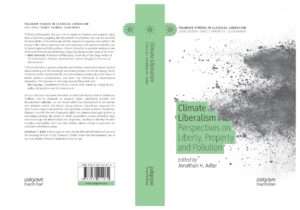
Climate Change

Judge Glock on "Climate Liberalism"

A review of Climate Liberalism: Perspectives on Liberty, Property & Pollution at Law & Liberty.

|

The Manhattan Institute's Judge Glock has a favorable review of Climate Liberalism: Perspectives on Liberty Porperty & Pollution over at Law & Liberty. Here is a taste:

A recent collection of essays edited by Jonathan Adler seeks to answer the question of whether "classical-liberal principles" can provide a distinctive perspective on climate change. After reading Climate Liberalism, I think the answer is no, they cannot. Insofar as government is going to respond to climate change, this book shows that the classical liberal or even libertarian response will look a lot like the modern liberal response.

Yet the book is a success at demonstrating, first, how contemporary responses to climate change can be fit into a classically liberal perspective, and, second, how much the free-market response to environmental problems in general has come to inform modern liberals' response, including their response to climate change. If classical liberals are going to wrestle with this issue, this book should make them comfortable that they can do so in their own tradition and without falling into anti-capitalist extremes.

I take the point, but I might shift the emphasis. Yes, I believe some contributions to the book suggest that classical liberals need to think about how government should respond to the threat of climate change more than whether it should respond. I further agree that climate change (like, perhaps, national security and disease) requires the consideration of governmental actions that classical liberals would generally (and rightly) resist. But I also believe -- and hope the book helps suggest -- that a classical liberal perspective is useful in evaluating competing climate policy options, both in terms of what sorts of policies may be effective and what sorts of policies are most compatible with a concern for individual liberty.

As Glock notes, the book focuses on political theory and policy, not science, and there is a reason for that.

The book makes a wise decision to separate the question of the science of climate change from the political question of what to do about it. Since there is no "classical liberal science" just as there is no "socialist science," this book does not try to contribute to that debate. But, as several authors note, even if one thinks the scientific consensus on climate is open to question, and even if one brings an appropriate humility to our ability to imagine the future, that provides little reason to pretend there could not be any costs to climate change, or at least that there could not be some risk to it.

For myself, a classical liberal skepticism of centralized governmental action, combined with an appreciation for how slow and brittle regulatory measures can be, cautions strongly against the sort of regulatory measures favored by progressives, particularly when there are alternative ways to mitigate the threat of climate change. A revenue-neutral carbon tax, for instance, leaves individuals and firms free to respond to energy prices along any margin they wish, providing incentives for emission reduction where such reductions can be achieved efficiently and with only a minimal reduction in the degrees of freedom individuals and firms have to act. Such a policy also avoids the fatal  conceit of regulators and planners who think they know when and in what form emission reductions should be achieved. Even an imperfectly calculated tax can fulfill this purpose, and significantly more effectively than the regulatory alternative.

Glock's review concludes:

Insofar as there is a single message in this book, it is the simple but powerful reminder that a classically liberal perspective demands humility—humility about how well policymakers can understand humanity's well-being and also about the ability of government to improve that well-being. But the book also reminds us that humility does not mean indolence. Just as classical liberals or libertarians cannot punt on the issues of national defense or public safety and merely gesture to the free market, despite some heroic attempts at trying, they also cannot pretend any attempt at addressing climate change is beyond the ideological pale. Climate change will remain a political issue, which means it will involve weighing evidence, trying to align public and private incentives, and coming to a political agreement on complex and almost unknowable issues. The best tradition of classical liberalism has done that in other spheres, and it can do it here.

I appreciate the engagement and the kind words for the book and the project it represents.

More