The Volokh Conspiracy

Mostly law professors | Sometimes contrarian | Often libertarian | Always independent | Est. 2002

The Volokh Conspiracy

What The Trump Indictment Left Out

Special Counsel Smith avoided charges of insurrection, seditious conspiracy, and incitement.

|

I have now had a chance to read the entire 45-page indictment in United States v. Donald J. Trump. Much of this information has been published in drips and drabs over the past two years. But reading through the entire chronology, from start to finish, was a very different experience.

Here, I would like to highlight what Special Counsel Jack Smith left out.

The most significant omission was that Trump was not indicted for insurrection, 18 U.S.C. § 2383. This decision was not particularly surprising, since none of the January 6 defendants have been charged with insurrection. Stuart Rhodes and the Proud Boys were convicted of seditious conspiracy. Federal prosecutions for insurrection are extremely rare, and there were many open questions about how to obtain a conviction.

The decision not to seek an indictment for insurrection has several immediate consequences. First, the punishment for violating Section 2383 includes being "incapable of holding any office under the United States." Seth Barrett Tillman and I wrote in early 2020 that even if Trump were convicted of violating this statute, he could not be disqualified from serving a second term as President. Now that Smith has not indicted Trump for violating this statute, we will not need to decide the scope of Section 2383.

Second, if Smith had indicted Trump for violating Section 2383, he would have had to lay out in a systematic fashion why Trump's conduct amounted to insurrection. Regardless of whether Trump was convicted of violating that statute, state election boards could have relied on that indictment as the predicate to disqualify Trump. In other words, there would have been a common nucleus of operating facts for a Section 3 claim against Trump. Smith's indictment could have been copied-and-pasted nationwide. But we do not have those facts. Indeed, based on my quick read, the word "insurrection" appears nowhere in the statute.

Third, what lessons should we draw from the fact that Smith did not indict Trump for insurrection? In some legal circles, advocates contend that it is so obvious that Trump committed insurrection. Yet, the special counsel, after studying the issue for months, opted not to bring that charge. Why? Perhaps Smith determined that he could not prove beyond a reasonable doubt that Trump engaged in insurrection. Or maybe Smith determined there were considerable legal questions about how to obtain such a conviction--most critically, was there an actual insurrection? (Yes, for the Supreme Court to knock Trump off the ballot, you need five votes to say that there was an insurrection as a matter of law--good luck with that!) Perhaps Smith engaged in a political calculus, and determined that he didn't need to wade into murky insurrection waters. There were so many other ways to obtain a conviction. Indeed, I speculated that Smith's decision to avoid "distracting fights" would counsel against bringing a Section 2383 charge. Ultimately, we don't know why Smith brought the charges he did. Everyone who is gung-ho on disqualifying Trump for insurrection should hesitate. But they won't, of course. They'll say that a criminal prosecution, with the full panoply of due process, requires a much higher burden of proof than a civil disqualification proceeding. Section 3 is the new Emoluments Clause.

Now, let's flash back to January 13, 2021. The House of Representatives adopted one article of impeachment:"incitement of insurrection." The precise contours were left deliberately vague, but it embraced both claims of insurrection and incitement. Once again, the fact that Smith chose not to indict Trump for insurrection casts at least some doubt on the decision to impeach Trump for insurrection. Of course, the counter argument is that the burden of proof with an impeachment is lower, there are no due process protections, and impeachment can be a political process. We hashed out all those arguments in 2021. But would about incitement? Why didn't Smith charge Trump with inciting violence?

If you read through the indictment, there are many allegations that seem perfectly suited for an incitement charge. Here is a sampling:

When that failed, the Defendant attempted to use a crowd of supporters that he had gathered in Washington, D.C., to pressure the Vice President to fraudulently alter the election results.

On December 19, 2020, after cultivating widespread anger and resentment for weeks with his knowingly false claims of election fraud, the Defendant urged his supporters to travel to Washington on the day of the certification proceeding, tweeting, "Big protest in D.C. on January 6th. Be there, will be wild!" Throughout late December, he repeatedly urged his supporters to come to Washington for January 6.

Within hours of the conversation [on January 1], the Defendant reminded his supporters to meet in Washington before the certification proceeding, tweeting, "The BIG Protest Rally in Washington, D.C., will take place at 11.00 A.M. on January 6th. Locational details to follow. StopTheSteal!"

That same day [January 5], the Defendant encouraged supporters to travel to Washington on January 6, and he set the false expectation that the Vice President had the authority to and might use his ceremonial role at the certification proceeding to reverse the election outcome in the Defendant's favor, including issuing the following Tweet . . . .

On January 6, starting in the early morning hours, the Defendant again turned to knowingly false statements aimed at pressuring the Vice President to fraudulently alter the election outcome, and raised publicly the false expectation that the President might do so . . . .

[On January 6 at 11:56 a.m.] The Defendant repeated false claims of election fraud, gave false hope that the Vice President might change the election outcome, and directed the crowd in front of him to go to the Capitol as a means to obstruct the certification and pressure the Vice President to obstruct the certification.

Finally, after exhorting that "we fight. We fight like hell. And if you don't fight like hell, you're not going to have a country anymore," the Defendant directed the people in front of him to head to the Capitol, suggested he was going with them, and told them to give Members of Congress "the kind of pride and boldness that they need to take back our country."

During and after the Defendant's remarks, thousand of people marched toward the Capitol.

Judge Mehta, in a detailed opinion, refused to dismiss the civil incitement lawsuits against Trump. Mehta also dealt with all of the First Amendment concerns that I (and others) raised during Trump's impeachment trial. Right or wrong, Smith could have relied on Mehta's First Amendment analysis to indict Trump for criminal incitement. But Smith didn't? Why? Maybe he thought the First Amendment analysis would not hold up on appeal to the Supreme Court. Maybe he thought that he may not be able to obtain a criminal conviction with proof beyond a reasonable doubt. Or Smith worried that criminalizing what was, to some at least, a political rally, was too risky. I'll pose a question I raised earlier: if the special counsel declined to bring an incitement charge, was this the right charge to bring in a court of impeachment? Same caveats as earlier.

Finally, six facts in particular were left out: the names of six un-indicted co-conspirators. The Washington Post speculates that Rudy Giuliani was #1, John Eastman was #2, Sidney Powell was #3, Jeff Clark was #4, Kenneth Chesebro was #5, and #6 remains unknown. Each of these five (six) individuals faces considerable legal exposure, and may still be indicted. We will see if they testify against Trump to avoid prosecution. There are also a number of lawyers mentioned throughout the report that worked in the Department of Justice and in Trump's orbit that have exposure. Smith is not done here.

I'll have much more to say about the prosecution in due course. These are only my preliminary thoughts.

Update: In the New York Times, Ryan Goodman and Andrew Weissmann opine on Smith not bringing an insurrection charge:

Although the Jan. 6 select committee referred Mr. Trump for investigation for inciting an insurrection, Mr. Smith wisely demurred. The Justice Department has not charged that offense in any other case involving the attack on the Capitol, and insurrection has not been charged since the 19th century. Of course, no president has engaged in it since then — but since no one else has been charged with that crime relating to Jan. 6, it likely would have been an issue. And since the penalty for the insurrection offense is that the defendant would not be eligible to hold federal office, it would have fueled a claim of weaponizing the Justice Department to defeat a political rival.
Free Speech

Journal of Free Speech Law: "The 'Constitutional' Rise of Chinese Speech Imperialism," by Prof. Ge Chen

Just published, through our normal blind review process.

|

The article is here; here is the Abstract:

This article conceptualizes China's new constitutional doctrine of "party supremacy" and explains the implications it carries for speech regulation in both domestic and international public spheres. In particular, the article captures the Chinese Communist Party's scheme of legitimizing its comprehensive speech regulation through party supremacy. This new constitutional doctrine, in contrast to China's earlier dualistic constitutional framework, attempts to overcome the textual and contextual barriers for speech regulation and reshape the constitutive mechanism of the CCP's domestic and international speech rules. Thus, there is a multi-layer "constitutional" spillover effect of intra-party speech regulation. First, the party-state may well redefine the distinction between the regulation of political speech and that of non-political speech:‌ the former is geared exclusively to the CCP's intra-party rules under the tutelage of constitutional law. Consequently, the new constitutional doctrine could alter the structure of China's speech regulatory framework in two aspects:‌ it both verticalizes the entire body of speech norms by prioritizing party rules and fully empowers party organs in the institutional governance of political speech.

Moreover, the party-state strives to extend the new constitutional framework to speech regulation in a transnational context. Here it seeks to reinforce the textual and contextual substance of its regulatory framework for overseas political speech by legitimizing party supremacy through authoritarian constitutional theories, customizing the CCP's speech regulation in cross-border trade arrangements, and building a global identity with constitutional legitimacy for party supremacy that goes against constitutionalism itself. Thus, the article unveils this scheme as the underlying driving force of Chinese speech imperialism—a nuanced and tangible legal regime with a tacit, but uncompromising, constitutional blueprint of a power-monopolizing party to undermine the protection of free speech in liberal democracies.

The author is an Assistant Professor in Global Media and Information Law, Durham Law School (England); an Affiliated Fellow, Information Society Project, Yale Law School; and an Associate, Center for Intellectual Property and Information Law, University of Cambridge. He has written extensively on Chinese law.

Columbia Law School Posts, then Retracts, Video Statement Requirement for Applicants

|

Aaron Sibarium reports for the Free Beacon:

"All applicants will be required to submit a short video, no longer than 90 seconds, addressing a question chosen at random," the school's admissions page said Monday morning. "The video statement will allow applicants to provide the Admissions Committee with additional insight into their personal strengths."

Critics slammed the move as a thinly veiled attempt to defy the Supreme Court's ruling and practice affirmative action by other means, using appearance as a proxy for race. Columbia's decision "has all the hallmarks of a willful effort to evade the requirements of Title VI of the Civil Rights Act," said Edward Blum, the founder of Students for Fair Admissions, the plaintiffs in the June case that outlawed affirmative action. "What is a 90-second video supposed to legitimately convey that a written statement could not?"

Reached for comment by the Washington Free Beacon, however, a spokesman for the law school said it had all been a misunderstanding and, by 6:00 PM Monday evening, Columbia had scrubbed the language from its website.

Free Speech

No Injunction Against Law That Authorizes Private Suits for Letting Minors Access Certain Online Materials

|

From Free Speech Coalition, Inc. v. Anderson, decided today by Judge Ted Stewart (D. Utah):

In 2023, the Utah legislature passed a bill—S.B. 287—requiring commercial entities that provide pornography and other materials defined as being harmful to minors to verify the age of individuals accessing that material. A commercial entity may be held liable if it "fails to perform reasonable age verification methods to verify the age of an individual attempting to access the material," and a commercial entity that is found to have violated the law "shall be liable to an individual for damages resulting from a minor's accessing the material, including court costs and reasonable attorney fees as ordered by the court."

S.B. 287 identifies three reasonable age verification methods. Relevant here is the use of a "digitized information card." The Act defines "digitized identification card" as

a data file available on any mobile device which has connectivity to the Internet through a state-approved application that allows the mobile device to download the data file from a state agency or an authorized agent of a state agency that contains all of the data elements visible on the face and back of a license or identification card and displays the current status of the license or identification card.

Plaintiffs contend that S.B. 287 is unconstitutional and seek an order "enjoining the Commissioner of Utah's Department of Public Safety from permitting its data files to be downloaded for use" in the age verification process "and the Attorney General from otherwise intervening to enforce the Act." …

The court concluded that such lawsuits against government officials—such as the Utah Attorney General and the Utah official in charge of issuing identification cards—are permissible only if those officials are involved in enforcing the law. When a law is enforced through civil lawsuits by private individuals (as is the case with, say, libel law, most workplace harassment and discrimination law, and many other areas of the law), preenforcement challenges aren't available unless some specific likely plaintiff can be identified. The court relied extensively on Whole Woman's Health v. Jackson (2021), which held largely the same about Texas's SB 8, which authorized private lawsuits against abortion providers; but other precedents had so held as well. The court concluded:

Read More

Podcasts

Last Month's Episodes of Divided Argument

|

In the last two weeks, co-host Dan Epps and I recorded four episodes of Divided Argument, our Supreme Court podcast. This follows the unpredictable decision to record almost no episodes during the month of June when the Court was actually releasing most of its opinions -- but now we are taking our time to catch up on a lot of interesting decisions!

The episodes are:

My Despised World (already linked here)

After some inevitable self-flagellation for our lengthy hiatus, we catch up on some recent news and debate SCOTUS ethics. We then talk about implications of the Harvard/UNC affirmative action case, revisit Mallory v. Norfolk Southern, and break down the latest case captioned "United States v. Texas."

Peak SG

This time, we take a deep dive into two jurisdiction-y cases in the Divided Argument wheelhouse: Jones v. Hendrix and Moore v. Harper.

Dishonorable Tradition

This time, we talk about the intersection of public accommodations law and the First Amendment in 303 Creative and the Confrontation Clause in Samia v. United States.

Triple Threat

We briefly discuss the jurisdictional complexities in the Mountain Valley Pipeline shadow docket dispute, and then revisit recent ethics controversies. Then, we continue marching through the June cases we missed. We talk about the First Amendment's "true threats" exception in Counterman v. United States, and then ponder the two student loan cases, Biden v. Nebraska and Department of Education v. Brown.

Transcripts and hyperlinks should be up soon.

Immigration

Amicus Brief Defending Legality of Immigration Parole Program for Migrants Fleeing Socialism, Oppression, and Violence in Four Latin American Nations

The program extends the successful Uniting for Ukraine policy to migrants fleeing Cuba, Nicaragua, Venezuela, and Haiti.

|

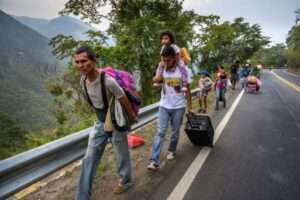
Venezuelans fleeing the socialist regime of Nicolas Maduro.


Earlier today, I submitted an amicus brief to the US District Court for the Southern District of Texas in Texas v. Department of Homeland Security, a case challenging the legality of the CNVH immigration parole program. I wrote the brief on behalf of the Cato Institute, MedGlobal (a humanitarian organization that provides medical assistance to refugees and victims of natural disaster), and myself. Here is an excerpt from the summary of the brief posted on the Cato website:

In January, the Biden Administration adapted the approach used by the successful Uniting for Ukraine private migrant sponsorship program to include a combined total of up to 30,000 migrants per month from four Latin American countries: Cuba, Nicaragua, Venezuela, and Haiti (the CNVH countries). Under these programs, migrants fleeing war, oppression, poverty, and violence in these countries can quickly gain legal entry into the United States and the right to live and work here for up to two years, if they have a private sponsor in the US who commits to supporting them.

Twenty GOP‐​controlled states filed a lawsuit challenging the legality of the program for the four Latin American nations (though not Uniting for Ukraine). They claim the program lacks proper congressional authorization. Ironically, the flaws in the lawsuit are highlighted by the plaintiff state governors' own statements about the evils of socialism and the urgent need to address the crisis at the southern border….

The CNVH program is authorized by the Immigration and Nationality Act which states that "[t]he Attorney General may, except as provided in subparagraph (B) or in section 1184(f) of this title, in his discretion parole into the United States temporarily under such conditions as he may prescribe only on a case‐​by‐​case basis for urgent humanitarian reasons or significant public benefit any alien applying for admission to the United States." 8 U.S.C. § 1182(d)(5)(A).

Part I of the brief demonstrated that migrants from the CNVH countries indeed have "urgent humanitarian reasons" to seek refuge in the United States. They are fleeing a combination of rampant violence, brutal oppression by authoritarian socialist regimes, and severe economic crises. So great is the humanitarian need here, that even the leaders of some of the plaintiff states have recognized and denounced the horrific conditions in these countries.

In Part II, we show that paroling CNVH migrants also creates a major "public benefit." That benefit is reducing pressure and disorder on America's southern border. Here, too, some of the Plaintiff states have themselves recognized the importance of this benefit, and indeed have loudly called for measures to achieve it. The CNVH program has already massively reduced cross‐​border undocumented migration by citizens of the four nations it covers.

Part III explains why the parole program is consistent with the statutory requirement that parole be conducted on a "case by case basis." 8 U.S.C. § 1182(d)(5)(A). The Plaintiffs' position on this point is inconsistent with statutory text, Supreme Court precedent, and basic principles of statutory interpretation. It would also lead to absurd results.

Finally, Part IV shows that, while the Plaintiffs have limited their lawsuit to challenging the CNVH program, if the court accepts their position it would also imperil Uniting for Ukraine. The latter relies on the same legal authority as the former.

In sum, this ill‐​conceived lawsuit deserves to fail for reasons well‐​articulated by leaders of some of the very same states that filed it.

The CNVH program has already helped many thousands of migrants fleeing violence and socialist oppression, and has also had a big impact alleviating pressure on the southern border. A court decision shutting it down would be both legally unjustifiable, and likely to cause great harm.

Missouri v. Biden Fifth Circuit Panel Announced

|

I believe this just happened today, since argument is next week (Aug. 10); the panel is Judges Edith Brown Clement, Jennifer Walker Elrod, and Don Willett. Recall that this is the expedited appeal of the July 4 injunction that barred various federal departments from encouraging social media platforms to delete certain content.

Law & Government

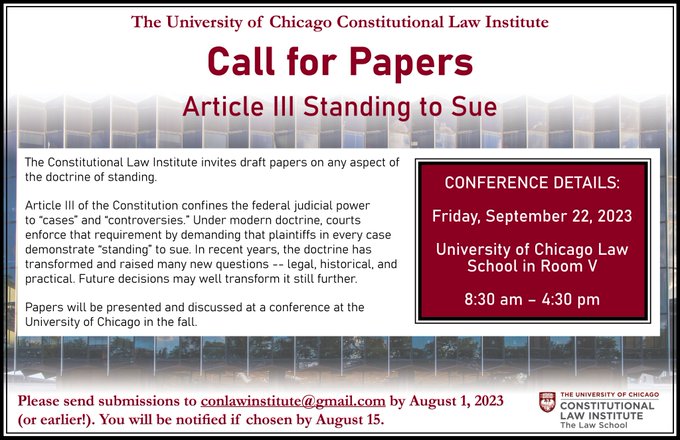
Do You Have a Paper About Article III Standing?

If so, please submit it to the Constitutional Law Institute's fall conference!

|

As followers of this blog will surely know, there have been a lot of important developments in the law of standing recently at the Supreme Court and in the lower courts. For that reason, the Constitutional Law Institute at the University of Chicago will be hosting a conference in late September about Article III standing doctrine. If you have a paper on this topic you might like to present, please consider submitting it by tomorrow.

The official announcement and submission details are below:

Image

Individual mandate

Is the ACA's "Shared Responsibility Payment" a "Tax . . . Measured by Income"?

The Affordable Care Act's individual mandate penalty meets the bankcuptcy code.

|

If you thought the courts were done figuring out whether the financial penalty imposed under the Affordable Care Act on those who failed to obtain qualifying health insurance was a tax or a penalty, you were mistaken. Today, the U.S. Court of Appeals for the Sixth Circuit revisted that question for purposes of the federal bankruptcy code.

Chief Judge Sutton summarized the issue in In re: Juntoff as follows:

In passing the Affordable Care Act, Congress created a "Shared Responsibility Payment" for individuals who did not purchase qualifying individual health insurance plans. Congress eventually eliminated the Payment. That development did not end debates over whether the Payment is a tax or a penalty. At issue today is whether the Payment amounts to a "tax . . . measured by income" under the Bankruptcy Code's provisions for prioritizing the payment of some debts over others. We join the Third and Fourth Circuits in concluding that it is.


Justice Alito's Interview in the Wall Street Journal

|

As a general rule, Supreme Court Justices speak through their opinions. From time to time, Justices will be "interviewed"by friendly interlocutors during public events. The screened questions are usually softballs, and even then, the Justices tend to avoid saying anything newsworthy. In recent years, perhaps the biggest outlier was Justice Ginsburg. In 2016, she gave an interview with Adam Liptak of the New York Times. RBG made critical comments about then-candidate Trump. Ultimately Ginsburg sort-of apologized, but still faced calls to recuse in certain Trump-related cases. She would not recuse. RBG should have been grateful the Supreme Court Ethics, Recusal, and Transparency Act (SCRET) was not in effect during this final years on the Court.

Speaking of the SCRET Act, on Friday, the Wall Street Journal published a "weekend interview" with Justice Alito. The Justice spoke with the Journal in early July. In April, Alito also spoke with the Journal for "four hours in two wide-ranging sessions" in his chambers. (I wrote about that interview here.) Perhaps the most significant aspect of the interview is that it happened at all. On the current Court, Justice Alito is the member most likely to talk to the press. And he had a lot to say--including about the SCRET Act, and his colleagues. Here are thirteen highlights.

First, Justice Alito repeated his refrain from April that the "bar" is not defending the Court against attack--indeed legal elites are leading the calls that the Court is "illegitimate."

"I marvel at all the nonsense that has been written about me in the last year," Justice Samuel Alito says during an early July interview at the Journal's New York offices. In the face of a political onslaught, he observes, "the traditional idea about how judges and justices should behave is they should be mute" and leave it to others, especially "the organized bar," to defend them. "But that's just not happening. And so at a certain point I've said to myself, nobody else is going to do this, so I have to defend myself."

My post in April was titled, "Justice Alito Defends The Supreme Court In Ways Chief Justice Roberts Cannot." I bet the Chief Justice's head exploded when he read this interview. But Justice Alito is right. The Chief only speaks out when it serves his interests Again, whenever the Chief Justice speaks of the Court's "legitimacy," he is actually speaking about himself--the man cannot separate himself from the Court. No Justice has done more to undermine the Court as a institution that follows law in a dispassionate fashion that Roberts himself. But so long as we avoid 5-4 conservative-liberal splits, he is happy, no matter what the opinion says. (More on Roberts later.)

Second, Justice Alito observed that "'There are very serious differences'" in how the six conservative justices approach cases." Well that's for darn sure.

Justice Thomas does not place much weight on precedent:

Justice Alito says. The simplest difference involves respect for precedent: Justice Thomas "gives less weight to stare decisis than a lot of other justices." It is, "in its way, a virtue of his jurisprudence," Justice Alito says. "He sticks to his guns." . . . The disadvantage of this approach, Justice Alito says, "is that you drop out of the conversation, and . . . lose your ability to help to shape what comes next in the application of that rule."

Justice Alito is right about this much: it is hard for Justice Thomas to play the game if he insists on eschewing precedent. Then again, is the game worth playing if you have to follow made-up law. Stare decisis does not mean inexorably stare at decisions from the Warren Court.

Read More

Nevada Magistrate Judge Recommends Rejecting Internet Preservation Challenge—And Why It's Wrong

The first opinion on Westlaw in response to a motion to suppress based on my model motion.

|

As regular readers know, I wrote an article, The Fourth Amendment Limits of Internet Content Preservation, on what I see as significant Fourth Amendment limits on the government's power to order Internet providers to run off copies of people's online accounts and save them for possible later government access.

Here's how the practice works.  When agents think a person might have some connection to a crime, federal agents order Internet providers to run off a government copy of the entire account and to hold it for the government away from the account holder. The point is to make sure suspects can't delete their files and thwart a possible investigation down the road.  A federal statute, 18 U.S.C. § 2703(f), requires Internet providers to comply. In recent years, the statute has been relied on with extraordinary frequency; in 2019, about 1 in every 820 adults had their account copied for possible government use.  This all goes on in total secrecy. Under order of federal law, Internet providers create and hold government copies, for the government, and in most cases no one tells the user.  The government still needs a warrant to ultimately access the copy, but preservation allows the government to gain access to a stored copy that they would not have otherwise—a copy that may have records that the user might have otherwise deleted.

My article, which I have turned into a model motion to suppress for defense attorneys to file, argues that there are Fourth Amendment limits on this process.  A private actor who does the government's bidding under penalty of law is a state actor, and running off a copy and holding it for the government, so the user cannot control it, is a Fourth Amendment seizure.  I argue that this seizure has to be justified as reasonable under the Fourth Amendment, which will usually require probable cause or at least reasonable suspicion.  But a common practice, in which every possible suspect's account can get copied and held for the government, "just in case," without particularized suspicion, is generally unconstitutional.  (There are then interesting questions of what the remedy is. A plausible remedy is that the government has to use the account copy that existed when they ultimately served the warrant to get the copy, not when they made the preservation request. But that's beyond today's post.)

A few motions have been filed based on my model motion, and the first opinion on the issue to just recently appeared on Westlaw.  The motion to suppress in this case wasn't the exact model motion I drafted, but it had the basic gist of it in a condensed form.

Here's the opinion, from Magistrate Judge Daniel J. Albregts of the U.S District Court for the District of Nevada: United States v. King, 2023 WL 4844888 (D. Nev. July 17, 2023).

Unfortunately, the Report and Recommendation contends that the motion should be denied on the ground that preservation is not a government seizure at all.  Under that reasoning, any federal, state, or local government employee could cause every account of every person in the United States to be copied and held for the government with no suspicion at all, and that simply wouldn't trigger the Fourth Amendment.

The rest of this post will explain Magistrate Judge Albregts' reasoning and why I am unpersuaded.  I'll do the arguments in reverse order, as I think it makes a little more sense that way. I'll start with whether there was state action, and then turn to whether a seizure occurred.

(1) The State Action Question

First, Judge Albregts argues that a provider who complies with a §  2703(f) request to preserve files for the government's potential use, as required by federal law, is not a state actor so the Fourth Amendment is never triggered in the first place:

The Court recommends denying King's motion to suppress the internet accounts. It finds that King did not meet his burden of showing that Omegle or TextNow should be deemed agents of the government by complying with the government's preservation request under 18 U.S.C. § 2703(f). Although the Government directed Omegle and TextNow to preserve the accounts, its involvement was limited only to requesting the preservation under 18 U.S.C. § 2703(f). And although Omegle and TextNow were responding to a request from the Government, they were also complying with their statutory obligations.

King has also failed to carry his burden of demonstrating that the Court should deem Omegle and TextNow agents of the government because the cases on which he relies are distinguishable and nonbinding on this Court. In Commonwealth v. Gumkowski, the Massachusetts Supreme Court found that Sprint acted as a government agent when it turned a defendant's cell site location information over to the government without a warrant. Commonwealth v. Gumkowski, 487 Mass. 314, 320-21 (Mass. 2021). However, here, the government did not ask Omegle or TextNow to turn over information, but instead requested that the electronic service providers preserve the information already in their possession under the Stored Communications Act pending the government obtaining a warrant. In United States v. Hardin, the Sixth Circuit Court of Appeals found that an apartment manager acted as an agent of the government when he entered a defendant's apartment at the government's request under the guise of repairing a leak to determine if the defendant was in the apartment. See United States v. Hardin, 539 F.3d 404, 417-20 (6th Cir. 2008). But Omegle and TextNow's actions of preserving information already in their possession as required under statute is meaningfully distinguishable from the private apartment manager entering a person's home to determine specific information at the government's behest.

With all respect to Magistrate Judge Albregts, I don't think that can be right.  Magistrate Judge Albregts is missing something super important:  Federal law mandates that providers comply.  It's a statutory "requirement," with the directive being what the provider "shall" do.  Here's the text of 18 U.S.C. §  2703(f), with emphasis added:

(f) Requirement To Preserve Evidence.—

(1) In general.— A provider of wire or electronic communication services or a remote computing service, upon the request of a governmental entity, shall take all necessary steps to preserve records and other evidence in its possession pending the issuance of a court order or other process.

(2) Period of retention.— Records referred to in paragraph (1) shall be retained for a period of 90 days, which shall be extended for an additional 90-day period upon a renewed request by the governmental entity.

Granted, the statute calls the government's demand a "request." But when the law mandates that you comply with a "request," that's not really a request.  It's an order. And when it's making you do the government's bidding, it's an order that makes you a state actor when you comply with it.

To see this, consider a hypothetical.  Imagine the statute were about making arrests rather than making copies of Internet files.  Let's slightly rewrite the statute accordingly into the following:

(f) Requirement to Make Arrests

(1) In general. —Any person, upon the request of a governmental entity, shall take all necessary steps to arrest a suspect who the government entity requests to be arrested.

(2) Period of detention.  A suspected arrested shall be detained for 48 hours, or until the government takes custody of the suspect arrested.

Imagine a police officer wants Bob arrested.  He comes up to Albert and says, "I request that you arrest Bob." The officer also shows Albert the legal requirement of federal law that he "shall" make an arrest when a police officer "requested" it.  Being made aware of the legal obligation to arrest, Albert arrests Bob on the police officer's behalf.

In that scenario, I think we would see pretty clearly that Albert is a state actor.   It would be pretty weak to say there was no state action because the government merely made a "request," as the federal statute said that a requested person "shall" do what the request was.  It's an order, not a request.  And it would be pretty weak to say that Albert was not a state actor because he merely "complied with his statutory obligations." The statutory obligation was to become a state actor; the law requires him to become the government's agent.

That's exactly the case with § 2703(f).  Internet providers don't fulfill preservation requests because they feel like it.  It's not their idea.  They get nothing from it.  They fulfill the requests because federal law makes them do it, and the providers don't want to violate federal law that requires them to comply.   When governments make preservation "requests" to providers, those providers are acting on the government's behalf, doing the government's bidding because they have to.  Seems pretty clear to me that the providers are state actors for Fourth Amendment purposes.

(2) The Seizure Question

Magistrate Judge Albregts also recommends concluding that, even if the providers were state actors, their running off a copy of the account that the defendant could not control does not "seize" anything.   As I read this, the government can order anyone's account to be copied without limit, or even order government servers to be installed that automatically make government copies of everyone's data. As long as the government doesn't look at its copy yet, the act of just having  the government copy made doesn't trigger the Fourth Amendment at all.

Here'e the argument: Read More

Free Speech

Accusing Trump of Perpetrating "Big Lie" Is Opinion and Therefore Not Libelous, Court Holds

|

From Trump v. CNN, decided Friday (quite correctly, I think) by Judge Raag Singhal (S.D. Fla.):

Trump alleges that CNN defamed him by making statements comparing him to Hitler and the Nazi regime …:

[a.] On January 25, 2021, CNN published an article written by Ruth Ben-Ghiat, a "frequent contributor to CNN Opinion," entitled "Trump's big lie wouldn't have worked without his thousands of little lies." Ben-Ghiat wrote: "This is Trump's 'Big Lie,' a brazen falsehood with momentous consequences." Ben-Ghiat likened the Plaintiff to an authoritarian dictator, writing:

Trump, a leader of authoritarian intentions and tendencies, had disadvantages with respect to the foreign autocrats he so admires. He had no state media, like China's Xi Jinping. He could not rule by decree, like Hungary's Viktor Orbán. He had to govern and run for reelection in an open society with a relatively robust free press. Moreover, although he succeeded in making journalists into hate objects for many of his followers, he could not revoke or destroy the First Amendment.

So Trump took a different tack, unleashing a barrage of disinformation common in authoritarian states but without precedent in the history of the American presidency. He told more than 30,000 documented lies in public (30,573 was The Washington Post's final tally), on Twitter, at rallies and in interviews. If taken as an average, it would come out to 21 lies per day over his four-year term.

[b.] On July 5, 2021, CNN published an article written by Chris Cillizza, CNN Editor-at-Large, entitled "Donald Trump just accidentally told the truth about his disinformation strategy." In this article, CNN's Editor-at-Large likens the Plaintiff to Nazi propagandist Joseph Goebbels: "One can only hope that Trump was unaware that his quote was a near-replication of this infamous line from Nazi Joseph Goebbels: 'If you tell a lie big enough and keep repeating it, people will eventually come to believe it.'" {The Trump quote referenced by Cillizza was made on July 3, 2022, in Sarasota, Florida: "If you say it enough and keep saying it, they'll start to believe you."}

Read More

Academic Freedom

Academic Freedom Alliance Letter to Texas A&M

Professor suspended for criticizing policies of Texas lieutenant governor

|

The Academic Freedom Alliance released a public letter to the Texas A&M University System regarding its suspension and investigation of Prof. Joy Alonzo for statements she made as a guest lecturer in a class about the policies of Texas Lt. Governor Dan Patrick. Patrick is well known for his attacks on higher education, recently pushing to ban tenure at state universities. Texas A&M was quick to try to mollify him when he got wind of a professor criticizing him.

The story was first broken by the Texas Tribune. Alonzo, a professor of pharmacy practice, was serving as a guest lecturer in a medical school class at the University of Texas discussing the opioid crisis. During the class, she apparently made some critical remarks regarding Patrick's resistance to Alonzo's favored policy responses. A student in the class complained to her mother, the Texas land commissioner, who in turn informed Patrick's office. Patrick's office pointed Texas A&M University System Chancellor John Sharp at Alonzo. Sharp immediately had her suspended and launched an investigation into potentially firing her. Meanwhile, both the University of Texas and Texas A&M sent internal emails cautioning professors against saying critical things about Texas politicians.

Read More

Law & Government

Chevron and Public Rights

An interesting point from Ilan Wurman.

|

There is an interesting post on the future of Chevron over at JReg, from Professor Ilan Wurman at ASU. With Prof. Wurman's permission, I thought I would post the whole thing here:

A Missing Distinction in Loper

Two weeks ago, the petitioners filed their brief in Loper Bright Enterprises v. Raimondo, the case next term in which the Supreme Court will reconsider Chevron deference. Several legal scholars have also filed amicus briefs in favor of petitioners or on behalf of neither party. I am not among them. But I was somewhat surprised that both the petitioners and these scholars left a critical legal distinction—that between private and public rights—largely unexamined or altogether unmentioned. Whether Chevron deference violates Article III or not seems to me, anyway, to depend largely on whether that case at hand involves private or public rights (aside from whether Congress has in fact authorized such deference).

Professor Mascott's brief and Professor Merrill's brief don't mention the distinction in their discussions of Article III; nor does the petitioners' brief mention the distinction at all. Professors Barnett and Walker argue that "constitutional arguments against Chevron are unpersuasive" because "Congress can preclude judicial review altogether of some or all claims under Article III." They briefly gesture to the relevance of the distinction when they write that "[p]erhaps Chevron offends Article III in certain contexts, such as when private rights are at issue or agency interpretations lead to criminal liability." Professor Bamzai gives the most attention to the public-private distinction in his brief. In cases in which "non-Article III adjudication" is permissible, deferential review might be permissible; those cases, as the Court said in Stern v. Marshall, typically involve what are called "public rights." But, Bamzai writes, taking an "extreme example," courts would surely not give deference to Department of Justice interpretations in criminal cases.

It seems to me that the question that Barnett and Walker, and Bamzai, address is the right one, but more elaboration would be useful. Can Congress in fact preclude judicial review altogether in "some" claims under Article III, or in "all" claims? This matters because, as Barnett and Walker recognize, the greater power to preclude review surely includes the lesser power to authorize deferential review. If this greater power only exists for some cases, it would seem to be very important to try to figure out what those cases are. So we should be asking: (1) What are public rights cases? (2) Why are public rights cases exempt from Article III?

This is not the place to go into all the details, but as I and several other scholars like Caleb Nelson, Ann Woolhandler, and Will Baude have written, at a minimum "private rights" are rights that persons would have had in the state of nature, as modified by the civil law, such as the rights to life, liberty, and to acquire and possess property; "public rights" are rights belonging to the public or are entitlements private individuals can claim from the government. The classic examples of public rights are rights of way, such as public roads and waterways; and public privileges like welfare benefits, public employment, and public land grants. It is familiar to all that, as a historical matter, public rights did not have to be determined by a court at all.

There are at least two reasons such rights could be resolved without a court. First, the administration of public benefits and government resources easily fit within the definition of executive power, as opposed to judicial power, which is required to divest someone of private rights. Second, sovereign immunity would have barred suits in which a citizen was wrongfully denied a claim for such benefits. If such matters need not be determined by a court at all, then the legislature can authorize limited judicial review, including deferential judicial review. Divesting persons of their private rights to life, liberty, and property, on the other hand, is the core of the judicial power; it is the kind of thing that only courts vested with the "judicial power" can do, at least as a historical matter. And sovereign immunity would not apply.

If all of that is right, and the judicial power is "emphatically . . . to say what the law is" in cases involving the rights of the individual, then at least deference to legal interpretations would seem to be unconstitutional in such cases. And if Congress can preclude review of public rights cases, then it can authorize deferential review in those cases.

There remains the problem, however, of the Supreme Court having greatly expanded the definition of public rights. To simplify a bit, in the middle two quarters of the twentieth century—the leading cases are NLRB v. Jones & Laughlinand Atlas Roofing—the Supreme Court held that many rights or causes of action created by congressional statute are public rights. But as even Crowell v. Benson recognized, the source of law is irrelevant to whether a matter is one of public or private right; the relationship between the parties and the legal interest at stake are what matter. See 285 U.S. at 51 ("The present case . . . is one of private right, that is, of the liability of one individual to another under the law as defined").

Thus, if the Supreme Court wants to address the constitutional question (which it may not want to do), it would eventually have to revisit its public rights jurisprudence. To be sure, it can avoid the issue entirely because even if Congress could have precluded review, the question remains whether it has required or authorized deferential review in those situations where review is available. And as Professor Bamzai writes in his brief, arguably APA section 706 answers those questions in the negative.

How would all of this cash out in Loper? Interestingly, the case involves the right to harvest fish in national fisheries. As I have written in a completely different context—the context of antebellum comity clause jurisprudence—access to natural resources such as fisheries was understood to be a public right! So I suspect that Congress could preclude review in these cases and could authorize deferential review. Whether it has done so in this case would seem to be the real question after all.

Justice Sotomayor Defends Racial and Ethnic Classifications Relied Upon by Harvard and UNC

She doesn't do a very good job of it.

|

Justice Sotomayor, in the Students for Fair Admissions affirmative action cases:

The Court also holds that Harvard's and UNC's race conscious programs are unconstitutional because they rely on racial categories that are "imprecise," "opaque," and "arbitrary."

We're off to a bad start. The issue is not simply that Harvard and UNC use these categories in a "race conscious" way, it's that Harvard and UNC classified their students by these categories, and then gave them an admissions bonus if they checked the box showing they were members of certain classifications.

To start, the racial categories that the Court finds troubling resemble those used across the Federal Government for data collection, compliance reporting, and program administration purposes, including, for example, by the U. S. Census Bureau. See, e.g., 62 Fed. Reg. 58786–58790 (1997). Surely, not all "'federal grant-in-aid benefits, drafting of legislation, urban and regional planning, business planning, and academic and social studies'" that flow from census data collection, Department of Commerce v. New York, 588 U. S. ___, ___ (2019) (slip op., at 2), are constitutionally suspect.

A lot of the things Sotomayor mentions are indeed problematic from a public policy point of view, because the classifications are so imprecise and arbitrary. Someone should write a book about it! But from a constitutional perspective, taking data based on these classifications into account for whatever reason is a different matter than classifying individuals and rewarding or penalizing them because they checked a particular box on a form.

The majority presumes that it knows better and appoints itself as an expert on data collection methods, calling for a higher level of granularity to fix a supposed problem of overinclusiveness and underinclusiveness.

As I discuss in some detail in my book, it was not "experts" who came up with these classifications, but, as Justice Gorsuch notes, "bureaucrats." Experts at the Census Bureau were livid when the Bureau decided to adopt these classifications for the 1980 Census. They found the "Hispanic" classification to be especially nonsensical, and product of politics rather than sound data policy.

But if we do want to defer to the pseudo-experts in the government who came up with them, we should recall that when they were initially published in the Federal Register in 1978, they came with these caveats: The "classifications should not be interpreted as being scientific or anthropological in nature" and should not be "viewed as determinants of eligibility for participation in any Federal program," assumedly alluding to affirmative action. As for various public and private planning uses of the data, the argument is circular; academics and planners use the data because the Census Bureau collects the data, which makes the relevant data cheap and readily available. If the Census Bureau used different classifications, researchers would generally use those instead.
Read More

More