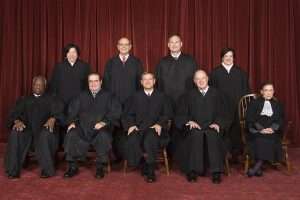
So the Montana Supreme Court holds, in Groo v. Montana Eleventh Jud. Dist.Ct., written by Chief Justice McGrath, joined by Justices Beth Baker, James Jeremiah Shea, and Jim Rice. A few passages:
The underlying case arises from Groo's purposeful and substantial use of social media to affect the business operations of Triple D Game Farm, Inc. (Triple D). In response, Triple D filed a Complaint and Demand for Jury Trial alleging Tortious Interference with Contractual Relations and Tortious Interference with Prospective Economic Advantage claims against Groo.
Groo moved to dismiss the claims against her for lack of personal jurisdiction. She contends that the statements she allegedly made on social media about Triple D did not create the minimum contacts with Montana as a forum nor constitute purposeful availment of the protections afforded by Montana law—both of which are required for a Montana court to exercise personal jurisdiction over an out-of-state defendant….
[S]imply posting information on the internet for anyone to see is not enough by itself to establish personal jurisdiction over a defendant. However, when a defendant engages in a targeted campaign against a Montana business, tags Montana residents and those doing business in Montana, and encourages them to refrain from doing or continuing actions in Montana, that person has purposefully directed conduct into Montana such that the Due Process Clause allows them to be haled into Montana courts.
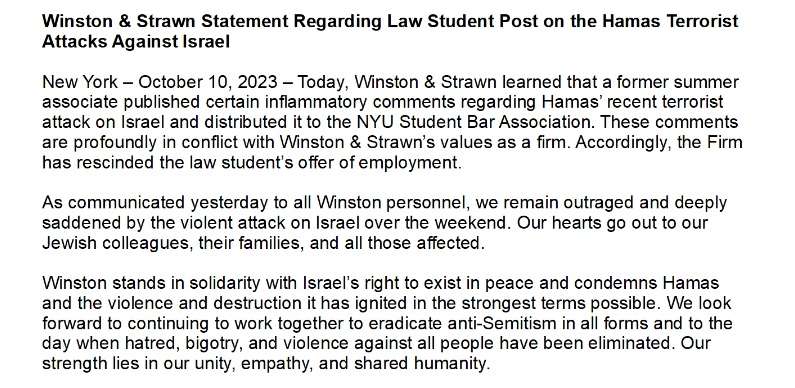
In recent days, we've seen some employers saying they'd refuse to hire people based on those people's praise of the Hamas attack on Israel (or at least certain kinds of praise), see, e.g., this story about one employer [UPDATE: and others] and this statement from another:
(For more on the particular statement that led to the revocation of the offer, see here.) Likewise, one can imagine other employers refusing to hire people based on those people's hypothetical praise of various kinds of Israeli retaliation against the attack. Is that legal, at least for private employers?
The answer is that it generally depends on state law, and sometimes even on county or city ordinances.
There is no general constitutional right of employers to refuse to hire people whose statements or actions are "profoundly in conflict with [the employer's] values as a firm." Federal and state laws, for instance, generally forbid discrimination in employment based on the employee's religion, however much the religion might profoundly conflict with the employer's values.
Some other time, I will express my views on when and if university administrators should express opinions about the issues of the day. For now, it's sufficient to note that they do all the time, and in that context should be judged by what they say, when they say it, and how they say it.
Here is Dean Ken Randall, Scalia Law (my law school) in an email I received this morning:
Dear Students, Faculty, and Staff,
Over the past few days, we have watched images of deadly acts of terrorism against Israel. Whether you have friends and family in the region, or your concerns are centered on your classmates and colleagues here at home, please know that my thoughts are with you. Terrorism has no place in our society, and we stand with the Israeli people. Especially in this season when we observe important Jewish holidays, I know that you will offer support to those in our community who are in need during this difficult time.
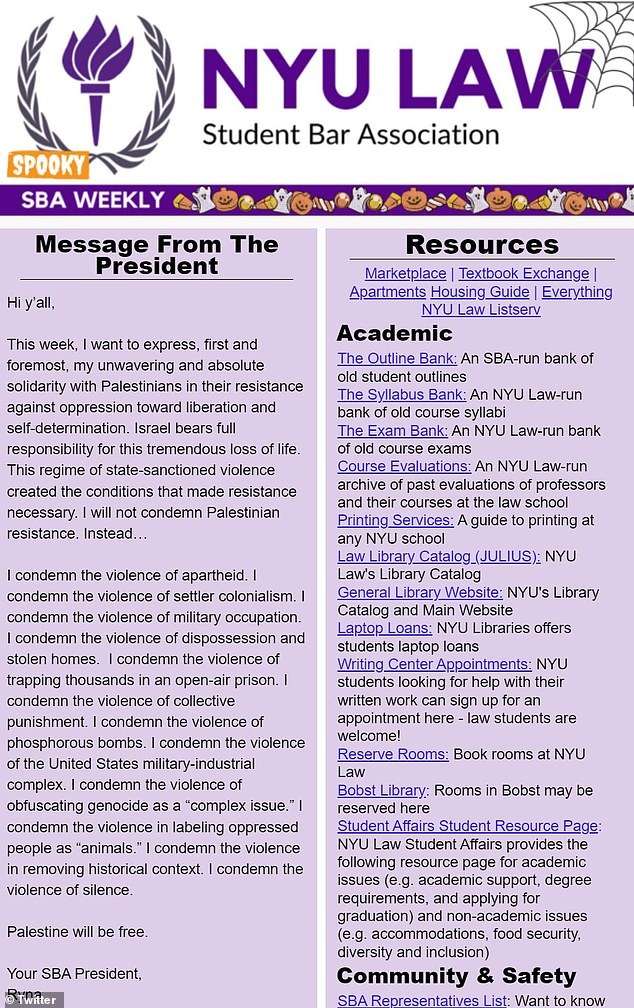
By contrast here is NYU Dean Troy McKenzie, in response to an official missive sent to law students by the president of the Student Bar Association, defending the massacre:
Dear Members of the NYU Law Community:
Some of you may have seen a message from the president of the Student Bar Association regarding the horrific conflict in Israel and Gaza. This message was not from NYU School of Law as an institution and does not speak for the leadership of the Law School. It certainly does not express my own views, because I condemn the killing of civilians and acts of terrorism as always reprehensible.
The attack on Israel and the subsequent and ongoing hostilities have made this a period of extreme pain and distress for many members of our community. Since the weekend, I have worked with administrators to provide support to students, faculty, and alumni who have been affected by this crisis.
The feelings that divide people in the world at large are certainly present within the Law School, but I hope that we are able to address them with compassion and mutual respect. The Law School's leadership team will continue to provide the resources and support we can.
And compare McKenzie's mealy-mouthed equivocation to this statement by the student's erstwhile employer, Winston & Strawn. One can have a separate discussion as to whether rescinded her offer was inappropriate "cancel culture"--my own general view of this is that when someone says something egregiously stupid, even evil, one should give that person a chance to reconsider and apologize before taking action--but regardless, W&S managed the moral clarity that Dean McKenzie did not.
UPDATE: Dean Paul Caron, Pepperdine Law School: "Our Pepperdine Caruso Law community is praying for [Professor] Michael [Helfand] and his family [who were in Israel at the time of the attacks], all of our Jewish faculty, staff, students, and alumni, the country and people of Israel, and all people in the region during this horrific time. We are heartbroken by the devastating suffering and loss of innocent lives."
Adopting the pseudonym "Jane Doe," Plaintiff filed this case against Defendant Crawford pursuant to 15 U.S.C. § 6851. She alleges Crawford engaged in "revenge porn" by transmitting a sexually intimate photograph of Doe to another man—Doe's current romantic partner—with the intention of embarrassing Doe. In describing her relationship with Crawford, however, Doe states only that they were in a "romantic relationship." In truth, Doe's relationship with Crawford is, and was, more than simply "romantic." …
The Court should seal the record of this case because Crawford's defense necessarily requires him to identify Doe and her relationship to Crawford, as well as disclose intimate details of their relationship…. To defend himself, Crawford must (1) identify Doe and her relationship to Crawford, and (2) disclose intimate details of that relationship in all substantive pleadings, including exhibits, before the Court….
Another procedure will not suffice because 15 U.S.C. § 6851 allows Doe to remain anonymous, yet Crawford must necessarily disclose Doe's identity to defend himself; therefore, sealing the entire case is the only option that allows Doe to litigate her claim anonymously and allows Crawford to defend himself….
On Thursday, Checks & Balances is hosting an online forum on whether Section Three of the Fourteenth Amendment bars Donald Trump from running again for President due to his efforts to overturn the results of the 2020 election. The event, "Section Three: Constitutional Remedy or Pipe Dream?" will feature former federal judge J. Michael Luttig and NYT columnist David French in conversation over whether Trump is disqualified under Section Three and what, if anything, state officials or federal courts should do about it. The online event is at noon, EDT, and is free of charge. Registration info is here.
I think the student who wrote the message should have every right to express her views, including views that support the killing of civilians. I most certainly don't share the student's views, and I do share the distinction that modern norms generally draw between directly targeting civilians (which is what Hamas has apparently done) and targeting military targets even when some civilians are inevitably killed. I also think we shouldn't forget that the Hamas Charter is expressly committed to "struggle against the Jews" and the destruction of Israel (rather than just a shifting of the borders), and stresses a passage from the sayings of Mohammed stating,
The Day of Judgement will not come about until Moslems fight the Jews (killing the Jews), when the Jew will hide behind stones and trees. The stones and trees will say O Moslems, O Abdulla, there is a Jew behind me, come and kill him.
Today the Supreme Court denied certiorari in Missouri v. Biden, one of multiple cases challenging the Biden Administration's use of estimates of the "Social Cost of Carbon" in environmental rulemakings and policy development. The Court's decision was no surprise.
That the Supreme Court had no interest in Missouri v. Biden should have been expected. There is no circuit split, and the Eighth Circuit's decision is clearly correct. The states did not challenge a particular regulatory action that allegedly harmed them, but rather sort to enjoin the executive branch from considering things (in this case the anticipated effects of greenhouse gas emissions) in developing administration policy. Add to that the Court's apparent disinterest in buttressing "special solicitude" for state standing, and there was no reason to take the case.
"Plaintiff cannot likely show that her rejection of Dr Greeson's alleged conduct was the basis for her asserted adverse educational action (i.e., failure of the Qualifying Exam)—Plaintiff appears to have failed the Qualifying Exam every which way."
From today's decision by Judge Renée Marie Bumb (D.N.J.) in Doe v. Rowan Univ.:
Plaintiff Jane Doe is a PhD student at Rowan University in the Department of Clinical Psychology. She alleges that between August 2019 and January 2021, … her professor and mentor, … Dr. Greeson[,] repeatedly asked her out on dates to lunch, dinner, and late-night drinks, and would forcibly hug Plaintiff without her consent while they were alone in his office with the door shut. Plaintiff alleges that when she told Dr. Greeson in July 2021 that she planned on leaving his lab due to his repeated advances, Dr. Greeson responded by telling Plaintiff that if she left his lab, he "would do everything in [his] power to get [her] dismissed" from the PhD program. {Dr. Greeson is subject to a no-contact order against Plaintiff.}
As part of the University's clinical psychology graduate program, students must pass certain program benchmarks, including a qualifying PhD examination …. To pass the Qualifying Exam and matriculate within the program, a PhD student must receive passing marks across seven different content areas. If a PhD student fails four or more content areas, the student is deemed to have failed the entire exam and must re-take the exam at the next available testing date. A student who fails the Qualifying Exam in part or entirely twice will be dismissed from the program. The exams are blindly graded.
On October 25, 2021, the Department notified Plaintiff that she failed her first attempt at the Qualifying Exam. Because she passed only four of the seven content areas, she would have to re-take the entirety of the Qualifying Exam. [According to the declaration that the court cited for this proposition, she actually failed four of the seven content areas. -EV] On August 16 and 18, 2022, Plaintiff re-took the Qualifying Exam. She failed, only passing six of the seven content areas. The only section she failed—Integrated Health—was a section that Dr. Greeson (and another professor) scored. {Plaintiff alleges that the second exam grader is "known to be a close colleague and collaborator with Defendant Greeson."} This issue was later addressed by the Department as discussed below.
The disputed policy is entitled "Administrative Regulations Regarding Transgender and Students Nonconforming to Gender Role Stereotypes." The policy was adopted in April 2022 as Board Policy 504.13-R. The policy sets forth regulations for the District that "address the needs of transgender students, gender-expansive students, nonbinary, gender nonconforming students, and students questioning their gender to ensure a safe, affirming, and healthy school environment where every student can learn effectively." …
[One section of the policy] is headed "Names and Pronouns." The policy provides that a student has "the right to be addressed by a name and pronoun that corresponds to their gender identity." The fourth and final paragraph under this heading states that "[a]n intentional and/or persistent refusal by staff or students to respect a student's gender identity is a violation of school board policies," including "anti-bullying" and "anti-harassment" policies. The policy defines "gender identity" as "[a] person's deeply-held sense or psychological knowledge of their own gender." A student who violates the policy "shall be disciplined by appropriate measures, which may include suspension and expulsion." …
The challenged policy provides that an "intentional and/or persistent refusal … to respect a student's gender identity" is a violation of school board policies and subject to discipline. Parents Defending argues that the policy's requirement that a child "respect a student's gender identity" violates the First Amendment on several grounds.
We conclude that Parents Defending is likely to succeed on its claim that this portion of the policy is void for vagueness. A governmental policy is unconstitutionally vague if it fails to "provide adequate notice of the proscribed conduct" and lends "itself to arbitrary enforcement."
[Plaintiff] alleges [that] … DPH caused the suspension of Alliance's Twitter account. A bench trial has been set for October 16, 2023….
[D]efendants argue that their actions in reporting the Alliance Twitter account ("Alt Account") were only to identify a "potential impersonation account"' and were not coercive or threatening…. Alliance … argues that defendants improperly coerced Twitter to permanently suspend the Alt Account….
Alliance has … shown that there is a material issue of fact as to whether DPM [likely meaning DPH -EV] improperly used its political connections to coerce Twitter to suspend Alliance's Alt Account…. [T]he parties generally agree that the law is unsettled as to the issue of when a private entity such as "X" becomes a state actor for First Amendment purposes. At the hearing, the parties argued the import of the recent decision of State of Missouri v. Biden.
In the Biden case, the Fifth Circuit Court of Appeals dealt with the issue of government actors who were alleged to have coerced social media platforms to take adverse actions against parties who expressed disfavored viewpoints. The opinion noted that there is a difference on the one hand between "persuasion" by a government actor and, on the other hand, "coercion and significant encouragement." Where that line is drawn depends on the facts of the case.
The Fifth Circuit endorsed the "four factor test" previously relied upon by the Second and Ninth Circuit Courts of Appeal. The factors are: (1) the speaker's word choice; (2) whether the speech was perceived as a threat; (3) the existence of regulatory authority and (4) whether the speech refers to or intimates adverse consequences. In applying those factors to the evidence in Biden, the Fifth Circuit concluded that the FBI and the CDC had coerced and/or significantly encouraged social media platforms to take adverse actions against the plaintiffs in that case. Because the "deprivation of First Amendment rights, even for a short period is sufficient to establish irreparable injury," the Fifth Circuit approved a preliminary injunction as to the FBI, the CDC and a number of named federal officials….
This Court concludes that the Biden case is well reasoned, highly persuasive and should be applied here. In doing so, it cannot be concluded as a matter of law that defendants' actions did not amount to coercion of and/or significant encouragement to X to suspend Alliance's Alt Account. Such a determinaion can only be made following a trial based on the evidence and the reasonable inferences to be drawn therefrom.
Here are the allegations related to the closing of the account (paragraphs 11 to 14 are agreed to by the parties, but the others are just the Alliance's claims):
Today's episode of the Cyberlaw Podcast begins, as it must, with Saturday's appalling Hamas attack on Israeli civilians. I ask Adam Hickey and Paul Rosenzweig, both with long histories in counterterrorism, to comment on the attack and what lessons the U.S. should draw from it, whether in terms of revitalized intelligence programs or the need for workable defenses against drone attacks.
The Fifth Circuit has expanded its injunction against the U.S. government, prohibiting the White House and several agencies from encouraging or coercing social media to suppress "disinformation." Adam, who oversaw FBI efforts to counter foreign disinformation, takes a different view of the facts than the Fifth Circuit. In the same vein, we note a recent paper from two former Facebook content moderators who say that government jawboning of social media really does work (as if you had any doubts).
Paul comments on the EU vulnerability disclosure proposal and the hostile reaction it has attracted from some sensible people.
Adam and I find value in an op-ed that explains the camps locked in a weird war, not over whether to regulate AI but over how and why.
You can subscribe to The Cyberlaw Podcast using iTunes, Google Play, Spotify, Pocket Casts, or our RSS feed. As always, The Cyberlaw Podcast is open to feedback. Be sure to engage with @stewartbaker on Twitter. Send your questions, comments, and suggestions for topics or interviewees to CyberlawPodcast@gmail.com. Remember: If your suggested guest appears on the show, we will send you a highly coveted Cyberlaw Podcast mug! The views expressed in this podcast are those of the speakers and do not reflect the opinions of their institutions, clients, friends, families, or pets.
From this morning's opinion concurring in the Court's refusal to hear the case Blankenship v. NBCUniversal, LLC (for more on the underlying dispute, which involved then-Senate-candidate Don Blankenship suing outlets for calling him a felon when he had been convicted only of a serious misdemeanor, see here):
"The common law of libel at the time the First and Fourteenth Amendments were ratified did not require public figures to satisfy any kind of heightened liability standard as a condition of recovering damages." To be sure, the law was not static; "[i]n the first decades after the adoption of the Constitution," the rule that "truth or good motives was no defense" to libel "was changed by judicial decision, statute or constitution in most States." But from the founding until 1964, the law of defamation was "almost exclusively the business of state courts and legislatures."
The Court usurped control over libel law and imposed its own elevated standard in New York Times Co. v. Sullivan (1964). It decreed that the Constitution required "a federal rule that prohibits a public official from recovering damages for a defamatory falsehood relating to his official conduct unless he proves that the statement was made with 'actual malice'—that is, with knowledge that it was false or with reckless disregard of whether it was false or not." The Court did not base this "actual malice" rule in the original meaning of the First Amendment. It limited its analysis of the historical record to a loose inference from opposition surrounding the Sedition Act of 1798, and primarily justified its constitutional rule by noting that 20th century state-court decisions and "the consensus of scholarly opinion apparently favor[ed] the rule."
I continue to adhere to my view that we should reconsider the actual-malice standard. "New York Times and the Court's decisions extending it were policy-driven decisions masquerading as constitutional law." The decisions have "no relation to the text, history, or structure of the Constitution." And the actual-malice standard comes at a heavy cost, allowing media organizations and interest groups "to cast false aspersions on public figures with near impunity." The Court cannot justify continuing to impose a rule of its own creation when it has not "even inquired whether the First or Fourteenth Amendment, as originally understood, encompasses an actual-malice standard."
Petitioner Don Blankenship asks us to revisit New York Times. I agree with the Court's decision not to take up that question in this case because it appears that Blankenship's claims are independently subject to an actual-malice standard as a matter of state law. See State ex rel. Suriano v. Gaughan (W. Va. 1996). In an appropriate case, however, we should reconsider New York Times and our other decisions displacing state defamation law.
For those who are interested, I thought I'd repeat some excerpts from some of the classic arguments by the Justices in this area (I should note that I tentatively support keeping the New York Times rule, as likely the lesser of the evils, but I think there are important arguments on both sides).
In the New York Times, some acknowledgements of failure of the sort we rarely see from US officials. It would be like leading retired American national security officials announcing in 2013 or so that they completely misunderstood the situation in Iraq for the past ten years.
Yet for Israeli leaders, Hamas was useful, too. It was someone in control of Gaza to talk to …. that could help keep stability, which is why Israel had refrained from a full-scale assault in Gaza. …
"We must admit that the conception was wrong, we can't hide behind it," said Tamir Hayman, a retired major general and managing director of Israel's Institute for National Security Studies…. "This conception has failed."
Yaakov Amidror, a retired major general who served as national security adviser to Prime Minister Benjamin Netanyahu in an earlier government, agreed.
"It's a huge mistake that I did, believing that a terror organization can change its DNA," he said. "I thought that Hamas, because of its responsibility and because it's not only a terror organization, but also an organization with ideas about the future, a small branch of the Muslim Brotherhood, is more responsible, and I learned in the hard way that it is not so, that a terror organization is a terror organization."
In some sense, the false "conception" was an obvious one to fall into, because it's what everyone wanted to believe. There were many reasons to avoid full-scale war in Gaza: general humanitarian concerns, concerns about world public opinion, concerns about casualties, concerns about unintended consequences, concerns about distracting Israel from greater threats from Hezbollah and Iran, and the sense that Palestinians in Gaza aren't going away, they will be Israel's neighbors for the foreseeable future, and Israel did not want to take any military or other action (like a full blockade, cutoff of electricity, etc) that could make eventual reconciliation nearly impossible. A "conception" that allowed Israel to avoid all those issues was attractive.
Now, though, every Israeli I know--left, right, center, religious, secular, etc.--is preoccupied with one thing: the cruelty of the enemy, which shocked even "the right." People are traumatized, but determined, and, after several years of internal dissension, united. One element of that unity is that toleration of Hamas rule in Gaza wasn't (unlike, say, Oslo) a mistake just of one-half of the public, but was based on widely shared illusions about Hamas.
A fusillade of amicus briefs has now been filed in support of affirmance of the Fifth Circuit's decision invalidating the federal ban on possession of a firearm while under a domestic violence restraining order (DVRO). While no one countenances the alleged behavior of respondent Zackey Rahimi, the various amici persuasively argue that the federal law – 18 U.S.C. § 922(g)(8) – facially violates the Second Amendment.
In this post, I'd like to identify some of the briefs that I thought to be extraordinary. All of the briefs are easily accessible in the docket on the Supreme Court's website.
But first I'd like to mention the Brief of Respondent, filed on behalf of Mr. Rahimi. Lead counsel is Matthew Wright, Office of the Federal Public Defender, N.D. Tex. The brief covers all of the bases of text and history, as mandated by the Court in NY State Rifle & Pistol Ass'n v. Bruen, and in particular does a thorough job of recording how the founding generation responded to interpersonal and domestic violence. That generation responded in numerous ways, but never by banning possession of arms. Contrary to myth, numerous men were jailed for spousal abuse in the new nation.
Public defenders are underappreciated, but they do God's work by providing counsel to indigents. Kudos to Mr. Wright's team for their professionalism.
Conservative columnist Jeff Jacoby explains why he reconsidered his previous favorable view of Columbus. The man was a brutal promoter of slavery - even by moral standards understood in his own time.
Christopher Columbus is one of a number of historical icons who has come under left-wing attack in recent decades, with the result that many jurisdictions have abandoned Columbus Day and replaced it with Indigenous People's Day. Some of this left-wing historical revisionism is unjustified and unfair. For example, I think they are mostly wrong in their denigration of the American Revolution. But, on some issues, they have a point, as in the case of taking down Confederate monuments. We should not honor people whose main claim to fame is fighting a bloody war in defense of the evil institution of slavery.
The left is also right about Christopher Columbus. In a column posted yesterday, conservative Boston Globe columnist Jeff Jacoby eloquently explains why he reconsidered his previous position on this matter:
In 1997 I wrote a column for Columbus Day weekend that opened on a smart-alecky note: "Say," I asked, "is it OK to admire Christopher Columbus again?"…
"For all his flaws," I concluded, "he was magnificent."
I wouldn't write that today. My view has changed….
In general, I consider it dishonest and arrogant to measure individuals who lived centuries ago by standards that didn't exist in their day or to judge them pitilessly for behavior that we find detestable but that they and their world would have regarded as normal.
But what changed my mind about Columbus wasn't anything written or said by his modern detractors. It was the testimony of his contemporaries….
Columbus returned from his first voyage to what he mistakenly called the Indies with a dozen abducted natives, as well as plans to capture and exploit many more. His first trip had been rushed, he told the monarchs, but on his next he was sure he could amass "slaves in any number they may order."
The king and queen ordered him to do no such thing. In written instructions dated May 12, 1493, they directed Columbus to "endeavor to win over the inhabitants" to Christianity and not harm or coerce them….
During his second journey to the Caribbean, historian Edward T. Stone wrote in a 1975 essay for American Heritage, Columbus captured a large number of indigenous men, women, and children, sending them back as cargo in 12 ships to be sold in the slave market at Seville…..
[R]eports of the savagery, slaughter, and enslavement committed by Columbus could not be ignored indefinitely. In 1500, the Spanish sovereigns finally lowered the boom. They commissioned Francisco de Bobadilla to investigate and report on the admiral's conduct. After gathering information from Columbus's supporters and detractors, Bobadilla filed a no-holds-barred indictment detailing the cruelties committed by Columbus and his lieutenants.
"Punishments included cutting off people's ears and noses, parading women naked through the streets, and selling them into slavery," reported The Guardian when a copy of Bobadilla's statement was discovered in 2006….
The charges were taken seriously. Very seriously: Bobadilla had Columbus arrested and shipped back to Spain — in chains — to stand trial. It was, in Stone's words, a "harsh and humiliating" downfall. Columbus eventually received a royal pardon, but Ferdinand and Isabella refused to restore his position as governor of the Indies….
Another of Columbus's contemporaries to excoriate his deeds was Bartolomé de las Casas….
Five years ago I read Las Casas's most famous work, "A Short Account of the Destruction of the Indies," which he published in 1542. It is ferocious in its wrath and graphic in its descriptions of the horrors inflicted on the native people. He raged against the sadism, greed, and treachery of the Spaniards. No one who reads his book can cling to the belief that condemnations of Columbus are nothing but 20/20 hindsight, or that they are based on moral standards by which no one in the 1500s would have judged him.
Las Casas and other 16th century natural law theorists, such as Francisco Vitoria, knew that it was wrong to conquer and enslave Native Americans. As Jacoby notes, even the King and Queen of Spain realized that, though they were happy to support it when it served their interests to do so.
The evil of enslavement was something people were entirely capable of understanding in Columbus's time. Thus, there was no excuse for his horrific actions. And none of his achievements as a mariner and explorer even begin to outweigh that evil. For that reason, Columbus deserves to be condemned, not celebrated. You don't have to be a "woke" leftist to understand that. Jacoby should be commended for recognizing a situation where ideological opponents turn out to be right about something. In this age of poisonous polarization, the rest of us can learn from his example.
If we conclude that Columbus is unworthy of honor and celebration, it is fair to ask whether the same point applies to the American Founding Fathers, many of whom also owned slaves, and also had good reason to know it was wrong.
In my view, they do indeed deserve condemnation for being slaveowners. But their achievements - including in helping to curb slavery over time - still justify honoring them, though we should not forget the wrongs they did. The scale of their liberty-enhancing achievements differentiates them from people like Columbus and the leaders of the Confederacy, who did little if any good to balance their great evil. On these points, my view is similar to that of Frederick Douglass. I summarized it here:
I do not, believe, however, that this fact completely exempts the Founders from severe criticism on their record with respect to slavery. Most obviously, they still deserve condemnation for the fact that many of them were slaveowners themselves. People like Thomas Jefferson, George Washington, James Madison, and George Mason all owned slaves throughout most of their lives, even though they well knew it was wrong and a violation of their own principles….
In addition to failing to free their own slaves, most of the Founders also failed to prioritize the abolition of slavery as an institution. They did take some important steps, such as promoting abolition in the northern states, barring the spread of slavery to the "Old Northwest," and eventually banning the importation of new slaves from abroad. But they pretty clearly did not give abolishing the greatest moral evil in the new republic the priority it deserved….
With great power, comes great responsibility. When it comes to slavery, most of the people who wielded great power in revolutionary America and the early republic failed to fully live up to theirs.
But the condemnation they deserve for that failure must be balanced against the very real progress they made possible—including on the issue of slavery. In addition, we should remember that we ourselves may not be free of the same types of faults.
It is far from unusual for people to set aside principles when they collide with self-interest. How many of us really prioritize doing what is right when doing so requires us to pay a high price? We like to think that, if we were in Jefferson's place, we would have freed our slaves and prioritized abolition. But it is far from clear we would actually have the courage and commitment to do so.