The Volokh Conspiracy

Mostly law professors | Sometimes contrarian | Often libertarian | Always independent | Est. 2002

The Volokh Conspiracy

Law & Government

"As an author of one of these briefs, I am free to admit the lie."

The relationship between scholarly amicus briefs and scholarship

|

Last week the Harvard Law Review published its annual Supreme Court issue, which contains a Foreword by a leading constitutional law scholar on some of the major themes of the term, or the era generally. This year the Foreword was The Constitution of Anti-Colonialism, by Maggie Blackhawk, one of the most prominent scholars of Federal Indian Law in the academy. The piece contains a lot of important themes and interesting discussions, including the Supreme Court's decision last term in Brackeen v. Haaland, which concerned the constitutionality of the Indian Child Welfare Act.

While this is far from the most important thing in the Foreword, I was particularly struck by a passage Professor Blackhawk wrote about the briefing in Brackeen:

Rather than identifying the preservation of colonized communities as a constitutional value, the well-established constitutional discourse around "equal justice," crafted in the aftermath of human enslavement and Jim Crow segregation,67 drove the legal arguments of advocates and, in turn, framed the issues before the Court.68 Advocates defending the constitutional status of ICWA assumed a defensive crouch, arguing against constitutional relevance.69 They argued instead that Native children were uniquely not part of racialized communities,70 that removal was not rooted in racism,71 and that federal "plenary" power was, on average, beneficial to Native nations.72 As an author of one of these briefs,73 I am free to admit the lie. As I have written elsewhere, "racial hierarchies formed whatever heart imperialism has"74 and "national power was no panacea for the subordination of Native peoples."75 But, again, what other option are we left with when the United States does not seem able to even admit its status as empire,76 much less reckon with it as a problem of constitutional order?

67: Transcript of Oral Argument, supra note 47, at 95 (discussing the principle of "equal justice" in Palmore v. Sidoti).

68: For example, Matthew D. McGill, counsel for Chad Everet Brackeen and others, argued that ICWA "flouts the promise of equal justice under the law." Id. at 5.

69: See, e.g., Brief of Amici Curiae American Historical Association and Organization of American Historians in Support of Federal and Tribal Parties at 7-11, Haaland v. Brackeen, 143 S. Ct. 1609 (2023) (Nos. 21-376, 21-377, 21-378 & 21-380) [hereinafter Brief of Amici Curiae AHA and Organization of American Historians] (arguing that the federal government has long regulated Native families and children without constitutional issue).

70: Federal Appellants' En Banc Brief at 1, Brackeen v. Bernhardt, 937 F.3d 406 (5th Cir. 2019) (No. 18-11479) ("ICWA's protections are triggered not by any individual's race but rather by the political fact of membership in a federally recognized tribe."); see also id. at 27-32 (arguing that the challenged provisions of ICWA draw upon political, not racial, classifications); Petition for a Writ of Certiorari at 12, 26, Brackeen, 143 S. Ct. 1609 (No. 21-376) (urging the Supreme Court to hold that "ICWA's Indian-based classifications are political, not racial, classifications").

71: See Brief of Amici Curiae AHA and Organization of American Historians, supra note 69, at 23-25 (describing the "fiscal concerns" underlying Native child removal in the mid-twentieth century, as opposed to the influence of "a long-standing federal policy of assimilation and racism," id. at 23).

72: See Transcript of Oral Argument, supra note 47, at 167 ("From the beginning, the … plenary power doctrine was used to protect Indians from non-Indians.").

73: See Brief of Amici Curiae AHA and Organization of American Historians, supra note 69, at 1-2.

74: Blackhawk, supra note 27, at 1861.

75: Id. at 1797-98.76: Id. at 1794 n.14 (citing Lisa Kahaleole Hall, Strategies of Erasure: U.S. Colonialism and Native Hawaiian Feminism, 60 AM. Q. 273, 275 (2008) ("The myth of a (mostly) empty North American continent waiting for (European) settlement and 'development' is foundational to the origin story of the United States as a 'nation of immigrants' developing an untamed wilderness. This continental origin story requires the denial of more than five hundred years of contrary facts beginning with the existence of millions of indigenous people inhabiting North America at the time of European contact and continuing through to the present with the struggles of more than 562 currently federally recognized tribal entities fighting to maintain their limited sovereignty and promised treaty rights in the context of complete public ignorance and complaints about their 'special rights."'); Patrick Wolfe, Settler Colonialism and the Elimination of the Native, 8 J. GENOCIDE RSCH. 387, 388 (2006) ("The logic of elimination … is an organizing principle of settler-colonial society rather than a one-off (and superseded) occurrence. The positive outcomes of the logic of elimination can include officially encouraged miscegenation, the breaking-down of native title into alienable individual freeholds, native citizenship, child abduction, religious conversion, resocialization in total institutions such as missions or boarding schools, and a whole range of cognate bicultural assimilations …. Settler colonialism destroys to replace." (footnotes omitted))) (surveying the literature on the erasure of colonialism).

What I find especially thought-provoking about the bolded passage above ("As an author of one of these briefs, I am free to admit the lie") is the tension it appears to raise between a law professor's role in authoring scholarship and his or her role in authoring amicus briefs. It appears to suggest that as amicus, a professor might make arguments that are likely to appeal to the court even if they are arguments that one would not make -- and indeed would disavow -- in one's scholarship. By contrast, others (most famously Professor Richard Fallon) have argued that scholarly amicus briefs should comply with the norms of scholarly integrity that apply to scholarship.

I would be curious to know what reactions others have to this tension.

[I would add that Professor Blackhawk's name does not actually appear on the scholarly amicus brief she references (except as a cited source), which was filed on behalf of the American Historical Association and the Organization of American Historians. But Professor Blackhawk describes herself as "[a]n author" of the brief in this passage, and has taken credit for it on her CV and elsewhere, so I take it that this incident does still raise the general question about the roles of scholarship and amicus brief.]
Free Speech

Firing of Law Firm Associate for Anti-Israel Letter

|

David Lat (Judicial Notice) writes, and I agree with him (at least assuming, as press accounts suggest, that Kiros was indeed fired for the viewpoint expressed in her open letter):

Another associate has lost their job because of a controversial statement about the Israel-Hamas conflict. Meet Melat Kiros, a 2022 graduate of Notre Dame Law and, until recently, a securities regulatory and enforcement associate in the New York office of Sidley Austin. She published an open letter on Medium responding to—and criticizing—an open letter signed by 200+ law firms, in which the firms urged law school deans to crack down on antisemitism on their campuses. While she condemned antisemitism, she argued against "conflat[ing] such bigotry with the geopolitical question of Israel's legitimacy." Kiros's letter went viral, she was asked to take it down, and after she refused, she was fired.

I'm going to be honest: I have concerns about Kiros's firing. Unlike some pro-Palestine statements, Kiros's cannot be reasonably read as supporting the October 7 attack specifically or terrorism more generally, since it explicitly declares that "[t]here is no justification for the attacks on Israel on October 7th." It just happens to be a very pro-Palestine letter that advocates a single-state solution, a secular nation "where all citizens are equal under the rule of law, regardless of religion or ethnicity."

I disagree strongly with most of Kiros's letter. For starters, I favor a two-state solution, including an Israel that is explicitly a Jewish state. But I don't consider her views to be outside the so-called "Overton window," and while I acknowledge Sidley's legal right to fire her, I'd prefer to live in a world where employers tolerate a wide range of views on controversial issues. As Greg Lukianoff of the Foundation for Individual Rights and Expression (FIRE) recently told me, "Does [a law firm] have the right to hire or fire whomever they want? Yes. And can they base it on things including their speech? Yes. But our goal is to get people to at least consider, in a way that we used to be better at as a society, old ideas like everyone's entitled to their opinion."

Read More

Law & Government

Podcast Episodes on Textualism

|

Last week I appeared in two podcast episodes that could be of interest, especially to those interested in statutory interpretation.

One was as a guest of Yale Law Professors David Schleicher and Samuel Moyn on "The Legal Theory Podcast: Digging A Hole," where I was very skeptically interrogated about unwritten law and textualist interpretation -- the themes of my Scalia lecture: Beyond Textualism? That episode is here: Episode 52: Will Baude — Digging a Hole: The Legal Theory Podcast (diggingaholepodcast.com)

The other was in our most recent episode of Divided Argument, with Professor Dan Epps. In this episode we focused on Pulsifer v. United States, a pending case argued last month about the meaning of the 2018 First Step Act in which a lot of fundamental questions of statutory interpretation were in play. (We also discussed the new SCOTUS Code of Conduct, the oral arguments in US v. Rahimi, and more.) That episode is here: Easy Win | Divided Argument.


Donald Trump

Colorado Court Rules Trump Engaged in Insurrection, but Cannot Be Disqualified Under Section Three Because the President is not an "Officer of the United States"

The court ruled against Trump on his strongest arguments, but accepted a weak one.

|

Donald Trump speaking
Donald Trump. ( Kyle Mazza/SOPA Images/Sipa USA/Newscom)


Yesterday, a Colorado trial court ruled that Donald Trump engaged in insurrection, but still cannot be disqualified under Section 3 of the Fourteenth Amendment, because the president is not an "officer of the United States." The Court thereby rejected relatively more plausible arguments against disqualifying Trump, but accepted a very weak one.

Section 3 states that "No person" can hold any state or federal office if they had previously been "a member of Congress, or… an officer of the United States" or a state official, and then "engaged in insurrection or rebellion against the same, or given aid or comfort to the enemies thereof." To my mind, the most difficult issue raised by Trump's effort to stay in power after losing the 2020 election is whether his conduct amounted to "engaging in insurrection" or giving aid and comfort to the enemies of the United States. By contrast, I think it's pretty obvious that the president qualifies as an officer of the United States. It would be utterly ridiculous if  Section 3 disqualifies an insurrectionist low-level bureaucrat, but not an insurrectionist who holds the most powerful office in the land. For obvious reasons, the latter is a vastly greater menace than the former.

Judge Sarah Wallace nonetheless managed to somehow rule against Trump on his best argument, while ruling for him on his worst.

I think it's pretty obvious that the January 6 attack on the Capitol qualifies as an "insurrection." After all, the attackers were trying to use force to block the transfer of power to the rightful winner of a presidential election. Whether Donald Trump was closely enough connected to these events is a closer question. After all, he didn't personally storm the Capitol himself, and his statements before the attack can be interpreted in different ways. It is also debatable whether his earlier efforts to illegally overturn the election results qualify as engaging in insurrection or giving "aid and comfort" to those who did.

In a detailed and compelling analysis Judge Wallace explains why Trump's actions on and before January 6 do qualify as engaging in insurrection, and are not protected by the First Amendment. Among other things, she shows that Trump's exhortations to the mob to "fight like hell" are best interpreted as literal incitements to violence, rather than merely figurative hyperbole - especially in context of his longstanding advocacy and defense of political violence by his supporters:

The language Trump employed must be understood within the context of his promotion and endorsement of political violence as well as within the context of the circumstances as they existed in the winter of 2020, when calls for violence and threats relating to the 2020 election were escalating. For years, Trump had embraced the virtue and necessity of political violence; for months, Trump and others had been falsely claiming that the 2020 election had been flagrantly rigged, that the country was being "stolen," and that something needed to be done….

Knowing of the potential for violence, and having actively primed the anger of his extremist supporters, Trump called for strength and action on January 6, 2021, posturing the rightful certification of President Biden's electoral victory as "the most corrupt election in the history, maybe of the world" and as a "matter of national security," telling his supporters that they were allowed to go by "very different rules" and that if they didn't "fight like hell, [they're] not going to have a country anymore." Such incendiary rhetoric, issued by a speaker who routinely embraced political violence and had inflamed the anger of his supporters leading up to the certification, was likely to incite imminent lawlessness and disorder…

Trump has, throughout this litigation, pointed to instances of Democratic lawmakers and leaders using similarly strong, martial language, such as calling on supporters to "fight" and "fight like hell." The Court acknowledges the prevalence of martial language in the political arena…. This argument, however, ignores both the significant history of Trump's relationship with political violence and the noted escalation in Trump's rhetoric in the lead up to, and on, January 6, 2021. It further disregards the distinct atmosphere of threats and calls for violence existing around the 2020 election and its legitimacy. When interpreting Trump's language, the Court must consider not only the content of his speech, but the form and context as well….

Consequently, the Court finds that Petitioners have established that Trump engaged in an insurrection on January 6, 2021 through incitement, and that the First Amendment does not protect Trump's speech.

The judge also explains in detail why incitement of the type Trump engaged in qualifies an "engaging" in insurrection, and why the attack on the Capitol was indeed an insurrection, and not merely a non-insurrectionary riot.

Much of the analysis in this part of the decision rests on factual findings about Trump's actions and motives, which are entitled to broad deference from appellate courts. In Colorado courts, as in federal court, trial courts' factual conclusions are only reversible on appeal if there is "clear error."

In contrast to the long and detailed analysis of the insurrection issue, which goes on for some 35 pages, Judge Wallace's discussion of whether the president is an "officer of the United States" is short, cursory, superficial - and extremely weak. She emphasizes that "To lump the Presidency in with any other civil or military office is odd indeed and very troubling to the Court because…. Section Three explicitly lists all federal elected positions except the President and Vice President." The other elected positions, however, are all legislative or electoral (members of Congress and the electoral college). Unlike executive branch officials, they cannot issue legally binding orders (as opposed to merely voting on laws), and therefore might not meet an ordinary language intuitive definition of an officer as a person who has the power to issue binding orders to subordinates. Not so with the president, who obviously does have that authority.

The presumption that the presidency is excluded unless specifically listed is the exact opposite of the on Judge Wallace should have made. To the contrary: it would be absurd to include all other elected and appointed officials - including low-level bureaucrats - while excluding the president - the official with the greatest power, and thus the one whose involvement in insurrection poses the greatest potential threat. Such an exclusion violates the longstanding rule that courts should avoid interpretations of law that lead to absurd conclusions. If such a result is clearly compelled by the text, there may be no choice. But there is no such indisputable clarity here. Judge Wallace "agrees that there are persuasive arguments on both sides." If so, she should have picked the one that does not lead to absurdity.

Judge Wallace cites no direct contemporary evidence that people at the time of the ratification of the Amendment thought the president was not an "officer of the United States" under Section 3. Scholars such as Mark Graber have provided extensive evidence that they did (see here and here). In addition, to the extent that constitutional interpretation should be based on the "ordinary meaning" of words as understood by members of the public, it is pretty obvious that an ordinary reader would assume that the president is covered, and would not embrace the absurd conclusion that it and the vice presidency are the only offices excluded. That's the kind of  hair-splitting sophistry that leads ordinary people to hate lawyers!

Judge Wallace relies heavily on inferences from passages in the original 1787 Constitution suggesting that the president is not an "officer of the United States," even though the original Constitution also repeatedly refers to the presidency as an office.  The inferences the judge relies on are highly questionable. But even if correct, they have little bearing on the meaning of "officer" under Section Three, enacted some eighty years later.

Finally, Judge Wallace claims the presidency isn't covered because Section 3 applies only to officers who have taken an oath to "support" the Constitution, whereas the President takes an oath to "preserve, protect and defend the Constitution of the United States." But, as she admits, "an oath to preserve, protect and defend the Constitution encompasses the same duties as an oath to support the Constitution." Thus, there is no meaningful difference between the two, and no reason to think that a reference to one necessarily excludes the other. At the very least, this kind of circuitous inference isn't enough to justify an absurd conclusion.

Unlike the court's ruling on the insurrection issue, the decision on the meaning of "officer of the United States" is a purely legal conclusion, rather than one that rests at least in part on judgments of fact. It therefore is not entitled to any deference on appeal.

This decision is likely to be appealed all the way to the Colorado Supreme Court. It could even potentially reach the federal Supreme Court. The only certainty here is that the legal battle over Trump and Section 3 is far from over.

Judge Wallace's ruling is nonetheless notable for its thorough analysis of the insurrection issue, for its far less defensible ruling on whether the president is an "officer of the United States," and for being the first decision on Trump's eligiblity that reaches the merits. Previous rulings by the Minnesota Supreme Court (which ruled that Trump was eligible to be on the GOP primary ballot because there is no legal requirement that a primary ballot be limited to candidates legally eligible for the office they seek) and a Michigan state court (which dismissed the whole issue as a nonjusticiable "political question"), dismissed claims against Trump on procedural grounds, which leave open the possibility that he could be legally disqualified. If the Michigan decision is correct (I think it isn't), state election officials could potentially remove Trump from the ballot on Section 3 grounds, without any judicial review.

Takings

Our Amicus Brief in Devillier v. Texas - an Important Takings Case Before the Supreme Court

The amicus brief is on behalf of the Cato Institute and myself.

|

NA

Yesterday, the Cato Institute and I filed our amicus brief in Devillier v. Texas, an important takings case before the Supreme Court. The brief builds on arguments we previously made in our earlier brief urging the justices to take this case.

I previously wrote about the issues at stake in this case here:

In its important decision in Knick v. Township of Scott (2019), the the Supreme Court reversed Williamson County Regional Planning Commission v. Hamilton Bank, a 1985 decision that made it almost impossible to bring takings cases against state and local governments in federal courts….

In a forceful opinion for the Court, Chief Justice John Roberts denounced this "Catch-22" and emphasized that "[a] property owner has an actionable Fifth Amendment takings claim when the government takes his property without paying for it…."

Access to federal court is crucial to protecting constitutional rights against violation by state and local governments….

Unfortunately, a recent decision by the US Court of Appeals for the Fifth Circuit (which covers the states of Texas, Louisiana, and Mississippi) goes against the principles outlined in Knick and threatens to create a new Catch-22 keeping takings claims out of federal court.

In Devillier v. Texas,…. a Fifth Circuit panel ruled that federal courts have no jurisdiction to hear takings claims against state governments because the Fifth Amendment doesn't create such jurisdiction, and there is no federal statute establishing it either….

What the court says is simply false. The Fifth Amendment does indeed create a "direct cause of action" against state governments, no less than other provisions of the Bill of Rights do. Nothing in the text or original meaning of the Constitution suggests otherwise….

Even worse, the Fifth Circuit ruling creates precisely the kind of Catch-22 that Knick forbids. Indeed, it may be even worse! This case ended up in federal court in the first place, because—after the plaintiffs initially filed in state court—the state of Texas removed the case to federal court under 28 U.S. Code Section 1441, which allows defendants to remove to federal court "any civil action brought in a State court of which the district courts of the United States have original jurisdiction."

Under the approach adopted here by the Fifth Circuit, takings claims against state governments cannot be brought in federal court. And if they are instead brought in state court, the defendant state can remove them to federal court and then force their dismissal!….

This is actually even worse than the Williamson County regime, under which takings claims could at least be litigated in state court…

I am guardedly optimistic that the Supreme Court will reverse the awful Fifth Circuit ruling and prevent it from gutting Takings Clause rights for millions of people. The flaws of the Fifth Circuit ruling are covered in greater detail in an earlier post about this case, and in our amicus brief itself.

Many thanks to our lawyer, former Supreme Court clerk Caroline Lindsey (Hilgers Graben PLLC), who represented us pro bono and did an excellent job of hammering my ideas into more coherent form, and adding some great additional points.

Broad Injunctions Against Enforcement of Allegedly Unconstitutional Statutes

An interesting opinion from Justices Kavanaugh and Barrett; it arose in a case challenging a Florida law that was aimed at drag shows, but it deals with the remedies question and not the underlying substantive First Amendment question.

|

From Thursday's order in Griffin v. HM Florida-ORL, LLC (see here for a post on the opinion below) (emphasis added):

The application for stay presented to Justice Thomas and by him referred to the Court is denied.

Justice Thomas, Justice Alito, and Justice Gorsuch would grant the application for stay.

Statement of Justice Kavanaugh, with whom Justice Barrett joins except as to footnote 1 [noted in braces below -EV], respecting the denial of the application for stay.

Florida recently enacted a law that makes it a misdemeanor for a restaurant or bar to knowingly admit a child to an "adult live performance," defined as a sexually explicit show that would be obscene in light of the child's age. An Orlando restaurant known as Hamburger Mary's sued the State (nominally, the relevant state official) and argued that the new Florida law violated the First Amendment.

The District Court agreed that the law was likely unconstitutional, and the court preliminarily enjoined the State from enforcing the law against Hamburger Mary's or any other entity, including non-parties to this litigation. Florida has appealed the District Court's judgment to the Eleventh Circuit. That appeal is pending.

As relevant here, Florida seeks a partial stay of the District Court's judgment while the appeal is ongoing. The Eleventh Circuit denied the State's stay request, and Florida now asks this Court for a stay pending appeal. For this Court to grant a stay pending appeal, a stay applicant must show, among other things, "a reasonable probability" that this Court would eventually grant certiorari on the question presented in the stay application if the district court's judgment were affirmed on appeal. The State has not made that showing here.

Read More

Colorado District Court "Holds that Section Three of the Fourteenth Amendment Does Not Apply to Trump"

"The Court is persuaded that 'officers of the United States' did not include the President of the United States."

|

Today, a state District Court in Colorado rejected a Section 3 challenge to President Trump's eligibility.  The court found that President Trump engaged in insurrection, but held that the presidency is not an "Officer of the United States" for purposes of Section 3. This is the argument that Seth Barrett Tillman and I have advanced. The full opinion is over 100 pages long. The analysis of the officer issue begins on page 95. Here is an excerpt, staring on p. 99:

311. On the other hand, Intervenors argue that five constitutional provisions show that the President is not an "officer of the United States."

• The Appointments Clause in Article II, Section 2, Clause 2 distinguishes between the President and officers of the United States. Specifically, the Appointments Clause states that the President "shall appoint Ambassadors, other public Ministers and Consuls, Judges of the supreme Court, and all other Officers of the United States, whose Appointments are not herein otherwise provided for, and which shall be established by Law." U.S. CONST. art. II, § 2, cl. 2.

• The Impeachment Clause in Article II, Section 4 separates the President and Vice President from the category of "civil Officers of the United States:" "The President, Vice President and all civil Officers of the United States, shall be removed from Office on Impeachment for, and Conviction of, Treason, Bribery, or other high Crimes and Misdemeanors." U.S. CONST. art. II, § 4.

• The Commissions Clause in Article II, Section 3 specifies that the President "shall Commission all the Officers of the United States." U.S. CONST. art. II, § 3.

• In the Oath and Affirmation Clause of Article VI, Clause 3, the President is explicitly absent from the enumerated list of persons the clause requires to take an oath to support the Constitution. The list includes "[t]he Senators and Representatives before mentioned, and the Members of the several State Legislatures, and all executive and judicial Officers, both of the United States and of the several States." US. CONST. art. VI, cl. 3.

• Article VI provides further support for distinguishing the President from "Officers of the United States" because the oath taken by the President under Article II, Section 1, Clause 8 is not the same as the oath prescribed for officers of the United States under Article VI, Clause 3.

312. The Court agrees with Intervenors that all five of those Constitutional provisions lead towards the same conclusion—that the drafters of the Section Three of the Fourteenth Amendment did not intend to include the President as "an officer of the United States."

313. Here, after considering the arguments on both sides, the Court is persuaded that "officers of the United States" did not include the President of the United States. While the Court agrees that there are persuasive arguments on both sides, the Court holds that the absence of the President from the list of positions to which the Amendment applies combined with the fact that Section Three specifies that the disqualifying oath is one to "support" the Constitution whereas the Presidential oath is to "preserve, protect and defend" the Constitution, [FN19] it appears to the Court that for  whatever reason the drafters of Section Three did not intend to include a person who had only taken the Presidential Oath. [FN20]

[FN19] The Court agrees with Petitioners that an oath to preserve, protect and defend the Constitution encompasses the same duties as an oath to support the Constitution. The Court, however, agrees with Intervenors that given there were two oaths in the Constitution at the time, the fact that Section Three references the oath that applies to Article VI, Clause 3 officers suggests that that is the class of officers to whom Section Three applies.

[FN20] Whether this omission was intentional, or an oversight is not for this Court to decide. It may very well have been an oversight because to the Court's knowledge Trump is the first President of the United States who had not previously taken an oath of office.

314. To be clear, part of the Court's decision is its reluctance to embrace an interpretation which would disqualify a presidential candidate without a clear, unmistakable indication that such is the intent of Section Three. As Attorney General Stanbery again noted when construing the Reconstruction Acts, "those who are expressly brought within its operation cannot be saved from its operation. Where, from the generality of terms of description, or for any other reason, a reasonable doubt arises, that doubt is to be resolved against the operation of the law and in favor of the voter." The Reconstruction Acts, 12 U.S. Op. Att'y Gen. 141, 160 (1867) (emphasis added).[FN21] Here, the record demonstrates an appreciable amount of tension between the competing interpretations, and a lack of definitive guidance in the text or historical sources.

[FN21] The Court is mindful that Stanbery was considering disenfranchisement, not qualification for office, and that he was interpreting a statute he considered "penal and punitive" in nature; the Court nevertheless finds that the principle articulated, that the law ought err on the side of democratic norms except where a contrary indication is clear, is appropriate and applicable to the circumstances.

315. As a result, the Court holds that Section Three of the Fourteenth Amendment does not apply to Trump.

This argument tracks very closely the arguments that Seth and I have advanced for some time. We look forward to reviewing the opinion more carefully.

AI in Court

Another Example of a Lawyer-Filed Brief That Apparently Includes Citations Hallucinated by AI

|

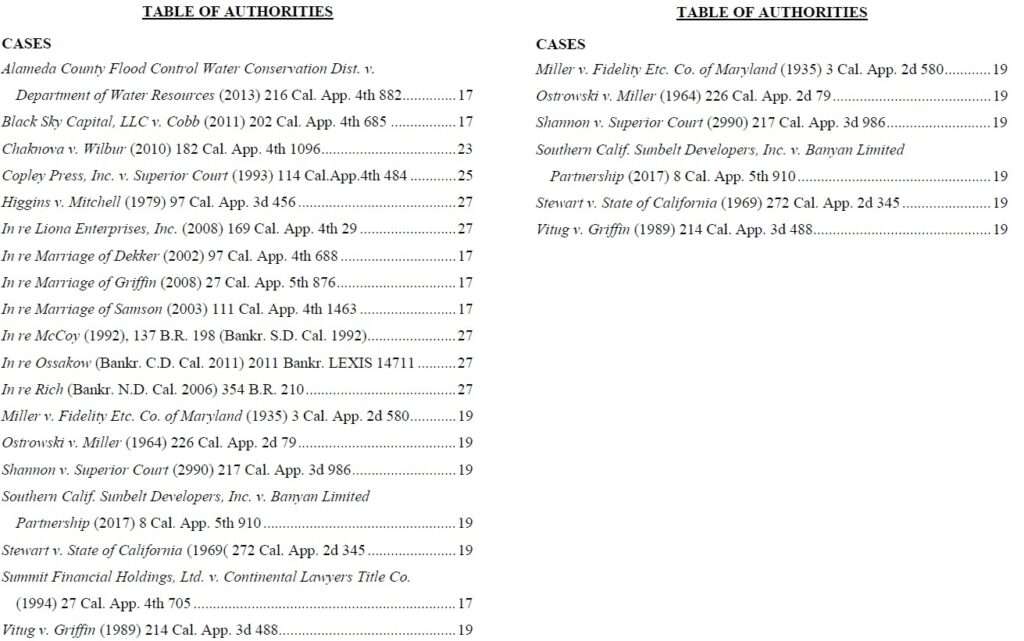
From the Table of Authorities (Cases) section of appellant's opening brief (left) and the amended appellant's opening brief (right) in Laguna HW, LLC v. Wilson; each lists all the cases filed in that brief:

The revised version is what appears to be the result of pruning all the AI-hallucinated citations. Or so theorizes the respondent's brief, which says, "Appellants likely used artificial intelligence to draft the opening brief, which is known to invent legal citations out of whole cloth." This is the 11th such case I found this year (cf. this federal case, and the state cases discussed here, here, and here—all involving documents filed by lawyers—plus the six federal self-represented litigant cases discussed here.)

Read More

Law of War

Prof. Samuel Estreicher (NYU) on The Laws of War, as to the Hamas-Israel War

|

From the article, by a leading American academic who teaches and writes about, among other things, Foreign Relations Law and the law of war:

Those who argue Israel does not have a right of self defense make two claims: First, they argue that Israel's "inherent right" is nullified because it is the "occupying power" of the Gaza Strip; and, second, they argue that the right of self-defense in Article 51 of the UN Charter applies only to force against other states, not non-state actors like Hamas.

Both arguments are unavailing. It is highly doubtful that Israel qualifies as an "occupying" power of the Gaza Strip because once it withdrew all military forces from Gaza in 2005, it has exercised no authority over the territory, which is a requirement under international law before assuming the responsibility of an occupying power. UN groups like the Human Rights Council counter that the status of "occupier" still applies because Israel has imposed stringent limits on travel to and trade with Gaza. And yet Egypt has (mostly) sealed off Gaza's other border without being termed an occupying power.

In any event, even if Israel were an occupying power, that status would not justify Hamas' intentional attacks on civilian targets in Israel or prevent Israel from using force to protect itself. For example, it was not considered illegal for the United States, as the occupying power of Iraq in the immediate aftermath of the 2003 Iraq War, to use force against Iraqis who were attacking U.S. forces within Iraq.

The second argument against Israel's right of self-defense—that it cannot invoke this right against non-state actors like Hamas—is equally untenable.

Read More

Civil Procedure

No Arbitration of Suit Alleging Stanford Internet Observatory et al. Collaborated with Government to Pressure Social Media Platforms

|

From Judge Terry Doughty's opinion yesterday in Hines v. Stamos (W.D. La.) (already being appealed), rejecting defendants' motion to compel arbitration:

Hines is a … co-Director of Health Freedom Louisiana, a consumer and human rights advocacy organization. Hoft is … the founder, owner, and operator of the news website, The Gateway Pundit. Hines and Hoft allege their … First Amendment [rights] … were violated by the censorship and/or suppression of their views on social media platforms….

Defendants [who are involved with the Stanford Internet Observatory and other similar organizations] are alleged to have worked closely and/or collaborated with state and federal government officials to urge, pressure, and coerce social media platforms to monitor and censor disfavored speakers and content….

According to Hines and Hoft, they do not seek to enforce Facebook, Twitter and/or YouTube's terms of service (which included an arbitration agreement) against the social media platforms, but they instead intend to challenge the pressure, coercion, cooperation, and entwinement of these outside persons and entities working with government officials to suppress and/or remove free speech from social media platforms….

No party disputes an arbitration clause exists in the Facebook and Twitter terms of service agreements. Also, no party disputes that the Defendants were neither parties nor signatories to the arbitration agreements entered into by Hines and Hoft. In an attempt to enforce the arbitration clause and the choice of law provisions in the Hines and Hoft terms of service agreement, Defendants attempt to use an equitable estoppel legal theory….

Read More

Politics

"NUMBER: Wisdom Above All Other"

|

From the John Scully and C.J. Herington translation of Aeschylus's Prometheus Bound:

What's more, for them I invented
NUMBER: wisdom
above all other.
And the painstaking, putting together of
LETTERS: to be their memory
of everything, to be their Muses'
mother, their
handmaid!

But above all, number. Thanks to Virginia Postrel for the pointer.

UPDATE: Commenter Magister adds:

But I had nothing to do with
EMOJIS: some of which revel in
being piles of poop.
Else I would deserve worse
punishments than
I have suffered.

Russia

Fund Ukraine's War Effort by Confiscating Russian Government Assets

The $300 billion in frozen Russian state assets in Western nations could fund a large part of Ukraine's defense.

|

The Bank of Russia. (NA)


There is an ongoing political debate about the appropriate extent of Western aid to Ukraine in resisting Russian aggression. How much cost is it worthwhile for Western taxpayers to bear? Whatever the answer, the burden can be greatly reduced by confiscating Russian government assets in the West, and using them to fund Ukraine's defense.

There is a staggering $300 billion in frozen Russian state assets located in Western nations backing Ukraine. Most of this wealth is located in European Union nations. But about $5 billion is in the US. To put this figure in perspective, it's worth noting that the total amount of US aid to Ukraine from February 2022 through July 31, 2023 was about $77 billion. The European Union, individual European states, and Canada, gave approximately $165 billion during the same period (I converted Euro figures to dollars at the current exchange rate). The $300 billion in frozen assets is equal to some two years of total Western assistance to Ukraine at the current pace of spending!

There is a strong moral and pragmatic case for seizing Russian state assets and using them to fund Ukraine's defense. Michael McFaul, a leading expert on Russian politics and foreign policy, summarizes some key points in a recent Washington Post article:

Since the war began, a broad coalition of countries has joined together to confiscate billions in Russian assets. Some of these assets belong to oligarchs who have propped up Putin's system; by far the largest amount, though, is sitting in frozen accounts held by the Russian Central Bank. These funds amount to some $300 billion, of which the largest share has been seized by the Europeans. These funds should be deployed as soon as possible to help bring the war to an end and finance Ukraine's reconstruction. Considering that Russia's unprovoked war has inflicted hundreds of billions of dollars of damage on the Ukrainian economy, it's only just that the international community should impose some of these costs on the Russian state itself….

[S]ome experts worry that transfer of these funds will set a negative precedent for global financial institutions. I disagree. Seizing assets of the Russian state after Putin invaded and annexed Ukraine sets a positive, deterrent precedent to other world leaders thinking about using military force to annex territory. And we should not want criminals to do their banking in the democratic world.

A recent Renew Democracy Initiative analysis by a team of lawyers led by Harvard law Prof. Laurence Tribe does a thorough job of addressing a variety of possible legal objections to such a step. But scholars such as Lee Buchheit and Paul Stephan, and Yale Law School Prof. Oona Hathaway have raised a variety of objections and reservations.

I won't try to go over all the law and policy issues here, and some are outside my areas of expertise. But I will cover some points that are within my competence, most notably those relating to property rights.

The most obvious moral objection is that the property in question ultimately belongs to the Russian people, and cannot legitimately be taken away from them by foreign powers. While the Putin regime is to blame for the war and resulting atrocities, most ordinary Russians are not. This objection might carry some weight if it were at all likely that Putin's government would use this property for purposes that benefit the Russian people. But given the nature of his authoritarian state, that is highly unlikely. If the present Russian government regains control of these assets, it is more likely to use them to further oppress Russians and Ukrainians like.

Using the assets to help Ukraine defeat Russia increases the likelihood of regime change in the latter state, or at least of some degree of liberalization. And that is the best hope for a Russian government that actually serves the interests of its people, or is at least less awful than the present regime. For that reason, we should not be deterred by fear of unjustly harming ordinary Russians. To the contrary, using Russian state assets to help Ukraine defeat Putin might actually benefit them.

There are also slippery slope objections to consider. If Western nations confiscate Russian state assets today, might they not confiscate other foreign property tomorrow, perhaps with far less justification? The answer to this objection is that legislation authorizing confiscation should be narrowly focused on Russian property, and possibly that of other states waging unjust wars of aggression and committing enormous human rights violations.

In addition, in the US the private property of foreigners is protected against confiscation by the Takings Clause of the Fifth Amendment, which requires the government to pay "just compensation" if it takes "private property." Most European nations have similar constitutional protections for private property rights, as does the European Convention on Human Rights.

But the Fifth Amendment and its European analogues do not offer the same kind of blanket protection to the property of foreign governments. This distinction undermines claims by some critics that uncompensated seizure of Russian state assets would violate the Takings Clause and similar constitutional guarantees in Europe. It also mitigates concerns that confiscating Russian government assets would create a dangerous slippery slope. Private property rights of foreigners would remain protected by constitutional guarantees.

There could still be a slippery slope with respect to property owned by foreign governments. But that is mitigated by the strong incentives governments have to maintain good relations with allies and trading partners. It's unlikely that Western nations will start systematically confiscating foreign states' assets outside of extreme cases like that posed by Russia's horrific assault on Ukraine. To the extent that confiscation of Russian assets leads other authoritarian rulers to think twice about imitating Putin's actions, or prevents them from investing in the West, slippery slope possibilities might even be a feature, rather than a bug.

What is true of property rights protections is also true of the Due Process Clause of the Fifth Amendment, and other similar procedural guarantees against seizure of property. The Due Process Clause and other such provisions are meant to protect private individuals and organizations against deprivation of life, liberty, and property without due process. They don't offer comparable protection to foreign governments. Indeed, it would be perverse to use laws intended to protect individuals against arbitrary state oppression to instead protect a mass-murdering oppressive state from having its assets seized for the purposes of using them to resist its aggression and massive human rights violations.

Oona Hathaway argues that confiscating Russian state assets would violate sovereign immunity. I think the Tribe report offers compelling responses to this argument (pp 60-64).

In addition, I am not convinced that sovereign immunity is actually a just principle that we have a duty to obey. It is in fact a perversion of justice, enabling rulers to escape accountability for violating human rights and other injustices they perpetrate. It was a mistake to read it into the US Constitution. It is equally a mistake to allow it to be a principle of international law. Some laws are so deeply unjust that we have no duty to obey them. The law of sovereign immunity is one such case.

At the very least, sovereign immunity should not be permitted to shield authoritarian states like Putin's regime from having their assets confiscated in order to combat their wars of aggression, mass murder of civilians, and other large-scale human rights violations. Such rulers no more deserve sovereign immunity than Mafia bosses. Indeed, they are far worse than Mafia bosses.

If necessary, the US and European nations should enact legislation stripping the Russian state of all sovereign immunity. Any possible violation of international law here is well-justified.

There is a pragmatic concern that, absent sovereign immunity, authoritarian rulers will confiscate the property of Western governments. But authoritarian states have vastly more assets invested in the West than vice versa. Moreover, many of them have strong incentives to stay on the good side of the US and its allies. Confiscating Russian assets might even strengthen those incentives. They might think twice about imitating Russian actions if doing so leads to the confiscation of assets they have stashed in the West. Private investors need have no fear of confiscation because they - unlike governments - are protected by the Takings Clause and similar constitutional rules in other countries.

The above analysis assumes that Ukrainian resistance to Russia is a just cause worth supporting. If not, there is no reason to assist it. I won't go through all the moral and pragmatic reasons why supporting Ukraine is the right thing to do. But I have previously covered many of them here, here, and here.

I also won't respond in detail to those who argue the West should force Ukraine to make peace. I will merely point out that such a step would embolden further aggression by Putin and other authoritarians, and consign hundreds of thousands of Ukrainians to horrific occupation. Anne Applebaum makes many additional relevant points in a recent Atlantic article critiquing the case for giving up on Ukraine.

UPDATE: I have made minor additions to this post.

What Did Rucho Do to the Political Question Doctrine?

|

If you're interested in the political question doctrine, you should read my colleague Derek Muller's latest post at the Election Law Blog. Derek identifies several shifts in how lower courts are using the political question doctrine after Rucho--manageability is becoming more important, and it is manageability of rules rather than manageability of remedies that is coming to the fore.

More