The case caption promises a mix of Bill & Ted's Excellent Adventure and Harold & Kumar Go to White Castle: The plaintiff styles himself "The Excellent Raj K. Patel, the Excellent from All Capacities" and the defendants are Patel and Kumar. But Wednesday's opinion in Patel v. Patel by Judge Laura Taylor Swain (S.D.N.Y.) reads like life in a household with two boys, with 15 extra years of age but not of development (to be fair, all we know about the defendant brother's actions are what the plaintiff brother alleges):
Plaintiff … filed this complaint against his brother … and his brother's wife, … and sets forth the following factual allegations.
Since watching Gangubai Kathiawadi, a 2022 Bollywood movie, Neal [defendant] has called Raj [plaintiff] "gangu" and "ganglia" a name of a child prostitute who become the madame of the facility, starting from existing the movie theater.
Raj left Neal at the restaurant they were eating at after the movie because Neal could not stop calling him the name. Raj and Neal's parents picked Neal up.
On May 17, Neal called me that, and I told him not to call me that again in writing.
On Thursday, June 8th when Neal arrived from New York to Indianapolis, as soon as he entered into my motel room he said "sup, gangu" or "sup, ganglia."
Patel has been suffering from stress, markedly since December 2017.
I demanded an apology from Neal which he has failed to give….
I had initially sent Neal a demand with a draft complaint to stop calling me this on June 12.
Neal visited Indianapolis after June 12th …, and he walked into my room earnestly and said, "what's up, ganga."
An excerpt from a long report and recommendation released Wednesday by Magistrate Judge Ona Wang (S.D.N.Y.) in Cassava Sciences, Inc. v. Bredt; for more details, read the whole opinion:
At various dates in 2021, the Neuroscientist Defendants filed a Citizen Petition and sent publicly available letters to the Food and Drug Administration ("FDA") expressing "grave concerns about the quality and integrity of the laboratory-based studies surrounding" simufilam {a [Cassava-developed] drug intended to treat Alzheimer's disease} and claims about its efficacy. The Neuroscientist Defendants accuse Drs. Burns {Cassava's Vice President of Neuroscience} and Wang {Associate Medical Professor at the City University of New York … and Cassava's "academic collaborator"} (and others) of intentional data manipulation and misrepresentation in Cassava's preclinical and clinical studies, and request that the FDA halt the ongoing trials of simufilam pending an audit of these issues….
The inference the Neuroscientist Defendants draw after examining the data and empirical research is not that "Cassava is a fraud" or even that "simufilam is not effective," which would have been analogous to the statements [given as examples in a past Second Circuit precedent -EV]. Rather, the Neuroscientist Defendants drew a more measured and nuanced series of inferences from Cassava's own underlying research, on which Cassava relies to support clinical testing of simufilam in humans: namely, that the research may be unreliable, based on certain irregularities in the reporting of data in the research.
Numerous press releases and basic science papers are attached and incorporated into the [Complaint], as if all of these statements, taken together, could be sufficient to "prove" Cassava's scientific conclusions to be true (or not). This is part of the "ongoing discourse" referenced in [the precedent] that courts should avoid. Indeed, the parties' repeated filings concerning CUNY's subsequent investigation (and its results) are irrelevant to this analysis. Rather, the fact of the investigation, conducted well after the Neuroscientist Defendants raised their concerns, shows that these statements are also not yet verifiable.
Please enjoy the latest edition of Short Circuit, a weekly feature written by a bunch of people at the Institute for Justice.
New case: In North Carolina, it is illegal for state-certified paralegals to provide advice to residents on how to fill out standard, court-created forms to resolve common legal problems, leaving low- and moderate-income residents to navigate the legal system on their own. But legal advice (both free and paid) is speech. And if the state wants to ban speech, it has to show it has a good reason—one that doesn't pale in comparison to the crisis in unmet legal needs.
Earlier today, the Federalist Society held a "Seat at the Sitting" online forum covering several cases the Supreme Court is about to hear. I participated, discussing two important takings cases: Devillier v. Texas (in which I have submitted an amicus brief) and Sheetz v. County of El Dorado. A full list of the participants and the cases covered is available here.
The panel featured several perspectives you might not expect at a Fed Soc event. Prof. Christopher Walker (U of Michigan) argued that the Supreme Court should decline to abolish Chevron deference to administrative agencies in Loper Bright Enterprises v. Raimondo. Mark Rienzi (Becket Fund for Religious Liberty) argued the government should not get deference in a case challenging the placement on the "No Fly List" of a Muslim suspected of ties to a radical mosque. And Grover Joseph Rees, III, former General Counsel of the U.S. Immigration and Naturalization Service in a GOP administration, argued the pro-immigration side likely deserves to prevail in Campos-Chaves v. Garland, case addressing the question of whether migrants received adequate notice of deportation proceedings.
I have embedded the video below. My presentation begins around 55:20:
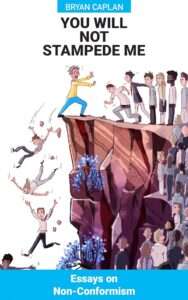
Given my background and views, I should be highly sympathetic to the positions laid out in economist Bryan Caplan's new book You Will Not Stampede Me: Essays on Non-Conformism(he summarizes the main themes of the book here). I'm a fan of Bryan's previous books on voter ignorance, immigration, and education (despite a few reservations about the latter). In addition, I'm a libertarian (a somewhat less radical one than Bryan, but more so than about 95% of Americans), an atheist (also like Bryan), author of a book on why majority views on political issues are often wrong because of systematic ignorance and bias, and an advocate of many unpopular views. People who know me well will tell you that I'm more likely than the average person to violate various social norms.
If anyone is a receptive audience for Bryan's new book, it would be someone like me! And I do indeed agree with a lot of it. For example, he gives excellent explanations of why many commonly held views are likely to be wrong. Bryan also effectively explains how you can often get away with non-conformism while suffering few or no social or economic penalties. On many issues, most conformists are unwilling to devote great time and effort to enforcing conformity! Indeed, doing so might get them branded as annoying fanatics, which is itself a kind of non-conformism that true conformists generally try to avoid.
For example, polls show that we atheists are an unpopular group. But, as Bryan explains, in most middle to upper-middle-class circles in the modern US, there are few or no costs to being an open atheist. That is similar to my own experience, as well. Though admittedly things would be different if I were running for political office, and possibly if I lived in a highly socially conservative Bible Belt area.
There are many other good points in Bryan's book, as well. But I think he and some other advocates of non-conformism may underrate some key arguments for - limited, but still substantial - conformity.
One is that conformism often makes good sense on questions you don't care much about. For example, I'm skeptical that moving towards gender-neutral language is a good idea, or that it does much to reduce sexism. But I don't actually care much about the terminology in question, and therefore usually go along with majority intellectual trends on these matters. I figure it's better to conform and thereby avoid unnecessarily alienating people, than to make a stand on a hill I don't care much about. Situations like this come up often. Bryan implicitly recognizes this when he recommends conformity in a few situations where the cost of non-conformity is high, and the benefit low. But he doesn't generalize the point - at least not clearly.
A more substantial problem is the possibility that some widely held norms and traditions might embody valuable wisdom, even if modern non-conformists don't understand why. This, of course, is the longstanding "Burkean conservative" argument for adhering to tradition.
The standard critique of Burkean conservatism is that history shows many longstanding, widely accepted traditions were horrifically wrong: slavery, serfdom, the subordination of women, persecution of religious dissenters, and more. This litany undermines the case for unthinking adherence to tradition, as a general rule. But there might be some categories of norms and traditions that deserve more deference than others. Back in 2008, I argued that Burkean conservatism is a poor rule when it comes to coercively imposed norms, including many of the familiar examples of awful traditions, such as slavery. The same can be said for many that are the result of the imposition of majority public opinion in a democracy. The work of many scholars -including both Caplan and myself - shows that majority opinion on political issues is often heavily influenced by ignorance and bias, and that voters have little incentive to seek the truth and correct wrong opinions.
That doesn't prove democracy is worse than dictatorship or oligarchy. But it does mean we should give little credence to the idea that political views are likely to be right merely because they are supported by a majority of voters and embraced by candidates who win elections.
On the other hand, however, social norms that emerge from market processes or civil society are more likely to be well-founded. In such situations, people "vote with their feet" and thereby have more incentive to get things right. That's no guarantee of infallibility. Far from it! But it does suggest a stronger case for deferring to rules and social norms that emerged in this way. If your workplace, your church, or your social circle has certain norms of behavior and civility, there's at least a substantial likelihood they make good sense, even if you may not understand why. Otherwise, these institutions would lose members, workers, and customers to rivals with better rules and traditions.
That's far from a guarantee of infallibility. But it does justify giving at least some substantial deference to norms in these situations. That's especially the case if you're new to the institution and have little knowledge of how it works, and what purposes its rules and norms might serve. The relevant comparison is not between the norm and perfection, but between the quality of the decision-making process that led to the norm, and the quality of your own judgment on the issue in question.
Finally, sometimes it makes sense to conform to the views of experts - at least in cases where there is a relatively broad consensus among the relevant experts, and they have relatively good incentives to seek the truth. I summarized the justification - and limits - of this kind of deference here, and more fully in a book chapter on "Trust and Political Ignorance."
Experts are far from infallible, and we should keep in mind biases and poor incentives that make them unreliable in some situations (as well as the tendency of many of them to opine on issues that are actually beyond their expertise). But we should also remember there are important issues on which experts' views are more likely to be reliable than those of laypeople. In those situations, a degree of conformist deference makes sense.
Even in situations where it makes sense to defer to tradition, norms, or experts, such deference should not be absolute. The case for deference could be outweighed by a large amount of contrary evidence, or moral considerations. But the burden of justification for going against "the herd" in such cases is higher than in areas where there is little reason to think that herd has any special wisdom or insight.
Some of these points are likely compatible with Bryan Caplan's views, laid out in his book. But he doesn't systematically incorporate them as limitations on his general (and often justified!) opposition to conformism.
They are also worth keeping in mind if you are the kind of person who views norms and traditions with suspicion. I am like that myself. Whereas the average person may tend towards excessive conformism, intellectuals - especially those who hold many unpopular views - may have the opposite bias. Such people are likely overrepresented among academics, political commentators, and possibly even readers of this blog.
[This post is co-authored with Seth Barrett Tillman]
Recently, James Heilpern and Michael T. Worley (the "Authors") posted an article to SSRN titled Evidence that the President is an "Officer of the United States" for Purposes of Section 3 of the Fourteenth Amendment. The Authors conclude that our position is incorrect. Their Article cites an "undeniable urgency" to answer this question. As often happens in anticipation of, and during fast-paced litigation, people who have no prior expertise in an area profess an immediate expertise, and make bold conclusions with the intent of influencing that litigation. This may be one such paper. For reasons we discuss below, Justices and judges, lawyers, scholars, and the press should exercise caution before citing this paper.
From yesterday's decision in Killebrew v. Gardner (opinion by Judge James Gardner Colins, joined by Judges Judith Ference Olson and Victor P. Stabile):
Father and Mother were married for a period of less than two years and had separated prior to Child's birth. On March 6, 2014, Father filed an initial custody complaint seeking shared legal and physical custody. On April 7, 2014, the trial court entered an order providing that the parties would share legal custody and Father would have partial physical custody on Tuesday and Thursday evenings and every other Sunday. Father's custody periods were expanded in orders dated October 17, 2014, and January 29, 2015, allowing Father to have Child overnight every other Thursday and one Saturday night per month. Father's partial custody was expanded again on December 9, 2015, to alternating two or four nights per week, and this allocation of custody continued, in substantially similar form, through a series of orders entered prior to 2020.
On January 27, 2020, Mother filed a petition for modification of custody order, alleging that Child was involved in two automobile crashes while being driven by Father's wife …. At a February 25, 2020 hearing on this petition before a hearing officer, Father presented evidence that Mother had posted sexually explicit photographs of herself on the "OnlyFans" website {"a subscription-based website that allows content creators to share sexually explicit materials with their fans, after engaging in direct messages and other interactions, for a fee"}. Father also informed the hearing officer that he had made a ChildLine [suspected child abuse] report concerning Mother's behavior.
On February 26, 2020, the trial court issued an order, upon the recommendation of the hearing officer, providing that Mother would have no contact with Child pending a scheduled forensic interview with Child. In the event that the forensic interview revealed that Child had no awareness of Mother's OnlyFans activity, the order authorized supervised telephone communication with Mother and Child but no in-person contact pending a future court order. Alternatively, if Child did indicate awareness of such activity, then Mother would be permitted no contact with Child at all. The order further provided that Mother was required to delete her OnlyFans account and submit to a psychological evaluation and follow any recommendations provided to her in that evaluation.
From Levy v. Shuster (né Doe v. Roe), handed down Nov. 28 but just unsealed yesterday, following the expiration of plaintiff's time to appeal:
Background. According to the allegations in the First Amended Complaint and Jury Demand …, Plaintiff and Defendant dated for nearly a year while enrolled at Tulane University … in New Orleans, Louisiana. After their relationship ended in October 2021, Defendant complained about Plaintiff's behavior to Tulane, which issued mutual no-contact orders the next month. Defendant also sought a protective order in Louisiana state court, claiming that Plaintiff stalked, harassed, shoved, and threatened her. In both proceedings, Defendant did not claim that Plaintiff sexually assaulted her. Plaintiff and Defendant agreed to a state court order, pursuant to which Tulane's no-contact order became permanent, and Plaintiff agreed to withdraw from Tulane and cease all contact with Defendant. Plaintiff alleges that he never sexually assaulted Defendant, and that he left Tulane voluntarily.
In August 2022, following a "period of reflection," Plaintiff enrolled in Front Range Community College in Boulder, Colorado, although he planned to transfer to the University of Colorado ("CU Boulder") after his first year there. At CU Boulder, Plaintiff rushed and sought to pledge an unspecified fraternity, and paid its dues. Shortly after the fraternity received his bid in September 2022, Defendant sent text messages to the fraternity's social chairs claiming, among other things, that Plaintiff transferred schools "not through his own choice, but because he was kicked out of Tulane for rape and stalking"; "sexually assaulted and raped [Ms. Shuster] countless times"; "forced [Ms. Shuster] into very uncomfortable sexual situations, forcing [her] to do painful things which [she] objected to"; "was abusive in every way"; "ha[d] been physically violent with [Defendant]"; "threatened [Defendant's] friends and family and attempted to cut [her] off from every person in [her] life"; and was "a threat to every woman's safety on [CU Boulder's] campus."
The fraternity "terminated" Plaintiff immediately, based on Defendant's allegedly defamatory claims, and refused to refund a deposit he paid. Plaintiff's college friends "cancelled him." Additionally, fraternity members "spread Ms. Shuster's malicious lies to numerous other students on campus, who proceeded to bully and ostracize Mr. Levy." Plaintiff was ultimately "forced to withdraw" from CU Boulder "and return home to California." Meanwhile, Defendant has returned to Tulane, where she continues to "publish[] her false and malicious lies to numerous students there." Seeking damages, Plaintiff has brought three claims arising out of these allegations: defamation, intrusion on seclusion, and unreasonable disclosure of private facts. Ms. Shuster has filed counterclaims for sexual assault, rape, battery, assault, stalking, cyberstalking, intentional infliction of emotional distress, and statutory violations under state and federal law..
The Court denied Mr. Levy's initial motion to prosecute this action pseudonymously on July 17, 2023, reasoning that, as Ms. Shuster and Professor Volokh [who had filed an objection to the motion] contended, no exceptional circumstances supported pseudonymity.
I wrote about that July 17 decision here. Plaintiff then sought reconsideration, but the court said no:
1/4/2012: President Obama makes three appointments to the NLRB. The Supreme Court would find these appointments unconstitutional in NLRB v. Noel Canning.
My forthcoming symposium article, "Empowering Hispanics to Vote With Their Feet" is now available on SSRN. It is part of the University of Houston's annual Frankel Lecture symposium, which this year focuses on the role of Hispanics in our democratic system.
This symposium contribution outlines the significance of foot voting for America's Hispanic population and highlights ways in which we can better empower them to "vote with their feet." People vote with their feet when they make individually decisive choices about the government policies they wish to live under, as opposed to ballot box voting, where each voter usually has an only an infinitesimally small chance of determining electoral outcomes or otherwise affecting policy. There are three major foot voting mechanisms: through international migration, by moving between jurisdictions in a federal system, and by making choices in the private sector.
Part II summarizes the advantages of foot voting over conventional ballot box voting as a mechanism of political choice. Foot voters have more meaningful opportunities to make decisive choices with a real impact on their lives, and better incentives to become well-informed. Part III outlines ways in which Hispanics often benefit from foot voting opportunities even more than most other groups in American society. This applies to both international migration and domestic foot voting. Part IV describes ways in which we can enhance both international and domestic foot voting opportunities for Hispanics. Much can be accomplished by increasing access to legal migration, legalizing the status of current undocumented migrants within the United States, and breaking down barriers to domestic interjurisdictional foot voting.
Expanding Hispanic foot voting is not merely a benefit for this group alone. Empowering them to "move to opportunity" also benefits other groups, including native-born Americans of all races. The liberty and prosperity of America's largest minority group is of obvious significance to the nation as a whole.
The piece also includes a brief explanation of why I use "Hispanic" instead of the more academically fashionable "Latinx" (a term rejected by most actual members of the group in question).
The principal Frankel Lecture was that of Prof. Rachel Moran (Texas A&M), entitled "The Perennial Eclipse: Race, Immigration, and How Latinx Count in American Politics." There is also a commentary by Prof. Joseph Fishkin (UCLA). I will post links to them when they become available online.
This is the Fifth Circuit's third Wages & White Lion opinion. A panel of the court had initially stayed the FDA's enforcement of its prohibition on the sale of unapproved vaping products (decrying the agency's "surprise switcheroo"), but a separate panel reversed course, upholding the FDA. Now, sitting en banc, the Fifth Circuit has again ruled against the FDA, taking the agency to task for its arbitrary treatment of Wages & White Lion's product applications and, by implication, those submitted by dozens of other manufacturers as well.
Judge Oldham wrote for the Court. He was joined by Chief Judge Richman and Judges Jones, Smith, Elrod, Willett, Ho, Duncan, Engelhardt, and Wilson. Judge Haynes wrote the principal dissent, joined by Judges Stewart, Southwick, Higginson, and Douglas. Judge Graves also dissented separately.
Judge Oldham's opinion begins:
Over several years, the Food and Drug Administration ("FDA") sent manufacturers of flavored e-cigarette products on a wild goose chase.
First, the agency gave manufacturers detailed instructions for what information federal regulators needed to approve e-cigarette products. Just as importantly, FDA gave manufacturers specific instructions on what regulators did not need. The agency said manufacturers' marketing plans would be "critical" to the success of their applications. And the agency promulgated hundreds of pages of guidance documents, hosted public meetings, and posted formal presentations to its website—all with the (false) promise that a flavored-product manufacturer could, at least in theory, satisfy FDA's instructions. The regulated manufacturers dutifully spent untold millions conforming their behavior and their applications to FDA's say-so.
Then, months after receiving hundreds of thousands of applications predicated on its instructions, FDA turned around, pretended it never gave anyone any instructions about anything, imposed new testing requirements without any notice, and denied all one million flavored e-cigarette applications for failing to predict the agency's volte face. Worse, after telling manufacturers that their marketing plans were "critical" to their applications, FDA candidly admitted that it did not read a single word of the one million plans. Then FDA denied that its voluminous guidance documents and years-long instructional processes meant anything. Why? Because, the agency said, it always reserved the implied power to ignore every instruction it ever gave and to require the very studies it said could be omitted, along with the secret power to not even read the marketing plans it previously said were "critical." It was the regulatory equivalent of Romeo sending Mercutio on a wild goose chase—and then admitting there never was a goose while denying he even suggested the chase. Cf. William Shakespeare, Romeo and Juliet act 2, sc. 4.
FDA justifies its behavior with two principal arguments. First, FDA argues that its years' worth of regulatory guidance was not worth the paper it was printed on because it was hedged with cautious qualifiers and never guaranteed that any particular submission would be granted. Second, and most disturbingly, FDA argues that its capriciousness should be forgiven as harmless because the agency promises to deny petitioners' applications even if we remand to make the agency follow the law.
Today we reject both propositions. As the Supreme Court recently reminded us: "If men must turn square corners when they deal with the government, it cannot be too much to expect the government to turn square corners when it deals with them." Niz-Chavez v. Garland, 593 U.S. 155, 172 (2021). No principle is more important when considering how the unelected administrators of the Fourth Branch of Government treat the American people. And FDA's regulatory switcheroos in this case bear no resemblance to square corners. As for the agency's harmless-error argument, the Supreme Court recently, unanimously, and summarily rejected it. Calcutt v. FDIC, 598 U.S. 623 (2023) (per curiam). We do the same here with the expectation that FDA will give petitioners the benefit of a full and fair regulatory proceeding on remand, notwithstanding its prior promises to reject their applications no matter what.
While the majority expected the FDA to comply with administrative law norms of fair notice and non-arbitrary treatment, the dissenters adopted a more permissive posture, concluding that vaping product manufacturers had failed to demonstrate that their products satisfied the FDA's regulatory standards.
This view may have commanded majorities on most circuit courts to consider the quesiton, but it did not command a majority of the Fifth Circuit. Wrote Judge Oldham:
FDA's counterargument boils down to this: Some other circuits agree with the agency. It is true that five circuits have sided with FDA, while the Eleventh Circuit and ours have found the agency acted arbitrarily and capriciously. But law is not a nose-counting exercise. Compare, e.g., Cochran v. SEC, 20 F.4th 194, 237 (5th Cir. 2021) (en banc) (Costa, J., dissenting) ("Five circuits have considered the question. By a count of 15-0, every judge deciding those cases has [found no jurisdiction.]"), with Axon Enter., Inc. v. FTC, 598 U.S. 175, 195–96 (2023) (unanimously finding jurisdiction in Cochran). Rather, the relevant question is whether our sister circuits have spotted a defect in petitioners' arguments that we have missed. With deepest respect for our colleagues who have seen this case the other way, we think not.
The question now is whether the Justice Department will seek Supreme Court review. Thus far, the Court has shown little interest in taking a vaping case, at least when cert petitions have been filed by manufacturers of denied products. Now that there is a clearer circuit split, and the FDA may be seeking review, perhaps the Court will change its mind.
In or around June 2023, the Boston [Violent Crimes Task Force] became aware of a series of armed robberies of commercial stores … in which all three stores were robbed at gunpoint by an individual. Based on video surveillance, witness statements, and patterns of behavior observed across the three robberies, agents believed that the robberies were connected, and that the perpetrator of each of the three robberies was likely the same person (the "Suspect").
As the FBI learned more about the robberies and learned of other robberies apparently involving the same Suspect, as well as other individuals believed to be involved in the planning and execution of the robberies, facts emerged that suggested that the SUBJECT PERSONS were involved in conduct other than purely commercial robberies. For example, toll records analysis showed that some purported victims of the supposed robberies were in contact with PATEL before the robberies. Also, investigation revealed that one of the individuals tasked with committing the robberies had traveled via airplane to commit a robbery in circumstances where the money likely to be obtained during the robbery could reasonably be expected to have been less than the cost of the travel to commit the robbery.
The FBI also learned about immigration-related activity of several store employees following their purported victimization during the robberies, as outlined below. As a result of these unusual factors, during the course of the investigation, the FBI began to suspect that the SUBJECT PERSONS and co-conspirators, both known and unknown, were engaged in a visa fraud scheme, rather than a series of Hobbs Act robberies.
As explained more fully below, there is now probable cause to believe that the purported robberies were staged for the purpose of supporting fraudulent visa applications….
I read this and much enjoyed it some years ago; it's an urban fantasy set at Yale, and I expect that people with some Yale or New Haven experience would enjoy it even more. Indeed, I recommended it to Will Baude, who went to Yale Law, and he just let me know that he "loved it almost as much as Lev Grossman's The Magicians." That's my reaction, too: I think Grossman's series is exceptionally good, and somewhat better than Ninth House and its sequel, Hell Bent, but I liked both very much.
If you've read the book, please let us know your thoughts in the comments.
The Heritage Foundation is now accepting applications for the 2024 Judicial Clerkship Training Academy. If you have been hired as a law clerk with a start date in 2024, you should apply.
The Academy will provide you with many of the tools to maximize your clerkship. I will be leading an interactive seminar on textualism and the canons of statutory interpretation. Tom Lee, formerly of the Utah Supreme Court, and James Heilpern will lead a session on corpus linguistics and originalism. Ross Guberman will teach a class on writing bench memos, opinions, and dissents. Plus, you can hear from federal judges and former law clerks about their experiences.
The deadline to apply is January 22, so move quickly.
My good friend from the Northwestern Pritzker School of Law faculty Steve Lubet has very politely, but firmly taken issue with my recent post on this Blog about Justice Clarence Thomas. Steve does "not question [my] assessment of Thomas's exceptional intellect." But he does question my assertion that Justice Thomas is the best of the 116 justices to have sat on the Supreme Court. I want to begin by defending that claim before turning to the ethics issues that Steve is troubled by.
First, I am not alone in thinking that Clarence Thomas is the best of the 116 Justices to ever serve on the Supreme Court. I am one of the three co-founders and the 40 year Co-Chairman of the Federalist Society's Board of Directors. The Society has 70,000 members nationwide, chapters at every law school in the country, lawyers chapters in every major city in the country, and a substantial presence on the federal judiciary. After forty years of attending thousands of Federalist Society gatherings, I have a pretty good sense of what Federalist Society members think. They adored the late Justice Antonin Scalia, but after Clarence Thomas had been on the Supreme Court for about ten years -- a frequent parlor game got started when Federalists got together. They would ask themselves who was right in those cases in which Justices Scalia and Thomas disagreed. The nearly unanimous answer was that Justice Thomas was right.
While Justice Scalia travelled all over the world and the United States giving speeches praising originalism and extolling its virtues, Justice Thomas worked in his office writing very consistent and powerful originalist opinions that started driving the Supreme Court in his direction. Some people said sadly as a joke that Justice Thomas had the courage of Justice Scalia's opinions. See Antonin Scalia, Originalism: The Lesser Evil, 57 U. Cinn. L. Rev. 849 (1988-1989) (arguing for faint hearted originalism that did not overturn major precedents). All too often, as in Gonzales v. Raich, 545 U.S. 1 (2005) a case about whether the federal government had power under the Commerce and Necessary and Proper Clauses, to prosecute a cancer patient for growing three medical marijuana plants in her kitchen, Justice Scalia was in the liberal majority for national power and Justice Thomas was in dissent along with Chief Justice Rehnquist and Justice Sandra Day O'Connor.
These episodes added up, and Justice Scalia served only twenty-nine years on the Supreme Court, while Justice Thomas is still going strong in his thirty-third year on the Supreme Court. I am not alone in thinking that Justice Thomas is the best of the 116 justices to have served on the Supreme Court today. Most Federalist Society members who I talk to think the same way. It is striking and a wonderful thing for the country that an overwhelmingly white group of conservative and libertarian lawyers would look up to a Black man as their personal hero. Many of the six Republican appointees on the current Supreme Court are beloved by the Federalist Society membership. The three Trump appointees fall in that category, but they have not been on the Court for long enough to form a reputation. Federalist Society members greatly admire Justice Alito, but they regret that he is not really an originalist and that he follows precedent over the text of the Constitution. Similar complaints are made about Chief Justice Roberts. Chief Justice Roberts is also seen as being too political and too concerned with public opinion about the Court. In my view, this is a form of corruption.