
Thursday Open Thread
What's on your mind?

Mostly law professors | Sometimes contrarian | Often libertarian | Always independent | Est. 2002
What's on your mind?
The issues, arguments, and evidence raised by Mikhail have already been addressed by extant scholarship, including our scholarship. Mikhail’s arguments and evidence were not “ignored or overlooked.”
[This post is co-authored with Professor Seth Barrett Tillman.]
This is the second part of our response to Professor John Mikhail's Balkinization post. Part I can be found here.
In his Monday, February 19, 2024 Balkanization post, Mikhail wrote:
Justice Story proposed this idea in his influential Commentaries on the Constitution of the United States, although he did so in a somewhat equivocal manner, first referring to the President and Vice President as officers of the United States (§789) before suggesting the opposite conclusion (§791).
Our Tuesday, February 20, 2024 responsive post pointed out that Section 789 says nothing at all about the President. In a follow-up post yesterday, on Wednesday, February 21, 2024, Mikhail posted a correction, indicating that he meant to refer to Section 788:
In my post on Monday, I wrote "789" instead of "788" when referring to the section of Joseph Story's Commentaries on the Constitution of the United States (1833) in which Story refers to the President and Vice President as officers of the United States. In Section 788, Story wrote: "From this clause it appears, that the remedy by impeachment is strictly confined to civil officers of the United States, including the president and vice-president." This mistake has now been corrected. (emphasis added)
We appreciate the correction, but Mikhail's characterization of Story is still not right. Sections 788 and 791 are not in tension. Story did not contradict himself, or "suggest[] the opposite conclusion."
Let's walk through the analysis.
This approach to doing so poses serious academic freedom problems
I think universities have a serious "intellectual diversity" problem, but a proposed bill introduced into the Indiana state legislature is not a good approach to trying to address that problem and would create significant academic freedom problems. You can find my take on this problem here.
Indiana Senate Bill 202 is discussed here. The state senator sponsoring the bill is a former aide to Mitch Daniels when Daniels served as the president of Purdue University. He hopes the bill would help change perceptions about American higher education among conservatives, but I'm skeptical that this bill would help much in changing those perceptions and I don't think it would make much progress in addressing the underlying concerns that conservatives have. The text of the bill can be found here.
The bill (ch. 2, sec. 1(b)(1)) directs the regents to develop a policy to block tenure of professors who are "unlikely to foster a culture of free inquiry." I think this is actually quite interesting and raises difficult questions. I'm not enthused about trying to do it through board policy, however. Could universities under this rule hire a professor who subscribed to various postmodern views about free speech or agreed with Marcuse on the need for "repressive tolerance"? Could universities hire professors with various views derived from critical race theory about the need to suppress certain ideas in the public sphere and in the universities specifically? Could universities hire conservative faculty who agree with Christopher Rufo and others about the need to weed out campus radicals and dispense with what they might characterize as luxury disciplines like women's studies? Perhaps not. There are classic problems regarding whether we must tolerate the intolerant, and universities do need to resist being captured by those who are hostile to their core mission of free inquiry and the neutral pursuit of the truth and the advancement of knowledge. But this kind of blanket ban is unlikely to have good effects.
Much more serious is sec. 1(b)(2) which would block tenure of those unlikely to expose students to works from "a variety of political or ideological frameworks."
Sec. 1. (a) This section applies to an institution that grants tenure or promotions to faculty members.
(b) Each board of trustees of an institution shall establish a policy that provides that a faculty member may not be granted tenure or a promotion by the institution if, based on past performance or other determination by the board of trustees, the faculty member is:
(1) unlikely to foster a culture of free inquiry, free expression, and intellectual diversity within the institution;
(2) unlikely to expose students to scholarly works from a variety of political or ideological frameworks that may exist within and are applicable to the faculty member's academic discipline; or
(3) likely, while performing teaching or mentoring duties within the scope of the faculty member's employment, to subject students to political or ideological views and opinions that are unrelated to the faculty member's academic discipline or assigned course of instruction.
What counts as a "variety"? Why is necessary that individual professors provide that variety? I can teach a class on "originalism and its critics," but I cannot teach a class on "originalism?" Do I get "variety" in my originalism class if I teach Rappaport, Baude, Barnett, Balkin and Whittington? Presumably not, but why exactly and who decides?
Sec. 1(b)(3) prohibits subjecting students to political views in teaching unrelated to subject matter of class. On the whole, good. But hair trigger and severe penalties could be wind up hampering teaching.
Sec. 2(a) would incorporate the same into a system of 5-year post tenure reviews. Sec. 2(c) would protect "expressing dissent" or criticizing the administration or outside political activity from retaliation during the post-tenure review, which is interesting. Not sure this is the best place to secure that kind of protection, and might not be terribly effective at doing the job.
Unsurprisingly, sec. 4 would create a system for taking student complaints about faculty performance on this "intellectual diversity" requirement. Systems of surveillance of classroom speech by university administrators leveraging student complaints is a sure path to chilling free inquiry in the classroom and punishing professors who become controversial or an annoyance to the administration.
The bill has other features on diversity statements and institutional neutrality, which I think are mostly good but won't get into the details here. As written in the bill, the whole process could be entirely within the board of trustees -- no faculty or administration involved at all. Likely not how it would play out in practice, but not how you would want to structure such a process.
I appreciate the instinct here, but this is not the way. It will encourage political witch hunts of faculty, and it invites inappropriate trustee intervention into teaching in unjustified ways. Sec. 1(b)(2) is a big problem and more difficulties flow from it. Intellectual diversity on campus is not going to be achieved through mandates to faculty about how they must teach their classes. Ultimately, free inquiry will depend on the composition and professional norms of the faculty.
This is the film based on the bestselling book by FIRE's Greg Lukianoff and Prof. Jonathan Haidt (NYU).

I just watched the premiere here in Los Angeles, and I much enjoyed it; I found it thoughtful and touching. It's the first film that's being distributed on Substack, and you can find it here (the rental fee is $8). Highly recommended.
The film was produced by Courtney Moorehead Balaker (Little Pink House) and directed by Ted Balaker (Can We Take a Joke?), both of Korchula Productions. Note that I have at times consulted for FIRE, and with worked with them on various legal projects; I am of course not being paid for this post, nor was I asked to put it up.
The Mischief Rule, an article on statutory interpretation that I published several years ago, begins this way:
A Tennessee statute imposed duties on railroad engineers. If a railroad engineer found an animal or obstruction on the tracks, the statute required "the alarm whistle to be sounded, and brakes put down, and every possible means employed to stop the train and prevent an accident." But what counted as an "animal" on the tracks? Cows and horses, yes. But what else? Did all the trains in Tennessee have to stop for squirrels?
The stop-the-train case poses difficult questions for some interpretive theories, especially textualism. The text does not identify a stopping point in what counts as an animal. Nor is there a dictionary definition that will include cows but exclude squirrels. Is a textualist interpreter duty bound to say that trains really do have to stop for squirrels?
Note that there is no dictionary definition for animal that will mean "sizable animal," or "animal of the sort you would need to stop a train for." If you are willing to look at context, including the mischief, but only if you can first find some ambiguity, then you will be absolutely flummoxed by the stop-the-train statute. The solution, or so I argue in The Mischief Rule, is that interpreters should consider the mischief as an aspect of context not only after concluding that a statute is ambiguous, but also when deciding whether it is ambiguous in the first place.
I thought of these points when I ran across this passage in an essay by jazz critic Ted Gioia. He notes that Sony recently invested "in Michael Jackson's song catalog at a valuation of $1.2 billion." He then added: "no label would invest even a fraction of that amount in launching new artists."
Now anyone reading that sentence knows exactly what Gioia means. He is not failing to get across his message. Nor is he an inept user of the English language. He isn't making a mistake.
What does Gioia mean by "a fraction"? No music label, he says, "would invest even a fraction of that amount in launching new artists." But that, of course, is exactly what a music label would do: it would invest not $1.2 billion in a new artist, but rather a fraction of that.
So what exactly does Gioia mean by "a fraction"? He does not simply mean a part of a whole. If Sony invested $1 billion in a new artist--a fraction to be sure, 5/6 of $1.2 billion to be exact--that would run counter to Gioia's point. So he means by "a fraction" not just a part, but a small part.
But he also does not mean "any part." If Sony invested $10,000 in a new artist, would that disprove Gioia's point? Not at all. But $10,000 is quite literally a fraction of $1.2 billion.
So what does Gioia mean? He means by "a fraction" (1) a part of the whole (2) that is small and (3) yet non-trivial. It's a small part of the whole that's actually something, not so small that we could say--and every reader would understand--"that's not even a fraction of what I wanted!" In other words, "a fraction" is being used as a concept that is bounded on both ends, a part that is neither a hair's breadth smaller than the whole, but also not just a hair's breadth. A fraction, a real fraction.
Yet even though (most) readers of Gioia's sentence will understand immediately what he means, the sense in which he is using the word is not identified in dictionaries. At least not in the three I checked just now, including the Oxford English Dictionary. Dictionaries sometimes get the first and second aspects of Gioia's usage, but not the third.
So, to draw the moral for legal interpreters: the semantic domain of a word is not coextensive with dictionary senses, and a word can be used in context in a way that makes sense to every reader and yet does not match any identifiable dictionary sense. Any good reader knows a slug is not an animal in the Tennessee statute, and any good reader knows that $10,000 is not even a fraction of $1.2 billion. Legal interpreters need to be more than good readers, but not less.
The Supreme Court snubbed Sidney Powell and a court orders Mike Lindell to pay up.
Last fall, the U.S. Court of Appeals for the Sixth Circuit largely upheld court ordered sanctions of approximately $150,000 against Sidney Powell, Lin Wood, and other members of the "Kraken" legal team that advanced false and frivolous claims in their efforts to challenge the 2020 Presidential election results. On Tuesday, the Supreme Court denied Powell and Wood's petitions for certiorari without comment. This should end their efforts to oppose these sanctions (though other legal proceedings against Powell and Wood remain ongoing).
Yesterday, a federal judge in Minnesota affirmed a $5 million arbitration award against MyPillow CEO Mike Lindell, who had offered a $5 million bounty to anyone who could debunk his alleged evidence of Chinese interference in the 2020 election. As I recounted last year:
Robert Zeidman, a computer forensics expert who had apparently voted for Trump twice, took Lindell up on his challenge. He analyzed the supposed evidence and demonstrated it was a steaming pile of digital detritus, and not evidence of any sort of election interference. Indeed, he showed (as Lindell's terms required) that the data had nothing to do with the 2020 presidential election. Lindell, expectedly, refused to pay, and the matter went to arbitration. There, despite Lindell having written the terms to make recovery difficult, the arbitrators sided with Zeidman.
Lindell refused to pay, so Zeidman took him to court, resulting in yesterday's judgment against the pillowmaker.
According to news reports, Lindell still maintains that he owes nothing, and will appeal. As with the 2020 election, Lindell seems to have a problem with evidence and legal conclusions that do not align with his priors. Also like Powell, Lindell faces other litigation, including defamation claims.
Unfortunately for both Powell and Lindell, they may have to bear the costs of their mounting legal losses themselves. Unlike Donald Trump, they do not have a political party and campaign organizations that will cover their legal costs.
2/22/2005: Kelo v. City of New London argued
Now out in the University of Pennsylvania Law Review.
In the last year or two, the U.S. Department of Justice has been arguing in federal courts of appeals that Terms of Service can narrow or eliminate Fourth Amendment rights in online accounts. If the government can win on this issue, it will largely defeat any claims to Fourth Amendment protection online. But as I argue in my just-published article, Terms of Service and Fourth Amendment Rights, 172 U. Pa. L. Rev. 287 (2024), these arguments are mistaken. Here's the abstract:
Almost everything you do on the Internet is governed by Terms of Service. The language in Terms of Service typically gives Internet providers broad rights to address potential account misuse. But do these Terms alter Fourth Amendment rights, either diminishing or even eliminating constitutional rights in Internet accounts? In the last five years, many courts have ruled that they do. These courts treat Terms of Service like a rights contract: by agreeing to use an Internet account subject to broad Terms of Service, you give up your Fourth Amendment rights.
This Article argues that the courts are wrong. Terms of Service have little or no effect on Fourth Amendment rights. Fourth Amendment rights are rights against the government, not private parties. Terms of Service can define relationships between private parties, but private contracts cannot define Fourth Amendment rights. This is true across the range of Fourth Amendment doctrines, including the "reasonable expectation of privacy" test, consent, abandonment, third-party consent, and the private search doctrine. Courts that have linked Terms of Service and Fourth Amendment rights are mistaken, and their reasoning should be rejected.
I'm delighted to pass along this item from Prof. Thomas Merrill (Columbia), whom readers might remember as a guest-blogger from a couple of years ago, and who is the author of The Chevron Doctrine: Its Rise, and Fall, and the Future of the Administrative State (2022):
In Loper Bright Enterprises v. Raimondo and Relentless, Inc. v. Department of Commerce, the petitioners are asking the Supreme Court to overrule the Chevron doctrine. Oral argument in the cases included multiple references to a decision called Brand X, short for National Cable & Telecommunications Association v. Brand X Internet Services, decided in 2005. The petitioners could not stop reminding the Court about Brand X.
Brand X held that when a court decides a question of statutory interpretation that would be eligible for Chevron deference if decided by an agency, and the agency subsequently disagrees with the judicial interpretation, the courts are obliged to follow the agency interpretation, not the prior judicial interpretation. Justice Scalia, in dissent, described Brand X as a "breathtaking novelty: judicial decisions subject to reversal by executive officers." He added that this was "probably unconstitutional."
The petitioners in the two pending cases were eager to remind the Court about Brand X in part because of the presumed aversion of the Justices to the idea that an administrative agency can "overrule" a decision of an Article III court—including potentially the Supreme Court.
Undoubtedly, they also thought Brand X was a perfect illustration of the instability in the law that they argue is caused by Chevron. Brand X upheld under Chevron an interpretation of the FCC during the Bush II administration that internet services providers are not subject to common carrier obligations under the federal communications laws. This interpretation, in turn, was later reversed by the Obama FCC, which was then reversed again by the Trump FCC, which itself is now slated to be reversed by the Biden FCC. In short, Brand X led to flip-flopping about the status of internet service providers with every election of a President of a different political party.
Episode 492 of the Cyberlaw Podcast
We begin this episode with Paul Rosenzweig describing major progress in teaching AI models to do text-to-speech conversions. Amazon flagged its new model as having "emergent" capabilities in handling what had been serious problems – things like speaking with emotion, or conveying foreign phrases. The key is the size of the training set, but Amazon was able to spot the point at which more data led to unexpected skills. This leads Paul and me to speculate that training AI models to perform certain tasks eventually leads the model to learn "generalization" of its skills. If so, the more we train AI on a variety of tasks – chat, text to speech, text to video, and the like – the better AI will get at learning new tasks, as generalization becomes part of its core skill set. We're lawyers holding forth on the frontiers of technology, so take it with a grain of salt.
Cristin Flynn Goodwin and Paul Stephan join Paul Rosenzweig to provide an update on Volt Typhoon, the Chinese APT that is littering Western networks with the equivalent of logical land mines. Actually, it's not so much an update on Volt Typhoon, which seems to be aggressively pursuing its strategy, as on the hyperventilating Western reaction to Volt Typhoon. There's no doubt that China is playing with fire, and that the United States and other cyber powers should be liberally sowing similar weapons in Chinese networks. Unfortunately, for all the heavy breathing, the public measures adopted by the West do not seem likely to defeat or deter China's strategy.
The group is not impressed by the New York Times' claim that China is pursuing a dangerous electoral influence campaign on U.S. social media platforms. The Russians do it better, Paul Stephan says, and even they don't do it well, I argue.
Paul Rosenzweig reviews the House China Committee report alleging a link between U.S. venture capital firms and Chinese human rights abuses. We agree that Silicon Valley VCs have paid too little attention to how their investments could undermine the system on which their billions rest, a state of affairs not likely to last much longer. Meanwhile, Paul Stephan and Cristin bring us up to date on U.S. efforts to disrupt Chinese and Russian hacking operations.
We will be eagerly waiting for resolution of the European fight over Facebook's subscription fee and the implementation by websites of "Pay or Consent" privacy terms. I predict that Eurocrats' hypocrisy will be tested by the effort to reconcile rulings for elite European media sites, which have already embraced "Pay or Consent," with a nearly foregone ruling against Facebook. Paul Rosenzweig is confident that European hypocrisy is up to the task.
Cristin and I explore the latest White House enthusiasm for software security liability. Paul Stephan explains the flap over a UN cybercrime treaty, which is and should be stalled in Turtle Bay for the next decade or more.
Cristin also covers a detailed new Google TAG report on commercial spyware.
And in quick hits,
You can subscribe to The Cyberlaw Podcast using iTunes, Google Play, Spotify, Pocket Casts, or our RSS feed. As always, The Cyberlaw Podcast is open to feedback. Be sure to engage with @stewartbaker on Twitter. Send your questions, comments, and suggestions for topics or interviewees to CyberlawPodcast@gmail.com. Remember: If your suggested guest appears on the show, we will send you a highly coveted Cyberlaw Podcast mug!
The views expressed in this podcast are those of the speakers and do not reflect the opinions of their institutions, clients, friends, families, or pets.
the parent's constitutional parental rights, including when the school conceals this from the parent.
From Doe v. Delaware Valley Regional High School Bd. of Ed., decided today by Judge Georgette Castner (D.N.J.):
Jane Doe is a freshman at Delaware Valley Regional High School in Frenchtown, New Jersey. Jane is a minor diagnosed with Attention-Deficit/Hyperactivity Disorder (ADHD) and Unspecified Mental Disorder (UMD), and has been under the care of a therapist for anxiety, depression, and gender confusion since April 2022. {The Court refers to Plaintiff's child as "Jane Doe," consistent with Plaintiff's Verified Complaint and the parties' briefing.} Plaintiff John Doe is Jane's father. Plaintiff alleges that he and mental health professionals "agreed to take a cautious approach to Jane's gender confusion" given her mental health diagnoses and the trauma following the death of Jane's mother.
At school, Jane participated in an extracurricular club known as "Students Advocating for Equality," or "SAFE," which "promote[s] open discussion and awareness about modern cultures and topics surrounding intersectionality while aiming to make positive contributions to [the] community and school." Defendant Ashley Miranda is a school counselor and the staff advisor of SAFE.
According to the Complaint, "Jane attended a SAFE meeting and expressed to … Miranda that she would like to undergo a social transition from female to male in school." Plaintiff alleges that Miranda "immediately affirmed Jane's expressed identity and began to facilitate Jane's social transition" and "asked Jane if she would like to change her name and pronouns and be known only as a male at school, to which Jane agreed." Plaintiff alleges that Miranda subsequently emailed the entire high school staff, except two teachers, informing them of Jane's name change, but that Plaintiff was not notified.
I just learned today about Minn. Stats. § 120B.20, enacted in 1993 (paragraph breaks added):
Each school district shall have a procedure for a parent, guardian, or an adult student, 18 years of age or older, to review the content of the instructional materials to be provided to a minor child or to an adult student and, if the parent, guardian, or adult student objects to the content, to make reasonable arrangements with school personnel for alternative instruction.
Alternative instruction may be provided by the parent, guardian, or adult student if the alternative instruction, if any, offered by the school board does not meet the concerns of the parent, guardian, or adult student.
The school board is not required to pay for the costs of alternative instruction provided by a parent, guardian, or adult student.
The decision allows such pseudonymity when the defendant has already been found (by default judgment) to have committed the assault, but Judge Wilkinson's concurrence argues that, absent this unusual factor, one-sided pseudonymity should be frowned on.
From today's Fourth Circuit opinion in Doe v. Sidar, written by Judge Toby Heytens and joined by Judges Robert Bruce King and J. Harvie Wilkinson:
A woman sued a man for sexually assaulting her and used a pseudonym throughout discovery. After the man refused to comply with its discovery orders [including by failing to provide a DNA sample], the district court entered a default judgment against him and ordered the woman to use her real name going forward. The woman appeals the district court's non-anonymity order …. [W]e hold the district court committed legal error by understating the woman's interest in anonymity, appearing to announce a general rule that fairness considerations invariably cut against allowing a plaintiff to be anonymous at trial unless the defendant is also anonymous, and failing to recognize the significance of its default judgment on liability….
Because the district court entered a default judgment on liability, we treat it as conclusively established that Cenk Sidar raped Jane Doe in London in September 2017. As this Court has explained, "[t]he legal effect of a default judgment is that the defendant is deemed to have admitted the plaintiff's well-pleaded allegations of fact … and is barred from contesting … the facts thus established." …
The trial court refused to allow Doe to proceed pseudonymously, and the Fourth Circuit held that this decision was mistaken. The Circuit acknowledged that pseudonymity is an exception, available only in rare cases. But it noted that lawsuits brought by rape victims are one category of cases in which plaintiffs can often proceed pseudonymously, to protect their privacy. And it held that the trial court wrongly concluded, among other things, that one-sided pseudonymity—pseudonymity for plaintiff when the plaintiff has named the defendant—is impermissible:
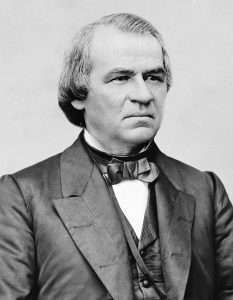
2/21/1868: President Johnson orders Secretary of War Edwin Stanton removed from office. In Myers v. U.S. (1926), the Supreme Court found that Johnson's actions were lawful.
The difficulties some cities are experiencing arise because many migrants aren't allowed to work, and because of restrictions on construction of new housing.

In recent months, many politicians and media outlets have focused on the "migrant crisis" in various cities, supposedly caused by the arrival of large numbers of asylum seekers. Many of these migrants cannot support themselves, and end up taking up shelter space or living on the streets. In a recent Atlantic article (unfortunately, paywalled), Jerusalem Demsas explains why the supposed crisis is in reality a product of flawed government policies, rather than migration, as such:
When the mayor of New York, of all places, warned that a recent influx of asylum seekers would destroy his city, something didn't add up.
"I said it last year when we had 15,000, and I'm telling you now at 110,000. The city we knew, we're about to lose," Eric Adams urged in September. By the end of the year, more than 150,000 migrants had arrived. Still, the mayor's apocalyptic prediction didn't square with New York's past experience. How could a city with more than 8 million residents, more than 3 million of whom are foreign-born, find itself overwhelmed by a much smaller number of newcomers?
In another legendary haven for immigrants, similar dynamics were playing out. Chicago has more than 500,000 foreign-born residents, about 20 percent of its population, but it has been straining to handle the arrival of just 35,000 asylum seekers in the past year and a half. Some people have even ended up on the floors of police stations or in public parks. Mayor Brandon Johnson joined Adams and a handful of other big-city mayors in signing a letter seeking help with the "large numbers of additional asylum seekers being brought to our cities."
Sometimes the best way to understand why something is going wrong is to look at what's going right. The asylum seekers from the border aren't the only outsiders in town. Russia's 2022 invasion of Ukraine brought a separate influx of displaced people into U.S. cities that quietly assimilated most of them. "We have at least 30,000 Ukrainian refugees in the city of Chicago, and no one has even noticed," Johnson told me in a recent interview.
According to New York officials, of about 30,000 Ukrainians who resettled there, very few ended up in shelters. By contrast, the city has scrambled to open nearly 200 emergency shelters to house asylees from the Southwest border.
What ensured the quiet assimilation of displaced Ukrainians? Why has the arrival of asylum seekers from Latin America been so different? And why have some cities managed to weather the so-called crisis without any outcry or political backlash? In interviews with mayors, other municipal officials, nonprofit leaders, and immigration lawyers in several states, I pieced together an answer stemming from two major differences in federal policy. First, the Biden administration admitted the Ukrainians under terms that allowed them to work right away. Second, the feds had a plan for where to place these newcomers. It included coordination with local governments, individual sponsors, and civil-society groups. The Biden administration did not leave Ukrainian newcomers vulnerable to the whims of Texas Governor Greg Abbott, who since April 2022 has transported 37,800 migrants to New York City, 31,400 to Chicago, and thousands more to other blue cities—in a successful bid to push the immigration debate rightward and advance the idea that immigrants are a burden on native-born people.
Demsas is largely right here. Ukrainians admitted under the Uniting for Ukraine (U4U) program have not caused any controversy in cities largely because they are allowed to immediately start working, and thereby can support themselves and contribute to our economy. By contrast, asylum seekers aren't eligible to apply for work permits for six months, and even then it often takes the federal immigration bureaucracy a long time to actually issue them.
What is true for Ukrainians is also true of Cubans, Nicaraguans, Venezuelans, and Haitians admitted under the "CNVH" program - an extension of the U4U model to a combine total 30,000 migrants per month fleeing oppression and violence in those four countries. Several hundred thousand people have entered the US under the CNVH program. But, like the Ukrainians, they have immediate work authorization, and therefore turn out to be an asset to cities, not a burden.
As Demsas explains, the federal government should abolish the six-month rule and let asylum-seekers work legally from day one. The Biden Administration has taken this step for many Venezuelans already in the US. But it needs to expand work authorization to other asylum seekers.
I do think Demsas gets one point wrong here. For the most part, it is not true that "the feds had a plan for where to place" U4U participants. The program requires each migrant to have a US sponsor. But, beyond that, the federal government makes little or no effort to control where and how they live.
I myself am a sponsor in the U4U program, and have advised other sponsors and migrants. Generally speaking, the migrants decide for themselves where they are going to settle in the US. Sponsors advise, but do not dictate. I now have eight Ukrainian sponsorees. To my knowledge, never once has a federal official attempted to plan where they live and work, or even offered advice on that subject.
Instead of planning and controlling, U4U mostly lets the market and civil society work. That, I think, is the real key to its success. While I don't myself have CNVH sponsorees, I know people who do; that program seems much the same.
Demsas also notes that, even when it comes to asylum seekers, the dfficulties encountered in New York and Chicago have largely been avoided in cities like Houston and Miami, even though the latter also have experienced recent influxes. What's the difference between these cases? I don't know for sure. But a major factor is likely that the cities with serious problems also tend to have highly restrictive zoning rules, which make it difficult or impossible to build housing in response to demand. I have previously noted this issue in the case of New York.
By contrast, Houston is famous for not having zoning at all (thereby making housing construction easy, and housing itself very affordable). And Miami is at least less restrictive than cities like New York and Chicago.
In New York, housing issues have been exacerbated by the city's ill-advised free shelter guarantee, which incentivizes both migrants and poor natives to seek out free housing at public expense. New York would be well-advised to end the guarantee, while simultaneously ending exclusionary zoning rules that block new housing construction.
It is also true, as Demsas notes, that Texas Gov. Greg Abbott's migrant busing program - which has heavily targeted New York and Chicago - has caused disruption in those cities:
When immigrants make their way to a city in an organic fashion, they usually are drawn to a place where they have family ties, job leads, or other connections and resources available….
That's very different from the haphazard Texas busing program. When Abbott's buses arrive at their destinations, many of them are filled with people who had specific plans to go somewhere else. Cities then re-ticket many of the passengers. The mayor of Denver told me that roughly 40 percent of asylees who are bused into his city have no intention of staying there.
Abbott should stop the busing program, and instead let migrants choose their own destinations and pay their own way. In addition to increasing the migrants' economic productivity (thereby boosting the US economy) and reducing disruption in New York and Chicago, it would also save Texas taxpayers money. The state has spent some $148 million busing migrants to other parts of the country.
In sum, the "migrant crisis" is largely caused by a combination of perverse federal, state, and local policies that bar asylum seekers from working legally, artificially restrict housing construction, and bus migrants to places other than where they actually want to go. Migrants who enter by programs that avoid these obstacles don't cause any crises. Indeed, they are actually assets to the economy. If governments want to end the "crisis," for the most part they need only get out of the way.
In Doe v. Jeancharles (M.D. Fla.), Doe is suing "alleging violations of the federal Trafficking Victims' Protection Reauthorization Act ('TVPRA'), violations of the Fair Labor Standards Act ('FLSA'), breach of contract," and related theories. The Complaint alleges that:
Dr. Jean-Charles targeted desperate and vulnerable Immigrant Medical Graduates ("IMG"), he lured them to work for JC Medical Center with the promise of compensation, experience, and a recommendation letter to help them "match" a residency program, he withheld payment or underpaid these vulnerable IMG's [including Doe], and has coerced them to work full-time hours seeing scores of patients.
But yesterday's decision by Magistrate Judge Robert Norway (M.D. Fla.) concludes that Doe had to sue under his own name:
Federal Rule of Civil Procedure 10(a) requires that "every pleading" in federal court "name all the parties." This rule "protects the public's legitimate interest in knowing all of the facts involved, including the identities of the parties." … A party may proceed anonymously or pseudonymously by establishing "a substantial privacy right which outweighs the 'customary and constitutionally-embedded presumption of openness in judicial proceedings.'" … The Eleventh Circuit has found that the "first step" [in this analysis] is to consider the three factors analyzed in Southern Methodist University Association of Women Law Students v. Wynne & Jaffe (5th Cir. 1979): "whether the party seeking anonymity (1) is challenging government activity; (2) would be compelled, absent anonymity, to disclose information of utmost intimacy; or (3) would be compelled, absent anonymity, to admit an intent to engage in illegal conduct and thus risk criminal prosecution."
Along with the SMU factors, the court should "carefully review all the circumstances of a given case and then decide whether the customary practice of disclosing the plaintiff's identity should yield to the plaintiff's privacy concerns." For example, the court may also consider "whether the plaintiffs were minors, whether they were threatened with violence or physical harm by proceeding in their own names, and whether their anonymity posed a unique threat of fundamental unfairness to the defendant." …
It was déjà vu, but this time post-Bruen.
The District of Columbia's ban on firearm magazines that hold over ten rounds was the subject of oral argument in the D.C. Circuit on February 13. The case is Hanson v. District of Columbia, and the appeal concerns the district court's denial of a preliminary injunction against enforcement of the ban. The circuit panel included Judges Patricia Millett ('13) and Justin Walker ('20), and Senior Judge Douglas Ginsburg ('86).
The argument should have turned on one, and only one, question: are the banned magazines commonly possessed by law-abiding citizens for lawful purposes? As Professor Mark W. Smith has explained, under District of Columbia v. Heller (2008) and N.Y. State Rifle & Pistol Ass'n v. Bruen (2022), that is the only relevant question in an arms ban case. See Smith, "What Part of 'In Common Use' Don't You Understand?" Harvard JLPP (2023). That is because the common use test is the product of the text first and then history approach the Supreme Court has applied in this context. In Heller, the Court examined the Second Amendment's language to determine that as a matter of plain text "arms" includes (but is not limited to) all firearms. It then examined history to determine that only dangerous and unusual firearms can be banned. It follows that citizens have a fundamental right to possess firearms that are in common use today, because if they are in common use, they cannot be "dangerous and unusual."
The answer to the common use question in this case is a resounding and unequivocal yes — there are hundreds of millions such magazines lawfully owned for lawful purposes by Americans today. By any measure, that's common possession. To be sure, magazines are not themselves firearms, but they are key components of all modern semiautomatic firearms, as they are the part of the firearm that holds and feeds the ammunition. And the practical effect of the magazine ban is to prohibit an entire category of firearms; i.e., firearms that are capable of firing more than 11 rounds (one in the chamber, 10 in the magazine) without reloading.
Instead, the oral argument was a bit of déjà vu all over again. In Heller, the Supreme Court held that firearms "in common use" for "lawful purposes like self-defense" may not be banned. After Heller, I was part of a team challenging D.C.'s ban on such magazines (as well as on semiautomatic rifles) in a case that came to be known as Heller II. In the D.C. Circuit, oral argument was conducted before Judge Douglas Ginsburg (yes, the same Judge Ginsburg) together with then-Judge Brett Kavanaugh and Judge Karen Henderson.
Did we get a hint to the outcome in one of this term's bigger cases at today's oral argument?
I was listening to the oral argument in Corner Post, Inc. v. Board of Governors of the Federal Reserve System today, and I was struck by the following exchange (from the transcript):
JUSTICE JACKSON: If I understand you correctly, each new company that is created in an industry can suddenly bring a challenge that might risk or undermine valid --invalidation of the entire basis of the industry, each new company, because you say each new company that's created can bring such a lawsuit. Now, whether or not it will succeed, I understand, but aren't you risking destabilization of the industry in this way?
MR. WEIR: We don't think so. We -- we think the experience in the Sixth Circuit is what you'll see. There --there was no uptick in challenges to old regulations in the Sixth Circuit, and we would have seen them there in the last --
JUSTICE JACKSON: Is --is that possible because we had other doctrines that prevented, so, you know, for example, Chevron existed and so there were lots of things that already --you know, right? Like, there are reasons why you might not have an uptick. I'm just wondering, in a world in which you could bring these actions, why wouldn't you have this problem?
MR. WEIR: Well, I --I think that because most regulations are --are valid, there's --there's no argument that they're unlawful. So you would --so you wouldn't see them. It's only the ones that have defects that you're going to see challenges to or potential defects.
Was this a suggestion that Chevron will no longer exist after this term? I suppose we will know by July.
UPDATE: I should have listened to the second-half of the argument before posting. Had I done so, I would have noted this question from Justice Kagan:
JUSTICE KAGAN: Mr. --Mr. Snyder, I want to emphasize that I'm asking you a hypothetical question. It's an "if" question. There is obviously another big challenge to the way courts review agency action before this Court. Has the --has the Justice Department and the agencies considered whether there is any interaction between these two challenges? And, again, you know, if Chevron were reinforced, were affirmed. If Chevron were reversed, how does that affect what you're talking about here?
Does this question make it more or less likely that Justice Jackson inadvertently disclosed Chevron's fate? Was Justice Kagan just being precise? Or was she covering for her colleague's gaffe? Again, time will tell.
Celebrate your independence with a subscription to Reason magazine, your most trusted source of honest, insightful news and analysis.




