The Volokh Conspiracy

Mostly law professors | Sometimes contrarian | Often libertarian | Always independent | Est. 2002

The Volokh Conspiracy

Free Speech

"Florida Woman Convicted of Civil Rights Conspiracy Targeting Pregnancy Resource Centers"

|

From a Justice Department statement, released Dec. 10 but just posted on Westlaw:

Gabriella Oropesa, of Cooper City, Florida, was convicted yesterday for her role in a conspiracy to injure, oppress, threaten or intimidate employees of pro-life pregnancy help centers in the free exercise of the right to provide and seek to provide reproductive health services. The defendant and her co-conspirators selected reproductive health facilities that provided and counseled alternatives to abortion and vandalized those facilities with threatening messages. Caleb Freestone, Amber Stewart-Smith and Annarella Rivera previously pleaded guilty for their participation in the conspiracy.

According to court documents and evidence presented at trial, between May 2022 and July 2022, Oropesa, Freestone, Smith-Stewart and Rivera engaged in a series of targeted attacks on pro-life pregnancy help centers in Florida. The defendants, in the dark of night and while wearing masks and dark clothing to obscure their identities, spray painted the facilities with threatening messages, including "If abortions aren't safe than niether [sic] are you," "YOUR TIME IS UP!!," "WE'RE COMING for U" and "We are everywhere."

Read More

Talking to the Justices About References

|

ABC News reports, "Supreme Court Justice Samuel Alito spoke to President-elect Donald Trump by phone Tuesday to recommend one of his former law clerks for a job in the new administration." ABC obtained a statement from Justice Alito to explain the context:

"William Levi, one of my former law clerks, asked me to take a call from President-elect Trump regarding his qualifications to serve in a government position," Justice Alito confirmed to ABC News Wednesday. "I agreed to discuss this matter with President-elect Trump, and he called me yesterday afternoon."

"We did not discuss the emergency application he filed today, and indeed, I was not even aware at the time of our conversation that such an application would be filed," Alito said. "We also did not discuss any other matter that is pending or might in the future come before the Supreme Court or any past Supreme Court decisions involving the President-elect."

I have a few thoughts on this story.

First, let's start with the byline: Katherine Faulders, Jonathan Karl, and Devin Dwyer. Dwyer is ABC News's Supreme Court Correspondent. Since he is listed last, I think it is safe to assume this was not his scoop. Karl is ABC News chief Washington. Again, if this was his scoop, I would think his name would come first. Faulders is a Senior Reporter at ABC News. I am not familiar with her work, but she has written many recent stories about the Trump cases. Given that her name came first, she was probably the person who obtain the information.

Second, how did Faulders obtain this information? Again, it is not clear that she has "sources" within the Supreme Court. And I can't even imagine who in the Court would have told her this! Justice Alito? Someone in the Alito chambers? This is unthinkable, especially after the Dobbs leak. The story provides very little information about the sourcing:

Supreme Court Justice Samuel Alito spoke to President-elect Donald Trump by phone Tuesday to recommend one of his former law clerks for a job in the new administration, ABC News has learned.

If the info did not come from the Court, the most likely source is from the other end of the call. No, I don't think President Trump spoke to Faulders. More likely? Trump told someone that he spoke to Alito, and that person told someone else, and that someone else told the press. Or maybe something like that happened.

Third, ABC News, and other outlets, are spinning this as President Trump talking to Alito shortly before Trump's emergency petition was filed. And Alito's comment says he wasn't aware that the petition had been filed when he took the call. It was safe to assume that Trump would go to the Supreme Court as soon as Judge Merchan scheduled the sentencing for Friday. But I don't think it would have mattered if Alito knew the petition was coming, or if Trump spoke to Alito after the petition was filed.

Fourth--and this may come as a shock--Judges are allowed to talk to parties in litigation about matters that do not concern litigation. It's true! The problem with ex parte communications is that a judge may disclose some information to only one party. But no cannon of ethics prevents a judge from having unrelated communications with someone who has an interest in the litigation. Judges are not hermits. Trust me, this happens all the time. And I think it often occurs in the context of job recommendations. I can prove it.

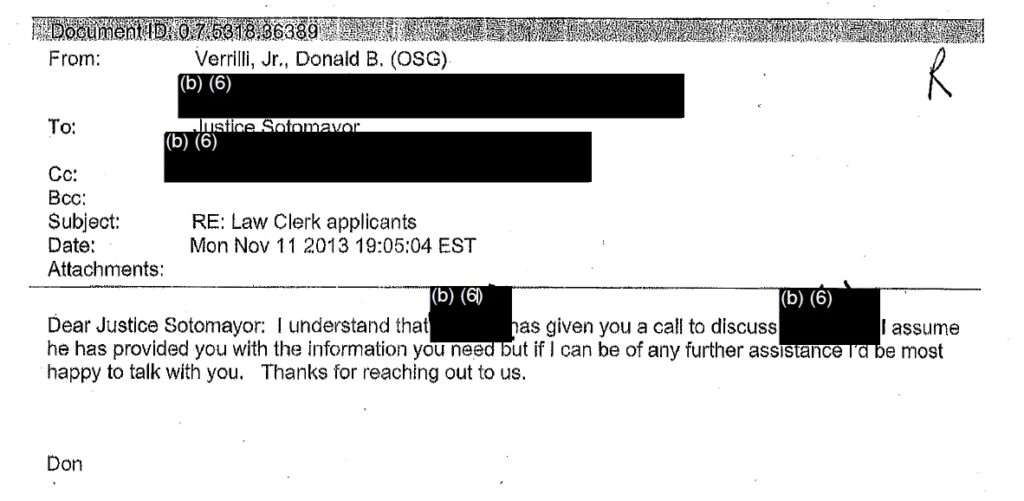
In 2016, Vice News used FOIA to obtain email correspondences between the Department of Justice and Supreme Court Justices. A November 2013 email was sent from Solicitor General Donald Verrilli to Justice Sotomayor about a law clerk applicant.

Dear Justice Sotomayor: I understand that [redacted] has given you a call to discuss [redacted]. I assume he has provided you with the information you need but if I can be of any further assistance I'd be most happy to talk with you. Thanks for reaching out to us.

To be clear, the Justice reached out to the SG about a potential law clerk, and the SG returned the message and offered to speak to the Justice.

At this very time, several very important cases filed by the SG were pending before the Supreme Court, including Noel Canning, Hobby Lobby, and more. Just one week earlier, Verrilli had argued Bond v. United States. This correspondence is not unique. I've studied the papers of many Justices. And they are replete with letters and correspondences with lawyers and parties involved in litigation. (I have in my files correspondences between Justice Brennan and Lawrence Tribe, who was a frequent litigant before the high court.) Is there any suggestion that it was inappropriate for a sitting Justice to talk to the top lawyer for the government about a job reference? Of course not. Why?

Fifth, with Trump, everything is different. The subtext of the ABC News article is that Trump was making the phone call for some illicit purpose--that he was trying to gain some influence on Justice Alito, or affect how he would rule in New York case. Is there any evidence of this? Of course not. What we are left with is yet another instance where Trump is denied the sort of customary privileges that are afforded to all other politicians. Trump can't even make a phone call to get a reference. As I recall, he was impeached based on a phone call. More of the same.

Update: Mollie Hemingway explains at The Federalist what should be obvious: the ethical guidelines expressly allow judges to receive calls from appointing authorities in the executive branch for references:

Federal judges and Supreme Court justices provide references for former clerks regularly, in the same way that other employers provide references for former employees regularly. Ethics guidelines for federal judges acknowledge this reality and mention how to handle such scenarios in the Published Ethics Advisory Opinions.

These guidelines say judges providing job references should not initiate contact with Congress or the White House, and should not respond to media requests in support or opposition of a nominee, but "there would be no impropriety in a judge answering an inquiry from a screening committee or appointing authority with respect to the judge's knowledge concerning the qualifications and other relevant factors of a nominee for appointment to any public office."

Will Levi is clearly in line for a presidential appointment. It was entirely proper for for Trump to call Levi's old boss, Justice Alito.

Immigration

The Laken Riley Act is Unjust - and a Trojan Horse

The act doesn't target violent criminals and sex offenders, and is likely to harm innocent people and divert resources from genuine anti-crime efforts. It also makes it easier for state governments to try to impede legal immigration.

|

AI-generated Image

Yesterday, the House of Representatives passed the Laken Riley Act (LRA), in a 264-159 vote. This legislation - named after a student killed by an undocumented immigrant - is often sold by proponents as a tool for combatting murderers and sex offenders. In reality, it focuses on detaining undocumented immigrants charged with theft-related crimes, including minor ones. It also includes a Trojan horse provision making it easier for states to challenge a variety of programs that make legal migration easier. These policies are unjust, and likely to impede genuine crime-fighting efforts more than they help them.

The main provision of the Laken Riley Act requires mandatory federal detention of any undocumented immigrant who "is charged with, is arrested for, is convicted of, admits having committed, or admits committing acts which constitute the essential elements of any burglary, theft, larceny, or shoplifting offense." Notice that the provision is triggered by a mere arrest or charge, and does not require any proof of guilt beyond that. Moreover, even the most minor forms of theft, burglary, or shoplifting qualify. If a migrant is arrested on suspicion of stealing a dime or a paperclip from a store, that's enough to trigger mandatory detention. Ditto if he or she is charged with even the most minor theft-related offense.

Pretrial detention is already overused, even when it comes to US citizens.  Forcibly detaining people who have never been tried or convicted of any crime is presumptively unjust, and should only be resorted to when it is the only way to prevent some grave threat to public safety, as in the case of suspected serial killers or terrorists.  The whole point of requiring trial and conviction before imprisoning people is to ensure that only those actually guilty of crimes are subject to such severe punishment. Making pretrial detention mandatory for a large population for arrests and charges for even the most minor theft-related crimes only makes the injustice worse.

Moreover, detention is expensive. Federal immigration detention currently costs an estimate $165 per day per detainee, and that doesn't count the costs of taking people out of the workforce. Those funds can be put to better crime-fighting use by, for example, putting more police on the streets, a strategy with demonstrated crime-reducing effects. Spending them on detention of migrants arrested or charged with even minor theft-related crimes is a waste. As my Cato Institute colleague and immigration policy expert David Bier notes, the first Trump administration's efforts to detain and deport nonviolent asylum seekers and undocumented immigrants predictably diverted resources from combating serious crime. If enacted, the Laken Riley Act will likely have a similar effect.

Moreover, the Laken Riley Act creates perverse incentives for state and local police and prosecutors. Normally, they are reluctant to arrest and charge people when there is little chance of securing a conviction. But under the LRA, a bogus arrest or indictment of an undocumented immigrant on a theft-related offense leads to mandatory detention paid for by the feds - not the state and local governments themselves. And such detention occurs even if the target is never convicted of anything. This could well incentivize officials with nativist sentiments (or those catering to such sentiments) to make dubious arrest and charging decisions. After all, the feds will foot the bill!

To be sure, a person suspected of even minor theft might, if released until trial, commit more serious crimes. Detaining such people will prevent at least a few more serious offenses. But by that reasoning, we should preemptively detain anyone who is suspected of even the most minor offense. There is always a small chance they might otherwise commit murder, rape, or assault.

For fairly obvious reasons, such preemptive mass detention would be gravely unjust. It would also actually undermine crime-fighting efforts by diverting resources from more effective strategies. And that is even more true for mass detention policies that target undocumented immigrants, who have significantly lower violent crime rates than native-born citizens.

Elsewhere, I have argued that migrants who commit crimes should get the same punishment as natives, not the more severe additional punishment of deportation. Governments can and should severely punish people who commit crimes of violence and theft.  But no one should get extra punishment merely because of an arbitrary circumstance of birth. That position is one of my more unpopular views. But even if you don't accept it anything like fully, you should at least consider whether it's just to have preemptive mass detention of undocumented migrants arrested or charged for very minor crimes - even in cases where the evidence against them is weak and the underlying crime would not normally result in a prison sentence upon conviction.

The LRA also includes a provision unrelated to any kind of violent crime or even theft, that gives state attorneys general standing to challenge in federal court any supposed violation of the requirement "that parole [for immigrants] solely be granted on a case-by-case basis and solely for urgent humanitarian reasons or a significant public benefit," so long  as the state or its residents suffer any "harm" as a result, "including financial harm in excess of $100."  There is a similar provision giving state AGs standing to challenge grants of other types of visas.

The goal of this provision is to make it easier for states to challenge federal programs that grant visas or parole (temporary legal entry, employment, and residency in the US), such as the Biden Administration CHNV program for people fleeing horrific violence and oppression in four Latin American nations (including three ruled by brutal socialist dictatorships). Last year, a conservative federal judge ruled against a lawsuit brought against the program by a coalition of red states, on the ground that the latter lacked standing due to not having suffered the requisite "harm" because of the program.

The LRA would make it much easier to get such standing. The requirement of $100 in financial harm can almost always be met, especially since the statute doesn't require a showing of net harmful effects. If a parole or visa program cost the state or one of its residents $101 on one occasion, that's enough, even if the state and its private sector actually derived large net benefits from the program, such as increased tax revenue and economic growth.

As a longtime critic of restrictive standing rules (at least as a constitutional matter), I am actually somewhat ambivalent about this provision. But, on balance, I oppose asymmetrical reduction in standing requirements that makes it easier for states to challenge federal policies that make legal migration easier, but not those that aim for the opposite effect. If we are going to reduce state standing requirements for challenges to immigration policies, we should at least do it for both sides.

It is possible that courts will strike down the standing provisions of the LRA. The Supreme Court has ruled (wrongly in my view) that "harm" and other standing requirements are constitutional rules that cannot be overridden by statute. If federal judges conclude that the LRA state standing rule lowers standing requirements below constitutional minimums (as defined by the courts), it might be invalidated.

Standing doctrine is vague and fuzzy enough that I'm honestly not sure what will happen if this issue gets to court. In recent years, the Supreme Court has been relatively restrictive on state standing, including in immigration cases. But the relevant precedent is far from a model of clarity.

In sum, the Laken Riley Act is unjust and likely to undermine efforts to combat serious crime. It also includes Trojan horse provisions intended to make it easier for state governments to pursue lawsuits to block various types of legal migration.

Energy & Environment

FERC Not Required to "Second Guess" State Energy Choices Under NEPA

The D.C. Circuit adopts a suitably constrained view of FERC's legal obligations when conducting environmental impact assessments.

|

Yesterday the U.S. Court of Appeals for the D.C. Circuit, in Citizens Action Coalition of Indiana v. FERC, rejected Citizens Actions claim that FERC had to consider alternatives to state-approved natural gas turbines before approving a natural gas pipeline. The opinion, written by Judge Rao, explains why such a requirement would impose far broader environmental review obligations than can be justified, and may represent a trimming of the D.C. Circuit's unduly expansive approach to NEPA (an approach currently under review by the Supreme Court in Seven County Infrastructure Coalition v. Eagle County, Colorado).

Here's how Judge Rao summarizes the opinion:

As night follows day, an environmental challenge follows the approval of a natural gas pipeline. In this case, the State of Indiana approved a plan that would retire a coal-fired facility and replace it with wind and solar energy sources. To ensure grid reliability with the move to renewable energy, the plan also included two new natural gas turbines. The Federal Energy Regulatory Commission approved a natural gas pipeline to serve those turbines. The Citizens Action Coalition of Indiana petitions for review, alleging that FERC's environmental analysis and order were unreasonable and inconsistent with the National Environmental Policy Act and the Natural Gas Act.

Citizens Action alleges numerous errors, but its core claim is that FERC was required to analyze non-gas alternatives before approving the natural gas pipeline. We disagree. Congress gave FERC authority to promote the development of interstate natural gas pipelines, but it left the choice of energy generation to the States. The purpose of the pipeline was to support Indiana's energy plan, and FERC has no statutory authority to consider non-gas alternatives already rejected by the State. Because FERC acted lawfully and reasonably when conducting the environmental analysis and assessing the public convenience and necessity for the pipeline, we deny the petition for review.

From later in the opinion:

In its first set of NEPA challenges, Citizens Action broadly argues that FERC should have assessed alternatives to natural gas, instead of focusing only on the mix of generation sources chosen by CenterPoint and the Indiana Commission. But NEPA does not require FERC to consider non-gas alternatives that are outside of FERC's jurisdiction and would fail to serve the purpose of the Project. We hold that FERC properly identified the Project's purpose as supporting CenterPoint's new natural gas units and reasonably considered alternatives that would satisfy that purpose.

The court also rejected other challenges, including claims that FERC was obligated to characterize predicted effects on greenhouse gas emissions, instead of merely reporting them in quantitative terms.

The opinion ends:

In its challenge to the Texas Gas Project, Citizens Action in effect seeks a judicial directive exhorting FERC to promote general environmental concerns. But such a directive would far exceed our review under the APA as well as FERC's authority under the NGA and NEPA. Congress charged FERC with the development of natural gas pipelines, not with making local energy decisions or setting national environmental policy. For the foregoing reasons, we deny the petition for review.

Of note, the opinion also included a footnote addressing the D.C. Circuit's recent decision (since taken for which there is a pending en banc petition) that the Council on Environmental Quality lacks the authority to adopt binding regulations governing NEPA review, noting that since FERC complied with CEQ's "guidance," making the question a non-issue for this case.

[Note: Post corrected as indicated. The en banc petition has not yet been granted.]

Guns

5th Cir. Says More on When Federal Ban on Gun Possession by Drug Users Is Unconstitutional

|

From Monday's U.S. v. Daniels decision, written by Fifth Circuit Judge Jerry Smith, joined by Judge Don Willett:

Title 18 U.S.C. § 922(g)(3) bars an individual from possessing a firearm if he is an "unlawful user" of a controlled substance. A jury found that Patrick Daniels, Jr., was such an unlawful user, and a judge sentenced him to nearly four years in prison. But the jury did not necessarily find that Daniels was intoxicated at the time of his arrest, nor did it identify the last time Daniels used an unlawful substance. So we reversed the conviction and held that § 922(g)(3), as applied to him, was inconsistent with the Second Amendment. The Supreme Court granted certiorari, vacated, and remanded for reconsideration in light of United States v. Rahimi (2024).

After Rahimi, this circuit heard a similar challenge to a prosecution brought under § 922(g)(3). In that case, United States v. Connelly, we held that the government could not constitutionally apply § 922(g)(3) to a defendant based solely on her "habitual or occasional drug use." That case controls this one. Because the jury did not necessarily find that Daniels was presently or even recently engaged in unlawful drug use, we reverse his conviction again and remand.

For more on Connelly, see this post. Monday's decision adds:

This is a closer case than Connelly because, unlike Connelly, this case went to trial, and the facts at trial seemed to reveal a defendant who was often intoxicated while transporting weapons. Daniels admitted to using marihuana roughly half the days of each month. Officers twice saw him with guns and marihuana in his truck. The marihuana in his truck was burnt, that is, used. When he was pulled over, he had a loaded handgun within arm's length and a loaded rifle in the back seat. If Connelly was an easy case because the defendant there merely used marihuana occasionally before bed while keeping a gun for home defense, this case is far less clear cut; all signs here point to a defendant's routinely driving around town while intoxicated with loaded guns in his car.

Read More

Free Speech

Defamation Lawsuit Over Statements Related to 2020 Georgia Ballot Counting Controversy Dismissed

The lawsuit is brought by Jacki Pick against Georgia Secretary of State Brad Raffensperger, based on statement in Raffensperger's book, Integrity Counts.

|

From Pick v. Raffensperger, decided Nov. 22 by Judge Eleanor Ross (N.D. Ga.), but only posted several days ago on Westlaw (an appeal is pending):

On November 3, 2020—election day—State Farm Arena in Atlanta, Georgia, served as a site for ballot counting. The ballot counting activity at State Farm Arena was recorded in an over 20-hour long Surveillance video ("Video"). After the 2020 election, Plaintiff (a licensed but non-practicing attorney) volunteered to "assist with election related matters in Georgia" and, in that capacity, "helped organize and summarize investigative facts and affidavits" from individuals alleging "potential or actual irregularities, misconduct, or fraud in the administration" of the election. Two of the affidavits Plaintiff assisted with were from individuals alleging irregularities in ballot processing at State Farm Arena.

On December 3, 2020, the Georgia State Senate Election Law Subcommittee held a hearing about the "alleged election irregularities, misconduct, or fraud in the 2020 election." Plaintiff attended the hearing and made a presentation using the Video. She did not show the Video in its entirety; rather, she "instructed the A/V tech multiple times to 'fast forward' or 'back up' to various times on the single video file[.]"

During her presentation, Plaintiff pointed to the ballot containers shown on the screen and said, "I'm going to call [the "containers for ballots"] a suitcase." Plaintiff, the only person to present the Video at the hearing, focused her presentation "solely on questions and potential irregularities that anyone could observe from the [V]ideo, matched to the statements in witness affidavits," and she raised "legitimate questions of why the ballots under the table were separate from the others and not coming from the same place that ballots had come from throughout the day."

In Integrity Counts, Defendant referred to the segments of the Video that Plaintiff showed during her presentation at the December 3, 2020 hearing as (1) "GIULIANI's SLICED-AND-DICED VIDEO," (2) "deceptively sliced and edited so that it appeared to show the exact opposite of reality," (3) "a slice of video that removed the clear evidence that Fulton County election works had protected the ballots and the process as required by law," (4) "chopped up," and "sliced and diced." Defendant allegedly also testified that the Video was "doctored" or "false." Plaintiff alleges that, through those statements, Defendant falsely accused Plaintiff of a crime under Georgia law—i.e., presenting misleading and false evidence to the Georgia legislature.

Read More

Free Speech

9th Cir. En Banc Upholds Oregon's Ban on Surreptitious Recordings of Conversations

|

An excerpt from yesterday's en banc decision, written by Judge Morgan Christen, in Project Veritas v. Schmidt (reversing the July 2023 panel decision); the full opinions are over 20,000 words long, so this just gives a flavor of the analysis:

Oregon's conversational privacy statute prohibits unannounced audio-only recordings of oral communications between two or more persons, and the audio portion of audiovisual recordings of oral communications. It does not address video-only recordings or photographs.

Oregon's general prohibition on unannounced recordings of face-to-face conversations has several exceptions, but Project Veritas focuses its challenge on two of them. The first, the felony exception, allows a person to "record[ ] a conversation during a felony that endangers human life." … The second, the law enforcement exception, allows a person to "record[ ] a conversation in which a law enforcement officer is a participant" if certain conditions are met. The recording must: (1) be "made while the officer is performing official duties"; (2) be "made openly and in plain view of the participants in the conversation"; (3) capture a conversation that is "audible to the person by normal unaided hearing"; and (4) be made from "a place where the person lawfully may be." …

The court concluded that the statute "regulates speech protected by the First Amendment":

It is well established that audio recordings and audiovisual recordings are generally entitled to First Amendment protection….The Supreme Court has recognized that "[w]hether government regulation applies to creating, distributing, or consuming speech makes no difference." Moreover, the Supreme Court has expressly applied First Amendment protections to speech-creation processes….

We do not suggest that any conduct related in some way to speech creation, however attenuated, is necessarily entitled to First Amendment protection. A law that regulates logging may incidentally raise the price of paper used to write a manuscript. A law that regulates mining silica sand may incidentally raise the price of microprocessors used to facilitate the writing of an electronic article. It is certainly not obvious that the First Amendment would invariably provide protection for activities like these, where burdens on speech are merely incidental….

[But a]t the pleading stage, we accept Project Veritas's assertion that giving notice to conversation participants that they are being recorded may alter the contents of conversations in which Project Veritas's reporters participate. Accordingly, we accept that Oregon's conversational privacy statute burdens an act of speech creation in which Project Veritas seeks to engage. Protection for this act of speech creation is implicit in any right Project Veritas has to publish the resulting recording….

But the court concluded that the Oregon statute was content-neutral:

Read More

Second Amendment Roundup: Supreme Court Considering Arms Ban Petitions on Friday

Whatever happened to long guns good, handguns bad?

|

The Supreme Court has distributed two important cases for its conference of January 10.  One is Snope v. Brown, which concerns whether Maryland may ban semiautomatic rifles that are in common use for lawful purposes.  The other is Ocean State Tactical v. Rhode Island, which asks whether a retrospective, confiscatory ban on the possession of ammunition feeding devices that are in common use violates the Second Amendment.

The Court should grant the petitions for writs of certiorari.  The cases present a critically important question going to the heart of the Second Amendment – may the government prohibit mere possession of AR-15s and similar semiautomatic rifles and of standard magazines that come with most semiautomatic rifles and pistols?

As I explained in my recent post "Firepower and the Fourth Circuit," Maryland's prohibition on AR-15s and the like rifles was upheld en banc on the merits under reasoning in direct conflict with the Supreme Court's precedents.  Likewise, the First Circuit's affirmance of the denial of a preliminary injunction against the Rhode Island ban follows the same trend by certain circuit courts flaunting even the most recent of the Court's rulings.

For most of the Nation's history, long guns – rifles and shotguns – were seen as good, while handguns were depicted by some as bad.  The muskets fired at Lexington and Concord became a symbol of American freedom.  Restrictions on the carrying of concealed pistols arose in the nineteenth century.  New York's Sullivan Law of 1911 required a permit just to keep a handgun in the home.  But as the New York court explained in People v. Raso (1958), "a rifle may be possessed in the home or carried openly upon the person on the street without violating any law," since in restricting concealed weapons, the legislature "carefully avoided including rifles because of the Federal constitutional provision and [NewYork's] Civil Rights law provision."  I personally heard Justice Scalia tell how, when he was on the high school rifle team, he carried his rifle on the New York subway.

The initial bill that became the National Firearms Act of 1934 listed pistols and revolvers first among the firearms that would be subject to registration.  Attorney General Homer Cummings depicted them as the ultimate gangster weapons, but they were removed from the Act as passed.

Repeating rifles with magazines holding numerous cartridges had been around since the mid-nineteenth century in the form of lever-actions.  Semiautomatic rifles with detachable magazines were on the market by the turn of the century.  Virtually no restrictions on either type were enacted.

Fast forward to District of Columbia v. Heller, in which the District's brief argued that its handgun ban "do[es] not disarm the District's citizens, who may still possess operational rifles and shotguns."  The law "continues to allow private home possession of shotguns and rifles, which some gun rights' proponents contend are actually the weapons of choice for home defense." Its amicus Violence Policy Center contended that "a wealth of evidence" shows that "in almost all situations 'shotguns and rifles are much more effective in stopping a [criminal].'"

Invalidating the handgun ban in Heller, the Supreme Court set forth principles that apply to both handguns and long guns.  First, "the Second Amendment extends, prima facie, to all instruments that constitute bearable arms, even those that were not in existence at the time of the founding."  Second, the Second Amendment protects arms that are "'in common use at the time' for lawful purposes like self-defense" and are "typically possessed by law-abiding citizens for lawful purposes."  Third, handguns as a class are protected by the Amendment and may not be banned; the Court did not need to mention that most handguns are semiautomatic.  Fourth, the Court suggested that "M-16 rifles and the like," i.e., fully automatic machineguns, and "sophisticated arms that are highly unusual in society at large" may be banned.

As its interpretative tools, Heller was based on text, which was informed by the original public understanding, and history, particularly the allowance from the Founding that the "carrying of dangerous and unusual weapons" could be restricted, but that arms could not be banned.  The Court rejected Justice Breyer's argument that the right could be eliminated based on judicial "interest balancing."

In response to the Heller decision, the District legalized handguns but banned numerous rifles it characterized as "assault weapons" together with "large capacity" magazines.  Given the above points from the Heller decision, we thought that a challenge to that ban would be a no-brainer, and brought the case that came to be known as Heller II.

In a 2-1 decision, the D.C. Circuit fully conceded that the banned rifles and magazines were commonly possessed in America, but upheld the ban under intermediate scrutiny, the very method of Justice Breyer that the Supreme Court rejected.  In "Reality Check," Georgetown Journal of Law & Public Policy, I explained how the factual record in the case refuted the unsworn claims by antigun lobbyists in the legislative record relied on by the court.  But the Heller II decision opened the Pandora's Box of intermediate scrutiny on which other circuits upheld semiautomatic rifle and magazine bans.

The silver lining in the cloud was then-Judge Brett Kavanaugh's dissenting opinion, which is a blueprint for how the Supreme Court should analyze similar rifle bans.  The opinion brilliantly exposits Heller's analytic method of text and history as well as traces the over-a-century history in which semiautomatic rifles with detachable magazines have been accepted by and are in common use by the American public.  Judge Kavanaugh anticipated what the Supreme Court empathically later held so clearly in Bruen – that the correct method begins and ends with text and history, and as Justice Thomas put it, intermediate scrutiny is "one step too many."

Now denied use of the term "intermediate scrutiny," the Fourth Circuit in Snope and the First Circuit in Ocean State Tactical continue to apply their own subjective judicial balancing tests in which the Second Amendment always loses.  The Snope court upheld Maryland's ban because supposedly the 9 mm cartridge, not the .223 caliber cartridge, is best for self-defense, oblivious to the fact that the ban is based on model and generic features, having nothing to do with caliber.  Yet even though the majority use .223 rounds, there are AR-15 type rifles designed to fire 9 mm rounds, and they too are banned based on their features.

Similarly, the Ocean State Tactical court decided that no evidence exists that magazines holding over ten rounds "are used in self-defense," and thus that banning them "imposes no meaningful burden" on the right to self-defense.  It wrote off what the people actually choose with the half-joke: "True, one could imagine Hollywood-inspired scenarios in which a homeowner would need to fend off a platoon of well-armed assailants without having to swap out magazines."

The Supreme Court should grant cert in these cases.  The courts of appeal that have upheld such bans openly flaunt the Court's jurisprudence.  It began after Heller, and it has now repeated itself after Bruen.  While the states with bans are outliers, their large populations represent a significant number of Americans whose rights are being trampled.

There is no circuit split because most states respect the Second Amendment and would not enact such bans.  The circuits that have upheld the bans appear to reflect the political judgments of at least some of the states under them.

The Snope litigants are represented by David Thompson (see cert petition) and the Ocean State litigants are represented by Paul Clement (see cert petition).  I've covered the topic at length in America's Rifle: The Case for the AR-15.

There are also two other worthy cases that are distributed for the Court's conference on January 10.  One is Gray v. Jennings, which seeks review of the Third Circuit's affirmance of the denial of a preliminary injunction against Delaware's ban on semiautomatic rifles.  The issue posed is "Whether the infringement of Second Amendment rights constitutes per se irreparable injury."  The other is Maryland Shall Issue v. Moore, which seeks review of Maryland's handgun license qualification requirement, which requires a redundant background check and duplicative waiting periods.


FLASHBACK: Glenn Greenwald: Pro-Israel sentiment in the U.S. is at least as bad for freedom of speech as Islamist terrorists murdering cartoonists

Greenwald's wild reaction to the Charlie Hebdo massacre ten years ago

|

My post from a decade ago is now behind a Washington Post paywall, but I reprint it below:

Apparently, the real lesson we should be learning from the murder of "blasphemous" French cartoonists is that American pro-Israel activists are at least as repressive as Islamist terrorists. That's because the former have purportedly created a "taboo" against criticizing Israel–a purported taboo, I should note, that Greenwald himself and many other bloggers, along with every major American newspaper and left-of-center journal, violate regularly, and one that somehow doesn't stop professors hostile to Israel from dominating Middle East Studies Departments in universities across the United States, such that the actual taboo in such departments is to express sympathy for Israel. Here's the money quote, which comes at the end of Greenwald's post:

That [criticizing Israel] is a real taboo – a repressed idea – as powerful and absolute as any in the United States, so much so that Brooks won't even acknowledge its existence. It's certainly more of a taboo in the U.S. than criticizing Muslims and Islams, which is in mainstream circles including the U.S. Congress – that one barely notices it any more. This underscores the key point: there are all sorts of ways ideas and viewpoints are suppressed in the west. When those demanding publication of these anti-Islam cartoons start demanding the affirmative publication ofthose ideas as well, I'll believe the sincerity of their very selective application of free speech principles. One can defend free speech without having to publish, let alone embrace, the offensive ideas being targeted. But if that's not the case, let's have equal application of this new principle.

The article is full of logical fallacies, and suggests that Greenwald doesn't understand why Charlie Hebdo was targeted (hint: it wasn't because of an allegedly offensive reference to Boko Haram's sex slaves), apparently doesn't understand what "blasphemy" means and certainly appears to believe that Der Sturmer-like anti-Semitic cartoons are the moral and logical equivalent of making fun of Moses or Muhammed. Put another way, what Greenwald is saying, in practice, is that until hostility to Israel becomes popular in the U.S., such that there is not even a prospect of social sanction for expressing it, and such that anti-Israel sentiment is expressed as often as Greenwald thinks it should be, pro-Israel advocates are at least as bad as Islamist terrorists. This, let's remember, is from a guy who many, including some of my libertarian friends, hold up as a poster boy for civil liberties. I can only imagine what other profound lesson Greenwald thinks we should draw from the murder by Islamist terrorists of four French Jews in a kosher supermarket in Paris today, but I'm guessing that it also has something to do with Israel.

Immigration

More on Birthright Citizenship and Undocumented Immigrants

Legal scholars Amanda Frost and Paul Gowder have both published notable new articles on the subject.

|

NA

The incoming Trump administration plans to deprive children of undocumented immigrants of birthright citizenship. As I explained in a recent article in Just Security, this would be a blatant violation of the Citizenship Clause of the Fourteenth Amendment, which grants citizenship to anyone "born … in the United States and subject to the jurisdiction thereof." There is no exception for children of illegal migrants. Legal scholars Amanda Frost (Univ. of Virginia) and Paul Gowder (Northwestern), have recently published excellent articles on the same topic: Frost in the Atlantic (there is a paywall), and Gowder in the UnPopulist. They effectively refute the various specious rationales offered for claims that children of undocumented immigrants aren't entitled to birthright citizenship because they are not "subject to the jurisdiction" of the US.

Among other things, they poke holes in the idea that these children aren't entitled to citizenship because their parents' entry into the US did not have "consent." I would add that nothing in the Citizenship Clause requires "consent," and that no real-world government genuinely enjoys the consent of the people it rules. Moreover, to the extent we care about consent, depriving children who have no other home of the right to live in the US would itself be an egregious nonconsensual exercise of government power.

In my Just Security article, I pointed out that denying birthright citizenship to the undocumented would in various ways go against the central objective of the Citizenship Clause which was to ensure citizenship rights for blacks denied them by the Supreme Court's ruling in the notorious Dred Scott case. Frost highlights another way in which this would be true:

In a recent law-review article, the legal scholars Gabriel Chin and Paul Finkelman explained that for decades, Africans were illegally brought to the United States as slaves even after Congress outlawed the international slave trade in 1808, making them the "illegal aliens" of their day. The nation was well aware of that problem. Government efforts to shut down the slave trade and deport illegally imported enslaved people were widely reported throughout the years leading up to the Civil War. Yet no one credible, then or now, would argue that the children of those slaves were to be excluded from the citizenship clause—a constitutional provision intended to overrule Dred Scott v. Sandford by giving U.S. citizenship to the 4.5 million Black people then living in the United States.

If children of people who entered the US illegally are not entitled to birthright citizenship, that logic would have applied to the children of illegally transported slaves.

There are many more good points in both articles. People interested in this issue should read both.

Parental Rights

Challenge to California Policy Limiting Teachers' Disclosure to Parents of Student's Changed Gender Identity …

can proceed (under the First Amendment and under parental constitutional rights law), the court says, though there's no actual decision on whether the plaintiffs (parents and teachers) will prevail.

|

From Mirabelli v. Olson, decided today by Judge Roger Benitez (S.D. Cal.), the introduction and the conclusion:

Plaintiffs are teachers in the Escondido Union School District ("EUSD") and parents of students in other California school districts…. The Plaintiffs contend that a state policy promulgated by the California Department of Education and adopted by local school districts violate their rights under the First and Fourteenth Amendments …. The gravamen of the state policy is that public school teachers are not to reveal to parents a student's announced change of gender identity in order to maintain the student's privacy, except where the student consents to disclosure….

It is still true that a request to change one's own name and pronouns may be the first visible sign that a child or adolescent may be dealing with issues that could lead to gender dysphoria or related health issues. Yet, for teachers, communicating to a parent the social transition of a school student to a new gender—by using preferred pronouns or incongruent dress—is not generally permitted under EUSD's and the State Defendants' policies.

The Supreme Court has long recognized that parents hold a federal constitutional Due Process right to direct the health care and education of their children. The Defendants stand on unprecedented and more recently created state law child rights to privacy and to be free from gender discrimination. These rights may compete when it comes to information about a child's expressed gender incongruence in a public school. Parents have a right to know about their child gender expression at school. And a child has a right to keep gender expressions private and to be protected from discrimination.

The Supreme Court and the Ninth Circuit have clearly and unambiguously declared parents' rights as they relate to their children…. "We have long recognized the potential conflict between the state's interest in protecting children from abusive or neglectful conditions and the right of the families it seeks to protect to be free of unconstitutional intrusion into the family unit, which can have its own potentially devastating and long lasting effects." …

There are no controlling decisions that would compel this Court to limit or infringe parental rights, notwithstanding the State's laudable goals of protecting children. This Court concludes that, in a collision of rights as between parents and child, the long-recognized federal constitutional rights of parents must eclipse the state rights of the child. Therefore, the Court finds that the Plaintiffs have stated plausible claims upon which relief can be granted and the motions to dismiss are denied.

The opinion is over 8000 words long, but here's an excerpt:

Read More

Free Speech

"FIRE to Defend Veteran Pollster J. Ann Selzer in Trump Lawsuit over Outlier Election Poll"

|

Just saw this announcement from FIRE; very glad to hear it. I copy below my explanation from Dec. 18 for why I think Trump's claim is unsound.

[* * *]

[The] Complaint in this case essentially alleges that pollster Ann Selzer's Nov. 2 poll for the Des Moines Register, which showed Harris ahead in Iowa by 3 points, was deceptive to consumers and thus violated Iowa consumer fraud law:

62. President Trump, together with all Iowa and American voters, is a "consumer" within the meaning of the statute.

63. Defendants furnished "merchandise" to consumers within the broad meaning of the statute since they provided a service: physical newspapers, online newspapers, and other content that contained the Harris Poll.

64. Defendants engaged in "deception" because the Harris Poll was "likely to mislead a substantial number of consumers as to a material fact or facts," to wit: the actual position of the respective candidates in the Iowa Presidential race.

65. Defendants engaged in an "unfair act or practice" because the publication and release of the Harris Poll "cause[d] substantial, unavoidable injury to consumers that [was] not outweighed by any consumer or competitive benefits which the practice produced," to wit: consumers, including Plaintiff, were badly deceived and misled as to the actual position of the respective candidates in the Iowa Presidential race. Moreover, President Trump, the Trump 2024 Campaign, and other Republicans were forced to divert enormous campaign and financial resources to Iowa based on the deceptive Harris Poll. Consumers within Iowa who paid for subscriptions to the Des Moines Register or who otherwise purchased the publication were also badly deceived. Additionally, Iowans who contributed to the Trump 2024 Campaign were similarly deceived.

Read More

More