The Volokh Conspiracy

Mostly law professors | Sometimes contrarian | Often libertarian | Always independent | Est. 2002

The Volokh Conspiracy

President Trump's Executive Order on the Death Penalty

|

I have not seen much press about President Trump's order concerning the death penalty. But several provisions could prove to be quite significant.

First, Trump has ordered that the murderers with commuted sentence be placed in "appropriate" conditions:

The Attorney General shall evaluate the places of imprisonment and conditions of confinement for each of the 37 murderers whose Federal death sentences were commuted by President Biden, and the Attorney General shall take all lawful and appropriate action to ensure that these offenders are imprisoned in conditions consistent with the monstrosity of their crimes and the threats they pose.

I suspect any change of conditions will give rise to an Eighth Amendment condition of confinement challenge. (See Point #4 below on whether these cases will succeed.)

Second, Trump has directed the Attorney General to refer federal inmates for state prosecution. Remember, there is no statute of limitation for murder, and states remain free to punish defendants who had their federal sentences commuted.

The Attorney General shall further evaluate whether these offenders can be charged with State capital crimes and shall recommend appropriate action to state and local authorities.

There is an obvious case to refer. John Fitzgerald Hanson is serving a life sentence in federal prison in Louisiana. He was also sentenced to death in Oklahoma for two murders. In 2022, the Oklahoma Court of Criminal Appeals scheduled Hanson's execution for December of that year, but the Federal Bureau of Prisons refused to transfer him to the custody of the state because they found it was "not in the public interest." President Trump should permit the transfer of Hanson so the execution can be carried out.

There are also the strange cases of Shannon Agofsky and Len Davis. These death row inmates received commutations from President Biden, but have apparently refused to accept them. Indeed, they filed suit in the Southern District of Indiana to enjoin the commutations (Agofsky v. United States, No. 2:25-cv-00001; Davis v. United States, No. 2:25-cv-00002). On January 17, the District Court denied the preliminary injunction. The judge found that "The Supreme Court decided nearly one hundred years ago that an inmate need not consent to a commutation, and that decision remains good law." Biddle v. Perovich (1927) stated:

When granted it is the determination of the ultimate authority that the public welfare will be better served by inflicting less than what the judgment fixed. See Ex parte Grossman, 267 U.S. 87, 120, 121. Just as the original punishment would be imposed without regard to the prisoner's consent and in the teeth of his will, whether he liked it or not, the public welfare, not his consent, determines what shall be done. So far as a pardon legitimately cuts down a penalty, it affects the judgment imposing it

It isn't clear if there is anything that Trump can do here.

Third, Trump ordered the AG to provide states with the execution drugs:

Sec. 4. Preserving Capital Punishment in the States. (a) The Attorney General shall take all necessary and lawful action to ensure that each state that allows capital punishment has a sufficient supply of drugs needed to carry out lethal injection.

Many states have had trouble obtaining these drugs. Now the federal government will provide the states with what they'll need.

Fourth, saving the best for last, the President urges the AG to challenge Supreme Court precedents on the death penalty!

Sec. 5. Seeking The Overruling of Supreme Court Precedents That Hinder Capital Punishment. The Attorney General shall take all appropriate action to seek the overruling of Supreme Court precedents that limit the authority of State and Federal governments to impose capital punishment.

If there is any area of the law where stare decsisis has the weakest force, it is the Eighth Amendment. The "evolving standards" test is by design is inconsistent with original meaning. I think the Court's current conservatives will be lock solid on this issue. Well, at least five of them. Justice Barrett joined the liberals in a 2022 death penalty case from Alabama. And Barrett has shown a stronger affinity for stare decisis. But we can see challenges to the Court's jurisprudence.
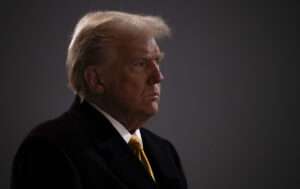
President Trump Comments on President Biden's Pardons: "An Unbelievable Precedent"

"Well I guess now I have precedent to do it, but I don't want to do it..."

|

Shortly after the inauguration, I observed that President Biden and his supporters would soon come to regret the Eleventh Hour pardons.

Monday evening, around 8:20 p.m., President Trump delivered these remarks about the pardons in the Oval Office (my transcription):

Trump: I was a little bit surprised he did it. It makes them look guilty. He will have to live with that. Now with that being said, it sets an unbelievable precedent, it creates poor precedent. But the precedent is unbelievable. Now maybe every president who leaves office they are going to pardon every person they ever met so they don't have some lunatic like deranged Jack Smith, whose a total lunatic by the way, not a smart guy, he's a dummy, but we beat the hell out of him. And I helped my reputation.

Question: Do you think you are going to have to do the same thing at the end of this

Trump: Well I guess now I have precedent to do it, but I don't want to do it, it makes you look very guilty. It makes Biden look very bad, very weak, very guilty.

What goes around comes around.

Short Thoughts on Several Of President Trump's Executive Actions

|

I have now reviewed each of the new presidential actions signed by President Trump. Here, I will offer some short thoughts on some of the lower-profile orders. I'll address several of the more significant actions in different posts.

First, a common theme in the orders was a focus on protecting American values and ideals. The order reforming the hiring process for government service provides:

(b) This Federal Hiring Plan shall:

(i) prioritize recruitment of individuals committed to improving the efficiency of the Federal government, passionate about the ideals of our American republic, and committed to upholding the rule of law and the United States Constitution;

I suspect some applicants for federal employment will bring a First Amendment challenge. Is there some objective "ideal of our American republic"?

Second, the order ending DEI program anticipates that the Biden Administration simply renamed DEI programs after the election to avoid being cut. The President asks for programs that have been "misleadingly relabeled."

(A)  agency or department DEI, DEIA, or "environmental justice" positions, committees, programs, services, activities, budgets, and expenditures in existence on November 4, 2024, and an assessment of whether these positions, committees, programs, services, activities, budgets, and expenditures have been misleadingly relabeled in an attempt to preserve their pre-November 4, 2024 function;

The President also requests a list of:

(B)  Federal contractors who have provided DEI training or DEI training materials to agency or department employees; and

(C)  Federal grantees who received Federal funding to provide or advance DEI, DEIA, or "environmental justice" programs, services, or activities since January 20, 2021.

I wonder if the Trump Administration will investigate these grants, and perhaps attempt to claw back some of the funding.

Third, the gender ideology order seems to undermine a core tenet of Bostock:

(a)  "Sex" shall refer to an individual's immutable biological classification as either male or female.  "Sex" is not a synonym for and does not include the concept of "gender identity."

To be clear, Justice Gorsuch did not actually conclude that "gender identity" was equivalent to "sex." Gorsuch accepted, at least begrudgingly, the concept of biological sex. Rather, Bostock was premised on applying the but-for test to Title VII. I never found this standard persuasive, but that was in the past. Given this new order, I don't see how the Solicitor General maintains the government's position in Skrmetti. We should expect a new brief from the SG shortly. Let's see if the Court appoints an amicus to defend the government's prior position, or simply dismisses the case altogether.

The order also rejects the Biden Administration's extension of Bostock to Title IX.

(f) The prior Administration argued that the Supreme Court's decision in Bostock v. Clayton County (2020), which addressed Title VII of the Civil Rights Act of 1964, requires gender identity-based access to single-sex spaces under, for example, Title IX of the Educational Amendments Act. This position is legally untenable and has harmed women. The Attorney General shall therefore immediately issue guidance to agencies to correct the misapplication of the Supreme Court's decision in Bostock v. Clayton County (2020) to sex-based distinctions in agency activities. In addition, the Attorney General shall issue guidance and assist agencies in protecting sex-based distinctions, which are explicitly permitted under Constitutional and statutory precedent.

I have not seen an order, yet at least, reversing the extension of Bostock to the Affordable Care Act. This Biden-era policy would require religious hospitals to perform transition surgeries. I suspect Trump will nix that policy.

Fourth, the order concerning Alaska denies a request for an "indigenous sacred site."

(xx)     deny the pending request to the United States Fish and Wildlife Service to an establish indigenous sacred site in the Coastal Plain of the Arctic National Wildlife Refuge;

No obvious justification is given for this denial. I don't know if there is a RFRA claim here. The Court has now relisted Apache Stronghold four times, so there may be a dissental in the works, probably from Justice Gorsuch. Dissenting about a denial of religious liberty for Indians is peak Gorsuch.

Fifth, Trump has determined that members of the Senior Executive Service must be removable at will:

The President's power to remove subordinates is a core part of the Executive power vested by Article II of the Constitution and is necessary for the President to perform his duty to "take Care that the Laws be faithfully executed." Because SES officials wield significant governmental authority, they must serve at the pleasure of the President.

Only that chain of responsibility ensures that SES officials are properly accountable to the President and the American people. If career SES officials fail to faithfully fulfill their duties to advance the needs, policies, and goals of the United States, the President must be able to rectify the situation and ensure that the entire Executive Branch faithfully executes the law. For instance, SES officials who engage in unauthorized disclosure of Executive Branch deliberations, violate the constitutional rights of Americans, refuse to implement policy priorities, or perform their duties inefficiently or negligently should be held accountable.

And Trump has called for the abolition of the current Executive Resources Board, and replace them with a majority of political appointees.

(d) Each agency head should terminate its existing Executive Resources Board (ERB), institute a new or interim ERB, and assign senior noncareer officials to chair and serve on the board as a majority alongside career members;

SES members who do not follow the Administration's priorities are to be removed:

(f)  Any agency head who becomes aware of an SES official whose performance or continued occupancy of the position is inconsistent with either the principles reaffirmed in this Order or their duties to the Nation under section 3131 of title 5, United States Code, shall immediately take all appropriate actions, up to and including removal of that official, with the support of OPM and OMB.  Restoring an accountable government workforce is a top priority of my Administration.

Sixth, President Trump ordered the revocation of John Bolton's security clearance, in part, due to Bolton's book:

National security is also damaged by the publication of classified information. Former National Security Advisor John R. Bolton published a memoir for monetary gain after he was terminated from his White House position in 2019. The book was rife with sensitive information drawn from his time in government. The memoir's reckless treatment of sensitive information undermined the ability of future presidents to request and obtain candid advice on matters of national security from their staff. Publication also created a grave risk that classified material was publicly exposed.

To remedy these abuses of the public trust, this Order directs the revocation of any active or current security clearances held by: (i) the former intelligence officials who engaged in misleading and inappropriate political coordination with the 2020 Biden presidential campaign; and (ii) John R. Bolton.

Sec. 2. Policy. (a) It is the policy of the United States to ensure that the Intelligence Community not be engaged in partisan politics or otherwise used by a U.S. political campaign for electioneering purposes. The term "Intelligence Community" has the meaning given the term in section 3003 of title 50, United States Code.

In the abstract, denying someone a governmental benefit due to their protected speech would violate the First Amendment. But there is a longstanding protocol in which people with security clearances must submit their books for pre-publication review. The argument is that people given this access to classified information surrender some of their First Amendment rights. Look for Bolton to file suit. As best as I can tell, he did not receive a pardon.

I will develop some of the other orders in future posts.

Time to Impeach Yet?

On pardoning the January 6 rioters.

|

Reading The Debates in the Several State Conventions (as one does), I see the following:

Mr. GEORGE MASON: . . . You will please, says he, to recollect that removal from office, and future disqualification to hold any office, are the only consequences of conviction on impeachment. Now, I conceive that the President ought not to have the power of pardoning, because he may frequently pardon crimes which were advised by himself. It may happen, at some future day, that he will establish a monarchy, and destroy the republic. If he has the power of granting pardons before indictment, or conviction, may he not stop inquiry and prevent detection? The case of treason ought, at least, to be excepted. This is a weighty objection with me.

. . .

Mr. MADISON, adverting to Mr. Mason's objection to the President's power of pardoning, said . . . [t]here is one security in this case to which gentlemen may not have adverted: if the President be connected, in any suspicious manner, with any person, and there be grounds to believe he will shelter him, the House of Representatives can impeach him; they can remove him if found guilty; they can suspend him when suspected, and the power will devolve on the Vice-President. Should he be suspected, also, he may likewise be suspended till he be impeached and removed, and the legislature may make a temporary appointment. This is a great security.

Since "a grave national injustice . . . has been perpetrated upon the American people," is anyone already keeping a list of impeachment-worthy offenses?

Free Speech

Executive Order Apparently Promises No Enforcement of TikTok Ban for 75 Days

|

An excerpt from the order, which appears not to be the sort of 90-day extension contemplated by the Tiktok divestiture statute itself, but rather appears to be the exercise of the Executive Branch's enforcement discretion:

I have the unique constitutional responsibility for the national security of the United States, the conduct of foreign policy, and other vital executive functions. To fulfill those responsibilities, I intend to consult with my advisors, including the heads of relevant departments and agencies on the national security concerns posed by TikTok, and to pursue a resolution that protects national security while saving a platform used by 170 million Americans. My Administration must also review sensitive intelligence related to those concerns and evaluate the sufficiency of mitigation measures TikTok has taken to date.

The unfortunate timing of section 2(a) of the Act — one day before I took office as the 47th President of the United States — interferes with my ability to assess the national security and foreign policy implications of the Act's prohibitions before they take effect. This timing also interferes with my ability to negotiate a resolution to avoid an abrupt shutdown of the TikTok platform while addressing national security concerns.

Accordingly, I am instructing the Attorney General not to take any action to enforce the Act for a period of 75 days from today to allow my Administration an opportunity to determine the appropriate course forward in an orderly way that protects national security while avoiding an abrupt shutdown of a communications platform used by millions of Americans…. In light of this direction, even after the expiration of the above-specified period, the Department of Justice shall not take any action to enforce the Act or impose any penalties against any entity for any conduct that occurred during the above-specified period or any period prior to the issuance of this order, including the period of time from January 19, 2025, to the signing of this order….

Read More

President Trump's "Weaponization" Executive Order

|

President Trump signed another executive order, titled "Ending the Weaponization of the Federal Government." It provides, in part:

The prior administration and allies throughout the country engaged in an unprecedented, third-world weaponization of prosecutorial power to upend the democratic process. It targeted individuals who voiced opposition to the prior administration's policies with numerous Federal investigations and politically motivated funding revocations, which cost Americans access to needed services. The Department of Justice even jailed an individual for posting a political meme. And while the Department of Justice has ruthlessly prosecuted more than 1,500 individuals associated with January 6, and simultaneously dropped nearly all cases against BLM rioters.

The order instructs the Attorney General to investigate actions taken by DOJ, the SEC, the FTC, and recommend "appropriate remedial action."

The Attorney General, in consultation with the heads of all departments and agencies of the United States, shall take appropriate action to review the activities of all departments and agencies exercising civil or criminal enforcement authority of the United States, including, but not limited to, the Department of Justice, the Securities and Exchange Commission, and the Federal Trade Commission, over the last 4 years and identify any instances where a department's or agency's conduct appears to have been contrary to the purposes and policies of this order, and prepare a report to be submitted to the President, through the Deputy Chief of Staff for Policy and the Counsel to the President, with recommendations for appropriate remedial actions to be taken to fulfill the purposes and policies of this order.

It does not seem that President Biden gave a pardon to Jack Smith. Or maybe Smith and his team refused to accept pardons.

Smith's work can also be tested under the False Claims Act. If Jack Smith was not in fact holding a lawful position, then he submitted false claims to the federal government. And I think the forum for such a suit would be Fort Pierce. Whether or not private relators are appointed in violation of the Appointments Clause, the United States could bring suit. I do not know if Smith submitted any claims to the state of Florida, perhaps for travel or security concerns. Those claims could also trigger the Florida False Claims Act.

Murthy v. Missouri, Redux

|

President Trump has already signed a slew of executive orders. One is titled "Restoring Freedom of Speech and Ending Federal Censorship." The order provides, in part:

The First Amendment to the United States Constitution, an amendment essential to the success of our Republic, enshrines the right of the American people to speak freely in the public square without Government interference. Over the last 4 years, the previous administration trampled free speech rights by censoring Americans' speech on online platforms, often by exerting substantial coercive pressure on third parties, such as social media companies, to moderate, deplatform, or otherwise suppress speech that the Federal Government did not approve. Under the guise of combatting "misinformation," "disinformation," and "malinformation," the Federal Government infringed on the constitutionally protected speech rights of American citizens across the United States in a manner that advanced the Government's preferred narrative about significant matters of public debate. Government censorship of speech is intolerable in a free society.

And there is a directive to the Attorney General:

The Attorney General, in consultation with the heads of executive departments and agencies, shall investigate the activities of the Federal Government over the last 4 years that are inconsistent with the purposes and policies of this order and prepare a report to be submitted to the President, through the Deputy Chief of Staff for Policy, with recommendations for appropriate remedial actions to be taken based on the findings of the report.

Murthy v. Missouri did not reach the merits. This issue may be adjudicated in a different forum.

The DOGE Race to the Courthouse

Docket Numbers 164, 165, 166, and 167.

|

It is inauguration day. That means it is time to sue an entity that doesn't yet exist! According to Lawfare, four separate suits were filed to stop DOGE. But who was first in the race to the Courthouse? We can tell based on the docket numbers.

Docket 1:25-cv-164 was brought by Public Citizen, State Democracy Defenders Fund, and the American Federation of Government Employees.

Docket 1:25-cv-165 was brought by the Center for Biological Diversity.

Docket 1:25-cv-166 was brought by National Security Counselors.

Docket 1:25-cv-167 was brought by American Public Health Association, American Federation of Teachers, Minority Veterans of America, Votevets Action Fund, The Center for Auto Safety, and Citizens for Responsibility and Ethics in Washington.

Let's see which judges receives these four cases.

As of yet, no suit based on the Emoluments Clauses. It's coming.

The 1st and 47th President On Being Saved From A Bullet By Providence

|

George Washington, letter to John A. Washington (July 18, 1755)

By the all-powerful dispensations of Providence, I have been protected beyond all human probability and expectation; for I had four bullets through my coat, and two horses shot under me, yet escaped unhurt, altho' death was levelling my companions on every side.

President George Washington's First Inaugural Address (April 30, 1789)

No people can be bound to acknowledge and adore the Invisible Hand which conducts the affairs of men more than those of the United States. Every step by which they have advanced to the character of an independent nation seems to have been distinguished by some token of providential agency.

President George Washington, letter to Samuel Langdon (September 28, 1789)

The man must be bad indeed who can look upon the events of the American Revolution without feeling the warmest gratitude towards the great Author of the Universe whose divine interposition was so frequently manifested in our behalf—And it is my earnest prayer that we may so conduct ourselves as to merit a continuance of those blessings with which we have hitherto been favoured. I am Sir, with great esteem Your most obedt Servt.

President Donald Trump's Second Inaugural Address (January 20, 2025)

Just a few months ago, in that beautiful Pennsylvania field, an assassin's bullet ripped through my ear. But I felt then, and believe even more so now, that my life was saved for a reason. I was saved by God to make America great again.

From My 'Commonplace Book,' No. 9: Thomas Mann, Richard Wagner, and Adolf Hitler

There's nothing like a look back at Germany in the 1930s to help us appreciate that things are not as bad as they could be

|

In  February 1933, just a few weeks after Adolf Hitler was named Chancellor of Germany, the novelist Thomas Mann gave a lecture at the University of Munich on "The Sorrows and Grandeur of Richard Wagner" (based on an essay of the same name that was to appear shortly thereafter in a Berlin arts journal).[FN1]  Mann, who was by then a major figure – possibly the major figure – in the German arts and literature community (and winner of the 1929 Nobel Prize in Literature), adored Wagner's operas, as the essay makes abundantly clear:

"A passion for Wagner's enchanted oeuvre has been a part of my life ever since I first became aware of it and set out to invest it with understanding. What it has given me in terms of enjoyment and understanding I can never forget . . . My curiosity about it has never flagged, and I never tire of listening to it, admiring it, following it . . ."

Much of the essay is similarly admiring, if not downright adulatory: Wagner's work was "elevated . . . far above the intellectual level of all previous forms of music drama"; his operas were "brilliant accomplishments .  . . never before had such complex thoughts, such convoluted emotions, been sung or put into singable form"; Wagner was "one of those musicians who can persuade even the unmusical to listen to music . . . the man who redeemed opera through myth, without peer in his mental affinity with this other world of images and ideas, without peer in his ability to evoke myth and infuse it with new life"; his music "is, in a word, heavenly – and one uses the word without embarrassment, gushing though it may be, in the knowledge that music alone can elicit such an epithet . . . Music such as that which accompanies Siegfried's Rhine Journey, or the lament for the slain hero [in Wagner's Ring of the Nibelungen] had never before been heard. . . .  It is hard to speak of these things when words are all one has to evoke them . . ."

Admiring and adulatory, but not, in Munich in 1933, admiring and adulatory enough. Read More

Immigration

Trump's Illegal First-Day Executive Actions

Several of his announced actions are likely to be illegal, especially some related to immigration.

|

President-elect Donald Trump at the Notre-Dame de Paris cathedral
Donald Trump. (Abaca Press/Blondet Eliot/Sipa USA/Newscom)


Donald Trump announced today a wide range of planned executive orders and other actions. Several of them are dangerous and illegal abuses of power. This post is a nonexhaustive list, focusing primarily on issues where I have some expertise, and (in many cases) I have written about them previously.

1. Denying birthright citizenship to children of undocumented immigrants.

This is blatantly unconstitutional.  Section 1 of the 14th Amendment grants citizenship to anyone "born … in the United States and subject to the jurisdiction thereof." There is no exception for children of illegal migrants. I go over the relevant issues in detail in a recent Just Security article, where I also address various specious arguments to the effect that children of undocumented immigrants aren't covered because their parents are not "subject to the jurisdiction" of the US. I think it highly likely that courts will strike down this action, as the text and original meaning are clear, longstanding Supreme Court precedent points in the same direction, and there is broad (though not quite universal) cross-ideological agreement on the subject among legal scholars.

2. Using the Alien Enemies Act of 1798 as a tool of mass deportation.

The Alien Enemies Act of 1798 is a component of the notorious Alien and Sedition Acts. It is the only part of that legislation that remains on the books today. The Alien Enemies Act allows detention and removal of migrants only when there "is a declared war between the United States and any foreign nation or government, or any invasion or predatory incursion is perpetrated, attempted, or threatened against the territory of the United States by any foreign nation or government." In that event, the president is given the power to detain or remove "all natives, citizens, denizens, or subjects of the hostile nation or government, being of the age of fourteen years and upward, who shall be within the United States and not actually naturalized."

As I explained in this article, the Alien Enemies Act cannot be used in our current situation because we are not in a "declared war" with any foreign nation, and there also is no "invasion or predatory incursion is perpetrated, attempted, or threatened against the territory of the United States by any foreign nation or government." My article also explains why illegal migration and cross-border drug-smuggling do not qualify as "invasion" and certainly not as an invasion by a "hostile nation or government." For more on why illegal migration and drug smuggling do not qualify as "invasion" and why a contrary ruling would set a dangerous precedent, see my March 2024 Lawfare article on this subject.

If Trump is able to use the Alien Enemies Act, notice that it would allow detention and deportation even of legal immigrants (so long as they have not yet been naturalized).

I think there is a good chance courts will rule against Trump on this issue, because the legal case against his position is very strong. But there is a risk that judges might conclude (wrongly) that the meaning of "invasion" is a "political question" that courts are not allowed to address.

3. Declaring a national emergency at the southern border.

The purpose of this is, presumably, to allow the use of the military for border enforcement, and to divert various military funds for that purpose. In my view, this is illegal for the same reason it was when Trump tried to do the same thing in 2019, in order to facilitate diversion of military funds to build his border wall. An emergency is a sudden, unexpected crisis, not an ongoing policy issue on which the president wants to redirect resources in ways not authorized by Congress:

If the president can declare an emergency and tap a vast range of special emergency powers anytime he wants for any reason he wants, that makes a hash of the whole concept of an emergency, raises serious constitutional problems, and creates a dangerous concentration of power in the hands of a single person.

It makes much more sense to interpret the National Emergencies Act as only allowing an emergency declaration in a situation where an emergency actually exists - defined as some sudden crisis that cannot be addressed swiftly enough through ordinary political processes. By that interpretation, the situation at the border doesn't even come close to qualifying.

There is no sudden crisis at the border right now. In fact illegal entries are down to their lowest level since August 2020, when the rate was unusually low due to the Covid pandemic. What remains is an ongoing policy issue, on which there is longstanding disagreement. In my view, the best way to address it is to make legal immigration easier. But those who disagree cannot get around using ordinary legislative processes by invoking an "emergency."

On this issue, I am much less confident about what courts might do than on 1 and 2 above. I fear that judges might (incorrectly) defer to the the president on the issue of whether an emergency exists.

Even if Trump prevails on the issue of whether he can declare an emergency, the specific actions he might want to adopt as a result might be illegal for other reasons, as was his attempted border wall funding diversion in 2019.

4. Declaring a national energy emergency.

I have the same objection to this as to the border wall emergency: There is no sudden crisis here, only an ongoing longterm policy issue. US energy production has greatly increased over the last several years, and prices have fallen since the inflation of 2021-23. I know much less about energy policy than border policy, so it is possible there is an angle I am missing here.

5. Designating Latin American drug cartels as terrorist organizations.

Terrorists are people who target civilians to further political causes. Drug cartels and gangs also sometimes resort to violence. But it's to protect and enhance their role in illegal markets. There is a fundamental difference between ordinary crime and terrorism. If drug cartels are terrorist organizations, so too are virtually any organized crime organizations that might resort to violence.

I worry that this designation is intended to pave the way to escalate the War on Drugs through military intervention in Mexico. That would be a disastrous idea that would make the already awful War on Drugs even worse than it already is, poisoning relations with an important neighboring state in the process. See my discussion of this issue here.

6. "Taking back" the Panama Canal.

Trump says he plans to "take back" the Panama Canal. If he means doing so by force, it would be a war of aggression in blatant violation of international law, similar in that respect to Vladimir Putin's invasion of Ukraine. Perhaps it was a mistake for the US to transfer the Canal to Panama in 1999. But we did do it, and there is no remotely plausible moral or legal justification for seizing it now. As with possible attacks on Mexico, it would poison relations with a key ally and damage the international standing of the US for no good reason.

Property

Choice of Law in Takings Cases After Tyler v. Hennepin County

The Tyler case and the choice of law questions it raises.

|

Thank you, Eugene! It's always an honor and a pleasure to write for The Volokh Conspiracy. My topic this week is specialized, but it's one likely to interest quite a few TVC readers: When a federal court hears an inverse-condemnation ("takings") lawsuit, the first thing it needs to do is to determine whether the plaintiffs have constitutional "private property" sufficient to give them federal claims. What law should the court consult to determine whether the plaintiffs have "private property" sufficient to support such a lawsuit? Some TVC bloggers and readers are staunch supporters of property rights. Other TVC bloggers and readers are fascinated by the ins and outs of federal courts doctrine, and specifically the doctrines about conflicts between federal and state law in federal litigation. I hope that the question interests both sets of bloggers and readers.

The U.S. Supreme Court tackled my question in a 2023 decision, Tyler v. Hennepin County, Minnesota. The most important holding in Tyler is a holding about "private property" for takings litigation: When a government forecloses on real estate to recover on a tax debt, the real estate's owner has private property in any residual proceeds post-sale left over after the tax debt is paid off. (Property lawyers call those residual proceeds an "equitable interest," and this week I'll follow suit by calling the proceeds "surplus equity.") To reach that holding, however, the Court needed to rely on choice of law principles. And the Court's choice of law holding is interesting. An old wedding tradition encourages brides to wear "something old, something new, something borrowed, something blue." In Tyler, the "old" and the "borrowed" are the basic principles of choice of law in federal constitutional litigation. The new and the blue come in details in application of those basic principles. To decide whether Tyler had constitutional property in surplus equity, the Court canvassed a wider range of legal sources than federal courts usually consult.

I'm writing a forthcoming article about Tyler and its choice of law holding for the Journal of Law, Economics, and Policy, based at George Mason University, my university. Together with the Pacific Legal Foundation, JLEP hosted a symposium on the future of regulatory takings doctrine, and my article contributed to that symposium. I wrote the article for an audience different from the audience of a standard article in a U.S. student-edited law review—not just academics, but also bar and bench. (One of the advantages of that focus is that my article is mercifully short—only 10,500 words!) As I'll explain this week, my sense is that judges, clerks, and takings lawyers don't appreciate the niceties of the choice of law principles I study. I also have the sense that property scholars don't understand the choice of law principles, and federal courts scholars don't appreciate the complications that property law and takings law create in choice of law. But I'm not certain I'm reading my different audiences correctly. So if you think I'm reading your section of the room wrong, please post a comment or email me!

Read More

Prof. Eric Claeys Guest-Blogging About the Takings Clause and Tyler v. Hennepin County

|

I'm delighted to report that Prof. Eric Claeys (George Mason University, Antonin Scalia School of Law) will be guest-blogging this week about Tyler v. Hennepin County, an important 2023 Takings Clause case. Prof. Claeys is a noted scholar of property law, and is currently writing Natural Property Rights (Cambridge University Press, forthcoming). He is also a member of the American Law Institute, serves on the ALI's Members' Consultative Group for the first Restatement of Copyright, and serves as an adviser to the Restatement (Fourth) of the Law of Property.

Biden's Last-Minute Pardons

"I say to my friends on the other side of the aisle, you will regret this, and you may regret it a lot sooner than you think."

|

In 2013, Senator Harry Reid triggered the so-called "nuclear option," which eliminated the filibuster for lower court nominees. At the time, Senator Mitch McConnell stated, "I say to my friends on the other side of the aisle, you will regret this, and you may regret it a lot sooner than you think." McConnell was right. When Democrats filibustered Judge Gorsuch, Reid's decision paved the way for Republicans to eliminate the filibuster for Supreme Court nominees. Had Reid not nuked the filibuster, Roe v. Wade would still be good law. McConnell was right.

And McConnell's words are relevant the final day of the Biden presidency. Yesterday, Seth Barrett Tillman and I wrote, "Who knows what else the final few hours will bring?" Well, a lot. The President has issued a slew of pardons to people who have not been sentenced, who have not yet been convicted, who have not been indicted, who have not been charged, and who have not yet even been investigated!

Pardons were given to members of the January 6 committee (who otherwise have immunity under the Speech or Debate Clause), unnamed staff members, and unnamed police officers who testified before the committee. Another pardon was given to Mark Milley, for his service between January 1, 2014, and the present. And for good measure, Dr. Anthony Fauci was pardoned. Alas, others were left out. Alexander Vinman's wife feels betrayed her husband was not pardoned.

Moreover, Biden has issued pardons to his entire immediate family, following the pardon to his son. These pardons were announced about twenty minutes before noon, after Biden was already in the Rotunda. No public pardon has been announced for Jill Biden, and the President himself. Query if Biden signed a self-pardon, and one for his wife, which may become public later.

These precedents will be regretted very soon by Democrats.

The Oaths

Chief Justice Roberts issues the presidential oath to President Trump, and Justice Kavanaugh issues the oath to Vice President Vance.

|

One day, there will be a trivia question: which Chief Justice issued the presidential oath to the same President, for non-consecutive terms, and presided over (at least) one of his impeachment trials?

If I had to guess, Justice Kavanaugh issued the oath to Vice President Vance because Second Lady Usha Vance clerked for Kavanaugh.

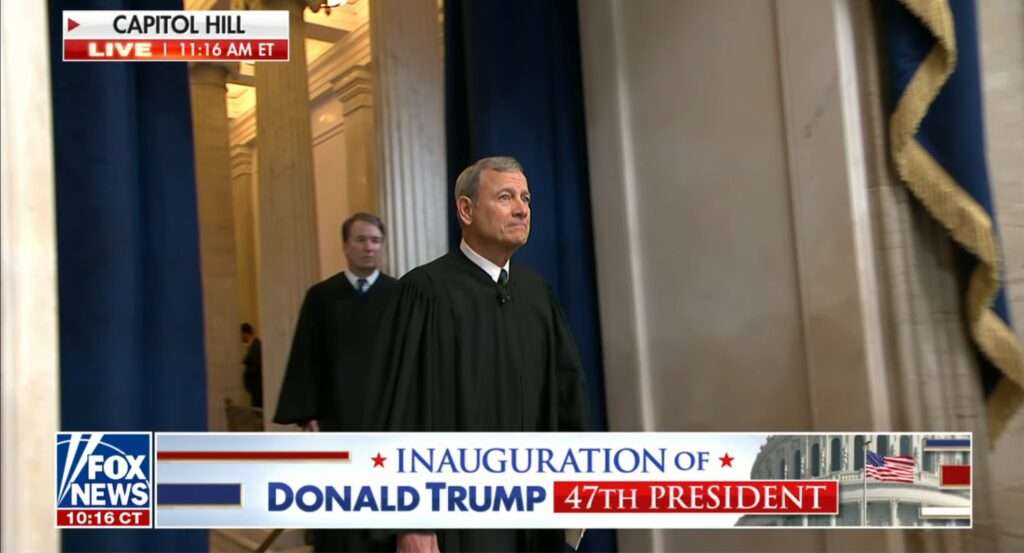
The Supreme Court Justices Enter The Presidential Inauguration

|

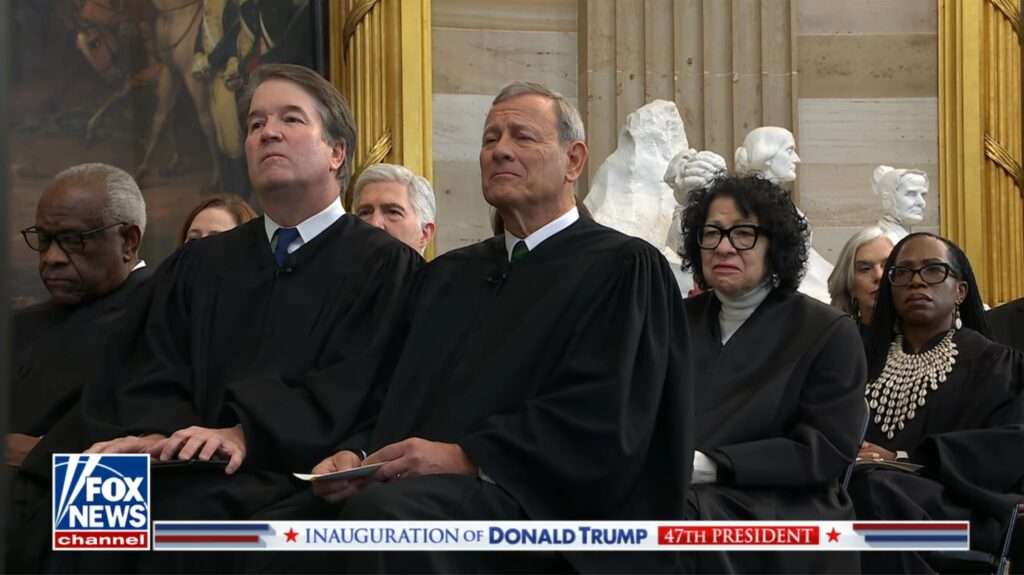
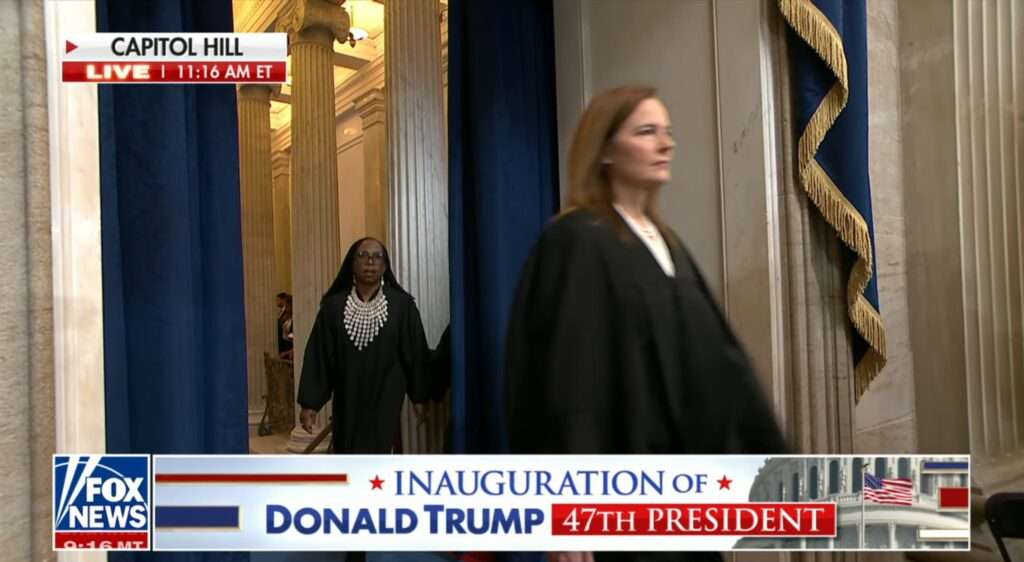
I'm not sure why Justice Kavanaugh entered after the Chief Justice. There was some seniority mixup.

The perfect caption for Chief Justice Roberts: Record Scratch. Freeze Frame. Yep, that's me. You're probably wondering how I got here.

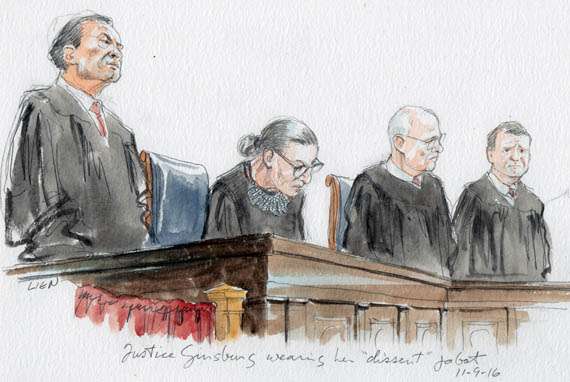
And is Justice Jackson wearing a dissent collar?

Remember RBG wore her dissent collar after Trump's election. Even if this was not intentional on KBJ's part, it was a fashion faux pas.

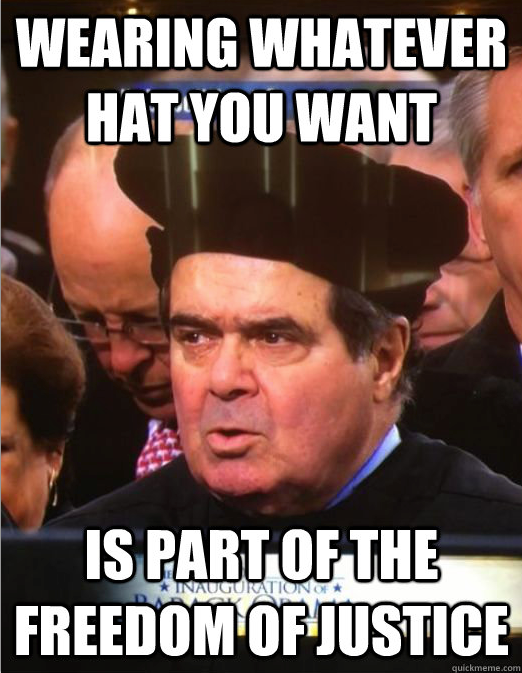
Regrettably, because the Justices are inside, they will not wear their special hats.


More