Nat'l Ass'n of Diversity Officers in Higher Ed. v. Trump, decided Thursday by Judge Adam Abelson (D. Md.), reaffirms an injunction against the Administration's DEI Executive Orders that the judge had issued (and that was stayed on appeal). The plaintiffs argue that "[new] factual developments merit vacating the injunction and permitting Plaintiffs to file an amended complaint and a renewed motion for a preliminary injunction," and the court said no. But in the process the court discussed the substantive question, and I thought I'd pass that along:
This Court remains of the view that Plaintiffs have shown a strong likelihood of success on the merits of their facial free speech and vagueness claims …. The Challenged Provisions forbid government contractors and grantees from engaging in "equity-related" work and from "promoting DEI" in ways the administration may consider to violate antidiscrimination laws; they demand that the "private sector" "end … DEI" and threaten "strategic enforcement" to effectuate the "end[ing]" of "DEI"; and they threaten contractors and grantees with enforcement actions with the explicit purpose of "deter[ring]" such "programs or principles."
This Court remains deeply troubled that the Challenged Provisions, which constitute content-based, viewpoint-discriminatory restrictions on speech (in addition to conduct), have the inherent and ineluctable effect of silencing speech that has long been, and remains, protected by the First Amendment. And they do so through impermissibly vague directives that exacerbate the speech-chilling aspects of the Challenged Provisions.
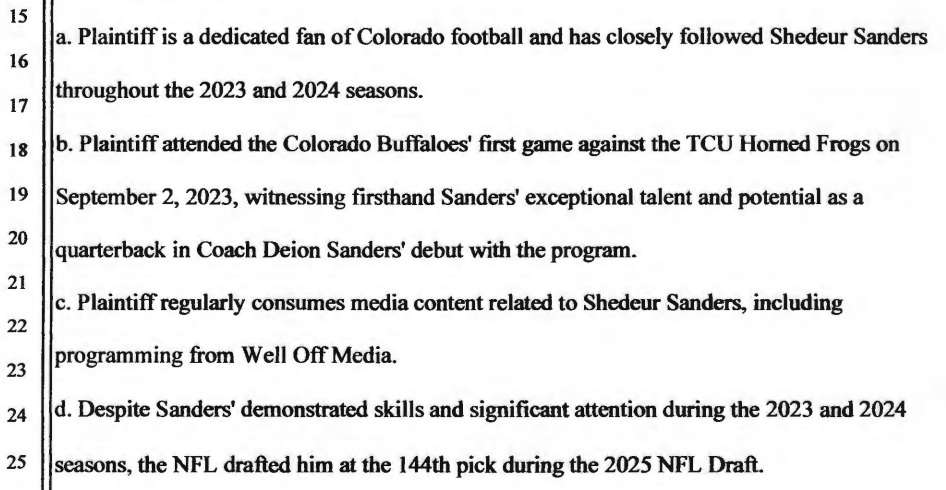
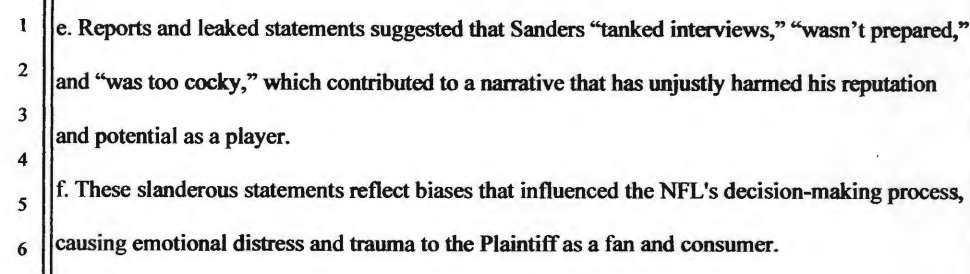
That claim, I'm pretty confident, is going nowhere. (Claims for "intentional infliction of emotional distress" based on extreme and outrageous conduct are indeed viable in some situations, but they require highly egregious conduct, generally targeted at the particular plaintiff.)
Doe also alleges violations of the Sherman Antitrust Act ("The collusion among NFL teams to influence the drafting process and the subsequent low selection of Shedeur Sanders constitutes a conspiracy to restrain trade and limit competition within the league") and federal antidiscrimination law ("The decisions made regarding Sanders may have been influenced by racial discrimination, violating his rights as a player").
5/3/1802: Washington D.C. incorporated as the capital of the United States. Article I, Section 8 empowers Congress to "To exercise exclusive Legislation in all Cases whatsoever, over such District (not exceeding ten Miles square) as may, by Cession of particular States, and the Acceptance of Congress, become the Seat of the Government of the United States."
This is a key issue in cases seeking to limit executive branch power grabs, including Trump's tariffs. Judge Ryan Nelson (a conservative Trump appointee) explains why the president is not exempt from the doctrine.
The Supreme Court's "major questions" doctrine (MQD) requires Congress to "speak clearly" when authorizing the executive to make "decisions of vast economic and political significance." If the statute isn't clear, courts must reject the executive's assertion of power. But the Trump Administration, like the Biden Administration before it, argues that the doctrine does not apply to assertions of power by the President, only those by lower-level executive branch officials, such as leaders of administrative agencies.
This issue came up in several cases challenging executive actions by President Biden, and it has arisen again in the lawsuit challenging Trump's massive IEEPA tariffs filed by the Liberty Justice Center and myself, on behalf five small businesses.
If there is any ambiguity over the meaning of IEEPA, courts should resolve it against the government by applying the major questions doctrine. Since 2021, the Supreme Court has invalidated several presidential initiatives under that rule,… Examples include cases invalidating President Biden's massive student loan forgiveness program, a coronavirus vaccination mandate imposed on workers employed by firms with 100 or more employers, and a pandemic-era nationwide eviction moratorium imposed by the first Trump administration and later extended by Biden.
If Trump's sweeping use of IEEPA to start the biggest trade war in a century is not a major question, it is hard to say what is. The magnitude of the Liberation Day tariffs exceeds that of most of the other measures declared major questions by the Supreme Court…. The nonpartisan Tax Foundation estimates that Trump's IEEPA tariffs will impose some $1.4 to 2.2 trillion in tax increases on Americans, over the next decade. That makes even President Biden's dubious $400 billion student loan forgiveness plan (which the Supreme Court rightly invalidated under the major questions doctrine) seem modest by comparison.
In sum, it is difficult to deny that Trump's invocation of IEEPA to impose the Liberation Day tariffs raises a major question. And if it does, courts should use the major questions doctrine to invalidate it. To understate the point, it is far from clear that IEEPA authorizes the use of tariffs, that trade deficits are an "emergency," or that there is any "unusual and extraordinary threat." If any of these three preconditions is not clearly met, then the major questions doctrine requires the courts to strike down Trump's tariffs.
The administration, however, argues that MQD just doesn't apply to the president at all! If so, that might shield not only the tariffs but many other presidential power grabs from judicial scrutiny. Under Biden, MQD was decried by some as a tool invented by conservatives to stymie left-wing policies. But, under Trump, progressives have every reason to make use of it themselves. More generally, it's a valuable resource to protect against excessive delegation of power, and enforce the common-sense textualist rule of interpretation that a grant of major authority requires clearer authorization than one that delegates only some minor power.
The claim that presidential actions are exempt from MQD has already been rejected by at least three federal courts of appeals, the Fifth, Sixth, and Eleventh Circuits. See Louisiana v. Biden, 55 F.4th 1017, 1031 n.40 (5th Cir. 2022) ("delegations to the President and delegations to an agency should be treated the same under the major questions doctrine") ; Georgia v. President of the U.S., 46 F.4th 1283, 1295–96 (11th Cir. 2022) (holding that an assertion of power by the President under the Procurement Act is "no exception" to application of MQD); Kentucky v. Biden, 23 F.4th 585, 606–08 (6th Cir. 2022) (applying MQD to a presidential directive). The Ninth Circuit went the other way in a decision that was later vacated as moot, and thus has no precedential value. Mayes v. Biden, 67 F.4th 921, 932–34 (9th Cir. 2023), vacated as moot, 89 F.4th 1186 (9th Cir. 2023). In a more recent ruling, Nebraska v. Su, the Ninth Circuit did apply MQD to a presidential action, but held that the policy did not run afoul of the doctrine because it wasn't a "transformative expansion" of executive authority.
Nebraska v. Su is also notable because it includes an excellent concurring opinion by Judge Ryan Nelson - a conservative Trump appointee - explaining why MQD applies to the president, not just administrative agencies:
The Supreme Court has never suggested that the President is exempt from major questions analysis. And it makes little sense to think that he is. Broad legislative delegations to the Executive Branch—whether to the President or to administrative agencies—are inherently suspect….
Much ink has been spilled on the "source and status" of the major questions doctrine. Biden v. Nebraska, 143 S. Ct. 2355, 2376 (2023) (Barrett, J., concurring). Some view the doctrine as a substantive canon rooted in non-delegation principles. See Nat'l Fed'n of Indep. Bus. v. Dep't of Lab., delegation doctrine are both "designed to protect the separation of powers"). Others understand the doctrine as a linguistic canon—"an interpretive tool reflecting 'common sense as to the manner in which Congress is likely to delegate a policy decision of such economic and political magnitude to an administrative agency.'" Nebraska, 143 S. Ct. at 2378 (Barrett, J., concurring)… Regardless of its source, the major questions doctrine does not yield because Congress delegated authority to the President and not an agency.
Let's assume major questions is fundamentally a separation of powers doctrine. On that view, the doctrine keeps Congress in its constitutional lane, preventing it from delegating "fundamental policy decisions" to the Executive Branch. Indus. Union Dep't, AFL-CIO v. Am. Petrol. Inst., 448 U.S. 607, 687 (1980) (Rehnquist, J., concurring in the judgment)… It makes no difference which Executive Branch officer has received an unlawful delegation: the "entire 'executive Power' belongs to the President alone." Seila Law LLC v. Consumer Fin. Prot. Bureau, 591 U.S. 197, 213 (2020)….
Indeed, a unitary executive is entrenched in our constitutional structure. The Founders envisioned a system in which the executive power is concentrated in a single President who does not make the laws, but executes them…. The Supreme Court's major questions cases recognize that basic premise….
Distinguishing between presidential and agency delegations also ignores the realities of administrative decision-making. The President is likely to be closely involved in major policies, even if they are ultimately promulgated by an agency….
Now assume the major questions doctrine operates as a linguistic canon that "situates text in context." Nebraska, 143 S. Ct. at 2378 (Barrett, J., concurring). Here, it would be even stranger to treat the President differently. We regularly interpret statutory grants of authority. In so doing, we recognize that Congress does not "hide elephants in mouseholes." Whitman v. Am. Trucking Ass'ns, 531 U.S. 457, 468 (2001)… Why would our normal interpretive process turn on the identity of the Executive Branch officer to whom Congress delegated power? An implausible reading of a statute is no less implausible when that statute confers authority on the President versus an agency.
Notice, as Judge Nelson points out, that the distinction between presidential and agency actions is particularly indefensible under the "unitary executive" theory endorsed by many conservatives, including the Trump administration (I myself have reservations about it). Under that approach, agencies are just extensions of the president's power, and are totally subordinated to him. Any delegation of power to an agency is is really a delegation to the president, as agency officials are ultimately there to do his bidding.
Judge Nelson goes on to explain why "political accountability" concerns don't justify treating supposed delegations to the president differently from those to agencies. Given extensive presidential control over agencies, the latter are subject to accountability through him.
I would add that they also face accountability through congressional action. Congress can legislate to curb the power of agencies that anger public opinion. Indeed, agencies actually face greater congressional constraints than the president, because Congress can adopt legislation abolishing an agency entirely, whereas it cannot do the same to the president. Removal of the president through impeachment is much more difficult than ordinary legislation curbing agency power.
Voter ignorance or partisan bias might lead the public to overlook problematic agency policies. But the same is true of those enacted by presidents.
In sum, there is every reason to apply the major questions doctrine to presidential actions no less than those of agencies. The Big Boss must be kept on a tight constitutional leash no less than his subordinates.
The majority opinion is a very quick read. It consists entirely of the following: "PER CURIAM: The judgment of the district court is AFFIRMED." After that comes 124 pages of separate opinions, consisting of seven concurrences and one dissent.
Here's a summary of the eight separate opinions, followed by some quick thoughts. I'll assume the reader is familiar with the case from my 2022 post, and just jump into the opinions:
Judge Diaz (solo opinion): The good-faith exception applies, so we should not reach the merits of how the Fourth Amendment applies to geofencing. These are hard issues and judicial modesty demands we not reach out and try to address other issues. The government should win on the good-faith exception alone.
Judge Wilkinson, joined by Judges Niemeyer, King, Agee, and Richardson (five judges total): Geofencing is not a search. The third-party doctrine is still good law, and users voluntarily disclose their location to Google. The government should win on the merits.
Judge Niemeyer (solo opinion): No search occurred here because the government was essentially just following the tracks left by users, which is not a search. Also, the good-faith exception applies.
Judge King (solo opinion): The good-faith exception applies.
Judge Wynn, joined by Judges Thacker, Harris, Benjamin, Berner, and mostly Gregory (six judges total): Geofencing is a Fourth Amendment search. We understand Carpenter v. United States to be a transformative decision that replaced the third-party doctrine and announced a new multi-factor test for what is a Fourth Amendment search. We apply the factors and we conclude that geofencing is a search. Still, the good faith exception applies, so the government wins.
Judge Richardson, with Judges Wilkinson, Niemeyer, King, Agee, Quattlebaum and Rushing (seven judges total): The government wins under the third-party doctrine, which dictates that there was no search here. Carpenter limited the third-party doctrine, but under Carpenter the rationale of the third-party doctrine applies because the information is limited and was voluntarily disclosed when users opted in to the location history feature.
Judge Heytens, joined by Judges Harris and Berner (three judges total): Whether or not a search occurred, the good-faith exception applies so the evidence is admissible.
Judge Berner, joined by Judges Gregory, Wynn, Thacker, Benjamin, and in part Heytens (six judges total): No search occurs when the government gets geofencing information in anonymized form. So the initial stage of geofence warrants is not a search. However, when the anonymized data is later linked to a particular individual, a search occurs and a warrant is needed. We disagree with the Fifth Circuit that geofence warrants are categorically unconstitutional, but we think a warrant individualized to each person is needed at the de-anonymization stage to reveal each person's identity, one warrant per person, which was lacking here.
Judge Gregory, dissenting (one judge total): The geofence warrant in this case was obviously unconstitutional, so the good-faith exception should not apply.
Using the powers of the federal government to target lawyers for their representation of clients and avowed progressive employment policies in an overt attempt to suppress and punish certain viewpoints, however, is contrary to the Constitution, which requires that the government respond to dissenting or unpopular speech or ideas with "tolerance, not coercion." 303 Creative LLC v. Elenis (2023). The Supreme Court has long made clear that "no official, high or petty, can prescribe what shall be orthodox in politics … or other matters of opinion." W. Va. State Bd. of Educ. v. Barnette (1943). Simply put, government officials "cannot … use the power of the State to punish or suppress disfavored expression." NRA v. Vullo (2024).
That, however, is exactly what is happening here. For this reason, and those explained more fully below, Executive Order 14230 is unconstitutional, and the findings and instructions to Executive Branch agencies issued in its Sections 1 through 5 cannot be allowed to stand….
[P]laintiff is entitled to summary judgment on the following: (1) the claims of unconstitutional retaliation and viewpoint discrimination, in violation of the First Amendment …; (2) the claim of unconstitutional compelled disclosure, in violation of the First Amendment …; (3) the claim of unconstitutional denial of equal protection of the law, in violation of the Fifth Amendment …; (4) the claims that EO 14230 violates the Fifth and Sixth Amendment right to counsel of plaintiff's clients …; (5) the claim of unconstitutional denial of due process of the law, in violation of the Fifth Amendment …; and (6) the claim that EO 14230 is unconstitutionally vague, in violation of the Fifth Amendment ….
Today, May 2, the Solicitor General asked the Supreme Court for an emergency stay in Social Security Administration v. AFSCME. This case was brought to stop DOGE employees from accessing SSA data.
Immediately after the application was filed, the Chief Justice called for a response due on May 12.
Response to application (24A1063) requested by The Chief Justice, due by 4 p.m. (EDT) on May 12, 2025.
Here, Roberts continues his trend by calling for a response immediately. but Roberts apparently does not think this case is urgent. He did not grant even a temporary administrative stay, and granted the Respondents a leisurely ten days to respond.
Yesterday, I tracked the average length of time for shadow docket responses. This will be the second-longest period, only behind Justice Jackson's timeline in the Maine case. I wonder if Roberts too is signaling that the shadow docket should slow down.
By giving one man the power to impose massive tariffs anytime he wants, Trump's policy undermines the predictability and impartiality that the rule of law requires.
Much has been written (including by me) about how Trump's massive new tariffs will severely damage the US economy, and why they are illegal for a variety of different reasons. But more attention should be paid to how they also threaten the rule of law.
The rule of law is a somewhat fuzzy concept that can mean different things to different people. It's important not to confuse it with justice. But one standard component of it that a wide range of people should be able to agree on is that important legal rules should be clearly stated in advance, and not easily changeable at any one person's whim. That is what differentiates the rule of law from "the rule of men." In addition, they cannot be easily manipulated to reward the ruler's allies and punish his political opponents.
Trump's gargantuan trade war is an egregious violation of these principles. Under the administration's interpretation of the International Emergency Economic Powers Act of 1977 (IEEPA), the president essentially has the power to impose any tariffs, in any amount, on any country, at any time. He can also create exemptions for any given firm, industry, or region of the country, as Trump has already done for various electronics imports.
IEEPA doesn't actually authorize tariffs at all, and invoking it requires the existence "unusual and extraordinary threat" to the US economy or national security, with respect to which the president has declared a "national emergency." But the administration claims the president has unreviewable authority to declare a national emergency whenever he wants, and that even bilateral trade deficits that have existed for decades (and are not actually harmful) constitute an "extraordinary and unusual threat." If so, then virtually anything can qualify as such.
If the president can impose any tariffs he wants, at will, and also reverse them or grant exemptions at will, that is the very opposite of the rule of law. It is essentially the rule of one man. And it's easy to see how such sweeping authority can be readily used to reward friends and cronies, while punishing political opponents. Studies show that firms contributing to the Republican Party were disproportionately likely to receive exemptions from much less extensive tariffs imposed in Trump's first term, while firms contributing to Democratic candidates were more likely to be rejected. Trump's massive "Liberation Day" tariffs are an opportunity to engage in such favoritism on a far greater scale.
In fairness, these dangers are not entirely unique to Trump's tariffs. Many other discretionary exercises of executive power also create legal uncertainty. And political cronyism and favoritism have occurred under administrations of both parties, including those of Barack Obama and Biden. Nor are tariffs the only threat to the rule of law under Trump (far from it).
But the enormous scale of Trump's tariffs is unique in modern times, greatly magnifying the threat they pose to the rule of law. The Tax Foundation estimates that Trump's IEEPA tariffs will impose some $1.4 to 2.2 trillion in tax increases on Americans, over the next decade, and have a massive impact on almost every part of the economy. For as long as the tariffs continue (and they have no enforceable expiration date), that's an incredible amount of power to be completely concentrated in one man's hands. And a nearly unlimited opportunity for favoritism. The danger is exacerbated by the fact that, under, Trump's interpretation of IEEPA, there are no legally binding rules determining how long the tariffs should last, which imports they should target, and whether exemptions can be granted or denied. Trump likes to call himself to a king, and his tariff policy would make him an absolute monarch over US international trade - and the many parts of the economy dependent on it.
To be sure, Congress could potentially curb Trump's authority by enacting new legislation. But that is unlikely to happen, given the requirement of a two-thirds majority in each house to overcome a veto. One of the purposes of judicial review and rules like nondelegation and the major questions doctrine (both of which Trump's IEEPA tariffs run afoul o) is to prevent the executive from usurping authority in ways that are difficult to reverse after the fact.
The threat to the rule of law is an additional reason why courts should not hesitate to strike down Trump's tariff power grab in the various cases brought against it, such as those filed by the Liberty Justice Center and myself on behalf of five small business, the Pacific Legal Foundation, twelve state governments, and others. Much more than economic harm (as important as that is in itself) is at stake in these cases.
Please enjoy the latest edition of Short Circuit, a weekly feature written by a bunch of people at the Institute for Justice.
Over at The Dispatch, IJ attorney John Wrench invokes General Slushington and makes the case that the White House's intimidation of law firms is an existential threat to the rule of law. Click here to read it.
In 2003, Accuracy in Media files a FOIA request with the CIA seeking records related to Vietnam-era POW/MIAs. In 2004, they filed suit after the CIA failed to respond to the request. And in 2025, the D.C. Circuit holds that the CIA still has not shown that it performed an adequate search for the records.
Iran provided material support for a Taliban attack that killed 30 Americans, including Navy SEAL Kraig Vickers. Vickers' family sues Iran under the Foreign Sovereign Immunities Act and all recover damages except for Vickers' youngest daughter, whom the district court regretfully holds is ineligible because she was not born until two months after Vickers' death. D.C. Circuit: That limitation isn't in the statute. Iran is on the hook for her damages, too. Read More
Last night, President Trump announced his intent to nominate Whitney Hermandorfer, Director of Strategic Litigation on the Tennessee Attorney General's Office, to the U.S. Court of Appeals for the Sixth Circuit. She will replace Judge Jane Stranch. This is the first judicial nomination of Trump's second term, and the announcement came late last night in a post on Truth Social.
Hermandorfer has strong and fairly conventional qualifications for a judicial nomination in a Republican Administration. Prior to joining the Tennessee AG's office worked at Williams & Connolly). She also clerked for both Justices Samuel Alito and Amy Coney Barrett on the Supreme Court, as well as for then-Judge Brett Kavanaugh on the U.S. Court of Appeals for the D.C. Circuit and district court Judge Richard Leon. She was first in her class and Editor-in-Chief of the law review at the George Washington University Law School and was graduated magna cum laude from Princeton University, where she was also co-captain of the Women's Varsity Basketball team. (N.B. I believe Hermandorfer is the first Trump judicial nominee to have clerked on the Supreme Court for one of Trump's Supreme Court nominees.)
After this nomination, there are five remaining current or pending appellate vacancies awaiting nominations: One on the First Circuit, two on the Third Circuit, one on the Seventh Circuit, and one on the Ninth Circuit. There are also fifty-five district court openings.
(1) Harvard, under a lot pressure from both the government and internal constituencies, released a lengthy report about antisemitism at the university since October 7. It's pretty devastating, and pretty much should shame all those who have been claiming that complaints about antisemitism there have been exaggerated "Zionist" propaganda.
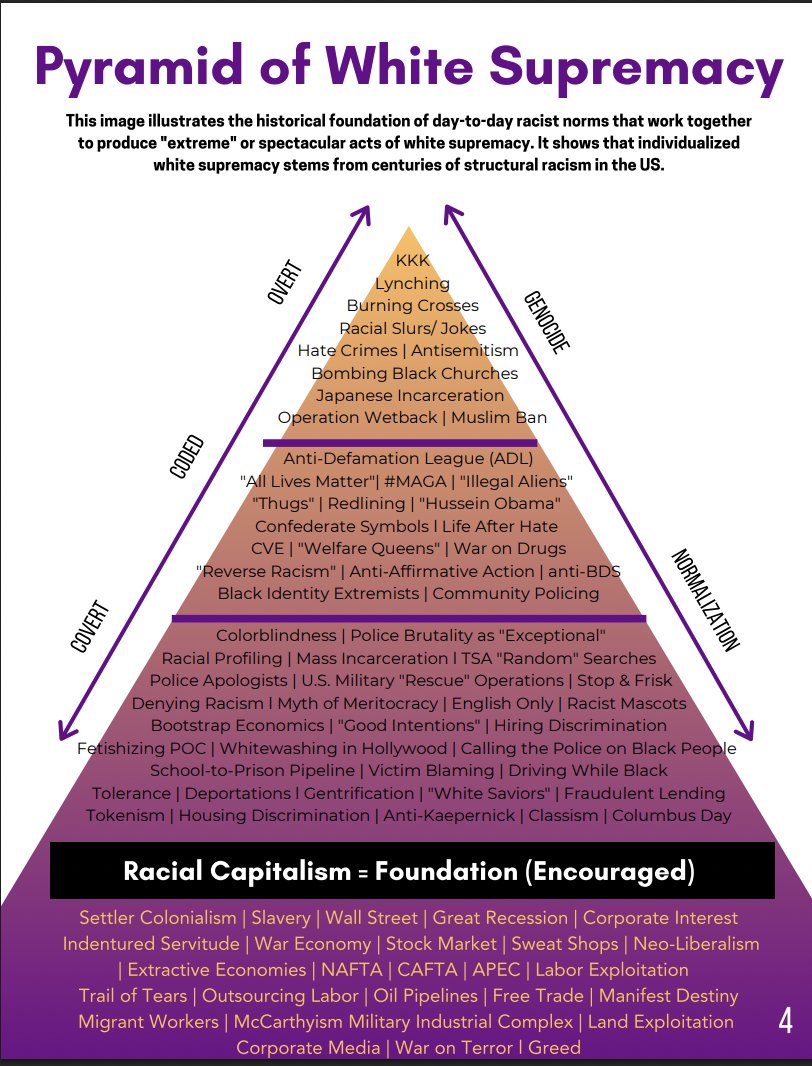
(2) There's a lot of crazy stuff in the Harvard report, but I can't stop thinking about this chart used in a *required* Education School class.
It's antisemitic, yes, in suggesting that the ADL, which has been fighting white supremacy for over 100 years, is one of the worst examples of white supremacism in the United States. But it's just batshit crazy more generally, and shows the connection between nutty woke ideologies and antisemitism. The report assures us that the instructor is no longer using this chart. IMHO, anyone who thought using this chart as a serious learning tool can and likely should be fired for cause.
(3) After the Washington Free Beacon revealed blatantly illegal racial preferences at the Harvard Law Review, law review editors took action--they began to try to find and punish the leaker, while defiantly proclaiming that they don't plan to charge their day-to-day policies. Out of curiosity, I dug up Harvard's anti-retaliation policy for whistleblowers, or at least what was the policy as late as this past March. (I had to retrieve it from Archive.org). Going after the student leaker is a blatant violation of that policy. I think we're getting to the point where there is good reason to question the top HLR's editors ability to meet the character and fitness requirements of state bars, given their blatant disregard for any laws or rules that apply to them.
(4) Not being satisfied with blatantly defying both federal law and Harvard policy, the Law Review decided to award a $65,000 fellowship to a rather, umm, interesting recipient. Law review editor Ibrahim Bharmal was caught on video assaulting a Jewish Harvard student. He was prosecuted, without Harvard's cooperation, by the local DA, and a few days ago was sent to a diversion program for first-time offenders in which he will have to pick up trash and do other public service and attend an anger management class. So he wasn't convicted, but the assault is, as noted, on video. Not only did that not stop the Law Review from rewarding him with a fellowship, but he will use the fellowship to work at the antisemitic Council on Islamic Relations' especially antisemitic Los Angeles office.
The United States has filed an amicus curiae brief in support of the cert petition in Wolford v. Lopez seeking review of the following issue: "Whether the Second Amendment allows a State to make it unlawful for concealed-carry license-holders to carry firearms on private property open to the public without the property owner's express authorization." As the brief explains, "after Bruen, five States, including Hawaii, inverted the longstanding presumption and enacted a novel default rule under which individuals may carry firearms on private property only if the owner provides express authorization, such as by posting a conspicuous sign allowing guns." The Ninth Circuit upheld Hawaii's law.
In doing so, Solicitor General John Sauer explained how multiple Justices and judges have recognized the need for more guidance from the Court on Second Amendment issues. The brief explains:
Rahimi began the process of clarifying who may possess arms…. This case affords an opportunity to begin addressing where arms may be carried. And the Court should, in an appropriate case, also provide a framework for evaluating what types of arms people may possess…. The Court's consideration of those important questions would help lower courts seeking to interpret the Second Amendment, legislatures seeking to comply with the Constitution, and (most important) ordinary Americans seeking to exercise their fundamental right to possess and carry arms for lawful purposes such as self-defense.
As to the "types of arms" that are protected, as I've posted previously, two cases have been repeatedly relisted and remain before the Court: Snope v. Brown, which concerns whether Maryland may ban semiautomatic rifles that are in common use for lawful purposes, and Ocean State Tactical v. Rhode Island, which asks whether a confiscatory ban on the possession of magazines that are in common use violates the Second Amendment. These cases have been distributed for the conference of Friday May 2, and both would make excellent vehicles to resolve the issue of protected types of arms.
The SG's brief in Wolford makes the following argument that would apply to a number of the ongoing Second Amendment challenges: "The preliminary-injunction posture in which this case arises should not deter this Court from granting review. The court of appeals did not decide this case in haste; to the contrary, it issued an 81-page opinion nearly a year after petitioners appealed…. And since the court's merits analysis all but foreordains the final outcome, further proceedings in the lower courts would serve no useful purpose."
I know I'll get this question, so to answer it: No, I'm not the reader. I wanted to be the reader, but the audio book company didn't pick me. I've been listening to the audio book and I can see why. I like to think I could read the book well, but a professional can read it better.
I am planning more posts on the book soon, too. Stay tuned.
From the decision just issued by Judge Yvonne Gonzalez Rogers in Musk v. OpenAI (N.D. Cal.):
[As to the express contract claim:] [T]he parties agree that there is no one single document that consists of a contract. At best, Musk argues that emails exchanged with various defendants between 2015 and 2019 constitute an express contract. The Court disagrees. Therefore, the motion to dismiss Count I is Granted.
[As to the implied-in-fact contract claim:] Although there is no express contract, Musk adequately pleads in the alternative that there is an implied-in-fact contract manifested by the alleged conduct of the OpenAI. The FAC also adequately alleges Musk's performance, defendants' breach, and the resulting harm to Musk. The motion to dismiss Count II is Denied….
The court allows some other related claims (for instance for unjust enrichment and fraud) to go forward as well, and rejects still others. This is just a decision on a motion to dismiss, so the court is only asking whether plaintiffs had plausibly alleged something legally actionable. A decision on whether there was indeed a breach of an implied contract, fraud, unjust enrichment, and so on is still in the future.
Whether the Second Amendment allows a State to make it unlawful for concealed-carry license-holders to carry firearms on private property open to the public without the property owner's express authorization.
From the earliest days of the republic, individuals have been free to carry firearms on private property unless the property owner directs otherwise. And in NYSRPA v. Bruen (2022), this Court confirmed that restrictions on carrying firearms for lawful purposes such as self-defense violate the Second Amendment unless they fit within a discernible historical tradition.
Yet, after Bruen, five States, including Hawaii, inverted the longstanding presumption and enacted a novel default rule under which individuals may carry firearms on private property only if the owner provides express authorization, such as by posting a conspicuous sign allowing guns. Violations constitute misdemeanors punishable by up to a year in prison. Because most property owners do not post signs either allowing or forbidding guns, Hawaii's default rule functions as a near-complete ban on public carry. A person carrying a handgun for self-defense commits a crime by entering a mall, a gas station, a convenience store, a supermarket, a restaurant, a coffee shop, or even a parking lot. Yet, in the decision below, the Ninth Circuit upheld that rule against a Second Amendment challenge.
From today's decision by Judge Corinne Beckwith, joined by Judges Anna Blackburne-Rigsby and Joshua Deahl, in Hattix v. D.C. Housing Authority:
Desean Hattix was convicted of attempted failure to register a firearm after police executed a search warrant at his home and recovered, among other things, two unregistered handguns. Following his conviction, the District of Columbia Housing Authority (DCHA) sued Mr. Hattix to evict him from his federally subsidized housing unit.
DCHA alleged that Mr. Hattix's possession of an unregistered firearm violated the federal "one-strike" provision in his lease, which prohibits tenants from engaging in "[c]riminal activity that threatens the residents' health, safety or right to peaceful enjoyment of the [property]." … [We agree with Mr. Hattix] (1) that possession of an unregistered firearm does not constitute a per se threat to residents' health, safety, or right to peaceful enjoyment of the property, and (2) that DCHA did not present sufficient evidence that Mr. Hattix's conduct posed a threat to residents' health, safety, or right to peaceful enjoyment of the property….
In January 2018, the Metropolitan Police Department (MPD) executed a search warrant at the federally subsidized housing unit where Mr. Hattix lived in Southwest D.C. MPD officers seized several items, including "two handguns, each with ammunition, a spent round of ammunition, a plastic bag containing drug paraphernalia and mail matter in [Mr. Hattix's] name." The firearms were not registered, and Mr. Hattix was not licensed to possess a firearm in the District. Mr. Hattix [pleaded guilty to] two counts of possessing an unregistered firearm and two counts of possessing unregistered ammunition. He subsequently pleaded guilty to attempted possession of an unregistered firearm.