
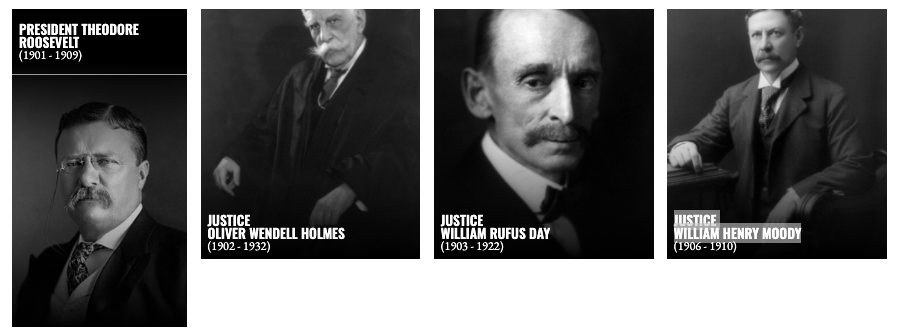
9/14/1901: President Theodore Roosevelt is inaugurated. He appointed three members to the Supreme Court: Justices Oliver Wendell Holmes, Rufus Day, and William Henry Moody.

Mostly law professors | Sometimes contrarian | Often libertarian | Always independent | Est. 2002

9/14/1901: President Theodore Roosevelt is inaugurated. He appointed three members to the Supreme Court: Justices Oliver Wendell Holmes, Rufus Day, and William Henry Moody.
What's on your mind?
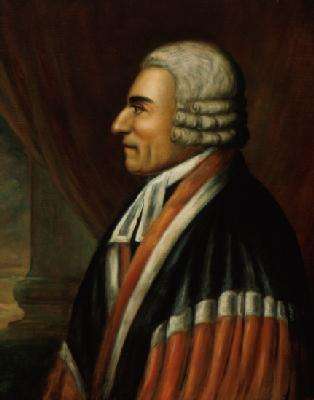
9/13/1810: Justice William Cushing died.
From today's decision in Noland v. Land of the Free, L.P., by Justice Lee Smalley Edmon, joined by Justice Anne Egerton and Riverside Superior Court Judge Kira Klatchko:
[N]early all of the legal quotations in plaintiff's opening brief, and many of the quotations in plaintiff's reply brief, are fabricated. That is, the quotes plaintiff attributes to published cases do not appear in those cases or anywhere else. Further, many of the cases plaintiff cites do not discuss the topics for which they are cited, and a few of the cases do not exist at all. These fabricated legal authorities were created by generative artificial intelligence (AI) tools that plaintiff's counsel used to draft his appellate briefs. The AI tools created fake legal authority—sometimes referred to as AI "hallucinations"—that were undetected by plaintiff's counsel because he did not read the cases the AI tools cited.
A nice headline for a Free Press editorial, drawing the entirely coincidental verbal connection to the aftermath of the Charlie Hebdo murders.
It also reminds me of a passage I mentioned after those murders, from Rebecca West, writing about the English in 1940 as they anticipated the German attack on England after the fall of France:
Let nobody belittle them by pretending they were fearless. Not being as the ox and the ass, they were horribly afraid. But their pale lips did not part to say the words that would have given them security and dishonour.
Perhaps this wasn't so with Hebdo, and the Charlie Hebdo editors really were fearless (see, e.g., this quote from Stephane Charbonnier). Perhaps Kirk hadn't really foreseen the risk to him (though it sounds like had faced serious threats before). But whenever I have occasion to think about true courage, it is West's words that come to my mind.
Big game hunts, Victorian London, and those trendy Trader Joe’s bags.
Please enjoy the latest edition of Short Circuit, a weekly feature written by a bunch of people at the Institute for Justice.
"Can civilization survive now that we have been made witness to the interior lives of others?"
I much appreciated John Podhoretz's comments on this, and I thought I'd pass them along in their entirety (without the Twitter breaks). Social media has in one way fulfilled the promise of free speech, by making speech cheaper, easier, and more frictionless than ever before. But some friction can be good, and we might be missing it about now. From Podhoretz:
Here's the danger of social media. It allows people to publish their internal monologues.
Our internal monologues and fantasies are often incredibly ugly. People go to therapists because they feel so guilty about them, and one of the tasks of a therapist is to explain that thoughts are not actions. You can rage in your thoughts about your brother, or someone at work, even fantasize about them dying—but you have done nothing and are guilty of nothing, and you need to forgive yourself and learn how to calm yourself down.
This is, I imagine, what Catholic confession is for, though you are, I gather, obliged to do penance for your evil thoughts. But remember—they are still inside you. They are between you and you.
Since 2007, people have a means of externalizing that interior monologue and this means something. A researcher at MIT saying, rather than thinking, "I really want to see that video of Charlie Kirk dying again because it works better than my anti-depressant" has become a public act. [I'm not sure whether this is a reference to a specific post, or just a concrete hypothetical standing in for posts of this sort. -EV] I see it. I am affected by it. The public discourse is too.
My sense of how the world works and what people are really like undergoes a change. I become rageful, and believe people who think this way are evil. It's likely they are not. They just have a means of externalizing the parts of them that no one ever saw.
But another human tendency, the tendency to extrapolate from individual samples to the whole, kicks in then as well. I will assume that anyone and everyone like that MIT researcher is an enemy of everything good and is unsalvageable. In that way my world shrinks.
From Chief Judge James Boasberg (D.D.C.) yesterday in Doe v. Rollins:
Plaintiffs … worked at the Department of Agriculture in jobs related to diversity, equity, and inclusion…. On the first day of his new Administration, Trump issued an executive order that denounced federal DEI programs as "shameful discrimination," charged them with "immense public waste," and directed federal agencies to end them. Days later, Plaintiffs were placed on administrative leave. The Office of Personnel Management then issued guidance that, Plaintiffs allege, shows that they would soon be fired and would be allowed to apply for reassignment only to other DEI-focused jobs—which, thanks to the recent Executive Order, no longer existed.
Plaintiffs are challenging their placement on leave and OPM's guidance as violations of the Administrative Procedure Act and the First and Fifth Amendments. And they have moved to bring that challenge under pseudonyms. For the reasons below, the Court will deny their Motion to proceed pseudonymously….
Generally, a complaint must identify the plaintiffs. See Fed. R. Civ. P. 10(a); [D.D.C. Local Civil Rule] 5.1(c)(1), 11.1. That requirement reflects the "presumption in favor of disclosure [of litigants' identities], which stems from the 'general public interest in the openness of governmental processes,' and, more specifically, from the tradition of open judicial proceedings." A party moving to proceed pseudonymously thus "bears the weighty burden of both demonstrating a concrete need for such secrecy, and identifying the consequences that would likely befall it if forced to proceed in its own name." As a result, the court must "'balance the litigant's legitimate interest in anonymity against countervailing interests in full disclosure'" … Plaintiffs have not met their burden to show that their privacy interests outweigh the public's presumptive and substantial interest in learning their identities.
Start with whether this case concerns "a matter of a sensitive and highly personal nature." Plaintiffs argue that it does because they fear that being outed as having worked on DEI programs will damage their professional prospects.
Some have been calling for the firing of people who publicly praised the murder of Charlie Kirk, or at least who argued that the murder was justified or defensible. I'm not wild about such calls; I think we generally need less cancel culture, not more, even as to people who say morally repugnant things. (Among other things, these calls for firing tend to spiral, to cover a wide range of other speech beyond the outrageous statements that first led to them.) But here let me focus not on the ethical or pragmatic question, but the legal one: If a government employer fires an employee for such speech, would that violate the employee's First Amendment rights?
[1.] Praising violence doesn't generally fall into any existing First Amendment exception, so that means it's protected against the government as sovereign—against criminal punishment, civil liability, and the like. The "incitement" exception is limited to speech that is intended to and likely to cause imminent illegal conduct. Praise of a past murder wouldn't qualify: Even if such praise may have a long-term tendency to influence people in the future to do bad things, the Court has rejected this "bad tendency" test for punishing speech.
Intentionally soliciting a criminal attack on a particular person may potentially be punishable as "solicitation" of crime, under U.S. v. Williams (2008) and U.S. v. Hansen (2023). But that certainly wouldn't apply to mere praise or justification of an attack that had already happened. (Just when it would apply to general advocacy of a future attack is a complex and unsettled question.) For more on these rules, see this post on the Graham Linehan controversy.
[2.] Of course, here the government is acting as employer, and in that capacity it has more latitude to discipline and fire employees than it does to imprison or fine them. Generally speaking, the government may discipline an employee based on the employee's speech if
The employee sued, claiming the firing was retaliation; the jury found for the hospital, and the Sixth Circuit upheld the verdict (among other things upholding the admission of evidence of the employee's interest in BDSM).
In Graf v. Morristown-Hamblen Hospital Ass'n, decided Wednesday by Sixth Circuit Judge Karen Nelson Moore, joined by Judges Richard Griffin and John Nalbandian, Graf—a nursing assistant technician—said that Ogle, a security guard, "had raped her" "during a lunch break and on hospital grounds." The hospital "determined that the sexual interaction between Graf and Ogle had been consensual," and fired "Graf on the grounds that she had violated hospital policy by having intercourse while on the clock and in an unauthorized area." (Ogle was also fired.)
Graf sued, claiming she was retaliated against for having brought the complaint, but the jury "returned a verdict in favor of MHHA on all counts." The court affirmed; here is an excerpt of the facts:
Records obtained during the discovery process indicate that Graf and Ogle began texting on June 19, 2021. The two exchanged hundreds of texts over the course of the next several months. According to Graf, the two were "work friends, and that was it."
But according to Ogle, although the relationship started off friendly, the two began discussing that they "were both part of the BDSM world" and having intimate, sexual conversations. Graf admitted to having discussions with Ogle about various topics, including her past abusive relationships and intimate sexual matters, but stated that Ogle always initiated sexual conversations and that they never discussed having relations with each other. The two also met "on a regular basis" during their breaks, meeting in a "numerous amount of spots" including stairwells around the hospital.
One day in June 2021, Ogle texted Graf and asked her to meet him for lunch. Graf agreed to meet, and Ogle guided her to the security office—a location that was on the hospital's campus but where Graf was not authorized to be—via text messages. Graf did not clock out, because she was not required to do so during breaks, and she had a coworker cover her during the break.
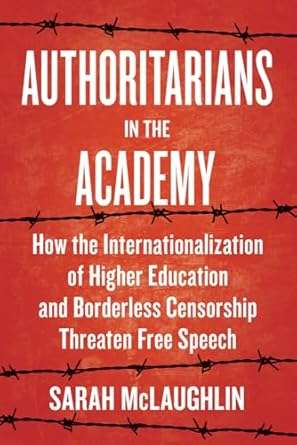
My book Authoritarians in the Academy: How the Internationalization of Higher Education and Borderless Censorship Threaten Free Speech was in its final edits and in the post-writing stage when Donald Trump was inaugurated into office for a second time. If I were still writing it today, I would need to dedicate new chapters to detailing another malignant censorship threat on American campuses: not the impositions by foreign powers, but the conduct of our own federal government.
In a post earlier this week I cited some of the illiberal and, in some cases, unconstitutional incursions by the Trump administration onto the First Amendment in the past few months. Some of the most disturbing violations, though, have targeted our institutions of higher education.
One of the most high-profile attacks has come in the form of the broadside against Harvard University. Thanks to Harvard's willingness to stand up for itself, however, this campaign against universities, despite widespread pusillanimity on the part of campus leaders, is finally starting to show some cracks.
Earlier this month, a Massachusetts federal district court found that the Trump administration violated Harvard's First Amendment rights, and Title VI of the Civil Rights Act, when it revoked billions in funding in a transparent effort to punish the university for its, and its community members', political views under the guise of combatting antisemitism. The government does not receive a dispensation to use unlawful means simply because it says it does so in the name of fighting antisemitism or other discrimination on campus.
9/12/1958: Cooper v. Aaron is decided.
What's on your mind?
Cato Institute scholar has a great overview of the data on how much political violence there is, and who perpetrates it. It is less prevalent than many think, and right-wing political violence is more common than the left-wing kind.
The awful murder of conservative activist Charlie Kirk has stimulated interest in the nature and extent of political violence in the United States. We do not yet know the identity and motive of the killer; but there is at least a substantial likelihood the motive was political in nature. My Cato Institute colleague Alex Nowrasteh has a great overview of the available data on political violence since 1975. He finds that the overall incidence of such violence is much lower than many assume. The 9/11 attacks dominate the stats, accounting for 83% of total deaths. Setting that aside, right-wing violence is significantly more prevalent than the left-wing variety.
It should, perhaps, go without saying. But I condemn the murder of Charlie Kirk without reservation. It is utterly indefensible, and I hope the killer is caught and severely punished. I was no fan of Kirk and his ideology. His organization, TPUSA, even once put me on its "Professor Watchlist" (they apparently removed me from the list a few months later, without explanation). But no one should be attacked or killed for their political beliefs. The murder is all the more tragic in light of the fact that Kirk left behind a wife and two small children. They did nothing to deserve this.
Now for Alex's summary of the data on violence:
A total of 3,599 people have been murdered in politically motivated terrorist attacks in the United States from January 1, 1975, through September 10, 2025. Murders committed in terrorist attacks account for about 0.35 percent of all murders since 1975. Only 81 happened since 2020, accounting for 0.07 percent of all murders during that time, or 7 out of 10,000. Terrorism is the broadest reasonable definition of a politically motivated murder because it is the threatened or actual use of illegal force and violence by a nonstate actor to attain a political, economic, religious, or social goal through coercion, fear, or intimidation….
Eighty-three percent of those murdered since 1975 were committed by the 9/11 terrorists…. The Oklahoma City Bombing accounts for about another 5 percent. Those murdered since 2020 account for just 2 percent. Terrorists inspired by Islamist ideology are responsible for 87 percent of those murdered in attacks on US soil since 1975…. Right-wingers are the second most common motivating ideology, accounting for 391 murders and 11 percent of the total. The definition here of right-wing terrorists includes those motivated by white supremacy, anti-abortion beliefs, involuntary celibacy (incels), and other right-wing ideologies.
Left-wing terrorists murdered 65 people, or about 2 percent of the total. Left-wing terrorists include those motivated by black nationalism, anti-police sentiment, communism, socialism, animal rights, environmentalism, anti-white ideologies, and other left-wing ideologies. Those murders that are politically motivated by unknown or other ideologies are a vanishingly small percentage, which is unsurprising because terrorists typically want attention for their causes.
"Right" and "left" are somewhat arbitrary and incoherent categories. Thus, people can argue about some of Alex's coding choices here. For example, I am not sure black nationalists really qualify as "left" and incels as "right." Nonetheless, the coding here mostly tracks the way these terms are generally used in current US political discourse. Thus, Alex is right to conclude that right-wing violence is more prevalent than the left-wing kind, even though one can quarrel with the classification of a few specific perpetrators at the margin.
Given the outsize weight of the 9/11 attacks in the data, partisans will be tempted to categorize radical Islamists with their political opponents. Thus, left-wingers might argue that Islamists are on the right, due to their extreme social conservatism (they hate LGBT people, want women to be subordinated to men, and so on). On the other hand, one could also argue that they are actually left-wing, due to their hatred of Israel and opposition to American influence in the world. These latter attitudes are more prevalent on the far left, though there are elements of them on the nationalist/MAGA right, as well. In my view, al Qaeda and its ilk don't really fit on the US right-left political spectrum, and thus Alex is right to group radical Islamists in a separate category from either.
Regardless of the source, it is reassuring that political violence is relatively rare. The average American is vastly more likely to die in a car accident than be a victim of politically motivated murder. And, as Alex notes, such attacks account for only a tiny percentage of all murders. Prominent political figures are probably more at risk. Nonetheless, the overall level of danger is low, even for most of them.
For understandable reasons, Alex's data does not include death threats, which are surely far more common than actual murders or attempts. While the vast majority of such threats aren't acted on, they still cause pain and fear to those they target. I have reason to know, having gotten several myself, over the years, including one that turned out to be from "mail bomber" Cesar Sayoc. Better-known activists and political commentators likely get a lot more than I do. The increasing prevalence of social media and other forms of electronic communication have, I suspect, made such threats more common.
I am not aware of any good data on the relative prevalence of death threats by ideology (as opposed to actual attacks). But I suspect that right-wing ones are more common here, as well.
One person's experience isn't necessarily indicative. But over twenty years of libertarian commentary on law and public policy issues, I have said many things that annoy people on both right and left. With one arguable exception (a Russian nationalist angered by my condemnations of Vladimir Putin's regime), every single one of the threats I have gotten was from right-wingers, mostly related to the issue of immigration. By contrast, I have never gotten threats for things like criticizing affirmative action, condemning socialism, opposing "defunding the police," or attacking student loan forgiveness. Some of these have generated other types of online nastiness. But never any threats of violence.
As already noted, more systematic data is needed here. Perhaps my experience will turn out to be atypical.
I don't see any ready solution to the problem of politically motivated death threats. Given how easy they are to make, it is probably unrealistic to expect the authorities to track down more than a small fraction of them. Social media firms may be doing a better job of combating them then a few years ago. But that, too, is difficult. All I can say is that we should condemn them, and avoid being intimidated by them.
As for actual political violence, it is good that it remains relatively rare. But we should be wary of the danger that it might become worse.
UPDATE: Alex Nowrasteh has a follow-up post with more information on his methodology and data sources.
"The Supreme Court has recently confirmed that the Free Exercise Clause does not prohibit a state from providing 'a strictly secular education in its public schools'"—and, the court held, that extends to California charter schools and their parental "home-based direct instruction approved by the school and coordinated, evaluated, and supervised by state-certified teachers."
From today's decision in Woolard v. Thurmond, written by Judge Andrew Hurwitz and joined by Judges Eric Miller, and Jennifer Sung:
California provides free public education through its common schools. It long did so through brick-and-mortar schools owned and operated by public school districts. In 1992, California authorized the establishment of charter schools, "public schools funded with public money but run by private individuals or entities rather than traditional public school districts."
Like traditional public schools, charter schools can provide non-classroom-based instruction, including "independent study" programs, in which parents provide home-based direct instruction approved by the school and coordinated, evaluated, and supervised by state-certified teachers. To participate in these programs, parents must enter into a contract with the school specifying the objectives, methods of study, and methods used for evaluating student work. The school is then required to provide appropriate materials and services necessary to achieve the agreement's objectives.
The plaintiffs in this 42 U.S.C. § 1983 action are parents and guardians of students enrolled in independent study programs at two California charter schools who requested that the schools purchase and permit the use of sectarian curricular materials for instruction in the programs. The schools rejected those requests because California law provides that "sectarian or denominational doctrine" shall not "be taught, or instruction thereon be permitted, directly or indirectly, in any of the common schools of this State," and that "a charter school shall be nonsectarian in its programs."
The court rejected the plaintiffs' Free Exercise Clause challenge:
The first few chapters of my book Authoritarians in the Academy: How the Internationalization of Higher Education and Borderless Censorship Threaten Free Speech are dedicated to the relationship between authoritarian governments abroad—primarily China—and U.S. campuses. But in the book's fourth chapter, I detail the ways that the Chinese government has imposed its will on campuses in free nations around the world, like Canada.
It's worrying enough to consider the reasons why students and academics on U.S. campuses may fear the consequences of offending the Chinese Communist Party, or how administrators may worry that they need to augment their operations to protect funding opportunities originating from China. But it becomes a concern of significantly greater magnitude when you look at this issue in its full scope. This is a challenge across higher education as a whole, not just in isolated countries.
What happens to the way we research, teach, discuss, and debate authoritarian nations when those same nations are seeking to remake higher education in their image on a global scale? The long term risks to the way all of us, now and in the future, understand the world we live in are severe. But so are the risks to the individuals who today bear the brunt of those repercussions, like Canada's student activists.
An excerpt:
"[T]he only evidence of disruption pointed to by Defendants is the fact that a teacher felt uncomfortable at a session designed with the expectation that participants would feel uncomfortable."
An excerpt from the long opinion in Grande v. Hartford Bd. of Ed., decided Tuesday by Judge Sarah Russell (D. Conn.):
This case centers around the Hartford Board of Education's investigation and reprimand of Grande for comments he made during a Zoom training held on October 28, 2020…. Grande began working as a physical education teacher for the District in 1989 and continued in that role until he retired on October 1, 2024.
As a result of the COVID-19 pandemic, the Hartford Public Schools stopped in-person instruction for a period of time beginning on March 17, 2020. In fall 2020, Grande was teaching remote physical education to his students…. Avicolli [Director of Arts and Wellness] sent a survey to teachers within her department regarding the level of student engagement during remote classes. Grande answered the survey reporting that not many students were showing up to his remote classes. This lower attendance reflected a national problem of student engagement during the pandemic. After Avicolli conducted the survey, she scheduled a professional development training for teachers in her department. …
The PowerPoint [used at the training] identifies as the "learning target" of the session the following goal: "I can explore my own identity and privilege to better understand how I relate to my students in order to increase engagement and collaboration." The agenda for the meeting shows that the session would include an "Identity and Privilege Activity" and "Break-Out Group Reflection Time" as well as "Closure in Whole Group." The PowerPoint explains that participants will "explore our privilege as related to various social identities" and says "[w]e believe it is critical for everyone to reflect on privilege in this way in order to use our individual and collective privilege(s) for equity and social justice."
The PowerPoint includes an "Identity Wheel" with pie slices that are labelled with categories including race, gender/sex, sexuality, nationality/citizenship, other, religion, class, and ability. Each pie slice is divided into eight sections. The instructions explain that slides for each social identity will be displayed with eight statements that describe examples of "privilege related to that category's system of oppression and privilege." Participants are instructed to shade a section of the wheel if their answer is "basically yes" to the statement….
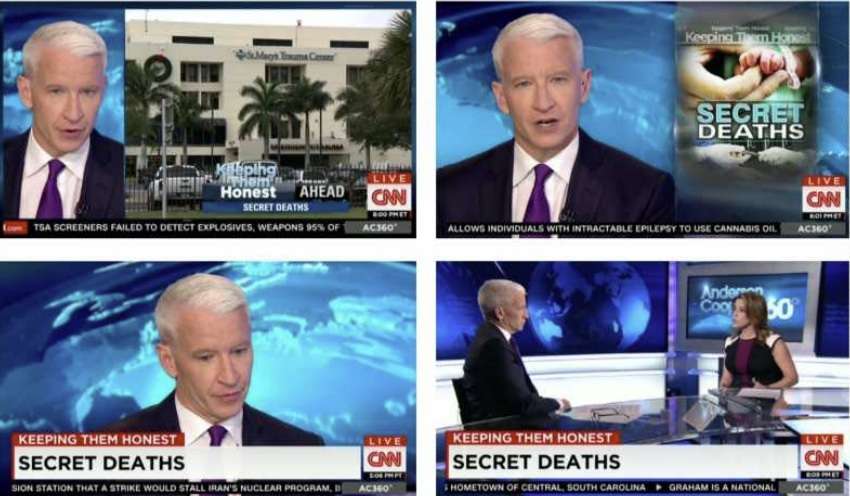
From Black v. CNN, Inc., decided yesterday by Florida Court of Appeal (4th Dist.) Chief Judge Jeffrey Kuntz, joined by Judges Spencer Levine and Alan Forst:
After CNN.com published a story about "surgeries gone wrong" at St. Mary's Hospital, CNN's Anderson Cooper 360°, a television program anchored by Anderson Cooper reported on "secret deaths" at the hospital. Cooper told his audience that these secret deaths stemmed from the surgeon leading the program, Dr. Michael D. Black, failing to conduct the surgeries safely. Cooper even asked why Dr. Black was allowed to continue operating…. Dr. Black filed a defamation lawsuit against the defendants ….
We express no opinion on the merits of Dr. Black's claim. But Dr. Black presented evidence alleging CNN and its employees published a story implying Dr. Black's allegedly deficient performance caused babies to die. The evidence is such that a reasonable jury could return a verdict for Dr. Black….
The factual summary is long, and available in the opinion; but the heart of the dispute had to do with whether CNN falsely portrayed Black as a dangerous doctor based on the raw mortality rate of his operations, which wasn't controlled for their difficulty; here is one of the allegedly libelous statements:
According to the documents CNN obtained from the state, from 2011 to 2013, [St. Mary's] performed 48 open heart surgeries on children and babies. Independently, CNN determined that six infants died, and confirmed the deaths with parents of all six children. From those numbers, CNN was able to calculate the death rate for open heart surgeries as 12.5%, more than three times the national average of 3.3% cited by [STS].
Here's the court's analysis:
Celebrate your independence with a subscription to Reason magazine, your most trusted source of honest, insightful news and analysis.




