Many people know Thomas Jefferson's phrase about a "wall of separation between church and state." Fewer know how that phrase entered constitutional law. It's a curious story, which I discuss in a new Legal Spirits podcast with historians Don and Lisa Drakeman.
The story begins with Jefferson's 1802 letter to the Danbury Baptists, written to reassure them that he shared their view of church-state relations. In that letter, Jefferson wrote that the First Amendment had built "a wall of separation between church and state." The metaphor was memorable, but the letter was not widely circulated and largely disappeared from public memory.
This was not surprising. Jefferson played no direct role in drafting of the Constitution or the First Amendment. Although he wrote the Virginia Statute for Religious Freedom in the 1780s, which influenced American thinking about liberty of conscience, he was abroad during the Philadelphia Convention and, by the time Congress proposed the Bill of Rights in 1789, he was serving as Secretary of State. The Religion Clauses were the product of Madison and the First Congress, not Jefferson.
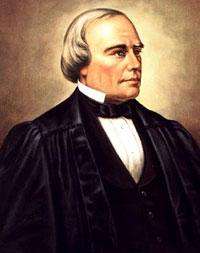
The Danbury letter might have remained obscure but for a rediscovery in the 1870s. Chief Justice Morrison Waite, with the help of his neighbor, historian George Bancroft, came across the letter and cited it in Reynolds v. United States (1879). The Court in Reynolds upheld the federal government's prosecution of a Mormon defendant for practicing polygamy, despite his claim of religious obligation. Waite distinguished between belief and conduct: Congress could not legislate about belief, but it could regulate conduct that violated social duties or threatened public order. To support this distinction, Waite quoted Jefferson's Danbury letter, treating him as an authoritative interpreter of the First Amendment.
But Waite didn't stop there. He also invoked an earlier piece of Jefferson correspondence, a letter to a Virginia wine merchant, in which Jefferson remarked that the Constitution should be ratified and then amended to add an express protection for religious freedom. That letter was largely about Jefferson's views on wine, not constitutional design, yet Waite used it to suggest that Jefferson was an "acknowledged leader" of the movement for a bill of rights. By relying on this passing aside, buried in a letter on an entirely different subject, Waite sought to link Jefferson directly to the First Amendment.
The move was "stunningly flimsy," the Drakemans argue. Jefferson's letters were written in contexts removed from the adoption of the First Amendment. Yet Waite elevated them into constitutional law, where they would play an outsized role for more than a century.
Indeed, Jefferson's metaphor of the "wall of separation" dominated the Court's Establishment Clause jurisprudence in the twentieth century. Although the Court has stepped away from the metaphor in recent decades, preferring instead a "history and tradition" approach, Jefferson's words remain influential in law and politics. Few metaphors in American constitutional history have had greater staying power.
This curious episode illustrates both the power and the risks of judicial reliance on history. Offhand remarks in private correspondence—about constitutional law, but mostly about Bordeaux—became touchstones for constitutional doctrine. The episode reminds us that history can take on a life of its own in ways the Founders themselves never imagined.
In the podcast, the Drakemans and I discuss Jefferson, Waite, and Bancroft, the risks of amateur history at the Court, and Jefferson's other writings on religious freedom. You can listen to the full conversation here.
I'm finishing serializing my forthcoming Emory Law Journal article titled Addiction to Constitutionally Protected Activity: Speech, Press, and Religion. In my earlier posts, I argued that concerns about psychological addiction can't justify restrictions that interfere with behavior presumptively protected by the Free Exercise Clause. I then turned to arguing that these concerns likewise generally can't justify restrictions with behavior presumptively protected by the Free Speech or Press Clause. Today, I close with the question whether some such restrictions may be upheld when focused on speech that reaches minors.
[* * *]
Perhaps because of the First Amendment concerns mentioned above, much of the discussion of regulating addictive technologies has focused on regulating use by minors, not by adults.[115]
The Court has generally concluded that minors have largely the same First Amendment rights as adults,[116] with the historically grounded exception of access to sexually themed material.[117] Justice Thomas has recently taken the view that the Free Speech Clause "does not include a right to speak to minors (or a right of minors to access speech) without going through the minors' parents or guardians";[118] but no other Justices have joined him.
In particular, the Court has held that minors have the same rights as adults to engage in political speech, including campaign contributions.[119] Presumably that would extend to consumption of political commentary and other opinion on public issues on social media. Minors also have the same rights as adults to access nonsexual entertainment,[120] including supposedly harmful material such as violent video games:[121]
Minors are entitled to a significant measure of First Amendment protection, and only in relatively narrow and well-defined circumstances may government bar public dissemination of protected materials to them. No doubt a State possesses legitimate power to protect children from harm, but that does not include a free-floating power to restrict the ideas to which children may be exposed. Speech that is neither obscene as to youths nor subject to some other legitimate proscription cannot be suppressed solely to protect the young from ideas or images that a legislative body thinks unsuitable for them.[122]
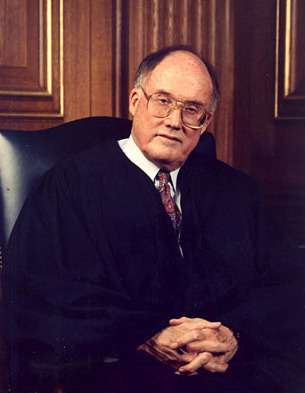
Last month I wrote a post about Judge William Young of the U.S. District Court for the District of Massachusetts.
I offered this unsolicited advice:
Judge Young turns 85 later this month. He has had a distinguished judicial career spanning half a century. A lot has changed since he graduated law school in 1967. Perhaps this apology provides a moment to reconsider where his talents and efforts are best suited.
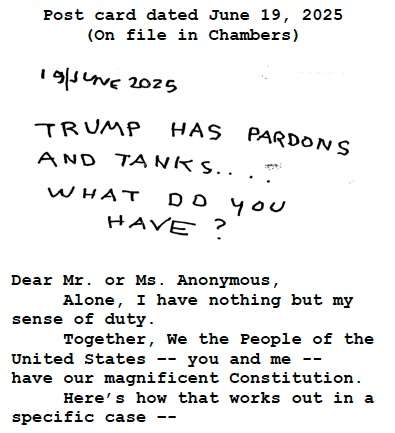
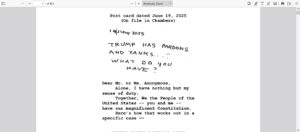
Judge Young did not take my advice. Instead, he styled a judicial decision as a 161-page letter to an anonymous postcard writer. It began in this fashion:
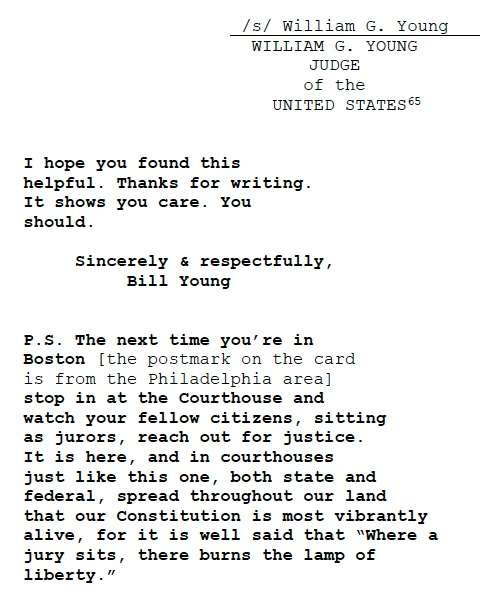
And closed like this:
I offer no comments on the merits here. Instead, I see the case of a judge who has forgotten what the judicial role is. Perhaps Judge Young has been led astray by zealous clerks who are taking advantage of the situation. Perhaps Judge Young is ignoring advice from friends and colleagues, and wrote this decision himself. Or perhaps there is some other situation at hand. I don't know.
Judge Young should step down. Article III offers life tenure, not a life sentence. Judge Young already took senior status during the early Biden Administration, so Trump cannot name his replacement. And Young's absence would have no negative impact on restraining President Trump. Indeed, quite the opposite would be true. Any other judge in Boston could reach the same result, with an opinion that is far less likely to be reversed. To paraphrase William F. Buckley, I would rather be governed by the first 2,000 people in the Boston telephone directory than by Judge Young.
Let this 161-page decision be Judge Young's magnum, and farewell, opus.
Today, in AAUP v. Rubio, federal district Judge William G. Young (appointed by Ronald Reagan) ruled that speech-based deportations of foreign students and academics violate the First Amendment. Here is his summary of his long and detailed ruling (which runs to 161 pages in all):
This case -– perhaps the most important ever to fall within the jurisdiction of this district court –- squarely presents the issue whether non-citizens lawfully present here in United States actually have the same free speech rights as the rest of us. The Court answers this Constitutional question unequivocally "yes, they do." "No law" means "no law." The First Amendment does not draw President Trump's invidious distinction [between citizens and non-citizens] and it is not to be found in our history or jurisprudence… No one's freedom of speech is unlimited, of course, but these limits are the same for both citizens and non-citizens alike.
With this constitution ruling firmly undergirding its approach, the Court here held a full hearing and a nine-day bench trial on the issue of whether the rights of these plaintiffs to constitutional freedom of speech have been unconstitutionally chilled by the deliberate conduct of any or all of these Public Official defendants. The Court heard 15 witnesses and admitted 250 exhibits consisting of documents, photographs, and video clips.
Having carefully considered the entirety of the record, this Court finds by clear and convincing evidence that the Secretary of Homeland Security Kristi Noem and the Secretary of State Marco Rubio, together with the subordinate officials and agents of each of them, deliberately and with purposeful aforethought, did so concert their actions and those of their two departments intentionally to chill the rights to freedom of speech and peacefully to assemble of the non-citizen plaintiff members of the plaintiff associations. What remains after issuing this opinion is to consider what, if anything, may be done to remedy these constitutional violations.
Much of the opinion is a long detailed recitation of the extensive evidence showing that the administration does indeed have a policy of targeting non-citizen students and university employees for deportation based on their anti-Israel or pro-Palestinian speech. One can quibble with some of the details here. But the combined weight of evidence is overwhelming, in so far as high officials from the president on down have openly said that is what they are doing. In several cases, such as that of Tufts graduate student Rumeysa Ozturk, they have indeed tried to deport people whose only offense was to engage in speech disapproved of by the administration. Thus, Judge Young is right to conclude there is a basis for a lawsuit by the AAUP and the Middle East Studies Association, both of which have members vulnerable to deportation under the policy.
The latter part of the opinion (beginning at pg. 116) has a solid explanation of why the First Amendment's protection for freedom of speech applies to non-citizens present in the US, and why Supreme Court precedent supports that position, or at least does not preclude it. Here is one key point:
Lastly,…. this Court observes that, on its face, the First Amendment does not distinguish between citizens and noncitizens; rather, it states simply, "Congress shall make no law . . . abridging the freedom of speech[.]" U.S. Const. amend. I. As the Supreme Court's now frequently cited statement in Bridges v. Wixon confirmed, this text at least arguably implies that "[f]reedom of speech . . . is accorded aliens residing in this country." 326 U.S. 135, 148 (1945). It also suggests something a little less obvious, but still worth saying, which is that its chief concern is with the character and quality of the "speech" that occurs on American soil, in what Justice Holmes called "free trade in ideas," which is "the best test of truth," Abrams v. United States, 250 U.S. 616, 630 (1919), and ensuring that Congress may not twist that speech in the federal government's preferred direction….
As I have pointed out previously, the First Amendment, like most constitutional rights is phrased as a generalized limitation on government power, not a privilege limited to a specific group, such as citizens. A few rights are explicitly confined to citizens (such as the Privileges or Immunities Clause of the Fourteenth Amendment) or to "the people" (such as the Second Amendment right to bear arms), which may be a euphemism for citizens. But that makes it all the more clear that rights not explicitly limited to citizens apply to everyone, without exception.
I have defended applying the First Amendment to non-citizens in greater detail elsewhere (e.g. here and here), including responding to the view that speech-based deportations are permissible because non-citizens have no inherent legal right to be in the US:
The text of the First Amendment is worded as a general limitation on government power, not a form of special protection for a particular group of people, such as US citizens or permanent residents. The Supreme Court held as much in a 1945 case, where they ruled that "Freedom of speech and of press is accorded aliens residing in this country."
A standard response to this view is the idea that, even if non-citizens have a right to free speech, they don't have a constitutional right to stay in the US. Thus, deporting them for their speech doesn't violate the Constitution. But, in virtually every other context, it is clear that depriving people of a right as punishment for their speech violates the First Amendment, even if the right they lose does not itself have constitutional status. For example, there is no constitutional right to get Social Security benefits. But a law that barred critics of the President from getting those benefits would obviously violate the First Amendment. The same logic applies in the immigration context.
While Judge Young's ruling - following Supreme Court precedent - applies a distinction between speech-based initial exclusions and speech-based deportations (allowing greater scope for the former), I would argue both are equally unconstitutional.
As Judge Young notes, today's ruling follows a number of previous court decisions reaching similar conclusions about Trump's speech-based deportations. But his analysis is particularly thorough and compelling.
Judge Young's opinion includes a number of rhetorical flourishes that some might consider inappropriate for a judicial ruling. For example, the beginning and end are framed as a response to an anonymous postcard sent to the court:
If I were in the judge's place, I probably would not have done this. While I share Judge Young's dismay at the administration's illegal actions, these remarks are unlikely to persuade readers who aren't otherwise inclined to agree with his reasoning. And the predictable controversy they engender could divert attention from the substantive reasoning underlying the court's ruling. They might also provide critics with an excuse to dismiss that reasoning without seriously engaging with it, by claiming that the judge was acting inappropriately.
That said, the debate over the appropriateness of some of the rhetoric in the opinion should not detract from the substance of Judge Young's reasoning, which is strong, and a good model for future court decisions on this issue.
In addition to the factual record and the constitutional questions, the ruling also covers claims under the Administrative Procedure Act, and a number of procedural questions (e.g. - associational standing for the plaintiffs), which I will not attempt to assess here.
The legal battle over speech-based deportations will continue. I hope higher courts will follow Judge Young's and other district courts' lead, and hold there is no immigration exception to the First Amendment.
From Thursday's decision by Magistrate Judge Elizabeth Preston Deavers in Doe v. Ohio Supreme Court:
Plaintiff alleges that the Universal Bar Examination score required by Defendant Ohio Board of Bar Examiners has a disparate impact on African Americans; Defendants' conduct exhibits a pattern, or practice of intentional discrimination, or a deliberate indifference to the rights of African American Bar Candidates as well as unequal treatment"; Defendant Supreme Court of Ohio's licensing standards for attorneys are not equally applied; Defendants' scoring of Plaintiff's three bar exams was racially discriminatory; Defendant Supreme Court of Ohio's adoption of "Rule I Section 1(E) of the Supreme Court Rules for the Government of the Bar of Ohio" violates the Fourteenth Amendment; Defendant Supreme Court of Ohio permitted "its employees to participate in a pattern, or practice of intentional discrimination, or allowed its employees" to violate the Fourteenth Amendment and federal and state laws; and Defendants behavior regarding Rule I Section 1(E) negligently caused Plaintiff emotional distress….
Plaintiff argues [in support of her request to proceed pseudonymously] that her "suit challenge [sic] governmental activity, [her] claim involves sensitive topics including Bar licensing failures, racial discrimination and Civil Rights violations, and an affirmative ruling does not force the Defendants to proceed with insufficient information to present their arguments against Plaintiff's claim." Plaintiff further asserts that public announcement of her multiple unsuccessful attempts to pass the bar exam "may place Plaintiff at risk of failing to obtain future employment, and it may affect Plaintiff's ability to attract future clients …."
From yesterday's order by Seventh Circuit Judges Diane Sykes, Frank Easterbrook & Michael Brennan in Doe v. M.S.:
Plaintiff seeks to hold two detectives liable under 42 U.S.C. § 1983 for making statements, when visiting his cell, that may have allowed other inmates to infer that he has supplied valuable information to law-enforcement personnel. The district court denied defendants' motion for summary judgment, and they have appealed.
The district court entered an order sealing the litigation in large measure, which effectively created anonymity for the litigants and any potential witnesses. A motion to continue the sealing during the appeal led to a one-judge order denying that request but requiring anonymity all around. The result is that the parties have filed public briefs but not identified the persons involved. After hearing oral argument, this court now concludes that anonymity is inappropriate given this court's strong presumption that adult litigants must use their own names. See, e.g., Doe v. Loyola University Chicago, 100 F.4th 910 (7th Cir. 2024); Doe v. Indiana University, 101 F.4th 485, 491–93 (7th Cir. 2024); Doe v. Blue Cross & Blue Shield United of Wisconsin, 112 F.3d 869, 872 (7th Cir. 1997).
As far as we can see, anonymity for the defendants is utterly inappropriate. Police officers, prison guards, and many other public officials are regularly sued in their own names on account of acts said to be unlawful or even unconstitutional. At oral argument counsel for the defendants consented to the use of their names. Counsel suggested that the district judge may have believed that identifying the defendants would have identified the plaintiff too, but any such belief is unsupported. The defendants are police officers who have dealt with hundreds if not thousands of prisoners over the years. Publication of defendants' identities would not point to any one prisoner.
Plaintiff sought to remain anonymous out of a professed fear that he would be harmed by other inmates.
This case involves the civil forfeiture of wild oysters …. The fisherman and claimant, Cheenulka Pocknett, holds a valid commercial shellfishing permit issued by the Division of Marine Fisheries (DMF). He is also a member of the Mashpee Wampanoag Tribe and, as such, has certain rights to fish for sustenance.
On Wednesday, December 4, 2019, Pocknett and a friend took a large number of wild oysters from Green Pond in Falmouth. Green Pond is closed to commercial fishing on Wednesdays (as well as Sundays, Mondays, and Fridays). See Chapter 275, Article II, § 15(D) of the Code of Falmouth. See also [Mass. Gen. Laws]. c. 130, § 52, par. 1 (authorizing municipalities to regulate shellfish fisheries). {The town of Falmouth created the Green Pond oyster fishery through aquaculture, and the restrictions are presumably to prevent overfishing.}
Pocknett kept some oysters for personal consumption; the Commonwealth took no action regarding those oysters and appears to recognize Pocknett's right to take oysters for personal consumption. Pocknett placed 1,600 oysters in containers and affixed the containers with "DMF-required shellfish tags with [his] name[ ], [his] DMF issued permit number, as well as the date, time and location of the harvest." He then sold those oysters to Big Rock Oysters in Harwich, a licensed wholesale shellfish dealer.
Plaintiff Karen Cahall is a third-grade math and science teacher …. The District, acting through one of the other individual Defendants—Superintendent Tracey Miller—imposed a three-day unpaid suspension on Cahall, asserting that she had violated the District's "controversial issues" policy based on certain reading materials she made available to the students in her classroom….
Cahall maintains a collection of books in her classroom that she makes available to students to read during in-class free time, but that she does not otherwise use in connection with instructing the students. The instant controversy arose when a parent complained about some of the books that Cahall included in that collection. In particular, in light of recent events that had occurred at the school (more on that below), Cahall decided to add four books to her collection: Ana on the Edge; The Fabulous Zed Watson; Hazel Bly and the Deep Blue Sea; and Too Bright to See.
As Cahall describes them, these books "each deal with characters who are LGBTQ+ and are coming to terms with feeling different and excluded simply because they are LGBTQ+." According to Cahall, the books "serve to reinforce [her] sincerely held moral and religious beliefs that all children, including children who are LGBTQ+ or the children of parents who are LGBTQ+, deserve to be respected, accepted, and loved for who they are."…
Cahall says her decision to add these books to her classroom collection grew out of what she describes as an earlier "controversy in the New Richmond District." According to Cahall, just before the 2021–22 school year, the District was considering allowing teachers to "wear Rainbow stickers on their name tags, or to display them on laptop cases or desk nameplates to show that [the teachers] were safe for LGBTQ+ students to confide in or to seek advice from." The District was also considering whether to provide students forms on which they could designate their "preferred gender identity preferred pronouns and name."
I'm serializing my forthcoming Emory Law Journal article titled Addiction to Constitutionally Protected Activity: Speech, Press, and Religion. In my earlier posts, I argued that concerns about psychological addiction can't justify restrictions that interfere with behavior presumptively protected by the Free Exercise Clause. In my post yesterday, I argued that these concerns likewise generally can't justify restrictions with behavior presumptively protected by the Free Speech or Press Clause, which includes most aspects of social media and video game interface design. Today, I turn to the question whether some of the restrictions may be upheld on the grounds that they are content-neutral.
[* * *]
For the reasons given above, content-based restrictions aimed at preventing "addiction" are very likely unconstitutional: They would be judged under strict scrutiny, which "as a practical matter, it is fatal in fact absent truly extraordinary circumstances."[102]
For instance, restrictions on "[d]isplay[ing] personal interactive metrics that indicate the number of times other users have clicked a button to indicate their reaction to content or have shared or reposted the content"[103] target the communication of particular facts, and restrictions on communicating particular facts are content-based.[104] The same is likely true of restrictions on speech that favorably reports the amount of time the user has remained on a site—e.g., "'badges,' 'streaks,' 'trophies,' and 'emojis' given to frequent users"[105]—or that more broadly notifies users about content created by the social media platforms or video games.[106]
Likewise, laws that are justified by a desire to prevent the amplification of "extremist" viewpoints are content-based as well.[107] Same, I think, for laws justified by a concern that excessive use of social media leads to body image problems by exposing one to too many idealized and possibly edited photos of beautiful people.[108]
Department of State v. AIDS Vaccine Advocacy Coalition strongly suggested that private litigants cannot bring suit under the APA to enforce the Impoundment Control Act. If that (interim) ruling is correct, how can the Impoundment Control Act be enforced?
Justice Kagan, in dissent, explained that the Comptroller General can enforce the law through a lawsuit:
Second, the Act gives the Comptroller General (a legislative officer) a way to sue over presidential impoundments. If he believes the President is unlawfully withholding funds, he is to send a report to Congress saying so. See § 686. And after a specified time, he may bring a civil action under the Act to compel the Executive to obligate the funds at issue. See § 687. According to the Executive's application for a stay, that statutory scheme "impliedly preclude[s]" the plaintiff organizations from bringing an APA suit to similarly enforce appropriations laws. Application 18. That suit, the Executive argues, would "supplant[ ] interbranch negotiations" and "leapfrog[ ] the Comptroller General" if allowed to go forward. Id., at 20
There is a lot to unpack here. As a threshold matter, Kagan stresses that the Comptroller General is a "legislative officer." No matter how hard Justice Kagan tries, she can never get away from more "officer stuff."
The Supreme Court, per Chief Justice Burger, discussed the status of the Comptroller General in Bowsher v. Synar (1986). This decision, which was decided on Burger's last day on the bench, ruled that Congress could not play a role in the Comptroller General's removal. Here is a snippet of the decision:
Appellants suggest that the duties assigned to the Comptroller General in the Act are essentially ministerial and mechanical, so that their performance does not constitute "execution of the law" in a meaningful sense. On the contrary, we view these functions as plainly entailing execution of the law in constitutional terms. Interpreting a law enacted by Congress to implement the legislative mandate is the very essence of "execution" of the law.
Kagan briefly asserting that the Comptroller General is a "legislative officer" doesn't do much work. Exactly in what regard the Comptroller General is a "legislative officer" is a question that has lingered for nearly four decades. There is an argument that the Comptroller General exercises executive powers, and accordingly, would be viewed as an executive officer. And if Slaughter goes the way we all think it will go, the President might be able to remove the Comptroller General at will.
More importantly, if the Comptroller General is a member of the executive branch, there will be a justiciability question of whether the CG could sue the President. Wouldn't this simply be an intrabranch dispute that does not belong in Court? United States v. Nixon held that the Special Prosecutor could issue the subpoena to President Nixon because there was a binding regulation in effect that allowed him to do so. This was an application of the so-called Accardi principle.
I know many nonlawyers are using generative AI to represent themselves in litigation. Some of them I learn about because courts spot hallucinated citations in their filings; but I expect that many others are much more careful, and that some may have actually been relatively successful. I doubt that generative AI is good enough right now to match a competent trained lawyer's written work all by itself. But for many self-represented litigants, the question is how AI—with the litigant's checking and editing—compares to just their own untrained selves, not how AI compares to a competent but unaffordable lawyer.
I'd like to learn more about this; if you or someone you know has litigated as a layperson with AI help, I'd love to hear the details. (If I write about it, I will not publish your name or other identifying details, unless you want me to.) What did you find the AI did well? What did you find it did badly? What did you do to try to improve the AI drafts, and do you think that worked out well? I'd like to know all this whether you won or lost.
Please e-mail me at volokh at stanford.edu if you have something you'd like to pass along. Thanks!