For a delightful moment, I thought Yale Law School decided to set up its naming hierarchy with animals on top, and underneath it with separate directories for people, cats, dogs (whether pets or bulldog mascots), and so on. Regrettably not: Turns out https://law.yale.edu/animals is the site of the Law, Environment & Animals Program, and the /people subdirectory is for the staff. Rats!
The Volokh Conspiracy
Mostly law professors | Sometimes contrarian | Often libertarian | Always independent | Est. 2002

"Courts Are Places to Resolve Judicial Disputes. They Are Not Playgrounds for Name-Calling. It Is More Than Past Time to Stop."
Probably not something the lawyers (or the litigants) want to see from a judge (in this case, Judge Robert Lehrburger in today's Rhee-Karn v. Lask).
Sikh and Non-Sikh Divorce, Disagree on Whether Children Should Get Haircuts
N.S. v. H.C., decided Friday by the California Court of Appeal (Justice Terry O'Rourke, joined by Justices Judith McConnell and Jose Castillo), involved a Sikh ex-husband, a "nonpracticing Christian" ex-wife, and a daughter and son who, "at the time of trial, … were seven and five years old respectively." The chief dispute had to do with whether the children should comply with various Sikh practices, including (1) not cutting their hair, (2) wearing religious bracelets, and (3) for the son, wearing a head covering (a patka). Here's an excerpt of the analysis as to the cutting of the hair:
The [trial] court concluded, "… The court finds that it is in the best interest of the children to feel comfortable with their hair and the length of the hair. However, the court finds that there have been times when mother has engaged in cutting [son's] hair, in particular, to intentionally upset … father. The court orders that if the children express a desire to have their hair cut, they may have their hair cut; however, at no time shall [son] receive a buzz cut and at no time shall [daughter's] hair be cut shorter than shoulder length. This assures that her father will still be able to braid her hair, notwithstanding that it is in two braids, rather than one braid." …
[The trial] court erred by failing to determine … whether mother had made a clear affirmative showing that if the children adhered to father's Sikh faith as regards the haircuts … it would be harmful to them. "[H]arm to the child from conflicting religious instructions or practices … should not be simply assumed or surmised; it must be demonstrated in detail."
Still the Stare Decisis Court (At Least For Now)
Even with a six-justice conservative majority, the Roberts Court has not (yet) increased the rate at which it overturns precedents.
The Roberts Court has attracted headlines overturning longstanding and high-profile precedents, including Roe v. Wade and Chevron v. NRDC. This term, the Court appears poised to topple another, Humphrey's Executor, if (as expected) it upholds President Trump's removal of Rebecca Slaughter from the Federal Trade Commission.
In the past, I have noted that the Roberts Court has overturned precedent less often than did the Warren, Burger, or Rehnquist Courts. Indeed, as I've blogged repeatedly and written in National Review, it is not particularly close, as shown in data compiled by the Library of Congress and in the Supreme Court database (which includes precedent alteration in its tabulations).
Given the rash of recent decisions overturning prominent precedents, it is reasonable to ask whether this claims are still true. The answer? Thus far it is. Even though the Court now has a six-justice conservative majority, which should make it easier to overturn precedents at odds with conservative jurisprudential principles, the rate at which the Court is overturning prior precedents has not (yet) increased. To the contrary, it appears to have slowed.
If one divides the Roberts Court into the first Roberts Court (2005-2020) and the second Roberts Court (2020-present), the rate at which the Court has overturned precedents is actually lower in the second Roberts Court (although for one of the three measures, the difference is minimal).
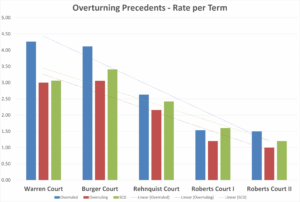
As illustrated in the accompanying chart*, whether one looks at cases overturning precedents per term, precedents overturned per term, or decisions altering precedent per term, we have not yet seen an increase in the rate at which the Roberts Court is overturning prior precedents. The confirmation of Justice Barrett to replace Justice Ginsburg unquestionably made the Court more conservative--and likely led to the overturning of Roe in Dobbs--it did not produce an immediate increase in the rate at which the Court has been moving the law in a conservative direction by overturning prior precedents.
These results may be surprising. There are multiple reasons why the shift from a 5-4 Court to a 6-3 Court would be expected to increase the number of precedents in jeopardy and the rate at which those precedents are overturned. It just has not happened yet.
One reason the Roberts Court has not overturned more precedent is that it hears fewer cases. It is stingy about granting certiorari, so it has fewer opportunities to overturn precedents.
At the same time, the Court appears somewhat deliberate about what cases it takes, and that includes what precedents it wants to revisit. The Court is overturning fewer precedents, but the precedents it is overturning may be higher profile. This may reflect a preference for stability in the law, accept when it comes to particularly significant decisions that push against the majority's jurisprudential vision.
I suspect it has been easier for the justices to coalesce about the need to overturn precedents that have long been targeted by conservative jurists, and for which the arguments for overturning the precedent are well developed and there is a fairly clear idea for what might replace the precedent. Roe, Chevron, Abood, and Bakke would all fit these criteria. But the number of such cases may not be as long as some think. And if the justices are hearing fewer cases, they are less likely to find themselves confronted with a case that requires reconsidering a precedent they had not already targeted.
It is also noting in this regard that since Justice Barrett has joined the Court, every case overturning a precedent that can be so characterized, moved the law in a more conservative direction. This stands in stark contrast to when Justice Kennedy was on the Court, and the Court would overturn precedents to move the law in both liberal and conservative directions, depending on Justice Kennedy's particular preferences.
It is also important to stress that it is still early, and what we have seen in the past few years--a Court wiling to overturn a few, high-profile precedents--may change. If the justices are interested in revisiting more areas of law, and reconsidering more precedents, cause attorneys and lower courts will likely give them the opportunity to do so.
[*Note: I initially uploaded the wrong version of the chart. This does not affect the bottom-line analysis, but did give an inaccurate picture of the magnitude change. I regret the error.]
No Defamation Liability for "Antagonistic Rants" Against Israeli Muslim Educational Institution, Including Claims It's Agent of Israeli Government
From Judge Paul Maloney's decision Friday in Al Qassimi Academy v. Abuhaltam (W.D. Mich.):
[Plaintiff] Al Qassimi Academy is an educational and religious institution serving the Muslim Arabic community in Israel. [Plaintiff] Abd Al-Raof Al-Qawasmi is a director and trustee on the Board of the Academy. He is also a member of the clergy in the Islamic community. Defendant resides in Okemos, Michigan. Using Facebook and other social media platforms, Defendant insults and mocks the Academy, its leaders and its faculty members.
Plaintiffs contend [in paragraph 41 of the Complaint that] Defendant has made the following [defamatory statements]:
[A.] calls for riots and violence against Al-Qasemi Academy and Al-Qasemi institutions.
[B.] using fighting words and inciting violence against the Plaintiff's Board members, educational staff, and their families, and thereby endangering their lives.
[C.] Defendant Abuhaltam uses computer graphic techniques such as Photoshop or other similar software tools to create images and/or change the shapes to mock, insult, defame, and slander the Plaintiff and its members.
[D]. Defendant Abuhaltam accuses Plaintiff and its members as "agents" and "proxies" of the government of Israel, thereby endangering their lives and property….
[F.] Defendant Abuhaltam posts slanderous and defamatory cartoon images of the Plaintiff's leaders and its members as "pigs" and other "pig-like" images. Pigs are considered by Muslims as vile, derogatory, disparaging, and filthy. Being depicted as pigs is the equivalent of an accusation of being heathens and disbelievers.
Today in Supreme Court History: October 20, 1973
10/20/1973: The Saturday Night Massacre occurs.
The First Citation of the Heritage Guide in a SCOTUS Brief
A very timely citation on the "Calling forth the Militia" Clause
One of the virtues of a project like the Heritage Guide to the Constitution is its utility. The constitutional history in that book will be used in future controversies that were not known when the book was written.
Case in point: the first citation to the guide comes in an amicus brief filed in Donald Trump v. Illinois. The brief cites the essay by Judge Greg Maggs and Professor Rob Leider on the Calling Forth the Militia Clause.
That determination is nonjusticiable because, as this Court held in Martin v. Mott, once Congress has authorized the President to call forth the militia when certain exigencies are present, "the authority to decide whether the exigency has arisen, belongs exclusively to the President, and that his decision is conclusive upon all other persons." 25 U.S. (12 Wheat.) 19, 30 (1827). Plaintiffs creatively packaged their request for an injunction against the President's determination in nine different boxes, see ECF No. 1, but all invited the district court (and this Court on appeal) to violate Mott by purporting to review and invalidate a decision that Supreme Court precedent has held is assigned to the political branches.
As scholars have recognized, Mott "held that Congress gave the President sole and unreviewable authority to determine when an emergency exists that is sufficient to justify deploying the militia." Judge Gregory E. Maggs & Robert Leider, The Calling Forth the Militia Clause, in THE HERITAGE GUIDE TO THE CONSTITUTION 218, 221 (Josh Blackman & John G. Malcolm eds., 3d ed. 2025). . . .
Under the Constitution, the states fully ceded to Congress their power to "provide for calling forth the Militia to execute the Laws of the Union." U.S. Const art. I, § 8, cl. 15. "The Constitution assigns the power to 'call forth the Militia' to Congress, and Congress has delegated portions of that power to the President." Newsom, 141 F.4th at 1055. It is "the clearest expression of federal power to conscript citizens." Maggs & Leider, supra, at 219 (emphasis added). Anti-Federalists had attempted during the ratification debates to "interject state governments into the process of calling forth the militia by requiring some form of state-level consent," but those efforts failed. Id. at 220.
I hope this is the first of many future citations.
Today in Supreme Court History: October 19, 1789
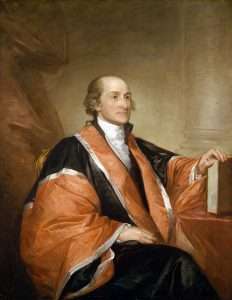
10/19/1789: Chief Justice John Jay takes oath.
Sunday Open Thread
What's on your mind?
District Court Dismisses Another Kids Climate Suit, As Existing Law Requires (Updated)
A suit asking a district court judge to undo every Trump Administration energy policy initiative is dismissed with prejudice; appeal to follow.
On Wednesday, Judge Dale Christensen on the U.S. District Court for the District of Montana "reluctantly" dismissed Lighthiser v. Trump, the latest "kids climate suit," on standing grounds. The only thing surprising about this was that Judge Christensen thought it was necessary to hold an evidentiary hearing, featuring multiple witnesses, before reaching this conclusion. Existing Ninth Circuit precedent--from Juliana v. United States, a prior kids climate case--clearly controlled the outcome.
As with prior kids climate cases, Lighthiser involved youth plaintiffs alleging that the federal government's failure to act more aggressively to control greenhouse gas emissions and mitigate climate change violated the plaintiffs' constitutional rights. In particular, the Lighthiser plaintiffs claimed that the Trump Administration's various energy-related Executive Orders and efforts to undo the Biden Administration's climate policies violate the Due Process Clause of the Constitution and are otherwise unlawful. As Judge Christensen noted, the plaintiffs were "effectively asking that this Court order the United States to return to the environmental policy of the previous administration."
Even had the court found a way around the Ninth Circuit's rejection of standing for similar claims in Juliana, the district court would still have been justified in dismissing the case. The Constitutional claim, like those in other kids climate cases, are audacious (to say the least) and at odds with existing jurisprudence. The Lighthiser plaintiffs were nonetheless able to get multiple prominent academics to serve as expert witnesses in their case.
Judge Christensen dismissed the case with prejudice, as he recognized that the plaintiffs faced more than a pleading problem, and any amendment to their complaint "would be futile." An appeal is likely. A different ultimate outcome is not. Even were the Ninth Circuit to reconsider its Juliana decision en banc, any decision allowing this litigation to proceed would be unlikely to survive a trip to One First Street.
UPDATE: The New York Times suggests the decision has a "silver-lining" for the plaintiffs. As a P.R. matter, that may be true. (Indeed, the NYT story would itself be evidence of that.) As a legal matter, not so much. As I told the Times:
Jonathan Adler, a professor at William & Mary Law School in Williamsburg, Va., who is not involved in the litigation, said the lawsuit was built on "fanciful" theories and its dismissal wasn't particularly surprising. Having young plaintiffs may make cases "a more interesting drama" for publicity reasons, he said, but it doesn't add legal heft. "This litigation is more about the court of public opinion than the courts of law," he said.
I disagree with Daniel Metzger of Columbia's Sabin Center for Climate Change Law that the decision offers "very detailed guidance for designing cases that can overcome the challenges this one faced," unless one understands that to mean that the opinion indicated that the only sorts of climate cases that can succeed are those that don't seek sweeping relief or advance broad constitutional claims.
Today in Supreme Court History: October 18, 1960
10/18/1960: Gomillion v. Lightfoot argued.
Seventh Circuit Rules Against Trump's Use of National Guard in Chicago
The Court of Appeals unanimously refused to stay a trial court ruling against Trump, signaling the judges believe his use of the Guard is illegal.
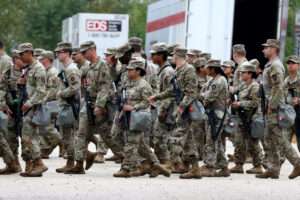
Yesterday, the US Court of Appeals for the Seventh Circuit refused to stay a district court ruling barring President Trump from using the National Guard in Illinois, ostensibly to counter violent protests against ICE deportation efforts. The court ruled that Trump was unlikely to prevail in this litigation, because the kind of emergency situations that legally permit federalization of the National Guard don't exist. Notably, the three judges were unanimous, and they include a George W. Bush appointee (Judge Ilana Diamond Rovner), an Obama appointee (Judge Hamilton), and a Trump appointee (Judge St. Eve). Thus, the ruling can't easily be depicted as a purely left-wing one.
This decision follows similar rulings by Illinois District Judge April Perry (which this decision refused to stay), Oregon District Judge Karin Immergut (a conservative Trump appointee), and California District Judge Charles Breyer (brother of former Supreme Court Justice Stephen Breyer). The three district court rulings lay out the issues in greater detail than the relatively brief Seventh Circuit decision, and all three are impressive and compelling, in my view.
Judge Breyer's decision was stayed by the Ninth Circuit appellate court, primarily on the grounds that he did not give enough deference to the president. I criticized that decision here. Significantly, the three more recent rulings against Trump on this issue have held there is no legal justification for his actions even under the Ninth Circuit's highly deferential approach. In a recent Dispatch article, I explain in detail why courts should not defer to executive determinations of whether an exigency justifying the use of extraordinary emergency powers exists. Otherwise, the executive could invoke such sweeping and dangerous powers anytime he wants, seriously threatening civil liberties and the structure of constitutional government. I also explain there why the executive's supposedly superior expertise is not a good reason for deference in such cases. A genuine massive emergency is readily apparent, and does not generally require specialized expertise to detect.
The statute Trump relied on, 10 U.S.C. Section 12406, can only be used to federalize state National Guard forces and use them for law enforcement in one of the following situations:
1) the United States, or any of the Commonwealths or possessions, is invaded or is in danger of invasion by a foreign nation;
(2) there is a rebellion or danger of a rebellion against the authority of the Government of the United States; or
(3) the President is unable with the regular forces to execute the laws of the United States
The Seventh Circuit explained why there is no "rebellion" going on in Illinois:
[W]e emphasize that the critical analysis of a "rebellion" centers on the nature of the resistance to governmental authority. Political opposition is not rebellion. A protest does not become a rebellion merely because the protestors advocate for myriad legal or policy changes, are well organized, call for significant changes to the structure of the U.S. government, use civil disobedience as a form of protest, or exercise their Second Amendment right to carry firearms as the law currently allows. Nor does a protest become a rebellion merely because of sporadic and isolated incidents of unlawful activity or even violence committed by rogue participants in the protest. Such conduct exceeds the scope of the First Amendment, of course, and law enforcement has apprehended the perpetrators accordingly. But because rebellions at least use deliberate, organized violence to resist governmental authority, the problematic incidents in this record clearly fall within the considerable daylight between protected speech and rebellion.
Applying our tentative understanding of "rebellion" to the district court's factual findings, and even after affording great deference to the President's evaluation of the circumstances, we see insufficient evidence of a rebellion or danger of rebellion in Illinois. The spirited, sustained, and occasionally violent actions of demonstrators in protest of the federal government's immigration policies and actions, without more, does not give rise to a danger of rebellion against the government's authority. The administration thus has not demonstrated that it is likely to succeed on this issue.
The court also explained why there is no inability to execute the laws with regular forces:
We turn next to the meaning of § 12406(3)—"unable with the regular forces to execute the laws of the United States." The administration exhorts us to accept the Ninth Circuit's reading of this subsection. In Newsom, the Ninth Circuit interpreted "unable" to mean that the federal government was "significantly impeded," and "regular forces" to mean "federal officers." 141 F.4th at 1052. The district court in this case, by contrast, concluded that the definition of "unable" is "not having sufficient power or ability; being incapable." And it determined that "regular forces" means the soldiers and officers serving in the regular armed forces.
We need not fully resolve these thorny and complex issues of statutory interpretation now, because we conclude that the administration has not met its burden under either standard. Even applying great deference to the administration's view of the facts, under the facts as found by the district court, there is insufficient evidence that protest activity in Illinois has significantly impeded the ability of federal officers to execute federal immigration laws. Federal facilities, including the processing facility in Broadview, have remained open despite regular demonstrations against the administration's immigration policies. And though federal officers have encountered sporadic disruptions, they have been quickly contained by local, state, and federal authorities. At the same time, immigration arrests and deportations have proceeded apace in Illinois over the past year, and the administration has been proclaiming the success of its current efforts to enforce immigration laws in the Chicago area. The administration accordingly is also unlikely to succeed on this argument.
Understood in context, I think inability to execute the laws with "regular forces" requires a massive breakdown of civil order, not simply a failure to apprehend all violators of federal law, or a situation where enforcement is "significantly impeded." The latter circumstances exists in almost every community in the nation, at virtually all times. Almost every community has large numbers of people who get away with violating one federal law or another, and whom law enforcement is unable to detect and prosecute.
For example, over 50% of adult Americans admit to having used marijuana at some point in their lives, and the true rate of usage is likely even higher; marijuana possession is a federal crime. Large percentages have also violated other federal laws and regulations without getting caught. As Judge Perry points out in the district court ruling in the Illinois case, "Defense counsel confirmed during oral argument that [the administration's position] would allow the federalization of the National Guard if there was any repeated or ongoing violation of federal law in a community." That state of affairs exists virtually everywhere at virtually all times.
There are various technical legal issues in these cases, and it is important that courts address them correctly. But it is even more important to recognize the big-picture issue well described in the three district court rulings: If the Trump Administration prevails, the president could federalize the National Guard against the will of state governments, and use it against Americans pretty much whenever he wants. Such domestic use of the military was, as Judge Perry recounts, one of the British abuses that led to the American Revolution, and we should not allow the President to act like King George III and Lord North. Courts can help ensure that domestic use of the military remains limited to extraordinary emergency circumstances, not become a normal practice that the president can invoke whenever he wants.
Short Circuit: An inexhaustive weekly compendium of rulings from the federal courts of appeal
Rebellion, bullet control, and vulgarity cloaked in euphemism.
Please enjoy the latest edition of Short Circuit, a weekly feature written by a bunch of people at the Institute for Justice.
At IJ's Center for Judicial Engagement, we've long argued that having judges who can say "no" to the executive branch are a crucial, necessary condition to freedom, prosperity, and the "rule of law." But just what does it mean to have a "rule of law"? Over at our blog, Anthony Sanders discusses the essentials.
New on the Bound By Oath podcast: For the final episode of Season 3, we survey several strands of Supreme Court precedent that make it really, really hard for Native Americans to put their property to peaceful and productive use.
- Gov't watchdog group brings FOIA lawsuit to force DOJ's Office of Legal Counsel to make several categories of its written opinions publicly accessible. D.C. Circuit: FOIA doesn't apply to any of the requested opinions, including those about interagency disputes, as they are neither adjudicatory nor adopted as the agency's working law. Watchdog group gets nothing. Concurrence: They should get nothing because they lack standing.
- New York requires ammunition sellers to conduct a background check on anyone buying ammunition. Ammunition sellers and gun owners sue and seek a preliminary injunction, alleging the law violates the Second Amendment. District court: The law is consistent with our historical traditions. Second Circuit: Actually, we don't even have to look at the history, because having to fill out some paperwork to buy bullets doesn't meaningfully constrain the right to keep and bear arms. Read More
Apparent "Fabricated Citations" in Smith v. Trump Motion Filed by One of the Defendants
In the underlying lawsuit, Capitol Police officers are suing over injuries sustained in the January 6 riot; the defendants include President Trump and many others, including Kelly Meggs (an Oath Keepers member). Yesterday's Order to Show Cause by Judge Amit Mehta (D.D.C.) orders Meggs' counsel to "show cause … why the court should not impose sanctions and make a referral to relevant bar authorities for "knowingly mak[ing] a false statement of … law to a tribunal or fail[ing] to correct a false statement of … law previously made to the tribunal by the lawyer":
On July 11, 2025, Plaintiffs filed a motion to compel various Defendants, including Defendant Meggs, to respond to discovery requests and respond to initial disclosures. Ms. Stewart [Meggs' lawyer] filed an opposition brief on behalf of Mr. Meggs ("Opposition"). The Opposition is rife with fabricated citations to this District Court's Local Civil Rules, such as: "Civil Procedure Rule 104 (7)-(8)," "local Rule 104," "D.D.C. local Rule 104(7)," "D.D.C. Rule 8(a)," "Court's Rule 8(a)," and "L.R. 104.8." Id. at 1, 5–7. These rules do not exist. The Opposition also includes fabricated block quotations purporting to recite the text of "D.D.C. local Rule 104(7)" and "D.D.C. Rule 8(a)."
"Viewpoint Diversity" Requirements as a New Fairness Doctrine: Conclusion
I have an article titled "Viewpoint Diversity" Requirements as a New Fairness Doctrine forthcoming in several months in the George Mason Law Review, and I've serialized a draft of it here. There is still time to edit it, so I'd love to hear people's feedback. The material below omits the footnotes (except a few that I've moved into text, marked with {}s, as I normally do when I move text within quotes); if you want to see the footnotes—or read the whole draft at once—you can read this PDF. Here is my Conclusion.
At many times in American history, the government has sought to promote the spread of ideas in various ways and to remove what it saw as interference with the spread of ideas. Early examples included the post office's lower rates for distributing newspapers and common carrier requirements for telegraph companies. Later, many state governments acted to protect private employees' political activity from retaliation by employers.
Some state and local governments have required private shopping malls to allow leafletters and signature gatherers, or barred landlords or places of public accommodation from excluding people based on their political activity. Federal, state, and local governments also often provide some sort of public funding for election campaigns. The availability of tax exemptions to nonprofit advocacy groups (at least ones that don't engage in electioneering or substantial amounts of lobbying) likewise helps promote "the diversity of association, viewpoint, and enterprise essential to a vigorous, pluralistic society." The candidate equal time rule—"[i]f any licensee shall permit … a legally qualified candidate for any public office to use a broadcasting station, he shall afford equal opportunities to all other such candidates for that office"—survived the death of the Fairness Doctrine.
Friday Open Thread
What's on your mind?
Court Concludes Filings (from >250-Lawyer Firm) Contained AI Hallucinations
Tovar v. American Automatic Fire Suppression Inc., decided Oct. 3 by San Diego County Superior Court Judge Carolyn M. Caietti, declined to impose sanctions on defendant's lawyers, because the plaintiff hadn't complied with certain procedural rules, but added:
Notwithstanding the denial on procedural grounds, the Court is deeply troubled by the conduct of Defense counsel. Defendants admitted to submitting authority that was miscited, non-existent or inapposite…. "Simply stated, no brief, pleading, motion, or any other paper filed in any court should contain any citations—whether provided by generative AI or any other source—that the attorney responsible for submitting the pleading has not personally read and verified." … [A] party's citation to fabricated legal authorities violate[] "a basic duty counsel owed to his client and the court" ….
One of Defendants' most recent motions contain both citations to cases that do not appear to exist and factual misrepresentations. On July 23, 2025, Defendants filed a motion to compel an independent medical examination of Plaintiff. There is a citation to a case that does not exist and a citation that does not stand for the premise asserted.
In addition, Attorney Woods' supporting declaration contained [non-AI-related] misrepresentations to the Court. [Details omitted. -EV]
Defendants also cite to a Notice of Errata filed in relation to the IME motion as having cured any false citations or misrepresentations. While the Notice of Errata removed citations to two of the cases cited, it more so "corrected" other citations to repealed statutes. It also minimized the citations to "clerical errors" that did not alter the substance of the legal argument presented. A stark contrast to the position taken by Defendants now.
Panel on Judicial Clerkships and Internships
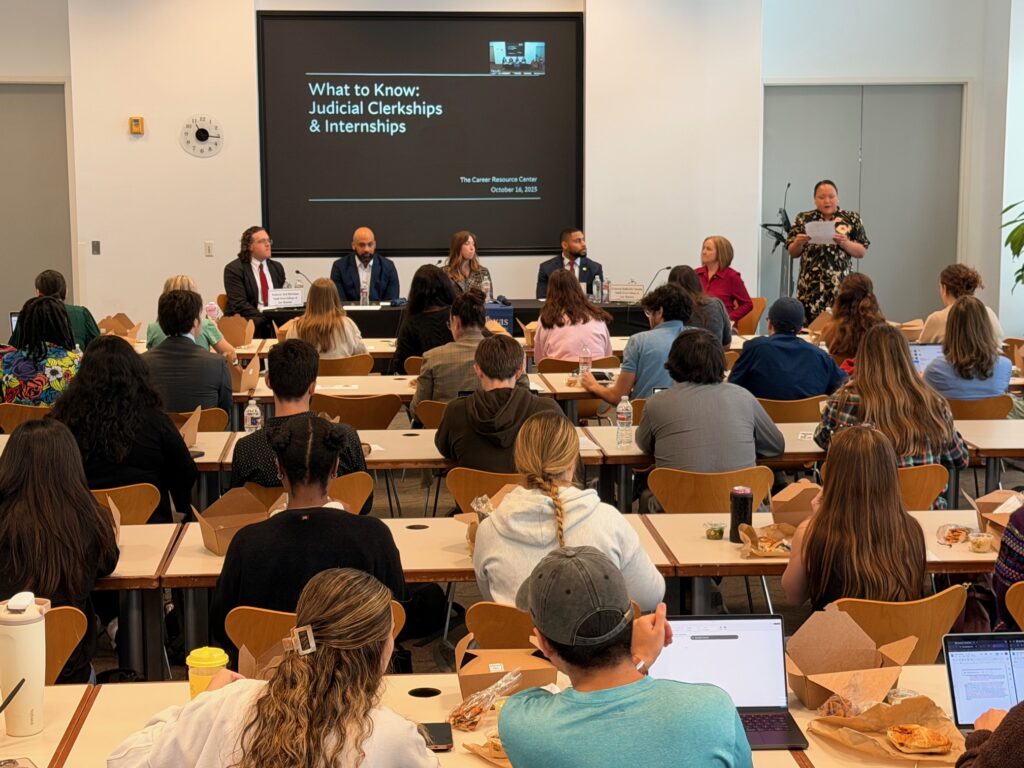
Today I led a panel at the South Texas College of Law Houston about judicial clerkships and internships. I was honored to be joined by three of our former students who clerked at the District Court, Fifth Circuit, and Supreme Court of Texas. I am very proud of our recent clerk placements, including seven students going to the Fifth Circuit, about the same number going to the Supreme Court of Texas, plus a host of students going to the federal district courts.
This video will be of interest to students at all law schools, and should also be of interest to those planning to go to law school--including at South Texas. If any students are applying to South Texas, they are welcome to sit in on my class. Please email me!