Records Show the Government Illegally Surveilled James Comey and Confirm the Absurdity of Its Case Against Him
The Secret Service asserted a nonexistent "emergency" to track Comey's cellphone, and the FBI's evidence falls far short of proving his seashell picture was a crime.
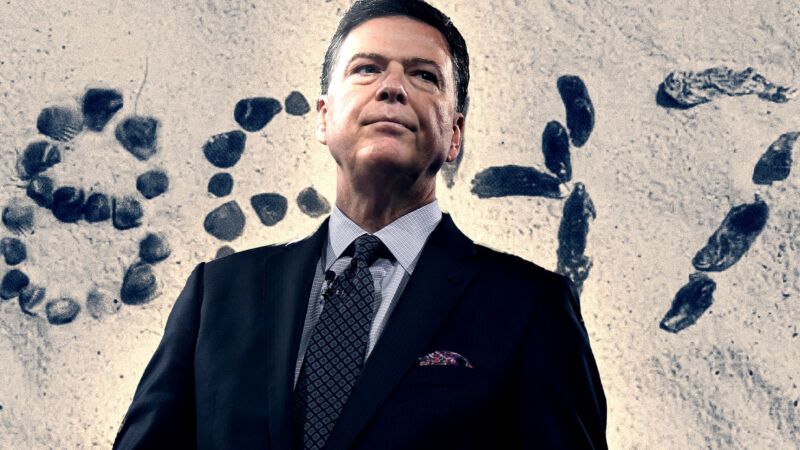
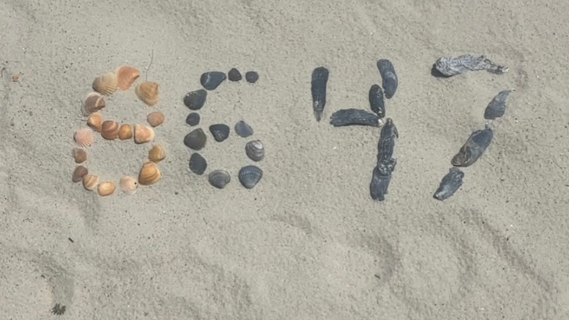
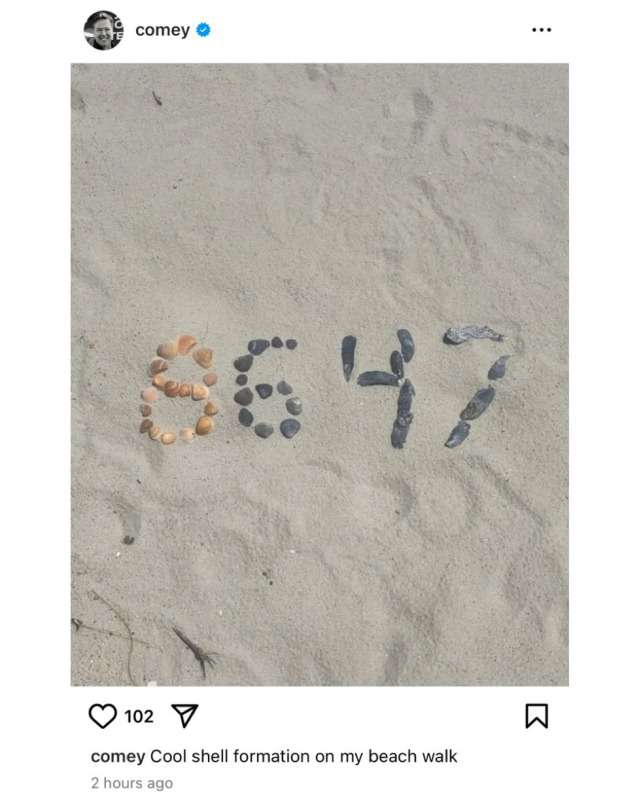
When former FBI Director James Comey used Instagram to share a photo of seashells arranged to form the numerical slogan "86 47" last year, federal prosecutors claim, he was publicly threatening to assassinate President Donald Trump. Yet before Comey posted that picture, Amazon vendors had offered more than 200,000 products featuring that supposedly homicidal phrase or variations on it, including "86 46" (referring to Joe Biden) and "86 45" (referring to Trump during his first term).
How many federal law enforcement inquiries did the sale or purchase of those products generate? Zero.
In a motion they filed on Tuesday night, Comey's attorneys cite that information from Amazon to support their argument that the April 28 indictment charging him with threatening the president should be dismissed because the prosecution is selective and vindictive, driven by Trump's personal animus against a longtime nemesis. They also submitted an affidavit in which Patrick J. Fitzgerald, one of Comey's lawyers, summarizes evidence that the defense obtained from the government through discovery. That evidence confirms that the Secret Service illegally surveilled Comey after he posted the seashell picture, and it contradicts Acting Attorney General Todd Blanche's account of how the case unfolded.
After Trump fired Attorney General Pam Bondi on April 2, Blanche was so desperate to secure his nomination to replace her that he eagerly pursued a legally absurd case against Comey based on a ubiquitous expression of opposition to the president that is clearly protected by the First Amendment. By posting that seashell photo, Blanche claimed with a straight face, Comey had committed two federal felonies punishable by up to 10 years in prison.
Comey took the picture at the center of the indictment while vacationing in North Carolina. He posted it on on May 15, 2025, with the jokey caption "cool shell formation on my beach walk." He took the post down within a few hours, offering this explanation: "I posted earlier a picture of some shells I saw today on a beach walk, which I assumed were a political message. I didn't realize some folks associate those numbers with violence. It never occurred to me but I oppose violence of any kind so I took the post down."
We already knew that the Secret Service tailed Comey and his wife as they drove back to their home in Virginia the day after the Instagram post. That was ridiculous enough, since it suggested that the former federal prosecutor, deputy attorney general, and FBI director might pose an active threat to the president's life. The new filings show that the Secret Service also submitted an "emergency" request for cellphone location information from Verizon so it could track Comey as he made his way back to Virginia.
The day of the Instagram post, a Secret Service special agent in charge (SAIC) "asked me about the possibility of pinging Comey's cell phone," an assistant to the SAIC (ATSAIC) reported in an email the next day. "I said it could be done, but it would be a bad idea."
Why? Under 18 USC 2702, a cellphone provider generally may not "knowingly divulge" customer records, but there is an exception when a "governmental entity" asks for the information if "the provider, in good faith, believes that an emergency involving danger of death or serious physical injury to any person requires disclosure without delay of communications relating to the emergency." In this case, there was no evidence to support such a belief.
"To declare an exigency exception" to the usual warrant requirement, the ATSAIC noted, "we needed to believe that there is an imminent threat to life or limb." At the time, he added, "we did not believe that anyone's life was in immediate danger," so "legally it was a bad idea to ping the phone." The ATSAIC said he "argued against taking this option" because it was "legally questionable." The SAIC "agreed with me but said we might do it anyway."
And so they did. On May 16, an agent filled out a form asking Verizon for Comey's location information, averring that the surveillance was "relate[d] to an emergency involving danger of death or serious physical injury to a person, necessitating disclosure without delay of information relating to that emergency." The agent, whose name is redacted in the copy of the form that Comey's lawyers filed in the U.S. District Court for the Eastern District of North Carolina, certified that "the foregoing is true and correct."
That agent said he "was asked by the SAIC to ping the cellphone of James Comey via exigency." He added that he did so "with hesitation." An assistant agent in charge (ASAIC) reported that "the #3 guy at DOJ 'wanted to ping the cellphone via an exigency request.'"
The Secret Service also interviewed Comey by phone the day of the Instagram post and again, in person, at the agency's headquarters in Washington, D.C., the next day. That interview, according to Fitzgerald's affidavit, "was attended in person by the General Counsel for Homeland Security, the General Counsel for the Secret Service, a Deputy Chief Counsel for the Secret Service, an Assistant U.S. Attorney from the Eastern District of Virginia, an ATSAIC from the Secret Service and a Special Agent from the Secret Service."
During a Fox News interview that morning, Trump had declared that Comey's seashell picture "meant assassination" and "says it loud and clear." Comey, he averred, was "calling for the assassination of the president."
A couple of hours after that interview, the Secret Service decided to start treating the phrase "86 47" as a potential indicator of violent intent. "Effective immediately, please include '8647' in manual keyterm searches for threats to POTUS," the directive said, because those four digits "could be coded threat language for 'kill the 47th President.'" Although "we will be in for a surge of discoveries/reports," it added, "please keep management informed and we will help manage the surge."
By the end of the day, the Secret Service had ditched that new policy. "As we figured," an assistant director said at 11:12 p.m., "this is a lot and we can't, nor should be expected to document all of these references to 8647. We should go back to business as usual, unless someone is inciting violence along with those numbers or adding egregious and threatening language."
Meanwhile, Trump was keenly interested in the Secret Service interview with Comey. In an email, SAIC John Bush, who was in charge of the Presidential Protective Division and traveling with Trump, said he was "getting LOTS of questions" about the interview and asked if he could "get an immediate readout." A Secret Service supervisor replied that he would "ask for the preliminary interview notes as soon as they are available." Around 12:15 p.m. that day, a Secret Service timeline noted, "POTUS was requesting a copy of the interview notes to use in his 6 pm press conference." Bush said "it is a hot topic on the plane and [the president] is very interested."
Bush received a summary of the 45-minute interview around 9:30 p.m., three hours after it was concluded. According to the Secret Service, Comey "presented a professional appearance, was eager to speak and agreed to the consensual conversation." He "answered all questions posed to him, and his attorney never stopped the interview."
The Secret Service had closed its investigation by November, classifying it as a "non-referred matter," meaning "the determination can be made based upon initial investigation that there is no risk of an unwanted outcome and there is no judicial outcome." But then the FBI launched its own investigation.
The day that Comey posted the seashell picture, FBI Director Kash Patel said his agency was "aware of the recent social media post by former FBI Director James Comey, directed at President Trump." He added that "primary jurisdiction is with [the Secret Service] on these matters and we, the FBI, will provide all necessary support."
Apparently unsatisfied with the outcome of the Secret Service investigation, the FBI shifted from support to instigation. But although its probe officially started on October 30, the flurry of investigative activity that Fitzgerald describes did not begin until April 13, about two weeks before the indictment, when the FBI finally got around to interviewing "Person-1," a hostile acquaintance of the Comeys whom the Secret Service had interviewed the previous May.
Person-1 had exchanged text messages with Comey's wife, Patrice, that resulted in the decision to take down the Instagram post. Patrice Comey reported that "Person-1 had contacted her to advise her that the post was being viewed by some as a call to violence against President Trump." Person-1, who had worked in the restaurant business, initially interpreted the "86" in Comey's photo in light of that experience ("like we're 86 on broccoli"). But after seeing right-wing reactions to the picture on social media, Person-1 decided that Comey's message had violent connotations.
Person-1 said that impression was reinforced by comments that former Trump lawyer Rudy Giuliani had made during a podcast five days after the Instagram post. Comey was "guilty as hell," Giuliani said. Given Comey's experience as a prosecutor in organized crime cases, Giuliani averred, he would have known that eighty-six means kill in mafia lingo. But Giuliani, who also had worked on organized crime cases as a federal prosecutor, conceded during a Newsmax interview the same day that "I didn't know what it meant until my boys told me."
In an effort to support a sinister interpretation of Comey's picture, the FBI's Charlotte field office searched the agency's database of investigations. "These searches produced inconclusive results regarding the use of '86' or 'eighty-six' as a slang term," it reported. "Additionally, the searcher was unable to determine if the subject [Comey] would have had access or been exposed to any potential files meeting the search parameters."
The FBI also searched records related to United States v. John Gambino, an organized crime case that Comey prosecuted in 1993, and United States v. Salerno, which Giuliani had prosecuted in the mid-1980s. Those searches, which continued into the night before the indictment, likewise found no "86" references.
On May 6, about a week after the indictment, the FBI case agent conducted telephone interviews with two retired agents. One agent, who "had worked organized crime cases in New York and was specifically assigned to the FBI squad that investigated the Gambino crime family," reported that he "was familiar with the term '86' and used it and heard others use it throughout his life." He "never understood the term '86' to mean to kill." He "did not recall any instances in which he heard organized crime subjects or sources use '86' to mean to kill someone."
The other retired agent, who "had worked organized crime cases in New York for
a 'very long time,'" could not recall "any instance where '86' was used in the organized crime context to mean 'kill.'" He "understood the term to be used by organized crime to mean 'get rid of things.'"
The day after those interviews, at the direction of W. Ellis Boyle, the U.S. attorney for the Eastern District of North Carolina, the FBI "conducted both open-source queries and artificial intelligence searches—namely, on Google AI and ChatGPT—about the term '86,'" Fitzgerald says. Regarding the government's premise that eighty-six means kill, one result said "many career law enforcement officials, including former FBI agents, have publicly disputed this, stating they never heard '86' being used for murder in 35+ years of duty, considering it purely a restaurant or bar [term] for removal." Another query "returned a document indicating that the Merriam-Webster dictionary does not officially enter a violent meaning for '86' because 'it is relatively recent and lacks widespread use compared to its hospitality meanings.'"
In a May 8 telephone interview with the case agent, by contrast, Salvatore "Sammy the Bull" Gravano, a cooperating witness in United States v. John Gambino, "stated his belief that Mr. Comey had to know what the term '86' meant 'as it related to killing someone.'" You would not expect that term to show up in legal or investigative records, Gravano said, because "members of organized crime families refrained from using terms such as '86' that were commonly used in day-to-day business in the presence of law enforcement officers."
Regardless of how often gangsters use eighty-six to mean kill, it is fair to say that is one of the verb's possible meanings. But it is by no means the only or most common usage. The term, which originated in the mid-20th century as a reference to banning unwanted bar customers, has since been extended to many other contexts. Generally speaking, it means "reject" or "discard," which explains why federal law enforcement agencies have never previously viewed phrases like "86 47" as grounds for criminal charges.
Since 2007, the FBI has maintained a database of "all communicated threats received by the FBI, comprised of thousands of images of letters, envelopes, and other communications." Comey's lawyers asked the government how many times eighty-six had appeared in that database prior to his indictment. The answer: zero.
To convict Comey, prosecutors have to prove beyond a reasonable doubt that he "consciously disregarded a substantial risk that his communications would be viewed as threatening violence," the minimum First Amendment standard for "true threats" under the Supreme Court's 2023 ruling in Counterman v. Colorado. One of the charges requires more: The government has to prove that Comey wanted people to view his seashell picture as a threat to kill the president.
In a Meet the Press interview five days after he announced Comey's indictment, Blanche conceded that the phrase "86 47" is "posted constantly" without triggering criminal charges. But in Comey's case, he said, it was "not just the Instagram post" that led to the indictment.
"This was an investigation that lasted 11 months," Blanche said. "If the only facts that existed was the posting of the Instagram [message], obviously that wouldn't have taken 11 months." The investigation, he claimed, turned up "witnesses," "documents," and "materials" that will be used to "prove intent."
That account glosses over the fact that the Secret Service, which Patel said had "primary jurisdiction" in the case, closed its investigation after concluding that there was "no risk of an unwanted outcome" and no basis for criminal charges. And when Blanche suggested that the government already had enough evidence to convict Comey, the FBI was still scrambling to shore up the government's case.
The post-indictment investigation that Fitzgerald describes, including the interviews with former FBI agents and the A.I. queries, mostly undermined that case. And while the Sammy the Bull interview supports the idea that eighty-six can have a murderous meaning, such evidence is a far cry from proving Comey understood that when he posted his picture, let alone that he intended it to be interpreted that way.
Still, Blanche was telling the truth when he said it is "not just the Instagram post" that resulted in Comey's indictment. The decision to charge Comey with two federal felonies based on constitutionally protected speech would be inexplicable but for Trump's personal vendetta against him and Blanche's eagerness to exact revenge at his boss's behest.