

Appeals Court Upholds Right To Film Police—but Grants Immunity to Cops Who Arrested a Connecticut Videographer
The 2nd Circuit is the latest federal circuit court to find a First Amendment right to record the police.
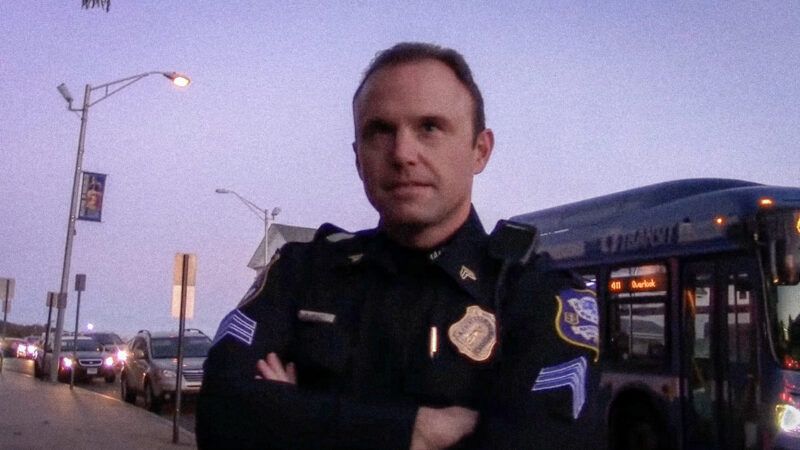
The U.S. Court of Appeals for the 2nd Circuit issued a landmark ruling Monday that a Connecticut man had a First Amendment right to film a police station from a public sidewalk, but it also ruled that the officers who arrested the man are immune from his lawsuit.
A three-judge panel of the 2nd Circuit held that Keith Massimino, a self-described "First Amendment auditing hobbyist," had a constitutional right to film the exterior of a police department in Waterbury, Connecticut, on an October evening in 2018.
"When the government wants to preserve its privacy, it may build a fence or close a door—but not ban speech," U.S. Circuit Judge Myrna Pérez wrote for the majority.
The panel's opinion creates binding precedent in Connecticut, New York, and Vermont, and, according to the opinion, it makes the 2nd Circuit the ninth federal circuit to agree on the issue. Although the Supreme Court has not ruled on the matter, every circuit court that has considered the issue has found an unambiguous First Amendment right to record and monitor the police, so long as one isn't physically interfering with or obstructing an officer.
"We begin by joining a growing chorus of our sister circuits that have recognized a First Amendment right to record law enforcement activity in public," Pérez wrote. "That right encompasses Massimino's recording of the exterior of a police station from a public sidewalk."
Waterbury police officers approached Massimino in 2018 while he was filming their police station and told him it was illegal to do so, which was false. Massimino is part of a growing trend of First Amendment auditors who film police and government employees to test their compliance with the Constitution. After Massimino gave vague answers about why he was filming and refused to produce his ID when ordered, the officers arrested him for obstruction. The misdemeanor charge was dismissed by prosecutors two and a half years later.
Massimino filed suit in 2021 for violations of his First and Fourth Amendment rights, represented by the American Civil Liberties Union of Connecticut (ACLU-CT). A federal district court dismissed his claims. Although the 2nd Circuit upheld Massimino's First Amendment right on appeal, it ruled that the right wasn't established at the time, making the Waterbury officers immune from his lawsuit. The appellate court also ruled that Massimino's behavior and refusal to hand over his ID gave the officers reasonable suspicion to stop him and probable cause to arrest him, voiding his Fourth Amendment claims.
Walter Olson, a senior fellow at the Cato Institute, a libertarian think tank, says the ruling is "a case of the bitter with the sweet."
It "helps secure an important First Amendment right for millions of people, and Keith Massimino deserves our gratitude and applause," Olson says. "Yet the court denied him simple justice in his own individual case."
Olson says that's a predictable result of qualified immunity, a legal doctrine that grants government employees immunity from civil suits when the right they violated wasn't "clearly established" at the time.
Civil liberties groups across the political spectrum say qualified immunity lets police officers and government employees bog down civil suits for years and escape accountability for gross violations of rights. The Cato Institute recently filed an amicus brief asking the Supreme Court to review and reverse a 6th Circuit decision granting qualified immunity to a Cleveland police officer who shot his partner while firing blindly into a boarding house bathroom.
"For now, I'm going to look on the brighter side," Olson says. "By the court's count, eight federal circuit courts had already recognized the First Amendment right to record police, while none took the contrary view. Now one of the most influential federal circuits, whose reach includes media center New York, has joined them."
Despite this broad consensus in the judiciary, local police officers have continued to arrest and retaliate against videographers, and the Department of Homeland Security has declared "surveillance" of law enforcement to be unlawful, extremist activity.
Nevertheless, the 2nd Circuit ruling puts police officers in three states on notice that they won't be able to escape civil suits in the future for identical arrests.
"This is big," Dan Barrett, legal director of the ACLU-CT, said in a press release. "It puts it in writing that the First Amendment protects our right to record the police in public. This decision is the difference between Connecticut residents being able to hold law enforcement accountable and the police deciding who gets to watch them work. It's a win for democratic oversight."




