

San Francisco's 'Historic Laundromat' Project Finally Begins Construction
Activists were able to block an apartment project in the city's Mission District by raising an increasingly ridiculous set of objections.
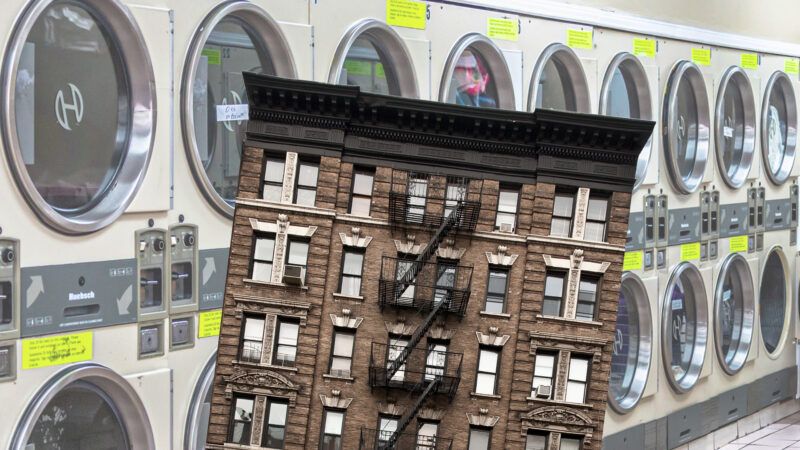
Happy Tuesday, and welcome to another edition of Rent Free. This week, we take a look at the final chapter in the long-running development battle over San Francisco's "historic laundromat."
'Historic Laundromat' Project Finally Begins Construction
When I first interviewed Robert Tillman about his effort to convert his laundromat in San Francisco's Mission District into a 75-unit apartment building in 2018, he quipped that "it's taken me longer to get to this point than it took for the United States to win World War II."
At that point, he'd already spent four years in the entitlement process and close to $1 million on predevelopment costs.
Rent Free Newsletter by Christian Britschgi. Get more of Christian's urban regulation, development, and zoning coverage.
Eight years on from that interview, and 12 years since Tillman initially proposed apartments on the site, the 75-unit project is finally beginning construction.
Observed on my afternoon run: construction is underway at the site of the Mission District's "Tillman laundromat."
The owner was a crank who said he'd sue the city rather than accede to "the groups," back at the dawn of the YIMBY era.
1/5 pic.twitter.com/T0oivu3YuB
— Chris Elmendorf (@CSElmendorf) August 13, 2026
The San Francisco Chronicle reports that developer Cresleigh Homes, which acquired the property from Tillman in 2019, has started site preparation and foundation work and will begin vertical construction next year.
Tillman's laundromat became a major flash point in San Francisco's development wars. It proved an illustrative case study of the city's complicated discretionary approval process and all the power that process gave local officials and antidevelopment activists to delay a project.
In Tillman's case, neighborhood activists were able to block his project for years by demanding he perform studies on the historic significance of his laundromat (turns out there wasn't any) and ensure the shadows cast by his project wouldn't stunt the growth of children at a nearby school (they'll be fine).
While activists put on compelling performances during public hearings, the environmental concerns they raised were not genuine. Demanding another shadow study was simply a way of keeping Tillman's project in costly development limbo until he eventually agreed to sell his land at a cut rate to a nonprofit developer.
This was something he refused to do. As Tillman explained to me at the time, he was trying to build a one-off project on land that he owned and which sported a money-making business.
That meant he could afford to resist city officials' and activists' demands, whereas a professional developer with carrying costs on the land and lots of projects pending city approval might have been forced to settle.
Eventually, he prevailed. After the city delayed his project again in an effort to get Tillman to conduct a third shadow study, he sued. He won his lawsuit, and in 2019, the city approved his project.
As the Chronicle reports, Tillman quickly sold to Cresleigh Homes. It was good timing.
The following years put a lot of headwinds on residential development in San Francisco. The pandemic and associated decline in public order suppressed demand for living in the city. High interest rates and rising construction costs further reduced the financial return to projects.
More recently, the city's AI boom is seeing rents spike again, making the development environment more favorable. Recent reforms at the state and local levels have also eliminated some of the tools activists used to delay projects like Tillman's.
It's good that the "historic laundromat" site is finally being developed. The decade-plus of delays makes it feel like a Pyrrhic victory.
When Tillman first proposed his 75-unit project, it was also a favorable development environment. Had the city's approval process been a little more rational, those 75 apartments could have been online years ago, housing people and putting downward pressure on everyone's rents.
Instead, it took a 20 percent spike in rents to get a dormant project first proposed 12 years ago off the ground.
(For some bonus content, check out Reason's 2019 documentary about the case.)
Quick Links
- A new study from the Philadelphia Federal Reserve Bank measures the impact of zoning by comparing suburban neighborhoods that were developed before the imposition of comprehensive zoning to those that were developed after zoning. The authors find that prezoning development patterns feature more multifamily housing and more businesses. Postzoning development is also exclusively single-family housing.
- Savannah, Georgia, Mayor Van Johnson proposes missing middle reforms.
- A small Delaware town walks back hotly contested accessory dwelling unit reforms.
- California Republican gubernatorial candidate Steve Hilton proposes a 10-year suspension of CEQA and other antidevelopment regulations.
- The company behind a controversial data center project next to the Nashville zoo is suing over what it claims are the local government's "illegal" delays in approving the project. Read Reason's past coverage here.
- The Seattle City Council passed a law banning pet rent as part of a general crackdown on so-called junk fees.




