15. WAYNE is informed and believes that sometime between 11:00 pm and midnight on February 12, 2022, KNUCKLES and/or SANDERS noticed that a PlayStation 5 ("PS5") was missing from their room.
16. WAYNE is informed and believes that based on racial animus, racial discrimination, racial profiling and racial bias, KNUCKLES concluded that "it must have been WAYNE" who stole the PS5.
The South Carolina Attorney General's opinion, issued last week, is here; here's the Conclusion, though you'll see that the A.G. acknowledges that there's a split of opinion among federal appellate courts on the subject:
While courts have reached varying conclusions regarding whether an ordinance [or statute] banning conversion therapy violates the First Amendment, we think a court is likely to conclude that the First Amendment is infringed by the Columbia ordinance. The Eleventh Circuit decision in Otto, which concluded that the First Amendment is violated in such circumstances, is well reasoned, and follows the Supreme Court's decision in NIFLA. As the Court in Otto concluded, "[p]eople have intense moral, religious, and spiritual views about these matters—on all sides. And that is exactly why the First Amendment does not allow communities to determine how their neighbors may be counseled about matters of sexual orientation or gender." We agree.
NOTE: I have reposted this list, because there have been many changes, including the addition of several new events, and the postponement of two others until the 2022-23 academic year.
Below is a list of my upcoming speaking engagements for the next six months or so. Unless otherwise noted, all events are free and open to the public - and in person. But those at universities are subject to their rules about on-campus access during the Covid pandemic. Those rules vary and may change over time. If you are not a student or faculty member at the relevant institution, you may wish to contact the university in question to ask about details on that front. Obviously, depending on the course of the pandemic, some in-person events may be shifted online or cancelled. I will update this post if that happens. I am guardedly optimistic the events will go forward. But it's hard to know for sure, at this time.
I will add additional events and information to this post, over time. In the meantime if your university, think tank, research institute or other similar organization would like to invite me to speak (either virtually or in person) on any topic within my expertise, I am open for business! You can get an overview of the issues I write and speak about at my website.
Unless otherwise noted, all times for in-person events refer to local time at the site, while times for virtual events refer to US eastern time.
January 20, 12:00-1 PM: "Voting With Your Feet: How Freedom to Move Can Improve Governance," R Street Institute, Washington, DC (with moderation and commentary by Jonathan Bydlak, Director, Governance Program, R Street Institute). This is a virtual event. You can sign up to view it for free here. The R Street Institute will be giving out 5 copies of my book Free to Move: Foot Voting, Migration, and Political Freedom, to randomly selected participants.
January 27, 12:30-1:30 PM: "Free to Move: Foot Voting, Migration, and Political Freedom," Georgetown University Law Center, Washington, DC. With commentary by Prof. David Schleicher (Yale Law School), Prof. Sheila Foster (Georgetown), and Dean Rose Cuison-Villazor (Rutgers). Virtual event. You can register to attend at the event website here.
January 28, time TBA: "Immigration and the Economic Liberty of Natives," New York University School of Law, New York, NY (Symposium on Immigration). Unfortunately, this is a virtual event, by invitation only. But I expect NYU law students and faculty will be allowed to attend.
February 3, 11-12 AM (US eastern time): "Free to Move: Foot Voting, Migration, and Political Freedom," University of Essex, United Kingdom (virtual event). As I understand it, this will be open to students and faculty of the University of Essex.
February 3, 3:20-4:45 PM (tentative time): "Nondelegation Limits on Covid Emergency Powers: Lessons from the Eviction Moratorium and Title 42 Cases," Panel on "Covid and the Feds: Moratoria, Mandates, and More," NYU Journal of Law and Liberty/Pacific Legal Foundation Symposium on Emergency Powers, Mayflower Hotel, Washington, DC.
February 21, 4-5:50 PM: "Federalism and Freedom," Seminar on "Modern Conservative Legal Thought," Boston College Law School, Boston, MA (virtual event). This event is limited to students enrolled in the seminar.
February 24, 12-1:15 PM: "Free to Move: Foot Voting, Migration, and Political Freedom," University of Wisconsin Law School, Madison, WI (sponsored by the U of Wisconsin Federalist Society).
February 25, 9 AM- Noon (approximate time): "Foot Voting, Ballot Box Voting, and Rational Ignorance," Panel on "The Rationality of Voting," American Philosophical Association, Central Division Annual Meeting, Chicago, IL. The other panelists are Julia Maskivker (Rollins College) and Zach Barnett (National University of Singapore). This event is only open to participants in the APA meeting.
March 1, 12-1:15 PM (tentative time): "Vaccine Passports as a Constitutional Right," faculty workshop, Georgetown University Law Center (with Kevin Cope). I expect this event will only be open to Georgetown faculty.
March 10, 5-6 PM: "Justice and the Russia-Ukraine War," panel on "Justice, International Law, and the War in Ukraine." Scalia Law School, George Mason University, Rm. 121, 3301 Fairfax Dr., Arlington, VA. (Sponsored by the George Mason Federalist Society).
March 15, 12-1 PM: "Free to Move: Foot Voting, Migration, and Political Freedom," University of Alberta. Edmonton, Alberta, Canada.
March, 15, 6-9 PM (tentative time): "The Case for 'Normal' Judicial Review of the Exercise of Emergency Powers" Edmonton Legal Forum, Edmonton, Alberta. This event also has several other speakers. My understanding is that only members of the Edmonton Legal Forum can attend.
March 17 [postponed until the Fall 2022 semester, due to Covid restrictions]: "Free to Move: Foot Voting, Migration, and Political Freedom," University of Calgary. Calgary, Alberta, Canada.
March 17, 12:25-1:45 PM, "How Protecting Property Rights Helps Minorities and the Poor," Duke Law School, Durham, NC (sponsored by Duke Federalist Society). Rm. 4049. More details on this event here.
March 18, 3-4:15 PM: "Guns, Takings, and Property Rights," panel on "Private Property and Gun Regulation." Conference on "Privatizing the Gun Debate," Duke Law School, Durham, NC. Sponsored by the Duke Center for Firearms Law. Other participants in the panel are Ian Ayres (Yale), Julia Mahoney (Univ. of Virgina), and Fred Vars (Univ. of Alabama).
March 22, 3-4:30 PM: "Free to Move: Foot Voting, Migration, and Political Freedom," American Enterprise Institute, Washington, DC. With commentary by Prof. Filipe Campante (Johns Hopkins University) and Emily Hamilton (Senior Research Fellow, Mercatus Center, George Mason University). See the event page here.
March 25, 12-1 PM (tentative time): "Immigration and the Economic Liberty of Natives," PPE Workshop, Georgetown University, Washington, DC. I expect this event will be open only to Georgetown faculty and students.
March 29 [Postponed to October 6]: "Free to Move: Foot Voting, Migration, and Political Freedom," Political Theory Project, Brown University, Providence, RI.
April 5, time TBA, but probably around noon: "Free to Move: Foot Voting, Migration, and Political Freedom," Columbia Law School, New York, NY (sponsored by the Columbia Federalist Society).
April 7, 5 PM: "Democracy and Political Ignorance: Why Smaller Government is Smarter," Kelley School of Business, University of Indiana, Bloomington, IN.
April 15, 12-1 PM: "Migration Rights Under Biden," Keynote Speech, Conference on "Immigration in the Biden Era," University of California, Davis School of Law, Davis, CA (sponsored by the UC Davis Immigration and Nationality Law Review).
April 20, Time TBA: "Free to Move: Foot Voting, Migration, and Political Freedom," Coastal Carolina University, Conway, SC.
April 27, time TBA: "Is the Supreme Court Politicized?" conference on "The Politicization of SCOTUS in the 2021-22 Term" Siena College, Loudonville, NY (tentative title).
May 30, 5-6:30 PM: "Democracy and Political Ignorance: Why Smaller Government is Smarter," Seminar Room, Corpus Christi College, Oxford University, Oxford, United Kingdom (sponsored by the Oxford Hayek Society).
May 31, 4-6 PM:"Free to Move: Foot Voting, Migration, and Political Freedom," King's College, Council Room, Level 2, Strand Campus, London, United Kingdom. See here for additional details and registration.
June 1, 1-2 PM: "Free to Move: Foot Voting, Migration, and Political Freedom," Institute of Economic Affairs, London, United Kingdom.
June 2 (tentative date), Time TBA: "Democracy, Foot Voting, and Knowledge" (tentative title), Conference on "Experts, Citizens, and Knowledge Problems in Democracy," King's College, London, United Kingdom.
Mr. Deschamps asserts that he has claims pursuant to 42 U.S.C. § 1983. Specifically, he asserts violations of the First Amendment (his "right to associate with pets"), the Fourth Amendment, the Eighth Amendment, and the Fourteenth Amendments. In the complaint, Mr. Deschamps explains that he has brought these claims because "[t]hey gave us 3 days to move to the tennis courts, and now they are taking away the structure I need to keep my cats." The TRO application sheds additional light on Mr. Deschamps's claims. In the TRO application, he states that he will not be allowed to use his "tent structure" and instead will be issued a "standard one" that is 8x6 feet. He asserts that the standard tent is inadequate because "[t]here is not enough space for my cats" and "they are made out [of] really thin material" that his "cats will rip up easily." In contrast, his own tent "is made [up of] strong reinforced canvas[] my cants can't tear up…. [If] my cats escape before they acclimate to the tennis courts, they will go astray and may die by getting hit by vehicles or eaten by coyotes."
Say what you will about Mr. Deschamps' plight, and about how government officials should deal with homeless encampments, I agree that the First Amendment isn't implicated here.
Today the Supreme Court heard oral argument in Arizona v. San Francisco, which in which the Court will decide whether states with interests should be permitted to intervene to defend a regulation (in this case, the so-called "Public Charge" rule) when the United States ceases to defend it, pending the development of a new regulation reflecting the current Administration's views.
During oral argument, Justice Stephen Breyer seemed to disclose how the Court will decide another case, Cameron v. EMW Women's Surgical Center, which was argued in October. Cameron presents the related question whether a state attorney general who is vested with the power to defend state law should be permitted to intervene to defend a state law after a federal court of appeals invalidated that statute and no other state actor will defend the law.
JUSTICE BREYER: . . . what about their argument, which is, look, one -- you say only five people were affected, but you added change of status applicants. So what they think is there may be millions of people, just across different borders, who will be here, you see, if -- a question of food stamps, and so all those people, we don't know, the record doesn't tell us whether they're in Arizona or not. And they say it's a billion dollars, and you say it's five people, and so forth.
Okay. That's one thing. But then they say we have a totally different ground. Our ground for intervening is simply this: The decision of the courts about the merits of the old rule is completely wrong. And if you allow this to stand, this totally wrong decision, courts of the United States, what the government will do is just acquiesce.
And that way they avoid notice-and-comment rulemaking. And that should be a ground for our being able to intervene to ask for rehearing en banc or maybe ask the Supreme Court.
Pretty similar to what we just allowed in that case of the attorney general. You know, it was a different party. What was it, Kentucky or -- we just -- and pretty similar. See? They won't defend it, but we'll defend it because it's totally wrong.
And we -- you see what we gain? Now, to me, that is a law professor's issue. My God, I don't know what the answer is. And we don't have to get into any of this mess if we can only get the Illinois case here in front of us. That's why I keep asking, what should we do?
The Supreme Court is scheduled to release opinions tomorrow. Perhaps Cameron is among them.
From People v. Johnson, decided last week by the Michigan Court of Appeals (written by Presiding Judge Jane Markey and joined by Judge Douglas Shapiro):
In March 2018, defendant was convicted by a jury of resisting or obstructing a police officer, MCL 750.81d(1), and allowing a dog to stray off-leash. This Court affirmed the convictions, which arose out of an incident involving defendant's dog and an altercation between defendant and a police officer who had responded to reports of a dog at large. At that earlier trial, several witnesses testified about the events that resulted in defendant's convictions.
One of those witnesses was then-14-year-old BP. BP testified that he encountered a three-legged white pit bull—the dog at issue—as BP walked to a clinic for a physical therapy appointment. BP further testified that the dog was barking, that the dog chased him, that BP was afraid that the dog was going to bite him, and that someone then called the dog back and BP was able to safely enter the clinic. The jury viewed a video of BP's encounter with the dog.
Defendant attempted to impeach BP's trial testimony with the video footage and a written statement that BP had provided to the police. Defendant's effort at impeachment primarily concerned whether BP was running or walking during portions of the episode. We note that any purported discrepancies in BP's account of events had no real bearing on whether defendant's dog was straying off-leash or on whether defendant resisted or obstructed the responding police officer. In May 2018, defendant was sentenced to 12 months in jail for the resisting-or-obstructing conviction and three months in jail for the stray-dog conviction.
With respect to the instant charge and conviction, on May 29, 2019, at 10:03 a.m., defendant, no longer incarcerated, sent a message to BP through Facebook Messenger. The message, which defendant admitted sending to BP, stated:
Judge Ketanji Brown Jackson of the U.S. Court of Appeals for the D.C. Circuit is one of the leading contenders to replace Justice Stephen Breyer on the Supreme Court. As ABC News reports, Judge Jackson apparently shared some candid views on one of her potential future colleagues in an interview for the book Supreme Discomfort: The Divided Soul of Clarence Thomas, by Kevin Merida and Michael Fletcher.
From the ABC News report:
More than two decades before becoming a top contender to be President Joe Biden's Supreme Court nominee, a young Ketanji Brown Jackson sat across from Justice Clarence Thomas, reportedly perplexed by how someone of his background -- not so different from her own -- could have developed such a conservative bent.
"I don't understand you,'" Jackson, who clerked for Justice Stephen Breyer from 1999 to 2000, remembered thinking, according to a 2007 biography of Thomas, "Supreme Discomfort: The Divided Soul of Clarence Thomas."
"'You sound like my parents. You sound like the people I grew up with.' But the lessons he tended to draw from the experiences of the segregated South seemed to be different than those of everybody I know," the book, by authors Kevin Merida and Michael Fletcher, said Jackson thought as she and Thomas shared lunch.
Yesterday, the Supreme Court heard oral argument in Ysleta del Sur Pueblo v. Texas, a case concerning the authority of specific Indian Tribes to regulate bingo and other gaming activities on Indian lands. The case largely turns on a question of statutory interpretation -- specifically whether a federal statute prevents Texas from enforcing gaming regulations on tribal territory.
As this case involves Indian territory, there is a question whether the Court should apply a substantive canon of construction that would resolve ambiguities in favor of Indian tribes. But during oral argument, Justice Kagan raised broader questions about the use of substantive (as opposed to semantic) canons of construction.
JUSTICE KAGAN: I'm about to take you outside the scope of this case, so I apologize beforehand. But Justice Alito raised what to me is an interesting question that I've been thinking about a good deal about what these substantive canons of interpretation are and when they exist and when they don't exist.
They're all over the place, of course. It's not just the Indian canon. Next week, we're going to be thinking about the supposed major questions canon. There are other canons.
I mean, if you go through Justice Scalia's book, you'll find a wealth of canons of this kind, these sort of substantive canons. Some of them help the government. Some of them hurt the government.
Is there any way that the government has of coming in and saying, like, how do we reconcile our views of all these different kinds of canons? Maybe we should just toss them all out, you know. . . .
I mean, I think kind of we should, honestly. Like, what are we doing here? But is there -- do you have a view of, like, when these canons are the kind that you're going to talk about in your briefs and when these canons are not the kind that you're going to talk about in your briefs?
MR. YANG: Well, I think our briefs generally grapple first with the text, right, as we've done here. And canons, I think, can play an important role in certain contexts. I think, for instance, Bryan recognized that in the Indian tribal sovereignty context, there is a very important principle that kind of underlays the body of the law there.
You do not want to read statutes to grant state regulatory authority on tribal lands without kind of a clear expression of that. And I think that those types of principles reflect a background body of law that one brings when reading statutes. So it's true, you know, I think I've seen the Court's decision that, you know, sometimes you get canons that conflict, right, that run in contrary directions. These are aids in interpretation, but you always start with the text.
UPDATE: I thought it was also noting this later question from Justice Kavanaugh that picks up on the question of when substantive canons should or should not apply.
JUSTICE KAVANAUGH: Just to follow up on Justice Kagan's question because I think that's important, and Justice Alito's as well, on -- on the Indian canon, I just want to isolate what kind of canon it is, because it seems like our substantive canons fall into two buckets. One bucket are in ambiguity-dependent canons; if a statute's ambiguous, do this. Another bucket of canons are plain statement canons for mens rea, extraterritoriality . . . and the like.
The former category, the ambiguity-dependent, like our deference, Rule of Lenity, and I want to confirm that you think the Indian canon is an ambiguity-dependent canon as it's been traditionally applied.
MR. YANG: I think that's generally true, but there's something else going on here too, which is the -- the principle that Bryan recognized. In the specific context when you're talking about the application of -- of state regulatory authority in -- on Indian lands, you know, you need to be more cautious.
Now, admittedly, this is a federal statute that implied -- that applies federal law, but I think some of the caution that Bryan reflects, I think, should -- should guide the Court.
JUSTICE KAVANAUGH: So that suggests you need more of a clear statement, and those usually -- those clear statement rules usually reflect some constitutional or quasi-constitutional value, due process, extraterritorial structure, the structure of the country. What would that reflect here, that principle you just described?
MR. YANG: Well, I think it -- it reflects that Indian tribes are sovereign nations, that they have before the founding of this country. And, you know, the Court's opinion in Bay Mills tracks some of this.
So, you know, whatever you think about the -- canons in general and whether that should be, you know, plain statement, just, you know, tip the balance in ambiguity, the Indian canon, at least when we're talking about tribal sovereignty and the application of state law on tribal lands, that does have a strong pedigree and I think ultimately it traces to the fact these are sovereign nations.
I learned from Mark Walsh's column at SCOTUSBlog that Art Lien, the veteran Supreme Court artist, will retire at the end of this term.
[Art Lien] is entering his last few months of arguments before himself retiring at the end of the term. He first started sketching Supreme Court arguments in the 1977-78 term, when Regents of the University of California v. Bakke, an affirmative-action case, was decided. I would like to prevail on him to go one more term and have some symmetry by sketching the Harvard and University of North Carolina affirmative-action cases, but it seems that his mind is made up. And unlike Breyer, Lien has not conditioned his retirement date on the confirmation of a successor.
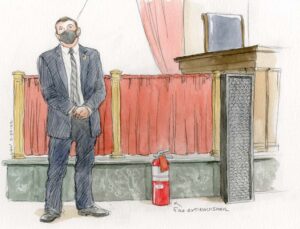
Art provides such a valuable function. Even with the audio live-streamed, we still have no visuals from inside the chamber. How else will we know if the Justices are wearing masks? And today, for reasons unknown, there was a fire extinguisher to the left of the bench. Why? Who knows. But Art drew it.
Mark Walsh had a comment that was just *fire emoji* (Reason.com blocks the inclusion of emoji in posts).
As we wait for the session to begin, the always astute Art Lien notices an object in the courtroom that is not usually there, at least not in so prominent a position. A fire extinguisher is resting on the floor just below and to the left of the bench. Perhaps the court has concluded that certain podcasters are in need of more fodder for their metaphors about the status of the court. Lien has, of course, quickly drawn a sketch of the fire extinguisher
This is in the libel case I blogged about yesterday, Gogol v. White; here's the plaintiff's framing of the situation:
Defendant Malissa White published multiple tweets accusing Plaintiff Frank Gogol of making racially insensitive jokes, using racial slurs, and engaging in overtly racist conduct at a social function where others were present. Witnesses who attended this social function have expressed concerns that they will face retaliation if they participate in this lawsuit, including as a result of a "cancel culture" movement on the internet….
Multiple witnesses expressed reluctance to becoming involved in this lawsuit in any manner, having observed the devastating effect of Defendant's statements on Plaintiff and fearing a similar retaliation by the Defendant, the internet community, and the comics community, generally… The comic book industry is a relatively small and close-knit profession, where an author's reputation is paramount. A stain on a comic book author's reputation can have severe consequences on the author's ability to work in the profession. This is particularly true given the rapidity and ubiquity of disclosures over the internet, where "cancel culture" mindsets can result in the immediate ostracization and "cancellation" of a person.
Troops and sanctions and accusations are coming thick and fast in Ukraine as we record the podcast. Michael Ellis draws on his past experience at the National Security Council (NSC) to guess how things are going at the White House, and we both speculate on whether the conflict will turn into a cyberwar that draws the United States in. Neither of us thinks so, though for different reasons.
Meanwhile, Nick Weaver reports, the Justice Department is gearing up for a fight with cryptocurrency criminals. Nick thinks it couldn't happen to a nicer industry. Michael and I contrast the launching of this initiative with the slow death of the China initiative due to a few botched prosecutions and a whole lot of anti-American racial political correctness.
Speaking of political correctness, Michael and I do a roundup of news (all bad) for face recognition technology. District Judge Sharon Johnson Coleman (ND IL) gets our prize for least persuasive first amendment analysis of the year -- in an opinion holding that collecting and disclosing people's public images can be punished with massive civil liability even if no damages have been shown. After all, the judge declares in an analysis that covers a full page and a half (double-spaced!), the Illinois law imposing liability "does not restrict a particular viewpoint nor target public discussion of an entire topic." Well, that settles that.
But if you're a first amendment fan, don't worry; the amendment is bound to get a heavy defense in the next big face recognition lawsuit – the Texas Attorney General's effort to extract hundreds of billions of dollars from Facebook for tagging the faces of their users. My bet? This one will make it to the Supreme Court. Next, we review the IRS's travails in trying to use face recognition to verify taxpayers who want access to their returns. I shamelessly urge everyone to read my latest op-ed on the topic in the Washington Post.
Finally, I mock the wokesters at Amnesty International who think that people living in high-crime New York neighborhoods should be freed from the burden of face recognition cameras that could identify and jail street criminals. After all, if facial recognition were more equitably allocated, think of how many Staten Island scofflaws could be identified for letting their dogs poop on the sidewalk.
Finally, Michael and I mull over the surprisingly belated but still troubling disclosures about just how opaque TikTok has made its code and methods of operation. Two administrations in a row have started out to do something about this sus app, I note, and neither has delivered – for reasons that demonstrate the deepest flaws of both.
Here's a special request. We've thought of doing episode 400 in person in Washington, or at least in a public Zoom session that listeners to see live. If you think you'd attend, and you support either a live or a Zoom session, please send a note to that effect to CyberlawPodcast@steptoe.com. If we get enough interest in one or the other, we'll try to make it happen.
The views expressed in this podcast are those of the speakers and do not reflect the opinions of their institutions, clients, friends, families, or pets.
Today, the Supreme Court denied certiorari in Ortiz v. Breslin. This case has been floating around for some time. It was first distributed for conference on 9/27/2021. It was rescheduled twelve times! It seems that Justice Sotomayor was likely trying to muster three more votes for cert. She was unsuccessful. Instead, she wrote a six-page statement respecting the denial of certiorari. It is not quite a dissent, but Justice Sotomayor states very clearly that she thinks the New York Court of Appeals got the case wrong.
Here is Justice Sotomayor's summary of the dispute:
In New York, criminal defendants who earn sufficient good time credits before the end of their prison sentences are entitled to conditional release. Defendants classified by the State as "level three sex offenders," however, must first assure the State that they will not reside within 1,000 feet of any school. In New York City, this is no easy task, and the difficulties of finding a compliant residence can result in defendants serving additional time in prison past the expiration of their sentences. Because petitioner Angel Ortiz was unable to identify any release address that satisfied the State's requirement, he spent over two additional years in-carcerated when he should have been at liberty. Although Ortiz's petition does not satisfy this Court's criteria for granting certiorari, I write to emphasize that New York's residential prohibition, as applied to New York City, raises serious constitutional concerns.
Justice Sotomayor explains that in New York City, it is virtually impossible for a person to live more than 1,000 feet from a school. And, she contends, the state's policy is not narrowly tailored to the density of New York City. She is exactly right. In many large cities, sex offenders are forced to live near highway overpasses and in other dangerous areas. These 1,000 feet buffer zones do not work in urban areas.
Turning to the constitutional analysis, Justice Sotomayor favorably cites the dissent of Judge Rivera on the New York Court of Appeals. (The Court of Appeals is New York's court of last resort, and its members are referred to as "Judge" rather than as "Justice".)
Judge Jenny Rivera's dissent below ably explains how New York's policies as applied to people like Ortiz raise constitutional concerns.3
When I first read this sentence, I wondered why Sotomayor would mention the judge's first name. When two judges on the same court share the last name, it is common to use the Judges' first names. For example, on the D.C. Circuit, Douglas and Ruth Ginsburg, or on the Eleventh Circuit, William and Jill Pryor. But there is only one Judge Rivera on the New York Court of Appeals. Then I googled Judge Rivera. She clerked for then-Judge Sotomayor on SDNY in 1993. (Rivera's term was Sotomayor's first or second year on the federal bench.) Here, Justice Sotomayor was giving her former law clerk a first name shout-out. And once Judge Jenny Rivera got a shout-out, Judge Rowan Wilson had to get a shout-out as well. In a Footnote, Justice Sotomayor offers some praise for the other dissenting vote--also identified by his first name:
FN3:Judge Rowan Wilson's dissent also importantly addresses how DOCCS's policy violates New York City's obligation to provide shelter to those in need.
I think "ably explains" is more praiseworthy than "importantly addresses."
Then, Justice Sotomayor engages in the sort of substantive due process analysis that was all-too-common in a bygone era:
Here, New York law provides that a defendant "shall . . . be conditionally released" once he earns sufficient credits, as Ortiz did. N. Y. Penal Law Ann. §70.40 (West 2021). As a New York City resident, Ortiz also enjoyed a right to "shelter and board [for] each homeless man who applies for it." Callahan v. Carey, 307 App. Div. 2d 150, 151, 762 N. Y. S. 2d 349, 350 (2003). In my view, under these New York state and city policies, Ortiz may well have held a liberty interest at the point that he became entitled to conditional release. At the very least, however, Ortiz indisputably held a liberty interest in his release at the expiration of his full sentence.
Sotomayor couldn't even get a second vote on this position.
As a policy matter, I agree with Sotomayor. New York's policy is irrational. These sorts of residency restrictions have not been shown to actually reduce reoffending. Indeed, to the contrary, restricting where a person can live may actually increase the risk of reoffending. But, these laws remain difficult to change. Sotomayor writes:
Despite the empirical evidence, legislatures and agencies are often not receptive to the plight of people convicted of sex offenses and their struggles in returning to their communities.
Still, I part company with Sotomayor's constitutional imperative:
Nevertheless, the Constitution protects all people, and it prohibits the deprivation of liberty based solely on speculation and fear. When the political branches fall short in protecting these guarantees, the courts must step in.
"Must step in." This position does not command a majority, or even a plurality of the current Court. Footnote 4 is once again a dictum.
Justice Sotomayor ends her dissent with a message to the New York Assembly:
New York should not wait for this Court to resolve the question whether a State can jail someone beyond their pa-role eligibility date, or even beyond their mandatory release date, solely because they cannot comply with a restrictive residency requirement. I hope that New York will choose to reevaluate its policy in a manner that gives due regard to the constitutional liberty interests of people like Ortiz.
I agree that the New York government is capable of creating a statutory right. This fact reaffirms why the Court was right not to intervene.
Stabilizing greenhouse gas emissions will require a dramatic expansion of renewable and other clean energy technologies and associated transmission capacity. The recently passed bipartisan infrastructure bill authorizes funding for some such projects, but such funding only matters if the projects can get built. Unfortunately, government regulation -- including much environmental regulation -- can get in the way, delaying and discouraging the deployment and installation of cleaner technologies and associated infrastructure.
In Nevada's Black Rock Desert, local environmentalists and devotees of the Burning Man festival are using the National Environmental Policy Act (NEPA) to oppose a geothermal energy plant. Further south, the Sierra Club has joined with all-terrain vehicle enthusiasts to stop development of what would be the nation's largest solar farm, which it says threatens endangered tortoises. Along the Atlantic seaboard, plans for major offshore wind farms have been hogtied by provisions of the Jones Act, an obscure law that requires maritime cargo to be transported exclusively by U.S.-flagged ships when it is shipped between domestic ports. It is an obstacle that may ultimately prove beside the point because proposals to develop wind energy in American coastal regions have also faced a constant barrage of NEPA and Endangered Species Act (ESA) lawsuits designed to stop them.
The problem isn't limited to renewable energy. In California, environmentalists have used a state law designed to protect fish eggs as a pretext to close the Diablo Canyon Nuclear Power Plant, the state's largest source of clean energy, while the California Environmental Quality Act has hobbled efforts to build both high-speed rail and high-voltage transmission lines that the state is counting on to meet its climate commitments. In Washington, D.C., meanwhile, the Nuclear Regulatory Commission peremptorily rejected last month the application of the first advanced nuclear reactor developer to seek a license before the commission, to cheers from leading environmental groups.
Across the country, foundational laws established in the 1960s and 70s to protect the environment are today a major obstacle to efforts to build the infrastructure and energy systems that we need to safeguard public health and save the climate. Though the Biden administration and Democrats currently propose to spend close to a trillion dollars on low-carbon infrastructure and technology, there is little reason to believe the U.S. is capable of building any of it in a timely or cost-effective way.
There is nothing in the bipartisan infrastructure bill that passed Congress nor in the "Build Back Better" proposals that would meaningfully address this problem. There is a tremendous appetite to fund clean technologies and energy sources, but little willingness to tackle the regulatory barriers that stand in the way of rapid deployment and construction. Worse, there are efforts to roll back the modest Trump Administration reforms to the NEPA review process that could have helped accelerate at least some clean projects.
Turning out the lights is not an option. We will power our moden economy one way or the other, and if it is too difficult or costly to deploy clean energy sources and to construct the infrastructure upon which it relies, we will stick with dirtier and more carbon-intensive energy sources. Thus a decision not to accelerate and ease clean energy development is a choice to stick with dirtier sources. Unfortunately, it seems at least some environmental activists are willing to make that choice.
From a Copyright Review Board decision (Re: Second Request for Reconsideration for Refusal to Register A Recent Entrance to Paradise) last week:
On November 3, 2018, Thaler filed an application to register a copyright claim in the Work. The author of the Work was identified as the "Creativity Machine," with Thaler listed as the claimant alongside a transfer statement: "ownership of the machine." In his application, Thaler left a note for the Office stating that the Work "was autonomously created by a computer algorithm running on a machine" and he was "seeking to register this computer-generated work as a work-for-hire to the owner of the Creativity Machine." …
[C]opyright law only protects "the fruits of intellectual labor" that "are founded in the creative powers of the [human] mind." U.S. Copyright Office, Compendium (Third) of U.S. Copyright Office Practices § 306 (quoting Trade-Mark Cases (1879)); see also Compendium (Third) § 313.2 (the Office will not register works "produced by a machine or mere mechanical process" that operates "without any creative input or intervention from a human author" because, under the statute, "a work must be created by a human being"). So Thaler must either provide evidence that the Work is the product of human authorship or convince the Office to depart from a century of copyright jurisprudence. He has done neither.
An interesting and important new article by Profs. Glenn Harlan Reynolds (InstaPundit) and Penny White, both of the University of Tennessee College of Law (see also this Wall Street Journal piece, excerpted without a paywall here):
Many municipalities have chosen to use the criminal justice system as a revenue-extracting tool. Offenses, even minor ones, produce fines and court fees that are used to fund municipal government removing the need to raise the taxes of those who might object to paying. In many cases, as in the Ferguson, Missouri example we discuss below, this revenue-generation strategy becomes the chief driver of a government's criminal justice priorities.
The result is an interaction between law enforcement and citizens that appears essentially predatory: Officers are tasked with finding (or generating) violations and issuing citations, after which courts and clerks assess a seemingly endless array of fees, fines and costs whose chief purpose is the fattening of government coffers. Meanwhile citizens are jailed, arrested, and bankrupted. They lose jobs, licenses, opportunities, and liberty….
Worse yet, judicial supervision in these cases is essentially missing in action, as the courts are not umpires, but rather participants, in this process, benefiting from the revenues that the system extracts. Instead of controlling the system, the courts are compromised by it. Moreover, the system is not racially neutral. A common factor in cities that rely on hefty fines, fees, and court costs as a mechanism of funding the courts is a large African-American population. What the Justice Department found to be true in Ferguson, Missouri, is true throughout the country. "Among the fifty cities with the highest proportion of revenues from fines, the median size of African American population—on a percentage basis—is more than five times greater than the national median." The disproportionate concentration in communities of color results not only in an increase in incarceration rates for African Americans but also in a community-wide increase in the racial wealth gap. The impact of this increase in the racial wealth gap often persists long after the citizen's encounter with the police has ended.
The current system of fee-based criminal justice as it prevails in many communities is both unfair and discriminatory. It is also unconstitutional. That is a strong charge, but it is also true. It also calls for strong measures in response, which we discuss below.
We begin this analysis from vastly different places. As people, lawyers, and law professors, we hold very different views about most of the important issues of the day. Our backgrounds are dissimilar, as are many of our values, interests, and areas of expertise. Yet, after starting at altogether different places, in the end, we are joined in conclusions and solutions and imagine that others, despite their varying points of view, may agree. Based on Supreme Court caselaw on judicial independence, along with two very recent cases from the Court of Appeals for the Fifth Circuit, we conclude that a judicial system that depends on revenue extracted from its "users"—criminal defendants, victims of civil forfeiture, and the like—violates due process of law because it is insufficiently independent and unbiased. We also offer a number of solutions that can be applied by both courts and legislatures.
Texas Lieutenant Governor Dan Patrick held a press conference last Friday to respond to the Faculty Council of the University of Texas, which recently passed a resolution reemphasizing the importance of academic freedom at the university and denouncing political interventions in the university curriculum. Patrick declared that he would make it a top priority in the next legislative session to ban the teaching of "critical race theory" at Texas universities, to terminate any faculty member who does so, and to abolish tenure at public universities. This is a disturbing escalation of the Republican war on higher education. Other politicians are likely to follow Patrick's lead, especially if his current crusade proves to be electorally advantageous.
Tenure protections for university faculty were adopted throughout American higher education in the twentieth century precisely in order to protect faculty from the efforts of politicians, donors, university administrators, and other faculty to suppress ideas that they do not like. The lieutenant governor's proposals strike at the very heart of the academic enterprise by prohibiting the teaching of certain ideas, thus immunizing contrary ideas from intellectual challenge. This, in effect, establishes campus orthodoxies and forbids the expression of dissent. Few things are more toxic to intellectual life.
To fulfill their missions, universities must be places where controversial ideas can be freely debated and where ideas are tested and supported through the consideration of evidence, argument, and analysis and not by subjecting them to popularity contests at the polls, in legislatures, or anywhere else. A free society does not empower politicians—or anyone—to censor ideas they do not like and silence scholars of whom they disapprove.