The Volokh Conspiracy

Mostly law professors | Sometimes contrarian | Often libertarian | Always independent | Est. 2002

The Volokh Conspiracy

Maybe Easier to Get Forgiveness Than Permission -- but Harder If You've Expressly Been Denied Permission

From the Federal Circuit, an opinion related to its COVID protocols; as it happens, the violators here did get forgiveness (at least in the absence of sanctions), but the court seems clear that future violations won't be treated the same way.

|

From last week's decision of the Federal Circuit (Judges Timothy Dyk, Evan Wallach, and Kara Stoll) in In re Violation of Revised Protocols for In-Person Arguments:

Under the in-person [COVID-related] argument protocols in effect during the events here, "[o]nly arguing counsel and no more than one attendee whose presence is necessary to assist or supervise arguing counsel (e.g., a client, lawyer sitting second chair, or paralegal)" [and who were both either vaccinated or had just gotten a negative test result] were "permitted access to the National Courts Building and the courtroom." …

Respondents are two partners and a special counsel at the same law firm that represented a party in an appeal before this court. A few days before the scheduled in-person argument, Respondents filed a motion seeking leave of court for two of the Respondents as well as two other individuals to attend in addition to arguing counsel (also a Respondent) and the one person authorized to be in the building and the courtroom who was necessary to assist or supervise arguing counsel. The proposed attendees were named in the motion. The motion was forwarded to the merits panel on the appeal for consideration. The panel denied that motion without further elaboration.

After receiving the order rejecting the request for additional attendees, Respondents decided that when one of the Respondent partners argued, an associate would be the one official attendee allowed to assist the arguing partner during the argument. Though they received the order denying their request to enter the building and attend argument only two days prior to argument, the responses state that Respondents nonetheless "determined that [the special counsel and the non-arguing partner] could go to the Court, identify who they were, and ask if they could attend, if circumstances had changed." The responses explain that "[t]hey were hoping … that the panel would let them attend."

Read More

Supreme Court

SCOTUS Allows State Attorney General to Intervene when Governor Stops Defending State Law

As Justice Breyer suggested last week, Kentucky Attorney General Daniel Cameron will be allowed to defend the state's controversial abortion law.

|

Today the Supreme Court decided Cameron v. EMW Women's Surgical Center, which concerned whether Kentucky Attorney General Daniel Cameron could intervene to defend a state abortion law after the state's Governor refused to do so during the litigation. As Justice Breyer had suggested last week, the Court concluded that Cameron could intervene, 8-1.

Justice Alito wrote for the Court, joined by the Chief Justice and Justices Thomas, Gorsuch, Kavanaugh, and Barrett. Justice Thomas wrote a separate concurring opinion. Justice Kagan wrote an opinion concurring in the judgment, joined by Justice Breyer. Justice Sotomayor was the lone dissenter.

Here is how Justice Alito begins his opinion for the Court:

This case concerns a state attorney general's attempt to intervene in a federal appellate proceeding for the purpose of defending the constitutionality of a state law. The issue arose after a panel of the United States Court of Appeals for the Sixth Circuit affirmed a decision holding a Kentucky statute unconstitutional. The Kentucky official who had been defending the law decided not to seek any further review, but the Kentucky attorney general then moved to intervene for the purpose of taking up the defense. The panel denied that motion, but we granted review.

Justice Alito went on to explain why the Court rejected the claim that AG Cameron's motion was barred and why the Sixth Circuit was wrong to deny it. Among other things, Justice Alito wrote:

Resolution of a motion for permissive intervention is committed to the discretion of the court before which intervention is sought, see Automobile Workers, 382 U. S., at 217, n. 10; Fed. Rule Civ. Proc. 24(b)(1)(a). But a court fails to exercise its discretion soundly when it "base[s] its ruling on an erroneous view of the law," Cooter & Gell v. Hartmarx Corp., 496 U. S. 384, 405 (1990), and that is what happened here. The Sixth Circuit panel failed to account for the strength of the Kentucky attorney general's interest in taking up the defense of HB 454 when the secretary for Health and Family Services elected to acquiesce.

Justice Kagan reached the same conclusion as Justice Alito, just taking a slightly different route. Here are excerpts from the opening and closing of her separate opinion:

I agree with the Court that the Sixth Circuit should have allowed the attorney general to intervene in this suit after another state official ceased defending the challenged Kentucky law. And my reasons for reaching that conclusion partly overlap with the Court's. But I would differently frame and respond to the serious threshold issue that respondent EMW raises. I also see no need to rely on "constitutional considerations" to resolve the intervention question before us. . . .

So I arrive, if via a somewhat different path, at the same endpoint as the Court. In my view, the attorney general's motion to intervene was not an end-run around the timely appeal rule. And with that issue out of the way, this is a textbook case for intervention. The Sixth Circuit should have allowed the attorney general to step into the litigation to defend the challenged law.

Interestingly enough, while many academics claimed that black letter law clearly supported the U.S. Court of Appeals for the Sixth Circuit's opinion below denying AG Cameron's attempt to intervene, it appears only one justice endorsed that view. Thus it seems those who claimed the only way the Court could reverse the Sixth Circuit was by applying some special exception for an abortion-related case, might need to reconsider, as that assessment certainly cannot explain Justice Kagan's and Justice Breyer's votes (even if one thought it did explain the votes of the others).

Justice Sotomayor's lone dissent begins as follows:

In every case, there must be a "point of time when litigation shall be at an end." Browder v. Director, Dept. of Corrections of Ill., 434 U. S. 257, 264 (1978) (internal quotation marks omitted). To effectuate that endpoint, our legal system requires parties to abide by representations made in a lawsuit regardless of later regrets. In this case, the attorney general of Kentucky stipulated to his own dismissal as a party in the District Court and agreed to have another official represent Kentucky's interests. Only years later, and after the Court of Appeals affirmed the District Court's judgment, did the attorney general ask the Court of Appeals to allow him to return based on a position he had disavowed when securing his dismissal earlier in the litigation. The Court of Appeals refused his request to intervene.

Generally, the decision whether to permit intervention in a case is left to the "sound discretion" of the court in which intervention is sought, as that court is the best positioned to assess potential inefficiencies and unfairness that might result. NAACP v. New York, 413 U. S. 345, 366 (1973). The Court acknowledges that highly deferential standard, but nonetheless bends over backward to accommodate the attorney general's  reentry into the case. I fear today's decision will open the floodgates for government officials to evade the consequences of litigation decisions made by their predecessors of different political parties, undermining finality and upsetting the settled expectations of courts, litigants, and the public alike. I respectfully dissent.

Supreme Court

Supreme Court Splinters Over State Secrets Privilege

Justice Breyer delivers the opinion for the Court in a heavily fractured opinion in U.S. v. Zubaydah.

|

This morning the Supreme Court issued its opinion in United States v. Zubaydah, in which the Court concluded that the U.S. Court of Appeals for the Ninth Circuit was wrong to conclude the state secrets privilege did not apply to information that could confirm or deny the existence of a CIA detention site in Poland in the context of a discovery dispute.

Justice Stephen Breyer delivered the opinion for the Court, but the line-up is a mess. Here is how the Court splintered:

BREYER, J., delivered the opinion of the Court, except as to Parts II–B–2 and III. ROBERTS, C. J., joined that opinion in full, KAVANAUGH and BARRETT, JJ., joined as to all but Part II–B–2, KAGAN, J., joined as to all but Parts III and IV and the judgment of dismissal, and THOMAS and ALITO, JJ., joined Part IV. THOMAS, J., filed an opinion concurring in part and concurring in the judgment, in which ALITO, J., joined. KAVANAUGH, J., filed an opinion concurring in part, in which BARRETT, J., joined. KAGAN, J., filed an opinion concurring in part and dissenting in part. GORSUCH, J., filed a dissenting opinion, in which SOTOMAYOR, J., joined.

So those justice concurring in the judgment were Breyer, Roberts, Kavanaugh, Barrett, Thomas and Alito. Kagan concurred in part and dissented in part, and Sotomayor and Gorsuch were the two dissenters.

Here is how Justice Breyer summarizes the decision:

Abu Zubaydah, a detainee in the Guantánamo Bay Naval Base, and his attorney filed an ex parte 28 U. S. C. §1782 motion in Federal District Court seeking to subpoena two former Central Intelligence Agency contractors. Zubaydah sought to obtain information (for use in Polish litigation) about his treatment in 2002 and 2003 at a CIA detention site, which Zubaydah says was located in Poland. See 28 U. S. C. §1782 (permitting district courts to order production of testimony or documents "for use in a proceeding in a foreign . . . tribunal"). The Government intervened. It moved to quash the subpoenas based on the state secrets privilege. That privilege allows the Government to bar the disclosure of information that, were it revealed, would harm national security. United States v. Reynolds, 345 U. S. 1, 6–7 (1953).

The Court of Appeals for the Ninth Circuit mostly accepted the Government's claim of privilege. Husayn v Mitchell, 938 F. 3d 1123, 1134 (2019). But it concluded that the privilege did not cover information about the location of the detention site, which Zubaydah alleges to have been in Poland. Ibid. The Court of Appeals believed that the site's location had already been publicly disclosed and that the state secrets privilege did not bar disclosure of information that was no longer secret (and which, in any  event, was being sought from private parties). Id., at 1132–1133. The Government argues that the privilege should apply because Zubaydah's discovery request could  force former CIA contractors to confirm the location of the detention site and that confirmation would itself significantly harm national security interests. In our view, the Government has provided sufficient support for its claim of harm to warrant application of the privilege. We reverse the Ninth Circuit's contrary holding.

Justice Gorsuch's dissent (again, joined by Justice Sotomayor) begins:

There comes a point where we should not be ignorant as judges of what we know to be true as citizens. See Watts v. Indiana, 338 U. S. 49, 52 (1949). This case takes us well past that point. Zubaydah seeks information about his torture at the hands of the CIA. The events in question took place two decades ago. They have long been declassified. Official reports have been published, books written, and movies made about them. Still, the government seeks to have this suit dismissed on the ground it implicates a state secret—and today the Court acquiesces in that request. Ending this suit may shield the government from some further modest measure of embarrassment. But respectfully, we should not pretend it will safeguard any secret.

And it concludes:

In the end, only one argument for dismissing this case at its outset begins to make sense. It has nothing to do with speculation that government agents might accidentally blurt out the word "Poland." It has nothing to do with the fiction that Zubaydah is free to testify about his experiences as he wishes. It has nothing to do with fears about courts being unable to apply familiar tools to disaggregate discovery regarding some issues (location, foreign nationals) from others (interrogation techniques, treatment, and conditions of confinement). Really, it seems that the government wants this suit dismissed because it hopes to impede the Polish criminal investigation and avoid (or at least delay) further embarrassment for past misdeeds. Perhaps at one level this is easy enough to understand. The facts are hard to face. We know already that our government treated Zubaydah brutally—more than 80 waterboarding sessions, hundreds of hours of live burial, and what it calls "rectal rehydration." Further evidence along the same lines may lie in the government's vaults. But as embarrassing as these facts may be, there is no state secret here. This Court's duty is to the rule of law and the search for truth. We should not let shame obscure our vision.

Privacy

No Clearly Established Right Not to Have Gov't Disclose Your Gender Identity to Your Spouse (+ Some Others)

|

From Judge Damon Leichty's opinion Tuesday in Doe v. Gray (N.D. Ind.), combined with an earlier opinion (to which the new one refers):

John Doe, born female and transitioning to male, says Detective Adam Gray of the Starke County Sheriff's Department disclosed John Doe's gender identity to A.B., his [wife] who was allegedly unaware of it. John Doe also claims that Detective Gray shared this information with Katherine Purtee, a family case law manager at the Indiana Department of Child Services, who thereafter disclosed the information to A.B.'s children….

Officials are shielded [by qualified immunity] from civil liability "'insofar as their conduct does not violate clearly established statutory or constitutional rights of which a reasonable person would have known.'" … The concept of ordered liberty protected by the Fourteenth Amendment's due process clause has been interpreted to include "the individual interest in avoiding disclosure of personal matters." Whalen v. Roe (1977). Courts of appeals, including this circuit, "have interpreted Whalen to recognize a constitutional right to the privacy of medical, sexual, financial, and perhaps other categories of highly personal information—information that most people are reluctant to disclose to strangers—and have held that the right is defeasible only upon proof of a strong public interest in access to or dissemination of the information." …

John Doe does not cite to any closely analogous cases to show that a Fourteenth Amendment right to keep his … gender identity private from disclosure to his spouse, his spouse's children, or foster parents by state authorities was clearly established…. Knowledge that the disclosure of medical information in some circumstances might be unconstitutional is simply not enough to show that Detective Gray and Case Manager Purtee would know, or should have known, that what they disclosed to these individuals under these circumstances was unconstitutional…. John Doe and A.B. have not met their burden to prove that existing precedent placed the constitutional question beyond debate. Detective Gray and Case Manager Purtee are accordingly entitled to qualified immunity.

Here's the backstory behind the incident, which stemmed from an arrest of Doe and Doe's wife, A.B., and which apparently explains how Detective Gray learned of Doe's gender identity:

Read More

The Trials of Rasmea Odeh, Part Four -- Prosecution and Defense

A straightforward prosecution was countered by a strained and devious defense.

|

This is the fourth of five posts on The Trials of Rasmea Odeh. Part One is here; Part Two is here; Part Three is here.

Rasmea Odeh's trial in the Eastern District of Michigan began on November 5, 2014. The presiding judge was Gershwin Drain, an African American appointed by President Obama, who had tried over 150 cases to verdict during his earlier career as a federal public defender. The defense had been optimistic when Judge Drain replaced Judge Paul Borman, who had recused himself when he discovered that his family held stock in Supersol's parent company. They were soon disappointed when Judge Drain held that Odeh could not testify about her torture by Israeli interrogators. The only issue in the case was Odeh's concealment of her conviction and imprisonment, he ruled, not the legitimacy of the Israeli criminal process. Deutsch lamented on Chicago Public Radio that the court had "cut the heart out of our defense."

The prosecution case was uncomplicated, based almost entirely on digitally presented documents. The prosecution introduced Odeh's visa and naturalization applications, highlighting the false answers to the questions about criminal convictions and imprisonment. The naturalization officer who conducted Odeh's citizenship interview could not remember the details of the session in 2005, but she testified that she had always asked the same questions in-person, and that she would have flagged any changed or corrected answers on the form. Finally, the prosecution offered certified copies on the Israeli indictment, conviction, and sentence, along with a set of Odeh's fingerprints, which had been produced pursuant to a Mutual Legal Assistance Treaty.

Still reeling from Drain's pretrial ruling, the defense was not without stratagems. Deutsch repeatedly attempted to raise the torture issue in testimony and argument, at times drawing rebukes from the court.

Read More

Religion and the Law

Taking Away Foster Parenting License Based on Religious Views About Homosexuality May Violate First Amendment

|

From Lasche v. N.J., decided yesterday by the Third Circuit, in an opinion by Judge Peter Phipps, joined by Judges Thomas Hardiman and Robert Cowen:

Two foster parents with religious views against same-sex marriage and homosexual conduct had their foster child removed and their foster license suspended. The foster parents claim that a New Jersey state agency took those actions based on their religious beliefs….

A Christian couple in New Jersey, Michael and Jennifer Lasche, have "traditional values and beliefs about family, marriage and sex." For over ten years, they served as foster parents.

In September 2017, the Monmouth County Office of the New Jersey Division of Child Placement and Permanency ('DCPP') contacted the Lasches about fostering two children. The children were sisters, one was thirteen ('Foster Child 1') and the other was ten ('Foster Child 2'). They also had three younger siblings who were placed in foster care. After speaking with a DCPP caseworker, Kyle Higgins, and her supervisor, Katie Epperly, the Lasches agreed to foster the two girls.

By November 2017, the girls' biological parents no longer retained any parental rights, and in October and December the Lasches heard from the caseworker, Higgins, that they were under consideration to adopt the girls.

But three weeks after informing the Lasches that they might be able to adopt the children, Higgins told the Lasches that a couple in Illinois was interested in adopting all five siblings. The Lasches inquired about the prospective adoptive family, and both Higgins and her supervisor, Epperly, stated that they did not know the answers to those questions. Later, in discussing the putative adoption with the foster parents for the other siblings, the Lasches learned that the Illinois couple was "two wealthy gay men with lots of family around to support them and the adoption."

Read More

"Tacoma Woman Sentenced to 5 Years in Prison for Arson at Downtown Seattle Protest"

|

From a Justice Department press release distributed yesterday:

A 26-year-old Tacoma, Washington, woman was sentenced today in U.S. District Court in Seattle to 5 years in prison for arson for burning five Seattle Police vehicles parked around Sixth and Pine in downtown Seattle on Saturday, May 30, 2020, announced U.S. Attorney Nick Brown. Margaret Aislinn Channon was arrested June 11, 2020, following an investigation by the FBI, ATF, and Seattle Police Department. At the sentencing hearing U.S. District Judge John C. Coughenour said Channon's conduct had done "tremendous damage to Black Lives Matter in Seattle."

"The right to protest, gather, and call out injustices is one of the dearest and most important rights we enjoy in the United States," said U.S. Attorney Nick Brown. "Indeed, our democracy depends on both exercising and protecting these rights. But Ms. Channon's conduct was itself an attack on democracy. She used the cover of lawful protests to carry out dangerous and destructive acts, risking the safety of everyone around her and undermining the important messages voiced by others."

Read More

Race

Ketanji Brown Jackson on Race and Judging

At her confirmation hearing for her current position on the court of appeals, KBJ testified that "race would be the kind of thing that would be inappropriate to inject in my evaluation of a case."

|

Judge Ketanji Brown Jackson (White House).


Racial issues have obviously played a big role in the public debate over President Biden's nomination of Judge Ketanji Brown Jackson to the Supreme Court. That's in part because of Biden's campaign pledge to nominate a black woman, which has been attacked by Republicans, despite the fact that race and gender played important roles in previous nominations, such as Ronald Reagan's campaign promise to nominate a woman (resulting in the nomination of Sandra Day O'Connor), and Trump's promise to name a woman to replace Ruth Bader Ginsburg (leading to the nomination of Amy Coney Barrett).

Given the controversy, it's worth noting what KBJ herself had to say about the role of race in judging, during her recent confirmation hearing for the seat she currently occupies on the US Court of Appeals for the DC Circuit:

Texas GOP Sen. John Cornyn…  asked Jackson about professional diversity and race.He said her experience as a trial judge would be a "very important qualification" and praised her "impressive" background…..

But Cornyn later said that "since our Democratic colleagues seem to be placing so much emphasis on race," he wanted to know something else. "What role does race play, Judge Jackson, in the kind of judge you have been and the kind of judge you will be?"

Without skipping a beat, Jackson said, "I don't think that race plays a role in the kind of judge that I have been and that I would be in the way you asked that question."

"I'm looking at the arguments, the facts and the law, I'm methodically and intentionally setting aside personal views, any other inappropriate considerations and I would think that race would be the kind of thing that would be inappropriate to inject in my evaluation of a case," she continued.

"I would say that my different professional background than many of the court of appeals judges, including my district court background," she said, "would bring value."

Cynics may think KBJ was just saying whatever she thought was necessary to get herself confirmed. But there are many ways she could have elided the question without endangering her confirmation chances, but also without flatly saying that consideration of race is "inappropriate." For example, she could have said that a judge's background inevitably has at least some impact on her decisions, and that is why it's important to have diversity of all kinds on the bench. Thus, I tend to believe she sincerely meant what she said.

Regardless, many may dismiss the sentiment she expressed as hopelessly naive. Few if any judges can achieve complete detachment from "inappropriate considerations," including the influence of their racial or ethnic background, which might lead them to empathize with some litigants more than others.

But even if such complete impartiality cannot be perfectly achieved, it's still an ideal to strive for. And history shows we can make greater progress than many might assume.

I explained some of the reasons why in a 2009 LA Times debate with prominent constitutional law scholar Erwin Chemerinsky,  at the time of Sonia Sotomayor's nomination to the Supreme Court. While the specific comments by President Obama that occasioned our debate are now little-remembered, the broader point I made remains relevant:

President Obama says he wants judges who have the "empathy to understand what it's like to be poor, or African American, or gay, or disabled, or old." But if judges who feel empathy for these groups can legitimately base decisions on it, the same goes for the considerably larger number of jurists who most easily empathize with what it's like to be rich, or white, or straight, or able-bodied. If we weaken the norm of judicial impartiality in favor of greater emphasis on empathy, minorities and the poor are unlikely to benefit.

Some argue that judicial impartiality is a pipe dream. Indeed, empathy can never be completely eliminated as a factor in judging. But we should strive to reduce its role rather than increase it.

This not a hopelessly utopian objective. A century ago, judges and others often discriminated against Irish American and Italian American litigants. Today, such prejudice has been largely eliminated from our society and rarely affects judicial decisions. Similarly, the average white jurist today is much less likely to discriminate against African American litigants than her counterparts 40 years ago, even though racism is far from completely eliminated. Numerous judges have issued 1st Amendment rulings protecting communist, fascist and radical Islamist speech against censorship even though those judges probably have little or no empathy for advocates of these and other unpopular ideologies. That is a major improvement over the first half of the 20th century….

To say that judges shouldn't base decisions on empathy is not to say they should ignore all "real-world" implications of their decisions. Many cases require judges to make empirical judgments…. However, judges should make such determinations by systematically considering the relevant evidence, not on the basis of any empathy they might feel for the litigants.

Reliance on empathy often actually impedes accurate evaluation of the consequences of judicial decisions. Empathy usually leads us to focus on a clearly visible, sympathetic person who has suffered some sort of readily apparent harm. But it is often difficult or impossible to feel empathy for people we never see who may be victimized by the indirect or unintended consequences of a decision. To take an example from my own field of property law, judges can easily empathize with upper middle class people who use restrictive zoning rules to maintain the attractive "character" of their communities. It is much harder to see how these laws often zone out the poor and create housing shortages. The people barred from a community by exclusionary zoning are generally invisible to judges and impossible for them to identify, much less empathize with…. Court decisions upholding the constitutionality of exclusionary zoning may have been influenced by such empathy-driven blindness, which might have led judges to ignore its broader regional implications.

Free Speech

#MeToo/#TheyLied Settlements, Arbitration, and Rescission

|

Reiterman v. Abid, decided today by the Eleventh Circuit (in an opinion by Judge Gerald Bard Tjoflat, joined by Judges Elizabeth Branch and Britt Grant), involves a sexual assault allegation which led to a libel lawsuit, and which in turn led to a settlement agreement calling for arbitration. The question is whether the settlement agreement was rescinded, so that the libel plaintiff (Reiterman) could again sue the initial accuser (Abid):

{We make no comment on the truth or falsity of any of the background facts of this case, as the merits of Reiterman's claims are not before us on appeal. For context purposes only, we summarize the facts of the merits dispute as they have been presented by the parties to this Court on appeal.}

Abid and Reiterman first met in 2014 in Tampa, Florida. At the time, Reiterman worked as an LSAT teacher for the test preparation company TestMasters. Abid was one of Reiterman's students, and the two briefly dated. After the relationship ended, Abid accused Reiterman of sexual assault. This accusation resulted in an investigation by the Tampa Police Department, which ultimately declined to charge Reiterman. The Florida Attorney General's Office also declined to intervene after reviewing the case at Abid's request.

Abid then allegedly engaged in a pervasive, anonymous internet campaign to ruin Reiterman's reputation by writing several blogposts accusing Reiterman of sexually assaulting multiple women. Each of these blogposts was ostensibly written by a different woman. The District Court would later describe this campaign as "remarkably extensive and forceful, in effect seeking to destroy Reiterman by painting him in the most graphic terms as a racist and a serial rapist." These allegations severely affected Reiterman's reputation while attending Harvard Law School from 2015 to 2018 and continue to impair his ability to obtain gainful employment.

Read More

Free Speech

"The Act of Silencing a Speaker Is Fundamentally Contrary to the Values of This School"

|

From Fox News (Jessica Chasmar):

Ilya Shapiro, a constitutional scholar who recently found himself in hot water over a tweet about President Biden's Supreme Court nominee, was shouted down by law students in San Francisco, videos show.

Shapiro joined a discussion Tuesday afternoon about Justice Stephen Breyer's Supreme Court vacancy at the University of California, Hastings College of the Law, but he was interrupted by protesters pounding on desks and chanting "Black lawyers matter." …

UC Hastings sent a letter to students Wednesday morning condemning the protesters' behavior, saying it violated the code of conduct.

Read More

Ukraine

The War in Ukraine, II

The Russians seem - understandably to want out, and I'm becoming more and more optimistic that they will be out, soon.

|

I am astonished that in all the 24/7 coverage of the Russian invasion, so little attention is being paid to what to my eyes seems clearly to be a most - perhaps the most - significant development of the past few days: The utter silence, on both the Russian and the Ukrainian side, about what they talked about at their first negotiating session at the border, followed, today, by the announcement that they will be holding a second round of talks shortly.

This is exactly what you would expect to happen if there were actually serious proposals under consideration. If it was all just arm-waving and table-pounding, you'd think that one side, or both, would have said so, blaming the other side for the futility of the exercise. I take the fact that the Ukrainians have agreed to a second meeting as a very positive sign; they must think that something useful could come out of continuing the discussions, and they're in a helluva lot better position to make that judgment than I am.

One thing is crystal clear: the Russians did not want to be in this position. When the invasion began, Putin had no intention of negotiating with Zelensky or his government. His plan - does anyone doubt this? - was to destroy Zelensky and his government, and then to get on with things. That wasn't merely incidental to his overall objective - it was his overall objective.

But now, six days in, he's negotiating with Zelensky.  Maybe it's a total sham, and he's just doing it to bide time, or for the publicity value. But the Ukrainians appear not to think it's a sham, and I'll trust their judgment.

What does it mean? It seems to me clear that the Russians want out. Putin has a problem he didn't anticipate, and it is a problem that, unfortunately for him but fortunately for the civilized world, will not be and cannot be solved on the battlefield.  The problem, of course, is the new weapon the Allies have deployed - collectively, the "sanctions" - which appears to be capable of laying waste to the Russian economy and the Russian standard of living. "Bombing them back to the Stone Age," as it were, but without the use of bombs.

And the Russians must surely see that that problem will not go away, even if they gain their objectives on the battlefield. Indeed, that may well make the problem worse; marching into and occupying Kharkiv and Kyiv, dissolving the government, imprisoning, or murdering, Zelensky and his associates, none of that is likely to further endear Putin to the world or to cause the Allies to loosen the noose.

So I continue to be optimistic that this tragedy may be coming to an end, because I think the Russians are pretty anxious for a way out, and I think - or at least I hope - that the Ukrainians can find one, some concession that they can swallow that gives Putin a way to declare victory and leave.

And in the true spirit of putting my money where my mouth is, I've got $50 that says that the war is over, and the Russians are on their way out of Ukraine, by the end of this month. First one to take me up on that in the Comments is in.

One advantage, incidentally, that the Allies' new weapon has in comparison to conventional weapons of war is that its effects are, to a very substantial degree, entirely reversible. The sanctions are a kind of siege - nothing comes in, nothing goes out, if it works well; once it is called off and the gates re-open, the Russian economy can return rather quickly to something like its pre-war state.  That, one has to assume, must be part of the negotiations now underway - some guarantee that the sanctions will be lifted if/when the Russians leave. [Which could get tricky, insofar as the Ukrainians aren't the ones imposing the sanctions]

So it's really not like bombing Russia back to the Stone Age, whose effects would not be so easily reversed.

Not to mention that actually bombing Russia back to the Stone Age - which we do, after all, have the capacity to do - would invite a retaliation whose consequences are obviously too horrible to contemplate.

But that points to another nice feature of the new weapon we have deployed: Russia can't turn it against us in retaliation. It can lay siege to Kyiv, on the ground; but it can't lay siege to the US economy, let alone all the component Allied economies, the way we can lay siege to its economy. That's a nice weapon to have at your disposal.


Copyright

Motivational Speaker Loses Copyright Lawsuit Against High School

And has to pay $10K in attorney fees to the high school as well.

|

From last week's decision by Fifth Circuit Judge Gregg Costa (joined by Judges Carolyn Dineen King and Don Willett) in Bell v. Eagle Mountain Saginaw Indep. School Dist.:

The softball team and flag corps at a public high school outside Fort Worth used their Twitter accounts to post a motivational passage [230 words, or one page from a 72-page book -EV] from sports psychologist Keith Bell's book, Winning Isn't Normal.

We do not know if the tweets motivated the students to perform at a higher level. We do know that the tweets resulted in Bell's suing the school district for copyright infringement. We must decide if the tweets were a fair use of the copyright that bars this suit.

Apparently the author, Dr. Keith Bell, had filed "over 25 copyright lawsuits" "[b]etween 2006 and 2017" over "unauthorized uses of [this] passage," mostly against "public schools or nonprofits, which published the WIN Passage on social media." But this time he lost:

Read More

Immigration

My New Article on "Immigration and the Economic Freedom of Natives"

It explains how immigration restrictions massively diminish both the "negative" and "positive" economic liberty of natives of receiving countries.

|

The Statue of Liberty. (NA)


A draft version of new article on "Immigration and the Economic Freedom of Natives" (forthcoming in a symposium in Public Affairs Quarterly) is now available on SSRN. Here is the abstract:

Much of the debate over the justice of immigration restrictions properly focuses on their impact on would-be migrants. For their part, restrictionists often focus on the potentially harmful effects of immigration on residents of receiving countries. This article cuts across this longstanding debate by focusing on ways in which immigration restrictions inflict harm on natives, specifically by undermining their economic liberty. The idea that such effects exist is far from a new one. But this article examines them in greater detail, and illustrates their truly massive scale. It covers both the libertarian "negative" view of economic freedom, and the more "positive" version advanced by left-liberal political theorists.

Part I focuses on libertarian approaches to economic freedom. It shows that migration restrictions severely restrict the negative economic liberty of natives, probably more than any other government policy enacted by liberal democracies. That is true both on libertarian views that value such freedom for its own sake, and those that assign value to it for more instrumental reasons, such as promoting human autonomy and enabling individuals to realize their personal goals and projects.

In Part II, I take up left-liberal "positive" theories of economic freedom, which primarily focus on enhancing individuals' access to important goods and services, and enabling them to have the resources necessary to live an autonomous life. Some also focus on expanding human capacities generally, or give special emphasis to enhancing the economic prospects of the poor. Here too, migration restrictions impose severe costs on natives. To the extent migration can sometimes harm the economic prospects of natives, the issue is better dealt with by "keyhole solutions" that address specific problems by means other than restricting migration.

Finally, Part III describes how to address situations where potentially harmful side effects of migration might undermine either negative or positive economic liberty of natives, without actually restricting migration. I have addressed such issues in greater detail in previous work, and here provide only a short summary of my approach and its relevance for economic liberty issues.

I am looking for some alternative to "natives" as a concise, non-clunky way to refer to "current citizens of destination countries." I welcome any suggestions readers might come up with. E-mail me if you have one!

The Ukrainian Embassy in D.C. is Located in William Marbury's Home

In 1992, the Embassy of Ukraine moved to the Forrest-Marbury House.

|

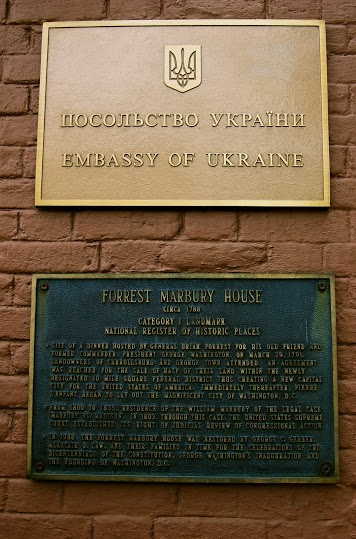
In 1992, the Embassy of Ukraine moved to the Forrest-Marbury House in Georgetown. That building was built circa 1788. Uriah Forrest, an early mayor of Georgetown, resided there. Around 1800, William Marbury moved into the house. Yes, the same William Marbury who didn't get his commission. Maybe John Marshall couldn't make his way out to Georgetown in time! Marbury lived in his house during the Marbury v. Madison litigation.

If you watch some of the media coverage of the Ukrainian embassy, you can see the commemorative plaque.

I posted this photo on my blog in 2014.

It reads:

From 1800 to 1835, residence of the William Marbury of the legal case Marbury v.Madison. In 1803, through this case, the United States Supreme Court established its right to judicial review of congressional action

The second sentence is not accurate, but I appreciate the recognition of Marbury's role.


Ketanji Brown Jackson

When Ketanji Brown Jackson Represented the Cato Institute

President Biden's Supreme Court nominee was counsel of record for a Cato Institute brief in a case challenging the detention of alleged enemy combatants.

|

In addition to having been an appellate judge, trial court judge, and public defender, Supreme Court nominee Ketanji Brown Jackson spent some time in private practice at Morrison & Foster. Like many lawyers, she devoted some of her time to pro bono work. One of her projects was serving as counsel of record on an amicus brief submitted in Al-Marri v. Spagone, a case concerning the military's authority to detain individuals who were lawfully present in the country. Of particular note, this brief was submitted on behalf of the Constitutional Project, the Rutherford Institute, and the Cato Institute.

The brief argued that the military's detention of Ali Saleh Kahlah Al-MArri was unlawful. I've reproduced the summary of the argument below the jump.

Read More

Introducing the 4th Edition of the Barnett & Blackman Constitutional Law Casebooks

Download the Teacher's Manual, Slides, and Sample Chapters.

|

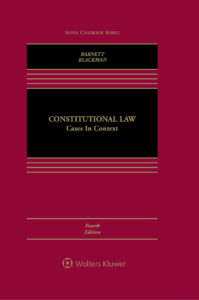
I am proud to announce the Fourth Edition of the Barnett & Blackman Constitutional Law Casebooks. Yes, Casebooks plural. We have three versions of the text: the full casebook and two splits.

  1. The Casebook: More than 200 cases in the constitutional canon, including foundational and modern decisions on structure and rights.
  2. The Structure "Split": Paperback edition perfectly-sized for a one-semester course on constitutional structure.
  3. The Rights "Split": Paperback edition perfectly-sized for a one-semester course on constitutional rights.


These books come with access to our full twelve-hour video library. No other product on the market includes so many resources for students and professors.

We have shared our Teacher's Manual, Powerpoint Slides, and sample chapters. If you are interested in requesting a review copy, please email me. (jblackman at stcl dot edu).

You can learn more about all our books ConLaw.us, and see a preview of our new book, Slavery and the Constitution.

Free Speech

If You're Suing Just Me, You Can't Get An Injunction Against My Wife

|

From yesterday's decision in Jacoby v. Jacoby (Pa. Super. Ct.), written by Judge Carolyn Nichols and joined by Judges Mary Jane Bowes and James Gardner Colins:

Richard G. Jacoby, Jr. (Father) appeals from the trial court's order that restricted the speech of his spouse, non-party Brena Jacoby (Stepmother). Father contends that the trial court's order improperly restricted non-party Stepmother's speech on a social media site. We vacate the order to the extent the order affects Stepmother….

Read More

More