The Volokh Conspiracy

Mostly law professors | Sometimes contrarian | Often libertarian | Always independent | Est. 2002

The Volokh Conspiracy

Religion

81% of Americans Believe in God, Down from 92% in 2011

|

For the 2011 number, see here. Note also that "Gallup has found that Americans are much less likely to attend church, become members of a church or rate themselves as confident in organized religion than to simply believe in God's existence."

Supreme Court

Justice Sotomayor Defends Justice Thomas

In remarks to the American Constitution Society, Justice Sonia Sotomayor shares her thoughts on the senior-most Associate Justice.

|

Yesterday, Associate Justice Sonia Sotomayor addressed the annual conference of the American Constitution Society. Her remarks were covered in the New York Times, CNN, and Huffington Post.  Video of the remarks is available here.

As noted in the NYT report, Justice Sotomayor defended the Court.

Justice Sonia Sotomayor urged an audience of progressive lawyers on Thursday not to give up on the Supreme Court.

"We have to have continuing faith in the court system and our system of government," she said, adding that she hoped "to regain the public's confidence that we — as a court, as an institution — have not lost our way."

A justice speaking in defense of the Court as an institution is not all that surprising. Perhaps more notably, she also came to the defense of her colleague, Justice Clarence Thomas. Again from the NYT report:

Justice Sotomayor singled out Justice Thomas for praise. "He is a man who cares deeply about the court as an institution," she said, adding that he is a beloved figure there.

"Justice Thomas is the one justice in the building that literally knows every employee's name," she said.

Justice Sotomayor said her interactions with Justice Thomas have been instructive. "I suspect I have probably disagreed with him more than with any other justice," she said.

"He has a different vision than I do about how to help people and about their responsibilities to help themselves," she said. "Justice Thomas believes that every person can pull themselves up by their bootstraps. I believe that some people can't get to their bootstraps without help.

"That's a very different philosophy of life, but I think we share a common understanding about people and kindness towards them," she said. "That's why I can be friends with him and still continue our daily battle over our difference of opinions in cases."

Free Speech

What Are Ya, Some Kind of Comedian?

Qualified immunity denied in case alleging a probable-cause-less arrest based on plaintiff's (comedian Hannibal Buress's) speech "roast[ing a police officer's] ass."

|

From Buress v. City of Miami, decided Wednesday by the Eleventh Circuit (Judges Kevin Newsom, Andrew Brasher, and Susan Black):

This case arises from the arrest of Hannibal Buress for disorderly intoxication. Buress brought a lawsuit against the City of Miami, Miami Police Officer Luis Verne, and Miami Police Officer Elio Villegas, alleging violations of 42 U.S.C. § 1983 for false arrest, retaliatory arrest, failure to intervene, and unlawful policy and practice, as well as state law claims for malicious prosecution and false arrest….

This appeal concerns whether Villegas is entitled to qualified immunity on Buress's claim that Villegas failed to intervene in a false arrest. We recount the facts as stated in Buress's first amended complaint, including the facts leading up to Villegas's participation in Buress's arrest, to put the relevant facts in context….

On December 9, 2017, Buress, a stand-up comedian and actor, was visiting Miami. Buress was socializing and drinking with friends at a venue when his phone battery died. Buress left the venue around 9:00 p.m. and began walking toward his hotel. While walking, Buress saw Officer Verne and requested that Verne call Buress an Uber in exchange for $20, but Verne refused the request. After Verne declined Buress's request, Buress observed Verne, who was on duty and wearing his Miami Police Department uniform, interacting with and kissing young women who were leaving a club. Buress told Officer Verne "you're over there kissing [women] but can't call me an Uber?" Buress asserts he intended the statement as a joke.

Verne responded to Buress's joke by ordering Buress to leave the street. Buress asserts he was at no point "aggressive, threatening, or behaving in a manner suggesting that he was a threat," but he nevertheless complied with Verne's orders and entered a bar in search of a phone charger or another patron willing to call an Uber for him. Verne followed Buress into the bar and ordered Buress to leave the bar, asserting Buress was too drunk to be on the premises. Buress was confused and asked Verne, "if I can't be on the street, where do you want me to be?" Verne responded by ordering Buress to leave the bar.

Buress complied and left the bar. Once Buress and Verne were outside the bar, Verne turned on his body camera and ordered Buress to leave. Buress walked away from Verne, but then stopped and turned around, saying into the body camera, "Hey it's me. What's up? This cop is stupid as fuck." Buress was backing away from Verne while making the statement. Verne instructed Buress to "get out of here," but then changed his mind. Verne then ordered Buress to put his hands behind his back, grabbed Buress by the arms, and placed handcuffs on Buress.

Read More

N.J. Supreme Court: "Danger Invites Rescue" Doctrine Doesn't Apply to Attempts to Save Pets

If Ann saves Beau from peril, and is injured in the process, she could sue whoever negligently endangered Beau (that's the "danger invites rescue" doctrine). But the court holds this doesn't apply if Beau is a dog.

|

From Samolyk v. Berthe, decided Monday by the New Jersey Supreme Court, in an opinion by Judge Jose Fuentes (temporarily assigned):

This appeal requires this Court to determine whether to expand the common law rescue doctrine to permit plaintiffs to recover damages for injuries sustained as a proximate result of attempting to rescue defendants' dog. After reviewing the noble principles that infuse the public policy underpinning this cause of action, we decline to consider property, in whatever form, to be equally entitled to the unique value and protection we bestow on a human life….

This matter arises from injuries sustained by plaintiff Ann Samolyk while trying to rescue a dog [Beau, a seventy-nine-pound boxer,] owned by defendants Ilona and Robert DeStefanis. Ann's husband, John Samolyk, filed a civil action against defendants, as Ann's guardian ad litem, alleging defendants were liable under the rescue doctrine by negligently allowing their dog to fall or jump into the canal that borders their property, prompting Ann to dive into the water to prevent the dog from drowning….

Read More

Slippery Slope Arguments

Slippery Slope Arguments in History: Some Arguments from the Left

|

I've often heard people pooh-pooh slippery slope arguments as devices of the political Right, which has puzzled me: People on the Left have made plenty of them as well. Here are three examples that I gathered for my 2003 article, though I'm sure one can find many more since then. I express no view on the merits of the arguments, but I'm just using them to show how ecumenical this mode of argument is:

[1.] Robynn Tysver, Traffic-Camera Bill Hits Bump in the Road, Omaha World-Herald, Feb. 23, 2001, at 9:

Tim Butz of the Nebraska chapter of the ACLU said [the installation of cameras to catch traffic offenders] is a "slippery slope" that infringes on people's rights. "[When] it comes to privacy, what's next?" Butz asked. "Are we going to put cameras in buses, city parks or restrooms?"

[2.] News Conference To Announce Opposition to Late Term Abortion [Ban], FDCH Political Transcripts, Nov. 7, 1995, remarks of Kate Michelman, President, National Abortion Rights Action League):

[This] is the first time that the Congress has used its federal authority to ban and outlaw an established medical procedure…. I know a lot of people use slippery slope arguments et cetera but I think in this case this is an extremely dangerous precedent that could lead the Congress to look at other medical procedures, indeed and in fact in the House, several members of the House made it very clear that in the case of abortion, they intend to introduce legislation that would ban other abortion procedures.

[3.] All Things Considered: Daily Prayer Sessions in Attorney General John Ashcroft's Office (NPR radio broadcast, May 18, 2001):

Laura Murphy, the Washington director of the American Civil Liberties Union, says holding the open prayer meetings in the attorney general's office is a slippery slope.

Free Speech

"[W]ell, People Really Be Tellin', People Be Tellin'. That Is Not Right, That Is Not Right."

A Snapchat post containing this line and "a copy of the police report summarizing [a witness's] identification of [a person] as the shooter" leads to a four-year prison sentence for witness tampering; a New Jersey court says the post is a constitutionally unprotected true threat of violence.

|

From State v. Dutton, decided Wednesday by the New Jersey appellate court, Judges Stephanie Ann Mitterhoff and Carmen Alvarez:

Defendant Shahouna Dutton appeals from an October 15, 2019 judgment of conviction sentencing her to four years for witness tampering. We affirm, substantially for the reasons articulated by Judge John A. Young in his thoughtful and well-reasoned opinion.

We discern the following facts from the record. On March 29, 2017, Terrell Smith was shot and killed in Jersey City. During the ensuing investigation, Hudson County Prosecutor's Office (HCPO) detectives spoke to Aladine Hicks, a witness to the shooting, who initially denied knowing the identity of the shooter. In a subsequent statement, however, Hicks identified Shaquan Hyppolite as the shooter. Hicks explained that he did not identify Hyppolite earlier because he feared for his safety. Approximately two-and-a-half weeks before Smith's murder, Hicks had been jumped by some of Hyppolite's associates. After giving his statements to the police, Hicks relocated out of state.

On June 20, 2017, Hyppolite was arrested and charged with Smith's murder. Hyppolite was ultimately indicted for murder and weapons offenses.

In July 2017, a police report outlining Hicks's statement to police was turned over to Hyppolite as part of pretrial discovery. The trial, originally scheduled to begin on February 28, 2018, was adjourned because Hicks refused to testify. Hicks allegedly refused to testify because, in August 2017, defendant posted a Snapchat video of an unknown person holding a copy of the police report summarizing Hicks's identification of Hyppolite as the shooter. A female voice in the background said "[w]ell, people really be tellin', people be tellin'. That is not right, that is not right." …

Read More

Slippery Slope Arguments

Attitude-Altering Slippery Slopes

|

[This month, I'm serializing my 2003 Harvard Law Review article, The Mechanisms of the Slippery Slope.]

"[T]he assault weapons ban is a symbolic—purely symbolic—move in [the] direction [of disarming the citizenry]," wrote columnist Charles Krauthammer, a proponent of a total gun ban. "Its only real justification is not to reduce crime but to desensitize the public to the regulation of weapons in preparation for their ultimate confiscation …. De-escalation begins with a change in mentality …. The real steps, like the banning of handguns, will never occur unless this one is taken first …."

This is a claim about slippery slopes, though made by someone who would welcome the slippage. Decision A (an assault weapon ban) will eventually lead to B (total confiscation of weapons) because A and similar decisions will slowly change the public's mind about gun ownership—"desensitize" people in preparation for a future step. (Note how this mechanism differs from the multi-peaked preferences slippery slope, which does not rely on people's underlying attitudes' being shifted.)

But how does this metaphorical "desensitization" actually work? Why don't people simply accept decisions A, B, C, and so on until they reach the level they've wanted all along, and then say "Stop"? Why would voters let government decisions "change [their] mentality" this way?

Let me start with slippery slopes where a legislative or judicial decision increases the likelihood of a future legislative (not judicial) decision. Here, I think the slippery slope may be driven by what I call the Is-Ought Heuristic, and by what others have called "the normative power of the actual."

Read More

Qualified Immunity

Qualifying Qualified Immunity: Toward a Reasonably Foreseeable Liability Test

|

This is the fifth and final post in a series on The Fair Notice Rationale for Qualified Immunity. Thanks so much to Eugene and the other conspirators for letting me post, and to you for reading to the bitter end!

Yesterday I said that there are some cases where the fair notice rationale clearly does not support the existing scope of qualified immunity, and some cases where it clearly does. In general, it does not support immunity when the official acted with malice or violated a criminal law, but it does support immunity when the liability depends on what is clearly a change to constitutional doctrine.

Today we consider the hard cases. The plaintiff alleges that the officer's conduct violated an existing legal standard, so we are not in "new constitutional rule" land. Yet the standard is vague and no court has ever held that the officer's specific conduct violates it. This problem could arise in a lot of doctrinal areas, from procedural due process to free speech, but the cases that tend to get the most attention are those that involve the use of force by police officers or incarceration officials. Was the search "reasonable" under the Fourth Amendment? Was the use of force "excessive"? And so on. These vague standards give rise to a generality problem: how specific must the rule be, or the facts in a prior case be, to "clearly establish" that the officer's conduct violated the plaintiff's right?

Read More

Politics

Harlan Institute-Ashbrook Virtual Supreme Court Championship Round

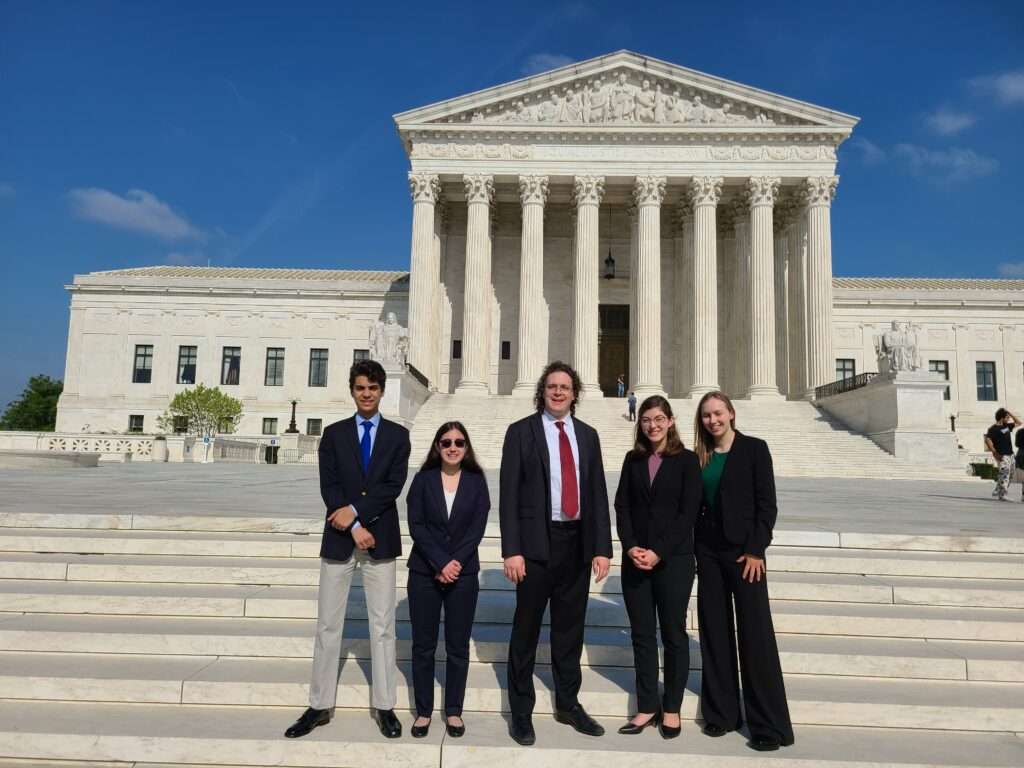
The top two teams presented oral argument in NYS Rifle & Pistol Association v. Bruen at the Georgetown Supreme Court Institute

|

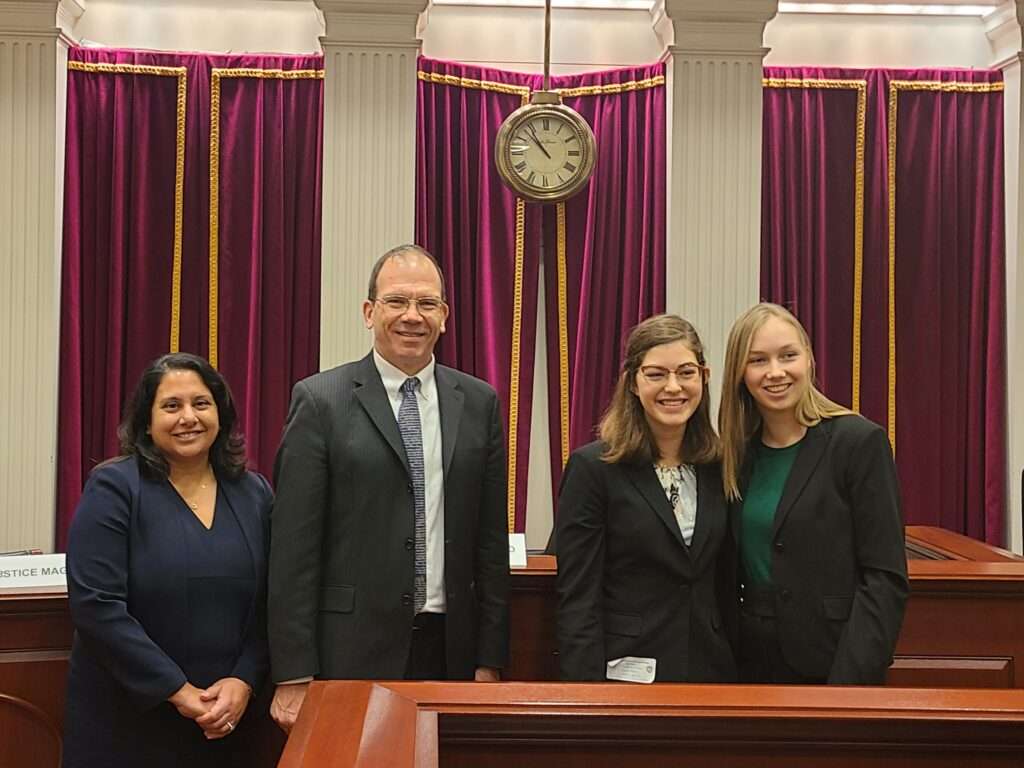
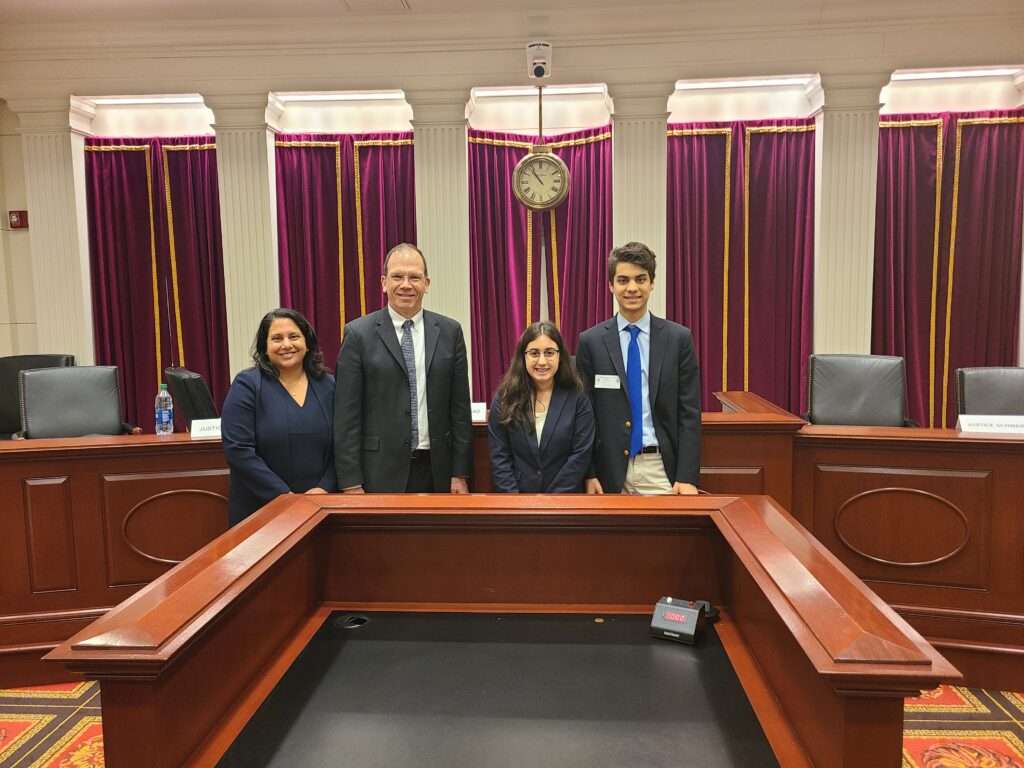
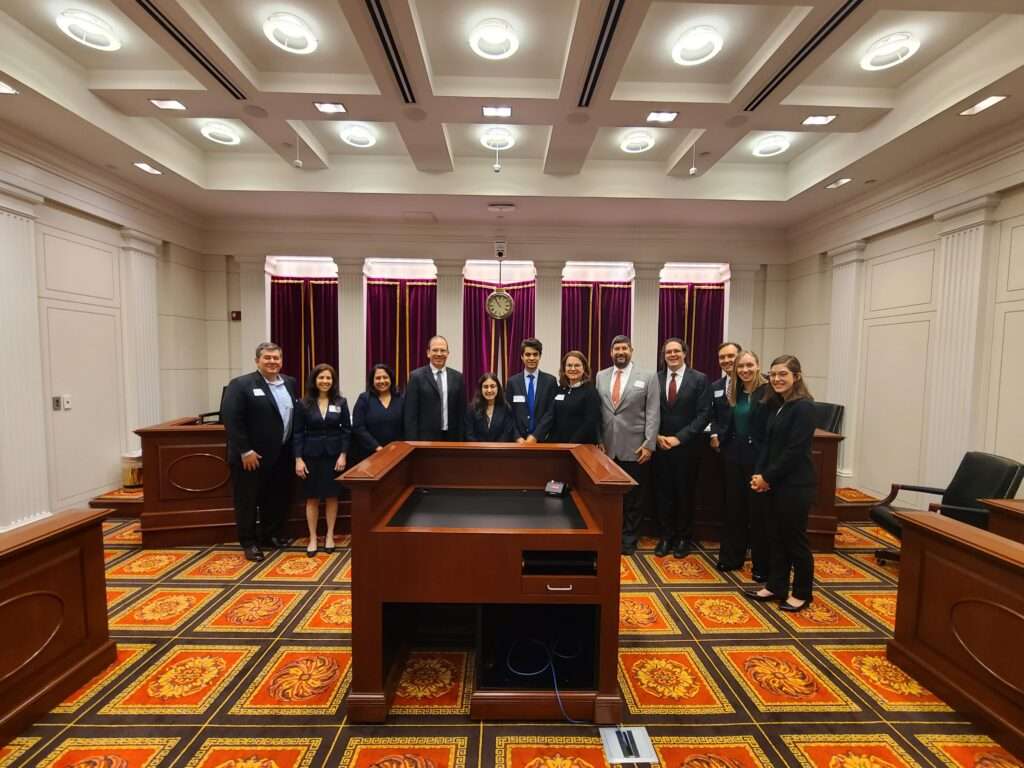
The topic for the 10th Annual Harlan Institute-Ashbrook Virtual Supreme Court competition was NYS Rifle & Pistol Association v. Bruen. On April 25, 2022, the top two teams presented argument at the Georgetown Supreme Court Institute. Presiding were Judge Neomi Rao (U.S. Court of Appeals for the D.C. Circuit), Judge Gregory Maggs (U.S. Court of Appeals for the Armed Forces), and Judge Stephen S. Schwartz (U.S. Court of Federal Claims).

Representing the Petitioners were Campbell Collins & Gabriella Lovins from Austin, Texas.

Representing the Respondents were Arjun Kishore & Nicole Orlofsky from Greenwich, Connecticut.

After a well-argued match, the Petitioners narrowly prevailed, and Campbell Collins was selected as best oralist. The students are truly phenomenal, and could participate in any law school moot court competition.

Congratulations to all of the the students, coaches, and parents, who participated.

After the argument, we took pictures outside the Supreme Court--thankfully before the barricades went up.

We plan to launch next year's tournament in August. The topic will be the Harvard and UNC affirmative action cases.

USA Today: "Some Individuals Quoted … Appeared to Be Fabricated"

|

From today's USA Today:

After receiving an external correction request, USA TODAY audited the reporting work of Gabriela Miranda. The audit revealed that some individuals quoted were not affiliated with the organizations claimed and appeared to be fabricated. The existence of other individuals quoted could not be independently verified. In addition, some stories included quotes that should have been credited to others.

As a result, USA TODAY removed 23 articles from its website and other platforms for not meeting our editorial standards. The headlines of the articles are listed below [see here]. Miranda has resigned ….

Thanks to Stephen Green (at InstaPundit) for the pointer.

China

Open the Door to Chinese Migrants Fleeing Brutal Covid Lockdowns

Taking this step is both a moral imperative, and the right way to advance US economic and strategic interests.

|

(WANG GANG/FEATURECHINA/Newscom)


Over the last few months, residents of Shanghai and some other Chinese cities have endured brutal Covid lockdowns that include such cruelties as forcible separation of parents from children, starvation, and fatal denial of medical treatment to people needing it for non-covid emergencies. This, combined with other repressive government policies, has led increasing numbers of Chinese to consider emigration to the West:

Sick of their lives being dictated by pandemic measures — the frequent and sudden lockdowns, never-ending rounds of mass testing and constant uncertainty — Zhu hopes to move her family to Thailand as soon as possible and eventually immigrate to Europe or the United States.

"I feel like I'm having an emotional breakdown," she said. "I feel powerless. It's like an overbearing father telling you that this is all for your own sake. You just need to listen. Don't ask questions."

Zhu is one of a growing number of Chinese urban professionals subscribing to a new school of thought known as runxue, the study of how to "run" away from their home country. For many like Zhu, it is not just about China's severe "zero covid" policy, but what the future looks like in a society where politics — upholding the top leader's policies no matter the cost — trumps science and the well-being of residents whose day-to-day lives are subject to ever more state interference.

"It's migration driven by a sense of disillusion," said Xiang Biao, a director at the Max Planck Institute for Social Anthropology in Germany focusing on migration. "People are not running away from the virus. People are running away from such top-down measures and disregard of individuals' feelings and dignity."

Inquiries into emigrating have surged since chaotic lockdown measures were imposed in April on China's most populous city, Shanghai, where residents struggled to feed themselves and watched family members die after being unable to get medical attention for non-covid emergencies. The term runxue, or "the science of running," soon gained momentum online among disaffected residents in Shanghai and dozens of other Chinese cities under some form of lockdown.

Cruel zero-Covid policies are just one of the more extreme manifestations of a broader increase in Chinese government repression over the last few years. Other examples include a crackdown on democracy advocates in Hong Kong, the detention of some 1 million members of the Uighur minority in concentration camps (combined with extreme oppression of those Uighurs who remain "free"),  and expanding suppression of dissent even among the Han Chinese majority.

In fairness, when it comes to Covid lockdowns and other pandemic-era restrictions on liberty, the West's own record is far from spotless. Many Western nations, including the United States, perpetrated serious injustices of their own during the pandemic. But they did not go as far as China. And, as vaccination has spread, and evidence accumulates that lockdowns did little good and much harm, Western democracies have mostly ended Covid restrictions. China, by contrast, has doubled down.

The US and its allies would do well to open their doors to Chinese fleeing cruel "Zero Covid" policies and other repression. The most important reason to do so is moral: people have a right to be free of oppression, and it is unjust to bar those fleeing it merely because they happen to be born in the wrong place, or to the wrong parents.

But opening our doors to Chinese migrants also serves US economic and strategic interests. I summarized some of the reasons why in a 2020 post advocating openness to Chinese immigration, which is now even more relevant thanks to the escalation of Zero Covid cruelty:

Chinese immigrants… have been enormously productive in the US and other Western nations, thereby boosting the receiving nations' economies. It is also clear that the images of Chinese finding refuge from oppression by coming to the US would be a major boost to America's now-badly tarnished international reputation, and a blow to China's position in the international "war of ideas."

During the Cold War, American conservatives readily understood that welcoming refugees from Cuba, the Soviet Union, and other communist nations was a major boost to America's prestige and a blow to that of the communists. The better political system is the one people "vote with their feet" to live under, not the one many risked their lives to flee.

To the extent that China has emerged as our most important geopolitical competitor, the more of "their" talent comes here, the better for us, and the less extensive the human capital available to the Chinese government. The more talented Chinese are contributing to US economic and technological development rather than helping Xi Jinping's regime, the better.

What of the threat of espionage by Chinese immigrants? The rate of such spying is very low, indeed lower than among the US population as a whole. To the extent it is a problem, the way to deal with it is not by barring Chinese migrants generally, but by carefully screening anyone given access to classified national security information (which is an important safeguard regardless of whether the people in question are immigrants or not). When it comes to "open source" information, realistically China and other adversaries are likely to acquire what they want of it, regardless of how much immigration there is. That's one of the downsides of being a relatively open and free society. But the many upsides easily outweigh it.

Regular readers will notice that the case for openness to Chinese migrants made above is very similar to that which I made for opening doors to Russians fleeing Putin's regime, among others. There are indeed obvious parallels between the two cases. Both are situations where we can simultaneously do what is right, and advance US economic and strategic interests. In previous writings on both China and Russia, I have responded to the counterargument that letting in migrants from these countries would diminish pressure for liberalization there.

Ultimately, I believe we should open the door to all fleeing war and oppression, regardless of their nation of origin. But there is also good reason to support incremental progress, which in some cases is likely to be focused on those fleeing key US adversaries. At this point, China and Russia top the latter list.


Abortion

White House Consults with Law Professors in Anticipation of Dobbs Ruling (Updated)

The Biden Administration is apparently considering a range of responses should te Supreme Court overturn Roe v. Wade.

|

The Biden Administration is reportedly considering a range of executive actions to safeguard abortion rights if, as anticipated, the Supreme Court overturns Roe v. Wade in the Dobbs case this term. The New York Times reports that the White House has been consulting with various legal academics on various steps the Administration could take. The White House also disclosed that Vice President Kamala Harris met with a group of constitutional law professors on Tuesday.

From the NYT:

Some of the ideas under consideration include declaring a national public health emergency, readying the Justice Department to fight any attempt by states to criminalize travel for the purpose of obtaining an abortion, and asserting that Food and Drug Administration regulations granting approval to abortion medications pre-empt any state bans, the officials said. . . .

No executive order can re-establish a constitutional right. It would take an act of Congress to restore a national legal standard barring states from outlawing abortion, and proponents currently lack sufficient votes in the Senate, where Republicans can filibuster such a bill. But Mr. Biden has signaled that he wants to move on his own.

Most of these strategies would require particularly aggressive assertions of executive power. As noted, one idea is to declare that FDA regulations would preempt state laws limiting access to abortifacient drugs. When the Bush Administration took a similar view of FDA authority (albeit to constrain tort litigation, not state regulations), many progressives and libertarians objected on the grounds only Congress may preempt state laws. Now the shoe could be on the other foot.

Laurence Tribe, a Harvard Law School professor who has consulted with [the White House], said in an interview that while he did not want "to pour cold water on people's peaceful reactions to impending disaster," some of the proposals the White House was being lobbied to consider were unwise and implausible extensions of executive power.

"It would take attention from the things that are really relevant — that the Supreme Court is out of control and we ought to be very critical of it — and shift the criticism to the president for responding in kind and doing things that are every bit as ungrounded in the Constitution as the court's overruling of Roe will be," Mr. Tribe warned.

According to the NYT report, the Administration is weighing the trade-off between modest actions that would be legally defensible, and bold, symbolic actions with questionable legal authority.

In the past, Mr. Biden has adopted a position that his legal team warned him was unlikely to stand up in court, betting that the political benefits of his executive actions outweighed the legal risks. In August, as House Democrats urged him to reverse course on letting a pandemic-related ban on evicting renters expire, Mr. Biden unilaterally extended the measure.

The move won praise from the left, at a moment when he needed to hold his coalition together in order to advance his legislative agenda. But while Mr. Biden's decision bought a little more time for pandemic assistance funds to reach renters, its practical impact was limited because courts, as predicted, swiftly struck it down — and his critics accused him of lawlessness.

Another idea being discussed is using federal enclaves as sanctuaries of a sort.

One calls for Mr. Biden to invite abortion doctors to work at federal enclaves, like military bases, inside states that criminalize abortion. State prosecutors lack jurisdiction in such zones, so the federal government handles crimes there, and it is not always clear whether criminal laws at the state level apply.

Doctors might still face challenges to their state medical licenses. And while the Justice Department under Mr. Biden could decline to pursue charges as a policy matter, control of the department could flip in the 2024 presidential election, and federal prosecutors could then charge people with crimes, like abortion, retroactively.

It is certainly true that this sort of strategy would be dependent upon Democratic control of the White House, but the suggestion that federal prosecutors could charge people with crimes seems like a stretch. Abortion is not a crime under federal law. But perhaps facilitating the use of federal resources in this way would violate the Hyde Amendment and laws concerning the misuse of federal funds. [UPDATE: Federal prosecutors may enforce state law in federal enclaves under certain conditions, pursuant to the Assimilative Crimes Act, so that explains the language of the story.]

Another idea is to declare a public health emergency so as to enable doctors to practice across state lines so that doctors could facilitate abortions in states without fear of sanctions from state licensing authorities or other legal liability. This policy, too, could be reversed by a subsequent administration.

Slippery Slope Arguments

Hidden Slippery Slope Risk and the Ad Hominem Heuristic

|

[This month, I'm serializing my 2003 Harvard Law Review article, The Mechanisms of the Slippery Slope.]

The discussion above has assumed that we know up front the preferences people have among positions 0, A, and B. But sometimes B might not even be considered at first, and the apparent choice might just be between 0 and A: for instance, returning to the enforcement need slippery slope example, shall marijuana be legal (0) or be subject to mild penalties (A)? Instead of the complicated mix of preferences I described in that post, we might at first see just two large groupings: a minority opposing the mild prohibition, and the majority supporting it. The risk that the mild law won't be complied with, which might lead to sterner measures, might not be much discussed.

Then, once the mild prohibition A proves ineffective, the hard-core war-on-drugs plan B will be brought up, and may succeed politically (if the preferences are as described in my earlier post). Some supporters of the mild penalty plan would regret their actions: they would rather stay with A, or even go back to 0, because they strongly oppose B; but their endorsement of A back when B wasn't even discussed now makes B possible. They might wish that they had thought earlier about the enforcement need slippery slope—but it would be too late, because there would now be a majority for going all the way to the newly proposed B.

This slippage is especially likely if A fails not just unexpectedly, but also because of changed circumstances. Say the United States is deciding whether to commit troops to a small peacekeeping mission in a foreign country (A). When this decision is being made, committing more troops to a broader military action (B) may not even be contemplated. But if the modest disorder that prompted the mission turns into a full-scale war, option A would no longer be feasible; we'd have a multi-peaked slippery slope, and A might slip to B even though B wouldn't have been authorized up front, without the initial step A.

And slippery slope risks might also be hidden—especially from average voters—by information asymmetry. Voters might not know exactly which step B would be proposed after step A is adopted. They might not know whether the results of step A would prove to be politically stable, or whether there are enough voters or legislators whose multi-peaked preferences would cause slippage to some broader result.

But voters might suspect that the politically savvy interest groups that are proposing A do know more about likely future proposals and likely voter preferences, and that those groups won't be satisfied with A but will push for something more. Sometimes A's advocates have explicitly said as much. Sometimes the proposal seems so unlikely to achieve its stated goals on its own that voters might reasonably conclude that it will surely be followed by other proposals. And sometimes voters might reasonably infer from the group's ideology that A isn't the only thing on the group's agenda.

Read More

Qualified Immunity

Qualifying Qualified Immunity: The Cases in Which the Fair Notice Rationale Clearly Supports …

and clearly does not support qualified immunity.

|

This is the fourth post in a series on The Fair Notice Rationale for Qualified Immunity (forthcoming Florida Law Review). So far I have argued that: (1) unpredictable adjudications are unfair in the same way that retroactive law is unfair, by treating the defendant as someone who is incapable of making plans; (2) constitutional liability, as a class of liability, is more likely to be unpredictable than other forms of civil liability, and when it is unpredictable, it is even more unfair because it is in tension with the officer's prior duty and carries the community's moral censure.

We are finally ready for the payoff—what does this mean for qualified immunity? This post will identify cases where the fair notice rationale clearly does not support the current scope of the doctrine, and cases where it clearly does. The final post tomorrow will discuss how courts should evaluate hard cases and briefly consider the possible application of the fair notice rationale to other areas of law.

[1.] Cases where qualified immunity does but should not apply

Under the current doctrine, it is irrelevant whether the official acted with bad faith or violated a clear criminal prohibition. All that matters is whether the official violated a clearly established constitutional right. The fair notice rationale does not support immunity in those cases.

When an official acted in bad faith—with the intent to violate the plaintiff's rights, or recklessly as to those rights—the unpredictability of constitutional liability is irrelevant. The defendant was trying to violate the plaintiff's rights, or was acting with reckless indifference to those rights. Far from treating the defendant as though he is incapable of planning, holding him liable simply rewards him for his actual plans, or at a minimum, for taking the bare minimum amount of care.

Read More

And Roberts Was His Name-O

The Chief treats in his dissent.

|

Chief Justice Roberts rarely writes dissents. But when he does, readers are in for a treat. The Chief did not disappoint in Ysleta del Sur Pueblo v. Texas. Roberts wrote the dissent, which was joined by Justices Thomas, Alito, and Kavanaugh. Justice Gorsuch wrote the majority opinion in favor of the Indian tribe. (I should create a macro for that sentence.) Justice Barrett cast the swing vote, and joined Gorsuch's opinion.

The case is extremely complex, but at bottom, considers whether an Indian casino can offer bingo. Or is it bingo? In dissent, Chief Justice Roberts contends that the game being offered is not bingo:

In 2017, Texas inspected the Pueblo's Speaking Rock Entertainment Center to determine whether it was complying with state law. The answer appeared to be "no." Slot machines are outlawed in Texas, as are "gambling device versions of bingo." Tex. Penal Code Ann. §47.01(4)(A) (West 2011); see also §47.02(a)(3) (West Supp. 2021). Yet inside the Tribe's casino, officials found more than 2,000 machines that looked exactly like "'Las-Vegas-style slot machines.'" 955 F. 3d, at 412. Players press a button, graphics spin, noise plays, and eventually players learn whether they have won or lost. The machines are accessible 24 hours a day and, for added effect, are emblazoned with names like"Big Texas Payday," "Welcome to Fabulous Las Vegas," and "Lucky Duck." 2019 WL 639971, *5 (WD Tex., Feb. 14, 2019). Although the machines resemble slot machines in every relevant respect, the Tribe insisted they were a form of bingo, because whether a player wins turns on "historical bingo draws." Ibid. [Footnote 1]

And in Footnote 1, we meet a certain dog who belonged to a farmer:

A photograph from the record of this version of "bingo" is appended to this opinion. It confirms that the electronic bingo played at the Speaking Rock Entertainment Center is about as close to real bingo as Bingo the famous dog.

Well done. The humor is subtle, but effective, like the Alice in Wonderland reference from Cruz v. FEC. As I read through Gorsuch's majority opinion, I kept waiting for a dreadful Bingo pun, and thankfully, it never came. For those who do not get the reference, here is the clip from CoCoMelon, the second-most popular YouTube channel, which I suspect most parents know all-too-well.

Roberts also used some excellent word-play in the penultimate sentence, with two meanings of "reservation":

The Court today throws out that balance, treating gaming on this reservation as if it were just like any other Public Law 280 reservation. I respectfully dissent. 

This technique takes style and patience. Truly exceptional.

May I offer Roberts some more praise? Yesterday the Chief favorably cited Judge Van Dyke in his public charge concurrence. What is going on?!

Lest anyone think I am going soft, I recently rewatched The Naked Gun and thought of the Chief. Far too often, Roberts emulates Leslie Nielsen's approach to umpiring.

Getting to the holding of a Roberts opinion sometimes resembles getting the third out in the classic Angels-Mariners game. And throwing up all the balls in the air at the last second reminds me of the hard look analysis in the DACA case--it is impossible to catch everything!

More