When a judge hearing a protection order petition thinks the defendant is engaged in "harassment," which can include two or more statements the judge thinks is libelous, the judge can effectively criminalize future libels of the plaintiff by the defendant.
A new Washington statute related to protection orders, which will become effective July 1, provides:
In issuing any type of protection order, other than an extreme risk protection order, the court shall have broad discretion to grant such relief as the court deems proper, including … an order restricting the respondent from … making harassing or libelous communications about the petitioner to third parties, or making false reports to investigative agencies.
These orders are likely to become quite common, because they will be listed as a possible box to check on the standard Petition for Protection Order form (p. 5, item M). And their effect (as to the "libelous communications" part) will be basically the same as a mini-criminal-libel law, for the particular covered speakers speaking about the particular covered plaintiffs: Violating the ban on "libelous communications" would be "a gross misdemeanor."
Moreover, the injunctions can easily be triggered simply by a judge's finding that defendant has made two or more libelous statements about the plaintiff, entirely apart from allegations of, for instance, domestic violence or indeed any other kind of violence. Such injunctions (long-term or temporary) are authorized whenever a judge concludes, by a preponderance of the evidence, that defendant's speech was (among other things) "unlawful harassment" or "stalking" (now renamed "cyber harassment"). "Unlawful harassment" is defined to mean
"knowing and willful course of conduct" ("a series of acts over a period of time, however short, evidencing a continuity of purpose" but excluding "constitutionally protected speech")
"directed at a specific person"
"that seriously alarms, annoys, harasses, or is detrimental to such person," and
"that serves no legitimate or lawful purpose," if
it "would cause a reasonable person to suffer substantial emotional distress," and
"actually cause[s] substantial emotional distress to the petitioner."
All these elements would be routinely satisfied by repeated false libelous statements said with "actual malice" (i.e., knowledge or recklessness as to their falsity). Likewise, they might well qualify as "cyber harassment," defined as
From McCarthy v. Harris, 2021 WL 8533067, decided by Maricopa County (Arizona) Superior Court Judge Randall Warner on July 21, but just posted to Westlaw a couple of weeks ago:
As alleged in the Complaint, Plaintiff Daniel McCarthy is a "Republican political hopeful." Defendant James T. Harris is a talk show host whose program, The Conservative Circus, is a podcast and a radio broadcast on KFYI in Phoenix. Defendant iHeartRadio, Inc. owns KFYI.
On November 7, 2020, McCarthy and Harris attended a rally at the Arizona State Capitol. The Complaint describes the rally as "a Republican-based 'stop the steal"' rally. Harris spoke and, nearing the end of his speech, several attendees began chanting for McCarthy to speak. McCarthy then spoke. The Complaint alleges that McCarthy's conduct at the rally was peaceful and focused on political issues.
In his radio show on November 9 and 10, 2020, Harris discussed McCarthy and his encounter with him at the rally. McCarthy alleges that several things Harris said about him were defamatory….
[A.] Non-Actionable Statements.
[1.] Name-Calling.
Several of the statements McCarthy alleges are, as a matter of law, not actionable because they are just name-calling. These are:
McCarthy is "shady," "unhinged," and "crazy."
McCarthy has "shady ass hat people around him."
"McCarthy is one of the 'ass hats that can end up starting problems, starting trouble' for the Republican movement."
McCarthy is a "lunatic."
McCarthy is a candidate who is "unhinged," "shady," and "crazy."
McCarthy is a "temper tantrum throwing juvenile."
"Ass-hat" is a word that has no meaning. It is just an epithet. So is the term "temper tantrum throwing juvenile."
Words like "crazy" and "lunatic," while they have meanings in other contexts, can only be construed as hyperbole or rhetoric in the political context. Nobody listening to Harris's broadcast would think he was claiming McCarthy suffered from mental illness. Similarly, the words "shady" and "unhinged" cannot reasonably be construed as asserting facts about McCarthy.
An interesting new twist on the argument, which particularly focuses on how social media quasi-common-carrier regulations can fight governmental pressure on platforms to censor certain material; it reminded me of Ian Samuel's The New Writs of Assistance, which similarly argued that some Big Tech companies should be legally required to limit the data they maintain about users, in order to fight governmental pressure on them to disclose it.
I'm not sure whether on balance such social media quasi-common-carrier rules are a good idea, but I thought the essay was worth passing along. (I have argued that some kinds of such rules are constitutional, and laid out some other arguments in their favor, but I can certainly see lots of arguments against them as well, some of which have been well laid out in this symposium.) I'd of course be glad to post or link to responses to this as well.
Recently leaked documents, published by Senators Grassley and Hawley, show the crucial importance of anti-discrimination requirements for Big Tech. Notably, they reveal the value of the Texas free speech statute currently under review in the U.S. Court of Appeals for the Fifth Circuit. The documents disclose planning by the Department of Homeland Security to work with its "partners" such as Twitter (and presumably the other dominant internet platforms) to monitor so-called "disinformation"—including through the infamous "Disinformation Board." This leads to the pressing constitutional question: Can the government sidestep the First Amendment by coordinating with private companies to shut down "misinformation" and "disinformation"?
The constitutional problem, interestingly, has a statutory solution. The First Amendment bars Congress from making any law abridging the freedom of speech, or of the press. But the courts have left unclear whether the Administration's coordination with the social media companies is unconstitutional. And that is why the Texas statute is so important.
The Texas statute, HB 20, finds the largest social media platforms to be common carriers—which is well justified by both their function and their size—and bars them from discriminating on the basis of viewpoint. It thus prohibits them from coordinating with the Biden administration to censor Americans in the ways described by the leaked documents. Just as AT&T cannot lawfully acquiesce to government-pressure to deny you a telephone, HB 20 makes it unlawful for the major internet platforms to go along with the Biden administration's pressure.
Government coordination with private organizations to censor individuals is not a new problem. The English government in the seventeenth century worked through the Universities and the Stationers Company (a trade guild) to censor printing. Although the government sometimes required them to do the censorship, it at times just coordinated with them.
The AP reports that the Biden administration is considering changes to official OMB racial and ethnic classifications. The most prominent proposals are to change the Hispanic/Latino category from an ethnic to a racial category, and to add a new MENA (Middle Eastern and North African) category. I will write about the latter in a later blog post, but here I will focus on the Hispanic/Latino classification.
As discussed in my forthcoming book, when the federal Office of Management and Budget invented the Hispanic category-- Latino was not added until twenty years later--in the late 1970s, it was subject to several controversies. First, there was the question of what to name this novel classification--previously, what we now call "Hispanics" were generally either considered generically white by the federal government, or listed separately as Mexican, Puerto Rican, and sometimes Cuban. In the early 1970s, the government started to use classifications like "Spanish-speaking" or "Spanish-surnamed," but these were ultimately deemed inadequate and imprecise for rather obvious reasons. Hispanic was chosen even though at the time few people thought of themselvse as "Hispanic."
Second, there was controversy over how to define the category. Should it include white people of Spanish descent? (Yes!) Should the American Indian category instead be "Original Peoples of the Western Hemisphere" to include Latinos of indigenous origin? (No!) Should the Hispanic classification be considered a race or an ethnicity? (Ethnicity!) And should forms asking about race and ethnicity include "Hispanic" as an alternative to white, black, Asian, or American Indian, or should Hispanic identity be asked about separately from the racial classifications? (At first, institutions were given the option of doing either, but in 1997 they were ordered to ask about Hispanic ethnicity separately; it took the Department of Education and the EEOC another decade to comply. The SBA's guidance on disadvantaged business enterprises still depicts Hispanic as a racial category.)
This did not end the controversy. As I explain in the book:
In the late 1970s and early 1980s, the Census Bureau proposed making "Hispanic" a racial category akin to "Black" or "White." Most major Latino organizations aggressively opposed the change.
Census Bureau employees specializing in racial demography also strongly opposed categorizing Hispanic as a racial identity. Their opposition reflected deference to civil rights and ethnic identity organizations. These groups worried that creating a Hispanic racial category would reduce their groups' reported populations and therefore their political clout.
African American groups feared that Afro-Latinos would identify as Hispanic, not Black; American Indian organizations were concerned that some individuals of indigenous heritage would identify as Hispanic, not Native American; and Asian American activists worried that some Filipinos would identify as Hispanic and not Asian. The bureau ultimately shelved the proposal.
In 1997, the OMB rejected a request from the National Council of La Raza, a Latino advocacy group, to combine the race and Hispanic origin questions into a single Race/Ethnicity category. In 2018, the Census Bureau recommended that "Hispanic or Latino" be changed from an ethnicity to a race category. The Trump administration, however, declined to adopt this recommendation.
The move to change Hispanic to a racial category reflects a problem with American racial classifications. Approximately fifty percent of American Hispanics have consistently considered themselves to be white in private surveys and on census forms (I understand the percentage was lower in 2020, but I haven't yet seen a good analysis of the data), and a small percentage identify as black. The rest don't find any of the racial categories congenial because they are of mixed European/indigenous (and sometimes others) ancestry. This is reflected in the following anecdote in my book:
I recently helped a native of Peru of mixed Spanish and indigenous origin apply for a green card. She was mystified by the form asking her to classify herself by one of the standard American racial categories. None of the racial options fit how she perceived herself. The American Indian category on the form, which might otherwise have covered her Inca ancestry, is limited to North American Indians.
Trying to be helpful, I asked, "Eres blanca?" ("Are you white?")
She replied, "No, no soy blanca." ("No, I am not white.")
"Pero tú no eres negra." ("But you are not black.")
"No, no soy negra. Soy mestiza." ("No, I am not black. I am a mestiza [Spanish-Indian].")
One possible solution, suggested by some scholars and activists, would be to replace the Hispanic classification with an Indigenous Latino/Mestizo classification for those who so identify, while white and black (and Asian) Hispanics could identify by those racial classifications.
However, "there is little appetite for such change in the government. Hispanic groups that have built their political power based on their diverse, multiracial constituents being perceived as having a common Hispanic identity are even less likely to pursue such a reform."
So we are left with a choice between the status quo and a Hispanic racial category. A Hispanic racial category creates an obvious problem: to the extent that one thinks that "race" is a salient way of dividing people, it's hard to come up with a good definition of race that applies to Hispanics, whose ancestry can be any combination of European, Middle Eastern, African, Asian, and Indigenous. It's dubious to even consider "Hispanic or Latino" classification an ethnicity, given the cultural heterogeneity within the category. Michael Lind argued in Salon back in 2012 that the category is "artificial" and "preposterous." It "include[s] blond, blue-eyed South Americans of German descent as well as Mexican-American mestizos and Puerto Ricans of predominantly African descent."
Artificial and preposterous does not necessarily stop government bean counters, as shown by the "Asian American" classification, which includes everyone from Pakistanis to Filipinos. But the AP also reports that Asian American groups are asking the government to rethink this problematic, overbroad "racial" category. It would be ironic if the government did so, while creating a new one.
From Legislative Decisions.—So far, I have argued that a legal rule may change some people's attitudes: People may apply the is-ought heuristic and conclude that if the rule exists, its underlying justifications are probably sound. And this conclusion may in turn lead people to accept other proposals that rest on these justifications.
Attitudes, however, are altered by the law's justifications as they are perceived. Say people conclude that A's enactment means that A is probably good, and that another proposal B is probably also good if it is analogous to A. Whether B is seen as analogous to A turns on which particular justification people ascribe to A, and see as being legitimized by A's enactment.
Consider, for instance, the tax for the support of Christian ministers that Madison condemned in his Memorial and Remonstrance. Madison reasoned:
Who does not see that the same authority which can establish Christianity, in exclusion of all other Religions, may establish with the same ease any particular sect of Christians, in exclusion of all other Sects? that the same authority which can force a citizen to contribute three pence only of his property for the support of any one establishment, may force him to conform to any other establishment in all cases whatsoever?
People should therefore be wary, Madison argued, of power "strengthen[ing] itself by exercise, and entangl[ing] the question in precedents"—they should recognize "the consequences in the principle," and "avoid[] the consequences by denying the principle."
But Madison's argument implicitly turned on the justification the public would infer from the law and accept as a "precedent" for the future. If the justification was, to borrow part of the statute's preamble, that the government may properly coerce people to do anything regarding religion, so long as such coercion supposedly has a "tendency to correct the morals of men, restrain their vices, and preserve the peace of society," then Madison's fears would have been well-founded. But if the justification was, to borrow another part, that the government may properly require people to pay a modest tax that will be distributed without "distinctions of preeminence amongst the different societies or communities of Christians," then his concerns would be less plausible.
Far from being somehow at odds with July 4 and the Declaration of Independence, Juneteenth celebrates the greatest achievement of the principles of the Revolution.
In addition to being Father's Day, today is also Juneteenth. Last year, I wrote a post about the meaning of this newly instituted federal holiday that I think remains relevant. I reprint it with minor modifications below:
Juneteenth commemorates the abolition of slavery in 1865. Some conservatives who opposed its establishment as a national holiday argue it might somehow detract from Independence Day on July 4, or promote left-wing identity politics. For their part, some on the left may view it as a condemnation of America's history of slavery and racism, or even a celebration of black nationalism.
In reality, however, the abolition of slavery was the greatest achievement of the universal principles underlying the American Revolution, and a rebuke to ethnic nationalism and separatism.
Abolition was only achieved thanks to a multiracial movement that emphasized the universality of the right to liberty, and the moral arbitrariness of distinctions based on race.
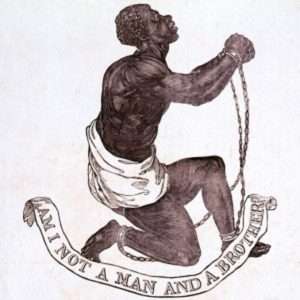
Josiah Wedgewood's famous 1787 image created for the antislavery movement.
It is no accident that the antislavery movement was also accompanied by what historian Kate Masur calls "America's First Civil Rights Movement," which sought equal rights for blacks that went beyond simply abolishing slavery.
While the hypocrisy and contradictions were very real, so too is the fact that Revolution and Founding made abolition possible, in part by giving a boost to universalistic Enlightenment liberalism on both sides of the Atlantic. I summarized some of the reasons why here:
Far from retarding the abolition of slavery, the Revolution actually accelerated it. Its triumph gave a big boost to Enlightenment liberalism, which inspired the First Emancipation in the US (the abolition of slavery in the North that became the first large-scale emancipation of slaves in modern history), and boosted antislavery movements in Europe, as well….
Had the Revolution been defeated, Enlightenment liberal ideology would have been dealt a setback in Britain and France, too. That would have set back antislavery movements there, as well. It is no accident that many antislavery leaders in Europe were also sympathizers with the American Revolution.
Those principles are at the root of most of America's achievements, of which the abolition of slavery was perhaps the most important. They are also what enabled America, at its best, to offer freedom and opportunity to people from a wide range of racial and ethnic backgrounds from all over the world.
Abraham Lincoln, who issued the Emancipation Proclamation whose belated enforcement Juneteenth celebrates - put it best in his famous speech on the Declaration of Independence and its implications for slavery:
I think the authors of that notable instrument intended to include all men, but they did not mean to declare all men equal in all respects…. They did not mean to assert the obvious untruth, that all were then actually enjoying that equality, or yet, that they were about to confer it immediately upon them…
They meant simply to declare the right, so that the enforcement of it might follow as fast as circumstances should permit.
They meant to set up a standard maxim for free society which should be familiar to all: constantly looked to, constantly labored for, and even, though never perfectly attained, constantly approximated, and thereby constantly spreading and deepening its influence and augmenting the happiness and value of life to all people, of all colors, every where.
The success of the antislavery movement's appeal to liberal universalism has been a model for later expansions of freedom, as well - including equal rights for women, the Civil Rights Movement of the twentieth century, and the struggle for same-sex marriage. It is a model that advocates of migration rights would do well to emulate today.
The work of fully living up to the ideals of the Founding wasn't completed in Lincoln's time, and it remains seriously incomplete even now. But Juneteenth commemorates perhaps our greatest step in the right direction. And it reminds us that further progress towards liberty and equal rights depends on emphasizing the same principles that made abolition possible.
This bonus episode of the Cyberlaw Podcast is an interview with Amy Gajda,author of "Seek and Hide: The Tangled History of the Right to Privacy." Her book is an accessible history of the often obscure and sometimes "curlicued" interaction between the individual right to privacy and the public's (or at least the press's) right to know.
Gajda, a former journalist, turns what could have been a dry exegesis on two centuries of legal precedent into a lively series of stories about the conflicts behind the case law. All the familiar legal titans of press and privacy -- Louis Brandeis, Samuel Warren, Oliver Wendell Holmes – are there, but Gajda's research shows that they weren't always on the side they're most famous for defending. You may come for deep thoughts about the law of privacy and press, but you'll stick around for generous helpings of sex and hypocrisy (which, it turns out, is pretty much the core of privacy and, often, journalism).
This interview is just a taste of what Gajda's book offers, but lawyers who are used to a summary of argument at the start of everything they read should listen to this episode first so they know up front where all the book's stories are taking them.
You can subscribe to The Cyberlaw Podcast using iTunes, Google Play, Spotify, Pocket Casts, or our RSS feed. As always, The Cyberlaw Podcast is open to feedback. Be sure to engage with @stewartbaker on Twitter. Send your questions, comments, and suggestions for topics or interviewees to CyberlawPodcast@steptoe.com. Remember: If your suggested guest appears on the show, we will send you a highly coveted Cyberlaw Podcast mug!
The views expressed in this podcast are those of the speakers and do not reflect the opinions of their institutions, clients, friends, families, or pets.
I just ran across an interesting article, "Should AI Psychotherapy App Marketers Have a Tarasoff Duty?," which answers the question in its title "yes": Just as human psychotherapists in most states have a legal obligation to warn potential victims of a patient if the patient says something that suggests a plan to harm the victim (that's the Tarasoff duty, so named after a 1976 California Supreme Court case), so AI programs being used by the patient must do the same.
It's a legally plausible argument—given that the duty has been recognized as a matter of state common law, a court could plausibly interpret it as applying to AI psychotherapists as well as to other psychotherapists—but it seems to me to highlight a broader question:
To what extent will various "smart" products, whether apps or cars or Alexas or various Internet-of-Things devices, be mandated to monitor and report potentially dangerous behavior by their users (or even by their ostensible "owners")?
One of the standard justifications for socialism is the claim that it will free workers from domination by their bosses. After the revolution comes, working people will no longer have to cater to the arbitrary whims of capitalists or their managerial lackeys. Anyone who has ever had to put up with a mean or incompetent boss can readily see the intuitive appeal of this idea.
The intuition is backed by the ideas of "non-domination" theorists (not all of them socialists), who emphasize the importance of freedom from the arbitrary control of others. Even if the victim of domination has a high material standard of living, they argue, she has still suffered a grave injustice. Thus, even the best-paid employees of capitalist firms still labor under the domination of the boss. Some non-dominationists add the point that this is true even if the boss's dictates are always reasonable and he never abuses his authority. The mere fact that he could wield arbitrary power over you if he wanted to, is enough to make you a victim of subordination. Socialism would, it is claimed, put an end to this grave injustice.
In a recent guest post at Bryan Caplan's "Bet on It" blog, political philosopher Christopher Freiman takes issue with the non-domination rationale for socialism. While it may free workers from the potential domination of bosses, it exposes them to worse abuses at the hands of fellow workers:
[I]magine that Alice is living under capitalism and owns a restaurant. She has somewhat puritanical sensibilities and doesn't like the look of her employee Tate's new tattoo. However, she would suffer a significant material cost if she acted on her anti-tattoo bias and fired him—namely, the loss of a productive employee. So even though Alice doesn't like tattoos, she has an economic incentive to grit her teeth and keep Tate on board. Indeed, it's plausible for Becker-type reasons that if Alice does start making hiring and firing decisions on the basis of occupationally-irrelevant considerations like tattoos, she'll lose productive workers to competitors and see her business languish as a result. The system as a whole will punish arbitrariness even if a particular employer indulges in it.
Now suppose Alice is living in a socialist society that's characterized by democratically-run, worker-controlled cooperatives. She still doesn't like tattoos and Tate—now her fellow worker-owner—still decides to get one. As an individual worker-owner in the cooperative, Alice can cast a vote to fire Tate. Notice that her material incentive to not indulge her anti-tattoo bias is much weaker in this scenario. Under capitalism, Alice's decision about Tate's employment is decisive—if she wants him fired, he's fired. Consequently, an arbitrary decision comes with a 100% chance of losing a high-productivity employee and taking money out of her own pocket.
However, under socialism, even if Tate is productive and firing him would make Alice worse off economically, it may still be rational for her to vote to fire him to express her distaste for tattoos. The vote, unlike the firing decision in the capitalist scenario, is not decisive—it comes with a much smaller chance of actually resulting in Tate's termination. Since there is a comparatively low chance that her vote to fire Tate will get him fired, the vote has a comparatively low material cost to Alice—making it more likely that she'll cast it. And the point holds for all of the other worker-owners, meaning this is a cooperative-wide problem. (It's true that Tate also gets a vote, but a single vote isn't much of a safeguard against domination.) While socialists claim that collectivization will liberate workers from the whims of their bosses, they tend to ignore how collectivization subjects workers to the whims of other workers. Indeed, worker-owners have stronger incentives than capitalist employers to make arbitrary decisions, so we should expect arbitrary decisions to be more prevalent under socialism than capitalism.
Freiman's point can be extended in several ways. First, the dynamic he identifies becomes worse with increasing size. The larger the number of workers employed by any given enterprise, the smaller the significance of any given vote in the cooperative assembly, and the greater the voters' incentive to indulge various prejudices. At the same time, the larger the electorate, the less the chance that any potential victim of those prejudices will be able to exercise enough influence to change the outcome. In Chapter 1 of my book Free to Move: Foot Voting, Migration, and Political Freedom, I explain in greater detail how these dynamics ensure that democratic processes generally fail to solve the problem of domination, and may even exacerbate it.
The danger of worker domination under socialism is exacerbated if the socialist system in question is one where enterprises are controlled not by their employees, but by the government - even a democratically elected one. In that event, the individual worker has even less chance of influencing the rules she must live under. And those rules apply not just to one enterprise - which dissatisfied employees can quit - but to every workplace throughout the economy. In that scenario, workers with minority preferences are likely to be far more thoroughly dominated than in almost any other.
In the real world, of course, "democratic" socialism is highly likely to devolve into dictatorship, as has happened with every large-scale experiment in socialism throughout history. Workers throughout the nation then end up subject to the whims of a much smaller, and more centralized clique of bosses who - unlike capitalists - don't have to compete for labor. Dissenting workers are lucky if they only get fired or demoted, as opposed to executed or sent to the Gulag.
As Freiman implies, the best safeguard against domination by bosses is the right of exit, combined with competition. If the boss makes arbitrary and unreasonable demands, she risks losing productive workers to her rivals. At the very least, she will have to pay good workers a higher salary to retain them. An employee who can say "no" to the boss by quitting has far more meaningful freedom from domination than one whose only recourse is, say, a 1 in 1000 chance of influencing the outcome of the next vote at the Workers Assembly.
Such exit mechanisms are far from perfect. But they are vastly preferable to socialist alternatives. And, as Freiman also notes, much can be done to increase mobility and competition in existing capitalist systems, most notably breaking down barriers such as occupational licensing and exclusionary zoning, which make it harder for workers to seek out new opportunities.
Finally, it's worth emphasizing that, if worker cooperatives are as wonderful as advocates claim, free market systems are entirely compatible with them. Nothing prevents people from setting up enterprises run by such collectives. Indeed, they have existed in "capitalist" societies for many decades now. If democratic cooperatives really do treat employees better than conventional bosses, that should give them important competitive advantages over the latter in attracting productive workers. They wouldn't have to pay as high wages to get the best people. And their happier workforces should be more productive, as a result, thereby increasing their competitive edge even more.
The fact that cooperatives don't seem to be successful in most sectors of the economy is a sign they may not be as great as enthusiasts claim. Either they don't actually diminish domination of workers (perhaps for the reasons Freiman notes), or employees care more about things like pay and benefits than they do about non-domination.
Some might even prefer a workplace where management is handled by the boss (or her specialized agents), because they find spending time on governance unpleasant and boring. As Oscar Wilde famously put it, "the trouble with socialism is that it takes up too many evenings."
Regardless, the existence of "socialist" enterprises in capitalist societies further expands exit options for workers, and further diminishes the risk of domination by bosses. By contrast, a socialist society cannot readily accommodate conventional "capitalist" firms - at least not without ceasing to be socialist if the capitalist firms begin to outcompete their cooperative rivals.
In sum, exit rights, not socialism are the best antidote to overbearing bosses. And if you are a non-domination theorist, they are also a far better solution to the problem of arbitrary power than is democratic governance.
From Greenburg v. Wray, decided yesterday by Judge Douglas Rayes (D. Ariz.) (key legal point highlighted):
Amanda Wray manages a 2,000-member Facebook group … "dedicated to propagating anti-mask policies, anti-vaccine policies, anti-LGBTQ policies, and anti-Critical Race Theory policies within the Scottsdale Unified School District." … Plaintiff[ Mark Greenburg]'s son serves on … the elected governing body that manages Scottsdale Unified No. 48 School District ….
In response to activities by Defendants [Wray and her husband] and the Facebook Group, Plaintiff began collecting information on them, including photographs, video footage, discussions with third parties concerning them, personal comments and thoughts, and political memes. Plaintiff stored these records on his personal "Google Drive" server. Plaintiff specifically shared server access with three individuals (including Plaintiff's son), who could access the server by signing into their own password-protected Google accounts. Although Plaintiff didn't realize it at the time, the sharing settings on his Google Drive also allowed anyone to access the server by typing in the exact URL.
In 2021, Plaintiff's son was accused of defamation. He responded to his accuser by emailing "13 photographs of public Facebook comments, made by his accuser, some of which were stored on the server." One of the photographs displayed the URL to the Google Drive, and that photograph made its way into Amanda's possession, where she noticed the URL and asked a third party to make a hyperlink for the URL. Once provided, she clicked on it to access the Google Drive. She reviewed, downloaded, deleted, added, reorganized, renamed, and publicly disclosed contents of the Google Drive.
In January of 2021, Plaintiff … was a senior high school student at The Wardlaw-Hartridge School when a video clip circulated of her using a racial epithet. The school disciplined Wysocki, and she was not permitted to attend in-person classes or activities for the remainder of the academic year, nor walk in the graduation ceremony. Wagner College, where Wysocki had signed a National Letter of Intent to play for the college's soccer program, likewise rescinded its offer of admission and scholarship….
The following version of events is derived from Plaintiffs' Amended Complaint and the exhibits referenced therein and attached thereto. For the purposes of resolving the instant motions, the Court is bound to accept Plaintiffs' factual allegations as true and view them in the light most favorable to Plaintiffs….
The Complaint omits any restatement or complete description of the video's contents or of Wysocki's exact remarks, but the allegations and exhibits suggest the video is a two-second clip, recorded approximately two years prior to it being circulated, of Wysocki using the n-word. Wardlaw student … Valcourt emailed the video clip to Wagner's Director of Admissions and the head coach of its soccer program on January 3, 2021.
Three days later, the video clip was posted on an Instagram account called "Wardlaw Uncensored" and then deleted after a few hours. Wardlaw student … Forsythe … participated in creating the account or posting the clip. Another student had overheard Forsythe months prior saying that he was going to sabotage Wysocki with the video. On or about January 7, Wysocki and her parents filed an Incident Report with the Edison Police Department stating that Wardlaw students were harassing Wysocki by circulating the video….
From Hoffmann v. Clark, in a unanimous opinion by Justice Matthew McDermott:
A jury awarded ["car tuning" company] Hoffmann Innovations, Inc., and its owner Jerry Hoffmann $11 million in compensatory and punitive damages against a fired employee, Scott Clark, and his new competing company [RealTuners] based mainly on defamatory statements that Clark made on social media, online forums, and in podcasts.
During the course of the litigation, the district court sanctioned Clark for violating a consent order that prevented both sides from making any statements about one another—particularly online statements—outside the litigation. But the court's contempt orders and sanctions for Clark's violations of the consent order didn't stop Clark from continuing to disparage Hoffmann. After several failed attempts to secure compliance with increasing sanctions, the court struck Clark's pleadings—most importantly, his answer and affirmative defenses. Without any defense pleaded to the petition's claims, trial proceeded on the only outstanding issue: the amount of damages….
I omit the complicated details about the case's procedural history and backstory, and turn to the court's important holdings about damages (which will in the process also quickly summarize the libel):
The jury awarded damages in roughly the amounts Hoffmann requested. It awarded Hoffmann personally $500,000 from Clark and $500,000 from RealTuners for libel per se ($1 million total). The jury awarded Hoffmann Innovations $2,060,250 from Clark and the same amount from RealTuners ($4,120,500 total). The remaining compensatory damages were for Hoffmann Innovations against Scott Clark: $27,000 for breach of fiduciary duty, $102,500 for breach of contract, and $250,000 for civil extortion. The jury thus awarded a total of $5.5 million in compensatory damages. The jury also awarded punitive damages against Clark for $2 million and against RealTuners for $3.5 million. The total verdict came to $11 million. The district court also granted the plaintiffs' request for common law attorney fees (awarded despite no contractual or statutory provision for such fees) for $210,743.21….
The Restatement offers a useful way of thinking about libel per se damages to reconcile our seemingly disparate treatments in cases. It describes special damages, which result from "the loss of something having economic or pecuniary value," and general damages, which are "imposed for the purpose of compensating the plaintiff for the harm that the publication has caused to his reputation," including emotional damages.
The Court doesn't decide whether that means they are subject to an "undue burden" test (as under Planned Parenthood v. Casey) or whether there is no right to abortion under the state constitution.
In Planned Parenthood of the Heartland v. Reynolds (PPH II) (Iowa 2018), we confronted a mandatory 72-hour waiting period for abortion that the legislature had enacted in 2017…. [W]e rejected the undue burden test. Instead, we found that the Iowa Constitution—specifically, the due process clause—protected abortion as a fundamental right. We determined that the waiting period could not survive strict scrutiny under that test and struck it down as unconstitutional….
[We] overrule PPH II, and thus reject the proposition that there is a fundamental right to an abortion in Iowa's Constitution subjecting abortion regulation to strict scrutiny, we do not at this time decide what constitutional standard should replace it. As noted, in PPH I [in 2015], we applied the undue burden test under our constitution when the State conceded that it applied. An amicus curiae argues that we should hold that the rational basis test applies to abortion regulations. But the State takes no such position; it simply asks that PPH II be overruled and stops there….
In addition, we are not blind to the fact that an important abortion case is now pending in the United States Supreme Court. See Dobbs v. Jackson Women's Health Org…. While we zealously guard our ability to interpret the Iowa Constitution independently of the Supreme Court's interpretations of the Federal Constitution, the opinion (or opinions) in that case may provide insights that we are currently lacking. Hence, all we hold today is that the Iowa Constitution is not the source of a fundamental right to an abortion necessitating a strict scrutiny standard of review for regulations affecting that right. For now, this means that the Casey undue burden test we applied in PPH I remains the governing standard. On remand, the parties should marshal and present evidence under that test, although the legal standard may also be litigated further.
This accurately summarizes the bottom-line outcome of the case, but note the split in the opinions:
The lead opinion, written by Justice Edward Mansfield, joined in relevant part by Justices Thomas Waterman and Dana Oxley, fully endorse that result.
Justices Matthew McDermott and Christopher McDonald, would have rejected any heightened scrutiny (including the "undue burden" test) for abortion restrictions.
Chief Justice Susan Christensen and by Justice Brent Appel would have preserved strict scrutiny (Christensen as a matter of stare decisis, and Appel, the only Justice on the court who was in the 2018 PPH II majority, on the merits).
The City of Miami has set up a voluntary gun buyback program to assist in providing safety and defense equipment to Ukraine.
Your donations will be used to assist the Ukraine support efforts. Receive a gift card starting at $50 for an old, unused, or found weapons, no questions asked. Do your part to make our streets safer. Visa Gift Cards will be exchanged for the weapons in the following amounts:
$50 Handgun
$150 Shotgun / Rifle
$250 High-powered assault rifle
But, as AmmoLand (Lee Williams) reports, it's complicated; he asked the Miami Police Department whether it has a firearms export license, which is apparently required for this sort of project, and was told "no," with the following explanation:
However, at the June 9, 2021 Commission Meeting, the City of Miami adopted Resolution R-22-0219 directing the City Manager to "take any and all action to work with federal authorities to ship any functional weapon received through the City's Gun Buyback program to Ukraine for use in the conflict against the Russian invasion." The directive to take "any and all action to work with federal authorities" may include, but is not limited to, the procurement of an export license in accordance to the Arms Export Control Act (AECA) including conformity to the requirements of the International Traffic in Arms Regulations (ITAR); any guidance from the Department of State's Directorate of Defense Trade Controls regarding AECA export controls and licensing for articles enumerated on the U.S. Munitions List; any relevant portions of the Code of Federal Regulations (CFR); and/or compliance with the Department of Commerce's Bureau of Industry and Security export controls for items listed in the Commerce Control List (including firearms) pursuant to the International Emergency Economic Powers Act and Part 774 of the Export Administration Regulations; and/or compliance with the National Firearms Act including any application to obtain a permit for permanent exportation of firearms; any necessary clearances from ATF prior to export; or compliance with any one-time licensing exception the City may be eligible to obtain as provided in the provisions of ITAR. The actual avenue for the City to lawfully export anything is speculative at this time because the City cannot predict the amount or types of firearms that will be donated at buyback event.
Now perhaps the plan was just to get people to turn in guns, whether or not the guns will actually make it to Ukraine (especially in any timely way). But, as CNN (Peter Nickeas) notes, "experts say there's no evidence the programs reduce violence"; for instance, a 2021 National Bureau of Economic Research paper, "Have U.S. Gun Buyback Programs Misfired?," by Toshio Ferrazares, Joseph J. Sabia, and D. Mark Anderson, concluded:
We conclude that GBPs are an ineffective policy strategy to reduce gun violence, a finding consistent with descriptive evidence that (i) firearm sales prices are set too low by cities to appreciably reduce the local supply of firearms (Reuter and Mouzos 2004), (ii) most GBP participants are drawn from populations with low crime risk (Planty and Truman 2013; Violano et al. 2014; Romero et al. 1998), and (iii) firearms sold in GBPs tend to be older and less well-functioning than the average firearm (Kuhn et al. 2002; Levitt 2004).
(See also this item from the Foundation for Economic Education.) And I particularly note item (iii); I'm not sure that the Ukrainians would be that helped by eventually getting a bunch of guns that Americans were willing to sell for $50-250, even if the shipment is limited to those that the Miami PD decides are "functional."
Please enjoy the latest edition of Short Circuit, a weekly feature from the Institute for Justice.
Los Angeles friends, come and join us on Thursday, June 30 at UCLA for a live recording of the Short Circuit podcast, plus the unveiling of our interactive study on clearly established law sufficient to overcome qualified immunity for each circuit. The event features Eugene Volokh of UCLA, Julia Yoo of the National Police Accountability Project, and Nicholas Yoka of Panish Shea Boyle Ravipudi LLP, among others. Click here to RSVP.
When is a pipe just a pipe—and not a pipeline? San Juan, P.R. liquified natural gas facility: When it's only a 75-foot pipe from our facility to the power plant next door. Federal Energy Regulatory Commission: Anytime a pipe is used to receive or send out gas for use in foreign or interstate commerce it's a pipeline. D.C. Circuit: To FERC's jurisdiction you must submit.
Victor "Little Vic" Orena, former Colombo family boss whose leadership led to intra-family mob war, is serving a life sentence in federal prison. And there he'll stay, despite deteriorating health (including apparently thinking that he's the president of the U.S.), says the Second Circuit.
Following the 2018 gov't shutdown, FBI employees sue the United States. Allegation: Had you contributed to our retirement accounts when you were supposed to, those contributions would've been a lot more valuable. Gov't: Sovereign immunity! Employees: Aha, but the Federal Employees' Retirement System Act of 1986 waives sovereign immunity for beneficiaries of our retirement plan to sue "to recover benefits." Gov't: Double Aha! What you're suing about here isn't a "benefit" but rather consequential damages stemming from our late payments. Third Circuit: The gov't is right. No waiver. No lawsuit. (NB: A restive faction among your humble staff wishes to offer big respect to Judge Bibas for going out of his way (at page 9) to correct the Supreme Court's failure to rigorously hyphenate its phrasal adjectives.)
The Constitution guarantees prisoners the right to access the courts, which includes the right to access the tools needed to file a complaint. But does that mean Pennsylvania corrections officials violated clearly established law when, the weekend before a prisoner's trial, they refused to let him use the main law library or lend him paper copies of the Federal Rules of Civil Procedure and Evidence? Third Circuit: Going forward, prisoners definitely have a right to access the courts even after they've filed a complaint (it'd be "ludicrous" to hold otherwise), but qualified immunity will protect the officials here.
Is assault by strangulation a "crime of violence" under North Carolina law? For folks who are new to the U.S. Sentencing Guidelines rigamarole, the Fourth Circuit explains why the answer is not so simple—but also why it is yes.
Across the U.S., "supermax" prisoners are held in solitary confinement for 22-24 hours per day, every day, without any meaningful opportunity to enter general population. Can the officials responsible for Virginia's solitary-confinement policy claim qualified immunity in a class-action lawsuit based on the harms caused by this long-term solitary confinement? Fourth Circuit: Negatory. We're at the motion to dismiss stage; plaintiffs have alleged that the defendants knew the harms of long-term solitary confinement but ignored them; and "qualified immunity does not protect knowing violations of the law."
North Carolina charter school: Our requirement that female students wear skirts isn't rooted in sexist stereotypes; it's just that women are "fragile vessel[s]" and need to be taken care of. Fourth Circuit (en banc): [blank stare]. Second dissent: I guess chivalry is dead.
The baroque doctrine of Younger abstention says the federal courts must decline to interfere with certain state-court proceedings. But there's an exception for "extraordinary circumstances." What are extraordinary circumstances? Fourth Circuit: It's hard to say with any precision, but the district court didn't abuse its discretion in finding extraordinary circumstances here, where there's a paper trail strongly suggesting West Virginia launched an administrative proceeding to "shut down" an out-of-state air-ambulance provider in favor of its in-state competitor. (We explored the doctrine in some detail on the podcast.)
The Constitution forbids striking potential jurors because of their race. So can four individuals sue an infamous Mississippi district attorney who allegedly regularly does just that? The Fifth Circuit (over a dissent) says no; the likelihood any one of them will be called for jury service is too remote. Plus, the DA "would need to be unchastened" by previous reversals at SCOTUS and in state court.
Louisiana landowners miss out on a natural-gas bonanza after a bank landman inadvertently leases the entirety of the mineral rights on their land, instead of just a portion, and does so right before advances in drilling technology make the land fantastically valuable. District court: No liability for this "mistake in judgment." Fifth Circuit: It was a mistake all right, but just the regular kind that you owe money for.
With prisons overcrowded, Louisiana state corrections officials work out a deal to house prisoners at local East Carroll Parish jail. Yikes! The deal doesn't include ensuring prisoners are released on time; many are held months past their release dates. Fifth Circuit: A reasonable jury could find that the defendants failed to adopt policies to prevent delays and at least some of the defendants directly participated in the conduct that caused overdetention. No qualified immunity. Dissent: The plaintiffs' claims are barred by Heck v. Humphrey, which prohibits civil lawsuits that undermine the validity of criminal convictions. Defendants should raise this argument on remand; they'll win.
Allegation: Louisville, Ky. police fabricated evidence, withheld exculpatory DNA evidence, and coerced a jailhouse informant into giving a false statement implicating 16-year-old in 2005 murder. District court: Because she took an Alford plea, pleading guilty but maintaining her innocence, her suit against the officers is Heck barred. Sixth Circuit: The governor pardoned her; she can sue.
In addition to securing bank deposits, the FDIC employs agency "judges" who hold hearings, take evidence, and issue decisions that (among other things) impose hefty monetary penalties. Sixth Circuit: The recipient of one such monetary penalty argues that the FDIC's agency "judges" enjoy unconstitutional protection from removal, but that challenge fails because, even if true, he cannot show that the removal protections caused him harm. Various other constitutional and statutory challenges also fail. Dissent: I agree that the constitutional challenges fail, but I would grant relief on statutory grounds. Also, while the petitioner did not argue that the use of agency "judges" violated Article III, it seems to me there must be some limit to the government's ability to adjudicate penalty proceedings before agency judges. (NB: Many will recall the Fifth Circuit's blockbuster ruling on that very topic just last month.)
Allegation: A and B are corporate rivals. Pretending to be a small customer rather than a competitor, B contracts with A, gets A's product, and steals A's trade secrets. A sues, and B invokes a clause in the contract to try to force the case into arbitration. Seventh Circuit (per Easterbrook, J., absolutely not having it): "Signing a contract with your fingers crossed behind your back does not add to your rights or subtract from anyone else's." A agreed to arbitrate with the made-up customer, not with B.
Allegation: Wynne, Ark. police officer stalks woman, parking near her home, following her around town. After she leaves the restaurant he followed her to, she is stopped by a second officer who then summons the stalker officer to the scene. She's arrested for driving under the influence. At jail, she pees into a cup, but the results of the drug test are lost, and she can't drive for a year (thanks to the stalker officer repeatedly seeking continuances in court) before charges are finally dismissed. Eighth Circuit: There's no evidence the stop or arrest was at the behest of the stalker officer, so qualified immunity for him.
Allegation: Without warning, ICE agents shove lawyer to the ground as she followed the agents and her clients into an ICE facility. The lawyer suffers a broken foot and concussion, among other injuries. Excessive force? Eighth Circuit: There's no case that says force used to repel someone, as opposed to force used to apprehend them, counts as a seizure under the Fourth Amendment. Qualified immunity.
Recall the baroque doctrine of Younger abstention? The one that says the federal courts must decline to interfere with certain state-court proceedings? Of course you do. So, is an insurance conservatorship one such proceeding? Ninth Circuit: Nope. But because the insurance conservatorship was an in rem proceeding and the federal case either in rem or quasi in rem, the equally baroque "prior jurisdiction rule" shunts these particular plaintiffs out of federal court. (Contrary to what this summary may suggest, the opinion's not a bad read.)
Sitting en banc, the Ninth Circuit holds that a constitutional challenge to now-rescinded California executive orders banning in-person instruction at public and private schools in 2020 and early 2021 is moot. Dissents: The case is not moot, but there's no constitutional violation.
Nicaraguan asylee has thrice been driven from his home under threats of torture and death for his political beliefs. Ninth Circuit: Those sound like very good reasons to grant him asylum. Dissent: Not under the thrice-deferential standard of review we are supposed to apply.
Mexican national seeks withholding of removal from the United States, but is denied because he twice "encouraged" his son to enter the United States illegally. He challenges the denial, arguing that the prohibition on "encouraging" is unconstitutionally overbroad under the First Amendment. Ninth Circuit: Not if we read it in its narrower, criminal law sense. Dissent: Well if you read it in that sense, it's largely redundant.
Allegation: Fired Albuquerque police officer sues the city, seeking records related to his termination. The city sues him right back, filing counterclaim for malicious abuse of process. Unconstitutional retaliation? District court: No, because the counterclaim was a civil tort action, not a criminal prosecution. Plus, the official who told the city's lawyers to file the counterclaim wasn't acting under color of law. Tenth Circuit: Case undismissed.
Without warning, DeKalb County, Ga. officer shoots suspected child murderer (who'd been pointing a shotgun at his own chin) in the head, shoulder, and leg. Another officer removes the shotgun, handcuffs the suspect, and pins him down. A third officer pistol-whips him when he tries to sit up. Eleventh Circuit: Qualified immunity for shooting him but not for pistol-whipping him. And though a jury might find it was unconstitutional to (allegedly) wait four minutes to call an ambulance, the law wasn't clearly established, so QI for that too.
And in en banc news, the Seventh Circuit will not reconsider its decision overturning a $350k jury verdict against a debt collector that tried to collect debt it knew was past the statute of limitations. Because the class representative wasn't fooled into paying the debt and otherwise suffered no concrete injury, she does not have standing to sue. Dissental (four votes): "Anyone who has experienced financial insecurity can easily understand her injuries."
And in amicus brief news, IJ is asking the Tenth Circuit to reconsider its decision allowing Denver officials to resume conducting unannounced sweeps of homeless camps. The panel reached its decision on grounds that the city did not argue and that the plaintiffs never had a chance to rebut. Which is something the Supreme Court frowns upon.
In 2018, Chaves County, N.M. Sheriff's Deputy David Bradshaw, for reasons known only to himself, took great offense at being lawfully passed by another driver, Mario Rosales. Bradshaw—who was off-duty and driving an unmarked personal vehicle with his 2-year-old in tow—followed Rosales home, blocked him in his driveway, yelled profanities, and pointed his gun at Rosales, who was lawfully armed but calm and nonthreatening. Bradshaw eventually left after another deputy arrived. And last year, a federal district court granted him qualified immunity. But, among other infirmities, the court failed to consider whether Bradshaw was acting within the scope of his authority and thus whether qualified immunity is even available to him in the first place. So this week, IJ appealed the ruling to the Tenth Circuit, including the dismissal of the claims against the sheriff, who hired and retained Bradshaw despite his history of violent behavior. Click here to read more.