7/7/1893: Justice Samuel Blatchford dies.

Mostly law professors | Sometimes contrarian | Often libertarian | Always independent | Est. 2002
7/7/1893: Justice Samuel Blatchford dies.
Plus a nice catalog of how high the bar can be for punishable threats under New York law.
From People v. Benavente, decided yesterday by Judge Wanda Licitra (N.Y. Crim. Ct.):
The People charge Ms. Benavente—a 24-year-old woman with no criminal record—with second-degree aggravated harassment. That charge, a violation of P.L. § 240.30(1)(a), is a class A misdemeanor punishable by up to 364 days in jail. To establish this charge, the People have filed an information accusing Ms. Benavente of calling another woman on the telephone and saying, in full: "That's why you had daddy issues. That's why you got molested. I'm gonna tell everyone you got molested. Here's my address, pull up. I know where you hang out." …
[According to the criminal information,] informant [i.e., the accuser] and defendant had both [allegedly] been previously involved with the same man….
This case alleges a violation of the penal law based solely on a person's speech. As applicable here, P.L. § 240.30(1)(a) criminalizes speech where someone:
[C]ommunicates … by telephone … a threat to cause physical harm to, or unlawful harm to the property of, such person … and the actor knows or reasonably should know that such communication will cause such person to reasonably fear harm to such person's physical safety or property.
An interesting threats case, from the Louisiana Court of Appeal
From Terrell v. Derouen, decided yesterday by the Louisiana Court of Appeal, in an opinion by Judge Wayne Ray Chutz, joined by Judge Guy Holdridge (with Judge John Michael Guidry concurring in the result):
Terrell alleged that he is the President and founder of the Louisiana non-profit organization, United Cajun Navy (UCN), which coordinates search-and-rescue efforts in response to natural disasters and other tragedies. He and UCN responded to the capsizing of the Seacor Power in the Gulf of Mexico on April 13, 2021, by activating the corps of volunteers and charitably raising money to fund and supply support for search-and-rescue efforts of crewmen.
On April 30, 2021, as UCN searched for seven missing Seacor Power crewmen, Terrell averred that he was ambushed by several individuals making false claims that UCN was not using donations for supplies and material and demanding that Terrell turn over UCN's bank statements. Terrell alleged that on May 1, 2021, in a Facebook live video, Derouen threatened to inflict bodily harm on Terrell and motivated third parties to threaten, harass, and intimidate him. {Terrell attached electronic communications from the third parties in which he was called "a piece of shit" and advised to "run and hide" and "burn in hell."} Also on May 1, 2021, Derouen texted a UCN volunteer stating, "But [Terrell]…if you watching this…you better run if you see me mother fucker."
From Richard v. Speaker of the House of Reps., decided today by the N.H. Supreme Court, in an opinion by Justice Gary Hicks:
On May 20, 2019, the plaintiff filed a remonstrance with the Secretary of State, the Governor, and the clerks of the House of Representatives and the Senate. His remonstrance complained that RSA chapter 654 diluted his vote because it granted "the right of suffrage to unqualified resident aliens."
The House Clerk received the remonstrance, but did not publish it or recognize its receipt in the House Calendar. The plaintiff re-filed his remonstrance and the House Clerk eventually published it in the House Calendar on December 31, 2020.
The plaintiff filed a second remonstrance with the same offices on January 6, 2020. His second remonstrance complained about House Bill 687-FN, a so-called "red flag" bill[, which] {allows "courts to order that firearms be temporarily removed from individuals who pose an imminent risk of harm to themselves or others"}. The January 10, 2020 House Calendar reflected receipt of the remonstrance, stating that it had been filed and was "available for inspection in the Office of the Clerk of the House." Neither the Speaker nor the Senate President otherwise notified their respective legislative bodies.
Plaintiff sued, claiming he was entitled under the state constitution to have a hearing on his petitions, but the court disagreed:
Except for minor differences in punctuation, Part I, Article 32 provides now as it provided when it was first enacted:
The people have a right, in an orderly and peaceable manner, to assemble and consult upon the common good, give instructions to their representatives, and to request of the legislative body, by way of petition or remonstrance, redress of the wrongs done them, and of the grievances they suffer.
To the framers, the word "redress" in this context meant to remedy or repair. The noun "petition" referred to a written or formal request "to a legislative or other body, soliciting some favor, grant, right or mercy." A "grievance" was defined as "that which burdens, oppresses, or injures, implying a sense of wrong done, or a continued injury, and therefore applied only to the effects of human conduct; never to providential evils" as in, "The oppressed subject has the right to petition for a redress of grievances." A "remonstrance" as used in Part I, Article 32 was a "strong representation of reasons against a measure," which "when addressed to a public body … may be accompanied with a petition or supplication for the removal or prevention of some evil or inconvenience," as in "[a] party aggrieved presents a remonstrance to the legislature." Thus, pursuant to its plain language, as understood by the framers, Part I, Article 32 grants citizens the right to request, by way of a formal petition or remonstrance, that the legislature right a wrong.
The article is now up on SSRN. It explains how migration restrictions have massive negative effects on both "negative" and "positive" economic liberty of residents of destination countries.
The revised version of my new article on "Immigration and the Economic Freedom of Natives" is now up on SSRN. This revision addresses a number of issues and potential criticisms more fully than the original version. Here is the abstract:
Much of the debate over the justice of immigration restrictions properly focuses on their impact on would-be migrants. For their part, restrictionists often focus on the potentially harmful effects of immigration on residents of receiving countries. This article cuts across this longstanding debate by focusing on ways in which immigration restrictions inflict harm on natives, specifically by undermining their economic liberty. The idea that such effects exist is far from a new one. But this article examines them in greater detail, and illustrates their truly massive scale. It covers both the libertarian "negative" view of economic freedom, and the more "positive" version advanced by left-liberal political theorists.
Part I focuses on libertarian approaches to economic freedom. It shows that migration restrictions severely restrict the negative economic liberty of natives, probably more than any other government policy enacted by liberal democracies. That is true both on libertarian views that value such freedom for its own sake, and those that assign value to it for more instrumental reasons, such as promoting human autonomy and enabling individuals to realize their personal goals and projects.
In Part II, I take up left-liberal "positive" theories of economic freedom, which primarily focus on enhancing individuals' access to important goods and services, and enabling them to have the resources necessary to live an autonomous life. Some also focus on expanding human capacities generally, or give special emphasis to enhancing the economic prospects of the poor. Here too, migration restrictions impose severe costs on natives.
Finally, Part III describes how to address situations where potentially harmful side effects of migration might undermine either negative or positive economic liberty of natives, without actually restricting migration. I have addressed such issues in greater detail in previous work, and here provide only a short summary of my approach and its relevance for economic liberty issues.
The project includes reports by conservative, libertarian, and progressive teams. I am coauthor of the Team Libertarian report.
Earlier today, the National Constitution Center released its series of reports on "Restoring the Guardrails of Democracy." I am a coauthor of the Team Libertarian report, along with team leader Clark Neily of the Cato Institute, and Walter Olson (also of Cato). There is also a Team Conservative report (coauthored by team leader Sarah Isgur, David French, and Jonah Goldberg, all of The Dispatch), and a Team Progressive report (coauthored by prominent election law scholars Edward Foley and Franita Tolson).
Here is an excerpt from the Introduction of our Team Libertarian report, which summarizes our recommendations:
American democracy faces a number of serious challenges. In the immediate future, we must establish institutional safeguards to prevent the kind of negation of election results attempted by Donald Trump in the aftermath of the 2020 presidential election. In the medium-to long-run, more must be done to empower people to be able to make meaningful choices about the policies they live under. Ballot-box voting has great value. But it is not enough to ensure genuine political freedom. The latter requires enhancements to both "voice" and "exit" rights. We need to both increase citizens' ability to exercise voice within political institutions, and give them more and better exit options.
This report takes on all three challenges. We propose a variety of reforms that, can address immediate short-term threats to democracy, while also increasing citizen empowerment in the long run.
Part I outlines reforms that can safeguard the electoral process against attempts at reversal, while also curbing presidential powers that could be abused in ways that undermine democracy. Among the most urgently needed reforms are new constraints on presidential powers under vaguely worded emergency statutes, such as the Insurrection Act. These can too easily be manipulated by an unscrupulous administration in ways that could hobble democracy. It is also essential to reform the Electoral Count Act of 1887 in order to definitively preclude the sort of effort to overturn an election that then-President Trump engaged in after his defeat in 2020. In addition, we propose ways to incentivize electoral losers to concede defeat, rather than engage in bogus accusations of fraud and voter suppression, and to gradually restore public trust in the electoral system….
Part II describes how a number of serious flaws in the democratic process can be alleviated by expanding people's opportunities to "vote with their feet." Under conventional ballot-box voting, individual citizens usually have almost no chance of influencing the outcome. They also have strong perverse incentives to be "rationally ignorant" about the issues they vote on, and to process political information in a highly biased way.…
Expanded foot voting rights can help alleviate these problems. People can vote with their feet choosing what jurisdiction to live in within a federal system, and also through making decisions in the private sector. Relative to ballot box voters, foot voters have a much higher chance of making a decisive choice, and therefore much stronger incentives to become well-informed. Expanded foot voting can also help alleviate the dangerous polarization that has gradually poisoned our political system.
Much can be done to expand foot voting opportunities in both the public and private sector by breaking down barriers to migration, such as exclusionary zoning. Foot voting can also be facilitated through greater decentralization of political power, which would reduce the incidence of one-size-fits-all federal policies from which there is no exit, short of leaving the country entirely.
Finally, Part III outlines ways in which ordinary citizens can be empowered to exercise greater "voice" in their dealings with the criminal justice system, particularly through reviving the institution of the citizen jury. Since the Founding and before, jury trials have been understood as an important tool of popular participation in government. Alexis de Tocqueville famously focused on the jury system as one America's most important institutions of "popular sovereignty….."
Sadly, in the modern criminal justice system, the constitutionally prescribed role of juries in resolving criminal charges has been almost entirely displaced by so-called plea bargaining. Indeed, widespread use of coercive plea-bargaining discourages the overwhelming majority of criminal defendants from exercising their right to a trial by jury, for fear that doing so would lead to far more severe penalties. As a result, citizen-jurors no longer exercise influence over those powers of government that directly impact the lives and liberty of the people more than most others.
We propose multiple reforms that can help restore juries to their proper role in the criminal justice system. Judges, governors, presidents, and legislators could adopt rules limiting the use of plea bargaining and especially coercive plea tactics. "Trial lotteries" could increase the number of cases brought to trial. State and federal governments can establish plea integrity units that can provide independent review of plea bargains to ensure that improper coercion was not used….
Within the trial process, more can be done to inform jurors of the full extent of their authority, particularly the ability to assess the justice of the laws and penalties in question, as well as factual questions related to the guilt of the accused.
Even if adopted in combination, our proposed reforms would not cure all the ills that afflict American democracy. But they can do much to shore it up against threats, and empower Americans to exercise greater control over the government policies they live under.
The progressive and conservative reports overlap with ours on some points, while diverging on others. For example, the Progressive report suggests changes to the Electoral Count Act that are similar to our proposals, and there is also some convergence on other measures related to protecting elections against reversal. On the other hand, it also recommends legislation criminalizing "deliberate electoral lies," whereas our report specifically counsels against such steps. The Progressive report's approach to the problem of voter ignorance (expanded civic education) is also at variance with ours (expanded foot voting). I express skepticism about the education solution in some detail in Chapter 7 of my book Democracy and Political Ignorance.
For its part the Conservative report largely focuses on a different set of issues than either ours or the progressive one. Their major recommendations involve strengthening Congress relative to the executive, and political parties relative to individual candidates and interest groups. I agree with much of this (particularly constraining the executive), but have some reservations on details. Like us, they recommend against controls on campaign-related speech, though for somewhat different reasons. On the other hand, they, like the Progressives, strike me as too optimistic about education as a tool for overcoming public ignorance.
There is, I think, much to be learned from all three reports, and I hope they will make useful contributions to the ongoing debate over these issues.
Tonight at 7 PM eastern time, the three team leaders - Ned Foley, Sarah Isgur, and Clark Neily - will be speaking about the reports with NCC President Jeffrey Rosen at a live webinar. You can register to watch for free here.
The Foundation for Individual Rights and Expression reports:
Incoming student Ash Mikkelsen (they/them) is fighting to defend artistic expression and their academic future after retweeting sexually explicit Japanese-style cartoons featuring nudity and sex, known as hentai, on their personal, pseudonymous Twitter account. The art institute investigated Mikkelsen, alleging that the images could constitute sexual harassment and contribute to a hostile learning environment. Though Mikkelsen did not tag anyone from the university community in their posts or send messages to anyone relating to the account, KCAI expelled Mikkelsen for their artistic expression — and permanently banned them from ever re-enrolling at the school.
Today, the Foundation for Individual Rights and Expression sent a letter to KCAI demanding that the school immediately reverse the outrageous expulsion….
After one student allegedly found the account and complained to administrators, KCAI attempted to justify investigating and then expelling Mikkelsen for non-Title IX hostile environment sexual harassment under its Student Code of Conduct. However, KCAI does not define sexual harassment under that code. It's patently unfair and unlawful to punish students under unpublished disciplinary standards. Moreover, Mikkelsen's retweets don't come anywhere close to meeting the legal definition of sexual harassment….
From Butcher v. Knudsen, decided today by the Ninth Circuit (opinion by Judge Daniel Bress, joined by Judge Sandra Ikuta):
Two retirees, Ed Butcher and Lonny Bergstrom, operate a website that tracks the voting records of Republican state legislators in Montana. Several local Republican groups in Montana took an interest in the website and invited Butcher and Bergstrom to speak on their findings. Based on the travel expenses they incurred in giving these presentations— such as for gas, meals at McDonald's, and a night at a La Quinta Inn—Montana's Commissioner of Political Practices determined that Butcher and Bergstrom had formed a "political committee" under Montana law.
Because Butcher and Bergstrom had neither registered their alleged political committee with the state nor complied with numerous reporting obligations, the Commissioner concluded they were subject to a civil fine and civil prosecution. Butcher and Bergstrom argue, however, that Montana law is impermissibly vague because they lacked fair notice that their conduct would not be treated as "de minimis," and thus exempt, under Montana Administrative Rule 44.11.603.
Over 150 new edited documents in the 2022 update to Gillman, Graber, and Whittington's American Constitutionalism
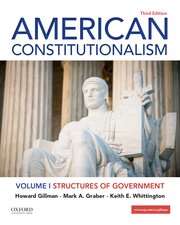
The first edition of Howard Gillman, Mark A. Graber, and Keith E. Whittington's American Constitutionalism was published by Oxford University Press in 2012. Both volumes of the casebook are now in their third edition, and there is also a one-volume version that includes materials on both structures of government and rights and liberties.
We always had more material than could fit between the covers, and we wanted to produce new materials as events warranted. OUP agreed to produce a companion website that would host those materials. Even more generously, OUP agreed to make that companion website freely available to the public. The classic version can be found here, and the new version can be found here. All materials will eventually migrate to the new version.
The companion website has hundreds of primary documents relating to American constitutionalism. Each document is edited and includes an explanatory introduction. An index to the materials can be found here.
In part because some materials did not get uploaded last year, and in part because American constitutionalism has been rather tumultuous of late, we are adding well over 150 new documents to the site this summer. An index of the 2022 update can be found here. Those materials include not only the major constitutional (and constitution-adjacent) cases of the just concluded term of the U.S. Supreme Court, but also myriad federal circuit court and state court decisions, non-judicial documents (relating to January 6th, the Trump impeachments, and more), and older documents relevant to better understanding current controversies (e.g., old and new OLC opinions on delays in inducting judges into office, cases on government pressure on private actors to suppress speech, an OLC opinion on whether former presidents can be indicted for the same offense for which they were impeached, cases on free exercise claims against vaccination requirements, cases on state restrictions on the right to travel across state lines).
A constitutional law class could easily be taught just using the open source materials on the companion website (and I have), but OUP only supports the website because of sales of the casebook so feel free to buy and/or adopt it.
From a letter (though not an official opinion) sent today by the Maryland Attorney General to Captain Andrew Rossignol, Commander of the Maryland State Police Licensing Division; you can also read the cited July 1 Maryland appellate court case, In re Rounds:
As explained in more detail below, Maryland's "good and substantial reason" requirement is now clearly unconstitutional, based on controlling Supreme Court precedent that is directly on point. Indeed, the Court of Special Appeals concluded as much just a few days ago in an unreported decision. In re Rounds, No. 1533, Sept. Term, 2021 (Md. Ct. Spec. App. July 1, 2022) (unreported). Thus, the Department is not required to continue enforcing—and, in fact, may not continue to enforce—the "good and substantial reason" requirement in processing public-carry permit applications.
But that conclusion applies only to the "good and substantial reason" requirement. That is, with limited exceptions specifically authorized by law, it remains illegal for an individual to carry, wear, or transport a handgun in public in Maryland without a permit from the Department of State Police. The Department also must continue to enforce all other statutory prerequisites for the issuance of public-carry permits. For example, among other statutory prerequisites, the Department still is prohibited from issuing a permit to an applicant who has been convicted of "a felony or of a misdemeanor for which a sentence of imprisonment for more than 1 year has been imposed," PS § 5-306(a)(2)(i), or who has "exhibited a propensity for violence or instability that may reasonably render the person's possession of a handgun a danger to the person or to another," PS § 5-306(a)(6)(i). In addition, Maryland's laws and regulations prohibiting the carrying of handguns in certain sensitive places—like schools—remain in effect….
Red Flag June Comes For Alden v. Maine.
Last term, I thought the most fascinating constitutional law decision was PennEast Pipeline v. New Jersey. The case held that New Jersey waived its sovereign immunity with respect to the federal eminent domain power. Here, FERC delegated to PennEast the power to condemn land for a pipeline. Chief Justice Roberts wrote the majority opinion, which was joined by Justices Breyer, Alito, Sotomayor, and Kavanaugh. Justice Gorsuch wrote one dissent, which was joined by Justice Thomas. Justice Barrett wrote a second dissent, which was joined by Justices Thomas, Kagan, and Gorsuch.
This case did not neatly break down along usual ideological divide. And, more importantly, Chief Justice Roberts, as well as Justices Alito and Kavanaugh, ruled against state sovereign immunity. During the 1990s and early 2000s, the Rehnquist Court focused on bolstering state sovereign immunity. Here, we got an early sign that the Court's conservatives may not be united on this topic. On balance, I found Justice Barrett's dissent to be far more persuasive than the majority opinion. In my view, Barrett's PennEast dissent is the most thoughtful opinion she has written on the Court.
Still, PennEast was not directly in tension with Alden v. Maine, because the federal eminent domain power does not appear in Article I. But PennEast did propose a new test: a state will be found to have waived sovereign immunity pursuant if that waiver is consistent with the "plan of the Convention."
Last week, the Court decided Torres v. Texas Department of Public Safety, which I think is the most fascinating opinion of the OT 2021 term. Here, Torres argued that Texas waived sovereign immunity with regard to Congress's Article I powers over military affairs. By a 5-4 vote, the Court agreed. Justice Breyer wrote the majority opinion which was joined by Chief Justice Roberts and Justices Sotomayor, Kagan, and Kavanaugh. Justices Thomas, Alito, Gorsuch, Gorsuch, and Barrett were in dissent.
Torres conflicts with Alden v. Maine, and potentially Seminole Tribe v. Florida. Those cases held that Congress could not abrogate sovereign immunity pursuant to its Article I powers in state court.
Justice Thomas makes this point in his dissent:
More than two decades ago, this Court found it "difficult to conceive that the Constitution would have been adopted if it had been understood to strip the States of immunity from suit in their own courts and cede to the Federal Government a power to subject nonconsenting States to private suits in these fora." Alden v. Maine (1999). Accordingly, we held—without qualification—that "the powers delegated to Congress under Article I of the United States Constitution do not include the power to subject nonconsenting States to private suits for damages in state courts."
No longer. Today, by adopting contrived interpretations of Alden and the recent decision in PennEast Pipeline Co. v. New Jersey (2021), the Court holds that at least two (and perhaps more) Article I "war powers" do, in fact, include "the power to subject nonconsenting States to private suits for damages in state courts," Alden, and that Congress has exercised that power by enacting the Uniformed Services Employment and Reemployment Rights Act of 1994 (USERRA). Alden should have squarely foreclosed that holding.
Justice Breyer insists that the dissent read Alden out of context:
The dissent makes two further points. First, it quotes Alden v. Maine for the proposition that "'the powers delegated to Congress under Article I of the United States Constitution do not include the power to subject nonconsenting States to private suits for damages in state courts.'" But the dissent would give this sentence more weight than it can bear. The quoted passage appears in the introduction to the Court's opinion, and it refers summarily to Article I's general delegations (i.e., Congress' broad authority under the Supremacy Clause and the Necessary and Proper Clause). Alden did not, in this sentence or elsewhere, suggest that there were no exceptions under which Congress could authorize private suits against States. In fact, Alden said the opposite. The Court expressly embraced "'the postulate that States … shall be immune from suits, without their consent, save where there has been "a surrender of this immunity in the plan of the convention."'" So, Alden made clear: "In exercising its Article I powers Congress may subject the States to private suits in their own courts … if there is 'compelling evidence' that the States were required to surrender this power to Congress pursuant to the Constitutional design." As we have discussed, PennEast and Katz recognize such exceptions as to the federal eminent domain power and the Bankruptcy Clause. And they establish the test for what constitutes "compelling evidence" of structural waiver.
Justice Thomas responds to this claim in a footnote:
The Court ignores all of this and instead invokes inapposite language elsewhere in Alden. For instance, the Court emphasizes that Alden expressly recognized "'the postulate that States … shall be immune from suits, without their consent, save where there has been "a surrender of this immunity in the plan of the convention."'" That is true enough, but beside the point. After stating this "postulate," Alden exhaustively evaluated constitutional history, precedent, and structure and expressly held that the States, "under the plan of the Convention, … have [not] consented to suits" filed by private individuals in state court.
I think PennEast changed the standard for sovereign immunity pursuant to Article I powers. Justice Thomas explains further:
By saddling "completeness" with more analytical weight than it can bear, the Court has devised a method that has the certainty and objectivity of a Rorschach test. Beyond its inconsistency with PennEast, this contrivance also threatens to rework or erase the Court's prevailing sovereign immunity jurisprudence.
In PennEast Chief Justice Roberts did what he does best--quietly undermine precedents. And in later cases, that abrogation becomes clear. Goodbye Rehnquist-bright-line-rule. Hello Roberts-Breyer-Rorschach-test. I did not expect that Red Flag June would come for Alden v. Maine. No one is safe from the red flags.
Like in PennEast, Roberts and Kavanaugh voted to weaken state sovereign immunity. Kavanaugh, in particular, may have been moved by his broad deference for military affairs. There is a valid pragmatic concern about states hobbling the federal war-making power. Though, I am persuaded by Justice Thomas that the states do retain some authority in this area, so there is not a "complete" surrender of sovereignty--assuming that "less than complete" is even the right standard.
Following the Court's logic, one could just as easily say that Congress' power under the Army and Navy Clauses is "less than complete" because "federal regulation of soldiers involves men and women who, before they join the military, are subject to regulation by a sovereign other than the Federal Government." Despite the Court's efforts, its "completeness" analysis simply fails to distinguish the Army and Navy Clauses from other Article I powers delegated to Congress in the plan of the Convention.
In any event, Roberts and (possibly) Kavanaugh are not on the same page as Rehnquist, et al. From PennEast to Torres Justice Alito switched sides. He may have thought that the federal eminent domain power was distinct, while the Article I military powers were governed by Alden v. Maine and Seminole Tribe.
Justice Thomas is already counting the votes to "jettison" and "purge" this precedent, which is quite limited:
Until the Court jettisons this erroneous decision from its doctrine, plan-of-the-Convention waiver would appear to exist only under those circumstances.
…
Most troubling, however, is the clear parallel between the Court's analysis today and the discredited approach to sovereign immunity that we rejected in Seminole Tribe. . . . Therefore, if Seminole Tribe was right, then the Court's decision today is wrong. Hopefully, the Court will someday purge the newly fashioned "completeness" standard from our jurisprudence.
The lower courts now have a roadmap to erode sovereign immunity. Stay tuned for new cases coming up in the PennEast pipeline.
A conversation with Eugene Volokh about the Shapiro controversy and political statements by university leaders
A new episode of The Academic Freedom Podcast from the Academic Freedom Alliance is now available. Subscribe through your favorite platform so you don't miss an episode.
In this episode, I talk with co-blogger and First Amendment expert Eugene Volokh about a couple of recent blog posts. He recently wrote about the report of the Georgetown University Office of Institutional Diversity, Equity & Affirmative Action in response to the Ilya Shapiro controversy at the Georgetown University Law Center. I have discussed the Shapiro controversy in past blog posts, and the Academic Freedom Alliance wrote a letter to GULC in regard to its investigation of him. Eugene had access to the IDEAA report, however, and concluded that it had disconcerting implications for the future of free speech and academic freedom at Georgetown well beyond Shapiro himself. If the university were to apply the principles laid out in the report in a consistent manner, a wide swath of ordinary political discourse could result in employees being fired and students being suspended. Of course, the university might choose not to apply those principles in a consistent manner and instead regard its report as a restricted ticket good for this day and train only. Eugene unpacks the report and why it should make professors nervous and why it means that Georgetown's Free Expression Policy might not be worth very much.
I also wanted to discuss with him a separate blog post about the University of California president's official public statement regarding the Supreme Court's decision in Dobbs v. Jackson Women's Health Organization. The statement was a bit unusual in declaring the Supreme Court's interpretation of the Constitution to be "antithetical to the University of California's mission and values." Conservative students and faculty members in the University of California system might well wonder whether the president regards many of their views -- and even their scholarship or presence on campus -- as antithetical to the university's mission and values. A conservative taxpayer might well wonder whether public funding should continue to be directed toward an institution that understands its mission in such a way. Our conversation explores the issue of political statements by university leaders and the logic behind the 1967 Kalven Report from the University of Chicago, which emphasized that universities as such should generally not take positions on matters of contested public policy and should understand their mission as providing a home for students and scholars who hold a diverse range of views on such issues.
One hears many anecdotes about white Africans claiming African-American status to benefit from affirmative action; does it ever actually happen?
In the course of telling various acquaintances about my book on racial classifications, I have heard in response a lot of anecdotes about people of African descent who are not "black" successfully claiming African American status when applying to college or graduate school to benefit from affirmative action. Sometimes, the purported beneficiary is North African--North Africans, such as Egyptians and Morroccans, are officially classified as white. Sometimes the purported beneficiary is a white South African.
Such stories are entirely plausible. The Department of Education, like all federal agencies, defines the African American/Black category as involving descent from "one of the black races of Africa." Colleges are required to use that definition in reporting statistics to the DOE.
However, the Common Application for college, though implicitly adopting the standard definition, does not provide that definition to applicants. Rather, it asks whether the applicant identifies as "Black or African American (including Africa and Caribbean)." It's entirely possible that a naive or willful non-black applicant could conclude that since his ancestors recently lived in Africa, he can justifiably claim African-American status.
Nevertheless, despite all the anecdotes I have heard, and despite their plausibility, in the course of my voluminous research I came across only one documented example of a non-black applicant claiming African American status, described in the Chronicle of Higher Education in 1994. It involved an applicant to Georgetown University Law Center named Raymond Tittmann, who checked off the Black/African American box and was admitted:
Mr. Tittmann who is white, later wrote Georgetown to explain that he considered himself African American because several generations of his father's family had lived in Tanzania. Not so fast, said Georgetown, which told Mr. Tittmann in May that it would not allow him to enroll until the case was investigated.
Georgetown sent his case to the Law School Admissions Council, which unsurprisingly decreed that it would be improper for Georgetown to classify him as an African American applicant. Mr. Tittmann ultimately withdrew his Georgetown application and decided to attend Notre Dame Law School, where he was on the Dean's List. It's not clear from the story whether he was admitted to Notre Dame, where he had also attended college, as an African American.
From Judge James Peterson's decision Friday in Ervins v. Sun Prairie Area School Dist. (W.D. Wis.):
February 1 was the first day of Black History Month, so Black history was part of the curriculum at the time [at a Sun Prairie middle school]. Sixth graders were also beginning a unit on ancient Mesopotamia. Because of the COVID-19 pandemic, classes at Patrick Marsh were taught remotely that semester. Students were sent a slide deck with lessons and activities to read and complete at home each day….
The February 1 slide deck in … included a Black History Month slide featuring Black leaders, including Barack Obama, Rosa Parks, and Martin Luther King, Jr. The rest of the deck was about the geography, religion, and politics of ancient Mesopotamia. The deck contained several slides about Hammurabi, a Mesopotamian king who created an early set of laws known as Hammurabi's Code.
At the end of the slide deck, there was an interactive assignment, titled "Hammurabi's Code—Your Turn to be the Judge," that asked students to apply Hammurabi's Code to three scenarios. One scenario stated:
A slave stands before you. This slave has disrespected his master by telling him "You are not my master!" How will you punish this slave?
The students were supposed to type in their answers and the correct answer would be revealed. The correct answer was "put to death."
The plaintiffs, parents of black students in the class, sued under Title VI (and brought related claims under the Equal Protection Clause), but the court rejected the claims:
[For the last month, I've been serializing my 2003 Harvard Law Review article, The Mechanisms of the Slippery Slope, and I'm finishing it up this week.]
As with other slippery slopes, the danger of a political momentum slippery slope creates a social inefficiency: the socially optimal outcome might be A, but it might be unattainable because some people who support A in principle might oppose it for fear that it will lead, through political momentum, to B.
This slippery slope inefficiency might sometimes be avoided by coupling a proposal supported by one side with a proposal supported by the other, for instance a new gun control with a relaxation of some existing control. This isn't just a compromise that moves from the initial position 0 to a modest gun control (A) but not all the way to a strict gun control (B)—such compromises are still moves in one direction and may lead legislators to upgrade their estimate of the gun-control movement's power. Rather, it's a proposal under which both sides win something and lose something, which should have no predictable effect on legislators' estimates of either side's strength.
Another reasonable reaction by B's opponents, though, may be to adopt the ad hominem heuristic, the presumption that one should usually oppose even modest proposals A that are being advocated by those who hope to implement more radical proposals B later. Acting this way might seem too partisan or even ill-mannered; a culture that values friendly disagreement may frown on people saying "It's not A that worries me so much as the people who support it, and I want them to lose on A because I want them to be seen as losers." Moreover, if overt concern about political momentum slippery slopes is seen as distasteful, the desire to hide this concern will tempt people to be disingenuous.
West Virginia v. EPA included the COVID cases in the Major Questions Canon.
Over the past year, the Supreme Court decided three important cases concerning the major questions doctrine. The third decision, West Virginia v. EPA, was decided on the regular docket. But the first two cases, like most COVID cases, were rendered on the shadow docket.
First, Alabama Association of Realtors v. HHS declared unlawful the eviction moratorium. Second, NFIB v. OSHA declared unlawful the vaccine/testing mandate. Both unsigned opinions relied on the major questions doctrine. At the time, I wrote that the Court has treated these shadow docket cases as precedential.
Now, we have West Virginia v. EPA. And the Court cites the Alabama case as part of the major questions canon. Here, the Court invokes Alabama and Brown & Williamson in the same breath:
Such cases have arisen from all corners of the administrative state. In Brown & Williamson, for instance, the Food and Drug Administration claimed that its authority over "drugs" and "devices" included the power to regulate, and even ban, tobacco products. Id., at 126–127. We rejected that "expansive construction of the statute," concluding that "Congress could not have intended to delegate"such a sweeping and consequential authority "in so cryptic a fashion." Id., at 160. In Alabama Assn. of Realtors v. Department of Health and Human Servs., 594 U. S. ___, ___ (2021) (per curiam) (slip op., at 3), we concluded that the Centers for Disease Control and Prevention could not, under its authority to adopt measures "necessary to prevent the . . . spread of " disease, institute a nationwide eviction moratorium in response to the COVID–19 pandemic. We found the statute's language a "wafer-thin reed" on which to rest such a measure, given "the sheer scope of the CDC's claimed authority," its "unprecedented" nature, and the fact that Congress had failed to extend the moratorium after previously having done so. Id., at ___–___ (slip op., at 6–8).
And here, the Court lists Alabama in a string cite with Brown & Williamson and Gonzales v. Oregon:
And the Agency's discovery allowed it to adopt a regulatory program that Congress had conspicuously and repeatedly declined to enact itself. Brown & Williamson, 529 U. S., at 159–160; Gonzales, 546 U. S., at 267–268; Alabama Assn., 594 U. S., at ___, ___ (slip op., at 2, 8).
The Court also cites NFIB v. OSHA in the same passage as Gonzales v. Oregon:
Similar considerations informed our recent decision invalidating the Occupational Safety and Health Administration's mandate that "84 million Americans . . . either obtain a COVID–19 vaccine or undergo weekly medical testing at their own expense." National Federation of Independent Business v. Occupational Safety and Health Administration, 595 U. S. ___, ___ (2022) (per curiam) (slip op., at 5). We found it "telling that OSHA, in its half century of existence," had never relied on its authority to regulate occupational hazards to impose such are markable measure. Id., at ___ (slip op., at 8).
By contrast, Fulton quite deliberately did not cite Tandom v. Newsom or Roman Catholic Diocese.
I think the Court is signaling that a published decision with some analysis should be treated as precedential, even if rendered in the absence of full briefing and oral argument. Relatedly, Judge Trevor McFadden and Vetan Kapoor wrote a helpful article summarizing whether an emergency stay order is precedential.
The long-standing deferred action policy fits many of the Chief Justice's criteria for majorness.
Last month, DACA turned ten years. Despite its vintage, the Supreme Court has never passed on the legality of the policy. Indeed, DHS v. Regents ducked the issue altogether, finding that the Trump Administration failed to justify the DACA rescission. (That precedent seemed to have expired with Biden v. Texas.) In Regents, I filed an amicus brief on behalf of the Cato Institute. We argued that DACA would trigger the major question doctrine.
As I read through West Virginia v. EPA, my mind kept wandering to DACA. Much of the Chief's analysis concerning the Clean Air Act would apply to federal immigration law.
DACA involves what I called "presidential discovery" of a transformative power in general provisions of the INA--a transformation that Congress repeatedly declined to enact by statute. The Chief Justice laid out some guardrails in West Virginia:
Under our precedents, this is a major questions case. In arguing that Section 111(d) empowers it to substantially restructure the American energy market, EPA "claim[ed] to discover in a long-extant statute an unheralded power" representing a "transformative expansion in [its] regulatory authority." Utility Air. It located that newfound power in the vague language of an "ancillary provision[]" of the Act, Whitman, one that was designed to function as a gap filler and had rarely been used in the preceding decades. And the Agency's discovery allowed it to adopt a regulatory program that Congress had conspicuously and repeatedly declined to enact itself. Brown & Williamson; Gonzales; Alabama Assn. Given these circumstances, there is every reason to "hesitate before concluding that Congress" meant to confer on EPA the authority it claims under Section 111(d). Brown & Williamson.
…
Finally, we cannot ignore that the regulatory writ EPA newly uncovered conveniently enabled it to enact a program that, long after the dangers posed by greenhouse gas emissions "had become well known, Congress considered and rejected" multiple times. Brown & Williamson; see also Alabama Assn.; Bunte Brothers (lack of authority not previously exercised "reinforced by [agency's] unsuccessful attempt … to secure from Congress an express grant of [the challenged] authority"). At bottom, the Clean Power Plan essentially adopted a cap-and-trade scheme, or set of state cap-and-trade schemes, for carbon. Congress, however, has consistently rejected proposals to amend the Clean Air Act to create such a program. It has also declined to enact similar measures, such as a carbon tax. "The importance of the issue," along with the fact that the same basic scheme EPA adopted "has been the subject of an earnest and profound debate across the country, … makes the oblique form of the claimed delegation all the more suspect." Gonzales.
Virtually every clause in these paragraphs can be applied to DACA.
Admittedly, the "expertise" point cuts differently. The Court found that the EPA lacks expertise to create the generating shifting approach. By contrast, DHS would have the expertise with regard to DACA. Still, the Court does not require a lack of relevant expertise to trigger the major questions doctrine. Justice Gorsuch recognized this point in his concurrence:
The dissent not only agrees that a mismatch between an agency's expertise and its challenged action is relevant to the major questions doctrine analysis; the dissent suggests that such a mismatch is necessary to the doctrine's application. But this Court has never taken that view. See, e.g., Brown & Williamson, (drug agency regulating tobacco); King v. Burwell (2015) (tax agency administering tax credits).
Eventually, the DACA litigation will hit the Fifth Circuit. West Virginia v. EPA will play an important role in that case.
Celebrate your independence with a subscription to Reason magazine, your most trusted source of honest, insightful news and analysis.