The Volokh Conspiracy

Mostly law professors | Sometimes contrarian | Often libertarian | Always independent | Est. 2002

The Volokh Conspiracy

Free Speech

Should the Law Limit Private-Employer-Imposed Speech Restrictions? Some Other Reasons Why

|

As I mentioned yesterday, ten years ago I wrote a descriptive and analytical law review article called Private Employees' Speech and Political Activity: Statutory Protection Against Employer Retaliation, which aimed to catalog these often-little-known statutes. This year, I'm returning to the subject, trying to analyze the strongest arguments for and against such statutes. The article (Should the Law Limit Private-Employer-Imposed Speech Restrictions?) will be published later this year in a Journal of Free Speech Law symposium issue, together with other articles that stemmed from an Arizona State symposium on Non-Governmental Restrictions on Free Speech; and this week and next I'd like to serialize it here.

Yesterday, I blogged the Introduction and the beginning of the argument in favor of such statutes, focused on the democratic self-government theory of the First Amendment; today, I add a discussion of the search for truth, self-expression, and autonomy theories, plus a bit on negative theories. Future posts will also of course cover the arguments against such statutes (and you can see the arguments right now, if you'd like, by looking at the PDF of the article).

[* * *]

A. Search for Truth

The same argument in favor of the statutes as the one given with regard to democratic self-government largely applies to free speech as a tool for searching for truth, or for promoting the marketplace of ideas.[1]

The analysis is not quite identical: For instance, while we may resist the use of coercive economic power as a means of influencing democratic processes, we might not have the same reaction to it as a tool for influencing debates about other matters. But in practice, most facts and ideas that fall within the rubric of "the marketplace of ideas"—or for which we want there to be a "search for truth"—are closely connected to political debates, whether the facts and ideas relate to morality, religion, science, history, or even art, music, and literature. And, again, so long as we think governmental restrictions on speech undermine, simply by their practical deterrent effect, the search for truth and the marketplace of ideas, we should recognize that private employer restrictions can undermine those values as much.[2]

B. Self-Expression and Autonomy

The same applies to free speech as self-expression[3] and as a tool for growth as autonomous citizens:[4] The threat of losing one's livelihood can certainly sharply interfere with these values as well.

Read More

Abortion

Kansas Voters Reject Repeal of State Constitutional Abortion Rights, by >58%-42% Margin

|

In 2019, the Kansas Supreme Court held (in Hodes & Nauser, MDs, P.A. v. Schmidt) that the Kansas Constitution's opening provision ("All men are possessed of equal and inalienable natural rights, among which are life, liberty, and the pursuit of happiness") protected abortion rights. Today, Kansas voters overwhelming voted to preserve this interpretation, by a 58.8%-41.2% margin (with 96.7% of all ballots counted) [UPDATE: revised slightly downward from the original news, which had it a bit over 60%-40% with 89% of all ballots counted]. The ballot pamphlet stated:

Explanatory statement. The Value Them Both Amendment would affirm there is no Kansas constitutional right to abortion or to require the government funding of abortion, and would reserve to the people of Kansas, through their elected state legislators, the right to pass laws to regulate abortion, including, but not limited to, in circumstances of pregnancy resulting from rape or incest, or when necessary to save the life of the mother.

A vote for the Value Them Both Amendment would affirm there is no Kansas constitutional right to abortion or to require the government funding of abortion, and would reserve to the people of Kansas, through their elected state legislators, the right to pass laws to regulate abortion.

A vote against the Value Them Both Amendment would make no changes to the constitution of the state of Kansas, and could restrict the people, through their elected state legislators, from regulating abortion by leaving in place the recently recognized right to abortion.

Shall the following be adopted?

Read More

Federalism

The Conservative Case for Sanctuary Cities and States

Political scientist David Leal explains why conservatives should reject efforts to compel states and localities to help enforce federal laws these jurisdictions oppose.

|


Subduing and punishing liberal "sanctuary cities" and states that refused to help enforce federal immigration restrictions was a principal focus of the Trump Administration, one backed by most conservatives. Ironically, that effort largely failed in part because sanctuary jurisdictions won a series of lawsuits in which they relied on constitutional federalism arguments previously pioneered by conservatives and libertarians, such as claims that the Tenth Amendment bans federal "commandeering" of state governments. In an insightful recent article, University of Texas and Hoover Institution political scientist David Leal argues that conservatives should rethink their opposition to sanctuary jurisdictions:

Donald Trump fought "sanctuary cities" from the very start of his presidency, but these efforts came to an unsuccessful end in 2020 for two reasons. The first was that sanctuaries beat the administration at the Supreme Court in June of that year; technically, the justices declined to hear United States v. California, thereby letting stand an appeals court ruling that upheld the bulk of California's sanctuary laws. The second was that Joe Biden won the presidential election. The federal government is no longer opposed to state and local sanctuary policies. This raises a question: when a Republican returns to the White House, should that person carry on the Trump administration's fight against sanctuaries or choose other battles?

This is a consequential matter. Sanctuary jurisdictions impede the ability of Immigration and Customs Enforcement (ICE) to identity and remove unauthorized immigrants…

Because the political debate about these local and state laws can generate more heat than light, this essay addresses the following questions: what is an immigration sanctuary; must states and localities follow the immigration enforcement priorities of the federal government; and what are the implications of the sanctuary controversy for policies beyond immigration?

A successful federal attack on sanctuary legislation could lead to spillover effects in many policy areas, and in ways that go against core conservative values. Many conservatives would be unwilling to pay such a price, so it is crucial for the sanctuary debate to consider this larger context….

To change this status quo would require a dramatic weakening of federalism, which would be contrary to core conservative values and could come back to haunt conservatives….

For example, consider the policy implications of a more "unitary" federal government with Democrats in power in Washington. Such a government could potentially deny funding to conservative locales unless they changed their laws and policies, thereby pressuring "red" states and locales into directly carrying out and enforcing "blue" federal policies. This could allow Washington to override state and local decisions about the best way to promote safety, health, growth, and education.

Leal summarizes a range of both policy and constitutional reasons for conservatives to back sanctuary jurisdictions, even if in some cases the latter use their autonomy for purposes the political right opposes.

As Leal points out, conservatives themselves have long relied on sanctuary-style policies to resist enforcement of federal gun control laws. In recent year, several conservative states - in a trend begun by Montana - have adopted "gun sanctuary" laws modeled on immigration sanctuary policies. While the Biden administration initially did little to counter this trend, more recently they have filed a dubious lawsuit against Missouri's gun sanctuary law - one in many ways modeled on Trump-era arguments against immigration sanctuaries.

Leal isn't the first analyst to highlight the conservative elements of the case for sanctuary cities. I have previously written about several of the issues raised by Leal, myself, in a 2019 Texas Law Review article  on Trump-era sanctuary city litigation, and a piece for the Washington Post (see also here and here). But Leal's article is notable for bringing together the major right-leaning policy and legal rationales for sanctuary jurisdictions all in one readily accessible place.

He also points out how the anti-immigration policies underpinning Trump's attack on sanctuary cities are themselves inimical to traditional conservative values, even aside from federalism concerns and fears about the consequences for other policy areas:

In addition, principled conservatives must ask whether attacks on sanctuary cities, and the more general impulse toward immigration restriction and enforcement, are consistent with prosperity, freedom, and family values. In his "Farewell Address to the Nation," President Reagan said the following:

"I've spoken of the shining city all my political life, but I don't know if I ever quite communicated what I saw when I said it. But in my mind it was a tall, proud city built on rocks stronger than oceans, windswept, God-blessed, and teeming with people of all kinds living in harmony and peace; a city with free ports that hummed with commerce and creativity. And if there had to be city walls, the walls had doors and the doors were open to anyone with the will and the heart to get here. That's how I saw it, and see it still…."

Sanctuary jurisdictions make the case that such policies reduce crime, while some police chiefs have argued that local enforcement of immigration laws actually encourages criminality. The reasoning is that immigrants grow fearful of contacting the police, which gives criminals greater latitude. Such criminality may also spread out beyond immigrant communities. Blanket bans on sanctuary policies may therefore increase the very lawbreaking that sanctuary critics decry.

As Matthew Feeney of the Cato Institute has argued, "Although some might like to portray sanctuary cities as lawless holdouts run by politicians who consider political correctness their North Star, the fact is sanctuary policies can help improve police‐community relationships." He observes that "such trust is crucial to policing" and that "it's not hard to see why officers in some communities prefer sanctuary policies to being perceived as deputized federal agents..,.."

Recent research finds no support for the claim that sanctuary cities increase crime….

President Reagan saw immigration as key to America and its success. He would be appalled to see the disparaging of immigrants and the disrespecting of federalism, and he would be shrewd enough to know that decisions made today in the name of fighting sanctuary cities might come back to haunt conservatives when party fortunes change, as they always do.

In my own writings, I have made the case that immigration restrictions are at odds with other traditional conservative values, such as color-blindness in government policy and economic liberty - including that of native-born citizens.

Of course, what counts as "conservative" is very much in flux. Much of the American political right today has more in common with European "big-government conservative" ethnonationalist movements than with the ideology espoused by Ronald Reagan. If your main priority is restricting immigration, then you are unlikely to find Leal's arguments persuasive. You may be willing to pay the price of restricting state and local authority, strengthening federal restrictions on gun rights, and impeding law-enforcement efforts to combat violent and property crime. Many "national conservatives" might even view the resulting increase in federal power as a feature, not a bug.

But if you view federal power with suspicion, and hope to maintain and strengthen constitutional constraints on it, then you have reason to applaud sanctuary jurisdictions. In a deeply divided society, decentralization of power could help ease conflict and tensions in a variety of ways, including by empowering people to "vote with their feet" for the policies they prefer. Sanctuary jurisdictions of both the left and right-wing varieties can play a vital role in achieving that goal.

The Progressive Free Exercise Clause

Progressives are pivoting to find arguments that will work with a conservative Court.

|

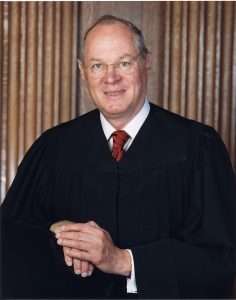
When Justice Kennedy reigned supreme, advocates on both sides had to frame arguments to appeal to the swing vote's proclivities. Mix a little federalism, sprinkle some dignity, balance everything out, and BAM! You got a narrow, incoherent 5-4 opinion in your favor. Thankfully, those days are long gone. But now, there is a new game in town: the way to win is religious liberty. And progressives have turned to the free exercise clause.

Exhibit A is abortion. Before Dobbs even dropped, members of progressive faiths argued that the Free Exercise Clause, and state RFRAs require exemptions to abortion restrictions. Indeed, Marci Hamilton, who has long assailed RFRA, has learned to stop worrying and love the substantial burden test. If there is hope to persuade a conservative Court to protect abortion, it must be based on religious liberty.

Exhibit B is affirmative action. Yesterday, a group of Catholic universities filed an amicus brief in the Harvard and UNC cases. The brief, authored in part by Kathleen Sullivan, argues that the Free Exercise Clause supports a religious liberty claim to consider race in admissions.

For Catholic colleges and universities like amici in particular, the Free Exercise Clause supplies an additional constitutional dimension to the compelling interest in racial diversity as one factor among many in admissions. Amici's foundational Catholic values and teachings inform their commitment to give value to the identity of the whole person in admissions and to compose a student body that will, after graduation, promote the Catholic mission of the common good and service to others, especially the poor and underserved.

Common good!? Did Vermeule ghostwrite this brief? That has to get five votes, right? Who knew that the Free Exercise Clause and RFRA support such progressive outcomes? Really Roe and Grutter should have been Free Exercise Clause cases--so much more elegant. The Due Process Clause and Equal Protection Clause can take a backseat to religious liberty.

I expect a third category to be environmentalism. Groups will argue they have a religious liberty interest in pristine nature, clean air, endangered species, etc. The APA is only the starting point. RFRA will be the backstop.

If you sense some sarcasm in my tone, you're very perceptive. I worry that these claims will irreparably set back the religious liberty movement. It took three decades of careful work to move the ball from Smith to Fulton. But less than two years after Justice Ginsburg's death, litigants are prepared to gerrymander the Free Exercise Clause and RFRA to fit every facet of the progressive agenda.

Free Speech

Should the Law Limit Private-Employer-Imposed Speech Restrictions?

|

The Constitution limits the government's—including government employers'—power to discriminate based on race, sex, or religion. A federal statute and statutes in nearly all states applies these norms to private employers as well. Many libertarians disapprove of any such restrictions on private employers; but for nearly 60 years, American law has imposed such restrictions.

The Constitution also limits the government's—including government employers'—power to restrict people's speech and political activity. And statutes in many states apply this norm, to some extent, to private employers as well. Indeed, a few of them have done this for 150 years (and even longer as to employers' discrimination against employees based on how the employees voted).

Ten years ago, I wrote a descriptive and analytical law review article called Private Employees' Speech and Political Activity: Statutory Protection Against Employer Retaliation, which aimed to catalog these often-little-known statutes. This year, I'm returning to the subject, trying to analyze the strongest arguments for and against such statutes. The article (Should the Law Limit Private-Employer-Imposed Speech Restrictions?) will be published later this year in a Journal of Free Speech Law symposium issue, together with other articles that stemmed from an Arizona State symposium on Non-Governmental Restrictions on Free Speech; and this week and next I'd like to serialize it here.

Let me begin with the Introduction and the beginning of the argument in favor of such statutes, though you can read the entire article in PDF if you'd like; future posts will also of course cover the arguments against such statutes.

[* * *]

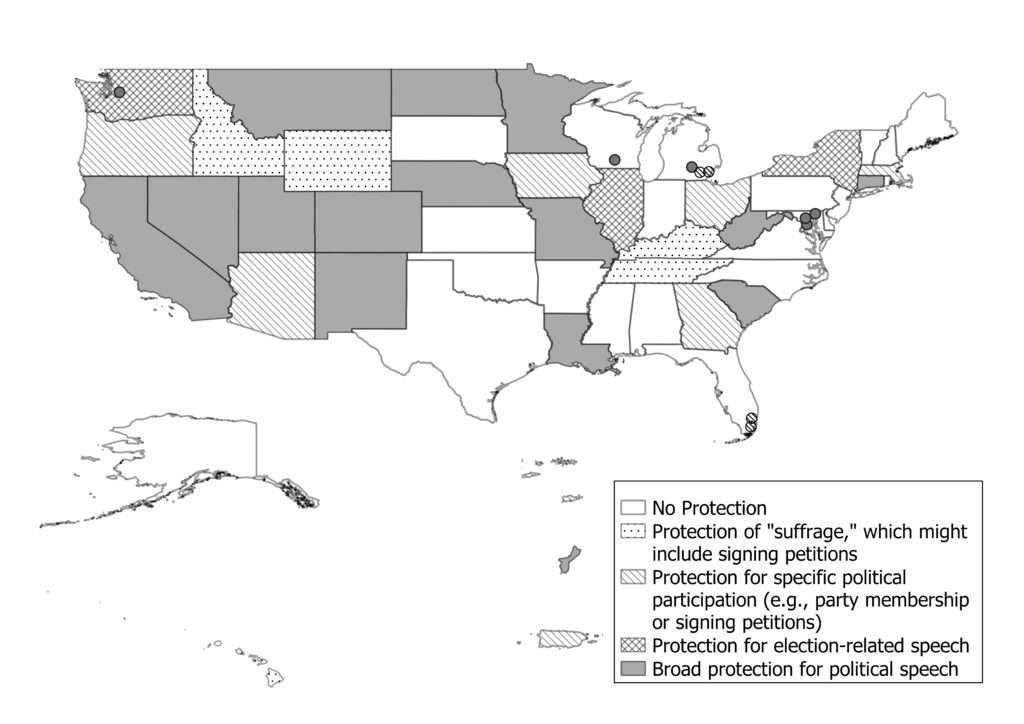
About half of Americans live in jurisdictions that protect some private employee speech or political activity from employer retaliation.[1] Of course, that means about half don't. Which jurisdictions are correct? And, if private employers should generally be barred from firing, disciplining, or perhaps even declining to hire workers based on their speech, which sorts of speech should be protected?

Existing private employee speech protection statutes
(the darker the shading, the more protection)

I. Arguments for Protecting Private Speech

A. Democratic Self-Government

To begin with, the threat of losing one's job is a powerful deterrent to most speakers. If the ability to speak freely, and without distortion by the threat of governmental punishment—or even the threat of loss of government benefits—is a necessary precondition of democratic self-government,[2] then legislatures ought to be concerned about the democratic process being distorted by private employers as well.

This is likely why nearly all states forbid discrimination based on how a person has voted:[3] Private economic power ought not be used to interfere, through threat of coercion of employees, with the political process. But American law has long recognized that for voting to be meaningful, the public also needs to freely discuss candidates and issues before voting on them,[4] and to speak out in ways that influence representatives between elections. This suggests that private employer sanctions against employee free speech interfere with democratic self-government almost as much as sanctions based on voting.

Read More

Prof. John Harrison: Remand Without Vacatur Assumes that Unlawful Regulations Bind Until Courts Act

|

I'm delighted to report that Prof. John Harrison (University of Virginia) will be guest-blogging this week on the subject of Administrative Procedure Act remedies, and specifically the putative remedy of "remand without vacatur." APA remedies is a huge and recurring question, and it has new urgency after the Supreme Court's cert grant in United States v. Texas. This is his first post, and here are his second, third, fourth, and fifth posts.

* * *

Thanks to a kind invitation from Sam Bray on behalf of the Volokh Conspiracy blog, I'll be doing a series of posts based on an article titled Remand Without Vacatur and the Ab Initio Invalidity of Unlawful Regulations in Administrative Law. The article is forthcoming in the BYU Law Review, whose editors have graciously agreed to this preview. The current version is posted to SSRN.  (Thanks also to Volokh blogger Jonathan Adler for comments on the draft.)

The article argues that the important administrative law doctrine of remand without vacatur rests on a false premise. Courts that follow the doctrine assume that when they find that an agency action is unlawful, they have discretion whether to vacate the action, and thereby deprive the action of its binding legal force, or leave that force in place. If the reviewing court decides not to vacate, but instructs the agency to conduct further proceedings to repair the defects that made the action unlawful, it is said to remand without vacating. The most important applications of the doctrine, with which the article is primarily concerned, involve agency regulations that purport to impose duties on private parties. The doctrine has been embraced by most of the federal courts of appeals, and is a mainstay of D.C. Circuit administrative law practice. The Supreme Court has neither endorsed nor rejected it.

As applied to regulations that impose duties on private people, remand without vacatur rests on a mistaken assumption. Courts applying the doctrine assume that unlawful regulations are binding until displaced by a court. That is a mistake. Regulations that are unlawful, as that concept appears in section 706 of the APA, are in general invalid ab initio. They never become part of the body of governing law. For that reason, courts do not have the option of directing an agency to conduct further proceedings while an unlawful regulation remains in force.

This first post will briefly describe the doctrine of remand without vacatur as the courts understand it, then bring to the surface the doctrine's unexpressed and undefended premise: that unlawful regulations of private conduct are binding until displaced by a court.

Read More

Free Speech

Anti-BDS Laws' Certification Requirements

|

Michael Dorf, Andrew Koppelman, and I have written elsewhere about why we think laws banning government contractors from refusing to deal with Israeli companies are generally constitutional. In this respect, we think such bans are like the government barring universities that get government funds from excluding military recruiters from recruitment fairs, or barring businesses that get government funds (and even ones that don't) from discriminating based on race, religion, etc. Refusals to deal are unprotected conduct, not protected speech. (The long version is here.)

Some people, however, have objected to a different provision of the laws: that contractors certify that they aren't boycotting Israeli companies through such refusals to deal. This certification, some have argued, is itself an impermissible speech compulsion.

I think that's mistaken; these requirements are like any other contractual provisions on which the government insists (in particular, like contractual warranties). The Arkansas anti-BDS law, for instance, provides,

a public entity shall not … [e]nter into a contract with a company … unless the contract includes a written certification that the person or company is not currently engaged in, and agrees for the duration of the contract not to engage in, a boycott of Israel.

This is just like a contract in which the company certifies that it's paying prevailing wage to its employees, or that it's using some fraction of American-made goods, or is using only organically farmed products, or that it will comply with antidiscrimination rules, or what have you. It's true that entering into a contract involves communication (e.g., "I accept your offer" or "I agree to this contract"), but that doesn't mean that government insistence on particular contractual provisions is generally subject to First Amendment scrutiny. Indeed, the formation of contracts is generally regulated by a wide range of laws that are not seen as subject to First Amendment scrutiny.

To be sure, requiring promises not to speak in a contract may violate the First Amendment, as would requiring assurances that the contracting party adheres to some ideological views. But requiring a promise not to act in a particular way is not itself an impermissible speech compulsion.

The Eighth Circuit en banc court in Arkansas Times, Inc. v. Waldrip was thus generally right when it held:

Read More

Guns

"Black Women Who Once Hated Guns Are Embracing Them as Crime Soars"

|

From today's article in the Washington Post (Peter Jamison) (reprinted, without a paywall, in the Philadelphia Tribune), documenting a trend that I generally very much favor:

Like many Black women in [the D.C. area] …, [Patrice Parker had] viewed guns for most of her life as the root of the violence that had wrecked countless lives in her community.

That changed, paradoxically, after her son was shot to death in a parking lot not far from her home. Exasperated with the police response and in despair over the sheer number of weapons on the streets, Parker decided there was only one way to protect what remained of her family. And that was to pick up a gun herself.

"I always felt like you needed to take the guns off the street. But the way things are now …. I don't feel safe anymore," she said. "You can't trust nobody."

Across America, Black women are taking up arms in unprecedented numbers…. Scarred—sometimes literally—by the firsthand consequences of gun violence and disenchanted with decades of urban gun-control policies that they regard as largely ineffective, some Black women in D.C. and other cities are embracing a view long espoused by Second Amendment activists: that only guns will make them safer….

Read More

Politics

Short Circuit: A Roundup of Recent Federal Court Decisions

Building inspectors, historic preservationists, NIMBYs, code enforcement, and the right to make contracts.

|

Please enjoy the latest edition of Short Circuit, a weekly feature written by a bunch of people at the Institute for Justice.

New on the Short Circuit podcast: Atlanta criminal defense attorney Andrew Fleischman joins the panel to talk absolute prosecutorial immunity and why the Fulton County DA's hotly anticipated prosecution of Donald Trump would almost certainly be removed to federal court (where a jury pool would have slightly different leanings than one from Atlanta). Big spoiler: It's because of the War of 1812.

  • After a jury convicts Libyan man on four counts for his role in 2012 Benghazi terrorist attack (acquitting on another 14 counts), the district court sentences him to 22 years—despite sentencing guidelines that suggest life plus 10 years. D.C. Circuit: It's okay that the judge didn't sentence him based on the conduct he was acquitted of, but even setting that aside the downward departure from the guidelines is unreasonable. Judge Millett, concurring: It's still kind of crazy we add years to people's sentences for conduct they were acquitted of.
  • Before a federal agency issues a rule, it must go through the lengthy notice and comment process. And if an agency wants to repeal a rule it must do the same thing. But what if just before a new president takes office, an agency says it's issuing a final rule that will become final in a few weeks, and the new administration repeals the rule before that time comes (as apparently happened in 2017, 2009, 2001, and 1993—to name just a few). Should the agency have gone through notice and comment before repealing? The majority of a D.C. Circuit panel says yes and characterizes the gov't's argument to the contrary to be that such a rule "exists in a state of superposition like Schrödinger's cat—simultaneously law and not law until the agency publishes or withdraws it."
  • Another week, another federal circuit opinion—this time from the D.C. Circuit—affirming the FDA's decision to deny pre-market approval to thousands of vaping products.
  • Man out front of the Bronx County Hall of Justice—with a sign that reads "Jury Info" and pamphlets that say "Google Jury Nullification"—is arrested under a statute prohibiting disseminating information within 200 feet of a courthouse "concerning the conduct of a trial being held in such courthouse." After being released, he sues under the First Amendment, winning an injunction in district court. Second Circuit: Well, first of all, the guy has standing. I mean, he was arrested. And the statute's definitely bad as applied to what he was doing and others doing similar stuff. But it probably isn't unconstitutional as a facial matter. Injunction vacated and case remanded. Partial dissent: The statute's so bad it's facially overbroad in a couple of different ways.
  • Groups managing nursing homes and assisted living facilities throughout the Northeast clash with unions representing employees at the facilities. Unions allege that the facilities engaged in a slew of unfair labor practices, such as improperly terminating employees and suppressing union communications. The facilities allege that the unions vandalized the facilities, brought on an HHS audit, and engaged in other extortionate behavior amounting to a RICO violation. District court: It's never RICO. Third Circuit: It actually might be here.
  • Wise County, Va. prison guards and inmate get into a physical altercation following a dispute over an empty peanut-butter jar. Inmate promptly and repeatedly seeks videos of the encounter. Zoinks! Some of the videos weren't preserved. Spoliation? District court: Don't worry about it. The videos that exist supports the officers' testimony. Fourth Circuit: We're worried about it.
  • Following a trial on whether Virginia Beach's system of at-large voting districts violated the Voting Rights Act—but before judgment—the Virginia Assembly outlawed the system. Fourth Circuit: So the case is moot. But since you've done most of the work you would do to challenge the new system, we'll remand and the trial court can decide whether you can amend your complaint. Dissent: The new law didn't fix everything, so the case is not moot.
  • For over two months and without a warrant, DHS agents constantly surveil the front and back of Houston home by means of cameras placed on poles outside. A Fourth Amendment violation? The Fifth Circuit says no; anyone strolling by could take in the same view. No need to suppress the evidence; defendant's 18-year sentence for his part in a marijuana-growing operation is affirmed, as is the forfeiture of his home, boat, weapons, and $7.2 mil. (N.B.: For an opposing view, might we recommend this IJ amicus brief?)
  • Sabine County, Tex. deputy sheriff conducting welfare check allegedly makes a series of sexually charged comments and sexually assaults woman. She files a complaint (at least the fourth filed against him) for sexual misconduct with the Texas Rangers, he's indicted, and she sues. District court: No constitutional violation here. Sheriff: Qualified immunity. Fifth Circuit: Both of you are very, very wrong.
  • "1-1-1!" No, that isn't an emergency number or a Herman Cain campaign promise. It's the breakdown of this Fifth Circuit case brought by disabled students who wanted to enjoin the Texas Attorney General's order forbidding schools from issuing mask mandates. One judge has a lot to say about how masks didn't give the plaintiffs standing, one judge dissents, and one judge oddly only concurs on the facts and the redressability prong of standing.
  • Guards at a Louisiana private prison empty a can of pepper spray on a prisoner and repeatedly drop him on his head before taking him to the "Four-Way," the one corner of the prison that cameras don't reach, for two hours. The man later dies of a skull fracture. District court: No one's liable for nothin'. Fifth Circuit (over dissent): We review the facts in the plaintiffs' favor. The officers used excessive force and they worked in concert to cause the injuries that killed this man. Also, both the city and corporation knew about these cruel practices, and they did nothing to stop it, so those claims survive too.
  • District court: It's obvious that jail officers shouldn't throw scalding water on detainees, and here are some prior cases (about chaining a prisoner to a post and choking a restrained detainee unconscious and leaving him to die) that clearly establish the law on that. Sixth Circuit (unpublished): And since there's no video or anything that shows otherwise, we have to treat the detainee's allegations as fact. No qualified immunity for this Grayson County, Ky, jail officer.
  • Plaintiffs: Columbus, Ohio's Historic Preservation Code lets a small band of private citizens dictate what we do with our own property in arbitrary ways. Sixth Circuit: Actually, Columbus's Historic Preservation Code lets a duly-appointed commission (which may—may!—even include lawyers or bankers) issue totally cool commands that you jerkwads should have just obeyed.
  • When Peninsula Township, Mich. wineries challenge local ordinances that restrict wine sales and prohibit hosting weddings, among other things, a local NIMBY group seeks to intervene in the lawsuit. The district court tosses their motion and rules that the ordinances are either unconstitutional or preempted by state law. Sixth Circuit: Not so fast. Even though the township strenuously fought the lawsuit, the NIMBYs' interests (property values, quiet enjoyment of their homes, viability of their farms) are different from the township's (preserving the public fisc). Let them in.
  • Can Loyola Chicago undergrad students get a refund on tuition because they were deprived "of in-person instruction and access to on-campus facilities" while COVID-19 had shut everything down? Seventh Circuit: Some of their breach of contract claims are cognizable under Illinois law and may proceed.
  • In 2021, the feds put a stop to what had been a regular July 4th fireworks display at Mt. Rushmore, denying South Dakota officials' request for a permit due to COVID-19, wildfire risks, and tribal opposition, among other things. (And in 2022, the feds deny the permit again.) Was the denial arbitrary and capricious? We'd need a time machine to let you do the fireworks now, says the Eighth Circuit, and who's to say whether the permit will be denied in 2023 and why? This case is moot.
  • St. Louis man guffaws at rally by then-presidential candidate Donald Trump, leading Trump to command the crowd to "Get him out of here!" He's arrested and charged with disturbing the peace but acquitted at trial. The man then sues the police for arresting him without probable cause. Eighth Circuit: Even if they didn't have actual probable cause, they did have arguable probable cause, and that's enough to give everyone involved qualified immunity.
  • Allegation: 7-year-old with bruises and abrasions tells school that her father beat her with a belt. When Des Moines, Iowa detectives come to her home with a social worker, her mother declines to let them in or bring her out. After six minutes of arguing, the mother is arrested for "interference with official acts." Eighth Circuit: The officers could either go get a warrant or look for an exigent circumstance to enter the home without one, but what they couldn't do was arrest her. Her "passive failure to cooperate" did not even create arguable probable cause that she was interfering with an official act. No qualified immunity.
  • The Eighth Circuit's said it before, and it's sayin' it again: The St. Louis officers who rounded up scores of allegedly peaceful protestors using a kettling technique are not entitled to qualified immunity for seizing the protestors. But since the plaintiffs did not adequately allege excessive force, QI will preclude those claims. Dissent: The complaint here is almost identical to the last case, where we said no QI for excessive force. So the conclusion should be the same here.
  • Allegation: Property owner overhears Honolulu building inspector say that he's causing costly delays to renovation project because the owner hired non-Hawaiian contractors. Unconstitutional interference with his right to make contracts? Could be, says the Ninth Circuit. Even if the delays were justifiable, the right to be free from racial animus in public decisions is clearly established. No qualified immunity. (N.B.: Interested readers might note that the suit proceeds under Section 1981, and that at least 10 other circuits say that Section 1981 provides no private right of action for damages against state actors.)
  • Washington law prohibits displaying a weapon in a manner that "warrants alarm for the safety of other persons." So did police have probable cause to arrest a Yakima County man after receiving reports that the man displayed a firearm? Ninth Circuit: Not in an open-carry state like Washington. The officers should have confirmed whether he displayed the weapon threateningly or alarmingly. All evidence found after the arrest (including an IED in the man's car) are suppressed.
  • Are Twitter or Facebook pages maintained by public officials public fora under the First Amendment? The Ninth Circuit weighs in on this fast-growing doctrinal area (the answer is "sometimes") but fails to acknowledge the really thorny question: the brewing circuit split over whether they're "public fora" or "public forums."
  • Allegation: Man convicted of sex offense at retrial is sentenced to a minimum of 10 years, which he has already served. Which means that under Washington state law, he's to receive a parole hearing within 120 days. But parole board members blow that deadline by nine months. (The hearing ultimately results in his release.) Negligence? False imprisonment? Ninth Circuit: Can't say. Parole board members are quasi-judges and thus protected by absolute immunity.
  • Allegation: Man forgets to remove belt, sets off Jackson Hole, Wyo. airport body scanner. TSA agents refuse to let him take off the belt and go through again, insisting instead on a groin pat, which the man equally insists he does not consent to. He's arrested by local police, one of whom says that his stay in jail (which ultimately lasted three hours) is being prolonged because he keeps asking for a lawyer. Tenth Circuit: Drawing all factual inferences in favor of the plaintiff, as we must at this stage of the case, the gov't says that's not why his stay was prolonged. Case dismissed. And furthermore, his claims against the municipality (which he pursued without amending to the district court's satisfaction) are so meritless that $55k sanctions against him and his attorneys are merited. (IJ filed an amicus brief arguing the sanctions aren't merited.)
  • Moreover, holds the Tenth Circuit (same case as above), there is no prior case clearly establishing that an officer wrenching a handcuffed person's wrist, injuring it, without provocation and in retaliation for their speech, would "chill a person of ordinary firmness" from continuing to engage in protected speech. (Nor is there such a case now.)
  • In response to a shooting spree that injured several children, Ocala, Fla. police chief—along with volunteer police chaplains—help to organize and sponsor a prayer vigil in the town square. Humanists and atheists attend the vigil and then sue, alleging Establishment Clause violations. Eleventh Circuit: And they have standing. But while this case was on appeal the Supreme Court killed the Lemon test that previously governed, so we'll send this back down for reconsideration.

"He has erected a multitude of New Offices, and sent hither swarms of Officers to harass our people, and eat out their substance." Anyway, apropos of nothing, we really can't recommend this longform article on abusive code enforcement by Radley Balko in the Nashville Scene enough. Nashville is bad. Memphis is bad. Lots of other places are bad. It is bad to eat out people's substance.

Administrative Law

West Virginia v. EPA: Getting to Actual Delegation

The Court should assimilate the “major questions” doctrine of West Virginia v. EPA and its precedents—including Chevron and what came even before that—to an approach that asks whether Congress has made an actual delegation. Only this will serve the relevant separation-of-powers principle.

|

Both the Chevron doctrine and West Virginia v. EPA are based on ideas about the delegation of interpretive authority from Congress to administrative agencies. Chevron introduced the idea of "implicit" delegations, and the doctrine spawned by it eventually held that any ambiguity in an agency statute is an implicit delegation. West Virginia is effectively an unacknowledged carveout. Without the majority's mentioning Chevron, the case posits that when a "major question" is involved, a delegation must take the form of a clear statement; presumably, only express delegations or something close to this will count.

Both positions are extreme. The idea that any ambiguity is a delegation transfers too much power to the administrative state. The view that only express delegations will do for major questions concentrates too much power in reviewing courts.

The better position, as suggested in my recent book, The Chevron Doctrine: Its Rise and Fall, and the Future of the Administrative State (Harvard University Press 2022), is that courts should condition any strong form of deference to agency interpretations on a finding that Congress has actually delegated authority to the agency to resolve the issue. This means more than finding ambiguity; courts must carefully interpret the statute and conclude that Congress left a gap for the agency to fill.

But it does not mean the delegation must be express; the delegation can be implicit but actual. For example, when Congress delegated authority to the EPA to promulgate emissions standards for new stationary sources (by the agency's determining the "best system of emissions reduction"), this was an implicit but actual delegation to the agency to interpret the meaning of "best system" for that purpose (Section 111(B)(1)(B) of the Clean Air Act).

Read More

Religious Freedom and the Respect for Marriage Act

If it becomes law, the Respect for Marriage Act would reassure millions of Americans about the legal status of their families and might set a successful bipartisan precedent for religious liberty

|

The proposed Respect for Marriage Act (RMA) would repeal the 1996 Defense of Marriage Act (DOMA). It would also provide for both federal and interstate recognition of same-sex marriages validly entered in a state.  The RMA passed the House with 47 Republican votes and awaits action in the Senate, where it will need at least ten Republican votes to survive a filibuster.

My co-blogger Ilya Somin has already addressed some of the interesting federalism aspects of the bill. I want to address here a particular religious-liberty dimension of the bill: its silence about the Religious Freedom Restoration Act (RFRA).

Members of Congress concerned about the effects of federal law on religious liberty, and about the myriad unanticipated ways legislation may burden religious exercise, have long been reassured by knowing that RFRA (42 U.S.C. 2000bb et seq.) provides a statutory floor of protection. As explained below, RMA is subject to RFRA's statutory protections for religious liberty, unlike other prominent civil rights proposals under consideration in the Senate.

RFRA provides: "Government shall not substantially burden a person's exercise of religion even if the burden results from a rule of general applicability," unless it demonstrates that application of the burden "furthers a compelling governmental interest" and is the "least restrictive means of furthering that compelling governmental interest." §2000bb–1.

RFRA applies by its terms to "all Federal law, and the implementation of that law, whether statutory or otherwise, and whether adopted before or after November 16, 1993." §2000bb–3 (a). The proposed RMA, of course, is one such federal statute.

RFRA further specifies: "Federal statutory law adopted after November 16, 1993, is subject to this chapter unless such law explicitly excludes such application by reference to this chapter." §2000bb–3(b). Nothing in RMA "explicitly excludes" application of RFRA.

By contrast, three bills now pending in Congress "explicitly exclude" RFRA. First, the Equality Act, H.R. 5 (https://www.congress.gov/bill/117th-congress/house-bill/5/text), provides in Section 1107: "The Religious Freedom Restoration Act of 1993 (42 U.S.C. 2000bb et seq.) shall not provide a claim concerning, or a defense to a claim under, a covered title, or provide a basis for challenging the application or enforcement of a covered title."

Second, both the Women's Health Protection Act of 2021 (H.R. 3755) (abortion-rights protection) (https://www.congress.gov/bill/117th-congress/house-bill/3755/text) and legislation designed to protect the use of contraceptives (H.R. 8373) (https://www.congress.gov/bill/117th-congress/house-bill/8373/text) include identical provisions explicitly excluding RFRA:  "[T]his Act supersedes and applies to the law of the Federal Government and each State government . . . and neither the Federal Government nor any State government shall administer, implement, or enforce any law, rule, regulation, standard, or other provision having the force and effect of law that conflicts with any provision of this Act, notwithstanding any other provision of Federal law, including the Religious Freedom Restoration Act of 1993 (42 U.S.C. 2000bb et seq.)."

The RFRA carveouts in these bills are one reason they're dead-on-arrival in the Senate. They can't get Republican support.

But RMA is different. In general, it requires state and federal governments and those "acting under color of state law" (commonly, government officials) not to refuse recognition or rights to validly married same-sex couples.  It does not govern purely private actors--like employers, landlords, or vendors--whose religious scruples might be triggered by an anti-discrimination requirement.

Moreover, even if RMA were understood more expansively to cover the rare putatively private actor, the provisions of RFRA still apply to the Act. A person whose RFRA rights are violated "may assert that violation as a claim or defense in a judicial proceeding and obtain appropriate relief against a government." §2000bb–1(c). Enforcement of RMA that substantially burdens a person's exercise of religion would in principle be subject to any available limitations and defenses under RFRA.

Important questions will remain about whether and exactly how RFRA would apply concretely to the enforcement of RMA in a particular instance. RFRA necessitates an accommodationist, intensely fact-bound inquiry. In particular, the upshot of applying RFRA could not sensibly be to altogether deny recognition or a marital right to which a married same-sex couple is entitled under RMA. Still, in light of other pending legislation, the omission of a RFRA carve-out from RMA is notable.

If RMA passes, it would be a milestone for a nation that once rushed to pass DOMA--emergency legislation barring recognition before a single same-sex marriage even existed. The country would now be protecting hundreds of thousands of existing same-sex marriages. It would provide an important measure of reassurance to millions of current and future spouses and their children.

It might also set a precedent for the passage of other LGBT rights legislation on a bi-partisan basis. If such legislation is to have a chance of seeing the president's desk, there is no other way.


More