Who among us is not eagerly awaiting the September 16 publication of the annual Cato Supreme Court Review? Among the articles I look forward to reading are the VC's Ilya Somin on the vaccine mandate cases and Jonathan Adler on West Virginia v. E.P.A. If you want to read about the Supreme Court's blockbuster decision on the Second Amendment, wait no longer. My Cato article Restoring the right to bear arms: New York State Rifle and Pistol Association v. Bruen is now available on SSRN.com.
Parts I and II of the article summarize the background to Bruen. After the Supreme Court decided United v. States v. Miller in 1939, rejecting a bootlegger's a facial challenge to a federal tax and registration system for sawed-off shotguns, the Court mostly ignored the Second Amendment in the succeeding decades. While several opinions mentioned the right to keep and bear arms in passing, and treated it as a normal constitutional right, the Court took no cases on the matter.
Starting in the late 1980s, the Court did begin taking cases involving the rights of gun owners, and deciding them favorably--but these cases turned on statutory interpretation, administrative law, or federalism, not the Second Amendment.
In the 1997 federalism decision Printz v. United States, which held that Congress cannot force local government officials to carry out a federal background check on handgun buyers, Justice Thomas concurred to raise the Second Amendment. After surveying recent scholarship, he wrote, "Perhaps, at some future date, this Court will have the opportunity to determine whether Justice Story was correct when he wrote that the right to bear arms 'has justly been considered, as the palladium of the liberties of a republic.'"
The Court did so in the 2008 District of Columbia v. Heller, holding that the District could not ban handguns, and could not ban possession of loaded firearms in the home. The Court followed up in 2010 with McDonald v. City of Chicago, ruling that the Fourteenth Amendment makes the Second Amendment enforceable against state and local governments, like almost all the rest of the Bill of Rights.
But then, the Court again fell into torpor. Many cert. petitions explained how lower courts were flouting Heller and McDonald. But only one petition was granted. In the 2016 Caetano v. Massachusetts, a per curiam decision granted, vacated, and remanded a decision upholding a ban on electric stun guns. As the Court noted, the rationale of the Massachusetts Supreme Judicial Court flatly contradicted Heller's rules for the Second Amendment. So did plenty of other lower court cases, but cert. was not granted.
Dissenting in Heller and McDonald, Justice Breyer had argued that Second Amendment cases should be reviewed under what he called "interest balancing." And that was what many lower courts were doing; although they called it "intermediate scrutiny," it often omitted the intermediate scrutiny subrules.
For example, intermediate scrutiny requires courts to look at the pro/con evidence submitted by each side yet. But sometimes, courts only considered whether the government had introduced evidence to support the restriction. If the government met that light burden, the government would win -- never mind the counter-evidence from the other side.
The MTA is a state affiliate of the National Education Association ("NEA"), a national labor union.
Established in 2011, Project Veritas is a non-profit conservative media outlet that conducts "undercover reporting" concerning "subjects that impact democratic interests," PV has long-standing history of public disputes with teachers' unions. Landino's responsibilities while employed by PV included fundraising, hiring, paying bills and managing staff. Prior to working at PV, Landino was convicted of felony narcotics possession in Connecticut.
On March 7, 2014, Gawker published an article about PV titled "James O'Keefe Employs a Convicted Felon," while Landino remained COO [Chief Operating Officer] at PV. The article states that Landino was "active in making fundraising queries and pitching sting ideas, introducing himself as the group's chief operating officer." Gawker reported, among other things, that Landino had a "felony narcotics record, thousands of dollars in unpaid child support and tens of thousands of dollars in IRS tax liens." Landino was subsequently fired by PV on March 31, 2014. Approximately two years later, in 2016, Landino received a pardon for his felony conviction. Thereafter, Landino contacted one of the authors of the Gawker article requesting a correction to reflect that Landino had since been pardoned.
The website Project Veritas Exposed ("PVE") posts content related to PV. In or around June 2018, PVE posted a profile to its site about Landino, identifying him as the COO of PV from 2013 to 2014 and quoting the 2014 Gawker article regarding Landino's criminal history, tax liens and unpaid child support. The profile includes an update that Landino was pardoned in May 2016. PVE is not an MTA website and MTA does not control it.
So holds a federal district court, also stressing that "this case does not involve banning books": "A school district does not 'ban' a book when ... it 'decides not to continue possessing [a] book on its own library shelves.'"
From C.K.-W.v. Wentzville R-IV School Dist., decided Friday by Judge Matthew Schelp (E.D. Mo.); assuming the facts are as described, the decision seems legally correct to me as to K-12 public school libraries (though the analysis would be quite different as to removals of speakers from government property that the government has opened up as a limited public forum for private speech):
Plaintiffs seek to enjoin Defendant, the Wentzville R-IV School District, from following its policy that allows parents, guardians, and students to initiate challenges to library materials, and Plaintiffs also ask the Court to require the District to restore access to any books it has removed from school libraries during the most recent school year…. Plaintiffs have failed to show that the relevant factors weigh in favor of a preliminary injunction in this case ….
Plaintiffs' characterization of this case {referencing the "Banned Books" in this case no fewer than thirty-five times} makes it important at the outset for the Court to clarify something: this case does not involve banning books. The District has not banned the books at issue here, and, despite repeatedly calling this a case on book bans, Plaintiffs make no factual allegations about anyone banning any books. Nowhere do Plaintiffs allege that the District has prohibited anyone from reading, owning, possessing, or discussing any book. Rather, through a policy enacted by its elected school board, the District allows librarians to use their best judgment to remove books in select scenarios, and, through another policy, the District temporarily has removed a limited number of other books while it determines their propriety for inclusion in the District's libraries.
The District's policy does not ban the District's students from reading the books at issue here. Nor does it ban students from acquiring the books or lending the books to others. Students may borrow the books from the public library or from a friend or neighbor. They likewise are free to purchase the books. The policy does not even ban students from bringing the books at issue to the District's schools. Nor does it ban students from discussing the books at school during their free time or encouraging others to read them…. [T]he "overwrought rhetoric about book banning has no place" in this case. Cf. Bd. of Educ. v. Pico (1982) (principal case on which Plaintiffs rely that, despite similar facts, does not use the word ban or any similar language to describe the board's actions). A school district does not "ban" a book when, "through its authorized school board," it "decides not to continue possessing [a] book on its own library shelves."
This is in the news again, in San Bernardino County—a county next to L.A., which is home to over 2 million people (AP):
The county's Board of Supervisors voted 4-0 on Wednesday to put the secession measure on the 2022 ballot, the Southern California News Group reported. One supervisor was absent.
The measure will go before the board again next Tuesday for final adoption. The initial draft would put this question to voters on Nov. 8: "Do the citizens of San Bernardino County want the San Bernardino County Board of Supervisors to study all options to obtain its fair share of state and federal resources, up to and including secession?"
Can they do that? Why, yes, they can, but only with permission of the state from which they're seceding as well as of the federal government. Article IV, section 3 of the U.S. Constitution provides,
Last Tuesday and Wednesday, I blogged the Introduction and the beginning of the argument in favor of such statutes, followed by an explanation of why such statutes usually don't violate employers' constitutional rights. This week, I discuss some other arguments against such statutes (and you can see the whole article right now, if you'd like, by looking at the PDF). Yesterday, I argued that the statutes should be rejected in order to protect employers' rights, even if not constitutionally protected rights, not to associate; today, I turn to more pragmatic concerns (though ones that can still be said to involve employers' rights).
Employers can also worry that protecting employee speech would risk creating spurious lawsuits, as employees who were fired for (say) incompetence start to routinely sue, claiming that this was just a pretext and that the real reason for the firing was their controversial speech. Indeed, one can imagine an employee who thinks that he might get fired for a legitimate reason, and who therefore deliberately starts saying controversial things so that management becomes reluctant to fire him for fear that he'll sue for political discrimination.
[Sorry, because of a posting glitch on my part, this went up twice; if you get to this post, say via Twitter, please see this other post for the substance.]
At present, there are at least three prominent investigations in which a prosecutor is investigating his or her political opponent.
First, District Attorney Fani Willis, of Fulton County Georgia was investigating republican State Senator Burt Jones. After the 2020 election, Jones had signed an electoral certificate stating that Trump won the Peach state. Jones is now running for state Lieutenant Governor. Willis, a Democrat, hosted a fundraiser for Jones' Democratic opponent in the LG race. Due to this conflict of interest, a superior court judge disqualified Willis from questioning Jones. The judge said that decision to host the fundraiser was "a 'What are you thinking?' moment with 'horrible' optics." Yet Willis apparently saw nothing wrong with fundraising for the opponent of the person she was investigating.
Second, in Michigan, Matthew DePerno is the presumptive Republican nominee for Attorney General. There are allegations that after the 2020 election, DePerno told election clerks that he needed to inspect election equipment. Now, Dana Nessell, who will likely face DePerno in the general election this fall, has begun an investigation against DePerno. According to the New York Times, the Attorney General's office "requested that a special prosecutor be appointed to continue the investigation and pursue potential criminal charges." You can read the petition here.
The statute does not explain if the Attorney General retains any supervisory authority over the special prosecuting attorney. But if the federal special counsel regulations are any indication, these investigations tend to take on a life of their own. Even Robert Mueller became Inspector Javert.
Speaking of special counsels, let's talk about the third prosecutor who is investigating his political opponent. Of course, I speak about the raid on Mar-A-Lago. According to early reports, the investigation concerns Trump's handling of classified documents. I have no doubt that Garland weighed this decision at some length before he signed off on the search. Will this search lead to an indictment? Who knows. But the optics here are stark: the chief law enforcement officer of the Biden administration is searching the home of the front-runner for the 2024 Republican ticket.
Several commentators have suggested that Trump should announce his candidacy early--before the midterms--to pre-empt any indictments. The thinking goes that DOJ would not prosecute President Biden's opponent in the run-up to the election. I think this thinking is flawed. The fact that Garland signed off on this search, even as Trump is signaling he will run, suggests that the election would not halt a criminal investigation. There is no statute that would bar a prosecution of Trump, even as he goes through the nomination process. The most likely outcome is that Garland would appoint a special counsel to investigate, and even prosecute Trump, as Biden runs for re-election. If you thought the Mueller investigation was unwieldy, this special counsel prosecution would be far, far more unconstrained.
We are veering into uncharted territories if the incumbent president is prosecuting the former president who is running for re-election. And even if Trump is convicted, he still would not be disqualified.
According to reports, the FBI searched Mar-A-Lago as part of an investigation about the handling of classified documents. Will this be the action that finally stops Trump? Several progressive commentators gleefully pointed to 18 U.S.C. § 2071. It provides:
Whoever, having the custody of any such record, proceeding, map, book, document, paper, or other thing, willfully and unlawfully conceals, removes, mutilates, obliterates, falsifies, or destroys the same, shall be fined under this title or imprisoned not more than three years, or both; and shall forfeit his office and be disqualified from holding any office under the United States. As used in this subsection, the term "office" does not include the office held by any person as a retired officer of the Armed Forces of the United States.
If Trump is convicted of violating this statute, can he be disqualified from the presidency? No. And my colleague Seth Barrett Tillman wrote about this precise issue in 2015. At the time, conservative commentators, including former Attorney General Michael Mukasey, argued that Hillary Clinton could be disqualified from the presidency due to the storage of classified materials on her private email server. Seth explained that Mukasey's argument does not work.
Under Powell v. McCormack and U.S. Term Limits v. Thornton, Congress and the states cannot "add to the express textual qualifications for House and Senate seats in Article I." And that reasoning, Seth concluded, would seem to apply to the qualifications for the presidency in Article II. Several courts in the Seventh Circuit, and elsewhere, reached that same conclusion.
On this blog, Mukasey later admitted that Tillman was correct, and he was wrong:
[O]n reflection . . . Professor Tillman's [analysis] is spot on, and mine was mistaken. . . . The disqualification provision in Section 2071 may be a measure of how seriously Congress took the violation in question, and how seriously we should take it, but that's all it is.
Tonight, Charlie Savage of the New York Times recounted this history in an article on the Trump search.
Some Republicans were briefly entranced with whether the law could keep Mrs. Clinton out of the White House, including Michael Mukasey, a former attorney general in the administration of George W. Bush. So was at least one conservative think tank.
Mr. Volokh later reported on his blog that Mr. Mukasey — who is also a former federal judge — wrote that "upon reflection," Mr. Mukasey had been mistaken and Mr. Tillman's analysis was "spot on." (Mrs. Clinton was never charged with any crime related to her use of the server.)
Once again, Tillman rebuts an argument that conservatives favored as a way to get Clinton, that liberals now favor as a way to get Trump. There is nothing new under the sun.
Back in 2015, Seth did not have to make the argument that the Presidency is not an "office under the United States" for purposes of Section 2071. But Seth and I did consider another statute, 18 U.S.C. § 2383, which also disqualifies a person from "holding any office under the United States." In an article published shortly after the inauguration, we addressed what happens if the Biden administration prosecutes and convicts Trump of insurrection. That article is suddenly relevant to our present moment.
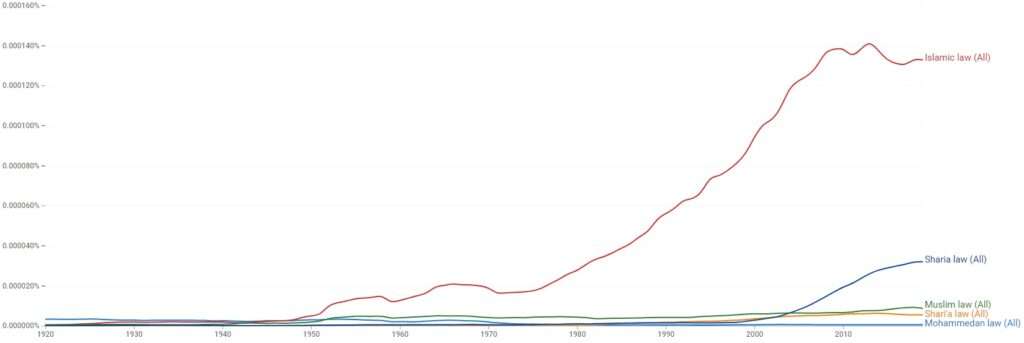
The Ohio Bangladesh telephonic wedding case I blogged about below mentioned "Mohammedan law," which struck me as unusual and archaic; and indeed a Google Ngrams search supports this. You can right-click on the image below and select "Open Image in New Tab" (or whatever your browser calls that) to enlarge, but basically the red line is for "Islamic law," the dark blue is for "Sharia law," and the light blue is for "Mohammedan law," which started in the lead around 1920 but is now very uncommon. ("Mahometan law" and "Mahomedan law," as you might gather, are even more unusual; "Muhammadan law" is about as rare as "Mohammedan law.")
There's nothing, of course, inherently derogatory about naming religious law after a prophet rather than after the formal name of the religion or of the religious law within the religion—portions of Jewish law, for instance, have historically been called "Mosaic law." But it's no longer customary, much as it's no longer customary to use "Hebrew" to refer to Jews as an ethnic group or a religion, though it was once quite normal, and is still reflected in the names of some synagogues and organizations, such as HIAS (Hebrew Immigrant Aid Society). And when such terms become archaic enough, people who hear them might wonder, "What does he mean by that?," even in the absence of specific reason to think they are pejorative.
But while it's no longer customary in America or in American law, as best I can tell, the term appears to be quite common (spelled "Mohammedan law," "Muhammadan law," or "Mahomedan law") in the legal systems of India, Pakistan, and Bangladesh. This may in turn stem from history, since many treatises have been so named; and because this has been such an important subject in those countries, the term seems to have stuck. And I take it that the Ohio court borrowed Bangladesh legal usage because that's what the Bangladesh law sources (which it viewed as relevant to determining the legal rules applicable to a marriage between Bangladesh citizens, conducted by telephone when the wife was in Bangladesh) used.
They thus can't be punished under a disturbing the peace law that bans "obscene language," though under the right circumstances they could be punished under separate provisions that generally ban "fighting words" (whether racially offensive or otherwise).
In Commonwealth v. Bliesath, decided Friday by the Pennsylvania Superior Court (Judge John Bender, joined by Judge Maria McLaughlin, with Judge Daniel McCaffery concurring in the judgment), the defendant had been convicted of disorderly conduct under 18 Pa.C.S. § 5503(a)(3), which covers anyone who, "with intent to cause public inconvenience, annoyance or alarm, or recklessly creating a risk thereof," "uses obscene language, or makes an obscene gesture." (He was sentences to 90 days' probation.)
The Commonwealth presented evidence that [Appellant] was seen by [City of Reading Police] Officer [Sean] Driscoll yelling at random people in the area of 6th and Penn Streets in the City of Reading. After being asked to stop by the [o]fficer, and failing to do so, the [o]fficer got out of the vehicle and approached [Appellant] to again ask him to stop and ask[ ] for his identification. When the [o]fficer was writing down [Appellant's] information, the [o]fficer observed [Appellant] yell racial slurs and threats at two males walking down the street while the [o]fficer was standing right in front of [Appellant]….
Specifically, Officer Driscoll stated that Appellant "yelled at the people to the southwest corner[, ']shut up you niggers[,'] and then he yelled again[, ']shut up I'm going to kill you because you are niggers[,'] and then he shouted[, ']I have two guns on me.[']"
The appellate court noted that Pennsylvania cases had read "obscene" to mean obscenity in the First Amendment sense—essentially, hard-core pornography. As a result, past precedents have found that, for instance, "chant[ing] 'fuck the police' during a funeral procession of a fallen police officer," "responding 'fuck you, asshole' to a street department employee and accompanying the response with the extension of his middle finger," and saying "go to hell Betsy," all didn't qualify as obscene.
From Momotaz v. Sattar, decided Thursday by the Ohio Court of Appeals, in an opinion by Judge Sean Gallagher, joined by Judges Anita Laster Mays and Eileen Gallagher:
On August 22, 2005, the parties participated in a telephonic marriage ceremony, which was conducted over a speaker phone. At the time of the marriage ceremony, husband resided in the United States, wife resided in Bangladesh, and both were citizens of Bangladesh. Husband traveled from Pennsylvania to New York and was with friends and relatives during the ceremony. Wife was in Bangladesh with friends and family members and husband's father. Also present in Bangladesh was Mawlana Kofiul Ahmed, who solemnized the marriage and identified himself as an assistant marriage registrar, and Abul Hashem Majumdar, a community leader who appeared to sign the marriage register on husband's behalf as his "pleader."
Pictures of the marriage ceremony were provided. {One photograph depicts Majumdar signing the marriage register during the marriage ceremony. Wife alleges that Majumdar was invited by husband's father to be the pleader. Although there are conflicting statements from witnesses, several witnesses stated that during the ceremony husband was asked for the appointment of Majumdar as his pleader and husband consented.} Witness statements indicated that the solemnization was according to Sharia law.
The legal marriage contract that was entered into between the parties is referred to as a "Nikah Nama." Husband stated in his deposition that there were no issues with the ceremony or the solemnization of the marriage before witnesses according to Muslim law, and he believed he was lawfully married according to Bangladesh law.
Following the marriage ceremony, wife continued to reside in Bangladesh until 2007, when husband traveled to Bangladesh. The marriage was consummated at that time. After a temporary stay in Canada, in August 2007, the couple arrived together in the United States, and they resided together in Pennsylvania. One child was born as issue of the marriage in February 2009. In October 2009, the family moved to Cleveland. Throughout their marriage, husband and wife presented themselves as a married couple. They lived together for 12 years, raised their child together, filed joint income tax returns, and wife received tuition benefits at Case Western Reserve University because husband was a faculty member.
But when the marriage broke down, the husband took the view that the marriage was invalid from the outset, arguing that various procedural rules required by Bangladesh law were not complied with. No, said the Ohio court:
Last Tuesday and Wednesday, I blogged the Introduction and the beginning of the argument in favor of such statutes, followed by an explanation of why such statutes usually don't violate employers' constitutional rights. This week, I discuss some other arguments against such statutes (and you can see the whole article right now, if you'd like, by looking at the PDF). I begin today with arguments that the statutes should be rejected in order to protect employers' rights, even if not constitutionally protected rights, not to associate.
[* * *]
Even in the absence of a constitutional right not to associate, of course, all of us have an interest in choosing whom we deal with, whether as friends, fellow club members, business partners, or employees. We may not want to deal with Nazis or Communists or Klansmen or supporters of terrorist movements. We may feel this particularly strongly because of our personal experiences: The child of refugees from Cuba may not want to deal with people who praise Che Guevara; the widow of a police officer who was killed in the line of duty may not want to deal with people who praise attacks on police, or call police officers "pigs"; a black or Jewish employer might especially not want to deal with Klansmen. Likewise, a business owner might want to cut off relations with someone because the business's other employees or customers don't want to associate with the person.
But when it comes to employment, our legal system has long generally rejected such claims. An employer might not want to employ union leaders, whose organizing, bargaining, and strike-threatening behavior he sees as jeopardizing the business he has spent a lifetime building up. An employer may not want to employ someone who made discrimination complaints against the employer in the past, perhaps on grounds that the employer views as ill-founded.
It was just filed today, Fairfax v. N.Y. Public Radio & WNYC (E.D. Va. Aug. 6, 2022); I'm traveling and so don't have time to analyze it closely, but I thought I'd link to the Complaint. Here's the opening, which of course is just Fairfax's allegation:
This defamation suit arises primarily from intentionally fabricated, false, and politically-motivated express and implied defamatory per se and per quod statements made with "actual malice" by both Meredith Watson … and Vanessa Tyson … alleging fictitious and intentionally fabricated sexual assaults by Justin Fairfax against them in 2000 and 2004, respectively. Those statements were published, republished, repeated, endorsed and presented as fact – both expressly and in context – with "actual malice" by NYPR and Melissa Harris-Perry … on or about August 6, 2021, during a broadcast of NYPR's and WNYC's news program "The Takeaway" titled "Politics, Power, and Abuse."
After an initial period when the United States accepted very few Ukrainians fleeing Russia's brutal invasion, admissions have ramped up in recent weeks, thanks in part to the Biden Administration's new Uniting for Ukraine program, which allows private citizens and organizations to sponsor Ukrainian migrants. These and other developments have led some to hope that the new policies herald a much broader shift to private refugee sponsorship. There is some basis for this optimism. But current policies have significant limitations that will need to be overcome in order to realize their full promise.
The U.S. received more than 100,000 Ukrainians in roughly five months following Russia's invasion of Ukraine, fulfilling President Biden's pledge of providing a temporary safe haven to those displaced as part of the largest refugee exodus since World War II, government statistics obtained by CBS News show….
Approximately 47,000 Ukrainians have come to the U.S. on temporary or immigrant visas; nearly 30,000 Ukrainians arrived under a private sponsorship program; more than 22,000 Ukrainians were admitted along the U.S.-Mexico border; and 500 Ukrainians entered the country through the traditional refugee system, the data show….
Only Ukrainians who entered the U.S. with immigrant visas or through the refugee admissions program have a direct path to permanent residency and ultimately, U.S. citizenship. These immigration pathways, however, typically take years to complete due to interviews, vetting and other steps.
Those who have arrived through the Uniting for Ukraine program, which was launched in late April to allow U.S.-based individuals to financially sponsor Ukrainians, were granted parole, a temporary humanitarian immigration classification that allows them to live and work in the U.S. for two years….
To fulfill Mr. Biden's pledge, DHS in late April set up the Uniting for Ukraine program, a free initiative that has drawn tens of thousands of applications from U.S. citizens and others hoping to sponsor the resettlement of Ukrainians, including their family members.
Since April 25, U.S. Citizenship and Immigration Services (USCIS) has received 92,000 applications from U.S. individuals seeking to sponsor Ukrainians, DHS figures show. More than 62,000 Ukrainians have been granted permission to travel to the U.S. as of July 29, including the nearly 30,000 individuals who have arrived so far, according to the DHS data.
In early May, the Biden Administration issued a call for proposals for a pilot private refugee sponsorship program, that might eventually be expanded into a broader policy that goes far beyond Ukrainian refugees.
The Administration's recent moves are obviously an improvement over the anemic official refugee system, which admitted a record low of only 11,411 refugees in fiscal year 2021, despite Biden Administration promises to improve it, after the damage done under Trump.
In a July 27 Foreign Affairs article [unfortunately paywalled, but you can get around it for free], migration policy specialist Gregory Maniatis argues that these and other moves herald a "refugee revolution" under which private refugee sponsorship will increasingly augment and overshadow traditional government-controlled refugee admissions, enabling the United States to take in more refugees at less cost, and with less opportunity for reversal by a hostile administration:
The State Department is the main gatekeeper for the resettlement system, but other federal, state, and local agencies also play critical yet complicating roles. A resettlement agency has to sign a cooperative agreement that is more than 100 pages long and regulates such finicky details as how many forks must be in a refugee's kitchen…. Refugees endure an average of two years of security, health, and other types of vetting, languishing overseas in often distressing or dangerous settings. The system's complexity has grown to the point that even sophisticated national service and faith organizations feel frozen out….
The consequences of the United States' narrow, professionalized approach to resettlement can be seen by comparing it with Canada's program. During the Vietnamese boat lift in the late 1970s, Ottawa opened up resettlement to the public through private sponsorship rather than insisting on a system run exclusively by the government. Today, Canada welcomes about 40,000 refugees a year—which in relation to the overall population would be equivalent to some 350,000 refugees in the United States—the majority through sponsorship….
Nearly a third of Canadians say they have been a member of a sponsorship group or have supported one. As a result, public backing for refugees in Canada makes resettlement untouchable—unlike in the United States, where the Trump administration nearly destroyed the system with surprisingly little resistance. It is one thing for a legislator to be lobbied by refugee professionals. It is quite another if the advocates are the lawmaker's neighbors who are volunteering their time to integrate newcomers—and who themselves are benefiting from the experience. Entire communities have been revived after deciding to systematically welcome refugees…..
The United States should make the Canadian sponsorship model the national resettlement standard—and improve on it. That process is already underway. This past year has upended the outdated American resettlement system as a rush of communities of care—veterans seeking to support their displaced Afghan interpreters and allies, members of the Ukrainian diaspora, service organizations, faith groups, local governments, colleges and universities, and ordinary Americans throughout the country moved by the plight of Afghans and Ukrainians—have demanded to be part of the response to the crises. The Biden administration has improvised in creative ways to address the surge of interest and need. These innovations point the way to a more powerful, community-led system of welcoming refugees in the United States.
I agree with many of Maniatis' points. In a July 18 Washington Post op ed, co-authored with Canadian refugee policy expert Sabine El-Chidiac, I myself argued that the United States should adopt a system modeled on Canada's, with various improvements. We too believe such an approach would be a massive improvement on the current US refugee admissions policy, and we too think the Uniting for Ukraine program was a valuable step in the right direction. The same can be said for the potential pilot program for private refugee admissions reaching beyond Ukraine. And I too believe that policies helping Ukrainian refugees should be extended to those fleeing war and oppression elsewhere. Doing so is both the right thing to do on moral and strategic grounds, and likely to benefit America's economy and society.
But Sabine and I also emphasized that recent initiatives have serious limitations - most notably that they give participating migrants only temporary residency and work rights (two years in the case of participants in the Uniting for Ukraine program). In addition, unilateral executive policies can often easily be reversed by a future, more hostile, administration - much like the anti-immigration Trump Administration undermined traditional refugee admissions.
Maniatis may well be right that community support will make private refugee sponsorship harder to attack than the traditional government-controlled system. But an administration whose base primarily consists of the more xenophobic and restrictionist portions of the population might be inclined to ignore the opposition of these communities.
Ultimately, a truly firm basis for private refugee sponsorship will require legislative, as well as executive authorization. It will also necessitate giving those admitted permanent residency and work rights, as opposed to merely temporary ones. In the long run, we should go further, and allow many more people - especially those fleeing awful conditions - to migrate without having any kind of advance sponsorship at all. Doing so would create vast benefits for current US citizens, as well as the migrants themselves.
In the meantime, recent administration initiatives are still useful steps in the right direction. The best should not be the enemy of the good! If nothing else, they have given the lie to claims that the US is incapable of absorbing far larger numbers of refugees.
Reece Jones of the Texas Observer has a helpful article urging the Biden Administration to end racial profiling in immigration enforcement. Racial profiling is a serious problem in many aspects of law enforcement, state, local, and federal. But, as Jones explains, this virtually the only one where such discrimination is actually endorsed by policy, so long as the profiling occurs in a "border" area:
Despite a broad public consensus that law enforcement officers should not use racial profiling, efforts in Congress to ban the practice have failed for decades. The situation is even worse in the border zone, where racial profiling is explicitly allowed for the Border Patrol and other federal immigration police based on Supreme Court decisions and the Obama administration's 2014 guidelines on race and policing, which are still in effect. The Biden administration should revise those guidelines to ban racial profiling for all federal police, including the Border Patrol, and should state explicitly that racial profiling is a violation of the Civil Rights Act [of 1964]….
In 2014, former Attorney General Eric Holder directed the Department of Justice to review federal guidelines for the use of race, ethnicity, gender, national origin, religion, sexual orientation, or gender identity in policing. The review resulted in new guidance that banned racial profiling for most federal officers, but it does not apply to the Border Patrol. Buried in a footnote, it said "this guidance does not apply to interdiction activities in the vicinity of the border, or to protective, inspection, or screening activities." At the time, a DHS official told the New York Times, "We can't do our job without taking ethnicity into account. We are very dependent on that."
The Trump and Biden administrations kept these guidelines on racial profiling in place.
The "border area" exception to rules against racial profiling is so broad that it effectively swallows the rule. As Jones notes, "the official border zone is defined as within 100 miles of borders and coastlines—a vast area that includes the homes of almost two-thirds of the United States population and many of the largest cities, including Chicago, Los Angeles, New York, and Washington, D.C."
You may not think that you live in a border area, but - as far as the Department of Homeland Security is concerned - you probably do. And if you belong to the same racial or ethnic group as suspected undocumented immigrants (or just look like you do), you are subject to racial profiling by law enforcement agencies seeking to catch and deport them.
If you truly believe that it is wrong for government to discriminate on the basis of race, you cannot ignore that principle when it comes to those government officials who carry badges and guns and have the power to kill and injure people. Otherwise, your position is blatantly inconsistent. Cynics will understandably suspect that your supposed opposition to discrimination only arise when whites are the victims, as in the case of affirmative action preferences in education.
I don't think I need to explain in detail why libertarians should be opposed to racial profiling in immigration enforcement, or law enforcement more generally. All our usual concerns about law enforcement abuses become even more pressing when racial discrimination enters the mix - especially if that discrimination is openly condoned by policy. And, of course, libertarians are no fans of immigration restrictions generally.
Finally, if you're a progressive, and you believe ending racial discrimination in the criminal justice system is an important priority, you cannot make an exception for immigration enforcement in so-called "border" areas that actually encompass areas where the vast majority of Americans live. You especially should not do so, given the long history of racial and ethnic bias in immigration policy.
Both major political parties and all three branches of government deserve a share of the blame here. As Jones describes, the current immigration enforcement guidelines permitting racial profiling were developed by the Obama Administration, and then continued by Trump and Biden, even as Congress sat back and did little or nothing to curb them.
Jones also explains how a series of misguided Supreme Court rulings from the 1970s sanctioned at least some racial profiling in immigration enforcement, even as the Court barred state-sponsored racial discrimination almost everywhere else. This is just one of many areas where the Court has endorsed pernicious double standards under which immigrant restrictions are often exempted from constitutional constraints that bind every other area of government policy.
Jones describes ways in which all three branches of government can begin to make up for their awful record in this field:
All three branches of government could act to end racial profiling in the United States. Congress should finally pass long-stalled bills to ban racial profiling. The Department of Justice should revise its guidance and remove the exception to the ban on racial profiling for the Border Patrol and immigration officers and should make clear that racial profiling violates Title VI of the Civil Rights Act. Finally, the Supreme Court should revisit the racial aspects of the Brignoni-Ponce and Martinez-Fuerte decisions.
In the past, the court has corrected erroneous rulings, often in cases about race. Brown v. Board of Education (1954) reversed Plessy v. Ferguson (1896), which had approved "separate but equal" public facilities for different races. Despite its current conservative composition, in Trump v. Hawaii (2018), the court condemned its previous decision in Korematsu v. United States (1944), which had allowed the internment of Japanese Americans during World War II. Chief Justice John Roberts wrote, "Korematsu was gravely wrong the day it was decided, has been overruled in the court of history, and to be clear 'has no place in law under the Constitution.'" Among those symbols of America's racist past, Brignoni-Ponce and Martinez-Fuerte stand alone because they are still put into practice by the Border Patrol every day. It is time to correct those gravely wrong decisions and end racial profiling for the Texas DPS, the Border Patrol, and all police in the United States.
Sadly, though it repudiated the racial discrimination endorsed by Korematsu, the Supreme Court in Trump v. Hawaiiperpetuated some other pernicious aspects of that infamous decision, at least in the context of immigration restrictions. Nonetheless, there is much all three branches of government can do to end the unjust practice of racial profiling in immigration enforcement. At the very least, the Biden Administration could easily withdraw the Obama-era guidelines permitting this practice in "border" areas, and Congress could easily ban it.
UPDATE: I should note that invoking Title VI of the Civil Rights Act of 1964 would only bar racial profiling immigration enforcement by state and local governments receiving federal funds. For example, as Jones notes, the Department of Justice is currently investigating racial profiling in immigration cases by the Texas Department of Public Safety. Racial profiling by federal officials is illegal by virtue of being unconstitutional, despite flawed Supreme Court decisions claiming that sometimes is not the case. Congress and the executive branch cannot disobey court rulings. But they can impose tighter constitutional constraints on themselves than the courts require, especially if they conclude the judicial branch's interpretation of the relevant constitutional provisions is flawed.