The Volokh Conspiracy

Mostly law professors | Sometimes contrarian | Often libertarian | Always independent | Est. 2002

The Volokh Conspiracy

Donald Trump

Trump Defines Constitutional Deviancy Down

His call for the "termination" of the Constitution is the latest in a long line of dangerous efforts to legitimate the indefensible.

|

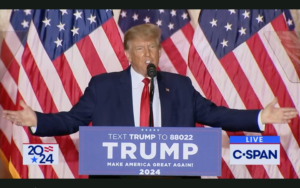
Former President Donald Trump gestures in front of a row of American flags.
Former President Donald Trump. (Screenshot from C-SPAN)


Former President Donald Trump recently called for the "termination" of the Constitution:

Do you throw the Presidential Election Results of 2020 OUT and declare the RIGHTFUL WINNER, or do you have a NEW ELECTION? A Massive Fraud of this type and magnitude allows for the termination of all rules, regulations, and articles, even those found in the Constitution.

This is just the latest in a long line of reprehensible norm-breaking statements and actions by Trump. Just within the last few weeks, he also had a congenial meeting with neo-Nazi Nick Fuentes and anti-Semite Kanye West, and called for instituting the death penalty for drug dealers. Even if you support the War on Drugs (which I obviously do not), this would be barbarically excessive punishment.

The usual excuse for for such behavior by Trump is to claim it's all just words and/or that he doesn't really mean it. If nothing else, Trump's effort to overturn the results of the 2020 election and the resulting attack on the Capitol should give the lie to the notion that he doesn't really mean what he says, and that his abhorrent statements won't lead to action. He and his most committed supporters are more than happy to undermine the Constitution if it gets in their way.

But even when Trump's awful ideas cannot or do not lead to immediate action, they can still cause longterm harm by normalizing the previously unthinkable. In 1993, Senator and former Harvard Prof. Daniel Patrick Moynihan published a famous article entitled "Defining Deviancy Down," in which he argued that (mostly) left-wing tolerance for various forms of criminal behavior and social pathology can increase crime and disorder over time, by making such actions more socially acceptable. For years, conservatives loved to cite this article as a warning against excessively permissive liberal attitudes towards criminality. While I don't agree with everything in Moynihan's analysis, the dynamic he identified is a genuine problem. At least on some issues, conservatives who cited it had a valid point.

Much the same point applies to Trump's deviations constitutional and political norms. The more we tolerate them, the greater the danger of normalization. I outlined this dynamic in a 2018 post on "Why Trump's Words Matter":

When Trump claims it is "treason" to refuse to applaud his State of the Union, denounces "so-called judges" for ruling against his policies, and threatens to use the regulatory powers of government against his critics, he may not (yet) be able to act on these sentiments. But the fact that he says such things makes these ideas and others like them more thinkable than before. That, in turn, increases the likelihood that Trump or a future president will act on them. Anything supported by the leader of one of the two major parties (especially one who wins the presidency) is likely to enter "mainstream" politics, and thereby get on the list of politically plausible outcomes.

This might not be the case in a world where voters have carefully considered political views and follow policy closely. But…. most voters are ignorant about a wide range of policy issues. And, as extensively documented in an important recent book by political scientists Christopher Achen and Larry Bartels, committed partisans often adopt positions based on whether their party is perceived as supporting them, rather than vice versa. Rather than objectively evaluating policy, many voters act as "political fans" cheering on whatever Team Red or Team Blue advocates. That is especially true in an era of severe polarization and partisan bias, where fear of the opposing party makes partisans reluctant to criticize their own party leaders, so long as those leaders continue to lead the struggle against the hated partisan enemy.

Events since 2018 have only heightened these concerns. The spread of election denialism in the wake of Trump's "Big Lie" about the 2020 election is just the most obvious case in point. If Trump continues to be the dominant figure in the Republican Party, he could potentially also normalize the idea of "terminating" the Constitution, and much other evil.

In fairness, Trump is far from the only recent president who tried to circumvent constitutional limits on his authority when they get in the way of his agenda. President Biden is doing so right now with his massive loan forgiveness plan, which is a  Trumpian attempt to usurp Congress' power of the purse. George W. Bush and Barack Obama also committed their share of constitutional sins.

But no other president or ex-president has gone so far as to try to stay in power after losing an election, or called for the complete "termination" of the Constitution, as opposed to merely pushing beyond the limits of his power on some specific issue. None has defined constitutional deviancy nearly as far down as Trump.

How do we forestall the dangerous normalization of constitutional deviancy? By ensuring that politicians who engage in such behavior pay a heavy price. Ideally, Trump and others like him should at least be ostracized from polite political society, and never again considered worthy of holding any position of power again. If that happens, it will serve as a valuable deterrent for future would-be political malefactors. The next time an unscrupulous ambitious politician considers whether imitating Trump's behavior is a good idea, he might conclude he better not, lest he suffer the same fate as Trump himself did.

Trump's defeat in the 2020 election and the failure of Trumpist election deniers in several key 2022 races was a step in the right direction. But much more needs to be done. So long as Trump remains a powerful figure in one of the two major parties and his anti-constitutional ideas remain part of the GOP mainstream, the threat of a dangerous spiral of constitutional deviancy will persist.

One of Moynihan's key insights in "Defining Deviancy Down" is that the most important agents of "normalization" of crime are not so much the criminals themselves as the surrounding society that has come to accept their behavior (or at least no longer protests against it). Similarly, Trump's behavior wouldn't matter as much if it were not so widely condoned and accepted on the political right. GOP tolerance for Trumpist excesses has waned somewhat in the wake of the 2022 election, as they have begun to fear that he is an electoral liability to the party. But the highly equivocal reaction of most party leaders to his latest attack on the Constitution is a sign that it hasn't waned nearly enough.

The party that claims to be a pillar of the Constitution and even promises to read every word out loud when they regain control of the House of Representatives, can't bring itself to ostracize a leader who openly calls for the Constitution's destruction. If that isn't an example of the process of defining deviancy constitutional deviancy down, it's hard to say what is.


 

"Strangers on the Internet" Podcast Ep. 15: Exclusive Interview with Tinder Swindler Victim Cecilie Fjellhøy

The best-known victim of fraudster Simon Leviev speaks out

|

The fifteenth episode (Apple Podcasts link here and Spotify link here) of Strangers on the Internet with co-host and psychologist Michelle Lange is a special one: In this exclusive interview, we sit down with Tinder Swindler celebrity victim Cecilie Fjellhøy.

See what the London-based Norwegian IT consultant has to say about fraudster Simon Leviev and the continued battles to bring him to justice, her and his current dating status, life after starring in Netflix's most-watched documentary of all time, her experiences with British law enforcement, her anti-catfishing activism, and much, much more.

Want to know what Simon's victims thought "was one of the questions [they] wanted explored in the documentary" that didn't make it through? Plus, why did Cecilie and other victims keep being told "you can't say that" by interviewers in the mainstream media about parts of their story they wanted out there? We asked, and she answered.

Some helpful background before listening to this episode, in addition to watching the Tinder Swindler Netflix documentary, is our episode on narcissism and past interview with two other catfishing victims (part 1 and part 2).

Don't forget to hit "Follow" here so you can automatically get part 2 of our Cecilie Fjellhøy interview and our future episodes on your preferred platform!

Justice Alito Asks Questions in 303 Creative from Jewish Coalition for Religious Liberty Amicus Brief

Justice Kagan confirms that J-Date is in fact a Jewish dating site.

|

Today the Supreme Court heard oral argument in 303 Creative v. Elenis. I was pleased that Justice Alito found useful the amicus brief filed by the Jewish Coalition for Religious Liberty. Around the 1:07:02 mark, he referenced our brief, and posed a few hypothetical questions that we raised.

Here is the audio:

JUSTICE ALITO: Let me ask you a -a --and then I'll finish this line. Some hypotheticals in a brief submitted by Josh Blackman, okay? A --a Jewish man and a Jewish woman who are engaged to be married ask a Jewish website designer to build a website to celebrate their upcoming --their nuptials. No problem. Okay? Another Jewish man and a Christian woman who are engaged to be married ask a Jewish website designer to build a website to celebrate their --their nuptials. Big problem. "Many Jews consider intermarriage an existential threat to the future of Judaism." Does that website have to accept the second couple?

MR. OLSON: Again, as we talked about before, if the Jewish website designer has, you know, very explicitly Jewish themes on the -the wedding, they don't need to --on the website, they don't need to take that down for the --the --the interreligious couple that comes. But they --if they offer a general service to the public, they need to offer that regardless of the customer's religion.

JUSTICE ALITO: So the fact that they offer this to --that this is a Jewish --that is offered mostly to Jews, that's enough to make it --or exclusively to Jews, that's enough to make it sufficiently selective to get them out from your -

MR. OLSON: No. I'm --I'm drawing a distinction between what the website designer chooses to put on the website and who the website designer sells the website to. The website designer can choose to put on their websites whatever they want, but they just can't refuse to sell --if they're a public accommodation, they can't refuse to sell that website to someone solely because of their -the customer's or the couple's religion.

JUSTICE ALITO: Okay. An unmarried Jewish person asks a Jewish photographer to take a photograph for his Jdate dating profile. It's a dating service, I gather, for Jewish people.

JUSTICE KAGAN: It is. (Laughter.)

JUSTICE ALITO: All right. Maybe Justice Kagan will also be familiar with the next website I'm going to mention. So, next, a Jewish person asks a Jewish photographer to take a photograph for his ashleymadison.com dating profile. (Laughter.)

JUSTICE ALITO: I'm not suggesting that. I mean, she knows a lot of things.

I'm not suggesting --okay. Does he have to do it?

MR. OLSON: Well, again, it would -it would --what Colorado look --it depends. What Colorado looks to is what services the photographer makes available to the public. And if --if the photographer makes that service available to --to others, taking pictures, you know, for use on websites, then probably yes, but it depends on -

JUSTICE ALITO: Okay, Justice --then I really will stop.

And here are the hypos from our brief:

Consider another hypothetical closer to the facts in 303 Creative. A Jewish man and a Jewish woman, who are engaged to be married, ask a Jewish website designer to build a website to celebrate their nuptials. No problem. Mazal tov! Another Jewish man and a Christian woman, who are engaged to be married, ask a Jewish website designer to build a website to celebrate their nuptials. Big problem. Don't stomp the glass. Many Jews consider intermarriage an existential threat to the future of Judaism.[1] Under the 10th Circuit's ruling, the Jewish artisan would be compelled to voice support for an existential threat to the future of his faith.

Let's turn from marriage to adultery. An unmarried Jewish person asks a Jewish photographer to take a photograph for his JDate dating profile. Swipe right for the shidduch.[2] Next, a married Jewish person asks a Jewish photographer to take a photograph for his AshleyMadison.com dating profile.[3] Swipe left for this shanda.[4] After all, adultery is a violation of the Seventh Commandment.[5]

In each of these examples, a Jewish artist would be compelled to betray his conscience. Yet, the Tenth Circuit would force the Jewish artisans to lend their voices to these breaches of faith.

[1] Rabbi Menachem Schneerson, What's Wrong With Intermarriage, Chabad.org, https://bit.ly/3wPo8fz (last visited May 30, 2022) (describing intermarriage as a "calamit[y]" that "concerns the whole Jewish people"), Rabbi Steven Weil, After Pew: What Will It Take to Save American Jewry, JewishAction.com, https://perma.cc/7ZN8-8UXW (last visited May 30, 2022) (noting that an "astoundingly high intermarriage rate" is one reason why "American Jewry is on a train speeding headlong into self-destruction").

[2] In Jewish circles, the word shidduch describes the dating process that (hopefully) leads to a Jewish marriage.

[3] Scott Cameron, The Infidelity App, NPR.org,  https://perma.cc/UNE9-6959 (Last visited May 30, 2022).

[4] Shanda is a Yiddish word to describe something shameful.

[5] The Ten Commandments, Chabad.org, https://bit.ly/3LQZteT (Last visited May 30, 2022).

Update: There was coverage of the brief in CNN and SCOTUSBlog.

Read More

Politics

Saying Three People Alleged Biased Treatment May Be Libelous If Only One So Alleged

|

From Dearborn Hills Civic Ass'n, Inc., v. Scripps Media Inc., decided Thursday by the Court of Appeals of Michigan (Presiding Judge Christopher Murray and Judges Mark Cavanagh, and Thomas Cameron):

This case arises from a July 15, 2020 news story that aired on WXYZ-Detroit … entitled: "Claims of Unfair Treatment Made by Homeowners Disputed by [DHCA]." DHCA is an organization of volunteers tasked with monitoring and enforcing deed restrictions in the Dearborn Hills neighborhood of Dearborn, Michigan….

The news story included interviews with three homeowners who live in the Dearborn Hills neighborhood—Mariam Sleiman, Lindsey Mahanna, and Nasser Beydoun (collectively, the "homeowners"). Defendants' story represented that these homeowners believed DHCA had unfairly targeted Arab-American homeowners. The homeowners' complaints arose from earlier legal actions by DHCA against them. Each of the homeowners had sought DHCA's approval to make certain renovations to their homes, but DHCA denied their requests on the basis of certain deed restrictions. When the homeowners refused to comply with DHCA's denials, DHCA filed suit. DHCA prevailed after a court in the respective actions found DHCA was within its authority to enforce the deed restrictions.

[WXYZ anchor Dave] LewAllen introduced the news story stating: "[O]nly on Seven tonight, a legal battle between a Dearborn civic association overseeing home improvements and some property owners claiming unfair treatment based on their ethnicity. Seven Action News reporter Simon Shaykhet goes digging for answers in Dearborn and he has both sides of the story." The story cut to Shaykhet who reported:

Read More

Free Speech

Free Speech Rules, Free Speech Culture, and Legal Education: Some More Recommendations

|

I was invited to participate in a Hofstra Law Review symposium on free speech in law schools, which will be happening in February, and I thought I'd serialize my current draft article; there's still plenty of time to improve it, so I'd love to hear people's comments. Here are some follow-up thoughts on what I think law schools should try to teach, though you can read the whole PDF, if you prefer:

[* * *]

[D.] Evenhandedly Encouraging Debates or Conversations Among People Who Disagree

Law schools may also want to encourage student groups to prefer debates—or conversations that aren't framed as formal debates, but that are still aimed at thought­fully highlighting and discussing disagreements—instead of talks. For much the same reason that adversary presentations can help find the truth in the courtroom, they can also help people better understand the strengths and weaknesses of arguments in the university.

A culture where law professors are willing to serve as debating opponents or commentators for student-group-invited speakers, for instance, may encourage such programs. That's especially so since the presence of a faculty member may encourage more students to attend (since many students may know and, one hopes, like the faculty member). Student groups will often do a lot to get more attendees; it shouldn't be hard to persuade them to frame a program as a debate or as a conversation with a faculty member, rather than just as an outsider's speech.

Read More

Libertarianism

Jeffrey Friedman, RIP

Friedman was a notable - and underrated - political theorist.

|

Jeffrey Friedman.


The distinguished political theorist Jeffrey Friedman passed away suddenly on December 2, at the far-too-early age of 63. Jeff was best-known for his work on democracy, political knowledge, and libertarianism, and for his role as the editor of Critical Review, the highly successful interdisciplinary academic journal he founded in 1987, and edited from then until his death. Jeff also taught at several universities around the country, including Barnard, Boston University, Dartmouth, the University of Texas, and Harvard (where, at the time of his passing, he was a visiting scholar at the Committee on Social Studies).

The best introduction to Jeff's multifaceted and complex work is his underrated 2019 book Power Without Knowledge: A Critique of Technocracy (Oxford University Press). He also authored or edited important books on the 2008 financial crisis and rational choice theory (of which he was a forceful critic).

While Jeff was generally considered a libertarian, or at least libertarian-adjacent, he largely rejected conventional libertarian political thought, and ultimately even the  "libertarian" label. He was equally skeptical of standard approaches to democratic theory. Like libertarian (and some non-libertarian) critics of modern democratic government, Jeff argued that widespread voter ignorance was a serious danger. But, unlike them, he claimed that most such ignorance was inadvertent "radical" ignorance, rather than individually rational behavior (as believed by most economists and other social scientists). He also argued that similar radical ignorance afflicted expert decision-making on public policy, and conventional social scientific analysis. He thus concluded that markets and other types of exit rights generally produce better results than government, not because of superior incentives, but because they offer better opportunities for trial-and-error learning.

The above is a highly oversimplified summary that doesn't really do justice to Jeff's incredibly sophisticated and nuanced writings. Few other scholars of our time could equal Jeff's depth and breadth of knowledge of a vast range of issues cutting across disciplinary boundaries. If you really want to understand his work, there is no substitute for reading it!

While Jeff and I wrote on some of the same issues, and often reached similar relatively libertarian conclusions, we differed on many points. Unlike Jeff, I believe that most political ignorance is in fact rational, and I think social science often generates more powerful insights than he gave it credit for. For a summary of our differences about democracy and public ignorance, see this 2013 symposium about my book Democracy and Political Ignorance, a work that surely benefited from Jeff's influence, even though it makes many points he strongly disagreed with.

Despite our differences - some of them on issues where he had very strong views - Jeff was an invaluable friend and mentor to me, over many years. The same was true of numerous other younger scholars. Way back in 1998, when I was a young graduate student, I published my very first article on political ignorance in Critical Review - at Jeff's suggestion. It remains one of my four or five most cited works to this day - a status it would not have achieved without Jeff's valuable suggestions and his criticisms of my many rookie mistakes.

In recent years, we had relatively little contact, as my time was taken up by other personal and professional commitments. That neglect is at least in part my fault, and certainly is my loss. It did not occur to me that so energetic a person as Jeff might leave us so soon.

In what is now a lengthy academic career spanning multiple universities, nations, and continents, I have rarely, if ever, met anyone who epitomized what it means to be a gentleman and a scholar more than Jeffrey Friedman. His passing is a terrible loss. I extend my condolences to his family, friends, and colleagues.

UPDATE: I have made minor additions to this post, such as noting that Jeff ultimately came to reject the "libertarian" label.

Politics

Volokh Conspiracy Holiday Gifts - 2022

Gift ideas for the VC readers in your life!

|

The holiday season is now upon us! If you are looking for possible gifts for the loyal Volokh Conspiracy readers in your life, what could better than books by VC bloggers?

The latest VC-author book is David Bernstein's Classified: The Untold Story of Racial Classification in America. It's an indispensable overview of the history and evolution of the use of racial classifications in the modern US.

VC-ers also published two books last year: Randy Barnett's The Original Meaning of the Fourteenth Amendment: Its Letter and Spirit (coauthored with Evan Bernick) and the revised edition of my own Free to Move: Foot Voting, Migration, and Political Freedom  (which officially came out in early 2022). Barnett and Bernick's book is a major contribution to our understanding of what many consider the single most important amendment to the Constitution. It has already begun to reshape our understanding of the Fourteenth Amendment.

Jonathan Adler's edited volume Marijuana Federalism was published in 2020. It has everything you ever wanted to know about the relationship between federalism and pot, and includes contributions by leading scholars in several different disciplines.

Free to Move makes the case for expanding opportunities for people to "vote with their feet" in federal systems, the private sector, and through international migration. I describe key advantages of foot voting over conventional ballot box voting, and explain how breaking down barriers to foot voting can massively increase freedom and opportunity for millions of people around the world. The revised edition addresses several new issues, including arguments that migration must be constrained to prevent the spread of  dangerous diseases such as Covid-19, claims that immigrants might generate a political backlash that threatens democracy, and the impact of remote work on foot voting. As with the original edition, I am donating 50% of all royalties from the book to charities benefiting refugees, who - sadly - are in more need than ever in this difficult time.

Among my other favorite books by VC authors are Randy Barnett's Restoring the Lost Constitution, David Bernstein's Rehabilitating Lochner, Dale Carpenter, Flagrant Conduct: The Story of Lawrence v. Texas, Jonathan Adler's Business and the Roberts Court, Josh Blackman's Unprecedented and Unraveled, and Eugene Volokh, Academic Legal Writing.

Randy's book is one of the best recent works on originalism and constitutional legitimacy. It is relevant to ongoing debates over legal interpretation that are sure to heat up again as the Supreme Court considers several major cases in the near future. Rehabilitating Lochner explodes numerous myths about one of the Court's most reviled decisions, one that remains relevant to current debates over "judicial activism." Flagrant Conduct is a great account of a milestone in the history of gay rights. It provides useful historical context for the still-ongoing battles over same-sex marriage and related issues.

Jonathan Adler's edited volume is an excellent guide to the issue of whether the Supreme Court favors business interests, and how we might assess claims that it has a pro-business bias. Josh Blackman's two books provide valuable blow-by-blow accounts of the extensive litigation generated by the Affordable Care Act. Finally, Academic Legal Writing is filled with useful advice, while also somehow managing to make this generally unexciting topic interesting.

The Cambridge Handbook of Classical Liberal Thought (edited by Todd Henderson), includes chapters by three different VC bloggers: Jonathan Adler on environmental policy, David Bernstein on anti-discrimination law, and my own contribution on "voting with your feet."

This list is not intended to slight important books by Ken Anderson, Sam Bray, Orin Kerr, David Kopel, David Post, and other VC bloggers. I have not discussed them only because their subjects are distant from my own areas of expertise.

In the spirit of shameless self-promotion, I will also mention the expanded second edition of my own book Democracy and Political Ignorance: Why Smaller Government is Smarter. My most recent book before Free to Move was Eminent Domain: A Comparative Perspective, co-edited with Iljoong Kim and Hojun Lee. It analyzes the use and abuse of eminent domain in a variety of countries around the world.

My other books include The Grasping Hand: Kelo v. City of New London and the Limits of Eminent Domain, which is the first book by a legal scholar about one of the Supreme Court's most controversial modern decisions, and A Conspiracy Against Obamacare: The Volokh Conspiracy and the Health Care Case (coauthored with VC-ers Randy Barnett, Jonathan Adler, David Bernstein, Orin Kerr, and David Kopel). Conspiracy Against Obamacare focuses on the VC's significant role in the Obamacare litigation, and is the only book that includes contributions by six different VC bloggers. In 2016, the University of Chicago Press published an updated paperback edition of the The Grasping Hand.

I wish all our readers a happy holiday season!

Abortion

Also on Religious Freedom and Abortion

|

From Judge Frank Easterbrook's opinion Monday in Doe v. Rokita, joined by Judge Michael Brennan and Michael Scudder:

Indiana requires abortion providers to dispose of fetal remains by either burial or cremation. This mandate applies only to providers; women may choose to take custody of the remains and dispose of them as they please. The Supreme Court sustained this regimen against a contention that it violates the Equal Protection Clause of the Fourteenth Amendment. Box v. Planned Parenthood of Indiana and Kentucky, Inc. (2019). Nonetheless, in this suit the district court held that it violates the First Amendment (applied to the states by the Fourteenth) and enjoined its operation….

Statutes that require people to disobey sincerely held religious beliefs can pose difficult analytical challenges. See, e.g., Fulton v. Philadelphia (2021). But Indiana does not require any woman who has obtained an abortion to violate any belief, religious or secular. The cremate-or-bury directive applies only to hospitals and clinics.

What's more, neither of the two plaintiffs who has had an abortion contends that a third party's cremation or burial of fetal remains would cause her to violate any religious principle indirectly. What these two plaintiffs contend is that cremation or burial implies a view—the personhood of an unborn fetus—that they do not hold. They maintain that only human beings are cremated or buried. This is questionable. Dogs, cats, and other pets may be cremated or buried, sometimes as a result of legal requirements not to put animals' bodies in the garbage. Indiana's statute about fetal remains therefore need not imply anything about the appropriate characterization of a fetus. At all events, a moral objection to one potential implication of the way medical providers handle fetal remains is some distance from a contention that the state compels any woman to violate her own religious tenets.

If the statute reflects anyone's view about fetal personhood, it is the view of the State of Indiana. Yet units of government are entitled to have, express, and act on, their own views about contestable subjects. See also Bowen v. Roy (1986) (private party's religious objection to Social Security numbers does not require the government to change its record-keeping system). Whether or not the Supreme Court continues to adhere to Employment Division v. Smith (1990), which holds that laws neutral with respect to religion may be enforced despite their effects on religious exercise, there is no problem with application of a law that leaves people free to put their own religious beliefs into practice. Nor does Indiana require any woman to speak or engage in expressive conduct.

The issues here are of course not the same as in Friday's Indiana state court decision that Indiana RFRA provides religious exemptions from the state's abortion ban, but I thought I'd pass along this decision alongside the other one.

Libertarianism

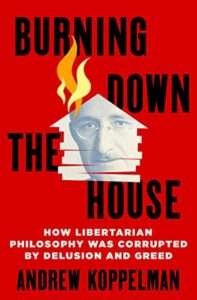
Andrew Koppelman Responds to Critics of His Book on Libertarianism [Updated]

The response is part of the Balkinization blog symposium on his book " Burning Down the House: How Libertarian Philosophy Was Corrupted by Delusion and Greed," in which I was among the participants.

|

Andrew Koppelman has posted a response to participants in the Balkinization symposium on his recent book Burning Down the House: How Libertarian Philosophy Was Corrupted by Delusion and Greed. I myself was one of the participants (see my contribution here), as were co-blogger Jonathan Adler, Richard Epstein,  Christina Mulligan, James Hackney, and others. I thought that Adler and Mulligan developed particularly compelling critiques of key aspects of the book.

Overall, I think Koppelman's response was not especially successful in rebutting the criticisms. But readers will have to judge that for themselves. In fairness, some of the wide-ranging issues raised cannot easily be addressed in a short essay! Here, I offer a brief rejoinder to the part of Koppelman's response addressing my own contribution:

Libertarians are typically drawn to the hypothesis that a nongovernmental solution is always better. It is an hypothesis worth testing, and I say that libertarians have made and continue to make important contributions by insisting upon it (pp. 52-53).   Sometimes it is correct. Sometimes it is a disastrous mistake.

Ilya Somin, my old friend and sometime collaborator, falls into that trap. He acknowledges my dissection of the classic libertarian writers, Hayek, Rothbard, Nozick, and Rand, but laments my "neglect of more recent and more sophisticated thinkers…."  At 237 pages, the book is necessarily compressed. I wrote it because there existed no short introduction to libertarianism for the general reader that was not written by enthusiasts. The "missed opportunity" Somin describes would have been a different book than I was attempting….

I will say that contemporary libertarians, including Somin, make the same mistakes as their predecessors whom I do describe, preeminently exaggerated trust in unregulated markets and exaggerated distrust of government. Somin is particularly troubled by my "neglect of modern libertarian critiques of democratic government, particularly those focused on voter ignorance and bias." Some modern libertarians, prominently including Somin himself, have argued that this fact is a reason to reject legislation in favor of "private-sector solutions to public goods problems and externalities." I acknowledge the possibility of such solutions…., but I say that "whether this is so in any particular case cannot be resolved without attention to the local evidence…"

The real gap between me and Somin is what I say next: "More fundamentally, the networks of mutual trust that facilitate such cooperation don't develop in nations where government is distrusted. Across prosperous democratic nations, and over time, trust in government and interpersonal trust are tightly correlated." Somin is committed to a picture in which government cannot be trusted to do anything right: given the effect on policy of voter ignorance and bias, "the quality of those policies is likely to be greatly reduced." For reasons I elaborate in the book, that picture is not only destructive to cooperation in markets; it is at some remove from reality. Despite voter ignorance and bias, Congress did manage to enact protections against death in the workplace and foul air, protections that the market was never going to supply, and which the Supreme Court has lately been gutting in the name of liberty.

I agree that "nongovernmental solutions" are not always better than government. However, the points I made about political ignorance as a shortcoming of government relative to foot voting amount to a systematic relative advantage of the private sector that should create a presumption against state control. The problem isn't limited to one or a few specific areas of government policy. The same goes for the points I raised about property rights.

That presumption becomes stronger when we add in a range of other issues raised by the modern libertarian literature on government, markets, and public goods that Koppelman largely overlooks in his book. At the very least, as noted in my contribution to the symposium, these issues pose a formidable challenge to thinkers -  including Koppelman himself - who acknowledge many of the important advantages of the private sector, but believe large-scale government intervention can still be justified so long as it is carefully calibrated to address harm caused by market failures, while avoiding creating great new harm of its own. Political ignorance and related issues raised by libertarian scholars (and others) undercut the plausibility of claims that  such careful calibration is even remotely possible. It doesn't necessarily follow that we should abjure all government regulation. But it does follow that its scope must be severely limited. Koppelman may have responses to these concerns. But developing them effectively requires grappling with modern libertarian scholarship on these topics.

The issue of trust is one I cannot do justice to here. I will only note that the extent to which trust matters to important social outcomes is highly contested by experts in the field. I summarize some of the literature in chapter 6 of my recent book Free to Move, where I criticize arguments that immigration must be restricted in order to preserve trust. Moreover, it could be that government will be more trustworthy if its powers are strictly limited, and therefore easier for "rationally ignorant" voters to monitor effectively. The immense size and scope of modern government makes political ignorance and resulting demagoguery and abuses of power far more dangerous than they would be otherwise. I discuss those dynamics in more detail in Democracy and Political Ignorance: Why Smaller Goverment is Smarter, and in this more recent article.

Finally, workplace safety was improving (largely due to increased societal wealth) for decades before the development of the Occupational Safety and Health Administration and other modern regulatory regimes.  The establishment of OSHA in 1970 does not seem to have increased the pace of change. And, as libertarians often point out, workers should be allowed to decide for themselves whether they wish to accept increased risk in exchange for increased pay or benefits. The  Clean Air Act is a much stronger case for Koppelman's thesis. But, as Jonathan Adler points out in his contribution to the symposium, it is also something of an anomaly.

Much more can be said. But, for now, I will stop here. Despite our many disagreements, Koppelman has performed a valuable service by highlighting some key areas of disagreement between libertarians and their critics, especially those on the political left. I hope and expect we will debate these issues further, in the future.

UPDATE: Koppelman responds to this post here:

Somin does not dispute my claim that sometimes, large regulatory programs are justified.  But, he says, the characteristic failures of democratic governance "amount to a systematic relative advantage of the private sector that should create a presumption against state control. The problem isn't limited to one or a few specific areas of government policy."  This is not, however, the sort of question that is appropriately addressed with presumptions.  As I say in the book, "whether this is so in any particular case cannot be resolved without attention to the local evidence."  (69)  Presumptions are not a substitute for such evidence….

Asymmetries of information create another appropriate occasion for intervention.  Addressing workplace safety, Somin writes that "workers should be allowed to decide for themselves whether they wish to accept increased risk in exchange for increased pay or benefits."  But of course there are some risks, such as exposure to toxic chemicals, that workers will not even know about, and which therefore cannot influence the terms of employment.

Given constraints of time and space, I will not attempt a comprehensive response. But I will note that presumptions are an essential element of governance when case-by-case decision-making has severe systematic flaws - including those caused by political ignorance. Koppelman himself accepts such presumptions with respect to a wide range of (mostly non-economic) constitutional rights.

In addition, information asymmetries are a poor justification for government intervention when even larger asymmetries exist between largely ignorant voters on the one hand, and government regulators (and special interests that influence them) on the other. On the whole, workers have far stronger incentives to learn about the potential risks of their jobs than voters do to learn about the risks created by government policy. Introducing government regulation into the mix doesn't reduce information asymmetries. It increases them - often enormously so.

Finally, I'm not much moved by evidence that government officials concluded that their regulations passed cost-benefit analysis. I won't attempt a deep dive into the literature here. But analyses by economists outside government routinely paint a far different picture.


Abortion

Court Holds That Indiana RFRA Provides Religious Exemptions from Abortion Ban

Note that the decision is not inconsistent with the Supreme Court's holding in Dobbs, though it may of course still be overturned on appeal on other grounds.

|

From Anonymous Plaintiff 1 v. Individual Members of Medical Licensing Bd. of Ind., decided yesterday by Marion County (Indiana) Superior Court Judge Heather Welch; Josh Blackman has just posted on the subject, but I thought I'd put up my post as well, because it quotes at greater length from the decision and offers some thoughts of my own. First, my thinking, which I think echoes what I blogged about in May:

[1.] If someone sincerely believes that she is obligated by her religion, or even motivated by her religion, to get an abortion under certain circumstances (which some of the plaintiffs did indeed assert, citing their understanding of Judaism), then she would indeed have a strong claim under a state Religious Freedom Restoration Act, such as Indiana's RFRA. By forbidding her from doing what her religion is telling her to do (or by forbidding others from helping her in this task, when their help is necessary), the state abortion ban is substantially burdening her religious exercise. The government therefore has to show that denying the exemption really is narrowly tailored to a compelling government interest. That's what the statute that the Indiana legislature enacted (RFRA) says, and a court must apply it.

[2.] One way of thinking about this is to consider drug laws. Courts have generally rejected the view that the Constitution includes a right to bodily autonomy that protects the right to use drugs. But when someone feels a sincere religious obligation or motivation to use a particular kind of drug, he can seek an exemption under a RFRA—and might indeed win, if the court concludes that granting the exemption wouldn't unduly undermine a compelling government interest. And indeed the plaintiffs in Gonzales v. O Centro (2006) did win under the federal RFRA as to the hallucinogen hoasca.

Likewise, the Court in Dobbs rejected the view that the Constitution includes a right to bodily or reproductive autonomy that protects the right to get an abortion. But when some feels a sincere religious obligation or motivation to get an abortion, she can seek an exemption under a RFRA—and might indeed win, if the court concludes that granting the exemption wouldn't unduly undermine a compelling government interest.

Of course, this requires resolving (among other things) whether there is indeed a compelling government interest in protecting fetal life, and one can debate that question—and, more importantly, the question of how American courts should resolve that question. That's the very thing that Dobbs sought to keep courts from having to do under some constitutional "substantive due process" or "right to privacy" analysis. But RFRAs do indeed call on courts to answer that question, as to religious exemption claims.

[3.] This having been said, I don't think it's enough for courts to conclude that there's no compelling interest because people disagree on the issue, even on religious grounds.

Read More

Indiana RFRA and Abortion

A trial court found that Indiana's abortion law violates the state RFRA.

|

Flash-back to March 2015. At the time, Mike Pence was the Governor of Indiana. And the Hoosier State enacted a version of the Religious Freedom Restoration Act. This move was highly controversial. Progressive groups feared this bill would provide a license to discriminate in the name of religion. I wrote an essay in National Review explaining that the state RFRA was modeled after the venerable federal standard.

Seven years later, that same RFRA which progressives excoriated, is now being used to stop post-Dobbs abortion laws. And a superior court in Marion County has enjoined the law based on the state RFRA.

Readers of this blog will likely be familiar with some of my writings on religion and abortion (see here, here, here, and here). Indeed, there are two law review articles that engage my views at some length. (I have some quibbles with how the former article characterized my article, and have been in touch with the authors; I think the latter article treats my work fairly.)

There is much to write about the trial court's ruling. Here, I will focus on five primary issues.

First, the court makes a categorical error, and asserts that there is only one view on Jewish law with regard to abortion. For example, the court said "In order to protect the woman, Jewish law recognizes that there are circumstances in which abortion should occur and is mandated even if there is not a physical health risk that is likely to cause death or the substantial and irreversible physical impairment to a woman's major bodily function." And the court said, "Judaism allows for and requires that an abortion be provided if the pregnancy threatens the woman's mental health, for instance if the pregnancy would aggravate psychological problems or cause such problems." To support these claims, the court cited declarations from a few rabbis. But these rabbis do not, and indeed cannot, speak to what Jewish law "mandates" or "requires." A court cannot state, as a matter of fact, what "Jewish law" obligates. (And query whether making these absolute statements amounts to an establishment of what the Jewish faith requires?). These sorts of statements are extremely problematic. I made this point in June:

There is no Jewish equivalent of a Pope. We often speak of "Orthodox," "Conservative," and "Reform" Jews, but even within these categories, there is no official or standardized set of teachings. Every Congregation, indeed, every Rabbi, may follow the teachings in different fashions. Moreover, every Jew can look to faith in his own fashion. And there is no obligation to be consistent. A Jew could hold one opinion in the morning, and then change his mind over lunch, and go back to the original position after dinner. The old saw, Two Jews, Three Opinions, is apt.

What's paradoxical is that the court recognized that another faith, Islam, has different perspectives on the abortion issue. No one spiritual leader can speak for all Muslims. The court wrote:

Although, as in any religion, there are different Islamic schools and views, some Muslim scholars take the position that the fetus does not possess a soul until 120 days after conception.

There are many different schools of thought within Judaism on abortion. The declarations from the rabbis do not speak for all Jews. My colleagues Howard Slugh and Tal Fortgang explain a different Jewish perspective on abortion.

Second, in any event, the specific contours of the Jewish faith are not dispositive for this case. Indeed, Anonymous Plaintiff 2 does "not belong to a specific religious denomination." Rather, her "personal religious and spiritual beliefs . . .  guide her moral and ethical practice and life." What are those beliefs? "She does not believe in a single, theistic god, but believes that there is within the universe a supernatural force or power that connects all humans and is larger than any individual person." Moreover, she has a "spiritual obligation to determine whether to remain pregnant." Anonymous Plaintiff 2 claims that her "religious beliefs are sincerely held."

RFRA defines the "exercise of religion" as "any exercise of religion, whether or not compelled by, or central to, a system of religious belief." If we assume the beliefs of this anonymous plaintiff are in fact sincerely held, I predict that a future ground of dispute is whether her system of beliefs is religious at all, or rather are based on something other than "religion." Calling something "religious" does not necessarily make it "religious." Justice Scalia's concern in Smith that "each conscience [can be] a law unto itself" would ring true. Given that we are defining a term in a statute, and not in the Constitution, it would be useful to know how the phrase "system of religious belief" was understood when the statute was enacted, and in prior caselaw.

Third, the trial court found that the state lacks a compelling interest to prohibit abortion in this context. Specifically, the court ruled that "the question of when life begins is a theological one not a factual question for this Court." In other words, the Court cannot accept the state's contention that there is a compelling interest to protect fetal life from conception, because that is a religious and not legal question. Dobbs was able to avoid this question, but at that moment, I realized that RFRA would force the court to grapple with defining the compelling interest.

Right here is the trial court's most vulnerable point. I don't expect this part of the ruling to survive on appeal. States can be afforded some latitude to define compelling interests, especially concerning the police power. And the Supreme Court is no doubt toiling with these issues now: Students for Fair Admission and 303 Creative may have to tackle the compelling interest issue. (I address that issue in an amicus brief for 303 Creative.) Justice Scalia in Smith objected to Sherbert due to the difficulty of defining a compelling interest. (Somewhere, Justice Barrett is wiping sweat off her brow for not overruling Smith in Fulton.)

By contrast, the analysis of "least restrictive means" is trickier, since there are exceptions for rape and incest, but not for religious exercise. Do those exceptions, in light of Fulton and the most-favored nation approach, undermine the state's compelling interest?

Fourth, if we take these arguments to their logical conclusion, then RFRA would provide greater protections than Roe and Casey. A person's sincerely-held religious belief, however defined, may require an abortion through the ninth month. Indeed, any burden--even if not undue--would violate those rights. For example, requirements to obtain a sonogram, which were upheld under the Casey regime, would violate a woman's free exercise. Who needed substantive due process when RFRA was here all along?

Fifth, I am not certain about the scope of the court's remedy. Usually, RFRA exemptions are granted to named plaintiffs, who articulate specific objections to a government practice. And the injunction here seems limited to the named plaintiffs. One of the groups, Hoosier Jews for Choice, presumably would probably accept as a member any Jewish woman who seeks to obtain an abortion. (It's not clear if every member of that organization needs to share the same religious beliefs, or if non-Jews could join?) How would other Indianans avail themselves of this ruling? Could a person in urgent need of an abortion suddenly find their faith, and profess a sincerely held belief? A class was not yet certified. And, as I wrote in May, certifying such a religious class would be difficult, as individual beliefs are so personal. And proving sincerity based on class representatives cannot work.

***

I wrote about this issue before Dobbs was decided because I recognized it would have legs. Those who historically have favored a broad reading of RFRA, and seek to overrule Smith, need to contend with these arguments. Doing so will not be pleasant, as the barrage of responses to my posts illustrate.  Abortion and religion are the third and fourth rails in our polity. (I lost count of how many times I was called an anti-semite.) Going forward, it is not enough for states to rely on the "compelling interest" prong. I think there needs to be a more careful discussion of "least restrictive means," and whether there is in fact a "substantial burden" of a religious exercise.

Predicting a Fragmented Vote in United States v. Texas

I don't think there will be a five vote bloc on standing or the remedy.

|

I wrote two posts on the latest incarnation of United States v. Texas. Based on my read of the oral argument, I think the ultimate vote may be very fragmented. The Court's six conservatives are not on the same page. And the Court's three progressives will--as they always do when it counts--hang together. The bottom line is the lower-court ruling would be vacated, without a single five-member majority opinion. Here is my crude prediction, that should not be taken very seriously.

First, I think Justice Barrett has already signaled that Article III does not permit the remedy Texas sought--a vacatur. And if the court cannot issue an order that remedies the plaintiff's purported injury, then the court lacks jurisdiction. Thus, Barrett could toss the case on redressability grounds, without deciding whether Texas suffers an injury in fact. The Court followed this path in California v. Texas, which Barrett presaged in oral arguments. Justice Gorsuch also seemed to lean in this direction. These two judges, who were never part of the D.C. Circuit cartel, will have no problem casting doubt on decades of "drive-by" rulings.

Second, I think Justice Kagan will find that Texas's theory of injury is far too broad because it would allow a state to challenge almost any federal policy based on a $1 cost. Justices Sotomayor and Jackson also suggested that Texas's injury, if any, was self-inflicted. Kagan will likely distinguish Massachusetts v. EPA, but find Texas's theory, which has been used countless times since 2014, does not work. If the votes line up this way, there would be five votes to dismiss the case on jurisdictional grounds, and the lower-court ruling would be vacated. But there would be no change in governing law. The D.C. Circuit cartel can continue issue five vacaturs before breakfast. And the Fifth Circuit can continue to rely on the Texas theory of standing. In other words, a fragmented decision will keep the status quo on both questions.

Third, Chief Justice Roberts and Justice Kavanaugh were very much opposed to this "radical" rewriting of administrative laws. But I also don't expect Roberts to actually defend the D.C. Circuit precedent. As Roberts acknowledged, the D.C. Circuit never considered the sorts of arguments raised by Sam Bray and John Harrison. Roberts and Kavanaugh were also very critical of Texas's merits argument. Given the limited appropriations, "shall" cannot mean "shall." And Kavanaugh was very concerned about the Article II issues lurking in the background. My prediction: Roberts and Kavanaugh bypass the jurisdictional argument altogether, and vacate the injunction on the merits. In theory at least, the Court can leapfrog a difficult jurisdictional question if the merits question is straightforward. (This argument was considered in California v. Texas.) Given five justices already found there was no jurisdiction, Roberts would have more of a free-hand to issue this merits-first ruling. And Kavanaugh will tag along, perhaps writing a concurrence that name-drops all of his former colleagues on the D.C. Circuit.

Fourth, I think Alito and Thomas will find that Texas has standing. And I think Alito and Thomas will rule for Texas on the merits. But the remedy may split them. During the Trump years, Thomas was critical of the nationwide injunction. I do not know if he harbors similar doubts about vacatur under the APA. Justice Alito did not seem troubled by the vacatur remedy. If I'm right (and I seldom am), only Justice Alito would affirm across the board. Thomas may find that the vacatur issue was not fairly presented, so it is not before the Court.  Or Thomas might even join Barrett and Gorsuch on the remedial question, even though he briefly served on the D.C. Circuit cartel. I'm not certain. It's possible that zero of the nine Justices will defend the D.C. Circuit's vacatur precedents, yet those precedents remain firmly in place.

The bottom line vote could be cast as 5-4, 7-2, 8-1, or maybe even 9-0. There are so many options.

A First Amendment for Everyone

What the Supreme Court should do in 303 Creative v. Elenis, Monday's case involving a graphic designer who does not want to create same-sex wedding websites.

|

Over the past century the First Amendment's protection of "the freedom of speech" has been interpreted to shield the reprehensible — White Supremacists and homophobes—as well as the admirable — the Black Civil Rights movement and the gay-rights cause. This jurisprudence reflects an American commitment to its own brand of classical liberalism in matters of conscience and expression.

On Monday, that commitment will be tested against another important one — equality under law — when the Supreme Court hears oral argument in 303 Creative LLC v. Elenis. Lorie Smith, a graphic designer who holds traditional religious views about marriage, wants to create custom websites only for weddings uniting one man and one woman.

But Colorado's public-accommodations law (like those in 28 other states) prohibits businesses from discriminating on the basis of sexual orientation in the sale of goods and services to the general public. While Smith says she is happy to serve gay customers in other ways, she does not want to send a message of approval of same-sex marriages.

The Nation's tradition of pluralism under the First Amendment is best understood to forbid Colorado to make Lorie Smith create speech celebrating same-sex marriages. Graphic designers of wedding websites have a limited First Amendment right to refuse to sell such expressive services. Importantly, and poignantly, the very same tradition of expressive pluralism allowed gay-marriage advocates to transform public attitudes about same-sex marriage itself. For the sake of all, that tradition should be preserved in 303 Creative.

Facing the credible threat of expensive and time-consuming investigations by the state civil rights commission, Smith preemptively sued Colorado in what is known as a "pre-enforcement" action, claiming a violation of her free-speech rights. She lost in the lower courts. (Disclosure: Along with Eugene and others, I filed an amicus brief supporting Smith.)

The case comes down to two main questions.  First, is the creation of custom wedding websites for sale in the public marketplace the designer's "speech"?  Second, if it is speech, does the designer have a First Amendment right to refuse such expressive services for same-sex weddings despite a state law compelling her to do so?

I.

The answer to the first question is surprisingly straightforward. The freedom of speech involves more than talking. It includes writing, picketing, dancing, and saluting flags. Government generally may not compel a person to speak against her will. And free speech must also include the freedom not to create speech.

In the commercial marketplace, as elsewhere, courts must draw lines between expression and non-expression. Speech protection should be extended only where the good or service involves an inherently expressive medium (e.g., the speaker's own original words or symbols) or a medium that has historically or traditionally been recognized in the law as expressive (e.g., parades).

Most business services and goods cannot plausibly be regarded as expressive. Hotel owners, limousine drivers, and tailors are not "speaking" when offering their professional services, even if they imbue these activities with great personal meaning. 

Not even all website design services are expressive. If Lorie Smith were just hosting customer-generated content on her online platform, or simply allowing customers to select off-the-rack design templates involving certain colors and fonts, her offerings in the wedding-website marketplace would be mainly her customers' expression — not her own. Similarly, if Smith were only offering an online platform to regurgitate prosaic details, like the time and place of the ceremony, such "speech" would not earn First Amendment protection. The Supreme Court has held that merely sending scheduling emails or announcing meeting locations is not constitutionally shielded expression.

The details matter. Borderline cases involving the multi-billion dollar wedding-industrial complex are certainly imaginable. For example, elaborate custom wedding cakes adorned with specific symbols and pastry-gun writing are perhaps a close call. The Supreme Court confronted a similar wedding cake case in 2018 in Masterpiece Cakeshop v. Colorado Civil Rights Comm'n, but sidestepped the free-speech issue by holding that the baker had been unconstitutionally targeted for unfavorable treatment because of his religious views. (Since Masterpiece Cakeshop, Justices Kavanugh and Barrett have been added to the Court. Their views on the application of free-speech principles to public accommodations laws in the marketplace are unknown.)

But Smith's case is not on the borderline of speech. She proposes actively to create each individual website. Even the Colorado Civil Rights Commission conceded that Smith's graphic and website designs are expressive in nature, as they contain images, words, symbols, and other modes of expression that are used to communicate a particular message of celebration. The appeals court, though it ultimately rejected Smith's constitutional claim, agreed that her bespoke wedding website designs are "pure speech."

Compelling Smith to promote the message that, in essence, same-sex marriages are authentic marriages and are as worthy of celebration and support as opposite-sex marriages is as much a speech compulsion as requiring her by law to proclaim "White Lives Matter" or "Jesus Saves."

II.

If Smith's designs are expressive, the question remains whether the state may nevertheless justify compelling her speech for customers wishing to promote same-sex weddings. In limited circumstances the Supreme Court has held that even fully protected speech may be regulated if the government can prove it has an overwhelming justification for the regulation and if such regulation intrudes on speech in a most limited way.

The state's objective is undoubtedly compelling: promoting equality in daily life for gay Americans. In Masterpiece Cakeshop, the Supreme Court cautioned that First Amendment objections by businesses must be limited lest they become broad licenses to discriminate. Conflicts should be resolved where possible "without subjecting gay persons to indignities when they seek goods and service in an open market."

Nevertheless, the Court upheld the right of Boston's annual Irish parade organizers to exclude a contingent that wanted to march behind a banner identifying themselves as gay. And it upheld the right of the Boy Scouts to expel an openly gay scoutmaster. Both cases involved state public accommodations laws. As in Smith's case, both involved compelled inclusion of gay-affirming messages the objectors did not wish to convey. And both doubtless insulted the persons excluded.

The constitutional answer remains somewhat unsettled in the commercial marketplace. Lower courts have ruled in favor of wedding calligraphers and videographers, but against a wedding photographer and a florist, who objected to providing goods for same-sex weddings.

Some of these may be difficult cases on the line between expression and non-expression, but in principle there's no reason why public-accommodations laws applied to the marketplace should enjoy a categorical immunity from First Amendment review. After all, it makes no difference whether speech is produced for profit to be sold to others or for principle simply to persuade them. Books, films, and newspapers are commercially sold but are no less protected. If creating custom wedding websites is speech (and almost everyone agrees it is) it does not matter whether the designer intends to sell the creations.

Colorado has also not demonstrated it is promoting equality in the least speech-intrusive way, as it might be able to do when a vendor has a monopoly on a product or service. The appeals court concluded that the speech compulsion was justified because Smith had a practical monopoly on her unique expressive services: the website designs could not be offered in exactly the same quality by one of the other numerous talented graphic and wedding website designers available easily online to same-sex couples. If the Supreme Court says nothing else about the case, it should squarely repudiate the bizarre conclusion that an artist's expressive skills must be provided because the artist has a monopoly on her own expression.  Neither Colorado nor any of its supporting amici have defended that misbegotten theory.

III.

But the Supreme Court should do more.  It should clarify that the First Amendment applies to expressive goods and services sold in the public square, offer guidance as to what does and does not count as "expressive," and send the case back to the lower courts with instructions that Colorado cannot enforce its public-accommodations law against Smith's proposed expression unless the state meets the burden of satisfying genuinely strict judicial scrutiny — not the watered-down version of the appeals court.

Many will ask, what about racial discrimination? After all, even the most venomous racist speech is protected.  But the distinctive features of racist denials of service (including region-wide prevalence) and the special horrors of racism (including slavery and Jim Crow) justified wholesale eradication of these practices from the marketplace.  They have no analogue in American history. American anti-discrimination law has long treated such discriminatory practices as sui generis, tolerating relatively few exceptions.

Free speech allowed gay America to flourish. Long before the right to marry was recognized, in a time when even their private sexual acts were criminalized, gay men and lesbians used the space provided by the First Amendment to organize politically and to persuade Americans to support their liberty and equality. If tolerance means anything, it means that marriage traditionalists like Smith may espouse their views (and refuse to espouse contrary views) in the public marketplace.

"Strangers on the Internet" Podcast Episode 14: Ten Years of Tinder - Where Are We Now?

We discuss a decade of mainstream dating app swiping

|

The fourteenth episode (Apple Podcasts link here and Spotify link here) of Strangers on the Internet with co-host and psychologist Michelle Lange has us reviewing some of us the recent popular writings on the topic of ten years of Tinder, including on the issue of burnout (see here and here).

We cover how apps have gamified dating and how some women have raised their standards in positive ways while others come in with unfair expectations and act flaky. Should women tell each other "You're the prize!", and what should we think about men who make Venmo requests after dates? Can people date casually and then decide from one day to the next it's time to settle down? Warning: your hosts are in a spicy mood on this episode!


Let's Not Set Aside The Scholarly Debate About Vacatur

Sam Bray and John Harrison have moved an argument about equity from "off-the-wall" to "on-the-wall"

|

I'll admit it. I long ago simply assumed that courts could issue nationwide injunctions. Likewise, I took for granted that the APA gave courts the power to "vacate" agency actions. Sure, I questioned whether those injunctions and vacaturs could be "national" in scope--that is, extend to non-parties. And I often pondered whether it was possible to remand-without-vacatur. (If the D.C. Circuit does it, it must be right, right?!) But I never considered whether the vacatur itself was permissible. That was, of course, until Sam Bray and John Harrison came along.

Sam's scholarship on the nationwide injunction was perfectly timed. The Trump Administration was under a constant barrage of nationwide injunctions. Sam demonstrated that this sort of non-party relief would have been unknown in the courts of equity. The Trump DOJ would routinely cite Bray for this proposition. Somehow--it still boggles the mind--the Supreme Court went Trump's entire term without answering the nationwide injunction question. (And we still don't have an answer!)

Come 2021, the Biden Administration was under a constant barrage of nationwide injunctions. And some conservative judges, perhaps sympathetic to Bray's arguments about the nationwide injunction, turned to a more familiar remedy: vacatur under the APA. These judges were not relying on some unenumerated equitable power, but instead were invoking an express delegation from Congress to "set aside" rules. Indeed, D.C. Circuit judges would vacate five rules before breakfast. But John Harrison argued forcefully that the APA could not be understood to support such a remedy.

Now, this precise issue is before the Supreme Court. The United States embraced Bray and Harrison's work, and asked the Court to wipe away decades of lower-court precedents. Well, sort of. Texas Solicitor General Judd Stone said the meaning of "set aside" is not "clearly presented" and is "fairly eclipsed within the questions presented." He said the "Court can essentially choose to charitably ignore it on that ground." But if Justice Barrett is right, and the remedial question is jurisdictional, then the Court would have to decide whether the lower court had jurisdiction to issue the remedy the parties sought.

Needless to say, the scholarship of Bray and Harrison did not go over so well with the D.C. Circuit "cartel," as Justice Kagan joked. (Of course, Justice Kagan was nominated to that cartel, but like with most cartels, the barriers to entry were too high.)

Chief Justice Roberts said that Solicitor General Elizabeth Prelogar's position was "fairly radical." Roberts was troubled by how "sudden" this argument was. Indeed, this issue has only been percolating for a few years, in light of Bray and Harrison's scholarship. Roberts, no fan of legal scholarship, referred to Harrison's article by name in a colloquy with Texas Solicitor General Jud Stone.

How did Prelogar handle these questions? She bit the bullet, and said the D.C. Circuit has been "getting this one wrong" for decades. "They have reflexively assumed that vacatur is authorized under Section 706 of the APA." I am fascinated by the word "reflexively." Think of a gag-reflex--it is something you do unconsciously and without thinking. I use this word from time-to-time to make the point very sharply that judges simply are not doing their job. (For example, in several spots I wrote that the lower courts reflexively followed Chief Justice Roberts's South Bay concurrence.)

Roberts responded to Prelogar, "Wow." The D.C. Circuit judges were issuing these remedies "all the time as a staple of their decision output." Prelogar shot back that, again, the courts did not think this issue through sufficiently. And she repeated the word "reflexively." No doubt this was a word prepared in moots.

GENERAL PRELOGAR: But they haven't been doing it with any attention to the text, context, and history of the provision. So it's not as though there are decisions out there that have really engaged with these arguments and come out the other way. Instead, it seems like this happened and came about because courts just reflexively transposed remedies that were available under special statutory review provisions, which do sometimes authorize vacatur, to the APA context writ large.

Prelogar likely knew that she would be assailed for this argument, but she firmly stood her ground.

Now the Chief Justice spent about two years on the D.C. Circuit. Judge Kavanaugh served on that court for twelve years. If we do some back-of-the envelope calculations--five vacaturs before breakfast, assume three meals a day, five days a week--Kavanaugh must have set aside nearly 10,000 actions! Kavanaugh was incensed at the notion that he, and several other judges he name-dropped--he likes to name-drop--could have gotten it all wrong.

Set aside, you said the judges on the D.C. Circuit haven't paid attention to text, context, and history. I guess I would respectfully push back pretty strongly on that. I sat with judges like Silberman and Garland and Tatel and Edwards and Williams. They paid a lot of attention to that.

Justice Barrett clerked for the late Judge Silberman, and Prelogar clerked for Judge Garland, and now works for Attorney General Garland. Like Roberts, Kavanaugh also remarked how novel this argument was.

And the government never has made this argument in all the years of the APA, at least not that I remember sitting there for 12 years. I haven't seen it made. It's a pretty radical rewrite, as the Chief Justice says, of what's been standard administrative law practice. And you devote three pages in your brief to this complete change that all these judges have been doing for all these years, and the government comes up and acknowledges that in case after case after case with labor, energy, environmental. And I think it's a big step.

Indeed, Kavanaugh faults a "recent law review article."

No one's really had this --no case has ever said what you're saying anywhere. No one --you know, it's a recent law review proposal, good for that, but, you know, that's not been the law.

"Good for that!" If you listen closely at 46:30, you can hear a female voice chuckling. I think it was Barrett--who was Bray's colleague at Notre Dame--but I am not certain. It may have been Kagan. Later, Justice Alito referred to Harrison's piece as an "innovative law review article that appeared in 2020." A bit more gracious.

This colloquy seemed personal for Kavanaugh. See how he pivots from "they" to "we."

And you say they're not paying attention to the text. Yeah, we did.

Kavanaugh's jab at Bray and Harrison felt like an episode of Scooby Doo: the D.C. Circuit Cartel would have gotten away with it too, if it wasn't for those meddling law professors. We really should stick to "the influence of Immanuel Kant on evidentiary approaches in 18th Century Bulgaria."

Listen to the recording. Kavanaugh seemed ticked off. After talking for two-full pages in the transcript, Kavanaugh admits "that's not really a question, but that is a comment." (Never have I ever heard a more academic line.) Kavanaugh's colloquy stretched 2.5 pages (starting on p. 54 through page p. 56), and lasts for nearly 2.5 minutes (44:55-47:28). To my memory, this is our first Kavanaugh Page.

Later in the argument, Justice Barrett returned to this issue. She said she was surprised by the briefing on Section 706. But all those D.C. Circuit cases may not be entitled to much weight. With regard to jurisdiction, she said, the Court "gives little weight to drive-by jurisdictional rulings." In other words, if those 10,000 orders that Judge Kavanaugh issued failed to address whether the court had Article III jurisdiction, then those decisions do not settle the question. Then, Barrett asked what has become her signature question. Assume "X," do you lose?

If I think you're wrong about the original meaning of the APA or what people expected "set aside" meant at that time and these are all drive-by remedial rulings, do you lose? 

I've noticed this framing in several other cases. Pro tip: when Barrett says "if I think you're wrong," then she thinks you're wrong.

***

Here, I commend Sam Bray and John Harrison. They successfully moved a legal argument from "off-the-wall" to "on-the-wall." They fought against decades of precedent, and received wisdom, with a commitment to clear scholarship and careful advocacy. They garnered the attention of Republican and Democratic administrations. And several Justices are now expressly considering whether they are correct. Whatever the Court does in United States v. Texas, Bray and Harrison deserve a world of credit.

More