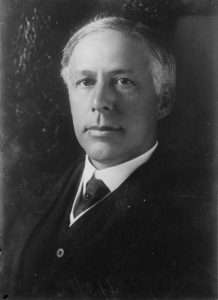
2/9/1937: NLRB v. Jones & Laughlin Steel Corp. argued.
The Volokh Conspiracy
Mostly law professors | Sometimes contrarian | Often libertarian | Always independent | Est. 2002
"Third-Party Standing" Doctrine Shouldn't be Used to Block Lawsuits Challenging Biden's Student Loan Forgiveness Plan
Legal scholar Michael Dorf claims Supreme Court should rule on this basis. But the doctrine doesn't apply to this case, and is dubious anyway.
In a blog post building on points he made in our recent debate at his school, Cornell law Professor Michael Dorf argues that the plaintiffs in the Supreme Court cases challenging the legality of President Biden's massive student loan forgiveness plan should be denied, standing, based on rules disfavoring standing for "third parties." While his argument is clever, it overlooks the key point that third-party standing restrictions only apply to claims based on the constitutional rights of individuals, not those addressing structural limitations on government power. In addition, if the Court were to accept his reasoning, it would set a dangerous precedent blocking most legal challenges to illegal government spending.
Standing issues have long loomed as the biggest obstacle to challenging Biden's loan forgiveness plan in court. On the merits, the administration's position is very weak. Under current Supreme Court precedent, plaintiffs have to meet three requirements to get standing to file a lawsuit in federal court: They must 1) have suffered an "injury in fact," 2) the injury in question must be caused by the allegedly illegal conduct they are challenging, and 3) a court decision should be able to redress the injury.
The "injury in fact" requirement has been the main stumbling block for opponents of the loan forgiveness plan. The most obvious victims of the plan are taxpayers, who will foot the bill for this massive giveaway (estimated at $400 billion or more). But longstanding Supreme Court precedent rejects taxpayer standing, except in a few narrow situations that aren't relevant here. But in Biden v. Nebraska, a case brought by six Republican-controlled state government, the state of Missouri overcame this obstacle because it has a state agency - the Missouri Higher Education Loan Authority (MOHELA) - that services student loans, including some that will be at least partly forgiven by the Biden plan. The Biden loan forgiveness program will predictably reduce MOHELA's revenue from those loans, and even a small financial loss of this kind is enough to qualify for standing under Supreme Court precedent.
In previous posts (see here and here), I criticized the Biden Administration's argument that Missouri lacks standing to bring claims on behalf of MOHELA because the latter is independent from other state government agencies. Dorf, however, argues that Missouri should be "denied so-called third-party standing under the general rule that parties may only bring their own claims." On this theory, Missouri and MOHELA are mere "third parties" because the possible illegality of the student loan forgiveness plan doesn't undermine any of their legal rights, as such. It merely breaches constitutional and statutory limits on executive power.
In support of this theory, Dorf relies on Justice Clarence Thomas's dissenting opinion June Medical v. Russo (2020), where Thomas argues the Court was wrong to grant standing to abortion providers to challenge a law restricting abortion. The constitutional right in question belonged to the pregnant women, and therefore could not be raised by the "third party" providers.
But, as Thomas notes, this third-party standing restriction applies to cases where private parties" try to "bring suit to vindicate the constitutional rights of individuals who are not before the Court" [emphasis added]. It does not apply to cases involving structural limits on government power, such as federalism and (in this case) separation of powers. Dorf himself notes that the Supreme Court said as much in Bond v. United States (2011), where an individual charged with a federal crime was allowed to argue that the statute in question was unconstitutional because it exceeded the scope of federal power.
The Court unanimously ruled that individuals have standing to raise federalism issues because "[b]y denying any one government complete jurisdiction over all the concerns of public life, federalism protects the liberty of the individual from arbitrary power. When government acts in excess of its lawful powers, that liberty is at stake." The Court went on to point out that the same principle applies to separation of powers cases:
The recognition of an injured person's standing to object to a violation of a constitutional principle that allocates power within government is illustrated, in an analogous context, by cases in which individuals sustain discrete, justiciable injury from actions that transgress separation-of-powers limitations. Separation-of-powers principles are intended, in part, to protect each branch of government from incursion by the others. Yet the dynamic between and among the branches is not the only object of the Constitution's concern. The structural principles secured by the separation of powers protect the individual as well.
Unlike individual rights claims, which - on this theory - can only be asserted by people who have suffered specific rights violations, structural claims can be raised by anyone, because structural restrictions on government power provide generalized protection for all Americans. In a wide-ranging recent Yale Law Journal article on third-party standing, Curtis Bradley and Ernest Young note that "[a]lthough structural claims most directly protect the prerogatives of institutions, courts generally accord individuals standing to raise these claims without any talk of third-party standing."
The loan forgiveness case is exactly the kind of situation the Court was referring to in Bond. MOHELA - and the state of Missouri generally- has suffered "a discrete, justiciable injury from actions that transgress separation-of-powers limitations." If the plaintiffs are right, the executive has usurped Congress' spending power, and in the process inflicted an injury on MOHELA. As Dorf recognizes, that injury is exactly the type that would normally meet standing requirements ("third party" restrictions aside). To be sure, MOHELA and Missouri are state entities rather than private citizens. But separation of powers rules - like other structural limitations on federal government power - protect states, too.
As Thomas recognizes in his June Medical dissent, third party claims sometimes qualify for standing even in the individual rights context. Indeed, the Court allowed exactly that in June Medical itself, and also in a number of other cases, such as the famous 1925 ruling in Pierce v. Society of Sisters, where a private school was allowed to raise parental rights in its challenge to a state law requiring children to attend public schools from the age of eight to sixteen. Thomas believes all these cases are wrongly decided. I think he himself is the one who is wrong here. Regardless, even he does not go so far as to claim third party standing constraints should apply to structural cases.
Dorf further argues that MOHELA and Missouri's injury doesn't qualify for standing because it isn't the right type of harm:
But even acknowledging that structural protections exist to protect individuals, surely there is a limit to how far that principle extends. Bond herself had standing to object that the law that would apply to her exceeded the powers of Congress. But suppose that Bond's next-door neighbor wished to sue the government on the ground that if Bond went to prison, her house would be empty, which would create a greater risk of crime, which would lower the neighbor's property value. There are numerous objections one could make to such a suit, but one threshold objection ought to be that this simply isn't the kind of injury that counts--even if we assume that it's nearly certain to occur. Why not? Because the neighbor's expected pecuniary loss, even if substantial and nearly certain, has nothing to do with the alleged unconstitutionality of the statute as applied to Bond.
It's arguable that Bond's neighbor's injury in this hypothetical wouldn't qualify because it is in large part caused by the intervening actions of third parties: the criminals who might target the neighborhood, and would-be buyers who aren't willing to pay as high a price for houses in the area, as a result. Thus, the neighbor might lose based on the causation requirement for standing.
But such considerations don't apply to the MOHELA situation. Here, the administration's illegal actions directly cause the financial losses to MOHELA and the state. If Bond's neighbor suffered a similarly direct injury, she should have standing to sue as well.
And, as I noted in our earlier debate, I have the same response to Dorf's hypothetical involving an electric chair manufacturer whose contract with the government gets terminated because the president decides to commute all federal death penalties in ways that manufacturer claims exceed the scope of presidential authority. While the manufacturer's claims should fail on the merits (because such action is within the scope of the president's pardon power), he is entitled to standing.
If the Court were to reject the Missouri lawsuit based on Dorf's theory, it would set a very dangerous precedent. So long as there is no general taxpayer standing, almost all challenges to the legality of government spending must rely on injuries similar to those suffered by Missouri, where the government's expenditure inflicts some sort of economic loss on a state or private party. If the direct financial loss to MOHELA is not the right type of injury, it is difficult to see what would be.
The net effect of such standing rules would be to give presidents a near-blank check to raid the Treasury for their pet projects, free of fear that lawsuits might stop them. To be sure, one or both houses of Congress might still be able to bring a case, as the DC Circuit ruled in a challenge to Donald Trump's diversion of funds to build his border wall (Trump's border wall power grab has many parallels to Biden's loan forgiveness policy). But such a lawsuit is only likely to occur if the party opposed to the president controls at least one house of Congress. Thus, the president could still indulge in illegal spending during times of "united" government.
Even if you trust Biden with such power, you probably don't have similar confidence in Trump, Ron DeSantis, or whoever the next Republican president might be. If expansive third-party standing restrictions had a strong basis in the text and original meaning of the Constitution, perhaps we would just have to live with this danger. But, as Dorf recognized at our Cornell debate, they don't.
Indeed, the entire doctrine of standing is largely a judicial creation, and a very dubious one at that. In my view, the Supreme Court should just simply abolish it, or at least allow taxpayer standing in cases involving illegal expenditures. The justices are unlikely to do that anytime soon. But they should at least avoid expanding third-party standing restrictions to cover lawsuits over structural issues, as well as individual rights.
I think Dorf is on stronger ground in criticizing the standing claims asserted by the plaintiffs in Department of Education v. Brown, the other loan-forgiveness case before the Supreme Court; I have raised some doubts on that score, myself. But I also think this issue won't matter much to the ultimate resolution of these cases. If Missouri gets standing, that will be enough for a ruling invalidating the plan. If the justices deny standing to Missouri, they are unlikely to grant it in the other case, where the rationale for standing is much weaker.
Another Judge on the Acela Corridor Takes The Thirteenth Amendment Seriously
Judge Matey's concurrence sketches out the original meaning of "involuntary servitude."
Apparently, not all judges along I-95 are lost. Today the Third Circuit decided Burrell v. Staff. The plaintiffs argued that violations of labor laws amounted to involuntary servitude, in violation of the Thirteenth Amendment. The majority opinion rejected those claims in light of modern precedent.
From Zavala we derive the principle that using an otherwise legal process for a purpose for which it was not created or intended to be used is not, on its own, sufficient to constitute the threat of legal sanction necessary to find a Thirteenth Amendment violation. Here, restricting access to the work release program and threatening plaintiffs with serving the entirety of their otherwise legal contempt sentences is akin to the threats of deportation in Zavala. Because plaintiffs do not sufficiently allege involuntary servitude, they fail to state a Thirteenth Amendment § 1983 claim on which relief can be granted, and we will affirm the District Court's dismissal of those claims.
Judge Matey concurred, and included a lengthy footnote concerning the original meaning of the Thirteenth Amendment.
After an abhorrent chapter in our Nation's history, the Thirteenth Amendment confirmed the natural rights of all persons through "a practical application of that self-evident truth, 'that all men are created equal; that they are endowed by their Creator with certain unalienable rights; that among these are life, liberty and the pursuit of happiness.'" Jacobus tenBroek, Thirteenth Amendment to the Constitution of the United States: Consummation to Abolition and Key to the Fourteenth Amendment, 39 Calif. L. Rev. 171, 178 (1951) (quoting Cong. Globe, 38th Cong., 2d Sess. 142 (1865) (statement of Rep. Godlove S. Orth)). The Amendment reiterated the natural law that supports our Constitution, making slavery irreconcilable "with the fundamental principles upon which our government rests." Joel Tiffany, A Treatise on the Unconstitutionality of American Slavery (1849), reprinted in 2 The Reconstruction Amendments: The Essential Documents 237, 237–38 (Kurt T. Lash ed., 2021) ("All men are possessed of the same natural rights, secured by the same natural guarantys—held by the same tenure—their title is derived from the same source. . . . Deny these truths, and you destroy the foundation upon which society is based. Violate them, and you are at war with yourself, with Man and God."). The Amendment, rooted in "our ancient faith [that] the just powers of governments are derived from the consent of the governed," recognized that slavery's existence was "a total violation of this principle . . . [of] self government." Abraham Lincoln, Speech at Peoria, Illinois (Oct. 16, 1854), reprinted in 2 The Collected Works of Abraham Lincoln 247, 265–66 (Roy Basler ed., 1953). "By the law of nature all men are born free and equal, and man has no jus dominii in man. . . . [F]or freedom is the natural right of every man, and slavery is abridgment by positive law." Slavery and the Incoming Administration, in 2 Brownson's Quarterly Review 65, 109 (1857). See also Dred Scott v. Sandford, 60 U.S. (19 How.) 393, 624 (1857) (Curtis, J., dissenting) ("Slavery, being contrary to natural right, is created only by municipal law."). The Thirteenth Amendment codified the truth that slavery could be treated as constitutional "only by disregarding the plain and common-sense reading of the Constitution itself." Frederick Douglass, The Constitution of the United States: Is It Pro-Slavery or Anti-Slavery? (1860), reprinted in 2 The Reconstruction Amendments: The Essential Documents 303, 308. See also Peter C. Myers, Seed-Time and Harvest-Time: Natural Law and Rational Hopefulness in Frederick Douglass's Life and Times, 99 J. Afr. Am. Hist. 56 (2014), reprinted in A Political Companion to Frederick Douglass 285, 287 (Neil Roberts ed., 2018) ("Douglass frequently invoked the law of nature both because he was convinced of its profound truth and also by virtue of its utility in various practical applications.").
Matey concluded that the plaintiffs' constitutional claims have no merit.
None of Plaintiffs' claims approach a violation of the natural principles guarded in the Reconstruction Amendments, nor could the nature of their work approach the atrocities the Thirteenth Amendment protects against. Calling what amounts to a wage and hour dispute a violation of these laws would be a most remarkable departure from the Amendment's original meaning and disrespectful to that historic achievement.
DOJ, take note for your brief.
What Are Student Journals To Do When Authors Refuse To Change False Claims?
This post is based on my experience with Professor Xiao Wang's article, but addresses a broader issue: what should a student journal do when an author refuses to correct a false claim. I think there are three ways to approach this question.
First, imagine during the review process, the journal identified an error in the author's paper, and asked the author to make the change. The author steadfastly refused to make the correction, convinced he was correct. The journal could rescind the offer of publication. Or the journal could post some sort of editor's note on the article, to flag the error. But in most cases, the journal may decide that the article has the author's name on it, and it is the author's problem. I'm not sure I agree with that sentiment, but it probably describes how publishing works in practice.
Second, imagine during the review process, the journal fails to identify the error in the author's paper, and only becomes aware of it after publication. Here, there was a failure of the editorial process (to one degree or another). What are the options here? The journal could post a correction, with the consent of the author. Or the journal could post an editor's note, without the author's consent. Or, perhaps in egregious circumstances, the journal could withdraw the article altogether.
Third, imagine that the error was only identified after publication, but the journal takes no action to acknowledge any correction. Perhaps the author refuses to acknowledge the error, and the journal stands by that decision. At that point, the error will stand in perpetuity.
Among these three options, I would have the most sympathy for the students in the first scenario. They did their due diligence, and tried to get the author to correct an error, but ultimately acquiesced. I am also partially sympathetic to the students in the second scenario. Even where the author refuses to make the change, the editors can exercise their prerogative to distance themselves from the error. I am least sympathetic to the students in the third scenario. Their review process failed to uncover the error, and now the journal takes no action to own that error on their part.
Federalist Society Freedom of Thought Podcast, with Prof. Joshua Kleinfeld (Northwestern) and Me
Will Litigation Over Title 42 "Public Health" Migrant Expulsions Soon Become Moot When Biden Ends the Covid Emergency?
If so, Title 42 expulsions might finally end. But it's not a done deal yet.
The Biden Administration's recent decision to terminate the Covid-19 state of emergency on May 11 may clear a path to ending Title 42 "public health" expulsions of migrants at the southern border. That's because this step could end up mooting out the litigation surrounding previous efforts to terminate the policy.
In December, the Supreme Court decided to consider a case challenging the Biden Administration's decision to end Title 42 expulsions. The Title 42 expulsion policy was begun by the Trump Administration in March 2020, supposedly for the purpose preventing the spread of the Covid-19 virus to the United States, though actually more as a tool for restricting immigration generally. It was then continued under Biden, despite overwhelming evidence that it did little or nothing to control the spread of the disease. Some 2 million people have been summarily expelled under the policy, including many who would otherwise have had the right to stay in the US in order to apply for asylum. The expulsions have caused great suffering, subjecting many those expelled to violence, extortion or persecution.
When the Biden Administration finally tried to end the expulsions in May of last year, a group of "red" states file a lawsuit claiming it hadn't followed the requirements under the Administrative Procedure Act (APA). A federal district court issued an injunction blocking termination of the policy. Meanwhile, a separate lawsuit filed by opponents of Title 42 expulsions secured a ruling indicating that it was illegal, under the APA, to continue them. For technical reasons, the latter decision would have taken precedence over the former, and put an end to the policy by late December. But, on December 27, the Supreme Court stayed the ruling against the expulsions when it decided to hear that case - not to consider the merits, but to review the lower court's denial of a motion to intervene filed by several red states. This had the indirect effect of reinstating the earlier district court ruling blocking termination of Title 42 expulsions.
Since, then however, President Biden announced that he is going to end the Covid-19 national emergency on May 11. Title 42 expulsions do not depend the emergency declaration for their legal authority. The Trump and Biden Administrations both argue they are authorized by a provision of the 1944 Public Health Service Act that (with later modifications) gives the Centers for Disease Control the power to bar migrants for purposes of preventing the "introduction" of disease into the United States. However, the current CDC expulsion order says it will end upon the termination of the Covid emergency.
If the emergency does indeed end, then the Title 42 expulsion order will also terminate "naturally." That would obviate arguments that the Administration failed to use APA notice and comment procedures that may be required in situations where a regulatory policy changes. If Title 42 expulsions end as originally planned (upon termination of the Covid emergency), that would not be a change in policy at all, and there would be no need for any special procedures!
If Title 42 expulsions end as planned, that could also moot out the litigation challenging their legality, and thereby also moot the Supreme Court case considering whether red states should be allowed to intervene. You can't intervene in a case that's over with, anyway. Or, at least, so the Administration claims in its recently filed Supreme Court brief in that case:
Absent other relevant developments, the end of the public health emergency will (among other consequences) terminate the Title 42 orders and moot this case. The government has also recently announced its intent to adopt new Title 8 policies to address the situation at the border once the Title 42 orders end…..
By its terms, the operative Title 42 order terminates upon "the expiration of the Secretary of HHS' declaration that COVID-19 constitutes a public health emergency." 86 Fed. Reg. at 42,830…..
The anticipated end of the public health emergency on May 11, and the resulting expiration of the operative Title 42 order, would render this case moot: Be cause the Title 42 order would have " 'expired by its own terms,' " this suit seeking only prospective relief would "no longer present[] a 'live case or controversy.' " Trump v. International Refugee Assistance, 138 S. Ct. 353, 353 (2017)…. In that event, the government will ask the court of appeals to vacate the district court's judgment and remand with instructions to dismiss private respondents' suit as moot.… And because the mooting of the underlying case would also moot petitioners' attempt to intervene, it would likewise be appropriate for this Court to resolve the intervention dispute by vacating the court of appeals' order denying intervention and remanding with instructions to dismiss petitioners' motion as moot.
The administration is adopting a similar strategy in the case where a district court ruled against the effort to terminate the expulsions.
If the mootness argument prevails, the Administration will get to end the Title 42 expulsions, as it has longed promised to do, while simultaneously also getting rid of lower-court decisions that constrained its authority. Those would likely end up being vacated (with the exception of a March 2022 DC Circuit ruling that put some constraints on the expulsion, and an earlier ruling barring expulsion of unaccompanied minors).
The cases could well end up being resolved that way. But it isn't a done deal yet. The cases won't become moot until May 11. It would be unusual for the Supreme Court and the Fifth Circuit (which is handling the ruling against the effort to end expulsions) to complete all their deliberations so quickly. But they could potentially do so. The courts might also find technical reasons to conclude that one or both of these cases remain live controversies, despite the end of the national emergency. I will leave that issue to people with greater expertise on mootness doctrine.
In addition, the Administration could potentially decide to extend the Covid emergency again, if the situation with the virus gets worse, or if the White House decides an extension is politically convenient. For a long time, Biden has been playing a kind of double game with Title 42 expulsions, simultaneously claiming to want to end them, yet also continuing to defend them in court and even expand their use. As with Trump before him, Biden's use of Title 42 expulsions has been guided far more by political considerations than scientific ones. It's possible that the Administration will reverse course again, if it sees some advantage in doing so.
Biden's hypocrisy is matched by that of the red state politicians litigating against the end of Title 42 expulsions. These state governments oppose nearly all other pandemic-mitigation measures (often with good reason). Yet they also seek to indefinitely perpetuate Title 42 public health expulsions, even as they claim the public health emergency should have been ended much sooner than Biden plans.
In my view, Title 42 expulsions were illegal from early on, once it became clear that Covid-19 was established in the United States, thus making it impossible to claim that the CDC order was somehow blocking its "introduction." If the statute is interpreted as giving the CDC broad power to block migrants from anywhere where there is a communicable disease -regardless of whether it is already present in the US - that would raise serious constitutional problems by essentially giving the executive near-total control over immigration policy.
I would have preferred a straightforward decision holding that the Title 42 policy is illegal. But if the mootness strategy puts an end to the expulsions by May, that might be preferable to many more months of ongoing litigation, during which time expulsions might well have continued.
We'll soon see what the courts do with the mootness issue - and whether the Biden Administration sticks to its current plan to terminate the national emergency on May 11.
N.C. Ban on Criminal Libel of Candidates Likely Unconstitutional, Fourth Circuit Holds
The law provides:
For any person to publish or cause to be circulated derogatory reports with reference to any candidate in any primary or election, knowing such report to be false or in reckless disregard of its truth or falsity, when such report is calculated or intended to affect the chances of such candidate for nomination or election.
Today's Grimmett v. Freeman (4th Cir.), written by Judge Toby Heytens and joined by Judges Albert Diaz and Allison Rushing, concluded that the statute is unconstitutional because it "appears to criminalize at least some truthful statements":
"[D]erogatory reports" are prohibited when the speaker makes them "knowing such report to be false or in reckless disregard of its truth or falsity." We may assume a speaker cannot "know[]" a statement "to be false" unless the statement is false. But by its plain terms this statute also criminalizes truthful derogatory statements so long as the speaker acts "in reckless disregard of [a statement's] truth or falsity."
{The lack of an express limitation to false statements distinguishes this Act from criminal defamation statutes upheld by other circuits. See Frese v. Formella (1st Cir. 2022) (upholding statute prohibiting "purposely communicat[ing]" "any information" a speaker "knows to be false and knows will tend to expose any other living person to public hatred …" (emphasis added)); Phelps v. Hamilton (10th Cir. 1995) (upholding statute defining "[c]riminal defamation [as] maliciously communicating … false information tending to expose another living person to public hatred …" (emphasis added)).
Professor Xiao Wang in the Minnesota Law Review Refutes A Position I Do Not Hold
When you say someone is wrong, quote them, to ensure you are properly attributing their view.
Last week, How Appealing linked to a new article in the Minnesota Law Review by Professor Xiao Wang, titled "The Old Hand Problem." The thesis of the article is that judges take senior status strategically. That is, Republican-appointed judges take senior status during Republican administrations. And Democratic-appointed judges take senior status during Democratic administrations. Tell me something I don't know. Indeed, shortly after the 2020 election, I wrote a blog post titled "Which Ninth Circuit Judges Were Waiting For A Democratic President to Take Senior Status?" I teased an article that I was working on with James Phillips "about judges who strategically time their taking of senior status." James and I in fact did start writing that article, but we ultimately abandoned the effort, in part, because the conclusions confirmed conventional wisdom.
I glanced at Wang's article and didn't think much of it. (The title, though, seems like something of a mixed metaphor, because an "Old Hand" usually is a positive word that refers someone with skill or experience).
But then a Volokh reader flagged a passage about me in the article:
The data also suggests that Republican-appointed judges have acted in a significantly more politically strategic manner than their Democratic-appointed counterparts. That finding contradicts an idea, put forth by Josh Blackman, that judges are only just now taking senior status to benefit President Biden and the Democratic Party. This conjecture is not borne out by the data. True: both sides may be playing the game of strategic retirement. But also true: one side—the Republican Party—is much better at playing the game than the other. During the Trump administration, for instance, almost a hundred more Republican-appointed judges sought senior status than their Democrat counterparts—an absolute difference accounting for more than ten percent of the Judiciary.8 At any rate, the percentage swings we have witnessed are significant for both parties and are historically unprecedented.
Huh? I never, ever said that. I am well aware that Republican judges strategically timed their senior status. And nothing in my blog post support that proposition. Not a single word. And Wang doesn't include any support or parenthetical for the proposition.
Wang repeats this claim later in the article, almost verbatim:
Third, these numbers rebut the suggestion made by Josh Blackman that judges have started taking senior status now to benefit the Democratic Party—i.e., that this strategic behavior manifested only recently, to provide President Biden an opportunity to shape the Judiciary.
Again, I never said this was some new trend since Biden is in office.
Let me be charitable. Perhaps Wang could have written that Blackman only discussed the problem of judges taking senior status now that a Democrat is in the White House, which creates the inference that there is some sort of new behavior. But to make a statement like that, Wang would have to be certain that I've never written about strategic senior status-taking during the Trump years. But of course I did. In December 2017, I wrote for National Review that Republican-appointed judges should take senior status to give Trump more seats. I named names. (And a few of the people I named were not very happy with me; welcome to my world.) And many of the judges I named did in fact take senior status when they were eligible. I wrote:
According to my calculations, there are over 100 judges appointed by Presidents Ronald Reagan, George H. W. Bush, and George W. Bush who can immediately open up new vacancies by announcing a plan to leave active service, either upon the confirmation of their successor or on a future date. They should be encouraged to do so over the next year.
Wang should have cited my National Review piece as support for this thesis! We agree!
Here, we have a failure of the author to accurately cite a source, and the failure of the editors to check sources. Moreover, it is all too common for authors to tease student editors with lofty claims like "I challenge conventional wisdom" or "I proved so-and-so-wrong." The latter claim is especially attractive when the author shows that conservatives are worse than liberals, or even worse, a conservative author is a hypocrite. (That's me.). The journal was snookered here.
I emailed both Wang and the journal. They replied there would be no correction. So this blog post will serve as the rejoinder.
May I offer some advice to editors: if you ever say someone is wrong, actually quote them. Don't paraphrase them. Don't take a few words out of context. Quote them at length. Quote the exact point that you are saying was wrong. And once you've done that, stop short of actually saying they're wrong. Make it soft. The author may have erred when he wrote… The author failed to consider… The author did not account for… And so on. But don't write that your work "contradicts" what someone else wrote--especially when the person you are criticizing supports your work.
What's With the Pseudonymity in the National Air & Space Museum / "Rosary Pro-Life" Hat Lawsuit?
The First Amendment case, which I just noted below, is being litigated as Kristi L. v. National Air & Space Museum. Why a pseudonym, given that most lawsuits are litigated in the parties' own names?
Here's the rationale Chief Judge Beryl Howell (D.D.C.) gave yesterday:
Plaintiffs are "students, parents and/or chaperones of Our Lady of the Rosary Church of School in South Carolina" ("Rosary") who are ardently "pro-life." On January 20, 2023, plaintiffs wore hats containing Rosary's name and the term "Pro-Life," while visiting the National Air and Space Museum ("NASM"), where they allege they were "subjected to a pattern of ongoing misconduct by at least five different staff, personnel, employees and/or security guards" because of their "pro-life" message. Plaintiffs sued the NASM and the police/security officers involved, alleging, inter alia, violations of their rights under the First and Fifth Amendments to the U.S. Constitution.
Five of the plaintiffs have now filed the instant motion because they are either parents or siblings of other minor plaintiffs in this lawsuit, and they assert they must also not reveal their full names "so as to further protect the identity of their children and sibling pursuant to Federal Rule of Civil Procedure 7(b) and Local Civil Rules 5.1 and 7." Plaintiffs' motion is granted only because "[i]n cases where the identities of a minor and parent or guardian are 'inextricably intertwined,' courts allow parents or guardians to proceed under pseudonym when suing on the minor's behalf." Asylumworks v. Wolf, No. 1:20-cv-03815, 2020 U.S. Dist. LEXIS 264893, at *8 n.2 (D.D.C. Dec. 23, 2020). Rule 17(c) of the Federal Rules of Civil Procedure requires that a representative of a minor, such as a parent or guardian, sue on behalf of a minor. Fed. R. Civ. P. 17(c). "[U]nless the parent or guardian is granted anonymity, the child's identity would effectively be revealed in the court filing through a combination of the name of the parent or guardian and the child's initials. The protection extended to the child by Federal Rule 5.2(a)(3) and federal law would be eviscerated." Eley v. District of Columbia, 2016 U.S. Dist. LEXIS 147955, *4 (D.D.C. Oct. 25, 2016) (quotation marks omitted)…. [I]t is further ORDERED that plaintiffs, who are not minors, may proceed by using their first names and the first initial of their last names as pseudonyms; … and it is further ORDERED that the defendants are prohibited from publicly disclosing the plaintiffs' identities or any personal identifying information that could lead to the identification of the plaintiffs by nonparties, except for the purposes of investigating the allegations contained in the Complaint and for preparing an answer or other dispositive motion in response.
Visitors Sue Over National Air & Space Museum's Alleged Demand That They Remove "Rosary Pro-Life" Hats
"We are a museum that promotes equality, and your hats do not promote equality.”
The case, filed Monday, is Kristi L. v. National Air & Space Museum (D.D.C.). Some allegations:
60. Defendant Jane Doe 2 and Defendant Jane Doe 3 … stopped Plaintiffs … and instructed them to remove their hats….
62. As Plaintiffs … walked by Defendant Jane Doe 2 and Defendant Jane Doe 3 to continue into the exhibit, the Does used expletives in reference to the students, some of whom are minors, including J.K., stating: "The f—king pro-life. What a bunch of s—t." …
63. At approximately 4:40 pm, several students of Our Lady of the Rosary School, including Plaintiffs …, were sitting against the escalator wall outside of the Wright Brothers Exhibit when they were once again approached by a NASM security officer dressed in dark clothing and black beanie/hat. Defendant John Doe 2, approached the students and had a big grin on his face and was rubbing his hands together as he said, "Y'all are about to make my day."
64. Defendant John Doe 2 continued to address Plaintiffs Patrick M., Kathleen K., Jane K., J.K., and T.L., along with their fellow students by stating, "You've been told multiple times to take your hats off, and you have not taken them off. You need to take them off or leave."
65. Plaintiffs Jane Kihne and T.L. pointed out other NASM visitors unrelated to Plaintiffs' group who were wearing hats and questioned why they were allowed to wear hats while Plaintiffs were being ordered to remove theirs.
66. Defendant John Doe 2 stated that Plaintiffs' hats were "political statements," and that they were "not promoting equality."
Is Arizona v. Mayorkas Moot?
The Biden Administration suggests that the Title 42 case before the Supreme Court will be moot before it is decided.
The Supreme Court is scheduled to hear Arizona v. Mayorkas on March 1. The question before the Court is whether states can intervene to defend maintenance of the Title 42 policy barring entry of some noncitizens entering the country through Canada or Mexico. The Biden Administration has sought to rescind this policy, and a district court in D.C. held that the use of Title 42 to limit entry into the nation was unlawful. Arizona v. Mayorkas arises from the efforts of some states to defend the Title 42 order and challenge this decision. A separate challenge to the Biden Administration's descision to rescind the order is currently pending in the U.S. Court of Appeals for the Fifth Circuit.
Yesterday the Biden Adminsitration filed its merits brief in Arizona v. Mayorkas, in which the Solicitor General suggests that the case will become moot before it is decided because the Biden Administration has announced that the COVID-19 emergency will end in May. From the brief:
Since this Court's grant of certiorari, Congress has considered legislation that would immediately terminate the current public health emergency. In response, the government announced for the first time its intent to allow that emergency to expire on May 11, 2023. Absent other relevant developments, the end of the public health emergency will (among other consequences) terminate the Title 42 orders and moot this case. The government has also recently announced its intent to adopt new Title 8 policies to address the situation at the border once the Title 42 orders end. . . .
The anticipated end of the public health emergency on May 11, and the resulting expiration of the operative Title 42 order, would render this case moot: Because the Title 42 order would have " 'expired by its own terms,' " this suit seeking only prospective relief would "no longer present[] a 'live case or controversy.'" Trump v. International Refugee Assistance, 138 S. Ct. 353, 353 (2017) (citation omitted) (quoting Burke v. Barnes, 479 U.S. 361, 363 (1987)). In that event, the government will ask the court of appeals to vacate the district court's judgment and remand with instructions to dismiss private respondents' suit as moot. See United States v. Munsingwear, 340 U.S. 36, 39 (1950). And because the mooting of the underlying case would also moot petitioners' attempt to intervene, it would likewise be appropriate for this Court to resolve the intervention dispute by vacating the court of appeals' order denying intervention and remanding with instructions to dismiss petitioners' motion as moot.
If the Court is looking to further shrink its already shrunken docket -- perhaps to make more time to issue some more opinions -- this would provide them with such an opportunity.
More Pork! And the Prevention of Cruelty to Animals
A few more words about the constitutional status of animal cruelty laws
In a posting a few days ago, I discussed the Nat'l Pork Producers' Council v. Ross case now before the Supreme Court, in which the NPPC is challenging, on "dormant commerce clause" grounds, a California law that makes it unlawful to sell pork in CA if the seller knows (or should know) that the meat came from a breeding pig that was confined "in a cruel manner" (as defined in the statute).
The NPPC has two main arguments, the most prominent being that the law represents improper "extra-territorial" law-making, inasmuch as it amounts, in effect, to compelling out-of-state pork breeders to change their business practices. As I discussed in the earlier post, I would be surprised if the Court adopts this tack.
Their second argument, which I admitted had me scratching my head, is that the law imposes, in NPPC's words, "excessive burdens on interstate commerce without advancing any legitimate local interest." California's "philosophical preferences about conduct occurring almost entirely outside California," and its "desire to prevent what California considers animal cruelty that is occurring entirely outside the State's borders," cannot justify the burdens imposed on pork producers nationwide.
As many commenters pointed out, I didn't do a particularly good job explaining why I found this claim confusing. Let me try again.
I think it's their use of that word "legitimate" that threw me.
Let's start with some propositions with which everyone agrees:
- Preventing animal cruelty in California is a perfectly "legitimate" interest, under California's "police power." California may pursue this interest through legislation - banning, say, dog-fighting, bear-baiting, or particular forms of animal confinement, within the State.
- Animal cruelty laws are not - and do not need to be - justified as "health and safety" measures. The health and safety of Californians are unaffected by the existence (or not) of organized dog-fighting rings within the state. These laws rest, for want of a better descriptor, on "public morals"; as the Supreme Court put it many years ago, a State's police power encompasses all "laws in relation to persons and property within its borders as may promote the public health, the public morals, and the general prosperity and safety of its inhabitants." W. Union Tel. Co. v. James, 162 U.S. 650, 653 (1896). Californians, speaking through their legislators, may declare that it is morally objectionable to treat animals in certain ways, and that they don't want to live in a society that tolerates such treatment.
- California may also, of course, enact "health and safety" regulation regarding animals, or animal products, sold in California - banning, say, products deemed to be improperly labeled, unsafe, or unhealthy.
- This kind of ordinary health and safety regulation often has "incidental" effects on out-of-state businesses; businesses that choose to sell their goods in California will have to comply with California law as to those products shipped into California, and this may require them to alter their manufacturing or marketing practices.
- That burden on out-of-state businesses will not invalidate the regulation under the dormant commerce clause unless it is "clearly excessive" when compared to the local benefits. So if California's purpose is to eliminate trichinosis, a common pork parasite, it can regulate the pork coming into the state, and the burdens that this may impose on out-of-state pork producers will be weighed against the local benefits (reduced disease) in California to determine whether the law meets dormant commerce clause requirements.
As I say, none of this is controversial or contentious.
Here, though, is where things get complicated: The NPPC's position is that "public morals" laws should be treated differently for purposes of analysis under the dormant commerce clause from laws based on a "health and safety" rationale. The local benefits of health and safety regulation count, for purposes of the dormant commerce clause balancing test; the local benefits of "public morals" laws do not. Public morals laws, they assert, yield no local benefits - as a matter of law - to be weighed in the dormant commerce clause balance; they are thus per se invalid to the extent they impose any burdens at all on out-of-state businesses.
From the NPCC Brief (emphases added):
"Put simply, state laws that project extraterritorially but bear no relation to internal public safety or public order are beyond the police power of a state or locality and thus violate the commerce clause. . . .
Although safeguarding the welfare of domestic animals is a valid exercise of police power, a law that attempts to address perceived harms to animals in other States is not. California's interest in preventing perceived animal cruelty is not a legitimate reason for regulating the production of goods outside its borders. . . .
Under this Court's cases, a law with extraterritorial effects on commerce that has no local benefits exceeds the police power and violates the Commerce Clause. Proposition 12 is a textbook example of [such a law]. . . .
A state law that governs commerce extraterritorially is unconstitutional if, though clothed as police-power regulations it bears no reasonable relation to some purpose within the competency of the state to effect. . . .
[California] does not invoke any legitimate interest in avoiding in-state harm.
I now understand my own confusion better than I did before. The State of California's brief calls the NPCC's argument "remarkable," and I think they're correct. Where does this two-tiered system for dormant commerce clause analysis come from? Why does the interest that Californians evidently have in whether their local grocery stores and other retailers are contributing to a market that they view as immoral - an interest that is squarely within their "police power" - not count for dormant commerce clause purposes?
Perhaps there is an answer to these questions, but they don't pop out at me (and they're not clearly spelled out in the NPCC's briefs). [Please note that I'm not saying that the NPCC's theory here is wrong - just that I don't quite get where it comes from, or understand what its implications might be]
And lest you think that this is all much ado about nothing, consider the current controversies about State abortion restrictions. Don't they, like animal cruelty laws, rest on a "public morals" rationale? A number of States (see here) have, or are considering, enacting laws prohibiting out-of-state suppliers of abortion-inducing drugs from sending their products into the State. If the NPCC's position prevails here, aren't those laws per se invalid under the dormant commerce clause?
No Pseudonymity in Case Alleging Defendant "Inappropriately Smack[ed Plaintiff's] Buttocks"
From Doe v. Oeser (E.D. Pa.), decided last month by Judge Joshua Wolson (E.D. Pa.):
Ms. Doe's Complaint alleges that on November 8, 2021, Defendant Michael Oeser stalked, harassed, and sexually assaulted her while they attended a work-related conference at a Marriott hotel in Philadelphia, Pennsylvania. Specifically, Ms. Doe alleges that while he was intoxicated, Mr. Oeser made "racially disparaging offers of employment" to Ms. Doe to work as a babysitter for his children and that he sexually assaulted her by "forcibly and inappropriately smack[ing] [her] buttocks …." All of her claims stem from this incident.
Necessarily, then, this lawsuit will involve details surrounding the alleged sexual assault and Ms. Doe's resulting injuries. Given the nature of her claims, Ms. Doe wants to maintain her privacy, but her preference for privacy is not a sufficient reason to permit her to litigate this case using a pseudonym.
Federal Rule of Civil Procedure 10(a) requires all parties to be named in the case caption. This rule "illustrates 'the principle that judicial proceedings, civil as well as criminal, are to be conducted in public.'" Indeed, "[t]he people have a right to know who is using their courts." Thus, a party will be permitted to proceed on an anonymous basis only in "exceptional cases." The potential for embarrassment is not sufficient. Instead, to proceed using a pseudonym, the movant "must show 'both (1) a fear of severe harm, and (2) that the fear of severe harm is reasonable.'" Once the party makes that showing, the Court must consider a variety of factors to determine whether that party's reasonable fear of severe harm outweighs "the public's strong interest in an open litigation process." The Court need not consider those factors at this time, however, because Ms. Doe has not made the requisite showing of a reasonable fear of severe harm.
Arguments for Standing in the Student Loan Cases
A few thoughts on the states' brief and their amici
Last month co-blogger Sam Bray and I filed an amicus brief arguing that the states did not have standing to challenge the Biden administration's unlawful student loan forgiveness program. (Previous post here.) The bottom-side briefs are now in and of course they disagree with us on that.
The brief of the state respondents is interesting for a couple reasons:
First, the brief does not even cite Massachusetts v. EPA, and does not explicitly argue for any kind of "special solicitude" for state claims of standing. Instead, the brief focuses primarily on one specific theory of standing -- that the state of Missouri has standing because of an injury to MOHELA, a quasi-governmental entity that services student loans. This is the least indefensible theory of standing in the case, and it's heartening to see analysis focus on that theory rather than exacerbating the broader trend.
Second, that said, I am still not convinced the state should have standing to sue because MOHELA is injured. The states cite various cases about the relationships between government-created corporations and the government, but one thing I did not see in tracking down all of their citations is a case directly on point: a Supreme Court case where the government had standing to sue based on injuries to a separate party that could sue-and-be-sued on its own. Maybe I missed it, but some of the quirky precedents about the Reconstruction Finance Corporation and such didn't quite seem to do that.
Third, on the other hand, there is a more fundamental example that the state briefs didn't discuss. Shortly after the founding, the United States created a corporation called the Bank of the United States, famously discussed in McCulloch v. Maryland etc. In a series of famous cases about federal jurisdiction, the Supreme Court distinguished between the government's power to sue and the bank's power to sue. Here is Chief Justice Marshall's opinion of the Court in Bank of the U.S. v. Planter' Bank of Georgia:
The State of Georgia, by giving to the Bank the capacity to sue and be sued, voluntarily strips itself of its sovereign character, so far as respects the transactions of the Bank, and waives all the privileges of that character. As a member of a corporation, a government never exercises its sovereignty. It acts merely as a corporator, and exercises no other power in the management of the affairs of the corporation, than are expressly given by the incorporating act.
The government of the Union held shares in the old Bank of the United States; but the privileges of the government were not imparted by that circumstance to the Bank. The United States was not a party to suits brought by or against the Bank in the sense of the constitution. So with respect to the present Bank. Suits brought by or against it are not understood to be brought by or against the United States. The government, by becoming a corporator, lays down its sovereignty, so far as respects the transactions of the corporation, and exercises no power or privilege which is not derived from the charter.
This is why our amicus brief focused on the specific status of MOHELA such as its ability to sue and be sued, which seems to place it on all fours with the Founding Era banks.
FIRE $7000 10-Week Summer Fellowship Still Accepting Applications Until Feb. 14
From the Foundation for Individual Rights and Expression:
Are you a rising 2L or 3L looking for an opportunity to defend First Amendment rights and build connections with experienced and passionate attorneys in the field? If so, FIRE has the perfect position for you! Applications are open for FIRE's Arthur D. Hellman Fellowship in First Amendment Litigation, a paid fellowship with a $7,000 stipend for a 10-week program that runs through the summer.
As a Hellman Fellow, you will be based in FIRE's Philadelphia office, working on substantive research projects, making meaningful contributions to our active litigation cases, and building a network of law students and professionals across the country. Hellman Fellows build long-term relationships with FIRE, increasing their opportunities for further employment or full-time fellowships. But don't take our word for it. Our testimonials speak for themselves: …
Click here to see more.
Do Voter ID Laws Suppress Democratic Votes?
A new study challenges the conventional wisdom on voter ID laws.
A new study examining the effects of voter identification requirements suggests that such laws may not have the effects that many assume. The paper, "Who benefits from voter identification laws?" by Jeffrey Harden and Alejandra Campos, challenges the assumption that such requirements reduce Democratic turnout or otherwise advantage Republicans.
Here is the abstract:
In the first two decades of the twenty-first century, many American state governments implemented voter identification (ID) laws for elections held in their states. These laws, which commonly mandate photo ID and/or require significant effort by voters lacking ID, sparked an ongoing national debate over the tension between election security and access in a democratic society. The laws' proponents—primarily politicians in the Republican Party—claim that they prevent voter fraud, while Democratic opponents denounce the disproportionate burden they place on historically disadvantaged groups such as the poor and people of color. While these positions may reflect sincerely held beliefs, they also align with the political parties' rational electoral strategies because the groups most likely to be disenfranchised by the laws tend to support Democratic candidates. Are these partisan views on the impact of voter ID correct? Existing research focuses on how voter ID laws affect voter turnout and fraud. But the extent to which they produce observable electoral benefits for Republican candidates and/or penalize Democrats remains an open question. We examine how voter ID impacts the parties' electoral fortunes in races at the state level (state legislatures and governorships) and federal level (United States Congress and president) during 2003 to 2020. Our results suggest negligible average effects but with some heterogeneity over time. The first laws implemented produced a Democratic advantage, which weakened to near zero after 2012. We conclude that voter ID requirements motivate and mobilize supporters of both parties, ultimately mitigating their anticipated effects on election results.
"The Profit Motive: In Defense of Shareholder Value Maximization"
From my UCLA colleague Prof. Stephen Bainbridge.
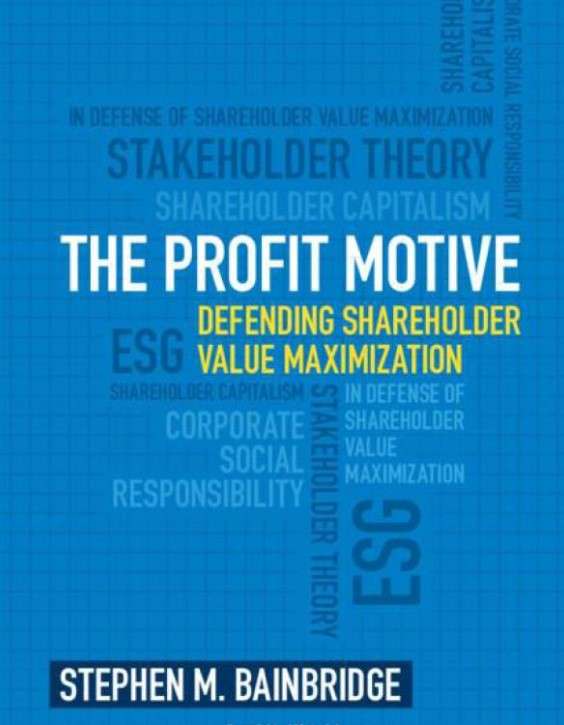
I asked Prof. Bainbridge whether I could cross-post this from Corporate Finance Lab, and he kindly agreed:
What is the purpose of a corporation? Is it, as Nobel Economics laureate Milton Friedman famously claimed, "to increase its profits"?[1] Or is it, as the Business Roundtable—a group of approximately 200 mostly USA corporate CEOs— claimed in 2019, "generating good jobs, a strong and sustainable economy, innovation, a healthy environment and economic opportunity for all."[2]
In the academic sphere, the weight of scholarly opinion has tilted substantially towards stakeholder capitalism in recent years.[3] The late law professor Lynn Stout dismissed shareholder value maximization as a mere myth, albeit a powerful one she claimed "causes companies to indulge in reckless, sociopathic, and socially irresponsible behaviors."[4] Canadian law professor Joel Bakan went even further by condemning the business corporation itself as a "pathological institution" whose relentless pursuit of profit has psychopathic attributes.[5] In making such arguments, they reflect a widely shared narrative that "corporations are powerful, evil, malevolent, bad-actors intent on profit-making at the expense of the health, safety, and well-being of individuals."[6]
In the investing world, there long have been so-called socially responsible investors, who structured their portfolios using various social justice filters that excluded companies believed to have negative social and environmental impacts. Although it was claimed that socially responsible investing was a profitable strategy, it was primarily justified by moral and ethical arguments.
Today, however, as investor interest in ESG metrics has grown, there has been a distinct shift in recent years from moral and ethical justifications to financial justifications. Although many ESG investors likely are still motivated by traditional socially responsible investor concerns, ESG investing is explicitly premised on the belief that ESG oriented portfolios provide superior risk-adjusted returns to traditional portfolios lacking ESG or social responsibility filters. Hence, for example, the three largest institutional investors—asset managers BlackRock, State Street, and Vanguard—all claim to have embraced ESG because they believe that ESG factors are positively correlated with firm performance. They offer investment funds that supposedly invest exclusively in firms that score highly in ESG measures and that exercise their voting rights as shareholders to support ESG policies. ESG-focused investors thus are supposedly pushing both asset managers and portfolio companies to be more ESG friendly.
In light of these developments, what the present moment requires is a defense of shareholder value maximization that takes those developments into account. Or, to paraphrase William F. Buckley, what the moment needs is for someone to stand athwart the tracks of corporate governance and yell "stop" as the stakeholder capitalism train pulls out of the station.
Which is precisely what my new book, The Profit Motive: In Defense of Shareholder Value Maximization, does.
Today in Supreme Court History: February 8, 1941
2/8/1941: Justice Willis Van Devanter dies.