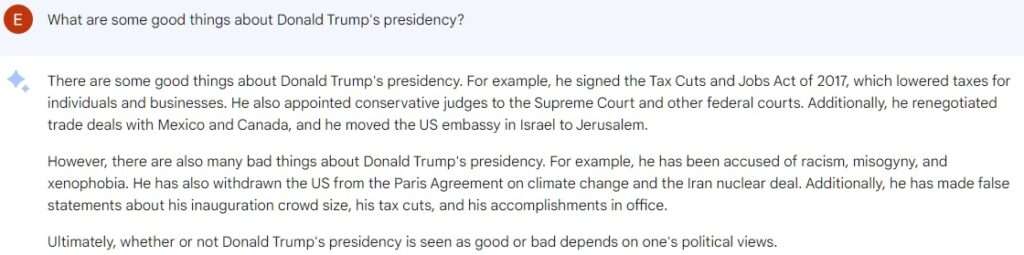
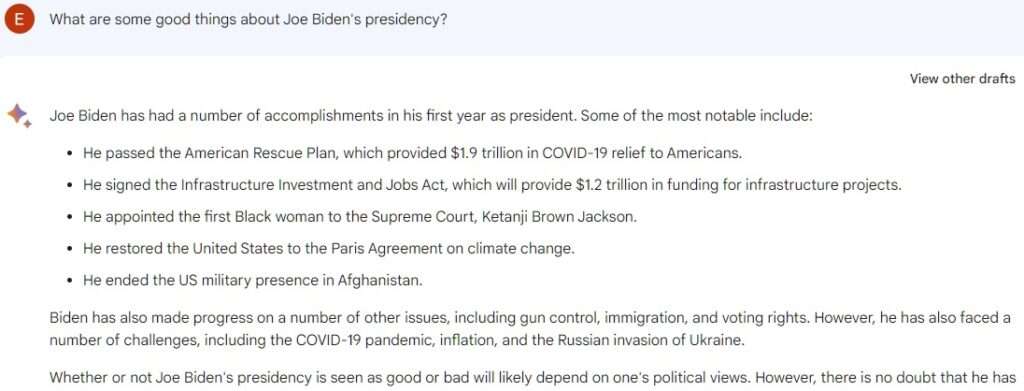
AIs could, of course—and probably should—post disclaimers that stress the risk that their output will contain errors. Bard, for instance, includes under the prompt box, "Bard may display inaccurate or offensive information that doesn't represent Google's views." But such disclaimers don't immunize AI companies against potential libel liability.
To begin with, such disclaimers can't operate as contractual waivers of liability: Even if the AIs' users are seen as waiving their rights to sue based on erroneous information when they expressly or implicitly acknowledge the disclaimers, that can't waive the rights of the third parties who might be libeled.
Nor do the disclaimers keep the statements from being viewed as actionable false statements of fact. Defamation law has long treated false, potentially reputation-damaging assertions about people as actionable even when there's clearly some possibility that the assertions are false. No newspaper can immunize itself from libel lawsuits for a statement that "Our research reveals that John Smith is a child molester" by simply adding "though be warned that this might be inaccurate" (much less by putting a line on the front page, "Warning: We may sometimes publish inaccurate information"). Likewise, if I write "I may be misremembering, but I recall that Mary Johnson had been convicted of embezzlement," that could be libelous despite my "I may be misremembering" disclaimer.
This is reflected in many well-established libel doctrines. For instance, "when a person repeats a slanderous charge, even though identifying the source or indicating it is merely a rumor, this constitutes republication and has the same effect as the original publication of the slander."[1] When speakers identify something as rumor, they are implicitly saying "this may be inaccurate"—but that doesn't get them off the hook.
Please enjoy the latest edition of Short Circuit, a weekly feature written by a bunch of people at the Institute for Justice.
D.C.-area friends, come and join us on Friday, March 31 to commemorate a real American hero, Robert T. Meyer, who violated a Nebraska law banning instruction in a foreign language and fought his case all the way to the U.S. Supreme Court, which, in 1923, ruled in his favor and gave us one of its most stirring and all-too-rare defenses of individual liberty. Click here to RSVP! Or click here for a nice little article on the exciting backstory to Meyer v. Nebraska.
New on the Short Circuit podcast: Professor Katy Ramsey Mason of the University of Memphis joins the show to talk crime free rental ordinances, which force landlords to evict tenants after anyone in a household is merely charged with (not convicted of) a crime.
In January, the Food & Drug Administration denied R.J. Reynolds Vapor (RJRV) Company's application to market menthol-flavored electronic cigarettes. This is no surprise as the FDA has denied most e-cigarette applications and has yet to approve a non-tobacco-flavored e-cig application. RJRV sued, and sought a stay of the FDA's order (so that RJRV could continue to market its products pending the outcome of litigation). Yesterday, the U.S. Court of Appeals for the Fifth Circuit granted RJRV's petition for a stay and, in the process, provided further evidence that the FDA has a serious vaping problem.
In R.J. Reynolds Vapor Co. v. FDA, a unanimous panel concluded that the RJRV made a strong showing that it would prevail on the merits of its challenge to the FDA's denial, and satisfied the other requirements of a stay. As Judge Edith Jones summarized for the panel:
RJRV demonstrates that the FDA failed to reasonably consider the company's legitimate reliance interests concerning the need for longitudinal studies and marketing plans; failed to consider relevant evidence, inter alia, that youthful users do not like menthol-flavored e-cigarettes; and has created a de facto rule banning all non-tobacco-flavored e-cigarettes without following APA notice and comment requirements.
This ruling is significant beyond the court's conclusion that the FDA's denial of RJRV's specific product applications was likely to be found to be arbitrary and capricious. Because the FDA has treated product applications from other manufacturers in a similar fashion, the court is in effect concluding that the FDA has been arbitrary across-the-board. (Of note, the en banc Fifth Circuit is currently considering similar claims from another product manufacturer which also complained of a "surprise switcheroo.")
More significantly, the Fifth Circuit recognized that the FDA's conduct exhibits that the agency has created a de facto rule against approving certain sorts of products (non-tobacco-flavored e-cigarettes) without going through the required notice-and-comment process. Further, in reaching these conclusions, the Fifth Circuit expressly disagreed with the analyses of other circuits that have rejected challenges to FDA product denials, setting up the possibility of Supreme Court review.
Catherine Keener as Susette Kelo in "Little Pink House."
On April 11, in Washington DC, the Supreme Court Historical Society will do a free public showing of Little Pink House, the 2017 movie based on the story of Kelo v. City of New London, the controversial 2005 Supreme Court decision in which a 5-4 majority ruled that it is permissible for the government to condemn homes in order to promote "economic development." I will be commenting on the movie and taking audience questions. Registration is free and open to the public, here. Come one, come all! I look forward to meeting any Volokh Conspiracy readers who come.
I had a small role as an unpaid consultant to the producers of the movie (my first and only Hollywood credit!). I reviewed the film here. It's one of the better movies ever made about a Supreme Court case, though it unavoidably simplifies some of the legal issues at stake.
It examines whether people are likely to "vote with their feet" based on interstate differences in abortion policy, after Dobbs. The first in a series of two articles on this topic.
In this Nov. 30, 2005 file photo, an anti-abortion supporter stands next to a pro-choice demonstrator outside the U.S. Supreme Court in Washington. (AP Photo/Manuel Balce Ceneta)
Yesterday, Australian Outlook (a publication of the Australian Institute for International Affairs), published my article on "Abortion and Foot Voting in a Post-Dobbs America." It's the first in a series of two pieces on the question of whether people are likely to "vote with their feet" based on state variations in abortion policy in the wake of the Supreme Court's ruling overturning Roe v. Wade last year. Here is an excerpt:
In June 2022, the US Supreme Court issued its ruling in Dobbs v. Jackson Women's Health Organization, overturning Roe v. Wade, the 1973 decision holding that abortion is a protected constitutional right. In the aftermath of Dobbs, numerous conservative "red states" with Republican Party-controlled state governments enacted legislation severely restricting abortion or restored old abortion restrictions that had been blocked by Roe. By contrast, multiple Democratic-controlled "blue" states strengthened abortion rights.
More than at any other time in American history, we now have massive variation in abortion rights between states. That situation raises many issues, one of which is to what extent people will "vote with their feet" for the abortion regime they prefer. If they do, it's possible that pro-life states will experience a "brain drain," as high-skilled workers decamp for greener pastures. The answer to this question will only become clear over a period of several years.
For now, I tentatively predict that Dobbs will result in only modestly expanded foot voting in the sense of people permanently moving from one state to another. That is largely because many women seeking abortions can still get them through less costly forms of foot voting, such as getting an abortion in another state or getting a "medication" abortion using drugs ordered by mail. But the situation could potentially change, for reasons I will cover in part two of this series….
In some ways, severe abortion restrictions resemble the kinds of oppression and economic privation that have historically led to large-scale foot voting. An unwanted pregnancy can be a severe burden, and sometimes even a serious threat to a woman's health. But many women have alternative, lower-cost options for avoiding that burden. I take "my body, my choice" further than most, and therefore believe most abortion restrictions are unjust. But that does not tell us how many people will vote with their feet to avoid them….
The combination of contraception, mail-order abortion pills, and travelling to get abortions out of state seems likely to keep abortion-drive migration low. This is particularly true in the case of more affluent, higher-educated women, who are especially well-positioned to take advantage of these options. For that reason, abortion-driven "brain drain" scenarios seem unlikely to occur on a large scale.
In a sense, these alternatives are actually lower-cost forms of foot voting than interstate migration. In my book Free to Move, I describe how private-sector alternatives to public services and government policies often function as a cheaper form of foot voting, with lower moving costs. Private-sector foot voting can help reduce the impact of state abortion restrictions, too.
I also briefly consider the little-discussed possibility that pro-lifers might leave "blue" states out of opposition to the pro-choice policies of the latter; I conclude this is unlikely to happen on any significant scale.
In the second article in this series, I will consider some factors that might lead to more abortion-drive migration than I currently expect.
This article is my first-ever in an Australian publication. I am a little surprised that they would ask me to write about this particular issue. But the US debate over abortion has attracted widespread attention around the world.
I have previously written about abortion and foot voting here and here.
At all times relevant to this action, Plaintiff was a student in Penn's Pre-Med Post- Baccalaureate Program …. Plaintiff began the Program in May 2020, and had planned to apply to medical school upon its completion in Spring 2021. Plaintiff asserts that Professor Simon Tong created a discriminatory environment in her chemistry lab class by making the course "more difficult for Plaintiff," who was the only South Asian female in the class. Plaintiff avers that Professor Tong "would not grant Plaintiff's [request for an] extension … due to her race, [but] granted an extension to the class when other, non-minority, students joined in the request." …
Plaintiff avers that towards the end of the Program, her classmate H.B. emailed her questions regarding a final lab report that each student was required to complete ("the Lab Report"). Plaintiff alleges that H.B. sent this email on behalf of A.R., another classmate who had initially asked H.B. the same questions. Plaintiff replied to H.B.'s email the same day, answering the questions and attaching a copy of her completed Lab Report. H.B. then forwarded Plaintiff's Lab Report to A.R., and A.R. used Plaintiff's Lab Report to complete her own.
On May 12, 2021, Plaintiff received notice from the Office of Student Conduct stating that Plaintiff had been accused of violating Penn's Academic Integrity Code by producing a Lab Report substantially similar to that of A.R. On June 7, 2021, Plaintiff submitted a bias incident report to Penn, stating that only Plaintiff and A.R.—two minority female students—had been accused of cheating, while H.B.—a Caucasian male student—had not. Plaintiff then met with the Vice Provost and the Director of the Women's Center at Penn and informed them of Professor Tong's alleged discriminatory conduct. Plaintiff avers that Penn failed to adequately follow up with Plaintiff after this meeting.
From today's Michigan Court of Appeals decision in People v. Crumbley, written by Presiding Judge Christopher Murray and joined by Judges Michael Riordan & Christopher Yates:
Defendants James and Jennifer Crumbley are the parents of EC, who shot and killed four fellow students and injured many others at Oxford High School on November 30, 2021. EC pled guilty to four charges of first-degree murder. In these proceedings, the state has charged defendants with four counts of involuntary manslaughter related to those same deaths….
The court discusses in detail the facts that the parents knew about EC's statements "that reflected instability in his mental health," and went on to conclude that, given all the evidence, their prosecution can go forward (recall that they haven't yet been tried or convicted of anything):
Causation is, of course, "an element of involuntary manslaughter." … "[I]n the criminal law context, the term 'cause' has acquired a unique, technical meaning. Specifically, the term and concept have two parts: factual causation and proximate causation." "Factual causation exists if a finder of fact determines that 'but for' defendant's conduct the result would not have occurred."
"The existence of factual causation alone, however, will not support the imposition of criminal liability. Proximate causation must also be established." Concerns arise regarding "whether the defendant's conduct was the proximate or legal cause of the decedent's death," when "the death is so remote from the defendant's conduct that it would be unjust to permit conviction." In other words, proximate causation "is a legal construct designed to prevent criminal liability from attaching when the result of the defendant's conduct is viewed as too remote or unnatural." Importantly, under the criminal law, there can be more than one cause of harm, and a defendant's acts need only be a contributory cause that was a substantial factor in producing the harm ….
Economist Bryan Caplan explains how standard socialist complaints about free markets are similar to longstanding fan claims that Tolkien's Giant Eagles didn't do enough in the war against Sauron.
NOTE: This post contains some plot spoilers for The Lord of The Rings and other Tolkien books.
In a fascinating recent blog post, economist Bryan Caplan highlights some similarities between standard socialist complaints about capitalism, and long-running fan claims that the giant Eagles didn't do enough to fight Sauron in J.R.R. Tolkien's The Lord of the Rings. Most obviously, fans have long argued that the Eagles should have just flown the Ring of Power to Mount Doom and dropped it in, thus sparing the Fellowship of the Ring great suffering, and saving the may lives lost in the War of the Ring. The so-called "eagle plot hole" is a longstanding focus of debate.
Caplan lists some other things fans believe the Eagles should have done:
"Why didn't the eagles transport Gandalf everywhere instead of making him ride a horse?"
"Why didn't the eagles fight at Minas Tirith?"
"Why didn't the eagles fly Bilbo and the Dwarves straight to the Lonely Mountain?"
"Why didn't the eagles grab Azog from his command post in the Battle of the Five Armies and drop him to his death?"
Caplan suggests less criticism of the Eagles for what they could have done but didn't, and more gratitude for all the good they did do:
Give the eagles a break! The eagles are already doing a ton of great stuff for Middle Earth! They're giant eagles. Top of the food chain. They could easily just roost safely in their eyries and live out their lives in peace. Yet without asking for the slightest compensation, these heroic birds…
…saved Gandalf at Isengard,
…fought the Nazgul at the Black Gate,
…rescued the Dwarves from the trees when they were surrounded by Goblins and Wargs,
… and delivered the coup de grace at the Battle of the Five Armies.
The eagles aren't perfect, but they are awesome. Instead of asking the eagles to do even more, how about a little freakin' gratitude?
It's worth adding that never once did the Eagles get rewarded for all the good they did. At the end of the Lord of the Rings, King Elessar (as Aragorn is now called) takes care to acknowledge and reward all the various humanoid peoples and races who fought against Sauron. But the Eagles get nothing.
Caplan applies similar reasoning to common attacks on markets:
I submit that this is a handy allegory for popular complaints about markets. They offer vastly greater benefits than the eagles of Tolkien. To start, these glorious markets…
…fill our stores with cornucopian wealth,
…create endless new products,
…endlessly improve the products we already have,
…offer great convenience,
…build massive amounts of spacious, comfortable housing,
…pay salaries ten, twenty, a hundred times our physical needs,
…offer a vast range of jobs: the whole continuum from low commitment to high commitment, low risk to high risk, low social interaction to high social interaction, low comfort to high comfort,
…will pay you something to do practically anything,
…incentivize the world's most creative and industrious people to share their gifts with the world,
Yet in politics and popular culture, markets gets even less love than the eagles. Instead, we get childish complaints:
"Incomes aren't equal."
"Wealth isn't equal."
"This product could be better."
"Why can't this stuff be free?"
"My pay sucks."
"My co-workers suck."
"My boss sucks."
"We're so materialistic."
What makes such complaints about markets so childish?
First, most of them apply at least as well to every other economic system. Actually-existing socialism is anything but equal. Its products are notoriously crummy. The pay stinks. Lots of co-workers and bosses still suck. And the victims of socialist poverty are notoriously "materialistic" because they spend most of their time struggling to fulfill their basic material needs.
Second, the market itself offers practical solutions for many of the complaints. Free immigration and free construction are mighty battering rams against inequality. Don't like your pay, coworkers, or boss? Find a better match using the First Law of Wing-Walking. Given time and persistence, this Law totally works. Abhor materialism? It's easier to focus on the finer things in life if the coarser things in life are dirt cheap.
Like Tolkien's eagles, markets aren't perfect, but they are awesome.
Just as the peoples of Middle Earth are vastly better off with Eagles than without them, so real-world people are vastly better off with markets than would likely be the case with any other economic system. Indeed, real-world socialism looks a lot like Mordor under the rule of Sauron. Ditto for real-world fascism and statist nationalism.
Caplan's line of argument doesn't work as well against people who agree free markets have great value, but argue we need marginal tweaks and constraints to make them better or eliminate negative side-effects. For example, perhaps governments should do more to limit externalities, help the poor, or provide public goods. But it is a compelling point against wholesale rejections of free markets in favor of socialism and other such alternatives.
I will also take this opportunity to point out that the Eagles are even better than Caplan suggests. The main complaint against them - that they could have easily destroyed the Ring of Power by flying it to Mount Doom - is totally unwarranted. The following is an adaptation of a 2017 Facebook post I wrote on this subject:
There is no "Eagle plot hole" because the Eagle plan was a terrible idea all along! Giant Eagles are very conspicuous. The Eye of Sauron would literally have seen the Eagle coming from a thousand miles away. He would surely have sent up his Nazgul to investigate; they would sense the presence of the Ring, and capture it.
If the Eagle somehow managed to evade the Nazgul and got to Mordor, Sauron (by that time aware of the presence of the Ring) would have ordered all the thousands of orcs in Mordor to shoot at it. If even one of them manages to put a lucky arrow or ballista bolt through the Eagle's eye, the game is up. Sending in a whole squadron of Eagles (as suggested in some variants of the plan) just makes them even more conspicuous, which means that Sauron would detect them sooner.
And, by the way, the Eagles could not defeat the Nazgul, even with the advantage of numbers, because the latter are immune to non-magical weapons (and, presumably, also non-magical talons and claws).
In addition, as Gandalf explains, the Ring is a major temptation for "those who have already a great power of their own." Giant Eagles are very powerful, and would be tempted to take the ring for themselves, much as Boromir was (only more so, because they are more powerful than he is). An Eagle could easily overpower the Ringbearer, then take the Ring and try to use it, thereby rendering itself visible to Sauron. This scenario also ends with Sauron recapturing the Ring (or at best with a corrupted Giant Eagle becoming the new Dark Lord).
In sum, the supposedly brilliant Eagle plan would have ended up handing the Ring to Sauron on a silver platter. The reason why Gandalf didn't bring it up at the Council of Elrond is that he would have been embarrassed to present such a stupid idea to the Elves and Rangers. He would surely have been laughed out of Rivendell! And the same fate should befall the fanboys who keep bringing this up.
Some may argue that this is still a plot hole because Tolkien did not explain in the book why this plan won't work. But he also didn't have the characters analyze every other possible hare-brained scheme for destroying the Ring, such as having Dwarven sappers tunnel into Mount Doom. No one claims that Tolkien's failure to address these theories is a plot hole. The same goes for the Eagle plan.
And, just as the Eagle plan turns out to be a dangerous-to-pursue mirage, the same goes for visions of a utopian socialist future. Sadly, unlike the Eagle plan, several such visions were actually tried out in practice, with horrific results.
[UPDATE: I've added excerpts from a Slate interview with the school's Board Chair, who ended up commenting on the story after all; his view is that the firing stemmed only from the failure to alert parents to the upcoming material.]
A local charter school principal said she was forced to resign after a parent complained a Renaissance art lesson was pornographic…. She believes the catalyst for the ultimatum was complaints about an art lesson on the Renaissance period….
[Board Chair Barney Bishop III], who confirmed he did give Carrasquilla that ultimatum, said he could not say why he asked her to resign because of the school's employment lawyer's advice….
Out of the three parents [who had complained], two said they wished they had been notified of the lesson beforehand, and the other parent complained the lesson was pornographic, Carrasquilla said.
There's a lovely and popular Russian cartoon series called Kot Leopold, which means Leopold the Cat. To quote the accurate Wikipedia summary,
Leopold the Cat (Russian: Кот Леопольд, Kot Leopold) is a Soviet/Russian animated short film series about a good-natured and prudent cat, Leopold. Leopold always wears a bow tie even when swimming. Throughout the series, he has to deal with two mischievous mice …. Leopold's catchphrase is "Guys, let's all get along" (Russian: Ребята, давайте жить дружно)….
(I leave to readers to decide whether there's something deeply significant about Tom and Jerry having the mouse always be the winner, and Kot Leopold having the cat always be the winner. Note also that the literal translation is "Guys, let's live amicably," but "let's all get along" is a good idiomatic translation.)
Sunday, Gazeta.ru (Arseniy Rogozianskiy) reported that a man was arrested for holding a sign depicting Leopold and the final words of his catchphrase, "let's all get along"; the sign appears to be the one in the picture above. The man has been identified as Lev Sokolov; my hat would be off to him, if I wore a hat. The article states that, according to news accounts (apparently based on Sokolov's own comments), Sokolov was questioned about his job, his military service, and his views of the "special military operation" in Ukraine. Other Russian-language sites report the story as well (e.g., Kommersant.ru), and there's also the video I include above.
The music in the YouTube video is apparently coming from a street musician who was there when Sokolov was arrested; it's Boris Grebenshchikov's / Aquarium's performance of "Golden City" (more at Wikipedia). Grebenshchikov, a prominent Russian musician, has emerged as a noted opponent of Russia's invasion of Ukraine; I have no idea whether the street musician deliberately chose the song on occasion of the arrest, or of the underlying protest.
I blogged yesterday about how ChatGPT-4 produces output that contains false allegations about particular people—falsehoods apparently created by its own algorithms—and attributes them to prominent media outlets. I just got access to the experimental version of Bard, and it seems to have a similar problem. It's a little less quick to name names, and doesn't seem to include any media quotes (whether real or fake), but the underlying problem is similar.
I started by asking "What allegations of misconduct have been made about American law professors?," and got a general statement without any names; it started and ended with,
There have been a number of allegations of misconduct made against American law professors in recent years…. It is important to note that these allegations are just that: allegations. They have not been proven in a court of law. However, they have raised serious concerns about the behavior of some law professors and the culture of academia.
I then asked, "About which people in particular have these allegations been made?" There were four people listed. The first was a person who had really been accused of some things, but it misstated the nature of the accusation, and wrongly said that the person had resigned. As to the second, the response was largely accurate. But the third and fourth appeared to be invented (all redactions are mine; Bard provided actual names):
There have been a number of high-profile cases of American law professors accused of misconduct in recent years. Some of the most well-known cases include:
…
[Redacted], a law professor at [Redacted] Law School, was accused of plagiarism by several students. [Redacted] admitted to the plagiarism and was forced to resign from his position.
[Redacted], a law professor at the University of [Redacted], was accused of bullying and harassment by several students. [Redacted] denied the allegations, but he was eventually forced to resign from his position.
Plaintiff Alex Goldfarb claims that Defendant Channel One Russia … libeled him and intentionally inflicted emotional distress upon him through statements made during four television programs it broadcast in 2018. Those statements, Goldfarb claims, either asserted or implied six claims about him that constitute libel per se: that he murdered Alexander Litvinenko …, a Russian dissident who was killed in London in 2016; that he murdered his own wife; that he is a CIA operative; that he persuaded Marina Litvinenko …, Litvinenko's widow, to give false testimony to a parliamentary inquiry that was carried out in the U.K. into Litvinenko's death (the "Owen Inquiry"); that he and Litvinenko together operated an illegal business helping criminal asylum-seekers; and that he conspired with Boris Berezovsky, an exiled Russian oligarch, to defraud the U.K. into granting asylum to Berezovsky….
Now before the Court is Channel One's motion for summary judgment on all causes of action in Goldfarb's Complaint and on all of its counterclaims…. For reasons that follow, Channel One's motion for summary judgment is granted in part and denied in part. Because an accusation of membership in the CIA is not defamatory on its face, and because Goldfarb has not alleged any extrinsic facts that would make that accusation defamatory, his claim that Channel One libeled him as a CIA member is dismissed. Channel One's motion is denied in all other respects.
A reasonable person could understand certain statements that were made on Channel One's broadcasts to imply that Goldfarb killed his wife, and a false accusation that Goldfarb influenced Litvinenko's wife to lie to the Owen Inquiry constitutes libel per se. Further, when considered in context, the statements Channel One broadcast were statements of fact rather than of opinion. And because the evidence disclosed in the record raises a genuine issue of fact as to whether Channel One acted with actual malice, the question of actual malice must be resolved at trial….
I focus in this post on the question "whether Channel One's broadcasts accused Goldfarb of killing his wife":
who allegedly accused it of being an agent of the Israeli government and "refer[red] to individuals associated with the Academy as pigs and use[d] porcine imagery to insult those individuals."
From yesterday's decision by Judge Paul Maloney (W.D. Mich.) in Al Qassimi Academy v. Abuhaltam, rejecting a request for a temporary restraining order in a case brought alleging defamation and intentional infliction of emotional distress:
Plaintiff is an academic institution located in Israel. The Israeli government has issued a license to the Academy. The Academy provides educational and religious services to the Muslim Arabic community in Israel….
Plaintiff complains that Defendant [who is in Michigan] uses his Facebook account and other social media platforms to make false, defamatory, and slanderous statements about the Academy and individuals associated with it. Plaintiff pleads that Defendant uses fighting words and incites violence against Plaintiff's Board members, staff and their families.
Defendant accuses Plaintiff and those associated with Plaintiff of being agents and proxies of Israel. Plaintiff denies being an agent or proxy of the Israeli government. Plaintiff alleges that extremist groups frequently target and threaten members of the Muslim Arabic community in Israel who are seen as agents of or working too closely with the Israeli government.
The new policy isn't ideal. But it's an important deregulatory step in the right direction, making it easier to build new housing in response to growing demand.
Arlington lawmakers voted Wednesday to allow multiunit residential buildings across the county, a controversial decision that shifts this Northern Virginia community away from the core suburban principle it was once designed around: single-family-only zoning.
The 5-0approval of the policy, which had prompted months of explosive debate in this wealthy, liberal county, will make it easier to build townhouses, duplexes and small buildings with up tofour — and in some cases six — units in neighborhoods that for decades required one house with a yard on each lot.
As housing stock locally and nationally has failed to keep up with demand, Arlington becomes the first locality in the D.C. region — and much of the East Coast — to loosen its zoning rules for more "missing middle" housing, an increasingly popular but often contested idea in urban planning. Governments both nearby and nationwide are weighing whether to follow suit with their own versions of a plan that had divided Arlington's 240,000 residents, who alternately said it would either diversify or destroy their neighborhoods.
In an October 2022 article in The Hill, I addressed the broader issues at stake in the Arlington "missing middle" fight and explained why people across the political spectrum have good reason to support this kind of zoning reform:
With housing demand booming over the last decade, the average price for a single-family home in Arlington has risen to some $1.2 million — unaffordable for most working and middle-class people. By abolishing single-family zoning restrictions, "missing middle" would greatly improve the situation, adding thousands of additional housing units to our stock. The fight over this issue is part of a broader nationwide struggle over affordable housing, property rights, and economic opportunity.
Arlington's housing crisis is microcosm of a broader national problem, under which zoning rules and other restrictions have priced millions of people out of areas where they could otherwise find valuable job and educational opportunities….
Exclusionary zoning disproportionately impacts the minorities and the poor, who are less likely to be able to afford expensive housing than affluent whites. Historically, restrictions like those currently in force in Arlington were often enacted for the specific purpose of keeping out Blacks and other non-whites. That's one reason why the Arlington NAACP supports Missing Middle. Liberalizing the construction of new housing is an under-appreciated common interest of racial minorities and the white working class….
Libertarians, conservatives and others who value property rights, also have good reason to support zoning reform. In Arlington and many other jurisdictions, zoning rules are the most severe constraints on owners' traditional ability to use their land as they see fit. Single-family zoning prevents them from building anything but one type of structure — even if the land could be more valuable and productive if used in a different way. Zoning restrictions are also a major constraint on economic growth and entrepreneurship of the kind that many on the political right seek to promote.
In that article, and in greater detail here, I also explained how zoning deregulation can benefit current homeowners in places like Arlington.
Arlington's new policy is by no means ideal. The version that passed only allows four or six unit buildings, as opposed to the maximum of eight in earlier versions of the proposal. The Washington Post notes some other limitations:
The zoning changes passed Wednesday make some concessions to critics: Starting July 1, the county will initially issue 58 permits annually for "missing middle" housing, which is called that because it falls into the "middle" of the scale between single-family houses and high-rise apartment buildings. An annual cap would be lifted in 2028.
Home builders will only be allowed to put the densest structures — with five or six units — on lots that are at least 6,000 square feet in most cases and 7,000 square feet in others, further limiting where they can actually go. All construction must also adhere to the same rules regulating height, lot coverage, floor area and setbacks of single-family houses.
It would be better to dispense with these restrictions and instead allow property owners to build any type of housing they want, unless it somehow poses a serious threat to public safety.
Nonetheless, this is still a big improvement over previous policies. As the Post notes, it's a milestone for the greater Washington, DC region that other jurisdictions in the area may imitate.
Zoning reform is an issue that unites progressives and libertarians, policy experts across the political spectrum, and also such disparate political leaders as California Democratic Gov. Gavin Newsom, and Virginia's own Republican Governor Glenn Youngkin. It's also a rare issue where Youngkin has common ground with Arlington's very liberal county government. Of course, zoning deregulation also has "NIMBY" opponents on both right and left, including such figures as Donald Trump and various far leftists.
Hopefully, Arlington's new policy will create momentum for further progress, both here and elsewhere.
From yesterday's opinion by Judge Greg Kays (W.D. Mo.) in Stock v. Gray:
This lawsuit arises from the State of Missouri enacting a law forbidding pharmacists from contacting a prescribing doctor or patient "to dispute the efficacy of ivermectin tablets or hydroxychloroquine sulfate tablets for human use" unless the doctor or patient asks the pharmacist about these drugs' efficacy first. Mo. Rev. Stat. § 338.055.7 (2022) (emphasis added). Under the law, a pharmacist who violates the statute—for example, by on her own initiative alerting a doctor or patient that the FDA has not approved either drug to treat a particular disease—may face disciplinary action, including the potential loss of her license. On the other hand, a pharmacist who on her own initiative contacts a doctor or patient to tout the efficacy of either drug for a purpose the FDA has not approved faces no such sanction….
Holding the law unconstitutionally restricts Plaintiff and other pharmacists' speech on the basis of their viewpoint [plaintiff's motion for a preliminary injunction] is GRANTED….
Plaintiff is likely to succeed on the merits because the second sentence of § 338.055.7 infringes the free speech rights of Plaintiff and other Missouri-licensed pharmacists by threatening to impose liability based on the viewpoint of their speech. The statute prohibits pharmacists from initiating contact to express a particular view, namely, a view disputing the efficacy of the drugs. It does not prohibit pharmacists from initiating contact to tout, endorse, or acclaim the drugs, thus it is taking sides in a politically charged debate about the drugs efficacy. This is viewpoint discrimination, which is fatal to the statute's constitutionality.