The Volokh Conspiracy

Mostly law professors | Sometimes contrarian | Often libertarian | Always independent | Est. 2002

The Volokh Conspiracy

Education

May Universities Revoke Degrees Based on Findings of Ex-Student's "Academic Misconduct in Pursuit of That Degree"?

Yes, says the Texas Supreme Court, applying Texas law.

|

The case is today's Hartzell v. S.O. (majority opinion by Justice Lehrmann); the court concludes the power is implicit in the statutory scheme authorizing the Texas public university systems, though it also holds that the university must provide due process before revoking a degree. There's also a short concurrence by Justice Boyd, and a long dissent by Judge Blaylock. An excerpt from the dissent:

The only resource in Texas legal history bearing on the question presented is a 1969 Attorney General Opinion, with which I largely agree. The Attorney General Opinion concludes that a state university wishing to rescind a graduate's degree must do what any other regretful grantor of property must do to rescind the grant. It must ask a court to require the property's return. That is correct. A party seeking rescission of someone else's property is quite obviously not managing its own internal affairs. It is seeking to manage the affairs of the party resisting its claims, and for this it typically needs the judicial power of a court. Nor is it exercising a power that flows naturally from the power to confer the property in the first place. The power to bestow something of value on another normally does not entail the power to unilaterally take it back. This kind of "self-help" remedy is rarely found in the law. It is so rare that I would expect it to be stated clearly in the governing statutes if the Legislature indeed gave it to universities.

An excerpt from the majority's response:

Read More

Free Speech

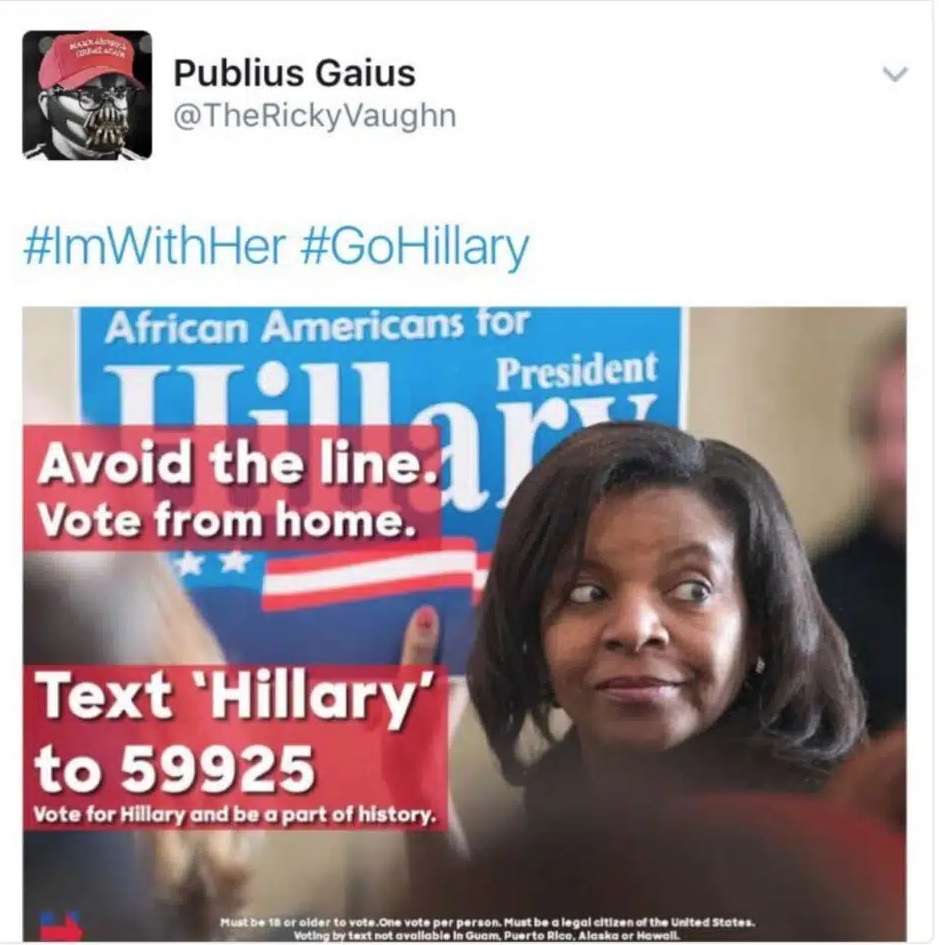
Douglass Mackey Convicted for Vote-by-Tweet Meme

|

Here's the E.D.N.Y. U.S. Attorney's Office press release:

Douglass Mackey, also known as "Ricky Vaughn," was convicted today by a federal jury in Brooklyn of the charge of Conspiracy Against Rights stemming from his scheme to deprive individuals of their constitutional right to vote. The verdict followed a one-week trial before United States District Judge Ann M. Donnelly. When sentenced, Mackey faces a maximum of 10 years in prison….

In 2016, Mackey established an audience on Twitter with approximately 58,000 followers. A February 2016 analysis by the MIT Media Lab ranked Mackey as the 107th most important influencer of the then-upcoming Presidential Election.

As proven at trial, between September 2016 and November 2016, Mackey conspired with other influential Twitter users and with members of private online groups to use social media platforms, including Twitter, to disseminate fraudulent messages that encouraged supporters of presidential candidate Hillary Clinton to "vote" via text message or social media which, in reality, was legally invalid. For example, on November 1, 2016, in or around the same time that Mackey was sending tweets suggesting the importance of limiting "black turnout," the defendant tweeted an image depicting an African American woman standing in front of an "African Americans for Hillary" sign.

Read More

Free Speech

Today's Order Allowing Dominion Voting's Case Against Fox to Go Forward

|

The order, which denied Fox's motion for summary judgment and partly granted Dominion's motion for summary judgment as to certain elements of the claim, is here; it's 130 pages long, and I'm likely not to have the time soon to get through the whole thing and digest it, but I thought I'd pass it along. An excerpt, though, as to the falsehood of the underlying statements (emphasis in original):

While the Court must view the record in the light most favorable to Fox, the record does not show a genuine issue of material fact as to falsity. Through its extensive proof, Dominion has met its burden of showing there is no genuine issue of material fact as to falsity. Fox therefore had the burden to show an issue of material fact existed in tum. Fox failed to meet its burden. The evidence developed in this civil proceeding demonstrates that is CRYSTAL clear that none of the Statements relating to Dominion about the 2020 election are true. Therefore, the Court will grant summary judgment in favor of Dominion on the element of falsity.

Free Speech

Hillsdale College Revokes Curriculum License to "Classical" School Over Its Objections to Michelangelo's David

"This drama around teaching Michelangelo's 'David' sculpture, one of the most important works of art in existence, has become ... a parody of ... the actual aims of classical education."

|

Tallahassee Democrat (Ana Goñi-Lessan) reported yesterday, linking to a Hillsdale press release:

Hillsdale College is no longer affiliated with Tallahassee Classical School. Tallahassee Classical previously held a license to use Hillsdale's curricular materials. That license has been revoked and will expire at the end of the school year.

Hillsdale College provides a classical scope and sequence to many schools across the country as a free resource. It is important to note that Hillsdale does not advise or train the teachers, board members, or school leaders of these curriculum schools.

Hillsdale's relations with those schools are founded upon a mutual understanding about the aims of education. Education is a cooperative endeavor between students, parents, and teachers. Discretion, good judgment, and prudence are essential for that endeavor to be successful.

To set the record straight: This drama around teaching Michelangelo's "David" sculpture, one of the most important works of art in existence, has become a distraction from, and a parody of, the actual aims of classical education. Of course, Hillsdale's K-12 art curriculum includes Michelangelo's "David" and other works of art that depict the human form.

For more, see this earlier blog post.

Free Speech

Communications Can Be Defamatory Even If Readers Realize There's a Considerable Risk of Error

And AI programs' "tendency [to, among other things, produce untruthful content] can be particularly harmful as models become increasingly convincing and believable, leading to overreliance on them by users. Counterintuitively, hallucinations can become more dangerous as models become more truthful, as users build trust in the model when it provides truthful information in areas where they have some familiarity."

|

Various commenters have suggested that AI programs' output can't be defamatory because reasonable readers wouldn't view the statements as "100% reliable" or "gospel truth" or the like. Others have taken the more modest position that reasonable readers would at least recognize that there's a significant risk of error (especially given AI programs' disclaimers that note such a risk). And our own Orin Kerr has suggested that "no one who tries ChatGPT could think its output is factually accurate," so I take it he'd estimate the risk of error as very high.

But, as I've noted before, defamation law routinely imposes liability for communicating assertions even when there is a clear indication that the assertion may well be false.

For instance, "when a person repeats a slanderous charge, even though identifying the source or indicating it is merely a rumor, this constitutes republication and has the same effect as the original publication of the slander." When speakers identify something as rumor, they are implicitly saying "this may be inaccurate"—but that doesn't get them off the hook.

Indeed, according to the Restatement (Second) of Torts, "the republisher of either a libel or a slander is subject to liability even though he expressly states that he does not believe the statement that he repeats to be true." It's even more clear that a disclaimer that the statement merely may be inaccurate can't prevent liability.

Likewise, say that you present both an accusation and the response to the accusation. By doing that, you're making clear that the accusation "may [be] inaccurate."

Read More

Politics

Short Circuit: A Roundup of Recent Federal Court Decisions

Disparaging scientists, disappearing warrants, and disgruntled lawyers.

|

Please enjoy the latest edition of Short Circuit, a weekly feature written by a bunch of people at the Institute for Justice.

Last year, Brookside, Ala. became the poster child of policing for profit. The town relentlessly towed cars to extract fees and issued dubious traffic citations, without regard for public safety or constitutional rights. Town leaders boasted of their 600% revenue increase, almost all of which went right back to the police to buy expensive SUVs and other goodies. Last week, a federal court rejected the town's and its towing-company partner's effort to dismiss IJ's class action, which demands accountability and the return of the town's ill-gotten gains.

Read More

Free Speech

Viewpoint-Based Removal of Books from Public Library Violated First Amendments, Holds District Court

|

From Little v. Llano County, decided yesterday by Judge Robert Pitman (W.D. Tex.):

In early July 2021, prior to their appointment to the New Library Board, Defendants Rochelle Wells, Rhonda Schneider, Gay Baskin, and Bonnie Wallace were part of a community group pushing for the removal of children's books that they deemed "inappropriate." For example, these Defendants objected to two series of children's picture books, the "Butt and Fart Books," which depict bodily functions in a humorous manner in cartoon format, because they believed these books were obscene and promoted "grooming" behavior. Defendant Milum, the library system's director, shared the complaints with the Commissioners Court {the municipal entity that controls the Llano County Library System}. Although several commissioners and librarians stated that they saw no problem with the books, Defendants Moss and Cunningham contacted Milum to instruct her to remove the books from the shelves.

By August 5, 2021, Milum informed Cunningham she would be deleting both sets of books from the catalog system. In the following months, other books, such as In the Night Kitchen by Maurice Sendak and It's Perfectly Normal, by Robbie H. Harris, were removed because of similar complaints: that they encouraged "child grooming" and depicted cartoon nudity. There was no recourse for Plaintiffs, or anyone else, to appeal these removals to the library system.

In Fall 2021, Wallace, Schneider, and Wells, as part of their community group, contacted Cunningham to complain about certain books that were in the children's sections or otherwise highly visible, labeling them "pornographic filth."  On November 10, 2021, Wallace provided Cunningham with lists, including a list of "dozens" that could be found in the library. The books labeled "pornographic" included books promoting acceptance of LGBTQ views. Other books in Wallace's list of pornographic books [were] about "critical race theory" and related racial themes. In other communications, Defendants refer to them as "CRT and LGBTQ" books.  In the email, Wallace advocated for the books to be relocated to the adult section because "[i]t is the only way that [she] could think of to prohibit future censorship of books [she does] agree with."

That same day, Cunningham and Moss ordered Milum, "[a]s action items to be done immediately," to pull books that contained "sexual activity or questionable nudity" from the shelves …. On November 12, 2021, Defendants removed several books on the Bonnie Wallace Spreadsheet from the Llano Library Branch shelves, including, for example, Caste: The Origins of Our Discontents, They Called Themselves the K.K.K.: The Birth of an American Terrorist Group, Being Jazz: My Life as a (Transgender) Teen, and Spinning….

Read More

Obamacare

Federal Court Strikes Down Obamacare Preventive Care Insurance Mandates

The ruling is based on separation of powers and Religious Freedom Restoration Act grounds.

|

After the Supreme Court decided California v. Texas, you might have thought we weren't going to have any more significant constitutional cases about Obamacare. I certainly did. But recent events might have proved us wrong!

Yesterday, federal District Judge Reed O'Connor issued a decision in Braidwood Management, Inc. v. Becerra, striking down some key Affordable Care Act regulations that require insurance plans to cover various types of preventive care without any cost-sharing by patients. Technically, yesterday's decision only addressed some procedural issues, including imposing a remedy of a nationwide injunction. But it builds on an earlier September 7, 2022 ruling in which Judge O'Connor addressed the constitutional issues. In that decision, he struck down ACA preventive care mandates  issued by the Preventive Services Task Force ("PSTF"), but upheld several issued by other agencies: the Advisory Committee on Immunization Practices ("ACIP") and the Health Resources and Services Administration ("HRSA").

Unlike previous major Obamacare cases, which involved issues of federalism (NFIB v. Sebelius), textual statutory interpretation (King v. Burwell), and severability (California v. Texas), this is one is mainly about separation of powers. Specifically, Judge O'Connor ruled that the regulations issued by PSTF are unconstitutional because the members of PSTF - volunteer experts selected by the Director of the Agency for Healthcare Research and Quality (AHRQ) - are "officers of the United States" who were never properly appointed in any of the ways allowed by by the Constitution: appointment by the president (if they are "principal officers") or by a head of department or a court of law (if they are "inferior officers").

Before getting into the details, it's worth noting that Judge O'Connor is the very same judge who wrote a truly awful decision in the last major Obamacare case (in which a group of red states tried to bring down the entire ACA by claiming that it couldn't be severed from the now-unconstitutional individual health insurance mandate). On appeal, the US Court of Appeals for the Fifth Circuit ordered him to go back to the drawing board. But O'Connor never got the chance to do so, because the Supreme Court took the case and definitively rejected it based on lack of standing.

This history doesn't inspire confidence in Judge O'Connor's handling of further Obamacare-related litigation. In addition, it seems likely that the plaintiffs (a group of individuals and business owners who object to the mandates based on a combination of economic and religious grounds) chose to file the case in this court precisely because they knew they would likely get O'Connor (who hears almost all the cases in the Wichita Falls division of the Northern District of Texas).

That said, each ruling must be assessed on its own merits. And my tentative judgment is that Judge O'Connor did a better job here than in his last Obamacare ruling.

Here are key passages on separation of powers and PSTF:

The Appointments Clause lays out the permissible methods of appointing "Officers of the United States." U.S. Const. art. II, § 2, cl. 2. Principal officers must be nominated by the President and confirmed by the Senate.… But Congress can authorize the appointment of "inferior Officers" by the President alone, the courts, or "the Heads of Departments…."

A person is an officer of the United States if he (1) occupies a "'continuing' position
established by law" and (2) exercises "significant authority pursuant to the laws of the United States"... The members of PSTF satisfy both criteria.

First, PSTF members occupy a continuing position established by law. Congress requires the Director of AHRQ to "convene" PSTF by assembling a group of "individuals with appropriate expertise." 42 U.S.C. § 299b-4(a)(1). Congress described the purpose of PSTF, assigned its duties, authorized appropriations for its activities, and insulated it from political pressure. See id. § 299b… Regulations lay out extensive qualifications for the members, who serve four-year terms….

Second, PSTF members exercise significant authority pursuant to the laws of the United
States. This second step "focuse[s] on the extent of power an individual wields in carrying out his
 assigned functions." Lucia, 138 S. Ct. at 2051. PSTF has authority to determine what preventive- care services receive an "A" or "B" rating. Private insurers must cover all services with an "A" or "B" rating. 42 U.S.C. § 300gg-13(a)(1). Therefore, PSTF has authority to determine what preventive-care services private insurers must cover…..

Because PSTF members are officers of the United States, their appointments must comply with Article II. Principal officers must be nominated by the President and confirmed by the Senate, while inferior officers may be appointed by the President alone, the courts, or the heads of departments, if Congress permits.….

PSTF members are principal officers. The AHRQ Director"convene[s]"PSTF, but he is not necessarily part of PSTF, whose members are otherwise "independent." 42 U.S.C. § 299b-4(a)(1), (a)(6). In that regard, PSTF is different from ACIP and HRSA, which are subject to the [HHS] Secretary's control…. PSTF is not even part of HHS, or any other agency… AHRQ has no oversight or supervision role over PSTF…. The AHRQ Director is appointed by the Secretary, but he neither directs nor supervises PSTF or its members.….

Because PSTF members are principal officers, they must be appointed by the President and confirmed by the Senate….

Even if PSTF members were inferior officers, their selection would still violate the
Appointments Clause. Congress can vest the appointment of inferior officers by the President alone, the courts, or the heads of departments. U.S. Const. art. II, § 2, cl. 2. If the power to "convene" PSTF is commensurate with the power to appoint its members, then Congress arguably vested the appointment of PSTF members in the AHRQ Director. See 42 U.S.C. § 299b-4(a)(1). The AHRQ Director is not the President or an officer of the courts, so the only question is whether he is one of the "Heads of Departments" mentioned in Article II. He is not.

Judge O'Connor concludes that some of these problems also apply to regulations issued by ACP and HRSA. However, he ultimately rejects plaintiffs' Appointments Clause challenges to these agencies' actions because their regulations can be - and were - "ratified" by the Secretary of Health and Human Services, who is a "principal officer" duly appointed by the president and confirmed by the Senate.

I am not an Appointments Clause expert, so could easily be missing something. But the above analysis about PSTF at least strikes me as highly plausible.  This body is indeed something of a strange beast that doesn't readily fit within normal constitutional categories. I think O'Connor is also right about how ratification by higher officials obviates the issues with ACIP and HRSA.

Later in the September 2022 opinion, O'Connor also rejects nondelegation challenges to regulations issued by all three of these bodies, on the grounds that they meet the very permissive nondelegation rules outlined in current Supreme Court and Fifth Circuit precedent, under which Congress can delegate even very broad power to the executive, so long as it is guided by an "intelligible principle."  I think O'Connor is right as to the current precedent. Whether things would change if the Supreme Court tightened up nondelegation standards (as several Supreme Court justices rightly want to do) is a much tougher question. We may find out if this case reaches the Supreme Court.

In the last part of his September 2022 opinion,  Judge O'Connor ruled  that PSTF's "PrEP" regulations mandating that insurance plans cover drugs that help prevent infection by the HIV virus violate the Religious Freedom Restoration Act when applied to those plaintiffs who object to them on religious grounds (because they believe the use of these drugs promotes "sexual activity outside marriage between one man and one woman, including homosexual conduct," and they further believe such sexual activity goes against the will of God).

I will leave this issue to RFRA experts, except to make the point that this is probably the least significant part of the ruling. Employers with religious objections to anti-HIV drugs are very rare, and workers who want coverage for them are highly likely to be able to find alternatives.

In such cases, it seems to me only right to let the religious objectors run their enterprises as they see fit, and let those who oppose their principles work elsewhere. Live and let live! I say that even though I myself have zero sympathy for the plaintiffs' moral stance here, and do not believe there is anything inherently wrong with "sexual activity outside marriage between one man and one woman." Whether Judge O'Connor's RFRA ruling is correct as a legal matter, is a different question, of course.

Some critics of Judge O'Connor's ruling argue that lifting the PSTF mandates is likely to be a disaster for workers. I am not convinced. Different workers have divergent needs and preferences. Some might prefer higher pay, lower insurance premiums, or greater coverage for other health problems to having the benefits mandated by PSTF. To the extent the mandates impose additional costs on employer-provided plans, employers will have incentives to cut pay or skimp on other benefits to make up for it. For some workers, that will actually be a worse deal than the alternatives that would exist in the absence of a mandate. Here, as elsewhere, one-size-fits-all mandates are generally a bad idea.

Both sides will almost certainly appeal the parts of this ruling they lost. As the case continues, it's worth keeping in mind an issue I highlighted in my analysis of Judge O'Connor's previous ACA ruling:

I do not expect this ruling to survive on appeal…. [But] the history of ACA-related litigation is filled with surprises and failed predictions by experts. My own predictions about the original [2012] Obamacare case were right on some key points, but wrong on others…

There is, however, one important distinction between the 2012 ACA case and the current one. Despite repeated claims to the contrary by the law's defenders, there was never a broad, cross-ideological consensus in favor of the constitutionality of the individual mandate. From early on, prominent conservative and libertarian legal scholars and commentators argued that the law was unconstitutional. The issue was one that divided experts largely along ideological lines. Thus, judges could (and did) write plausibly defensible opinions on either side of the issue.

By contrast, expert support for the states' severability argument in the present case is notable by its near-total absence. Those conservative and libertarian legal scholars who have opined on the subject have almost all argued that the states' position is badly wrong…. Judges don't have to listen to expert commentators…. But lack of intellectual respectability does make it much harder for a controversial new argument to prevail, especially in a high-profile case like this one.

The plaintiffs' main arguments in the severability case never did achieve meaningful intellectual respectability. That was a key reason why they ultimately went down to defeat, and Judge O'Connor's ruling ended up a widely reviled outlier.

As the current case makes its way through the system, keep an eye on the reactions of expert commentators. If this O'Connor ruling is also met with cross-ideological expert condemnation, that's a strong sign it is likely to be overruled. But if experts start to divide along ideological lines - as happened with the Obamacare litigation that led to NFIB v. Sebelius - then things become far more uncertain.

Free Speech

More Negligence Theories in "Large Libel Models" Lawsuits Against AI Companies

|

This week and next, I'm serializing my Large Libel Models? Liability for AI Output draft. For some earlier posts on this (including § 230, disclaimers, publication, and more), see here; in particular, the two key posts are Why ChatGPT Output Could Be Libelous and An AI Company's Noting That Its Output "May [Be] Erroneous" Doesn't Preclude Libel Liability.

Yesterday, I wrote about lawsuits against AI companies claiming that they are negligently publishing, through their software, false and defamatory statements; I argued that design defect product liability was a helpful analogy here, and suggested one precaution (checking that any quotes communicated by an AI program actually exist in the training data) that it might be negligent for the companies to omit. Today, I discuss some other possible precautions.

[* * *]

[4.] Possible precautions: Avoiding quotes altogether

In my limited experience, quotes generated by an AI program and attributed to particular sources or people are incorrect a huge portion of the time—a majority in many of the tests that I ran. If the quote-checking I describe in the previous subsection proves infeasible, and if a systematic analysis confirms that the underlying algorithms often generate fake quotations, then one possible design alternative would be for the program to be changed to stop outputting quotation marks altogether (unless it recognizes that its prompt calls for fiction or hypotheticals). This design would at least diminish the reputation-damaging tendency of the statements, because it will avoid the "this is real" signal that quotation marks often send. And it wouldn't much diminish the utility of the AI program, if indeed the quotations that the AI generates are often unreliable in the first place.

[5.] Possible precautions: Double-checking output

Read More

Vatican Repudiates "Discovery Doctrine"

|

Last month, Chief Justice Marshall's opinion in Johnson v. McIntosh turned 200 years old. Most 1Ls read this case in property. In this canonical decision, Marshall explained that European explorers "acquired" land in the Americas pursuant to the discovery doctrine.  Of course, indigenous people already resided on this territory, but those "fierce savages," as Marshall called them, did not have any property rights. Thus, European explorers could "discover" these new lands, as if they were uninhabited.

Here is how Marshall described the discovery doctrine:

Discovery is the foundation of title, in European nations, and this overlooks all proprietary rights in the natives… All the proprietary rights of civilized nations on this continent are founded on this principle. The right derived from discovery and conquest, can rest on no other basis; and all existing titles depend on the fundamental title of the crown by discovery….

On the discovery of this immense continent, the great nations of Europe were eager to appropriate to themselves so much of it as they could respectively acquire. Its vast extent offered an ample field to the ambition and enterprise of all; and the character and religion of its inhabitants afforded an apology for considering them as a people over whom the superior genius of Europe might claim an ascendency. The potentates of the old world found no difficulty in convincing themselves that they made ample compensation to the inhabitants of the new, by bestowing on them civilization and Christianity, in exchange for unlimited independence. But, as they were all in pursuit of nearly the same object, it was necessary, in order to avoid conflicting settlements, and consequent war with each other, to establish a principle, which all should acknowledge as the law by which the right of acquisition, which they all asserted, should be regulated as between themselves. This principle was, that discovery gave title to the government by whose subjects, or by whose authority, it was made, against all other European governments, which title might be consummated by possession. The exclusion of all other Europeans, necessarily gave to the nation making the discovery the sole right of acquiring the soil from the natives, and establishing settlements upon it. It was a right with which no Europeans could interfere. It was a right which all asserted for themselves, and to the assertion of which, by others, all assented.

The discovery doctrine was grounded, in part, on religion. Christians were superior and the native people were inferior. Indeed, according to the doctrine, Christians were helping the native people by bestowing "civilization and Christianity" on them. The Catholic Church, in particular, had endorsed these principles when it approved various European expeditions. Indeed, some of these papal decrees stretch back to the 1400s.

The doctrine was laid out in a series of papal "bulls," or decrees; the first one was issued in 1452. They authorized colonial powers such as Spain and Portugal to seize lands and subjugate people in Africa and the "New World," as long as people on the lands were not Christians.

Scholars widely note three bulls: Pope Nicholas V's Dum diversas (1452) and Romanus Pontifex (1455); and Pope Alexander VI's Inter caetera (1493).

Now, the Vatican has taken the action to repudiate these decrees. Or more precisely, the Vatican stated that these decrees were never actually part of the teachings of the Catholic church:

5. It is in this context of listening to indigenous peoples that the Church has heard the importance of addressing the concept referred to as the "doctrine of discovery." The legal concept of "discovery" was debated by colonial powers from the sixteenth century onward and found particular expression in the nineteenth century jurisprudence of courts in several countries, according to which the discovery of lands by settlers granted an exclusive right to extinguish, either by purchase or conquest, the title to or possession of those lands by indigenous peoples. Certain scholars have argued that the basis of the aforementioned "doctrine" is to be found in several papal documents, such as the Bulls Dum Diversas (1452), Romanus Pontifex (1455) and Inter Caetera (1493).

6. The "doctrine of discovery" is not part of the teaching of the Catholic Church. Historical research clearly demonstrates that the papal documents in question, written in a specific historical period and linked to political questions, have never been considered expressions of the Catholic faith. At the same time, the Church acknowledges that these papal bulls did not adequately reflect the equal dignity and rights of indigenous peoples. The Church is also aware that the contents of these documents were manipulated for political purposes by competing colonial powers in order to justify immoral acts against indigenous peoples that were carried out, at times, without opposition from ecclesiastical authorities. It is only just to recognize these errors, acknowledge the terrible effects of the assimilation policies and the pain experienced by indigenous peoples, and ask for pardon. Furthermore, Pope Francis has urged: "Never again can the Christian community allow itself to be infected by the idea that one culture is superior to others, or that it is legitimate to employ ways of coercing others."

7. In no uncertain terms, the Church's magisterium upholds the respect due to every human being. The Catholic Church therefore repudiates those concepts that fail to recognize the inherent human rights of indigenous peoples, including what has become known as the legal and political "doctrine of discovery".

Johnson v. McIntosh remains good law. If there is any reason to cancel John Marshall, this is it.

Joan Biskupic Breaks Some News About Pavan v. Smith and Masterpiece Cakeshop

Did Roberts and Kennedy swap votes to GVR Pavan and grant Masterpiece?

|

Earlier this week, I wrote about Joan Biskupic's first article on her new book. Her exclusives were barely there. Biskupic's second article, however, breaks some news. Now, these reveals are a bit dated, but they do shed some light on the Chief Justice.

Let's flash back to 2017 when two cases that concerned gay rights reached the Court's docket. First, Masterpiece Cakeshop was distributed for the January 13, 2017 conference. Second, Pavan v. Smith was distributed for conference on May 2, 2017. Both cases, however, would linger in docket purgatory for some time. In Masterpiece, the Court requested the record, then rescheduled the case, and then distributed the petition for fifteen consecutive conferences. Finally, on June 26, 2017, the Court granted the petition. That was the same day the Court handed down all of its remaining opinions, including Trinity Lutheran and Hernandez v. Mesa. And on that same day, the Court (per curiam) granted review in the travel ban cases, and stayed the lower court injunctions. Pavan v. Smith also lingered on the Court's docket for some time. The Court also requested the record here, and then distributed the petition for four consecutive conferences. And, on June 26, 2017, the Court GVR'd the Arkansas Supreme Court.

There was special significance to this date. Justice Powell announced his retirement on June 26, 1987; Lawrence v. Texas was decided on June 26, 2003; United States v. Windsor was decided on June 26, 2013; and Obergefell v. Hodges was decided on June 26, 2015. I've called June 26th St. Anthony's day. (On June 25th, 2017, I asked on my blog, "What will happen on June 26, 2017?").

I've long suspected that the Supreme Court (the Chief in particular) holds all of the controversial matters for the final day of the term, in part, to overload the public. If there are so many blockbuster cases in a short period of time, there simply is less time for the press to cover everything. June 26, 2017 was such a day. At 9:30 a.m., the Court's order list reflected the grant in Masterpiece Cakeshop and the GVR in Pavan v. Smith, as well as the grant/stay in the travel ban case. And at 10:00 a.m., the Court began to hand down the remaining blockbuster cases. What an overload! You would have been forgiven for overlooking Pavan and the Masterpiece grant. Indeed, I checked my blog, and I only wrote about the travel ban case that day. I didn't get to Pavan till July 1.

Back to Biskupic. On Thursday, she published another excerpt from her new book. Biskupic claims that it was not a coincidence that Pavan and Masterpiece were both granted on June 26. According to Biskupic, Chief Justice Roberts and Justice Kennedy reached some sort of arrangement: the Chief would vote to summarily reverse Pavan if Kennedy voted to grant in Masterpiece. Or something like that. Here is Biskupic's account:

Here, Roberts would join Kennedy in favor of LGBTQ interests in ruling that Arkansas could not prevent two lesbians from both being named on their baby's birth certificate.

Meanwhile, Kennedy would vote for the court to hear the appeal of the owner of Masterpiece Cakeshop in Colorado, who'd been sanctioned for refusing to bake a wedding cake for two gay men….

The justices' public action in both cases was deliberately announced on the same day, June 26, 2017. That also reflected a pattern of Roberts'. The acceptance of an appeal from a baker who had refused to create a cake for a gay couple based on religious objections could easily have led to a public perception of new Supreme Court hostility toward gay rights. But announcing the Arkansas birth-certificate ruling countered that perception, at least in the moment.

Now this account, by itself, seems incomplete. It takes six votes to summarily reverse Pavan, so Kennedy would have needed Roberts's vote. But certiorari only requires four votes. And for Masterpiece, there were already four: Roberts, plus Thomas, Alito, and Gorsuch. I suspect what is really going on here is that Roberts wanted Kennedy to vote to grant, which would signal that Kennedy would also vote to reverse the lower court, and rule for Jack Phillips. Roberts may have opposed casting the fourth vote to grant certiorari in Masterpiece unless he was certain there was a fifth vote on the merits. This alleged deal between Roberts and Kennedy would thus provide that support: Roberts commits to a sixth vote to summarily reverse Pavan on very narrow grounds, and Justice Kennedy wrote a very narrow opinion in Masterpiece on Free Exercise Clause grounds. (Now, nearly six years later, the Court will finally resolve the Free Speech Clause issue in 303 Creative.) Of course, this deal was risky. The SumRev came in June 2017, so Roberts's vote was locked in. But Kennedy's vote would be in flux until June 2018--in what would turn out to be his final sitting on the Court. Still, Roberts rolled the dice.

Moreover, we do know that Roberts ultimately assigned Kennedy the majority opinion in Masterpiece, which provides some support for Biskupic's writing. Then again, St. Anthony wrote every opinion concerning gay rights:

During oral arguments in December 2017 and subsequent negotiations in the Masterpiece Cakeshop case, Kennedy continued to be torn. He was ready to side with Phillips but to a limited extent. Roberts assigned Kennedy to write the opinion for the court, aware of the fine line Kennedy traversed, and because of Roberts' own interest in a decision that avoided the deep split of Obergefell.

Biskupic writes that Breyer and Kagan, who joined the Kennedy opinion, "were willing to make a deal with Kennedy and, to some extent, Roberts."

We learn a bit more from Biskupic's reporting. Justice Alito prepared a draft dissent from the denial of certiorari in Masterpiece:

The pact had an additional result of keeping a testy draft from Justice Samuel Alito regarding the Masterpiece Cakeshop petition from becoming public….

Alito, focused on potential hostility toward the baker's religious beliefs, began working on a dissenting opinion from the expected denial of the Masterpiece Cakeshop appeal. But that Alito dissent, circulated to his colleagues and described by court sources, never reached the public because the justices eventually agreed that the baker's claim of religious discrimination should be heard.

It is not difficult to imagine what that dissental would have looked like. Think Storman's Pharmacy.

The story also provides some insights into Justice Kennedy's thinking concerning Pavan and Masterpiece:

[Kennedy] wanted to reverse the Arkansas state court, based on Obergefell's protections for same-sex couples, and was joined by the four liberals who had helped compose the majority in Obergefell. They believed the Pavan v. Smith matter was straightforward enough to be done through a summary reversal opinion, without holding oral arguments or a full round of written briefs. . . .

Kennedy was reluctant to take up the baker's case, so soon after the Obergefell decision and without significant lower-court consideration of such emerging issues. He'd previously told colleagues that he was skeptical of religious exemptions for retailers who would deny services to gay people. So Phillips' petition languished.

Biskupic also opines on the horse-trading issue:

The justices abhor any suggestion of dealmaking, whether overt or implicit, but closed-door pacts occur, and Roberts has been at the center of them for years. In many instances, law clerks know about a deal struck between justices. But in others, only the two justices involved truly know. Sometimes various chambers have dueling accounts of what happened, or individual justices remain baffled about why a colleague voted the way he or she did in the end.

Roberts traded votes in NFIB: in order to get Breyer and Kagan to join his taxing power opinion, he voted to make the Medicaid expansion optional. And, according to Biskupic, he horse-traded votes in Pavan and Masterpiece. I'm sure there are more such cases. No matter how hard Roberts slices it, he is the most political Justice. He treats the law the same way a legislator would: casting votes to achieve as much of his agenda as possible while alienating as few constituents as possible. Now, with Breyer and Kennedy gone, the Chief has much less room to operate, but he will still try.

Finally, there is the question of sourcing. Who gave Biskupic this information? The story itself emerged in mid-2017, so I think it safe to say that Justices Kavanaugh, Barrett, and Jackson are not likely sources. It is possible that Justice Ginsburg may have been a source, and Biskupic was sitting on this story for a few years. Remember that Biskupic's rate of inside scoops came to a halt after RBG died. The story also speaks about what Kennedy told "colleagues" about Masterpiece, so RBG may have been one of those colleagues. It is also possible that Justice Kennedy spoke to the press, perhaps in an attempt to rehabilitate his image post-Trump, though I am skeptical AMK would breach decorum. The source may also have been Justices Breyer or Sotomayor, but I too am doubtful they would talk to a reporter, especially after the Dobbs leak. My best guess is that this information is several years old.

Let's see what the third story brings.

Free Speech

Meghan Markle Wins Dismissal of Defamation Suit Brought by Half-Sister Samantha Markle

|

See today's decision by Judge Charlene Edwards Honeywell (M.D. Fla.) in Markle v. Markle. There's a lot going on there, but here is one excerpt. First, one defamatory passage from an Oprah Winfrey interview, with the allegedly defamatory material underlined:

Oprah Winfrey: And Samantha Markle, your half-sister on your father's side, has written a, a supposedly tell all book about you. What is … your relationship with her?

Defendant: I think it would be very hard to tell all when you don't know me. And … this is a very different situation than my dad, right? When you talk about betrayal, betrayal comes from someone that you have a relationship with. Right? I don't feel comfortable talking about people that I really don't know. But I grew up as an only child, which everyone who grew up around me knows, and I wished I had siblings. I would have loved to have had siblings ….

And here's the court's rejection of the claim that this is defamatory:

Here, a reasonable listener would not think that Defendant was suggesting that she has no half-siblings, that Plaintiff does not actually exist, or that Plaintiff is not related to her…. As a reasonable listener would understand it, Defendant merely expresses an opinion about her childhood and her relationship with her half-siblings. Thus, the Court finds that Defendant's statement is not objectively verifiable or subject to empirical proof…. Because the statement is not "capable of being proved false, it is protected from a defamation action."

Congratulations to Jonathan P. Steinsapir and Michael J. Kump (Kinsella Weitzman Iser Kump and Aldisert), Nicholas Soltman, and Ronnie J. Bitman (Bitman, O'Brien & Morat, PLLC), who represent defendant.

Free Speech

Don Blankenship Loses Libel Lawsuit Against Donald Trump, Jr., Who Called Blankenship a "Felon"

Coal baron and later Senate candidate Blankenship had been convicted of a misdemeanor, and served a year in prison for it; a federal judge has concluded that Blankenship hadn't introduced enough evidence that Trump, Jr. knew that he had erred in calling Blankenship a "felon."

|

From Blankenship v. Trump, decided today by Judge John Copenhaver (S.D. W. Va.):

Following an explosion at Upper Big Branch, a West Virginia coal mine, on April 5, 2010, which resulted in the death of twenty-nine miners, the United States government initiated an investigation into the cause of the explosion. While the plaintiff was not charged with the death of the miners or with causing the explosion, the government charged the plaintiff with three felonies, including conspiracy to defraud the federal Mine Safety and Health Administration, and one misdemeanor for conspiracy to violate federal mine safety laws. On December 3, 2015, a federal jury found the plaintiff not guilty of the felony charges but convicted him of the misdemeanor offense. The plaintiff was sentenced to one year in prison, which the plaintiff served and from which he was released in the spring of 2017.

In January 2018, the plaintiff announced his campaign to run as a Republican for a United States Senate seat in West Virginia…. The plaintiff alleges that political and news media figures conspired to defeat his candidacy by referring to the plaintiff as a "felon" or a "convicted felon," despite the fact that the plaintiff was cleared of the felony charges and was only convicted of the misdemeanor offense. One of these figures was Trump, Jr. On May 3, 2018, after allegedly attending a meeting with members of the National Republican Senatorial Committee ("NRSC"), Trump, Jr. published a series of tweets about the plaintiff from his Twitter handle @DonaldTrumpJr.

Read More

Abortion

My New Article "Abortion and Foot Voting in Post-Dobbs America: Prospects for Change"

Second in a two-part series published by Australian Outlook, a publication of the Australian Institute for International Affairs.

|

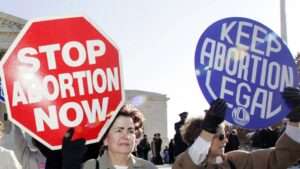
In this Nov. 30, 2005 file photo, an anti-abortion supporter stands next to a pro-choice demonstrator outside the U.S. Supreme Court in Washington. (AP Photo/Manuel Balce Ceneta)


Australian Outlook, (a publication of the Australian Institute for International Affairs), has published my article "Abortion and Foot Voting in Post-Dobbs America: Prospects for Change." This piece is the second in a two-part series. The first part, published last week, explained why post-Dobbs interstate variations in abortion policy may be unlikely to generate much in the way of foot voting by people seeking to avoid abortion restrictions - at least not the kind of foot voting that involves actually moving to another state. This one considers potential developments that might change that. Here's an excerpt:

As described in Part I of my series on abortion and foot voting in the wake of Dobbs, the broader response to the Supreme Court's 2022 decision holding there is no constitutional right to abortion is likely to lead to only modest abortion-driven foot voting. The combination of contraception, mail-order abortion pills, and traveling out of state to get an abortion provide relatively low-cost substitutes for in-state abortion access for most women. In addition, exclusionary zoning, high taxes, and job-killing regulations reduce the attractiveness of many pro-choice "blue" states to potential foot voters.

But a number of factors might change that. Most obviously, policy changes could potentially reduce or eliminate low-cost alternatives to in-state abortion access. For their part, blue states have been taking steps to make themselves more attractive to would-be movers….

The most obvious shift that could change foot voter calculations is that conservative states might try to ban contraception. But contraception is overwhelmingly popular in the United States and doesn't generate the same kinds of deep-seated, left-right divisions as abortion…

A conservative group has filed a lawsuit claiming that the federal Food and Drug Administration (FDA) illegally approved Mifepristone, a drug used in most medication abortions. The plaintiffs' legal arguments are dubious. But they could potentially get a favorable ruling, at least at the initial trial court stage. If the plaintiffs ultimately prevail, it would make mail-order abortion much more difficult…

As with mail-order pills, red states could also try to ban interstate travel to get an abortion. The Missouri state legislature has already considered doing just that, and Idaho is considering a more limited ban, focusing on travel by minors. But such restrictions probably would not stand up in court, as there are multiple strong constitutional arguments against them. In a concurring opinion in the Dobbs case, Justice Brett Kavanaugh – a key member of the conservative majority on the Supreme Court – emphasised his view that such restrictions would indeed be unconstitutional….

In the article, I also consider the possibility that the federal government might enact nationwide legislation on abortion, either of the pro-life or pro-choice variety.

I have previously written about abortion and foot voting here and here.

Immigration

How Biden's Private Sponsorship Parole Policy Reduced Illegal Migration by Making the Legal Kind Easier

Biden extended the successful Uniting for Ukraine model to cover migrants from four Latin American nations with oppressive governments and horrible conditions, thereby greatly reducing illegal migration from those nations. This effect undercuts a lawsuit challenging the program, filed by twenty red states.

|

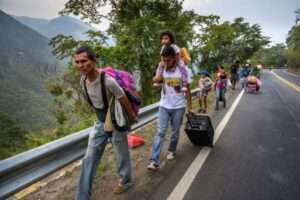
Venezuelans fleeing the socialist regime of Nicolas Maduro.


In early January, the Biden Administration extended the model used by the successful Uniting for Ukraine private migrant sponsorship program to include  up to 30,000 migrants per month from four Latin American countries: Cuba, Venezuela, Nicaragua, and Haiti. Under the program, migrants from these countries can quickly gain legal entry into the United States and the right to live and work here for up to two years, if they pass a background check and have a private sponsor in the US who commits to supporting them.

As in the case of Uniting for Ukraine, the main justification for this program is to grant refuge to people fleeing horrific violence, poverty, and oppression. Three of the four nations covered by the program are ruled by repressive socialist dictatorships, and the fourth (Haiti) suffers from horrific escalating violence and extreme poverty.

In a recent substack post, Cato Institute immigration analyst Alex Nowrasteh (one of the nation's leading immigration policy experts) describes how the program has a notable additional benefit. It greatly reduces illegal border crossings:

Encounters of migrants crossing the southwest (SW) border with Mexico are down 39 percent from December 2022 to February 2023. President Biden's immigration and border plan that expanded legal migration to the United States through humanitarian parole should take credit for this decline. Under Biden's plan, up to 30,000 migrants from Venezuela, Cuba, Nicaragua, and Haiti (VCNH migrants) are allowed to enter the United States legally each month through humanitarian parole. As a result, more of them are waiting to come legally rather than attempting to cross illegally.

In February 2023, the number of VCNH migrants encountered, found inadmissible by Customs and Border Protection (CBP), or apprehended by Border Patrol decreased by 84 percent compared to December 2022. The number of VCNH migrants showing up at the border fell from 91,344 in December to 22,084 in January and then further down to 14,381 in February….

This trend supports Cato's theory that legal migration discourages illegal immigration and border crossings. Non-VCNH migrants who do not have the option of humanitarian parole fell by only 12.5 percent from 160,651 in December 2022 to 134,192 in January and rose again to 140,617 in February. Almost 80 percent of the total decline in encounters along the border from December to February comes from a reduction in VCNH migrants….

Biden's border plan reduced chaos along the Southwest land border in a short period. That's good for its own sake, helps clear the air for a serious immigration debate, and is politically astute for Biden, which means that the incentives for good policy are politically aligned and sustainable. Second, the Biden plan increases legal immigration when U.S. labor demand is still high. Third, it defunds criminal networks and cartels by channeling many migrants into the legal system and away from the black market.

For reasons Alex explains, the reduction in illegal crossing by VCNH country migrants cannot be explained by other factors. It is powerful evidence for the proposition that the easiest way to reduce illegal migration is to make the legal kind easier. This also, of course, has the effect of reducing disorder at the border, and curbing opportunities for organized crime.

In addition to the policy advantages noted in Alex's post, the reduction in illegal border crossings undercuts the rationale for the lawsuit challenging the program filed by twenty red states. As I explain here, the statute authorizing the president to use the "parole" power to let in migrants indicates that he may do so "on a case-by-case basis for urgent humanitarian reasons or significant public benefit." Reducing illegal migration and disorder at the border qualifies as such a "significant public benefit." Or at least it does if you believe the leaders of the plaintiff states, who have long been loudly complaining about illegal border crossings, and claiming they constitute a major crisis.

For reasons laid out in my earlier post, it is also pretty obvious that there are compelling "humanitarian reasons" for paroling migrants from these four nations. On this point, too, you don't need to take my word. You can instead take that of the governors of some of the plaintiff states in the lawsuit:

Three of the four nations included in the program are ruled by oppressive socialist dictators, whose policies have created horrific conditions. Few have put it better than Florida Governor Ron DeSantis, whose state is one of the participants in lawsuit. As he said last year, Venezuela's socialist president Nicolas Maduro is a "murderous tyrant" who "is responsible for countless atrocities and has driven Venezuela into the ground." DeSantis went on to say that "people [in Venezuela] are "really hurting,"due to the government's policies. It is indeed true that Venezuelan socialism has resulted in widespread oppression, poverty, and hyperinflation, leading to the biggest refugee crisis in the history of the Western hemisphere, with some 6 million people fleeing. Texas Governor Greg Abbott, whose state is spearheading the lawsuit, has also noted the severe economic crisis in Venezuela, which he (rightly) blames on socialism.

In 2021, DeSantis  signed a law requiring Florida public schools to provide 45 minutes of instruction each year on the evils of Communist regimes, including that of Cuba, which DeSantis correctly described as responsible for "poverty, starvation, migration, systemic lethal violence, and suppression of speech." Cuba, likewise, inflicts severe poverty and oppression on its people, including recent brutal suppression of protests in July 2021….

Nicaragua under the increasingly authoritarian socialist rule of Daniel Ortega is a similar story. Ortega's repression has deepened already severe poverty, and created what even the left-leaning BBC describes as an "atmosphere of terror…."

Abbott, DeSantis, and other GOP governors have repeatedly denounced both the evils of socialism generally, and those of the Cuban, Venezuelan, and Nicaraguan governments specifically.

But perhaps they have somehow forgotten these things. If so, DeSantis should invite his fellow GOP governors to sit in on one of the 45-minute classes on the evils of communism, established under the law he signed last year.

More