

4/20/2010: United States v. Stevens decided.
The Volokh Conspiracy
Mostly law professors | Sometimes contrarian | Often libertarian | Always independent | Est. 2002

Race and Kidney Transplants - A Brief Rejoinder to Dr. Stanley Goldfarb
My brief rejoinder to his response to my earlier post on this subject.

In my last post, I put up a reply by Dr. Stanley Goldfarb to a post I wrote on "Race, 'Wokeness,' and Kidney Transplant Shortages," which was in part a critique of Dr. Stanley Goldfarb's article on the same subject, published by the City Journal. In this post, I offer a brief rejoinder to Dr. Goldfarb.
In his response, Dr. Goldfarb write that he does not support "a race-based formula for determining kidney function," which in turn would affect prioritization for kidney transplants. Rather, he says he merely rejects claims that the race-based formula recently replaced by the Organ Procurement and Transplantation Network (OPTN) and the United Network for Organ Sharing (UNOS), was racist, because it disadvantaged African-Americans. He also object to the retroactive application of the new, race-neutral formula to patients already on the transplant waitlist.
I appreciate Dr. Goldfarb's clarification of his views. However, it seems to me that, in his original article, he did in fact object to the displacement of the old race-conscious formula. Indeed, he described it (along with another policy change) as "perhaps the most dangerous victory for wokeness in health care to date." Even in his reply, he continues to support the use of the race-based system for patients already on the waitlist. At the very least, his position strikes me as far from an unequivocal rejection of racial discrimination.
As noted in my previous post, the use of racial criteria here can perhaps be defended on the ground that this is one of the very rare cases where there are genuinely significant physical differences between racial and ethnic groups that affect their chances of a successful transplant. But, as also noted there, such an argument at least requires strong evidence that there is no other comparably accurate way to assess patients. In addition, as discussed in my earlier piece, racial discrimination is particularly indefensible in a situation where we can easily eliminate kidney shortages for patients of all races, simply by legalizing organ markets.
While Dr. Goldfarb and I may continue to differ on the issue of racial discrimination, there are some points of agreement between us, as well, also covered in my previous piece. For example, we agree it would be a mistake to reduce the priority given to kidney donors in the waitlist, in order to promote racial "equity."
Reed v. Goertz, California v. Texas, and WWH v. Jackson
Justice Kavanaugh's six-page majority opinion does not withstand scrutiny against Justice Thomas's 20-page dissent.
Today the Supreme Court decided Reed v. Goertz. Reed was convicted of murder. Reed asked the prosecutor to conduct DNA testing of certain evidence. The prosecutor granted testing of some, but not all evidence. In state court post-conviction proceedings, Reed requested DNA testing of the remaining evidence. The state trial court denied Reed's motion. The Texas Court of Criminal Appeals affirmed that ruling, and later denied rehearing. Reed petitioned the Supreme Court for certiorari, which was denied. Then Reed repackaged his cert petition as a Section 1983 motion in federal district court. The District Court found that the claim was barred by the two-year statute of limitations. Specifically, the trial court started the clock from when the state trial court denied relief, not when the Court of Criminal Appeals denied rehearing. A panel of the Fifth Circuit affirmed. Reed then petitioned for certiorari from the Supreme Court.
A six-member majority reversed the Fifth Circuit. Justice Kavanaugh wrote the majority opinion. Justice Thomas wrote a solo dissent. Justice Alito wrote another dissent, which was joined by Justice Gorsuch.
The bulk of the Kavanaugh majority opinion, and the Alito dissent, disagreed about when to start the statute of limitation. Here, I want to focus on Justice Thomas's dissent, which focuses on subject matter jurisdiction.
The posture of this case is very unusual. How could Reed "appeal" the Court of Criminal Appeal's decision to a federal district court? Generally, the only route of appeal from a state court of last resort is to the United States Supreme Court through certiorari. And here, the Supreme Court denied cert. Federal district courts do not have "appellate" jurisdiction. They only have "original" jurisdiction. Why did the federal district even have subject matter jurisdiction here?
Justice Kavanaugh's analysis on jurisdiction spans only a page. Indeed, the entire decision is six-pages long.
First, what exactly is the injury in fact?
First, Texas argues that Reed lacks standing. We disagree. Reed sufficiently alleged an injury in fact: denial of access to the requested evidence. The state prosecutor, who is the named defendant, denied access to the evidence and thereby caused Reed's injury. And if a federal court concludes that Texas's post-conviction DNA testing procedures violate due process, that court order would eliminate the state prosecutor's justification for denying DNA testing.
There is some sleight of hand here by Justice Kavanaugh. What exactly is the claimed injury? Is the injury the prosecutor's denial of DNA testing? Or is the injury the Court of Criminal Appeal's denial of rehearing. If the injury is the former, then the clock started ticking even before the trial court ruled. But can the injury even be the latter? In other words, can the actions of a state court judge inflict an Article III injury, that can be redressed in federal court? Any order by the Supreme Court would, in effect, run against the prosecutor indirectly due to a change of law. But we usually don't think of the Supreme Court vacating a lower court opinion as a means to redress an Article III injury. Rather, what redresses the injury is an order that runs directly against an executive-branch official. This is a very unusual conception of redressability.
How does Justice Kavanaugh get around this theory? More sleight of hand:
It is "substantially likely" that the state prosecutor would abide by such a court order. Utah v. Evans, 536 U. S. 452, 464 (2002) (internal quotation marks omitted). In other words, in "terms of our 'standing' precedent, the courts would have ordered a change in a legal status," and "the practical consequence of that change would amount to a significant increase in the likelihood" that the state prosecutor would grant access to the requested evidence and that Reed therefore "would obtain relief that directly redresses the injury suffered." Ibid.
Justice Thomas explains why this approach cannot work:
The majority also misses the mark when it asserts that it is "substantially likely that the [district attorney] would abide by [Reed's requested] court order." Ante, at 3 (internal quotation marks omitted). Again, the only "court order"Reed seeks is a declaration disapproving the legal underpinnings of the CCA's judgment. Such an "order" would have no bearing on the district attorney's future conduct; in a literal sense, there would be nothing for him to "abide by."
Moreover, Whole Woman's Health v. Jackson suggests that this theory of redressability does not work. The upshot of that rocket docket case is that you can only sue executive-branch officials who enforce laws, and inflict injuries. You cannot sue state court judges, and their clerks who simply apply the law. Here, the district attorney is the nominal defendant, but the alleged injury really lies against the state court.
The Texas Solicitor General expressly invoked Jackson in his brief.
In other words, Reed does not dispute that courts, rather than district attorneys, adjudicate the merits of Chapter 64 claims and order or withhold DNA testing accordingly. "[N]o case or controversy" exists, however, "between a judge who adjudicates claims under a statute and a litigant who attacks the constitutionality of the statute." Whole Women's Health v. Jackson, 142 S. Ct. 522, 532 (2021) (citation omitted). Reed cannot avoid that problem by suing a different state official who does not enforce Chapter 64.
Justice Thomas explains that the injury, if one exists, was not by the district attorney, but by the court itself.
Fundamentally, Reed's complaint—like his certiorari petition before it—contests how "the Texas courts" "interpreted, construed[,] and applied" Chapter 64"to deny his motion for DNA testing," App. 14, ¶3, which is why the only relief he requests is an abstract "declaration that the CCA's interpretation and application of [Chapter] 64 . . . is unconstitutional." Id., at 49. The idea that his claim "does not challenge the adverse state-court decisions," ante, at 4 (internal quotation marks omitted), cannot survive even a cursory examination of his complaint. See supra, at 9–10. Nor would the other possibility make any sense. Reed cannot be seeking relief from the district attorney's enforcement of Chapter 64, because the district attorney has not enforced that law against Reed at all.
Now Justice Kavanaugh did not cite Jackson. Nor did Justice Thomas. Perhaps that wound is too fresh. The failure to engage with Jackson suggests that precedent will not have much vitality.
But there is another, even more relevant precedent, also from the Fifth Circuit: California v. Texas. Yes, who can forget the ill-fated Obamacare case. The Supreme Court made emphatically clear that a statute, standing by itself, cannot inflict an Article III injury. Rather, the enforcement of the statute creates the injury. And, as we all learned, a penalty-less mandate is not enforced. Or so we were told. Yet, Justice Kavanaugh walks right into California v. Texas!
Under the so-called Rooker-Feldman doctrine, federal district courts do not have appellate jurisdiction over state-court judgments. But Kavanaugh writes that Rooker-Feldman does not apply here. Why? Because Reed is targeting the statute! Huh?
That doctrine prohibits federal courts from adjudicating cases brought by state-court losing parties challenging state-court judgments. But as this Court explained in Skinner v. Switzer, even though a "state-courtdecision is not reviewable by lower federal courts," a "statute or rule governing the decision may be challenged in a federal action." 562 U. S. 521, 532 (2011). Here, as in Skinner, Reed does "not challenge the adverse" state-court decisions themselves, but rather "targets as unconstitutional the Texas statute they authoritatively construed." Ibid.
No, this argument does not work. Justice Thomas, who joined the California majority, invokes California in his dissent:
The majority accepts Reed's representation that he "does 'not challenge the adverse' state-court decisions themselves," but only "'targets as unconstitutional the Texas statute [Chapter 64] they authoritatively construed.'" Ante, at 4 (quoting Skinner v. Switzer, 562 U. S. 521, 532 (2011)). But this workaround to Rooker-Feldman raises a glaring Article III problem: As this Court has repeatedly explained, a federal court may not entertain a free-floating challenge to a statute unmoored from a concrete case or controversy. See, e.g., California v. Texas, 593 U. S. ___, ___–___ (2021) (slip op., at 7–9);
Thomas explains that Reed cannot seek an advisory opinion:
Unless Reed merely seeks an advisory opinion, his due process challenge to Chapter 64 must seek relief from some concrete enforcement or application of that law that affects him.More specifically, Reed must be challenging either (1) some conduct of the district attorney constituting enforcement of Chapter 64 against him or (2) the CCA's application ofChapter 64 as a rule of decision in his case.
The mere enactment of a statute does not provide a basis for standing:
By itself, a State's legislative enactment of an unconstitutional law does not give rise to a justiciable case or controversy. See California, 593 U. S., at ___–___ (slip op., at 7–9);
I know it is fashionable to attack Justice Thomas as a partisan hack. But on standing, he is completely consistent. He found no jurisdiction in the Obamacare case. And no jurisdiction in the murder case. The other eight justices cannot make such a claim to consistency. Everyone else switched sides.
When I first saw Kavanaugh's 6-page decision, I was shocked. It is rare that a Supreme Court decision is so short--especially where there are two lengthy dissents. Writing such a short opinion conveys the issues are open-and-shut. But Kavanaugh completely fails to engage with Justice Thomas's dissent. More misdirection. Nothing to see here.
I think this is a case where some conservatives thought it was unfair to rule against a criminal defendant who pursued his appeal through the state court system, and was then kicked out of federal court on statute of limitation grounds. Plus, this is a case where the conservatives can rule in favor of a criminal defendant convicted of a vicious murder and rape, who has no plausible defense of actual innocence. The virtues signal themselves!
Ultimately, none of these arguments will matter. Reed will not escape the execution chamber, as Justice Thomas explains:
If there is a mitigating factor to today's decision, it is that the §1983 action that the Court misguidedly allows to proceed is no barrier to the prompt execution of Reed's lawful sentence. See Hill v. McDonough, 547 U. S. 573, 583–584 (2006). Indeed, Reed conceded at oral argument "that you do not get a stay of execution just because you brought [aChapter] 64 proceeding or just because you're in [§]1983proceedings . . . challenging the adequacy of the procedures available to you from the state." Tr. of Oral Arg. 68. Texas is free to take him at his word. But, because the majority undermines vital principles of federal jurisdiction and destabilizes the orderly working of our judicial system, I respectfully dissent.
Finally, I'm disappointed Justice Barrett joined Justice Kavanaugh's majority opinion. During oral arguments in California, Justice Barrett repeatedly asked about redressability, and made clear that standing cannot be grounded on a challenge to a statute, standing by itself. I've seen Barrett as something of a jurisdiction wonk on the Court. The Kavanaugh majority should not have been a join.
Update: I see now that celebrities like Beyonce, Rihanna, and Kim Kardashian came out in support of Reed. I am now more confident in my virtue signaling analysis. I'm sure these important people will suddenly change their view of the Supreme Court, and the author of the majority opinion.
Dr. Stanley Goldfarb Responds to Me on Race and Kidney Transplants
This piece is his response to my post criticizing of an article he wrote in the City Journal.

On April 14, I put up a post on "Race, 'Wokeness,' and Kidney Transplant Shortages," which was in part a critique of Dr. Stanley Goldfarb's article on the same subject, published by the City Journal. Dr. Goldfarb has sent me a thoughtful response to my piece, which I am happy to post here, at his request. I will likely put up a rejoinder in a separate post [update: now available here].
Here is Dr. Goldfarb's response to me:
Dear Professor Somin,
Thank you for the opportunity to respond to your article quoting my piece, "Reparations Come to Medicine" in City Journal. You described my position as favoring a race-based formula for determining kidney function. If the article conveys that idea, I apologize as that is not my position. The previous formulas that required a separate calculation for African Americans have been labeled as racist. That is simply and demonstrably untrue. They were verified in multiple clinical studies with hundreds of patients. As part of the "racial awakening" of the health care enterprise, there was a push to eliminate all race-based algorithms in healthcare. I object to characterizing the older, empirically derived equations as racist as has become a standard trope for activists. It is all part of blaming health care disparities on discriminatory health care treatment and it is a canard. My article sought to make clear that the old formula was absolutely not an indicator of racism.
Adopting new formulae for calculating kidney function is fine if they are accurate and objective. The latest formula using readily available blood chemistries is not more accurate than the old formula and chosen since it produces the desired outcome of lowering the estimation of kidney function in Black patients. Counterintuitively, estimating lower kidney function in Black patients has a benefit: It allows them to enter the kidney transplant waiting list sooner. It is unlikely to increase the number of Black patients receiving a kidney as the actual basis for the disproportionately low number of Black kidney recipients is lack of willingness to pursue this very demanding form of treatment.
I object to the use of the new formula to retroactively alter previous estimates of kidney function and to revise the transplant wait list to reflect the newly calculated values. Using the new formula prospectively will likely have a minimal impact but using it retrospectively will force a to-be-determined number of White and Asian patients to lose their place on the transplant wait list and be forced to wait longer for their transplants. As the formula was knowingly constructed to achieve this result, this retroactive revision is unfair.
Sincerely yours,
Stanley Goldfarb MD
Chairman, Do No Harm
UPDATE: I have posted a rejoinder to Goldfarb here.
Court Declines to Block Congressional Subpoena of Former Special Assistant Prosecutor in Trump Prosecution
From Bragg v. Jordan, decided today by Judge Mary Kay Vyskocil (S.D.N.Y.) (and an appeal has already been filed); I'm on the run and don't have the time to focus on it further, but I thought I'd pass along some key paragraphs from the opening and closing parts.
The request by Manhattan District Attorney Alvin L. Bragg Jr. for a temporary restraining order, enjoining enforcement of the subpoena issued to Mark F. Pomerantz by the Committee on the Judiciary of the United States House of Representatives, chaired by Congressman Jim Jordan, is DENIED. The subpoena was issued with a "valid legislative purpose" in connection with the "broad" and "indispensable" congressional power to "conduct investigations." It is not the role of the federal judiciary to dictate what legislation Congress may consider or how it should conduct its deliberations in that connection. Mr. Pomerantz must appear for the congressional deposition. No one is above the law….
On April 6, 2023, the Committee on the Judiciary of the United States House of Representatives (the "Committee") issued a subpoena, directing Mark F. Pomerantz ("Pomerantz"), a former pro bono employee of the Office of the District Attorney for New York County ("DANY"), to appear on April 20, 2023 "to testify at a deposition touching matters of inquiry committed to [the Committee]." The subpoena does not request that Pomerantz produce any documents.
The subpoena was accompanied by a letter from the Chairman of the Committee, Jim Jordan ("Jordan"). The letter requests Pomerantz's appearance due to his "unique role as a special assistant district attorney leading the investigation into President Trump's finances." It further explains that Pomerantz has "already discussed many of the topics relevant to [the Committee's] oversight in a book [that Pomerantz] wrote and published in February 2023, as well as in several public interviews to promote [his] book." Jordan notes that DANY has "acknowledged that it used federal forfeiture funds in its investigations of President Trump," and that the Committee was considering "potential legislative reforms," such as "broadening the existing statutory right of removal of certain criminal cases from state court to federal court."
The book referenced in Jordan's letter is People vs. Donald Trump: An Inside Account, written by Pomerantz and published in early 2023. As its subtitle indicates, the book recounts Pomerantz's insider insights, mental impressions, and his front row seat to the investigation and deliberative process leading up to the DANY case against former President and current presidential candidate Donald Trump. Among Pomerantz's observations:
US Regains Pre-Trump, Pre-Pandemic Immigration Levels
We owe this achievement to a combination of Covid vaccines and Biden Administration policy changes. But much more can be done.

The combination of Donald Trump's restrictionist policies and the Covid-19 pandemic caused a massive decline in immigration to the US from 2016 to 2021. But over the last two years, the US has largely returned to pre-Trump/pre-pandemic immigration levels. The Financial Times has a helpful summary of this shift:
Immigration is back, in the US at least. Over the past two and a half years, immigration into the American labour market has increased by 4mn workers, and the working age immigrant population has now finally reached its pre-pandemic trend level. This is likely to be a central factor in strong employment growth, particularly in leisure and hospitality. It is also part of the story on increasing workforce participation, as well as being good news for the fight against inflation….
In the US, immigration accounted for about half of the growth in the working age population between 1995 and 2014 according to Pew Research. Unfortunately, between Donald Trump's "build a wall" jingoism and the Covid pandemic, there was then a sharp drop in immigrant workers. Over the course of four years, according to a February paper from the San Francisco Federal Reserve, the Trump administration took 472 executive actions aimed at reducing immigration, from increasing immigration enforcement to freezing refugee admissions to moving away from family immigration. Between 2016 and 2019, the number of new permanent residents dropped 13 per cent and the number of student F1 visas declined 23 per cent. Covid didn't help. Many laid-off workers lost visas or simply preferred to ride out the pandemic in their own countries. The two trends together fuelled a strong tightening in the labour markets, according to the San Francisco paper. The authors found that the drop in immigration from 2017 onwards resulted in a 5.5 percentage point increase in the vacancy to unemployment ratio in the US.
But happily, the recent uptick has resulted in a 6 percentage point reduction to that ratio. More than 900,000 immigrants became US citizens during 2022 — the third highest level on record and the most in any fiscal year since 2008, according to Pew….
Bottom line — the US seems to be returning to pre-Trump, pre-pandemic rates of immigration.
This is a highly beneficial development. Most obviously, it has allowed many thousands of immigrants to escape poverty and oppression and find greater freedom and opportunity. In addition, as the Financial Times notes, increased immigration also creates major benefits for the US economy as a whole. Immigration restrictions inflict great economic harm on natives as well as would-be immigrants, and constrain the economic freedom of natives more than virtually any other US government policy.
Some of the credit for increasing immigration goes to the vaccine producers who played a key role in ending the Covid pandemic. Fittingly, immigrants from poor nations or the children thereof played a key role in developing both of the first two Covid vaccines approved by the US government. By so doing, they not only saved millions of lives, but also helped facilitate the return of immigration to normal levels. Lowering immigration restrictions further would enable more such life-saving innovations (to which immigrants contribute disproportionately).
While the waning of the Covid pandemic was a crucial factor, much of the credit for increased immigration goes to Joe Biden. He has reversed many of Trump's restrictionist policies. In addition, he has opened up new pathways for legal immigration by creating private sponsorship opportunities, such as the Uniting for Ukraine program and its extension to migrants from four Latin American nations. In this latter respect, Biden has not only been more open to migration than Trump (a very low standard of comparison!), but also more so than the Obama Administration was.
Biden's immigration policies are far from perfect. I have been highly critical of his new Trump-lite asylum restrictions, the double game he played on Title 42 "public health" expulsions (this may now be about to end, after two awful years), and other flaws. Moreover, most of the present administration's achievements rest on discretionary exercises of executive power that could potentially be reversed in the future, if a more restrictionist administration comes to power. But, on balance, Biden has presided over great progress in this field, especially compared to his predecessor.
But there is much room for further progress. The example of Canada - which accepts several times more immigrants relative to population than the US does - is just one indication of what is possible.
UPDATE: The Financial Times article cites research on how mobility after arrival in the US has been a crucial factor in immigrants' economic success relative to otherwise similar native-born workers. I discussed this issue in more detail in a July 2022 post, where I also note ways in which we can make it easier for natives to "move to opportunity."
Can the Supreme Court "Develop and Apply Customary International Law"?
Justice Gorsuch raises the question that the majority elides.
Today, the Supreme Court decided Turkiye Halk Bankasi A.S. v. United States. In this case, the United States brought criminal charges against a bank that was an instrumentality of the Turkish government. The bank argued that they had immunity under the Foreign Sovereign Immunities Act. By a 7-2 vote, the Court held that the FSIA only extends to civil cases, and not criminal cases. I don't have strong thoughts on this statutory issue. But the case does not end here.
Justice Kavanaugh's majority opinion left open the possibility that the bank may still be protected by "common-law immunity principles." The Court remanded the case to allow the Second Circuit to "fully consider the various arguments regarding common-law immunity that the parties press in this Court." What exactly is the basis for a common law immunity with regard to international law?
Justice Gorsuch's dissent, which was joined by Justice Alito, identifies one possible answer: customary international law. Gorsuch, however, is not optimistic that the Court could discern a clear answer in customary international law.
The second option—applying customary international law—comes with its own puzzles. If the briefing before us proves anything, it is that customary international law supplies no easy answer to the question whether a foreign sovereign enjoys immunity from criminal prosecution. Compare Brief for Professor Roger O'Keefe as Amicus Curiae 11–16 with Brief for Mark B. Feldman et al. as Amici Curiae 12–13.
I may be biased here. I took international law with Professor Jeremy Rabkin at George Mason. On the first day of class, we read the Declaration of Independence. Professor Rabkin explained that the Declaration was real international law--or, in the lingo, the law of nations. Then, he said (I'm paraphrasing from 15 years ago) that customary international law was whatever the United Nations said. In other words, there is no such thing as customary international law.
In any event, Justice Gorsuch raises a far more foundational question: can federal courts develop customary international law? Gorsuch writes:
Nor is it even altogether clear on what authority federal courts might develop and apply customary international law. Article VI of the Constitution does not list customary international law as federal law when it enumerates sources of "the supreme Law of the Land." And Article I vests Congress rather than the Judiciary with the power to "define and punish . . . Offences against the Law of Nations." §8, cl. 10. See Sosa v. Alvarez-Machain, 542 U. S. 692, 739–742 (2004) (Scalia, J., concurring in part and concurring in judgment); Jesner v. Arab Bank, PLC, 584 U. S. ___, ___–___ (2018) (GORSUCH, J., concurring in part and concurring in judgment) (slip op., at 4–5); Nestlé USA, Inc. v. Doe, 593 U. S. ___, ___ (2021) (GORSUCH, J., concurring) (slip op., at 3).
The modern Supreme Court has held that federal courts are not supposed to develop federal common law. But what about customary international law?
Perhaps Article III incorporated customary international law into federal common law. But since Erie R. Co. v. Tompkins, 304 U. S. 64 (1938), federal courts have largely disclaimed the power to develop federal common law outside of a few reserved areas. See Sosa, 542 U. S., at 740– 742 (opinion of Scalia, J.). And whether customary international law survives as a form of federal common law after Erie is a matter of considerable debate among scholars.Compare C. Bradley & J. Goldsmith, Customary International Law as Federal Common Law: A Critique of the Modern Position, 110 Harv. L. Rev. 815 (1997), with H. Koh, IsInternational Law Really State Law?, 111 Harv. L. Rev. 1824 (1998).
I haven't given this question much thought before. I should now.
No First Amendment Violation in Requiring Law Student to Meet with "Behavior Intervention Team" Related to …
allegedly "threaten[ing] ... administrators, ma[king] female instructors and students uncomfortable, and show[ing] signs of 'disjointed' thinking."
From Singh v. Amar, decided Dec. 5 by Judge Sue Myerscough (C.D. Ill.):
Plaintiff … is a second-year law student at the University of Illinois College of Law. Mr. Singh enrolled in the University on a full-tuition merit scholarship and eventually was invited to join the Illinois Law Review.
Shortly after beginning his first semester, Mr. Singh met with Defendant Virginia Vermillion, the law school's Dean of Students, to amend his law school application. He alleges that Dean Vermillion responded to his request by remarking that "[y]ou fucking [M]iddle [E]asterners are untrustworthy." Mr. Singh is of Sikh origin.
After his first semester, Mr. Singh filed formal complaints against instructors who he believed had graded his coursework and exams capriciously. Mr. Singh also had conflicts with other students and school administrators. The school made several informal attempts to resolve Mr. Singh's concerns and disputes, but those attempts were unsuccessful.
In April 2022, Dean Vermillion contacted the University of Illinois Behavioral Intervention Team (BIT) to share her concerns regarding Mr. Singh's behavior. Dean Vermillion alleged that Mr. Singh had threatened Dean Vermillion and other administrators, made female instructors and students uncomfortable, and shown signs of "disjointed" thinking.
Illinois law requires that post-secondary institutions take preventive and proactive action to prevent campus violence. The BIT therefore assesses and monitors "students exhibiting aberrant, dangerous, or threatening behavior." To ensure that the BIT's work is unimpeded, the University's various codes of conduct require the subject of a BIT complaint to comply with any "reasonable" directives. Failure to comply with BIT's directives can result in disciplinary sanction, including dismissal.
Intervening to Stop "True Threats" from Delusional Stalkers and Devious Stalkers
Today's oral argument in Counterman v. Colorado--the "true threats" case--highlights the importance of protecting stalking victims from objectively threatening communications.
I just finished listening to the live feed of the Supreme Court oral argument in Counterman v. Colorado. The question presented is "whether the First Amendment precludes criminal conviction of a defendant who makes a communication that a reasonable person would understand as a threat of injury or death unless the prosecution has proof beyond a reasonable doubt of the defendant's subjective intent or knowledge that it would be taken as such a threat." Along with Allyson Ho and Brad Hubbard from Gibson Dunn, I filed an amicus brief in the case for the victim: singer-songwriter Coles Whalen. In the brief, we explained that a ruling for the defendant (Counterman) would make it very difficult for law enforcement to protect victims of delusional stalkers and devious stalkers. Both Colorado and the Solicitor General referred to our brief in their powerful presentations to the Court. I hope that the Court will consider the need for effective protection of stalking victims--and the lack of any originalist foundation for precluding such protection--and rule in Colorado's favor.
Some quick factual background: Whalen, the victim in the case, was making a name for herself as a singer-songwriter. But in 2014, she began receiving thousands of unsolicited messages from Counterman that only intensified in frequency and hostility over time.
Things escalated in spring 2016, after Counterman repeatedly messaged Whalen with such threats as "Die, don't need you" and "Staying in cyber life is going to kill you." He also made clear that he'd been watching her. The messages terrorized Whalen, and she eventually sought help—first from family and later from law enforcement, who arrested Counterman for stalking in May 2016. After a three-day trial, the jury convicted Counterman after finding that he knowingly communicated with Whalen in a way that would cause a reasonable person to suffer serious emotional distress. After the conviction was affirmed by Colorado's courts, the Supreme Court agreed to review the First Amendment question presented.
In today's oral argument, Colorado's Attorney General--Phil Weiser--gave a compelling defense of Colorado's stalking statute. During his argument, he referenced a passage in Whalen's amicus brief about "delusional" and "devious" stalkers that is worth highlighting (citations omitted):
The State's approach (like most other jurisdictions') appropriately reflects the reality that stalkers commonly harbor dangerous delusions or other mental conditions that underlie their obsessive contacts with their victims. Accepting Counterman's position would mean that the more delusional the stalker, the harder for the State to protect victims. Nothing in the First Amendment requires such a perverse result.
In addition to preventing States from punishing delusional stalkers, adopting Counterman's position would also create a dangerous roadmap that would enable devious stalkers to inflict terror with impunity. To evade prosecution, a devious, sophisticated stalker need only intersperse his threats (e.g., "Die, don't need you") with purportedly delusional messages. In that situation, a specific-intent requirement would not only make an arrest warrant harder to get but also erect a near-insurmountable hurdle for prosecutors who must show a subjective intent to threaten beyond a reasonable doubt.
The point that Attorney General Weiser emphasized today is presumably why the majority of states--and most federal Courts of Appeals--have recognized that the First Amendment does not impose barriers to legislative action to criminalize "true threats." A true threat is narrowly defined as a statement that a reasonable person would understand, in context, to be a serious expression of intent to cause unlawful physical violence--and is outside First Amendment protection.
Attorney General Weiser also cited another amicus brief in the case supporting Colorado--this one filed on behalf of VC's own Eugene Volokh and Professors Evelyn Douek (Stanford Law) and Genevieve Lakier (U. Chicago Law). Here is a key passage from their brief about how stalking laws (such as Colorado's) pose no threat to First Amendment values:
Stalking laws like Colorado's prohibit a course of repeated conduct that is by definition directed at a specific person. So, while the repeated conduct may include communications, it is typically not addressed to a broad public audience. That means stalking laws pose much less risk to the "uninhibited, robust, and wide-open" public discussion that the First Amendment protects than laws that punish one-off, untargeted communications. N.Y. Times Co. v. Sullivan, 376 U.S. 254, 270 (1964). A stalker's communications are also always directed at an unwilling listener. As this Court's cases recognize, "[n]othing in the Constitution compels us to listen to or view any unwanted communication, whatever its merit." Rowan v. U.S. Post Off. Dep't, 397 U.S. 728, 737 (1970). Finally, because stalking convictions require proof of multiple instances of the offending behavior, it is less likely that stalking laws will be used to "criminaliz[e] inevitable misunderstandings" than threat statutes. For all of these reasons, it is not necessary to read a heightened mens rea requirement into stalking laws in order to ensure adequate "breathing room" for expressive freedom.
Today's oral argument also made clear that Counterman has no real history or tradition supporting his position. The First Amendment has never been considered to require some sort of heightened "mental state" requirement for objectively threatening communications. A ruling overturning Colorado's statute (and effectively those in many other states) would not be originalist in any sense of the term.
The United States filed an amicus brief making this point, skillfully reciting the history of prosecutions for threatening communications. One passage in the Solicitor General's Brief is worth more attention than it has received--a passage demonstrating persuasively that, at the Founding, proof of specific intent was not generally a requirement in American criminal law:
The common law at the time of the Founding did not generally require proof of specific intent in criminal cases. Rather, it often used "a purely objective standard to presume a subjective state of mind and hence wilful and reckless conduct," although that presumption ultimately evolved into a "rebuttable" one. Paul H. Robinson, A Brief History of Distinctions in Criminal Culpability, 31 Hastings L.J. 815, 839 (1980). Indeed, "historical evidence suggests that courts were unable to undertake [a] subjective inquiry until relatively recently" because such inquiry was thought to be "beyond the power of juries" and the introduction of evidence that would be "most relevant to the subjective inquiry" was barred. Id. at 844-845 (emphasis omitted); see J. W. C. Turner, The Mental Element in Crimes at Common Law, 6 Cambridge L.J. 31, 33 (1936) (noting "the practice of imputing mens rea from certain given sets of circumstances" and "the well-established rule that a man is presumed to intend the natural consequences of his acts").
Professor Robinson's historical point is one often overlooked by modern day criminal law commentators. Most of us have grown up in a world of the Model Penal Code, which beginning in 1953 made mens rea requirements (purpose, knowledge, recklessness, or negligence) critical features of American criminal law. But that approach is not at all what the Founders would have understood in crafting the First Amendment. Indeed, as Professor Robinson points out, at the Founding, defendants could not even testify as to their own state of mind:
[Historically,] [m]ost devastating to this inquiry [into a defendant's subjective state of mind] was the rule which prohibited defendants from testifying in their own behalf, on the ground that they were incompetent as witnesses because of their interest in the case. At first, a defendant was not even permitted to present any witnesses. This rule later was altered to allow defense witnesses to testify, although not under oath, and thus with less weight than the Crown's witnesses. Ultimately, the rule was liberalized to permit defense witnesses under oath in all cases. The rule disqualifying defendants was repealed in 1853, but defendants were not permitted to testify under oath until 1898. Thus, until the early twentieth century no such inquiry into the actor's actual state of mind was or could have been undertaken effectively. This confirms the doctrinal historical evidence that until that time the reckless-negligent distinction was not implemented.
Robinson, supra, at 845.
In short, no good reason exists--from either a policy or historical perspective--for preventing legislators from enacting laws criminalizing objectively true threats.
My client-- Coles Whalen--also appreciated that fact that the trauma she suffered from Counterman's repeated threats was highlighted during today's oral argument. The threats forced Whalen to move away from her home and essentially abandon her career as a stage performer, as we recount at length in her amicus brief. She has asked me to pass along an important message to other stalking victims:
I am glad the Supreme Court heard this morning about the trauma that I suffered due to the repeated threats that I was sent over many years. Today's argument highlighted the far-reaching implications of this case. I hope that the Court's decision will be made with the understanding that violent, threatening communications cause significant and enduring harm to their victims. If you are afraid - please - trust yourself, and reach out for help.
Another amicus brief filed in support of Whalen came from (among other groups) Legal Momentum, the National Crime Victim Law Institute, and the National Domestic Violence Hotline. The hotline number can be found here.
One last note: VC's own John Elwood skillfully presented the arguments this morning for Mr. Counterman.
Update: Several of the comments flagged the point that I referred to Attorney General Weiser as "General Weiser." That was the usage, as I recall, of at least one Justice during the oral argument. But in looking at Bryan Garner's Dictionary of Legal Usage, he makes a persuasive argument that "[d]espite its prevalence among some of the most esteemed members of the bar and judiciary, it [referring to attorneys general as "General So-and-So"] is incorrect." I have updated accordingly. I have also corrected a few typos.
Supreme Court Decides to Hear Important Asset Forfeiture Procedural Property Rights Case
The Court will determine whether the Due Process Clause prevents the government from using asset forfeiture to seize property and hold it for many months without a timely hearing.

Earlier this week, the Supreme Court decided to hear Culley v. Attorney General of Alabama, a case consolidating two claims against the Alabama authorities that raise the issue of whether the government can use asset forfeiture to seize property and hold it for many months without giving the owners the opportunity to contest the seizure in a hearing. The case raises important constitutional property rights issues that affect thousands of people across the country. Such practices impose a major burden on affected property owners, and are a flagrant violation of the Due Process Clause of the Fourteenth Amendment, which bars states from depriving "depriving "any person of life, liberty, or property, without due process of law."
There is a long history of debate over whether and to what extent the Due Process Clause protects substantive rights. But whatever you may think of "substantive" due process, what we have here is a denial of pure, old-fashioned procedural due process. If the Due Process Clause protects property rights at all, surely it bars the state from taking your property and keeping it for many months without any due process at all.
C.J. Ciaramella of Reason has a helpful article laying out the egregious facts of these cases:
Under civil asset forfeiture laws, police can take property suspected of being connected to criminal activity even if the owner hasn't been charged with a crime. Property owners then often have the burden of going to court and proving their innocence, a process that can take months and sometimes years.
Take the two cases at issue: In the first, Halima Culley's son was pulled over by police in Satsuma, Alabama, while driving Culley's car. He was arrested and charged with possession of marijuana and drug paraphernalia. The City of Satsuma also seized Culley's car. It took 20 months, during all of which Culley was bereft of her vehicle, before a state court ruled that she was entitled to the return of her car under Alabama's innocent-owner defense.
In the second case, a friend of Lena Sutton took her car to run an errand in 2019. He was pulled over by police in Leesburg, Alabama, who found methamphetamine in the car and seized it. Sutton also eventually was granted summary judgment on an innocent-owner defense, but not until more than a year after the initial seizure of her car.
In both cases, the state brought asset forfeiture claims against the property, and the owners ultimately prevailed in state court. But in the meantime, they had no opportunity to contest the government's seizure and continued detention of the property. And the resolution of the state's cases against them took many months. The property owners argue that the Due Process Clause requires the state to give them a timely opportunity to contest the seizure and detention of their vehicles, rather than having to wait for the resolution of the state's case against them.
As Ciaramella notes, such asset forfeiture practices are common in many states. They often lead to seizure and detention of property even in cases where the owner is never charged with any crime (which is what happened in these two Alabama cases). These policies are particularly burdensome for lower-income property owners who are disproportionately likely to be caught up in the War on Drugs, and also often unable to afford to live without their cars for long periods of time. Relatively affluent property owners can usually afford to buy a replacement car or get a longterm rental vehicle without suffering major hardship. But for a poor or working class person, being deprived of their car for a year or more is often a huge imposition. An amicus brief by the Pacific Legal Foundation lays out the class bias here in greater detail, and also explains why the Due Process Clause forbids these kinds of practices [PLF is also my wife's employer; but she was not involved in writing this brief].
There may be difficult line-drawing questions about exactly how swift a hearing the Due Process Clause requires in such cases. Is a week too long? A month? But it should at least be obvious that delays of a year or more are unconstitutional.
The issues raised in these cases are similar to those in Alvarez v. Smith, a 2009 Supreme Court case that was ultimately dismissed as moot after the state and the property owners reached a settlement. In Krimstock v. Kelly (2002), then-Judge Sonia Sotomayor wrote a Second Circuit decision striking down a similar vehicle asset forfeiture detention policy. I praised Sotomayor's Krimstock ruling in my testimony at her Supreme Court confirmation hearing, even as I was highly critical of some other aspects of her record on constitutional property rights.
I hope the Supreme Court will reach a result similar to the one Sotomayor and the Second Circuit reached in Krimstock:
A car or truck is often central to a person's livelihood or daily activities. An individual must be permitted to challenge the City's continued possession of his or her vehicle during the pendency of legal proceedings where such possession may ultimately prove improper and where less drastic measures than deprivation pendente lite are available and appropriate.
There are lots of other constitutional and policy flaws in asset forfeiture policies, such as that many of them violate the Excessive Fines Clause of the Eighth Amendment, that they pervert law enforcement priorities, and more. The Alabama case won't resolve these broader questions. But the justices can at least compel state and local governments to respect the procedural due process rights of property owners.
UPDATE: In the original version of this post, I accidentally misidentified the author of the Reason article about this case, linked above. The correct author is C.J. Ciaramella. I apologize for this mistake, which I have now corrected.
Court Refuses to Enforce United Arab Emirates Child Custody Decree That Disfavored Christian Parent
From Al Namani v. Watson, decided last year by Judge Daniel Klau (Conn. Super. Ct.), but just posted on Westlaw:
General Statutes § 46b-115ii bars a Connecticut family court from enforcing a foreign court judgment that is "repugnant to the public policy of this state." Citing this statute, the respondent (Mother) opposes the registration and anticipated enforcement of a foreign child custody determination of the United Arab Emirates (UAE judgment). The UAE judgment states that the petitioner (Father) shall have custody of the parties' two minor child because the Father and the children are Muslim, but the Mother is Christian….. [T]he court agrees with the Mother that the UAE judgment is repugnant to Connecticut public policy and, therefore, cannot be registered or enforced….
The following facts are offered solely for background purposes. The Mother, an American citizen, met the Father in Oman in 2008. The parties married in Tanzania in 2009 and then lived in the UAE. They have two children: Sabriya and Adil, born in the UAE in 2009 and 2011, respectively. Under UAE law, the children are deemed Muslim because the Father is Muslim.
The parties separated in April 2012. Each offers different reasons for the separation. There is no dispute, however, that the children remained with the Mother, who filed for divorce in the UAE in December 2012. The court granted a default divorce in October 2013, after the Father failed to appear. The court awarded custody of the children to the Mother. She subsequently remarried and had another child with her new husband, who was from the UAE. She returned to the United States in December 2018 for a new job. However, the parties' two children remained temporarily in the UAE with the Mother's new husband because the Father obtain ex-parte travel bans. The children eventually moved to the United States in August 2019. They now live with the Mother in Connecticut….
[The UAE] judgment succinctly sets forth the UAE court's reasons for granting the Father custody:
As per the documents and papers, daughter, Sabriya who was born [in 2009], is 11 years old and son, Adil who was born [in 2011] is 9 years old. The plaintiff is still Christian as per the statement of claim; the custody right is for the benefit of the child. The personal Status [apparently referring to the UAE On Personal Status law -EV] stipulates that the custodial patent's [sic] religion shall be the same as the child's religion and her custody shall be until the child becomes five years old whether a male or female. Accordingly, the court cancels her right of child custody of Sabriya and Adil, the father shall be the custodial parent and all alimony and child support shall be cancelled effective from the date of granting him the custody….
Default Judgment in Libel Case: No More "Lucy and the Football"
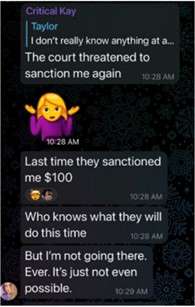
From Judge Carlton Reeves' decision today in Andreacchio v. Yax (S.D. Miss.):
Plaintiff Rae Andreacchio is the mother of Christian Andreacchio, a young man who allegedly "died under suspicious circumstances" in 2014. She resides in Lauderdale County, Mississippi, where she is a mental health service provider.
Defendant Karen Yax is a "prominent social media figure" known to her followers as "The Critical Kay." She operates a webcast where she discusses "real-crime stories." She is a resident of Michigan.
On March 21 and April 11, 2021, Yax discussed Christian Andreacchio's death on her webcast. Yax stated that Rae Andreacchio has "really dominated the narrative about this case via intimidation, bullying, outright lies … , bribery, getting people drunk, [and] getting young people drunk," among other claims. Yax also stated, "I really do believe that Hayes [Mitchell, a different patient,] was treated by Rae, and Hayes is now dead with a drug overdose …. He's dead also by self-harm. So, she has a son that is dead by self-harm. And she has a patient who is dead by self-harm."
Andreacchio contends that these statements "leave[] the false impression that [she] had somehow caused—or contributed—to their deaths." Andreacchio adds that these statements have "defamed or painted [her] in a false light, thereby causing her to suffer injury to her reputation and/or emotional damage." Accordingly, she filed this suit against Yax on June 4, 2021, alleging defamation and false light invasion of privacy.
Kavanaugh v. Gorsuch -- The Return
Today's opinions are a requel to prior splits among the most recent Republican appointees to the Supreme Court.
This morning the Supreme Court decided two cases in which Justice Brett Kavanaugh wrote the majority opinion and Justice Neil Gorsuch dissented: Reed v. Goertz and Turkiye Halk Bank v. United States. The former case concerned the statute of limitations for Section 1983 procedural due process claims. The latter (in which Justice Gorsuch only dissented in part) concerned whether district courts have jurisdiction over criminal claims against foreign state-affiliated banks given foreign sovereign immunity.
This is not the first time we have seen splits between these two justices who were appointed to the Supreme Court by the same President within a span of only 18 months. I blogged about splits between Justices Kavanaugh and Gorsuch back in 2019, here and here.
Note that we've also seen a significant number of splits between Justices Gorsuch and Barrett, including Bittner v. United States, in which Gorsuch wrote the majority and Justice Barrett wrote the dissent. Last term, Justice Gorsuch dissented from two-thirds of Justice Barrett's majority opinions.
This growing list of splits among justices appointed by the same President, across a range of subjects, helps illustrate how simplistic descriptions of justices' perceived political ideology do not capture much about their actual jurisprudence.
[Note: Yes, I meant to use the word "requel" in the subhead above.]
Today in Supreme Court History: April 19, 1920
4/19/1920: Missouri v. Holland decided.
The international regulatory dogpile on AI
Episode 453 of the Cyberlaw Podcast
Every government on the planet -- or nearly so -- announced last week an ambition to regulate artificial intelligence. Nate Jones and Jamil Jaffer take us through the announcements. What's particularly discouraging is the lack of imagination, as governments mostly dusted off their old prejudices to handle this new problem. Europe is obsessed with data protection, the Biden administration just wants to talk and wait and talk some more, while China must have asked an AI chatbot to assemble every regulatory proposal for AI ever made by anyone and translate it into Chinese law.
Meanwhile, companies trying to satisfy everyone are imposing weird limits on their AI, such as Microsoft's rule that asking for an image of Taiwan's flag is a violation of its terms of service. (For the record, so is asking for China's flag but not asking for an American or German flag.)
Matthew Heiman and Jamil take us through the strange case of the airman who leaked classified secrets on Discord. Jamil thinks we brought this on ourselves by not taking past leaks sufficiently seriously.
Jamil and I cover the imminent Montana statewide ban on TikTok. He thinks it's a harbinger; I think it may be a distraction that, like Trump's ban, produces more hostile judicial rulings.
Nate unpacks the California Court of Appeals' unpersuasive opinion on law enforcement use of geofencing warrants.
Matthew and I dig into the unanimous Supreme Court decision that should have independent administrative agencies like the FTC and SEC trembling. The court held that litigants don't need to wend their way through years of proceedings in front of the agencies before they can go to court and challenge the agencies' constitutional status. We both think that this is just the first shoe to drop. The next will be a full-bore challenge to the constitutionality of agencies beholden neither to the executive or Congress. If the FTC loses that one, I predict, the old socialist realist statue "Man Controlling Trade" that graces its entry may be replaced by one that both PETA and the Chamber of Commerce would probably like better. My thanks to Bing's Image Creator for the artwork.
In quick hits:
- I update listeners on the fight over renewal of Section 702 of the Foreign Intelligence Surveillance Act and the FBI's search of its 702 database for messages about Congressman Darin LaHood (R-IL). It's far from a scandal, and it may show that the whole effort to treat such searches as shocking privacy intrusions is bogus.
- Hackers have claimed deep access to Western Digital systems. The good news is that they seem unable to encrypt it all, so they're relying on doxing threats to earn the ransom they want.
- The Indian government has given itself authority to "fact check and order the deletion of social media posts. Nobody thinks that's a good idea, but when I ask whether it's all that different from the CDC/social media alliance that suppressed true information during COVID, Jamil disagrees. If you've missed our conservative catfights, you'll enjoy this.
You can subscribe to The Cyberlaw Podcast using iTunes, Google Play, Spotify, Pocket Casts, or our RSS feed. As always, The Cyberlaw Podcast is open to feedback. Be sure to engage with @stewartbaker on Twitter. Send your questions, comments, and suggestions for topics or interviewees to CyberlawPodcast@steptoe.com. Remember: If your suggested guest appears on the show, we will send you a highly coveted Cyberlaw Podcast mug! The views expressed in this podcast are those of the speakers and do not reflect the opinions of their institutions, clients, friends, families, or pets.
Ninth Circuit Rules Berkeley Gas Hookup Ban Is Preempted
A local California ordinance prohibiting natural gas hookups in new construction conflicts with federal law according to a federal appellate court.
Yesterday a unanimous panel of the U.S. Court of Appeals for the Ninth Circuit concluded that a Berkeley, California ordinance prohibiting the installation of natural gas piping in newly constructed buildings is preempted by the federal Energy Policy and Conservation Act (EPCA). The opinion by Judge Bumatay in California Restaurant Association v. City of Berkeley was joined by Judges O'Scannlain and Baker, each of whom also wrote a separate concurrence.
Here is how Judge Bumatay summarizes the opinion:
By completely prohibiting the installation of natural gas piping within newly constructed buildings, the City of Berkeley has waded into a domain preempted by Congress. The Energy Policy and Conservation Act ("EPCA"), 42 U.S.C. § 6297(c), expressly preempts State and local regulations concerning the energy use of many natural gas appliances, including those used in household and restaurant kitchens. Instead of directly banning those appliances in new buildings, Berkeley took a more circuitous route to the same result. It enacted a building code that prohibits natural gas piping into those buildings, rendering the gas appliances useless.
The California Restaurant Association, whose members include restaurateurs and chefs, challenged Berkeley's regulation, raising an EPCA preemption claim. The district court dismissed the suit. In doing so, it limited the Act's preemptive scope to ordinances that facially or directly regulate covered appliances. But such limits do not appear in EPCA's text. By its plain text and structure, EPCA's preemption provision encompasses building codes that regulate natural gas use by covered products. And by preventing such appliances from using natural gas, the new Berkeley building code does exactly that.
We thus conclude that EPCA preempts Berkeley's building code's effect against covered products and reverse.
Judge Bumatay's opinion concludes that the the plain text of EPCA preempts the ordinance, and thus does not rely upon any form of implied or conflict preemption.
From his discussion:
EPCA's preemption clause establishes that, once a federal energy conservation standard becomes effective for a covered product, "no State regulation concerning the energy efficiency, energy use, or water use of such covered product shall be effective with respect to such product," unless the regulation meets one of several categories not relevant here. 42 U.S.C. § 6297(c). For our purposes, we need to determine what constitutes a "regulation concerning the . . . energy use" of a covered product. . . .
by its plain language, EPCA preempts Berkeley's regulation here because it prohibits the installation of necessary natural gas infrastructure on premises where covered natural gas appliances are used.
Berkeley's main contention is that its Ordinance doesn't regulate "energy use" because it bans natural gas rather than prescribes an affirmative "quantity of energy." While Berkeley concedes that a prohibition on natural gas infrastructure reduces the energy consumed by natural gas appliances in new buildings to "zero," it argues that "zero" is not a "quantity" and so the Ordinance is not an "energy use" regulation. But that defies the ordinary meaning of "quantity." In context, "quantity" means "a property or attribute that can be expressed in numerical terms." Oxford English Dictionary Online (2022). And it is well accepted in ordinary usage that "zero" is a "quantity." . . .
a regulation that imposes a total ban on natural gas is not exempt from EPCA just because it lowers the "quantity of energy" consumed to "zero." In other words, a regulation on "energy use" fairly encompasses an ordinance that effectively eliminates the "use" of an energy source. As the Court said long ago, a regulation may "assume the form of [a] prohibition." Champion v. Ames, 188 U.S. 321, 328 (1903). . . .
by enacting EPCA, Congress ensured that States and localities could not prevent consumers from using covered products in their homes, kitchens, and businesses. So EPCA preemption extends to regulations that address the products themselves and the onsite infrastructure for their use of natural gas. . . .
States and localities can't skirt the text of broad preemption provisions by doing indirectly what Congress says they can't do directly. EPCA would no doubt preempt an ordinance that directly prohibits the use of covered natural gas appliances in new buildings. So Berkeley can't evade preemption by merely moving up one step in the energy chain and banning natural gas piping within those buildings. Otherwise, the ability to use covered products is "meaningless" if consumers can't access the natural gas available to them within the City of Berkeley.
Judge O'Scannlain concurs, but expresses some misgivings about the precedents that (he believes) compel the result in this case.
I agree that EPCA preempts the Ordinance. But I only reach that conclusion because, under Ninth Circuit precedent, I believe I am bound to hold that the presumption against preemption does not apply to the express-preemption provision before us today. That conclusion is not obvious or easy. In my view, this issue presents a challenging question in a deeply troubled area of law—namely, which of the apparently conflicting lines of cases we should follow in applying the presumption against preemption in expresspreemption cases.
His concurrence concludes with a plea for greater clarity on preemption from the Supreme Court:
We are duty-bound to apply binding precedents of the Supreme Court and the Ninth Circuit. Alas, those precedents "are not always clear, consistent, or coherent." Separation of Church & State Comm. v. City of Eugene of Lane Cnty., State of Or., 93 F.3d 617, 627 (9th Cir. 1996) (O'Scannlain, J., concurring). Here, I believe I am bound by our post-Franklin precedents to hold that the presumption is inapplicable to the express-preemption provision before us today. And for that reason, I join the panel's opinion. But I remain concerned that this area of law is troubling and confused, with tensions in the Supreme Court's precedents, splits in the circuits, and important practical questions unanswered. Greater clarity and further guidance from the Court on how to navigate preemption doctrine after Franklin would be most welcome.
Judge Baker, a judge on the Court of International Trade sitting by designation, also concurred with a detailed discussion of why he believes the Berkeley ordinance "invades the core area" preempted by EPCA. His concurrence concludes:
The Berkeley Ordinance—a building code—prohibits the customer-owned piping that receives gas distributed by the utility at the meter, and scrupulously avoids touching on infrastructure owned by the utility, including the meter or the service pipe connecting the meter to the gas distribution main. And although EPCA has little, if anything, to say about a state or local government's regulation of a utility's distribution of natural gas to customers, it has everything to say about "State or local building code[s] for new construction concerning the . . . energy use of . . . covered product[s] . . . ." 42 U.S.C. § 6297(f)(3). "[R]egulation[s] or other requirement[s]" in such codes are preempted unless they "compl[y] with all of" various specified conditions. See id. § 6297(f)(3)(A)–(G). And it's undisputed the Ordinance does not do so.
Thus, far from having only "a tenuous, remote, or peripheral connection," N.Y. State Conf. of Blue Cross & Blue Shield Plans v. Travelers Ins. Co., 514 U.S. 645, 661 (1995), to the subject matter preempted by EPCA, the Berkeley Ordinance cuts to the heart of what Congress sought to prevent—state and local manipulation of building codes for new construction to regulate the natural gas consumption of covered products when gas service is otherwise available to premises where such products are used. And as the panel explains, because EPCA would unquestionably preempt a building code that prohibited the attachment of covered appliances to the owner's piping that receives gas at the utility's service delivery point, it necessarily also preempts a building code that instead bans that piping to evade preemption. I therefore join the panel opinion in full.
"40 Officers of China's National Police Charged in Transnational Repression Schemes Targeting U.S. Residents"
"Defendants accused of creating fake social media accounts to harass PRC dissidents, and working with employees of a U.S. telecommunications company to remove dissidents from company's platform."
From a Justice Department statement released yesterday:
Two criminal complaints filed by the U.S. Attorney's Office for the Eastern District of New York were unsealed today in federal court in Brooklyn charging 44 defendants with various crimes related to efforts by the national police of the People's Republic of China (PRC)—the Ministry of Public Security (MPS)—to harass Chinese nationals residing in the New York metropolitan area and elsewhere in the United States. The defendants, including 40 MPS officers and two officials in the Cyberspace Administration of China (CAC), allegedly perpetrated transnational repression schemes targeting U.S. residents whose political views and actions are disfavored by the PRC government, such as advocating for democracy in the PRC.
In the two schemes, the defendants created and used fake social media accounts to harass and intimidate PRC dissidents residing abroad and sought to suppress the dissidents' free speech on the platform of a U.S. telecommunications company (Company-1). The defendants charged in these schemes are believed to reside in the PRC or elsewhere in Asia and remain at large.
"These cases demonstrate the lengths the PRC government will go to silence and harass U.S. persons who exercise their fundamental rights to speak out against PRC oppression, including by unlawfully exploiting a U.S.-based technology company," said Assistant Attorney General Matthew G. Olsen of the Justice Department's National Security Division. "These actions violate our laws and are an affront to our democratic values and basic human rights."
"China's Ministry of Public Security used operatives to target people of Chinese descent who had the courage to speak out against the Chinese Communist Party—in one case by covertly spreading propaganda to undermine confidence in our democratic processes and, in another, by suppressing U.S. video conferencing users' free speech," said Acting Assistant Director Kurt Ronnow of the FBI Counterintelligence Division. "We aren't going to tolerate CCP repression—its efforts to threaten, harass, and intimidate people—here in the United States. The FBI will continue to confront the Chinese government's efforts to violate our laws and repress the rights and freedoms of people in our country." …
United States v. Yunpeng Bai, et al.
For Yom HaShoah, My Grandmother's Memoir of Life in Poland 1905-21
Today is Yom HoShoah, the annual Jewish Day of Remembrance for victims of the Shoah (Holocaust). I haven't done so for a while, so I'm posting a link to my paternal grandmother's memoir of her life in a shtetl in Poland. It wasn't a pleasant one. Her father died shortly after she was born, leaving her mother with five daughters, and no means of support, three of the older sisters gradually left for America, my grandmother was hospitalized for months by herself in Germany (!) when she couldn't have been more than eight years old, she was a refugee during World War I, and then her mom's small store faced an antisemitic boycott by Polish nationalists after the War.
Anyway, I'm posting this for two reasons. First, in addition to remembering the victims, I think it's important to remember the world that was destroyed. There seem to be precious few memoirs about Jewish girls growing up in Eastern Europe pre-Holocaust.
Second, my grandmother recounts being expelled suddenly from her home by the government, though she does not provide any context. I have since learned that the Russian tsar (Poland was part of the Russian Empire at the time) decreed in 1915 that all Jews living close to the front, a total of approximately five hundred thousand people, must leave their homes immediately, for fear that they would aid the enemy. The human suffering was undoubtedly immense, but the Holocaust has erased these "lesser" but still immense traumas from our collective memory. This includes not just the expulsion noted above, but the murder of tens of thousands of Jews by the White and Red armies during the Russian Civil War, Leninist and then Stalinist repression of Jewish religion and Zionism (I have several distant cousins who were deported to Siberia for religious or Zionist activities), and the antisemitic legislation and boycotts in Hungary, Romania, and Poland before World War II.
For the curious, of the relatives mentioned in the memoir, I have discovered that my great-great-grandfather's second wife Zelda Tetenbaum and her eight children all came to America, but my great-grandmother's one "full" sister, my grandmother's aunt, married a tailor, and moved to Germany. The couple were expelled from Germany just before Kristallnacht, when, in an infamous incident, Germany deported its Jews who were Polish citizens to the border with Poland. After the war, they were sent to a ghetto in Poland and eventually murdered in Treblinka. They had two daughters who wisely fled Germany in 1933, but unwisely went to Paris, where they survived the war, but their husbands were caught and murdered.




