The article is here; here are the Introduction, Part I, and the start of Part II:
Despite the sharp decline in the number of local newspapers, it's important to understand that other legacy news-delivery platforms—particularly local TV news—have not been suffering the same degree of loss. Pew Research Center found that local TV news actually saw its audience increase across the evening and late-night timeslots in 2020, and that local TV companies earned more revenue than the previous year. In fact, local TV was deemed to be on par with or outpacing cable and network TV. Pew survey data show more Americans still prefer to get their local news from television than from any other medium, including online. Even with an increasing preference for digital delivery, "local television stations have retained a strong hold in the local news ecosystem."
Why and how has local TV news managed to stay afloat while local newspapers close their doors? Even as we mourn the loss of local news from print media, we should not overlook its surviving sibling that continues to churn out news to small and medium markets. Why do some media survive in the face of competition from new, disruptive media technologies? What lessons might be learned? Is there a role that government might play? Yet with the loss of local newspapers, are broadcast stations and online platforms adequate substitutes for providing local news? Or is local broadcast news actually just on a slower decline compared to newspapers?
[I.] Surviving Disruption
Much of the blame for the fall of the newspaper industry rests with the rise of the Internet and online competition. For example, digital offerings have cannibalized the editorial side of the business as online aggregators. Social-media sites have become the alternate entry point for daily news as readers rapidly migrate to social media.
The emerging culture war over the holiday is misguided. In reality, Juneteenth celebrates one of the greatest triumphs of America and its founding principles.
Today is Juneteenth, the holiday commemorating the abolition of slavery in 1865 - established as an official federal holiday in 2021. You might think that commemorating an event like the abolition of slavery would be uncontroversial. But, like almost everything else these days, Juneteenth has gotten swept up in the left-right culture war. A recent University of Massachusetts poll found that 69%of Democrats, but only 13% of Republicans and 32% of independents supported making it a federal holiday. The ideological divide mirrors the partisan one (77% of self-described liberals express support, 40% of moderates, and only 14% of conservatives).
There are various possible non-ideological reasons why people might oppose the establishment of this federal holiday. For example, some might believe there were too many federal holidays already. In addition, a large minority of respondents (39%), simply don't know what Juneteenth is; if you don't know what the holiday celebrates, you might quite reasonably refrain from expressing support until you know more. Some of those who don't know the right answer about what Juneteenth commemorates actually endorsed wrong answers (14%) as opposed to simply saying they don't know (25%). Members of the former group, too, may have reasons for opposing the holiday that have little to do with left-right ideological divisions.
But the stark partisan and ideological divide in support for Juneteenth suggests that much of the opposition is based on fears - expressed in 2021 by Republican critics of the establishment of the holiday - that it represents a form of left-wing identity politics, an attack on America, or a repudiation of July 4.
Nothing can be further from the truth. In reality, Juneteenth celebrates one of America's greatest achievements. And the way that achievement came about is an indictment of bigotry and racial identity politics, both left and right.
In 2021, I wrote a post about the meaning of the then-newly instituted federal holiday that covers these points in more detail, and I think remains relevant today. I reprint it with some modifications below:
Juneteenth commemorates the abolition of slavery in 1865. Some conservatives who opposed its establishment as a national holiday argue it might somehow detract from Independence Day on July 4, or promote left-wing identity politics. For their part, some on the left may view it as a condemnation of America's history of slavery and racism, or even a celebration of black nationalism.
In reality, however, the abolition of slavery was the greatest achievement of the universal principles underlying the American Revolution, and a rebuke to ethnic nationalism and separatism. Slavery was America's worst injustice, and its abolition is obviously worthy of celebration.
Abolition was only achieved thanks to a multiracial movement that emphasized the universality of the right to liberty, and the moral arbitrariness of distinctions based on race.
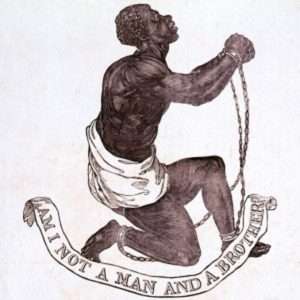
Josiah Wedgewood's famous 1787 image created for the antislavery movement.
It is no accident that the antislavery movement was also accompanied by what historian Kate Masur calls "America's First Civil Rights Movement," which sought equal rights for blacks that went beyond simply abolishing slavery.
While the hypocrisy and contradictions were very real, so too is the fact that Revolution and Founding made abolition possible, in part by giving a boost to universalistic Enlightenment liberalism on both sides of the Atlantic. Among other things, it inspired the First Emancipation in the US (the abolition of slavery in the North that became the first large-scale emancipation of slaves in modern history). Without the First Emancipation, we could not have achieved the second and greater one.
Those principles are at the root of most of America's achievements, of which the abolition of slavery was among the most important. They are also what enabled America, at its best, to offer freedom and opportunity to people from a wide range of racial and ethnic backgrounds from all over the world.
Abraham Lincoln, who issued the Emancipation Proclamation whose belated enforcement Juneteenth celebrates - put it best in his famous speech on the Declaration of Independence and its implications for slavery:
I think the authors of that notable instrument intended to include all men, but they did not mean to declare all men equal in all respects…. They did not mean to assert the obvious untruth, that all were then actually enjoying that equality, or yet, that they were about to confer it immediately upon them…
They meant simply to declare the right, so that the enforcement of it might follow as fast as circumstances should permit.
They meant to set up a standard maxim for free society which should be familiar to all: constantly looked to, constantly labored for, and even, though never perfectly attained, constantly approximated, and thereby constantly spreading and deepening its influence and augmenting the happiness and value of life to all people, of all colors, every where.
The success of the antislavery movement's appeal to liberal universalism has been a model for later expansions of freedom, as well - including equal rights for women, the Civil Rights Movement of the twentieth century, and the struggle for same-sex marriage. It is a model that advocates of migration rights would do well to emulate today.
The work of fully living up to the ideals of the Founding wasn't completed in Lincoln's time, and it remains seriously incomplete even now. But Juneteenth commemorates perhaps our greatest step in the right direction. And it reminds us that further progress towards liberty and equal rights depends on emphasizing the same principles that made abolition possible.
UPDATE: Some commentators on Twitter and elsewhere point out that slavery was not fully abolished on June 19, 1865, which was merely the date when Union troops reached Galveston, Texas, and announced the implementation of the Emancipation Proclamation in one of the last parts of the former Confederacy where it had not yet been implemented. Slavery in the US was not fully banned until the ratification of the Thirteenth Amendment in December 1865. I am well aware of this. But the Juneteenth holiday is nonetheless is meant to commemorate the end of slavery as a whole, and that is in fact how it has been understood for many decades, long before it became a federal holiday.
July 19 is the traditional date for commemoration of abolition, even if it is not the anniversary of the day on which the last vestiges of slavery were actually banned. Similarly, we celebrate Independence Day on July 4, even though July 2, 1776 was the date when the Continental Congress actually voted for independence.
If people want to move the celebration of abolition to some other appropriate date, such as the day of ratification of the Thirteenth Amendment, I don't object. But that's not what most objections to Juneteenth have been about.
From Gregory v. Chohan, decided Friday by the Supreme Court of Texas, in an opinion by Justice Jimmy Blacklock, joined by Chief Justice Nathan Hecht and Justice Brett Busby, and mostly joined by Justice Jane Bland (three Justices didn't participate in the decision, so these four were a majority of the remaining six):
This case arises from a fatal accident on an icy, unlit stretch of highway near Amarillo. An eighteen-wheeler driven by Sarah Gregory jackknifed across lanes of traffic, and the resulting pileup caused four deaths. Among those killed was Bhupinder Deol, a truck driver, but more importantly a husband, son, and father of three.
Deol's wife and family brought a wrongful death action against Gregory and her employer, New Prime, Inc. The jury awarded approximately $16.8 million to Deol's family. Noneconomic damages—awarded to six family members for past and future mental anguish and loss of companionship—accounted for just over $15 million of the total. On appeal, the defendants challenged the size of the noneconomic damages award….
Assigning a dollar value to non-financial, emotional injuries such as mental anguish or loss of companionship will never be a matter of mathematical precision. But when properly called upon, appellate courts have a duty to ensure that the damages awarded for a noneconomic injury are the result of a rational effort, grounded in the evidence, to compensate the plaintiff for the injury…. "[T]here must be evidence that the amount found is fair and reasonable compensation, just as there must be evidence to support any other jury finding." Rather than limit review of noneconomic damages to elastic, impractical standards like the "shocks the conscience" test, our precedent instead requires evidence of both the "existence of compensable mental anguish" and "evidence to justify the amount awarded." …
"While the impossibility of any exact evaluation of mental anguish requires that juries be given a measure of discretion in finding damages, that discretion is limited." No matter the cause of action, the results of litigation should always be justifiable based on evidence and reason. "Juries cannot simply pick a number and put it in the blank." To guard against arbitrary outcomes and to ensure that damages awards are genuinely compensatory, the plaintiff in a wrongful death case should be required to demonstrate a rational connection, grounded in the evidence, between the injuries suffered and the dollar amount awarded.
Mental anguish and loss of companionship damages are neither punitive nor exemplary. They are compensatory. That label is illusory if courts do not require a rational connection between the amount awarded and the evidence of injury. While precision is not required—and surely cannot be achieved when placing a dollar value on the emotional toll of losing a loved one—some rational basis for the size of the judgment is a minimal requirement on which the law must insist.
Here, the plaintiffs produced—and the court of appeals recounted—sufficient, even ample, evidence demonstrating the existence of compensable mental anguish and loss of companionship suffered by Deol's family. But nothing in the record or in the plaintiffs' arguments demonstrates a rational connection between the injuries suffered and the amount awarded. The arguments made to the jury regarding the proper amount included references to the price of fighter jets, the value of artwork, and the number of miles driven by New Prime's trucks. Rather than rationally connect the evidence to an amount of damages, these arguments did just the opposite by encouraging the jury to base an ostensibly compensatory award on improper considerations that have no connection to the rational compensation of Deol's family….
From Basulto v. Netflix, Inc., decided May 25 by Magistrate Judge John Goodman, but just posted on Westlaw:
In this defamation lawsuit against Defendant Netflix, Inc. and other Defendants, certain Defendants known as "the Foreign Defendants" filed a Motion to Dismiss for Lack of Jurisdiction….
As explained below, the Undersigned is recommending that the District Court grant the Foreign Defendants' Motion. However, before turning to the specific legal principles which will inform this recommendation, the Undersigned offers the following introductory remarks about a theme articulated in a business management book:
"Confront the Brutal Facts" and its companion concept, "The Stockdale Paradox," developed in business management consultant Jim Collins' book Good to Great, tout the following principle: a successful person must maintain unwavering faith that he will prevail in the end, regardless of the difficulties, while also having the discipline to simultaneously confront the most brutal facts of the current reality, whatever they might be.
Collins' perspective comes to mind in connection with the motion to dismiss the Undersigned will analyze here. Plaintiffs Jose Basulto and Brothers to the Rescue, Inc. seem to have unbridled confidence in their ability to prevail on the motion and to obtain personal jurisdiction over these Defendants. But, as this ruling will soon explain, Plaintiffs' enthusiastic optimism is not enough to overcome the harsh facts (including a lack of facts) undermining their legal position. In many instances, Plaintiffs either ignore the negative facts, describe them incompletely, omit troublesome aspects, fail to address omitted facts and/or exaggerate the significance of other facts.
The article is here; here are the Introduction and the start of Part I:
Current approaches to content moderation generally assume the continued dominance of "walled gardens": social-media platforms that control who can use their services and how. Whether the discussion is about self-regulation, quasi-public regulation (e.g., Facebook's Oversight Board), government regulation, tort law (including changes to Section 230), or antitrust enforcement, the assumption is that the future of social media will remain a matter of incrementally reforming a small group of giant, closed platforms. But, viewed from the perspective of the broader history of the Internet, the dominance of closed platforms is an aberration. The Internet initially grew around a set of open, decentralized applications, many of which remain central to its functioning today.
Email is an instructive example. Although email is hardly without its content-moderation issues—spam, in particular, has been an ongoing problem—there is far less discussion about email's content-moderation issues than about social media's. Part of this is because email lacks some of the social features that can make social media particularly toxic. But it is also because email's architecture simply doesn't permit the degree of centralized, top-down moderation that social-media platforms can perform. If "ought" implies "can," then "can't" implies "need not." There is a limit to how heated the debates around email-content moderation can be, because there's an architectural limit to how much email moderation is possible. This raises the intriguing possibility of what social media, and its accompanying content-moderation issues, would look like if it too operated as a decentralized protocol.
Fortunately, we don't have to speculate, because decentralized social media already exists in the form of the "Fediverse"—a portmanteau of "federation" and "universe." Much like the decentralized infrastructure of the Internet, in which the HTTP communication protocol facilitates the retrieval and interaction of webpages that are stored on servers around the world, Fediverse protocols power "instances," which are comparable to social-media applications and services. The most important Fediverse protocol is ActivityPub, which powers the most popular Fediverse apps, notably the Twitter-like microblogging service Mastodon, which has over a million active users and continues to grow, especially in the wake of Elon Musk's purchase of Twitter.
Public spaces are public spaces. Public spaces are not private spaces. Public spaces are not majority spaces. The First Amendment of the United States Constitution ensures that all citizens, popular or not, majority or minority, conventional or unconventional, have access to public spaces for public expression….
Plaintiffs Southern Utah Drag Stars, LLC ("Drag Stars") and Mitski Avalōx ("Avalōx") seek their opportunity to speak in the public square through a community drag show which they say conveys messages of diversity, inclusion, and support for individuals with non-traditional gender expression and identities. Drag Stars applied for a special event permit (the "Permit") to hold "Our Allies & Community Drag Show" ("Allies Drag Show") at a public park in St. George, Utah (the "City").
The City denied the Permit based on never-previously-enforced ordinances that prohibit special event advertising until a final event permit is issued. The record shows the use of this prohibition was a pretext for discrimination.
The City also enacted a moratorium barring all new special event permit applications for six months. At the same time the City's two-step blocked Drag Stars from holding the Allies Drag Show for at least six months, the City retroactively exempted the majority of other known violators of the advertising prohibition and exempted major swaths of events from the moratorium….
The court's opinion is long (60 pages) and detailed, so let me focus on the brief section on why the drag show is constitutionally protected speech, and then provide the court's summary of the other matters:
An Evansville woman is behind bars after police say she set an American flag on fire and hung up an ISIS flag….
Authorities say they arrested Sierra Malloy, who made a comment about cutting off two of the officer's heads….
The affidavit shows Malloy had taken down the American flag off Spectrum's flag pole and set it on fire….
Malloy claimed to be ISIS and was saying homophobic slurs to officers.
Malloy was booked into the Vanderburgh County Jail for two counts of communication intimidation, criminal trespass, criminal mischief, and flag desecration.
It is certainly a crime to destroy someone else's flag, like it's a crime to destroy other people's property more generally; that's the criminal mischief charge. But it can't be punished as "flag desecration."
According to the Indictment in U.S. v. Comiskey, the defendant tweeted, about Rep. Lauren Boebert,
"If I ever saw Lauren I'd be glad to take her out and go to prison. Would be job well done."
"Don't worry Lauren, someone is coming soon to show your face the 2nd amendment in practice with a copper jacket. Enjoy."
"Someone needs to put Lauren down like a sick dog. She is a true waste of life! Someone exercise their 2nd amendment right to her face! Since the @CIA is a failure and @FBI is incompetent at charging her for being a terrorist it's time to do it ourselves! Pew pew Lauren."
"I got my 2 amendment tool all ready to destroy Lauren's face! Hopefully in front of her kids."
"[D]on't come to Florida us libs have big guns here and we stand out [sic] ground. Take you down like Trayvon."
Defendant pleaded guilty (and was sentenced Monday), so we don't have more detailed facts about the context here. But on its face, these do indeed seem like constitutionally unprotected "true threats" of criminal conduct. And the court agreed that the indictment sufficiently alleged true threats, despite defendant's argument "that two of the Twitter posts contain conditional statements, while another does not indicate that Defendant 'personally' threatened to shoot the Representative."
Annika Marie Miranda, Karla Albite & Yara Klukas represent the government.
I started teaching in August of 2012. One month earlier, the Court decided NFIB v. Sebelius. And one month later, a cert petition was filed in United States v. Windsor. At the time, I and everyone else recognized that DOMA was doomed. The only question concerned on what grounds the Court would rule. Would it be the Due Process Clause or Equal Protection "component" of the Fifth Amendment? Or would Justice Kennedy adopt a federalism-based argument--perhaps along the lines of a brief submitted by several Volokh conspirators. Ultimately, Justice Kennedy did what he did best: sprinkle a bit of Due Process, grate some Equal Protection, add a pinch of dignity, let it simmer over a low flame of federalism, and voila--Liberty!
No one really cared about the reasoning. What mattered was the bottom line--love wins! And more importantly, Justice Kennedy gave a green light to every judge to strike down marriage laws. But one part of the majority opinion seems especially relevant for Brackeen. The Court discussed at some length why the federal government, historically, "has deferred to state-law policy decisions with respect to domestic relations." Indeed, the Court relied on this principle to show that the federal Defense of Marriage Act was unconstitutional.
One would think that Brackeen should have addressed Windsor. While DOMA merely defined marriage for purposes of federal law, leaving state laws intact, ICWA forces every state to enforce a federal domestic law. But Justice Barrett does not even cite Windsor. Look how quickly she cabins unhelpful precedent:
It is true that Congress lacks a general power over domestic relations, In re Burrus (1890), and, as a result, responsibility for regulating marriage and child custody remains primarily with the States, Sosna v. Iowa (1975). See also Moore v. Sims (1979). But the Constitution does not erect a firewall around family law.
Barrett cites several cases in which federal law pre-empts state family laws. But none of these cases comes even remotely close to what ICWA does. We aren't merely talking about preemption--ICWA dictates, even commandeers, states to award custody of children to tribal members. There is no precedent on point. Rather than cabining non-originalist precedent, Justice Barrett--as well as the other two Trump appointees--quietly extends federal power without any hesitation. And she drags James Madison into this sordid business:
Petitioners are trying to turn a general observation (that Congress's Article I powers rarely touch state family law) into a constitutional carveout (that family law is wholly exempt from federal regulation). That argument is a nonstarter. As James Madison said to Members of the First Congress, when the Constitution conferred a power on Congress, "they might exercise it, although it should interfere with the laws, or even the Constitution of the States." 2 Annals of Cong. 1897 (1791). Family law is no exception.
Justice Alito, in dissent, does cite Windsor, and calls out how unprecedented this holding is:
As the majority observes, we have held that federal legislation that regulates certain "economic aspects of domestic relations" can preempt conflicting state law. . . . But we have never held that Congress under any of its enumerated powers may regulate the very nature of those relations or dictate their creation, dissolution, or modification. Nor could we and remain faithful to our founding. "No one denies that the States, at the time of the adoption of the Constitution, possessed full power over" ordinary family relations; and "the Constitution delegated no authority to the Government of the United States" in this area. Haddock v. Haddock (1906). It is a "most important aspect of our federalism" that "the domestic relations of husband and wife"—and parent and child—are "matters reserved to the States and do not belong to the United States." Williams v. North Carolina (1945).
In Brackeen, Justice Barrett has a heads-I-win-tails-you-lose approach to stare decisis. When the petitioners failed to fully consider every conceivable precedent, they failed to meet their burden. When petitioners identified that precedent does not support the respondents' case, they still failed to meet their burden because the Court set a new precedent.
Justice Scalia in Windsor was right, as always: "The only thing that will 'confine' the Court's holding is its sense of what it can get away with."
Earlier this month, I overheard a conversation during a trip to Florida. A woman on vacation from Ohio was complaining that the Cleveland baseball team changed its name from the Indians to the Guardians. She stated, without any sense of irony, that "natives did not want to change the name." Of course she was referring to baseball fans in Cleveland, who did favored the Indians name--that is, the "native" people in Ohio. I do not think she realized that the people who favored the name change were, quite literally, natives! That is, Native Americans who objected to the Indian name and logo. And, to be precise, there were natives in present-day Ohio before there were white settlers. Still, the people who had the closest connection with the baseball team objected to intermeddling by tribes who cared little for the team's history, but instead, were promoting non-baseball goals that were important to the tribes.
This conversation neatly sums up the dispute between Justice Gorsuch and Justice Alito in Brackeen. (I swear, this conversation actually happened--I couldn't make it up if I tried.)
Let's start with Justice Alito, who is, after all, a big baseball fan. (I do not know if Justice Gorsuch is celebrating the Nuggets' victory.) His dissent states, clearly, that ICWA "subordinat[es] what family-court judges—and often biological parents—determine to be in the best interest of a child to what Congress believed is in the best interest of a tribe." Alito discusses in heart-string-tugging detail the cases of the poor children who were plucked from their loving adoptive families by the meddling tribes. Indeed, one of the children was placed with a maternal grandmother, "who had lost her foster license due to a criminal conviction." Alito is clearly on the side of the adopted parents, and not the tribes. And, for good measure, Justice Alito jabs the tribes in Footnote 1:
The state of affairs on many Indian reservations, however, does not speak well of the way in which these duties have been discharged by this putative trustee. See, e.g., U. S. Commission on Civil Rights, Broken Promises: Continuing Federal Funding Shortfall for Native Americans102–107, 135–138, 156–157, 165–166 (Dec. 2018) (discussing poor performance of students in tribal schools, substandard housing and physical infrastructure on reservations, and high rates of unemployment amongIndians living on reservations).
Why mention these statistics? Alito suggests that these vulnerable children will be placed on reservations where they will be subject to poor living conditions. In other words, the Tribes have not lived up to their ends of the bargain. The implication: better for the kids to stay with non-Indian parents who can serve the best interest of the child.
I suspect Justices Thomas and Alito would contend that the tribes intervening in ICWA cases are not doing so to preserve the best interest of the children--many of whom have no actual connections to Tribes--but instead to promote broader notions of tribal autonomy, in the abstract. To use a phrase from the opinion, the children are mere commodities.
Also on Thursday, the Supreme Court decided Lac du Flambeau Band of Lake Superior Chippewa Indians v. Coughlin. The question presented concerned abrogation of tribal sovereign immunity. But the facts do not paint the Band in particularly favorable light. Coughlin, the plaintiff, took a payday loan from Lendgreen, which is ostensibly operated by the Indian tribe. Coughlin declared bankruptcy, which should have triggered an automatic stay against further collection efforts. But Lendgreen did not stop. Justice Jackson explained, "Coughlin alleges that Lendgreen was so aggressive in its efforts to contact him and collect the money that he suffered substantial emotional distress, and at one point, even attempted to take his own life."
Justice Thomas's dissent suggests that tribal immunity has led to tribal impunity:
Finally, this Court's tribal immunity doctrine continues to artificially exempt tribes from generally applicable laws.I warned nearly a decade ago that tribal immunity "will continue to invite problems, including de facto deregulation of highly regulated activities; unfairness to tort victims; and increasingly fractious relations with States and individuals alike." Id., at 825. This is a case in point. In order to avoid state payday loan regulation, "payday lenders . . . often arrange to share fees or profits with tribes so they can use tribal immunity as a shield for conduct of questionable legality." Ibid. Petitioners here rely on tribal immunity to avoid not only state but also federal payday loan regulation.They further seek to leverage this immunity to pursue respondent on his debt while other creditors' collection efforts are stayed. Tribal immunity thus creates a pathway to circumvent vast swaths of both state and federal laws.
Again, I suspect that Justices Thomas and Alito are skeptical of claims to tribal sovereignty in light of how they exercise that autonomy: business interests that rely on exemptions from generally-applicable state and federal laws, such as gambling, payday lending, and sale of alcohol and tobacco, to say nothing about violent Indian criminal defendants who will not actually be prosecuted by Indian tribes post-McGirt.
Framing matters at the Supreme Court. If you read Justice Gorsuch's concurrence in Brackeen, you would think that ICWA is an essential law to preserve Native American culture and the future of the tribes. Part I of his dissent warns about the "existential threat to the continued vitality of Tribes." But if you read Justice Alito's dissent, you would think that ICWA forces states to surrender vulnerable non-Indian children to poorly-run tribes. On the Supreme Court, and all courts, framing is very important.
One final note. Many media accounts have focused on the fact that Chief Justice Roberts and Justice Barrett have adopted children, which may help explain their vote. But lost in this narrative, as usual, is Justice Thomas. He was de facto adopted by his grandfather and grandmother. Thomas moved from his birthplace of Pin Point, Georgia, which was steeped in Gullah culture, to a much larger city, Savannah, where he was able to obtain a formal education, and start his path to the Supreme Court. (You may have read about that home in Savannah.) Later, Justice Thomas de facto adopted his grandnephew to give him a better life. I would think Justice Thomas's life experiences may have some relevance here. But as usual, he is ignored.
I have much to say about Brackeen. I noted in my earlier post that the primary intellectual joust occurred between Justices Gorsuch and Thomas. Here, I'll start with Justice Barrett's majority opinion. In one sense, the majority opinion is underwhelming. The Court does not break any new ground with regard to the Indian Commerce Clause, fails to fully-explain the so-called plenary power doctrine, and adopts a really narrow conception of redressability to avoid tackling the equal protection issue. (Justice Barrett readily citedCalifornia v. Texas on that last point.) But if you read between the lines, Justice Barrett seems annoyed that the plaintiffs did not present a better case. It seemed like she was open to ruling in favor of the plaintiffs, but their lawyers didn't make the case.
Here's the tell. Search for the word "Petitioners." Over and over again, Barrett refers not to the actual Petitioners--that is, the families challenging ICWA. Rather, she is referring to counsel for Petitioners, and the arguments they make. Barrett consistently knocks the lawyers, led by the Texas Solicitor General, for failing to present fully-developed arguments. I felt like I was reading a Professor grading a student's paper. And Professor Barrett was not pleased.
Consider a sampling:
Petitioners are trying to turn a general observation (that Congress's Article I powers rarely touch state family law) into a constitutional carveout (that family law is wholly exempt from federal regulation). That argument is a nonstarter.
Ticking through the various sources of power, petitioners assert that the Constitution does not authorize Congress to regulate custody proceedings for Indian children. Their arguments fail to grapple with our precedent, and because they bear the burden of establishing ICWA's unconstitutionality, we cannot sustain their challenge to the law.
Even the judges who otherwise agreed with petitioners below rejected this narrow view of the Indian Commerce Clause as inconsistent with both our cases and "[l]ongstanding patterns of federal legislation." 994 F. 3d, at 374–375 (principal opinion of Duncan, J.). Rather than dealing with this precedent, however, petitioners virtually ignore it. [If only the students at Stanford had read Judge Duncan's opinion!]
Once again, petitioners make no argument that takes our cases on their own terms.
Presumably recognizing these obstacles, petitioners turnto criticizing our precedent as inconsistent with the Constitution's original meaning. Yet here too, they offer no account of how their argument fits within the landscape of our case law. For instance, they neither ask us to overrule the precedent they criticize nor try to reconcile their approach with it. They are also silent about the potential consequences of their position. Would it undermine established cases and statutes? If so, which ones? Petitioners do not say.
We recognize that our case law puts petitioners in a difficult spot. We have often sustained Indian legislation without specifying the source of Congress's power, and we have insisted that Congress's power has limits without saying what they are. Yet petitioners' strategy for dealing with the confusion is not to offer a theory for rationalizing this body of law—that would at least give us something to work with.Instead, they frame their arguments as if the slate were clean. More than two centuries in, it is anything but.
If there are arguments that ICWA exceeds Congress's authority as our precedent stands today, petitioners do not make them.
If ICWA commandeers state performance of a "core sovereign function," petitioners do not give us the details.
When a federal statute applies on its face to both private and state actors, a commandeering argument is a heavy lift—and petitioners have not pulled it off.
The individual petitioners do not dispute—or even address—any of this.
And even when Texas tried to reconcile the disparate precedents, Barrett faulted the SG for failing to explain why Congress's powers were so limited:
Texas floated a theory for the first time at oral argument. It said that, taken together, our plenary power cases fall into three buckets: (1)those allowing Congress to legislate pursuant to an enumerated power, such as the Indian Commerce Clause or the Treaty Clause; (2) those allowing Congress to regulate the tribes as government entities; and (3) those allowing Congress to enact legislation that applies to federal or tribal land. Tr. of Oral Arg. 55. According to Texas, ICWA is unconstitutional because it does not fall within any of these categories. We have never broken down our cases this way. But even if Texas's theory is descriptively accurate, Texas offers no explanation for why Congress's power is limited to these categories.
Readers may recall that in Lopez, Chief Justice Rehnquist create somewhat arbitrary categories to describe the Court's Commerce Clause precedents. Texas attempting to do much the same. And Justice Barrett did not even attempt to explain why Texas's buckets were wrong.
Throughout the opinion, Justice Barrett placed the burden squarely on the petitioners--and that burden was staggeringly heavy. In dissent, Justice Thomas acknowledged that some of the arguments were lacking:
While I share the majority's frustration with petitioners' limited engagement with the Court's precedents, I would recognize the contexts of those cases and limit the so-called plenary power to those contexts.
But Justice Thomas countered that the majority inverted the burden:
In the normal course, we would say that the Federal Government has no authority to enact any of this. Yet the majority declines to hold that ICWA is unconstitutional, reasoning that the petitioners before us have not borne their burden of showing how Congress exceeded its powers. This gets things backwards. When Congress has so clearly intruded upon a longstanding domain of exclusive state powers, we must ask not whether a constitutional provision prohibits that intrusion, but whether a constitutional provision authorizes it.
The dissent followed a presumption of liberty. The majority hewed to a presumption of constitutionality. Justice Gorsuch, who in every other context places burdens on the federal government, joined Justice Barrett with alacrity.
There is an unfortunate asymmetry on the current Court. Progressive lawyers can present the most half-baked ideas and still cobble together five votes with ease, because legitimacy. It doesn't even have to be baked! A raw kernel of an idea is enough. The Chief chef will cook up a blue-plate special, and Justice Kavanaugh will ladle it out. But to get Justice Barrett's vote, conservative lawyers need to submit the equivalent of a peer-reviewed law review article that fully considers every possible implication of how the theory affects every Supreme Court decision ever written. Short of that, they are going to lose.
I wrote in January about a New York trial court decision that allowed the New York Attorney General's office to subpoena VDARE's records related to alleged financial self-dealing by nonprofit directors; I quoted extensively from the decision. Peter Brimelow of VDARE has written up a response to the Attorney General's allegations, and I'm glad to pass it along as a counterpoint to the court decision. I've also updated the original post to link to the response.
On Thursday, the Supreme Court decided Haaland v. Brackeen. This 7-2 decision upheld provisions of the Indian Child Welfare Act (ICWA) that governed adoptions of children with some connection to an Indian tribe. The opinion, in total, stretched 133 pages. (Obergefell, by contrast, was only 103 pages!) Justice Barrett's majority opinion was 34 pages. Justice Gorsuch's concurrence, which was joined in part by Justices Kagan and Jackson, was 38 pages long. Justice Kavanaugh wrote a brief solo concurrence. Justice Thomas wrote a 40-page solo dissent. And Justice Alito dropped a pithy ten-pager.
I will have much more to say about this case in a series of posts. For now, you can download the edited version of the case for the Barnett/Blackman 2023 supplement. I've distilled the case down to about 30 pages. If you want to assign this case in class, to be frank, I would simply assign the Gorsuch and Thomas opinions. The majority opinion breaks little ground, and goes out of its way to not decide questions.
More to come soon--and I still have to write about Polansky, Qui Tam, and Justice Souter!
A mom took to TikTok, begging for advice: "My kid was outside, another kid was walking outside somewhere, and then they stopped and started playing together."
She was baffled.
The mom went on to explain that the unknown kid was 8 years old. He was polite and seemed well cared for. He came into the house with her son, and they proceeded to play video games all afternoon. The polite, nameless boy didn't leave for six and a half hours.
Wednesday, May 31, 2023, I finally regained access to my Amazon account after an unexpected and unwarranted lockout that lasted nearly a week, from Thursday, May 25. This wasn't just a simple inconvenience, though. I have a smart home, and my primary means of interfacing with all the devices and automations is through Amazon Echo devices via Alexa. This incident left me with a house full of unresponsive devices, a silent Alexa, and a lot of questions.
I do want to note that since I host many of my own local services and many devices are local only. I only lost the ability to use Alexa. My home was fine as I just used Siri or locally hosted dashboard if I wanted to change a light's color or something of that nature. However, this was a huge over reaction and I'm hoping we as consumers get more protections and will truly be able to own our devices….
The sequence of events that led to this digital exile began innocuously enough. A package was delivered to my house on Wednesday, May 24, and everything seemed fine. The following day, however, I found that my Echo Show had signed out, and I was unable to interact with my smart home devices….
[I] received an email … from an executive at Amazon…. When I connected with the executive, they asked if I knew why my account had been locked. When I answered I was unsure, their tone turned somewhat accusatory. I was told that the driver who had delivered my package reported receiving racist remarks from my "Ring doorbell" (it's actually a Eufy, but I'll let it slide)….