The Volokh Conspiracy

Mostly law professors | Sometimes contrarian | Often libertarian | Always independent | Est. 2002

The Volokh Conspiracy

Free Speech

When State Court Rules Limiting Sealing Aren't Quite Followed ….

|

From Livesay Law Office v. Ricartea, decided Thursday by the Texas Court of Appeals (Corpus Christi-Edinburg), in an opinion by Chief Justice Dori Contreras, joined by Justices Gina Benavides and Nora Longoria, reversing an order by Judge Fernando Mancias:

The underlying case is a divorce proceeding in which appellant … filed a motion for sanctions against … one of the attorneys representing respondent (appellee herein) …. At the final divorce hearing on January 20, 2023, appellee's co-counsel asked "that any motions for sanctions not only be withdrawn but stricken from the court's file completely and sealed." The trial court replied, "They will be." Appellant's co-counsel replied, "I think you were going to do that anyway, Judge." The trial court signed an order on March 23, 2023, granting the oral motion for sanctions, but the order itself was "sealed by the court." {The order states appellant's co-counsel agreed "to seal [the subject] motion for sanctions, all exhibits and all proposed and signed orders associated with [the] motion."} On May 22, 2023, appellant filed a notice of appeal challenging "the order sealing record[s] entered on March 23, 2023." …

On June 15, 2023, we … remanded the case with instructions for the trial court to "determine whether any party has filed a written motion requesting sealing of the subject records." Our order stated, among other things, that "if no party has filed a written motion to seal records, the trial court shall certify that fact in a written order" and shall "cause its written order to be included in a supplemental clerk's record, which shall be filed with the Clerk of this Court within thirty (30) days from the date of this order." On the other hand, if the trial court determined that a party had filed such a motion, we ordered the trial court to conduct proceedings in accordance with Texas Rule of Civil Procedure 76a.

On July 18, 2023, appellant filed a "Notice of Trial Court's Refusal to Comply With This Court's Order," observing that the deadline for the trial court to file its order had passed. On July 26, 2023, appellant filed a "Notice of Trial Court's Continuing Refusal to Comply With This Court's Order," observing that the trial court had still not filed its order pursuant to our directions…. We ordered appellee to file a response to the requests made in appellant's notice on or before 5:00 p.m. on Thursday, August 3, 2023. Appellee did not file a response.
Read More

Free Speech

Court Rejects Lawsuit by Sorority Members Against Sorority for Admitting Transgender Member

The sorority, the court held, had a First Amendment freedom of expressive association right to choose which students to admit (logic that suggests that a sorority would equally be free to exclude transgender members).

|

From Westenbroek v. Kappa Kappa Gamma Fraternity, decided today by Judge Alan Johnson (D. Wyo.) (the defendant is, for historical reasons, labeled a "fraternity," but today it would be described as a sorority):

Embittered by their chapter's admission of Artemis Langford, a transgender woman, six KKG sisters at the University of Wyoming sue their national sorority and its president. Plaintiffs, framing the case as one of first impression, ask the Court to, inter alia, void their sorority sister's admission, find that KKG's President violated her fiduciary obligations by betraying KKG's bylaws, and prevent other transgender women from joining KKG nationwide. A "woman", say Plaintiffs, is not a transgender woman.

Unadorned, this case condenses to this: who decides whether Langford is a Kappa Kappa Gamma sister? Though given the opportunity to vote this past fall, not the six Plaintiffs. Not KKG's Fraternity Council. Not even this federal Court. The University of Wyoming chapter voted to admit—and, more broadly, a sorority of hundreds of thousands approved—Langford. With its inquiry beginning and ending there, the Court will not define "woman" today. The delegate of a private, voluntary organization interpreted "woman", otherwise undefined in the non-profit's bylaws, expansively; this Judge may not invade Kappa Kappa Gamma's freedom of expressive association and inject the circumscribed definition Plaintiffs urge. Holding that Plaintiffs fail to plausibly allege their derivative, breach of contract, tortious interference, and direct claims, the Court dismisses, without prejudice, Plaintiffs' causes of action….

[Plaintiffs'] derivative claim condenses to this: from 1870 to 2018, KKG defined "woman" to exclude transgender women; any new definition may not be enacted, ultra vires, without a KKG bylaw amendment. Expectedly, Defendants counter: private organizations may interpret their own governing documents and define "woman" as including transgender women.

Defendants are correct. Defining "woman" is Kappa Kappa Gamma's bedrock right as a private, voluntary organization—and one this Court may not invade….

First, Ohio law is highly deferential to associational interpretation. "As a general rule, Ohio courts are unwilling to interfere with the management and internal affairs of a voluntary association." More specifically:

Read More

Free Speech

Court Rejects RNC's Lawsuit Claiming Google Discriminatorily Treated RNC's Email as Spam

Section 230, the court says, immunizes good-faith attempts to block spam—and RNC didn't introduce enough evidence of bad faith.

|

From Republican National Comm. v. Google, Inc., decided yesterday by Judge Daniel Calabretta (E.D. Cal.):

[RNC] brings this suit alleging that [Google] has been intentionally misdirecting the RNC's emails to Gmail users' spam folders at the end of each month "to secretly suppress[ ] the political speech and income of one major political party." According to the RNC, "[w]hether Google is characterized as a common carrier, public accommodation, or a business providing a service, California law prohibits Google's spam filtration of RNC emails based on political affiliation and views." Plaintiff seeks recovery for donations it allegedly lost as a result of its emails not being delivered to its supporters' inboxes.

Defendant has moved to dismiss Plaintiff's Complaint on the basis that Plaintiff has failed to plausibly allege its claims, and that section 230 of the Communications Decency Act, 47 U.S.C. § 230, compels the case be dismissed regardless. While it is a close case, the Court concludes that under the pleading standards set forth in Bell Atlantic Corp. v. Twombly (2007) and Ashcroft v. Iqbal (2009), the RNC has not sufficiently pled that Google acted in bad faith in filtering the RNC's messages into Gmail users' spam folders, and that doing so was protected by section 230….

Beginning in December 2021, the RNC observed a drop off of its messages' inboxing rate at the end of the month, a pattern that repeated in every subsequent month in 2022. Compared to other large email providers, Google allegedly diverts a larger percentage of the RNC's emails to spam at the end of every month, and with more consistency.

Read More

Generative AI and VR/AR/Gaming: Complementary Technologies

|

This may be pretty obvious to many readers, but I thought it would be fun to have a discussion about it: Generative AI should sharply propel forward the development of lifelike Virtual Reality and Augmented Reality environments (and of sub-VR visual environments, such as those for many computer games).

That's particularly clear, I think, for art, but it should be especially true of Large Language Models, which will make it much easier for users to have conversations with non-player characters (or their non-game analogs). This should sharply increase the realism and immersiveness of the world. And for games, LLM hallucinations needn't be much of a problem: If part of the game is that you need to talk to NPCs to get hints, or to organize joint activities, LLMs' tendency to brazenly confabulate will just make things more life-like.

But that's just my speculation. What do you folks think about it? In particular, are there computer games, VR/AR or otherwise, that are already creating LLM-based NPCs, or otherwise using generative AI in an interesting way? Please post your thoughts in the comments.

Religion and the Law

No Constitutional Right to Opt out of Sexual-Minority-Themed Curriculum Elements at Public Elementary School

A federal court rejects challengers' Free Exercise Clause and parental rights claims.

|

From Mahmood v. McKnight (D. Md.), the quick factual summary (the opinion is long, so, as usual, I've had to excerpt heavily):

In this lawsuit, parents whose elementary-aged children attend Montgomery County Public Schools ("MCPS") seek the ability to opt their children out of reading and discussion of books with lesbian, gay, bisexual, transgender, and queer characters because the books' messages contradict their sincerely held religious beliefs about marriage, human sexuality, and gender. Last school year, MCPS incorporated into its English language arts curriculum a collection of storybooks featuring LGBTQ characters (the "storybooks" or "books") in an effort to reflect the diversity of the school community.

Initially, parents could opt their children out of reading and instruction involving the books, as they could with other parts of the curriculum. In March of this year, the defendants—the Montgomery County Board of Education, the MCPS superintendent, and the elected board members (collectively, the "School Board")—announced that parents no longer would receive advance notice of when the storybooks would be read or be able opt their children out. Following the announcement, three families of diverse faiths filed suit against the School Board ….

This didn't unconstitutionally burden the parents' or students' Free Exercise Clause rights, the court held:

In their declarations, the parents claim a sacred obligation to teach their children their faiths and their religious views on family structure, gender, and human sexuality. Mahmoud and Barakat state their faith prohibits prying into others' private lives and discourages public disclosure of sexual behavior. They state it would violate their religious beliefs and the beliefs of their children if their children "were asked to discuss romantic relationships or sexuality with schoolteachers or classmates." They also state "[i]ntentionally exposing" their children to contrary instruction would conflict with their religious obligations.

The Romans state their child loves his teachers and implicitly trusts them, so "[h]aving them teach principles about sexuality or gender identity that conflict with [their] religious beliefs significantly interferes with [their] ability to form his religious faith and religious outlook on life and is spiritually and emotionally harmful to his well-being." The Persaks state "exposing" their children to viewpoints that contradict their beliefs "conflicts" with their religious duties and "undermines [their] efforts to raise [their] children in accordance with [their] faith …." Finally, Morrison, a board member of Kids First, states her religious obligations are "pressured" by the books because "it is practically impossible for [her and her husband] to contradict" contrary instruction due to her child's learning disability, which prevents her from understanding their disagreement with the books and differentiating their instruction from her teachers' instruction. Morrison also states she has no realistic alternative to public school for her child's education.

The Court begins with the asserted burden on the children's religious exercise. The plaintiffs contend not allowing opt-outs from the storybooks exerts "behavioral pressure" on the children to "modify their religious beliefs and behavior." The pressure comes from the books' calls to action and introspection and the inevitable teacher-led discussion, which advance the School Board's express goal to normalize an inclusive environment. In essence, the plaintiffs argue that by being forced to read and discuss the storybooks, their children will be pressured to change their religious views on human sexuality, gender, and marriage….

Read More

Free Speech

Joke "We Need You Brad Pitt" Post at Start of COVID Pandemic Protected by First Amendment

The post led to the author being arrested for "terrorizing"; so clearly unconstitutional that the police officer lacks qualified immunity, says the Fifth Circuit.

|

From today's Fifth Circuit decision in Bailey v. Iles, written by Judge Dana Douglas and joined by Judges Patrick Higginbotham and James Graves:

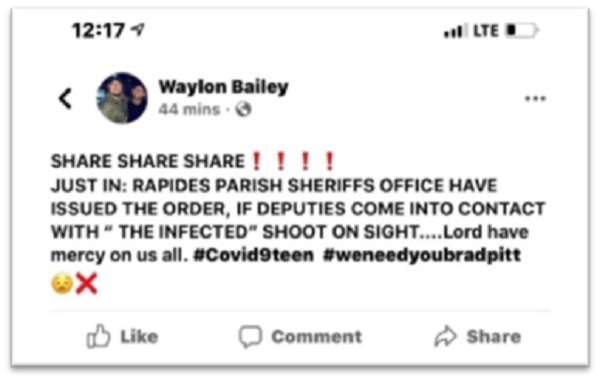
Bailey lives in Rapides Parish in central Louisiana. On March 20, 2020—during the first month of the COVID-19 pandemic—he posted this on Facebook:

Bailey intended the post as a joke and did not intend to scare anyone. The "hashtag" "#weneedyoubradpitt" referenced the zombie movie World War Z, starring Brad Pitt. Bailey included the hashtag to "bring light to the fact that it was a joke." He was bored during the COVID-19 lockdown and used Facebook to keep in touch with friends and "make light of the situation."

Bailey's post was in response to another friend—Matthew Mertens— posting a joke about COVID, and Mertens understood Bailey's post to be a joke. The two continued to post comments underneath Bailey's post. Merterns posted "lol and he [referring to Bailey] talking about my post gonna get flagged � he wins." Bailey posted "this is your fault" and "YOU MADE ME DO THIS." Another person, who Mertens later identified as Bailey's wife, also jokingly commented "I'm reporting you."

Shortly after Bailey posted, Detective Randell Iles was assigned by the Rapides Parish Sheriff's Office (RPSO) to investigate. Iles' supervisors were  concerned that the post was a legitimate threat; Iles testified at his deposition that he thought that the post was "meant to get police officers hurt." Iles looked at the post and the comments and concluded that Bailey had committed "terrorizing" in violation of Louisiana Revised Statute § 14:40.1. Iles had no information regarding anyone contacting RPSO to complain about the post or to express fear, or if any disruption had occurred because of the post….

According to Bailey, he was working in his garage when as many as a dozen deputies with bullet proof vests and weapons drawn approached him and ordered him to put his hands on his head, after which Iles told him to get on his knees and handcuffed him. While Bailey was handcuffed, one of the deputies (not Iles) told him that the "next thing [you] put on Facebook should be not to fuck with the police" and the deputies laughed….

Read More

Free Speech

No Pseudonymity or Sealing for Japanese User Seeking to Use American Courts to Subpoena Twitter Critics' Names

"Applicant's warning of a prima facie violation of Japanese law's privacy protections fails to constitute a harm severe enough" to justify pseudonymity.

|

In Doe v. X Corp., decided Monday by Magistrate Judge Sallie Kim (N.D. Cal.), plaintiff—who operates the account @Midnight_Tokyo, which has >50K followers—had asked an American court for an order that would require Twitter

 to identify a wrongdoer operating certain Twitter Accounts '@suan_news' and '@suan_team' … who engaged in privacy invasion under Japanese tort law. The privacy invasion occurred by disclosure of direct messages on Twitter and of the information which could be taken to be Applicant's real name and Applicant's specific attributes such as the Applicant's occupation….

In this case, the wrongdoer, by creating an open chat, encouraged and enticed Twitter users and readers of the articles to identify who is the operator of the Applicant's Account. As a result of the conduct, more than 1000 people joined the open chat eagerly seeking and providing information to identify Applicant as the operator of the Twitter Account.

The goal of the order is to use the defendants' identities in a Japanese court proceeding.

Plaintiff sought to proceed pseudonymously, and with certain identifying documents filed under seal, but the court said no. First, as to sealing:

Read More

Guns

Second Amendment Roundup: Looking for Historical Tradition in All the Wrong Places

The Government drops reference to the slave codes as a historical analogue in Rahimi.

|

"The Government … points to laws in several colonies and states that disarmed classes of people considered to be dangerous, specifically including … slaves," noted the Fifth Circuit in U.S. v. Rahimi.  Applying the Supreme Court's test in N.Y. State Rifle & Pistol Ass'n v. Bruen, the court found the federal ban on gun possession by a person with a domestic violence restraining order (DVRO) to lack Founding-era precedent and hence violates the Second Amendment.

In its merits brief in the Supreme Court, the Government drops any mention of slavery like a hot potato.  However, it cannot escape the racist taint of so many historical gun laws.  It approvingly cites California's "Greaser Act" of 1855 which provided: "All persons who are commonly known as 'Greasers' or the issue of Spanish and Indian blood, … and who go armed and are not known to be peaceable and quiet persons, and who give no good account of themselves, may be disarmed by any lawful officer, and punished otherwise as provided in the foregoing section."  That was 90 days at hard labor.

The Second Amendment recognizes the preexisting "right of the people to keep and bear arms," which laws like the above violated.  The Government devotes several pages under the heading: "History confirms that Congress may disarm persons who are not law-abiding, responsible citizens."  While Bruen made reference to "law-abiding, responsible citizens," it did not purport to substitute that term for "the people."  As the Greaser Act illustrates, the Government places no limit on what laws are passed and thus who is "law-abiding."

Read More

Free Speech

What Does "Maliciously" Mean, When an Extortion Statute Bans "Maliciously Threaten[ing]"?

|

From Tomlinson v. State, decided today by the Florida Supreme Court, in an opinion by Justice John Couriel:

Kevin Tomlinson threatened to ruin the reputation of two fellow real estate brokers unless they paid him. Must the State prove that Tomlinson made this threat with hatred for the complainants in seeking a conviction under Florida's extortion law? …

In April 2015, Kevin Tomlinson filed a complaint with the Miami Association of Realtors (MAR) alleging that two brokers, Jill Hertzberg and Jill Eber, known in the market as "the Jills," were preventing other brokers from courting their clients by manipulating data in a listing service that MAR operated. In their response to the complaint, the Jills took responsibility for altering the data. Nonetheless, the grievance process continued.

Tomlinson demanded that the Jills pay $400,000, or else he was "going to ruin" them "by, among other things, 'call[ing] the Wall Street Journal' and convincing the Florida Department of Business and Professional Regulation to take away the Jills' real estate licenses." "He told [Hertzberg] that her reputation was at risk, and that he did not want her 'beautiful career to be marred.' He also mentioned that other brokers were interested in filing similar complaints, but that he had no desire to 'corral all these people who want to bring down the Jills.'" They agreed to the $400,000 (apparently as part of a police-supported arrangement to gather evidence against him), but he upped the demand to $800,000.

Tomlinson was convicted of extortion under Florida Statutes § 836.05, which at the time provided (emphasis added):

Whoever … maliciously threatens to accuse another of any crime or offense, or by such communication maliciously threatens an injury to the person, property or reputation of another, or maliciously threatens to expose another to disgrace, or to expose any secret affecting another, or to impute any deformity or lack of chastity to another, with intent thereby to extort money or any pecuniary advantage whatsoever, or with intent to compel the person so threatened, or any other person, to do any act or refrain from doing any act against his or her will, shall be guilty of a felony of the second degree ….

Read More

Free Speech

California Public Records Requester Can File Anti-SLAPP Motion Objecting to Attempt to Block Request

The motion allows early dismissal of a lawsuit, here the lawsuit that aimed to block UC Irvine from responding to a public records request from the Center for Scientific Integrity (the Retraction Watch people).

|

From today's California Court of Appeal opinion in Iloh v. Regents of U.C., decided by Justice Thomas Goethals, joined by Justices Maurice Sanchez & Joanne Motoike; this case is important because it lets anti-SLAPP motions be brought not just by defendants who are being directly sued (here, that's the UC) but also by the "real parties in interest" whose public records request triggered the lawsuit:

The Center for Scientific Integrity (CSI) is an organization that reports on academic retractions and accountability. CSI wrote an article about Constance Iloh, a professor at the University of California, Irvine (UCI), after several academic journals retracted articles Iloh had written due to concerns about possible plagiarism or inaccurate citation references. In a follow-up to that article, CSI sent UCI a records request under the California Public Records Act (CPRA) …, requesting Iloh's postpublication communications with the journals and UCI.

Iloh filed a petition for writ of mandate, declaratory relief, and injunctive relief against UCI to prevent disclosure of her communications, and later added CSI as a real party in interest. She then filed a motion for preliminary injunction to prevent disclosure. Meanwhile, CSI filed a motion to strike Iloh's petition under the anti‑SLAPP (strategic lawsuit against public participation) statute.

Our first opinion in this case concerned Iloh's motion for preliminary injunction. The trial court denied that motion on the grounds that Iloh had not established a likelihood of prevailing on the merits, and we affirmed that order.

We now consider CSI's anti-SLAPP motion. The trial court denied the motion, finding that although protected activity may have led to the petition, it was not the "basis" for the petition. We disagree. In issuing the CPRA request, CSI was engaging in newsgathering so it could report on matters of public interest, such as how a public university funded largely by taxpayer dollars resolves quality or integrity problems in its professors' publications. CSI was therefore engaged in protected activity when it issued the CPRA request.

Iloh filed her petition for writ of mandate to prevent UCI from complying with CSI's CPRA request. By targeting and seeking to impede CSI's newsgathering activity, Iloh's petition threatens to chill CSI's speech-related processes like newsgathering; if successful, this could inhibit CSI's exercise of free speech. This is the type of lawsuit the anti-SLAPP statute is designed to address, and it should be stricken if Iloh cannot demonstrate a probability of prevailing on her petition.

Read More

Right of Access

Court Rejects Lawsuit Claiming Police Discriminatorily Refused to Prosecute Rapist

The opinion was decided July 21, but was originally issued sealed; it was just unsealed today, in response to my motion to unseal.

|

From Judge William S. Stickman IV's opinion in Doe v. Northern Regional Police Dep't of Allegheny County (W.D. Pa.):

Plaintiff Jane Doe … [sued] to address purported violations of her constitutional rights arising from an incident with a male student, A.M., during the school day at Pine-Richland High School. She contends that due to the "shoddy, unprofessional, and inadequate investigation" undertaken by Defendants, A.M. was never prosecuted….

During the school day of January 7, 2019, Plaintiff, a "Latinx female," who was born in Guatemala and identifies as "Mayan/Native (Central) American," and "is of Hispanic origin," contends that she was "secluded" "in a school restroom where, ignoring her pleas to stop and physical resistance, [A.M.] restrained her, vaginally raped her with his penis, finger and tongue, forced her to perform oral sex, and attempted to anally rape her." She reported the incident to Pine-Richland High School personnel, law enforcement, and medical personnel that day.

{Before her parents arrived, Plaintiff began to provide school officials with a handwritten statement. When her parents arrived, she was directed to stop writing. Therefore, Plaintiff's statement was "unfinished" and "incomplete." According to Plaintiff, it "did not include the multiple additional forced penetration offenses that occurred, the multiple acts of indecent assault and sexual assault that occurred, or [her] attempts to escape." Her statement, which only described two of the five acts of forcible penetration committed against her, was given to Detective Rick by school personnel.} {That evening, Plaintiff gave a statement to medical personnel at the hospital. Three months later, she gave another statement in connection with a Sexual Violence Protection Order she obtained against A.M.} As to her report to law enforcement, Plaintiff gave a videorecorded statement to Detective Rick, a white male, at the Northern Regional Police Department in the presence of her mother.

Read More

Voices for Liberty Symposium on Civil Rights and Free Speech, 9/22, Registration Open!

|

REGISTRATION OPEN: Voices for Liberty Symposium on Civil Rights and Free Speech

FRIDAY, SEPTEMBER 22, 2023 | Antonin Scalia Law School and Virtual

Visit our webpage for details and registration: https://tinyurl.com/3t9d63j8

* * * * * * * * * *

Does free expression help or harm the cause of social progress?

Join senior scholars and exciting new voices presenting cutting-edge research on the role freedom of speech plays in advancing civil rights movements (past, present and future). Academic research into this important topic has been surprisingly limited. Scholars will present new papers exploring whether free expression entrenches an unjust status quo or provides critical support for groups wishing to challenge it.

Don't miss keynote speakers Jonathan Rauch and Nadine Strossen!

Voices for Liberty, an initiative of the Liberty and Law Center at George Mason's Antonin Scalia Law School, aims to broaden debates about freedom of speech through new scholarship, campus speakers, and public events. 

Questions? vfli@gmu.edu

Free Speech

Federal Judge: "Public Interest" Requires That Restrictions on "Medical Misinformation" Not Be Enjoined

So a court concludes in a case brought by presidential candidate Robert F. Kennedy, Jr.

|

In Kennedy v. Google, decided yesterday by Judge Trina Thompson (N.D. Cal.), plaintiff sued Google and YouTube claiming that they violated his First Amendment rights by removing videos in which he speaks about vaccines, and seeking a temporary restraining order:

On March 3, 2023, Kennedy spoke at Saint Anselm College's New Hampshire Institute of Politics. The speech centered around Kennedy's concerns about the merger of corporate and state power as related to the number of vaccines children take. He also spoke about his environmental and legal work fighting corporate polluters. On or about the same day, Manchester Public Television posted a video of the speech and YouTube removed it…. Plaintiff alleges that YouTube [also] removed … [the video] "RFK on Joe Rogan – Pfizer COVID Vaccine Trial." …

The court rejected Kennedy's First Amendment claim against Google, reasoning (correctly and unremarkably, I think) that Google isn't the government and thus isn't bound by the First Amendment, and any government interaction with Google urging it to remove certain speech about vaccines wasn't enough to make Google into a government actor.

But the court then went through the other preliminary injunction factors, and said the following (among other things):

Even if Plaintiff could establish that a Google was a state actor attributing its conduct to that of the governments, the rights guaranteed under the First Amendment are not unencumbered by any restrictions:

[I]t is well understood that the right of free speech is not absolute at all times and under all circumstances. There are certain well-defined and narrowly limited classes of speech, the prevention and punishment of which has never been thought to raise any Constitutional problem. These include the lewd and obscene, the profane, the libelous, and the insulting or 'fighting' words—those which by their very utterance inflict injury or tend to incite an immediate breach of the peace. It has been well observed that such utterances are no essential part of any exposition of ideas, and are of such slight social value as a step to truth that any benefit that may be derived from them is clearly outweighed by the social interest in order and morality.

Chaplinsky v. New Hampshire (1942). "The Ninth Circuit has consistently recognized the significant public interest in upholding First Amendment principles." However, there is also a strong public interest in protecting the community from an international public health crisis such as the COVID-19 pandemic…. The coronavirus still poses a health risk to certain individuals, and it would not serve the public interest to let medical misinformation proliferate on YouTube.

That strikes me as remarkable. It suggests either that

Read More

More