The Volokh Conspiracy

Mostly law professors | Sometimes contrarian | Often libertarian | Always independent | Est. 2002

The Volokh Conspiracy

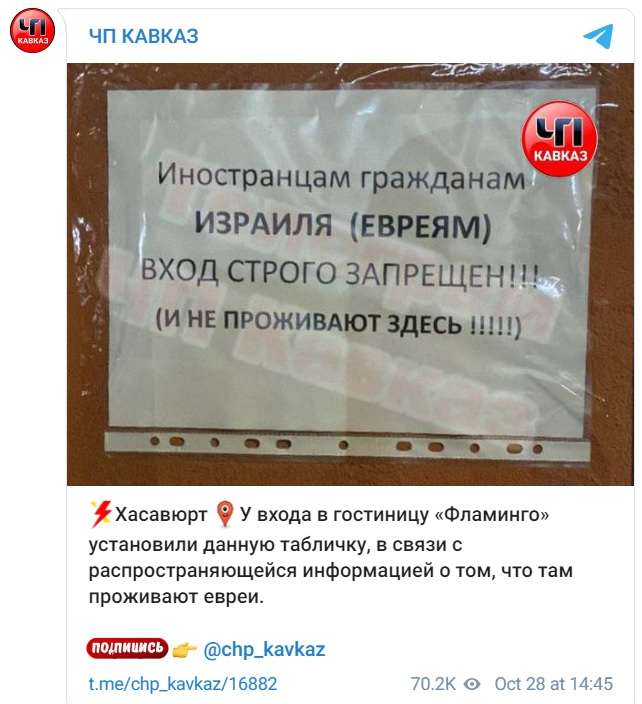
Attacks on Jews in Southern Russia (Northern Caucasus)

"For foreign citizens of Israel (Jews) entrance is strictly forbidden!"

|

The sign says:

For foreign citizens
of Israel (Jews)
entrance is strictly forbidden!!!
(And they aren't staying here!!!!!)

The caption, from a Russian-language Telegram channel, says:

Khasavyurt [a city in Dagestan, north of Azerbaijan] / This sign was placed at the entrance to the hotel "Flamingo," in connection with rumors that Jews were staying there.

Read More

Chemerinsky: "Nothing has prepared me for the antisemitism I see on college campuses now"

"I call on my fellow university administrators to speak out and denounce the celebrations of Hamas and the blatant antisemitism that is being voiced."

|

Erwin Chemerinsky, the dean of Berkeley Law School, authored a powerful essay in the Los Angeles Times. He recounts the anti-semitism he has seen with his own eyes and ears on campus:

But none of this prepared me for the last few weeks. On Friday, someone in my school posted on Instagram a picture of me with the caption, "Erwin Chemerinsky has taken an indefinite sabbatical from Berkeley Law to join the I.D.F." Two weeks ago, at a town hall, a student told me that what would make her feel safe in the law school would be "to get rid of the Zionists." I have heard several times that I have been called "part of a Zionist conspiracy," which echoes of antisemitic tropes that have been expressed for centuries.

These incidents are, regrettably, becoming more and more common. I've heard many horror stories over the past few weeks. Anti-Semitism is as old as civilization itself. It never vanishes. In every generation, anti-semitism simply manifests in different forms.

Virtually every law school has courses of critical racial studies. Query how much of that curriculum focuses on anti-semitism? Every law school has a DEI department. Query how much of that programming focuses on anti-semitism? I suspect the answer to both questions is very little. Indeed, in 2021, Stanford's DEI Department said the quiet part out loud. They do not focus on anti-semitism as not to diminish discussion of anti-black racism. And, anti-semitism is not as important because Jews can hide behind their white privilege.

I was first exposed to this line of thinking when I was protested at CUNY Law School in 2018. I saw, with my own eyes, a woke mob. I learned quite a bit. One of the more jarring experiences was being called a white supremacist and a Nazi. My grandparents, who were both Holocaust survivors, could never have fathomed their grandson would be called a Nazi. One of the students engaged me, and explained that as a Jewish person, I was both an "oppressor" (because of my white privilege) and I was "oppressed" (because I was Jewish). This sort of dichotomy is textbook CRT. Everyone must be separated based on their level of victimhood. Those at the top of the oppression pyramid can dictate the terms of engagement for those at the bottom of the pyramid. I was inserted somewhere in the middle of that pyramid, but still, my role was constrained. Anti-semitism simply does not matter enough when other, more oppressed people, are being victimized. David Bernstein's recent post is a must-read on this point.

Fast-forward to the summer of 2022. Before and after Dobbs, I wrote about Jewish people raising RFRA objections to abortion laws. I fully expected that I would be attacked for my views. Critics would say I am wrong about RFRA, wrong about Jewish teachings on abortion, and wrong to suggest that some people raising these claims are insincere. What I didn't expect was the claim that I was an anti-semite. I received many emails, voicemails, and other missives to this effect. (I do not read my Twitter notifications, so I'm sure that claim was rampant on social media). It was so easy for critics--including many Jews--to call me an anti-semite.

Yet today, there is an utter unwillingness to label anything anti-semitism. Here is Chemerinsky again:

Of course, criticism of the Israeli government is not antisemitism, any more than criticizing the policies of the United States government is anti-American. I strongly oppose the policies of the Netanyahu government, favor full rights for Palestinians, and believe that there must be a two-state solution. But if you listen to what is being said on college campuses now, some of the loudest voices are not advocating for a change in Israeli policies, but are calling for an end to Israel. Students regularly chant, "from the river to the sea, Palestine will be free" and "We don't want no two states, we want all of 48," referring to going back to 1948 before Israel existed.

An oft-repeated mantra among some is that Israel is a settler colonialist country and should be forced to give the land back to the Palestinians. I have no idea how it would be determined who is rightly entitled to what land, but I do know that calling for the total elimination of Israel is antisemitic.

And Chemerinsky issues a call to all of the silent administrators across the nation:

There has been enough silence and enough tolerance of antisemitism on college campuses. I call on my fellow university administrators to speak out and denounce the celebrations of Hamas and the blatant antisemitism that is being voiced.

Yasher Koach.

Second Amendment Roundup: NYC's "Good Moral Character" Requirement Void

An official may not deny the right to possess a firearm based on subjective criteria.

|

On Oct. 24, Judge John P. Cronan of the Southern District of New York rendered summary judgment in favor of an applicant for a license to possess firearms who had been denied for supposed inadequate "good moral character."  The case is Srour v. City of New York.

There were actually two license denials, one for a license to possess a rifle or shotgun, the other to possess a handgun.  The pre-Bruen denials recited Srour's alleged 28 moving violations and 30 driver's license suspensions (wow!) as "reflecting negatively on your moral character."  After he filed his Second Amendment lawsuit, Bruen was decided.  Srour then withdrew his as-applied challenge, rendering discovery unnecessary, and proceeded with his facial challenge.

The rule that a facial challenge can succeed only if a law is invalid in all applications, the court found, does not apply when the law implicates "fundamental rights protected by the Constitution. And as Bruen stated, "when the Second Amendment's plain text covers an individual's conduct, the Constitution presumptively protects that conduct."

The burden then shifts to the state to demonstrate that its restriction is consistent with America's history of firearm regulation.  In footnote 6, Judge Cronan noted: "In their briefing, Defendants at times seem not to appreciate that it is their burden to come forward with evidence that the challenged regulations are consistent with our country's historical tradition of firearm regulation."  He then quotes two passages in which the City tried to flip the burden upside down.

Read More

Politics

Short Circuit: A Roundup of Recent Federal Court Decisions

Drone speech, roofer speech, and quasi-judicial speech.

|

Please enjoy the latest edition of Short Circuit, a weekly feature written by a bunch of people at the Institute for Justice.

In Texas, Louisiana, and Mississippi, public school employees who use unconstitutional violence against students—and those who ignore such violence—enjoy complete immunity from Section 1983 claims. That is bananas, and this week we asked the Supreme Court to put a stop to it (and also to resolve a split between nine other circuits on how such claims should be handled). Click here to learn more.

Read More

Free Speech

Settlement of University of Wyoming "God Created Male and Female and Artemis Langford Is a Male" Case

|

I wrote about the court decision in favor of plaintiff back in August; now I see that the parties have settled, and are asking for court approval of the following consent order:

1. Defendants are hereby permanently enjoined from censoring Schmidt's views on the sexual identity of Artemis Langford and from applying the one-year table ban on Schmidt that was initiated on December 7, 2022.
2. This injunction does not diminish Defendants' ability to sanction possible future misbehavior by Schmidt, such as continuing to engage with students who do not wish to speak with him.
3. Defendants shall pay certain attorney fees and expenses in the amount of $35,000 within 20 days of this Order….

Here's my original post:

[* * *]

From Schmidt v. Siedel, decided yesterday by Judge Nancy Freudenthal (D. Wyo.) (see also the coverage in Cowboy State Daily (Clair McFarland), and this post about a pseudonymity issue in a lawsuit stemming from the sorority controversy):

Schmidt is an elder at the Laramie Faith Community Church…. He has reserved a table in the UW Union breezeway on a regular basis for the past 17 years. The UW Union allows campus groups and various outside organizations to utilize breezeway tables to communicate with students. The breezeway tables provide access to a high degree of student pedestrian traffic. Schmidt uses his breezeway table to display various DVDs and books. He also places on his table a Velcro-backed sign with plastic lettering to display different messages.

Read More

Free Speech

Advocacy in Support of Hamas vs. Illegal Material Support of Hamas

Whether Florida may order universities to derecognize Students for Justice in Palestine chapters would likely turn on whether there's evidence on sufficient coordination between them and the national SJP, and the national SJP and Hamas.

|

[UPDATE 11/1/2023, 4:12 pm: Here's an open letter on this subject sent today by the ACLU.]

FIRE wrote this letter Wednesday to various Florida public universities:

FIRE is deeply concerned by reports [link] that Florida's public universities … have been ordered by State University System of Florida Chancellor Ray Rodrigues, at the behest of Florida Governor Ron DeSantis, to derecognize campus chapters of Students for Justice in Palestine due to their affiliation with National Students for Justice in Palestine, which distributed a guide to protests to its student chapters. {The guide [link] called for "a national day of resistance from the student movement for Palestine liberation on college campuses" on October 12 and provided an RSVP link for a meeting on "'how to organize a protest,' including roles, security, media training, and more," as well providing additional ways to engage in the movement should protest not be possible, including teach-ins and writing local statement of solidarity. It also includes information about the organization's messaging and framing, hashtags for social media use, and graphic templates..}

By insupportably alleging that communications about campus protests from the national organization to its campus chapters constitutes material support for Hamas' terrorist activity overseas, this order unlawfully threatens students' clear expressive and associational rights under the First Amendment. To avoid violating clearly established law, [Florida universities] must not comply with the order.

In a letter to all State University System of Florida presidents on Monday [link], Rodrigues said that "based on National SJP's support of terrorism, in consultation with Governor DeSantis, the student [SJP] chapters must be deactivated. These … student chapters may form another organization that complies with Florida state statutes and university policies."

Read More

Free Speech

Court Upholds Denial of Pseudonymity to Plaintiff in #TheyLied Libel Suit Stemming from Title IX Complaint

"Appellant wants the option to hide behind a shield of anonymity in the event he is unsuccessful in proving his claim, but he would surely identify himself if he were to prove his claims."

|

In yesterday's Doe v. Doe, defendant Jane Doe had filed a Title IX complaint against fellow Tulane student John Doe: Both Jane and another student (not a party to the case), Sue Roe, had "reported having consensual sex with [John], falling asleep, and waking up to him engaging in sexual activity." Tulane found John "responsible for sexual misconduct" and expelled him, but

[John] alleges that [Jane's] statement to Tulane investigators was false, defamatory, and contradicted by other evidence, and that [Jane] conspired with Sue Roe and submitted false evidence in the course of the investigation.

John therefore sued Jane for, among other things, libel, and sought to proceed pseudonymously, but the District Court rejected that request, and the Fourth Circuit upheld that decision. Much of the Fourth Circuit's analysis turns on the appellate standard of review, which is for "abuse of discretion," so the Fourth Circuit's holding is simply that the District Court didn't seriously err in denying pseudonymity—the Fourth Circuit did not hold that courts must deny pseudonymity in such situations. Nonetheless, the court had some general things to say that I expect will be relevant for future cases:

[1.] Many courts have allowed plaintiffs suing universities based on allegedly unfair Title IX proceedings to proceed pseudonymously (though some have disagreed) (see pp. 1441-48 of this article). But the Fourth Circuit rejected the argument that the connection to the Title IX proceeding justifies pseudonymity here:

Read More

Free Speech

Scientific Journal Dismisses Editor-in-Chief for Endorsing Onion Item on Gaza and Israel

|

Science reports:

Michael Eisen, editor-in-chief of the prominent open-access journal eLife and longtime critic of traditional journals, says he is losing that job for publicly endorsing a satirical article that criticized people dying in Gaza for not condemning the recent attacks on Israel by the Palestinian group Hamas.

"I have been informed that I am being replaced as the Editor in Chief of @eLife for retweeting a @TheOnion piece that calls out indifference to the lives of Palestinian civilians," Eisen posted on the social media platform X today. Multiple editors at eLife or advisers to the journal have already resigned to protest his dismissal.

eLife subsequently confirmed the firing in a statement, saying: "Mike has been given clear feedback from the board that his approach to leadership, communication and social media has at key times been detrimental to the cohesion of the community we are trying to build and hence to eLife's mission. It is against this background that a further incidence of this behaviour has contributed to the board's decision." …

[A day after his original post but before the firing], [Eisen] posted, "Every sane person on Earth is horrified and traumatized by what Hamas did and wants it to never happen again. All the more so as a Jew with Israeli family. But I am also horrified by the collective punishment already being meted out on Gazans, and the worse that is about to come.… The Onion is not making light of the situation. And nor am I. These articles are using satire to make a deadly serious point about this horrific tragedy."

It may well be that the removal also stems in part from friction between Eisen and others in the past (see this Nature article); but as I understand the quoted eLife statement and the credible-seeming press accounts surrounding it, his statements here were indeed the immediate cause of the dismissal. [UPDATE 10/27/23, 9:04 pm: Here's eLife's statement, which likewise says, "Mike has been given clear feedback from the board that his approach to leadership, communication and social media has at key times been detrimental to the cohesion of the community we are trying to build and hence to eLife's mission. It is against this background that a further incidence of this behaviour has contributed to the board's decision."]

I'm at a conference and can't get into this in more detail, but if the facts are as reported, it seems to me that eLife behaved in a way that scientific institutions (including journals) ought not behave. I'm with the professor quoted below:

Read More

Westchester County and Planned Parenthood Attempt to Manipulate SCOTUS Jurisdiction To Save Hill v. Colorado

Abortion groups urge adoption of "bubble" around abortion clinic, and before cert is filed, urge repeal of "bubble."

|

Before Dobbs was decided, I identified the epicycles of Roe--the distortions of various areas of constitutional law that stemmed from the abortion "ad hoc nullification" machine. One such precedent was Hill v. Colorado (2000). This case upheld a ban on sidewalk counselors approaching women near abortion clinics--they had to stay eight feet away. In dissent, Justice Scalia charged, "What is before us, after all, is a speech regulation directed against the opponents of abortion, and it therefore enjoys the benefit of the 'ad hoc nullification machine' that the Court has set in motion to push aside whatever doctrines of constitutional law stand in the way of that highly favored practice." And in Dobbs, Justice Alito referred to Hill as a "distortion" of First Amendment law. Hill is not long for this world.

Shortly after the Dobbs draft opinion was leaked, Planned Parenthood urged Westchester County (an affluent suburb of New York) to enact an eight-foot buffer zone. The County Attorney acknowledged that Hill may be on the chopping block, but it was still good law. Five days after Dobbs was decided, Westchester County enacted the exact same law at issue in Hill. Debra Vitagliano, who counseled women near abortion clinics, challenged the law. During the litigation, Planned Parenthood called the bubble law "critical" to protect abortion rights, and was "narrowly tailored." As could be expected, Westchester relied on Hill and the lower courts agreed. The Second Circuit upheld the law on June 21, 2023.

But a funny thing happened three weeks later: Planned Parenthood had a change of heart! On July 10, 2023, Planned Parenthood wrote a letter urging the County to repeal the "bubble" zone law.

Since the passage of the Reproductive Health Care Facilities Access Act last year, we have not seen how the 8-foot bubble zone has been beneficial to patients and guests entering and leaving our health centers. The bubble zone provision of the legislation is unenforceable, and therefore disrupts the integrity of the legislation's overall ability to achieve its goal of protecting patients of reproductive health care facilities. Repealing the bubble zone provision will, in fact, strengthen the Reproductive Health Care Facilities Act by making the protections of the law more concrete and clearer for all people to understand.

A law that was "critical" and "narrowly" tailed was suddenly no longer "beneficial." That same day, the National Institute for Reproductive Health also wrote a letter to the County to urge them to repeal the law. What a coincidence!

On July 21, 2023, Vitagliano filed her cert petition. And two weeks later, Westchester repealed the bubble law. Here, we have a naked effort to evade Supreme Court review. Amicus briefs from the Ethics & Public Policy Center and Texas Right to Life/America First spelled out all the details. Indeed, I teased this issue back in a July post.

Westchester has now filed its Brief in Opposition to certiorari. Unsurprisingly, the government contends that the case is moot since the bubble law was repealed. They also argue that the voluntary cessation doctrine should not apply, in part, because even Planned Parenthood opposes re-enacting the law!

Here, the County has repealed the bubble zone provision of Chapter 425; it has not modified it or otherwise kept it alive in some fashion. Further, there is no evidence that the County is considering or otherwise intends to reinstitute the bubble zone provision, and we have been informed that there is no intention of doing so. Indeed, with the benefit of a one-year lookback, it was clear to the County that the bubble zone was not necessary—it had never been enforced, and it would be difficult to do so, leading to confusion over what was or was not permissible under Chapter 425. The repeal was further supported by, inter alia, organizations directly impacted by Chapter 425 (Planned Parenthood) and reproductive-rights advocacy organizations (Choice Matters and the National Institute for Reproductive Health) who confirmed the difficulties with enforcement. [FN7]

FN7: 7 See letters in support from Planned Parenthood, Choice Matters, and the National Institute for Reproductive Health, available at http://tiny.cc/BubbleZoneRepeal.

Let me break this down. Planned Parenthood urged Westchester to repeal the law to avoid Supreme Court review. And now Westchester is citing Planned Parenthood's lobbying as evidence that the Supreme Court should deny review. Some chutzpah.

Here, I think we are seeing a redux of Acheson Hotels, LLC v. Laufer, which I wrote about in July. During oral argument in Acheson, Chief Justice Roberts highlighted the risk of maneuvering to avoid Supreme Court review. Roberts asked of counsel for Petitioner:

CHIEF JUSTICE ROBERTS: Maybe people will think that's easy or maybe not. The mootness question of whether or not a plaintiff can moot a case to manipulate the jurisdiction of this Court, I mean, the mootness papers weren't filed until after the Petitioner's opening brief. And we certainly have the authority under our precedent to decide, if you have two jurisdictional issues, which one to do first. And in terms of, you know, I think it's a difficult question as to whether or not somebody, particularly when you have a program of litigation like this around the country by people who may or may not have standing, can manipulate the Court's jurisdiction by, after the Court's granted cert, mooting out the case.

And the Chief posed a similar question for the United States as amicus curiae:

You're confident that the mootness question is easy. Is the government at all concerned about the manipulation of this Court's jurisdiction when you have -- because Ms. -- Ms. Laufer, I gather, is not the only person doing this, bringing hundreds of cases around the country, and then, when the Court gets interested in her case, it's all gone. It's moot. It doesn't stop any of the other dozens of people, however many there are, who are doing the same thing. So we may have to come up with another case as soon as this -- this one, if it's -- if it's not addressed, and then they will -- that one will be mooted. And, you know, we can't sort of keep granting cert and having it constantly being mooted with never a determination of whether there's standing in those variety of cases. I mean, you may think that that's not necessarily easier or harder than the standing question, but it's certainly not one that we can just, you know, toss off with the back of our hand, is it?

Roberts is right. Every county that has a "bubble" law will vigorously enforce it until a cert petition is filed, then repeal it. In case after case, abortion advocates will try to manipulate the Court's jurisdiction. The Court should not allow these shenanigans in Acheson, and should not allow them in Vitagliano.

Or, I have an ever better idea. The Planned Parenthood national organization should urge every jurisdiction to repeal any Hill-style laws because they are not "beneficial." That option would avoid a lot of unnecessary litigation to say nothing of chilled speech. But of course Planned Parenthood won't do that. They want these laws to remain in effect unless and until a certiorari petition is filed--which is precisely why the Court should grant review, and sweep Hill into the dustbin of repudiated constitutional principles.

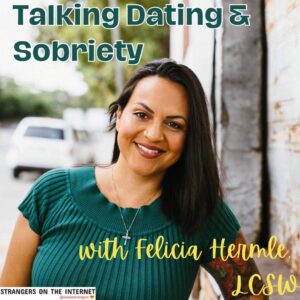
"Strangers on the Internet" Podcast Episode 46: Dating While Sober

Substance abuse specialist Felicia Hermle guides the path for a good life after addiction

|

The forty-sixth episode (Apple Podcasts link here and Spotify link here) of "Strangers on the Internet" with co-host and psychologist Michelle Lange features California-based social worker and addiction specialist Felicia Hermle.

Historically, dating has been deeply entwined with going out for a drink. But what happens if one of the two dating parties has opted for a life of sobriety? And what are the pros and cons of replacing substance use with romance, or what is the effect of infatuation on the brain?

We discuss with Felicia how to handle recovery from substance use in the dating context, and how partners can show their support. Felicia talks science, introspection, and empathy on this important episode. For more of her insights, her podcast "Sobriety Checkpoint" is available here.

Michelle Lange

Free Speech

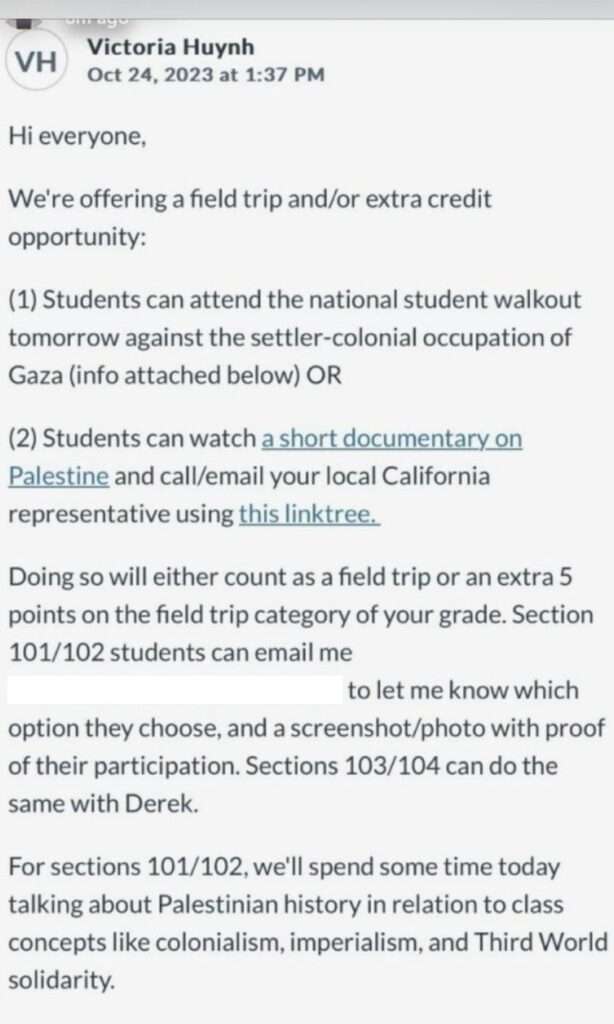
UC Berkeley Reverses Instructor's Attempt to Give Extra Credit for Pro-Palestinian Political Activity

"While instructors enjoy considerable freedom and all individuals, when acting as private citizens, enjoy free speech rights, University policy does impose limits on using the classroom or one's course for purposes of political advocacy."

|

Newsweek (Matthew Impelli) reported today on this incident, which involved "a graduate student" instructor "at UC Berkeley's Department of Ethnic Studies." (The story may have been first broken by Israelly Cool [David Lange].) Fortunately, UC Berkeley promptly rejected this; when I e-mailed the media relations office, I was informed that:

As soon as the administration was made aware of the assignment it moved quickly to ensure that it would be changed. The situation has been remedied, the assignment has been changed and there are now a number of options for extra credit, not just one. Students can now attend any local event they wish—such as a book talk or a panel discussion----related to the course's subject, including the protest…or they can watch any documentary they wish about the Middle East.

The Berkeley provost's office has also just sent out this follow-up, apparently to "all faculty, staff, and students":

I write to remind people of University policy as pertains to academic freedom and political advocacy in the classroom. While instructors enjoy considerable freedom and all individuals, when acting as private citizens, enjoy free speech rights, University policy does impose limits on using the classroom or one's course for purposes of political advocacy.

Read More

Online Harassment Against Asian-American Professors

An allegedly deafening silence from law enforcement

|

I wanted to flag an article today in The Verge that discusses the long-time online harassment of my colleague Prof. Alex Sinha and his wife Prof. Janani Umamaheswar, among other targets of anti-Asian American attacks. The piece raises important questions about what is the role of law enforcement in such cases and why we see so little intervention even with persistent abuse.

Free Speech

Repent Your Unlicensed Contractor Sins!

Repeatedly saying so isn't harassment under Florida law, court says.

|

From Potts v. Lewis, decided today by the Florida Court of Appeal (Judge Kelly, joined by Judges Rothstein-Youakim and Atkinson:

[Fla. Stat.] Section 784.048(2) provides that the offense of stalking is committed when a person "willfully, maliciously, and repeatedly follows, harasses, or cyberstalks another person." Relevant here, section 784.048(1)(a) defines the term "harass" as "to engage in a course of conduct directed at a specific person which causes substantial emotional distress to that person and serves no legitimate purpose." Because the record does not demonstrate a basis for [the trial court's] finding that Potts' actions amounted to harassment as defined by the statute, we reverse….

"[S]ubstantial emotional distress 'is greater than ordinary distress,' and … 'a reasonable person does not suffer substantial emotional distress easily.'" Annoyance, frustration, or embarrassment will not suffice….

[W]e conclude that Lewis's evidence was not legally sufficient to establish that Potts' alleged course of conduct would have caused substantial emotional distress in a reasonable person. Potts is a licensed plumber who knew Lewis from church. Prior to the events leading to the injunction, they were friendly and socialized along with other church members.

Read More

More