The Volokh Conspiracy

Mostly law professors | Sometimes contrarian | Often libertarian | Always independent | Est. 2002

The Volokh Conspiracy

AI in Court

Second Circuit Refers Lawyer for Disciplinary Proceedings Based on AI-Hallucinated Case in Brief

|

From Park v. Kim, decided today by the Second Circuit (Judges Barrington Parker, Allison Nathan, and Sarah Merriam); this is the 13th case I've seen in the last year in which AI-hallucinated citations were spotted:

We separately address the conduct of Park's counsel, Attorney Jae S. Lee. Lee's reply brief in this case includes a citation to a non-existent case, which she admits she generated using the artificial intelligence tool ChatGPT. Because citation in a brief to a non-existent case suggests conduct that falls below the basic obligations of counsel, we refer Attorney Lee to the Court's Grievance Panel, and further direct Attorney Lee to furnish a copy of this decision to her client, Plaintiff-Appellant Park….

Park's reply brief in this appeal was initially due May 26, 2023. After seeking and receiving two extensions of time, Attorney Lee filed a defective reply brief on July 25, 2023, more than a week after the extended due date. On August 1, 2023, this Court notified Attorney Lee that the late-filed brief was defective, and set a deadline of August 9, 2023, by which to cure the defect and resubmit the brief. Attorney Lee did not file a compliant brief, and on August 14, 2023, this Court ordered the defective reply brief stricken from the docket. Attorney Lee finally filed the reply brief on September 9, 2023.

The reply brief cited only two court decisions. We were unable to locate the one cited as "Matter of Bourguignon v. Coordinated Behavioral Health Servs., Inc., 114 A.D.3d 947 (3d Dep't 2014)." Appellant's Reply Br. at 6. Accordingly, on November 20, 2023, we ordered Park to submit a copy of that decision to the Court by November 27, 2023. On November 29, 2023, Attorney Lee filed a Response with the Court explaining that she was "unable to furnish a copy of the decision." Although Attorney Lee did not expressly indicate as much in her Response, the reason she could not provide a copy of the case is that it does not exist—and indeed, Attorney Lee refers to the case at one point as "this non-existent case."

Read More

Going deep on deep fakes

Plus an interview with Rob Silvers on the Cyber Safety Review Board

|

This was a big week for AI-generated deep fakes. Sultan Meghji, who's got a new AI startup of his own, walked us through four stories that illustrate how AI will lead to more confusion about what's real and what's not. First, a fake Biden robocall urged people not to vote in the New Hampshire primary. Second, a bot purporting to offer Dean Phillips's views on the issues was penalized by OpenAI because it didn't have Phillips's consent. Third, fake nudes of Taylor Swift led to a ban on Twitter searches for her image. And, finally, podcasters used AI to resurrect George Carlin and got sued by his family for violating copyrightish law. The moral panic over AI fakery meant that all of these stories were too long on "end of the world" and too short on "we'll live through this."

Regulators of AI are not doing a much better job of maintaining perspective. Mark MacCarthy reports that New York City's AI hiring law, which has punitive disparate-impact disclosure requirements for automated hiring decision engines, seems to have persuaded NYC employers, conveniently, that none of them are using automated hiring decision enginess, so they don't have to do any disclosures. Not to be outdone, the European Court of Justice has decided that pretty much any tool to aid in decisions is an automated decision making technology subject to special (and mostly nonsensical) data protection rules.

Is AI regulation beginning to suffer from backlash? Could be. Sultan and I report on a very plausible Republican plan to attack the Biden AI executive order on the ground that its main enforcement mechanism, the Defense Production Act, simply doesn't authorize the measures the order calls for.

In other Big Tech regulation, Maury Shenk explains the EU's application of the Digital Markets Act to tech companies like Apple and Google. Apple isn't used to being treated like just another tech company, and its contemptuous response to the EU's rules for its app market could easily spur regulatory sanctions. Looking at Apple's proposed compliance with the California court ruling in the Epic case and the European Digital Market Act, Mark says it's time to think about price regulating mobile app stores.

Even handing out big checks to technology companies turns out to be harder than it first sounds. Sultan and I talk about the slow pace of payments to chip makers, and the political imperative to get the deals done before November (and probably before March).

Senator Ron Wyden, D-Ore. is still flogging NSA and the danger of government access to personal data. This time, he's on about NSA's purchases of commercial data. So far, so predictable. But he's also misrepresenting the facts by claiming flatly that NSA buys domestic metadata, ignoring NSA's clear statement that the metadata it buys is "domestic" only in the sense that it covers communications with one end inside the country. Communications with foreign countries that flow into and out of the U.S. have long been considered appropriate foreign intelligence targets, as witness the current debate over FISA section 702.

Maury and I review a Jim Dempsey's effort to construct a liability regime for insecure software. His proposal looks reasonable, but Maury reminds me that he and I produced something similar twenty years ago, that is still not even close to adoption anywhere in the U.S.

I can't help but rant about Amazon's arrogant, virtue-signaling, and customer-hating decision to drop a feature that makes it easy for Ring doorbell users to share their videos with the police. Whose data is it, anyway, Amazon? Sadly, I'm afraid we know the answer.

It looks as though there's only one place where hasty, ill-conceived tech regulation is being rolled back. China. Maury reports on China's decision to  roll back video game regulations, to fire its video game regulator, and to start approving new games at a rapid clip -- though only after a regulatory crackdown had knocked more than $60 billion off the value of its industry.

We close the news roundup with a few quick hits:

Finally, as a listener bonus, we hear from Rob Silvers, Under Secretary for Policy at the Department of Homeland Security and Chair of the Cyber Safety Review Board (CSRB). Under Rob's leadership, DHS has proposed legislation to give the CSRB a legislative foundation. The Senate homeland security committee recently held a hearing about that idea. Rob wasn't invited, so we asked him to come on the podcast to respond to issues that the hearing raised – conflicts of interest, subpoena power, choosing the incidents to investigate, and more.

Download 489th Episode (mp3)

You can subscribe to The Cyberlaw Podcast using iTunes, Google Play, Spotify, Pocket Casts, or our RSS feed. As always, The Cyberlaw Podcast is open to feedback. Be sure to engage with @stewartbaker on Twitter. Send your questions, comments, and suggestions for topics or interviewees to CyberlawPodcast@gmail.com. Remember: If your suggested guest appears on the show, we will send you a highly coveted Cyberlaw Podcast mug! The views expressed in this podcast are those of the speakers and do not reflect the opinions of their institutions, clients, friends, families, or pets.


Free Speech

Prof. Jeannie Suk Gersen (Harvard Law) on The Future of Academic Freedom

|

An excerpt from this article in Saturday's New Yorker (the whole thing is much worth reading):

Sometime in the twenty-tens, it became common for students to speak of feeling unsafe when they heard things that offended them…. [C]olleagues at other schools [besides the law school] within Harvard and elsewhere feared that their administrators were using concepts of discrimination or harassment to cover classroom discussions that make someone uncomfortable. These colleagues become more and more unwilling to facilitate conversations on controversial topics, believing that university administrators might not distinguish between challenging discussions and discrimination or harassment. Even an investigation that ended with no finding of wrongdoing could eat up a year of one's professional life and cost thousands of dollars in legal bills….

Students across the political spectrum, but largely liberals, have told me that they felt it would be foolish to volunteer their opinions in class discussions, or even that they routinely lied about their views when asked. These self-censorious habits became even more conscious with the rise of the #MeToo and Black Lives Matter movements, such that a large range of political remarks—questioning abortion rights, calling a fetus an "unborn child," doubting the fairness of affirmative action, praising "color-blindness," or asking who should compete in women's sports—could be perceived as being on a continuum of bigotry. In this climate, it became increasingly difficult to elicit robust discussions because students were so scared of one another….

The events of October 7th—and an open letter issued that day with signatures from more than thirty Harvard student groups, holding "the Israeli regime entirely responsible for all unfolding violence"—changed the terms of the academic-freedom debate…. The two sides had effectively flipped: activist students, whose politics overlapped with principles of D.E.I., were engaged in speech that some faculty members, who were supportive of academic freedom, now wanted the university to treat as harmful….

Read More

Supreme Court

Justice Sotomayor Voices Her Frustration with Supreme Court and Advocates

Some candid remarks at the University of California at Berkeley

|

CNN reports on remarks Justice Sonia Sotomayor gave yesterday at the University of California at Berkeley.

"I live in frustration. And as you heard, every loss truly traumatizes me in my stomach and in my heart. But I have to get up the next morning and keep on fighting," Sotomayor, the court's senior liberal member, said at an event at the University of California, Berkeley School of Law.

"How can you look at those people and say that you're entitled to despair? You're not. I'm not," she said, responding to a question from the school's dean about how students there increasingly feel discouraged by the current court and how it's shaping American law. "Change never happens on its own. Change happens because people care about moving the arc of the universe toward justice, and it can take time and it can take frustration."

According to this Bloomberg report, she also finds the work taxing.

"And to be almost 70 years old, this isn't what I expected," Sotomayor said Monday during an appearance at the University of California, Berkeley's law school. "But it is still work that is all consuming and I understand the impact the court has on people and on the country, and sometimes the world. And so it is what keeps me going." . . .

"Cases are bigger. They're more demanding. The number of amici are greater, and you know that our emergency calendar is so much more active. I'm tired," she said. "There used to be a time when we had a good chunk of the summer break. Not any more. The emergency calendar is busy almost on a weekly basis."

Justice Sotomayor also expressed concern about they way some advocates present their cases to the Court. From the CNN report:

"I can't tell you how often I'll look at (Justice) Neil Gorsuch and I'll send him a note and say, 'I want to kill that lawyer.' Because he or she didn't give up that case. Because by the time you come to the Supreme Court, it's not about your client anymore. It's not about their case," she said. "It's about how that legal issue will affect the development of law and how you pitch it – if you pitch it too broadly, you're gonna kill the claims of a whole swath of people."

These later remarks may well provoke some interesting discussion about the obligations of Supreme Court advocates. It is a fair observation that zealous advocacy for an individual client may come at the expense of a broader cause otherwise aligned with that client's interest, as may happen when a criminal defendant's attorney petitions for certiorari in a case that is likely to result in a pro-prosecution ruling from the Court. Whether this means that lawyers should refrain from such representation, or simply consider the likely downside risks in crafting and presenting arguments, is an important question.

Immigration

No, Texas Has Not "Defied" The Supreme Court

Perhaps Governor Abbott will flout a directive from the Supreme Court in a future case, but reports of Texas "defying" the Supreme Court are bunk, and many making such claims should know better.

|

There is quite a bit of hyperbole about immigration policy and the southern border these days. To take one prominent example, Texas Governor Greg Abbott suggests there is an "invasion" of illegal immigrants that justifies state action under the Constitution. As a constitutional matter, this is not true.

It is not just politicians who are engaged in false, hyperbolic statements, however. Journalists and purported experts are doing it too, such as those who claim that Texas is "defying" the Supreme Court by continuing to put up c-wire on state and private land near the border with Mexico. According to these accounts, because the Supreme Court lifted an injunction that barred the federal government from removing c-wire where necessary for immigration enforcement activities, Texas is flouting the Supreme Court by continuing to place c-wire on state and private property. This is not true either.

In the relevant case, Department of Homeland Security v. Texas, Texas is suing the federal government, in tort, for the destruction of state property (c-wire barriers and the like). The district court generally concluded that Texas was right on the facts, but wrong on the law, because Texas could not seek money damages from the federal government due to sovereign immunity. The U.S. Court of Appeals for the Fifth Circuit enjoined the federal government from taking additional actions that remove or destroy c-wire barriers on state and private land, save where such actions were necessary to address a medical emergency, pending additional proceedings. Among other things, the Fifth Circuit concluded Texas would be likely to show the federal government had waived its sovereign immunity under 5 U.S.C. Section 702.

All the Supreme Court did (in this order) is eliminate this injunction -- likely because it concluded that the federal government is likely to prevail on sovereign immunity grounds. It did not rule on -- indeed, it was not called to rule upon -- the lawfulness of anything Texas is doing. Nothing in what the Supreme Court did told Texas to take or refrain from any action.

But don't just take my word for it. Here is what Professor Steve Vladeck (no fan of the Abbott administration) wrote in his "One First" substack newsletter:

perhaps the most important thing to say about the order is how little it actually resolved (someone really ought to write a book about why this is a bad thing): By vacating the Fifth Circuit's injunction, the Court effectively protected the federal government from contempt sanctions if it continues to remove the razor wire that Texas has placed along the border—and nothing more. Thus, nothing Texas did or said later in the week was "defying" the Court's ruling; much like President Jefferson and Marbury v. Madison, there was no real way Abbott could defy such a modest ruling because it wasn't directed at Texas in the first place. Instead, as explained in more detail below, the real legal disputes between Texas and the federal government at the border remain very much open and unsettled (and are likely to only escalate further, given the politics of the moment).

As Vladeck notes, there are other pending cases that challenge the lawfulness of actions Texas has taken that conflict with the Biden Administration's immigration policy enforcement choices. One of these cases challenges a new immigration law in Texas that looks highly suspect under Arizona v. United States, a 5-4 decision from 2012 in which the Court concluded that many state actions to enforce federal immigration laws are preempted. If courts rule against Texas in those cases--and I suspect they might--and Texas does not stand down, then it will be appropriate to call out the Lone Star state for defying the Supreme Court. But that is not what has happened yet, and it is irresponsible for journalists and others who should know better to say so.

Governor Abbott may be reckless and cavalier, particularly with his rhetoric, but he's no Judge Aiken (at least not yet).

Free Speech

Public Has Right to Access Sex Offender Litigants' Identities,

at least under Washington law; the litigants had unsuccessfully sued to challenge disclosure of their sex offender records until the Washington Public Records Act.

|

From today's nonprecedential decision in John Doe P v. Zink:

After the trial court allowed the plaintiffs to litigate in pseudonym, it directed them to file a sealed document containing their actual names (Disclosure Document)…. We hold that the record does not support the trial court's finding that continued sealing was justified by compelling privacy or safety concerns that outweighed the public interest in access to court records….

In 2014, Zink sent a Public Records Act (PRA) request to Thurston County seeking various sex offender records, including registration records, special sex offender sentencing alternative (SSOSA) evaluations, and special sex offender disposition alternative (SSODA) evaluations. John Doe P, John Doe Q, John Doe R, and John Doe S (collectively Does) sued to enjoin the county from releasing the records. John Does P, Q, and S are level I sex offenders {those classified as the least likely to reoffend} who alleged they complied with registration requirements. John Doe R alleged he was convicted of a sex offense in juvenile court, had completed treatment, and had been relieved of the duty to register. The Does alleged that releasing the records Zink requested would cause irreparable harm because they would reveal the identity of sex offenders, like themselves, who were not statutorily required to be listed on the state's publicly available website.

Zink eventually largely prevailed on the substantive Public Records Act claims, after several different decisions of appellate courts and the state supreme court (including John Doe A and John Doe P II). And in this decision, she also prevailed in her argument that the documents in which Does identified themselves to the court needed to be made public:

Read More

Judiciary

More Circuit Court Vacancies For Biden To Fill (But Not As Many As There Could Be)

Quite a few judges have opted to take senior status, but some who are eligible have not.

|

So far in 2024, four federal circuit court judges have announced their intention to take senior status upon the confirmation of their successor, including (most recently) Judge Jane Stranch of the U.S. Court of Appeals for the Sixth Circuit. The others are Judges Charles Wilson (11th), Ilana Rovner (7th), and James Wynn (4th).

Including Judge Stranch, whose intentions were just reported today, this means there are ten current and pending vacancies on the federal circuit courts of appeals. Four of these seats have pending nominees.

Ten appellate seats to fill in the final year of a presidential term is a tall order, but I suspect Senate Democrats can get it done if they are willing to devote the floor time to it. In the absence of significant legislation, there will be political pressure to move on appellate judges.

Will there be even more vacancies to fill? I doubt it. There are twelve circuit court judges who are eligible for senior status and were appointed by Democratic Presidents, but who have not taken announced their intention to leave active status. Given that this is an election year, if they do not announce soon, it is reasonable to assume they will not be going senior during this presidential term. Even without blue slips for appellate nominees, it can be difficult to get folks through in an election year, particularly if nominees cannot be named before the spring.

For those keeping track, here are the circuit court nominees appointed by Democratic presidents who are eligible to take senior status, but who have not yet taken that step. Also included in this tabulation are the number of current or pending vacancies on each court.

  • First Circuit: (none) - 2 current/pending vacancies
  • Second Circuit: (none)
  • Third Circuit: (none) - 1 current/pending vacancy
  • Fourth Circuit: Gregory, King - 2 current/pending vacancies
  • Fifth Circuit: Graves, Stewart
  • Sixth Circuit: Clay, Moore - 2 current pending vacancies
  • Seventh Circuit: (none) - 2 current/pending vacancies
  • Eighth Circuit: (none)
  • Ninth Circuit: Gould, Rawlinson, Wardlaw
  • Tenth Circuit: Matheson
  • Eleventh Circuit: (none) - 1 current/pending vacancy
  • D.C. Circuit: (none)
  • Federal Circuit: Dyk, Reyna

Also, for the record, there are some two dozen circuit court judges in active service who were appointed by Republican presidents and are currently eligible for senior status.

Climate Change

Justice Department to Seek Mandamus to End Juliana Litigation (Again)

Will Judge Aiken finally accede to the law and allow this particular climate case to end?

|

The Department of Justice is not acquiescing to Judge Ann Aiken's efforts to keep Juliana v. U.S., the so-called "kids climate case," on life support. In a new filing the Department has asked Judge Aiken for a stay of the litigation so that the Department may file a writ of mandamus with the U.S. Court of Appeals for the Ninth Circuit seeking to have the case dismissed or, in the alternative, to allow interlocutory review.

As I noted here, Judge Aiken denied the federal government's motion to dismiss in December. This ruling was bad enough. What was worse--indeed, astounding--was her denial of the federal government's request that she certify the case for interlocutory review and failure to provide any explanation (let alone justification) for the denial. This was as reckless an act of judicial defiance as we have seen from any district court in the past three years.

From the DOJ filing:

The Court should stay proceedings in this case pending Defendants' forthcoming petition for a writ of mandamus. The Ninth Circuit ordered this Court to dismiss this case: "[W]e reverse the certified orders of the district court and remand with instructions to dismiss for lack of Article III standing." Juliana v. United States, 947 F.3d 1159, 1175 (9th Cir. 2020). The Ninth Circuit's opinion in this case forecloses the theory that a declaratory judgment, standing alone, can redress Plaintiffs' alleged injuries, as required to show Article III standing. Id. at 1170. The Court's December 29, 2023, Order therefore violates the rule of mandate. . . . And even if the Court's order does not violate the mandate, the Supreme Court's observation still pertains: "the justiciability of [these Plaintiffs'] claims presents substantial grounds for difference of opinion." July 30, 2018, Supreme Court Order, ECF No. 330-1.

Because this Court denied Defendants' motion to certify its orders for interlocutory appeal, the government will seek a writ of mandamus from the Ninth Circuit to enforce its mandate and direct the Court to dismiss this case in its entirety. If granted, the government's petition will end this case, and any public resources spent on further litigation while the petition is pending would be wasted. The government therefore respectfully requests the Court to enter a stay of all proceedings in this Court pending resolution of the mandamus petition, as the Ninth Circuit did when considering the government's prior mandamus petition in this case.

The question now is how Judge Aiken will respond. From the start of this litigation she has shown herself quite sympathetic to the plaintiffs' cause, embracing their extravagant legal theories and resisting the federal government's procedural defenses. Now, however, she is directly contravening controlling legal authority about this very case.

According to the docket, the plaintiffs will be responding to the federal government's motion this week. Then Judge Aiken faces a choice: Grant the stay and allow the Ninth Circuit to consider the writ of mandamus, or refuse and force the Justice Department to proceed on an emergency basis.

As has been clear for some time, the question is not so much whether this litigation will end, but how it ends, and whether Judge Aiken's shenanigans produce rulings that hamper other climate change litigation.

*  *  *

For those interested, here are my prior posts on the Juliana litigation:

The FTC and national security

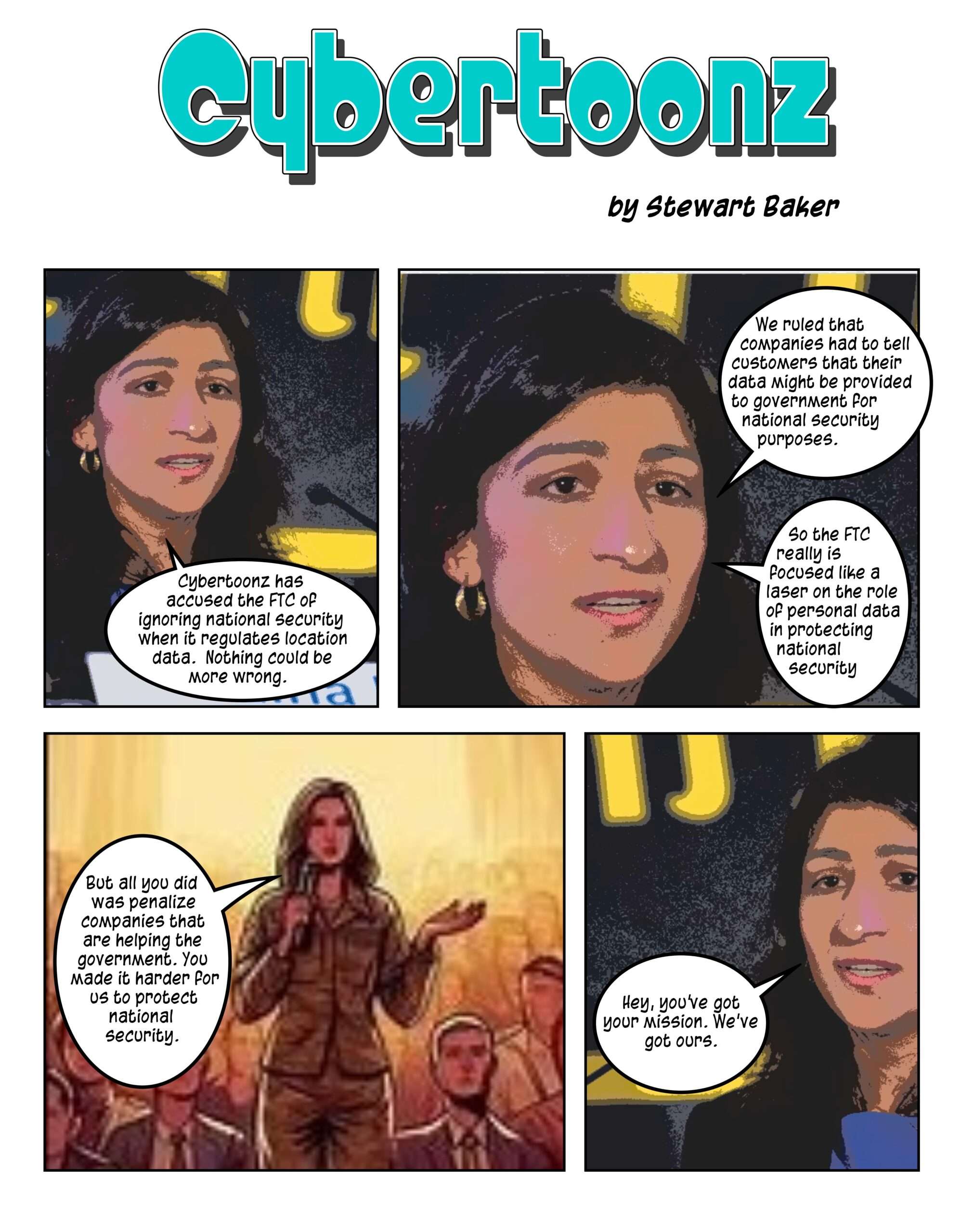
Cybertoonz gives the Commission a right of reply

|

Okay, maybe past Cybertoonz have been a little hard on the FTC in past issues, hinting that it has paid no attention to the national security concerns around personal data. In light of the Commission's recent ruling in the X-Mode case, it's become clear that the FTC is in fact focusing on how personal data is used to protect national security. So to give the Commission equal time on the issue, we've turned Cybertoonz over to Chair Lina Khan to express its views.

Prof. Rick Hasen (UCLA) on Trump's Brief in the Section 3 Disqualification Case

|

From his Slate column today:

There are many ways that Trump could win in the Supreme Court. For example, the court could accept the First Amendment defense Trump has offered. Or it could agree with Trump that states can only consider disqualifying candidates under Section 3 if Congress passes a statute authorizing it. Or it could agree that Trump did not have an adequate chance to defend himself in the state court. Or it could hold that the evidence was not sufficient to show that he actually "engaged in insurrection." Or it could resuscitate an extreme version of the "independent state legislature" theory that Colorado law did not authorize Colorado courts to remove Trump from the ballot for violating Section 3. Winning on some of these issues would mean not only that Trump would be back on the ballot in Colorado, but potentially throughout the country.

What's most interesting about Trump's brief, though, is what it leads with—and what it leaves out, telling us a lot about where Trump thinks he has the best shot at the Supreme Court and the strength of his arguments. Trump leads with the hypertechnical argument accepted by the trial court (but rejected by Colorado's Supreme Court) that Trump is not an "officer of the United States" for purposes of Section 3. Trump devotes about three times as much space to this argument compared to any of his other individual arguments. [To be precise, the argument takes up 12½ pages, and the two longest other arguments each take up a bit more than 5 pages each. -EV]

Briefs are typically written to put the strongest argument first. Why would Trump think the officer argument is the strongest? It seems weak: As Trump's challengers argue in the Supreme Court: "It would defy common sense to hold that Section 3 disqualifies every oath-breaking insurrectionist officer (down to postmaster or county sheriff) except the most powerful one—a former Commander-in-Chief." This is especially true given the historical context of the amendment's passage. As conservative scholar Sam Bray recently wrote over at the Volokh Conspiracy:

Read More

Campus Free Speech

Prof. Danielle Allen (Harvard) on Diversity and Academic Freedom

|

An excerpt from an opinion piece that she wrote at the Washington Post Dec. 10, but that I had missed:

I was one of three co-chairs of Harvard's Presidential Task Force on Inclusion and Belonging, which in 2018 delivered a strategic framework for the campus…. Across the country, DEI bureaucracies have been responsible for numerous assaults on common sense, but the values of lowercase-i inclusion and lowercase-d diversity remain foundational to healthy democracy….

We wrote [in our report]: "Our shared pursuits … depend on the open and direct expression of ideas and on criteria of evaluation established by the judgments of experts. Excellence therefore also requires academic freedom. Inclusion and academic freedom — these principles are linked in each being necessary to the pursuit of truth."

We grounded the work in a broad commitment to pluralism. We wanted a diversity of views on campus, and we recognized that the sources of diversity are myriad. We cared as much about viewpoint and religion as any other source of diversity…. While we acknowledged historical patterns in our report, we did not dwell on the theme of historical injustices. We did not see the challenge in front of us as "white supremacy"; we never used a vocabulary of that kind. Our faces were set to the future. We saw in the rich diversity of our campus an opportunity — a chance to achieve a higher level of excellence powered by intense engagements across a vast range of viewpoints….

Read More

Section Three and the "First Insurrection" … That Wasn't

|

[Prof. Kurt Lash (Richmond), who is a leading legal historian of the Fourteenth Amendment, was kind enough to pass along this response to an amicus brief by Profs. Akhil Reed Amar (Yale) and Vikram David Amar (Illinois) in Trump v. Anderson, and I'm delighted to have it published here. As readers of the blog know, several of our bloggers have expressed their own views on the case, which are quite different from each other, and I'm very glad that the blog provides a forum for those competing views. None of them, of course, is the view of the blog as a whole, or of anyone other than the individual author. I would of course be delighted to publish any response to this item as well. -EV]

Professors Akhil Amar and Vik Amar have submitted an interesting amicus brief in Trump v. Anderson, the case involving Donald Trump's potential disqualification under Section Three of the Fourteenth Amendment. The brief claims that Section Three represents the framers' response to two insurrections, one tall and one small, and that the small one is analogous to the events of January 6, 2021.

The smaller "First Insurrection" (the brief capitalizes the term) supposedly involved an oath breaking cabinet member named John B. Floyd. Floyd, they argue, was a co-conspirator in the First Insurrection(ist) attempt in February 1861 to disrupt the counting of electoral votes and prevent the inauguration of Abraham Lincoln. Since the framers of Section Three intended this small failed First Insurrection to fall within the meaning of the text, they must also have intended to include the similarly small but briefly successful "insurrection" of January 6, 2021.

The brief is fun and imaginative, as is everything the Amars write. Unfortunately, in this case the historical evidence does not support the argument. Their brief is an unsuccessful attempt to place someone who wasn't there at an insurrection that did not occur. Even more damningly for their side, the brief calls attention to an 1862 statute that actually blows a hole through the already weak originalist case for disqualification.

First: The man who wasn't there. John B. Floyd served as President Buchanan's Secretary of War. Floyd objected to Buchanan's reinforcement of Fort Sumter and he resigned his position on December 29, 1860. This was more than a month before Congress met in joint session to count the electoral votes on February 13, 1860, and more than two months before Lincoln's inauguration in early March. When Virginia voted to secede in April 1861, Floyd fled a pending indictment for corruption and fraud[1] and joined the Confederacy, eventually rising to the position of general in the Confederate Army.[2]

Read More

Campus Free Speech

Against Political Statements by Academic Departments

Universities should not be in the political activism business

|

The University of California system is debating whether to allow academic departments to issue political statements. Barnard College is currently in the midst of a campus controversy over college officials removing a political statement from a department's website.

Should departments be issuing such statements, and who should be understood to control the content of a departmental website or social media account? In an essay in the Chronicle of Higher Education, I argue that such political statements have no place in academia. They invite a further erosion of public support for higher education, and they threaten the foundations of individual academic freedom.

Here's a taste:

Another set of concerns involves the direct pressure put on individual scholars by the proliferation of institutional political statements. Individual members of the faculty are free to engage in individual political expression or to associate with others to express themselves collectively, and universities should be diligent in protecting the freedom of individual professors to do so. But individual members of the faculty also have the freedom to remain silent on matters of controversy and to choose their own time and manner of expressing their political views. They should not, as a condition of employment at a university, be dragooned into the political activities of others. Departmental statements make that impossible. Dissenting individuals are forced either to hold their tongue and allow statements to be issued in their name or to wade into a political controversy when they would prefer not to do so. Faculty members can always speak in their own name. That is an exercise of free expression. To attempt to speak in the name of others is rather an infringement on free expression.

For departments qua departments to issue political statements is to assert that those sentiments are not just personal, but professional. As such, they may also become professionally relevant to evaluation of current and future members of the faculty. It is an important protection of the academic freedom of individuals that institutions not take the personal political views and activities of professors into account when making decisions regarding hiring and promotion. It is possible to construct a firewall protecting professors from being punished for their political opinions by distinguishing such personal activities from professional activities. If, however, a department as such has specific political views, then the political views of prospective members of the faculty are suddenly professionally relevant and cannot be regarded as off-limits. Junior faculty would justly worry that their professional future will be damaged if they do not go along with the political activities of their senior colleagues. Dissenting members of the faculty will justly believe that they are made outsiders to their own department as a consequence of their political beliefs.

Read the whole thing here.

Professor Akhil Reed Amar and Professor Vikram Amar Retreat From Their "Global" Rule for the "Offices" and "Officers" of the Constitution

Their amicus brief endorses the view that members of state legislatures are officers. They took the exact opposite position in 1995 and in subsequent publications.

|

[This post is co-authored with Professor Seth Barrett Tillman]

On January 18, Professor Akhil Reed Amar and Professor Vikram Amar filed an amicus brief in Trump v. Anderson, the Section 3 case. The brief was styled as in support of neither party, but the clear import of the brief is that the Supreme Court should disqualify Trump from the ballot. Professor Jason Mazzone describes the brief as "eye-popping and game-changing." We think that characterization is apt, but not for the reasons Mazzone described. As we read the brief, the Amars have retreated from the central position they put forward in an influential 1995 Stanford Law Review article. As their brief and other current commentary does not note their changed intellectual position, we wonder if they realize what they have done. 

Read More

More