Please enjoy the latest edition of Short Circuit, a weekly feature written by a bunch of people at the Institute for Justice.
New on the Short Circuit podcast: Two former Judge O'Scannlain clerks join the show to talk about a suspended progressive prosecutor and a preempted ban on gas stove piping.
The post (at Balkinization) is here; as I've mentioned before, I haven't studied the issues in this case closely enough to speak to this myself, but Prof. Lederman is a leading constitutional expert, and his thoughts struck me as much worth passing along:
1. Colorado Is Not "Enforcing" or "Implementing" Section 3.
The briefs of all four of the parties in the Supreme Court (and those of many amici, as well) proceed on the assumption, articulated repeatedly in their briefs, that if Colorado were to omit Donald Trump's name from its presidential primary ballot—something that, as I explain in this post, Colorado has not in fact done and is unlikely to do—the state would acting to "enforce" or "implement" Section 3 of the Fourteenth Amendment. Indeed, some of the parties' arguments take this as a jumping-off point, and depend upon it.
But it's wrong. Colorado isn't purporting to "enforce" Section 3, and states don't have any power to enforce its disqualification directive with respect to federal officers.
To be sure, a state has the power to enforce Section 3 with respect to state officers who are subject to Section 3's disqualification rule. Relevant state officials or courts with statutory or state constitutional authority, for example, can refuse to appoint a Section-3-disqualified person, or remove such a person from office. And, if state law prescribes it, a state legislature might be able to remove state legislators, as well as other state officers by way of impeachment, etc.
But a state does not have any legal authority—nor, to my knowledge, has any state ever claimed such power—to enjoin a disqualified federal official from holding office, or to remove him or her from such office….
Once one understands that Colorado is simply enforcing its own state-law rule prescribing exclusion of ineligible candidates from primary election ballots for purposes of state election management—a rule not confined to presidential candidates—one can see that Trump's argument that Colorado is imposing an additional "qualification" for Trump to hold office (according to Trump, Colorado has effectively required a candidate not to be subject to Section 3 ineligibility at the time of the primary election rather than on January 20, 2025) rests upon a category error: By declaring that candidates for President may not appear on its presidential primary ballot unless they meet certain conditions (including apparent eligibility to hold the office), Colorado is no more imposing extraconstitutional "qualifications" on persons holding that national office than Virginia did in 2012 when it excluded Rick Perry from its presidential primary ballot because he failed to timely submit the necessary number of voter signatures. See Perry v. Judd, 471 F. App'x 219 (4th Cir. 2012). (I pulled that example from Derek Muller's excellent amicus brief.)
2. Colorado Also is Not (Yet) Exercising Its Authority Under Article I's "Electors" Clause
Five and a half months ago, in August 2023, our article on Section Three of the Fourteenth Amendment, The Sweep and Force of Section Three, was accepted for publication by the University of Pennsylvania Law Review.
The article's core thesis – that Section Three's disqualification of insurrectionists from office is legally operative, self-executing, sweeping in scope, and likely disqualifies numerous participants in the efforts to overturn the 2020 presidential election – obviously has enormous implications for our national political life today. Among other important consequences, it means that former president Donald J. Trump, who is running for president again in 2024, is constitutionally disqualified from holding that or any other covered office, unless and until two-thirds of both houses of Congress vote to remove his disqualification.
Shortly after being accepted for publication, we posted the draft manuscript of the article on the Social Sciences Research Network (SSRN). The article (and its thesis) immediately attracted wide interest: For an academic article, The Sweep and Force of Section Three has provoked an unusual amount of interest and attention. It has been widely discussed on air, in print, online, and in the academy. And it has been widely cited in the current litigation about the enforcement of Section Three. As readers surely know, the Colorado Supreme Court held that Mr. Trump is indeed disqualified by Section Three from future office as a matter of federal constitutional law; and that this renders him ineligible for inclusion on the state primary ballot for election to that office as a matter of Colorado state law. The U.S. Supreme Court has granted certiorari to review that decision in what is sure to be one of its most important cases of the term.
For the most part, we have been content to let the analysis and arguments of The Sweep and Force of Section Three speak for themselves and have not participated in the subsequent public debate and litigation over its thesis. The manuscript itself is quite detailed – it runs 126 pages in its pre-publication form – and frankly it anticipates many of the objections that have been raised against its legal conclusions. Up until now, we have not elsewhere responded to these objections in print, at least not systematically.
But the occasion of the Colorado Supreme Court's decision in Anderson v. Griswold, and the Supreme Court's pending review of that decision in Trump v. Anderson, provides, we think, an appropriate occasion for us to address some of the arguments that have been made about Section Three. As noted, we discuss some, even many, of these points in our original article. The article is now in the final stages of editing with the excellent staff of the University of Pennsylvania Law Review. In the editing process, we decided against burdening the article's discussion with many responses to specific objections that have been made to its thesis, as those objections have arisen in public debate over the last four months, for two reasons: First, the version from last fall, as edited, largely stands on its own and has already been read by many in that form, which would makes it somewhat awkward (and perhaps irritating to some readers) to revise that text significantly to respond to assertions or critiques offered since September. Second, and relatedly, responding on the fly in the main text to objections as they arose would have made the article something of a moving target, and perhaps further delayed publication.
We adhere to all the points we made in that manuscript and have changed little. Nothing in the ensuing commentary, discussion, and litigation has caused us to revise our core propositions:
According to documents, Palestinian-American student Seif Asi, 21, approached a table of Jewish students and got into a one to two-minute "heated conversation" during a UCF Office of Student Involvement approved pro-Israel free expression event on Jan. 23….
When UCFPD stopped Asi, he told them that he was Palestinian and had family in Palestine, adding that he was tired of seeing Jewish supporters on campus and complained about a pro-Israel match that occurred last week.
The arrest report shows that Asi told police he saw the same group of students at the march, and it made him upset when he saw them setting up their table on Tuesday. He also told police that he's "tired of seeing students on campus defend the killing of Palestinian people."
The 21-year-old said he was on his way back from working out when his "emotions got the better of him." … The three victims, who are part of a group called "Students Supporting Israel" or SSI, provided sworn verbal and written statements consistent with each other. The students said Asi accused them of supporting the death of his family members back home. Then, all three students allegedly heard Asi say, "You won't be here anymore when I come back and shoot you."
Asi was charged with three counts of intimidation based on display of indicia of religious or ethnic heritage, under Fla. Stat. § 784.0493, which reads:
On Wednesday, Jan. 17, an MU student pled guilty to second degree property damage in Columbia Municipal Court for flipping a display Shabbat table with symbolic place settings for Israeli hostages in Speakers Circle in November 2023….
[Students Ilay] Kielmanowicz [of Mizzou Students Supporting Israel] and [Daniel] Swindell had set up two tables — one of which was arranged like a Shabbat table to show support for Israeli hostages. The other had "books and pamphlets about Israel and Jews and Zionism and the Israeli Palestinian conflict, which students were able to take," Kielmanowicz said. The Shabbat table included fliers with photos of Israeli hostages that read "KIDNAPPED" above them….
The police report states that the student approached Swindell because he was wearing a garment that said "Zionist." Swindell confirmed this detail, and Adam Kruse, Assistant City Prosecutor, cited it in court.
The student stated they found the display "insensitive and offensive," according to Kielmanowicz. The two engaged in a conversation about display and the Israel-Hamas war until the student reportedly flipped over the volunteers' Shabbat table, breaking the place settings consisting of Swindell's dishes….
"The university is committed to ensuring everyone on our campus continues to have the right to demonstrate in a peaceful manner," Christian Basi of the MU News Bureau wrote in a statement to The Maneater. "We will not tolerate actions that disrupt others['] rights to demonstrate or exercise their free speech rights." …
UPDATE: I erroneously omitted the sentence: "a year of probation, 20 hours of community service and a court fee of $31.50."
Aimenn D. Penny, 20, of Alliance, Ohio, was arrested and charged last year with one count of violating the Church Arson Prevention Act, one count of using fire to commit a federal felony, one count of malicious use of explosive materials, and one count of possessing a destructive device. On Oct. 23, 2023, Penny pleaded guilty to the church arson hate crime and using fire and explosives to commit a felony.
According to court documents, on March 25, 2023, Penny made Molotov cocktails and drove to the Community Church of Chesterland (CCC), in Chesterland, Ohio. Angered by the church's plan to host two drag events the following weekend, Penny threw two Molotov cocktails at the church, hoping to burn it to the ground. Through Penny's guilty plea, he admitted to using force through fire and explosives, intending to obstruct CCC congregants in their enjoyment and expression of their religious beliefs….
In 1967, Florida's Legislature created the Reedy Creek Improvement District (RCID), a special improvement district in Central Florida. The district is perhaps best known as the home of Walt Disney World, which has operated there for decades. And as the district's largest landowner, Disney has effectively controlled the district's board, whose members were elected based on land ownership. That changed last year, after the Florida Legislature substantially amended the district's governing structure. Now, Florida's Governor selects the board members, subject to Senate confirmation. As a result, Disney no longer controls the special improvement district in which it operates. (That district is now called the Central Florida Tourism Oversight District, or CFTOD.)
This change—which works to Disney's significant detriment—came after Disney publicly criticized another Florida law, the Parental Rights in Education Act. In Disney's view, this timing was no coincidence. Disney alleges that the Florida Legislature changed the district's governing structure to punish it for its speech. The issue in this case is whether the Legislature's action constituted unlawful retaliation against Disney's speech in violation of the First Amendment….
"As a general matter, the First Amendment prohibits government officials from subjecting individuals to retaliatory actions after the fact for having engaged in protected speech." But it is settled law that "when a statute is facially constitutional, a plaintiff cannot bring a free-speech challenge by claiming that the lawmakers who passed it acted with a constitutionally impermissible purpose." The Eleventh Circuit has "held that many times." And this settled law forecloses Disney's claim.
The new issue of the Case Western Reserve Law Review with a symposium on the First Amendment and classrooms has now arrived, and with it my article, "What Can Professors Say in Public? Extramural Speech and the First Amendment."
From the abstract:
Since the early twentieth century, academics have urged universities to recognize robust protections for the freedom of professors to speak in public on matters of political, social, and economic controversy—so-called "extramural speech." The U.S. Supreme Court eventually recognized First Amendment protections for government employees, including state university professors, who express themselves about matters of public concern. The Court has indicated that the state should be especially solicitous of the speech of government employees in an academic context, but it has not adequately elaborated on the nature of those protections and how courts and government employers should assess the state's interests relative to the extramural speech of professors employed at public universities.
This Article describes the state of the existing principles and doctrine surrounding extramural speech and examines the factors that private and public universities can reasonably take into consideration when responding to such speech—and what rationales for suppressing such speech or sanctioning faculty for engaging in such speech are inappropriate. Controversies surrounding the public speech of university faculty have only become more common and more intense in recent years, and both public and private universities need to be more self-conscious about the risk of stifling the intellectual environment of universities and chilling unpopular speech when responding to such controversies. If First Amendment values are particularly weighty in the context of the marketplace of ideas on university campuses, then many of the rationales for disciplining government employees for controversial speech that may make sense in some governmental workplaces should be rejected if applied in the university context.
The article focuses on the balancing test in the Supreme Court's Pickering doctrine for government employee speech, and how that balancing test should be conducted in the specific context of universities and faculty speech. Although the constitutional test is specific to state universities, it works well for thinking through protections for free expression at most private universities in the United States as well.
From the conclusion:
There are very few occasions when university officials can properly sanction a university professor for his or her extramural speech. . . . Professors may say things in public that are mistaken, offensive, or even repugnant and vile—or they may simply say things that threaten the interests of powerful groups and individuals or run contrary to prevailing sentiment—but general principles of free speech protect their right to say such things and university employers should refrain from penalizing them for such speech. When universities claim that firing professors who say controversial things is justified, courts should stand ready to closely interrogate such claims. When the extramural speech of professors is weighed in a Pickering balance, the university's legitimate interest should not include an interest in suppressing speech because it is unpopular or uncivil or gives rise to the commotions that unpopular or uncivil speech can trigger.
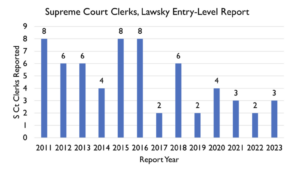
From 1940 to 1990, about one third of Supreme Court law clerks became law professors. But in recent years, Brian Leiter and Jeff Gordon note, that percentage has dropped considerably. Sarah Lawsky has some numbers of clerks entering legal academia in the last decade or so that Brian recently posted:
Even if Sarah is missing some former clerks in her numbers, that's a noticeable drop. What explains the trend? Over in the comments to Brian's post, Professor Dan Epps has a suggestion that I think explains a lot: The increasing separateness of the law clerk and law professor track.
I realize this is a niche topic, but here's a little background to explain that increasing separateness for those who may be interested. It used to be, decades ago, that getting a top clerkship and getting a top professorship were the same track. If you were a law student and you wanted to be a law professor, you got the highest grades you could and tried to use your grades to get a clerkship with the most prestigious judge you could. The clerkship acted as a sort of graduate degree in law. If you hit the jackpot and clerked on the Supreme Court, that was reasonably likely to lead to a professorship at a very good law school. The top schools tried to hire former clerks, with some law school Deans visiting the Supreme Court to meet with clerks and pitch becoming a professor at their schools. This was the era of 1940 to 1990, noted at the top of the post, when about one third of clerks later became professors.
These days, by contrast, the paths are a lot more separate. First, there's more of a multi-year process of planning for a Supreme Court clerkship. Most Supreme Court clerks now have multiple prior clerkships before starting at the Supreme Court—according to David Lat, 29 of the current 36 clerks had two or more clerkships before their current positions. And those are often spaced out, too. Just skimming the list at David's site, it looks like a typical clerk graduated about 3-4 years before starting at the Supreme Court. By the time you're done with the Supreme Court, you're 4-5 years out of law school and you may still only have a year or so of actual legal practice. Meanwhile, biglaw firms await with what are now apparently $500,000 clerkship bonuses if you join them.
If you want to become a law professor, on the other hand, the pathways today tend to be different. Law schools are now evaluating potential entry-level professors much more on their scholarship than on their grades or clerkships. As a practical matter, you need to have spent a few years researching and writing scholarship to get ready to go on the market for a tenure-track job. Getting a Ph.D. has become a very common way to develop a scholarly methodology and start to write some articles. At most top schools I am aware of, a clear majority of recent entry-level hires have one. And even if you don't have a Ph.D., you will probably need to spend two years at a law school as a Fellow or Visiting Assistant Professor (VAP), learning the quirky ways of academia and working on an article or two to get ready for the entry-level market. As Sarah Lawsky has found, about 90% of new entry-level hires have either a fellowship or a doctorate. Many have both.
The takeaway of all this, I think, is that the single path of decades ago has largely divided into two separate paths. Once you're in law school, the way to maximize your odds of getting a Supreme Court clerkship is different from the way to maximize your odds of getting a professorship, especially at a top school. I think this largely explains why we see fewer people today succeeding on both tracks, first clerking at the Supreme Court and then later becoming an academic. It's not the only explanation. But I think it's the main one.
As I said earlier, this is a niche topic. Some readers (if anyone is still reading) may be wondering, "Who cares?" And totally fair if you don't. This may just be navel-gazing that has no significance outside the faculty lounge. But I wonder if it may also be a small signal of a broader change of the role and background of law professors, and in turn, of law schools. As Richard Posner noted in the 2007 essay I blogged about last month, there has been a switch over the decades from the model of the law professor as top lawyer steeped in lawyering to the model of the law professor as academic who writes and teaches in the field of law. I wonder if the declining number of former Supreme Court clerks entering academia might be one small indicator of that switch continuing.
UPDATE: If there are recent clerks or recently-appointed profs (or both) who want to weigh in on this, I'd be happy to post reactions as to their sense of this and whether they agree. Happy to remove names if requested, too. Just send me an email, orin at berkeley dot edu.
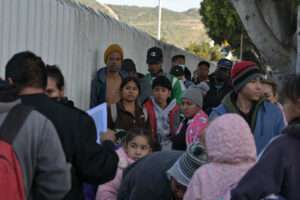
Migrants wait in line at the U.S.-Mexico border. (Carlos A. Moreno/ZUMAPRESS/Newscom)
In a recent New York Times article (non-paywall version here), my Cato Institute colleague David Bier - a leading expert on immigration policy - explains how President Biden can alleviate pressure on the southern border by expanding opportunities for legal migration:
A bipartisan immigration deal to restrict border crossings took a hit last week when Donald Trump pushed Congress to reject it. It's the latest in a series of episodes over the last decade where one party blows up a deal just as the other gives in. President Biden wants to break this cycle, but to get the politics right, he must get the policy right first.
As long as the border is in chaos, Mr. Trump bets voters will continue to prefer him on this issue. He's almost certainly right. But perhaps it's chaos, not immigration per se, that upsets voters, and Mr. Biden can curb the chaos by letting more immigrants come to the United States legally….
It seems that some Republicans would just as well let the crisis at the border persist. In response, Mr. Biden must not merely blame Republicans for blowing up the deal and then leave the issue alone. The president will always receive the bulk of the blame whenever there is lawlessness and chaos….
The politics here are frustrating policy reform, but better policy could help the politics. Mr. Biden can double down on expanding parole sponsorship programs that allow people lawful and orderly ways to enter the United States.
Letting people in through private sponsorship programs negates the need to expand resources because they'll have the opportunity to line up jobs and housing in advance of getting here. If all else fails, they will have U.S. sponsors to help them out if necessary.
Some Republicans may not like immigrants coming in — legally or otherwise — but American voters don't buy invasion rhetoric to describe people getting vetted to travel here legally. Fearmongering about drug smugglers and terrorists can work when people enter illegally.
Right now, Mr. Biden has only created legal processes for five countries — Ukraine, Cuba, Haiti, Nicaragua and Venezuela — and he has set a cap far below demand. These processes are legal and orderly. Expanding these procedures into other major origin countries and letting more people enter legally will reduce the flows to more manageable levels.
As discussed in Chapter 6 of my book Free to Move, it is indeed the case that real or imagined chaos at the border is a major factor in stoking public hostility towards immigration. This creates a vicious dynamic where restrictionism leads to increased illegal entry (as desperate migrants have no other way to escape violence, poverty, and oppression), which in turn bolsters support for more draconian restrictions, and so on.
The best way to break the cycle is by making legal migration easier. Just as the abolition of alcohol Prohibition massively reduced illegal black market sales of booze, so making legal migration easier cuts down the illegal kind, and reduces pressure at the border. It also bolsters the US economy and helps people fleeing oppression and poverty find freedom and opportunity.
In a November USA Today article, David Bier and I made the case for this approach in more detail and outlined a variety of additional measures Biden could take to make legal migration more accessible.
Relying on discretionary executive action is not ideal. Such policies could potentially be reversed by future unilateral executive action. It would be better if Congress and the executive would make these policies permanent. But executive action along these lines is authorized by existing statutes, and is far better than either doing nothing or giving in to restrictionists (thereby feeding the vicious circle rather than breaking it).
Today, I filed an amicus brief in Trump v. Anderson, the Supreme Court case addressing the issue of whether Donald Trump is disqualified from the presidency under Section 3 of the Fourteenth Amendment. It explains why a prior criminal conviction on charges of insurrection (or any other criminal charges) is not necessary for for Trump to be disqualified. Text, original meaning, and O.J. Simpson all support that conclusion! I previously wrote about this aspect of the case here. Here's an excerpt from the brief's Summary of Argument:
Section 3 of the Fourteenth Amendment… safeguards our republic against the threat posed by public officials who have previously undermined it by engaging in insurrection or giving "aid and comfort" to the enemies of the United States. U.S. Const. Amend. XIV, § 3. Having shown their true colors once, these insurrectionist present and former officials are not permitted a second chance to undermine the republic….
The key questions before this Court are whether Donald Trump is disqualified under Section 3, and who has the authority to determine that Section 3 is applicable and, therefore, should be applied.
As this Court undertakes the weighty task of reviewing this case, this amicus brief hopes to provide guidance on two specific issues that have been raised repeatedly by Petitioner and Petitioner's amici. The first is whether Mr. Trump had to be convicted of a crime before he could be disqualified under Section 3. The second is whether disqualification in the absence of such a conviction violates Mr. Trump's right to due process under the Fourteenth Amendment…. [T]he answer to both questions is a resounding "No."
Part I explains why a criminal conviction is unnecessary for disqualification under Section 3. A criminal conviction is not required under the text and original meaning of the Fourteenth Amendment. In addition, the distinction between civil and criminal proceedings is a fundamental aspect of our legal system. The same events can give rise to both criminal charges and civil liability or (as in this case) disqualification. One is not a prerequisite to the other. Indeed, as demonstrated by the famous case of O.J. Simpson, a person acquitted of a crime may nonetheless be subject to civil liability for the very same events.
If there is no general requirement of a criminal conviction, there can be no requirement of a specific conviction under 18 U.S.C. § 2383, the federal criminal insurrection statute. Conviction under Section 2383 is not and was not designed to be the exclusive mode of enforcing Section 3 disqualification.
Part II explains why disqualification in the absence of a criminal conviction does not violate Mr. Trump's due process rights. The Due Process Clause of the Fourteenth Amendment only applies to situations where a person is deprived of "life, liberty, or property." U.S. Const. Amend. XIV, § 1. Neither life, nor liberty, nor property is lost by virtue of disqualification from various public offices. Even if the Due Process Clause does apply, the civil process and standard of proof used by the Colorado courts are more than sufficient.
I am grateful to Gerson Smoger, a highly experienced litigator and Supreme Court amicus brief writer, for his assistance in drafting the brief on short notice. Prof. Gerard Magliocca, one of the leading academic experts on Section 3, provided valuable insights on the historical record.
I have written about other issues related to the Section 3 litigation in a variety of writings, most extensively here and here.
From today's Oregon Court of Appeals decision in Cider Riot, LLC v. Patriot Prayer USA, LLC, in an opinion by Chief Judge Erin Lagesen, joined by Judge Jacqueline Kamins and Megan Jacquot:
Plaintiff Cider Riot, LLC, is a brewery and bar in Northeast Portland. Plaintiff Goldman-Armstrong is its owner and operator. This tort case arises, for the most part, out of a 2019 clash between patrons of Cider Riot, who are associated with Antifa, and, among others, defendants Gibson, Kramer, Ponte, Willis, and Lewis, all of whom are associated with a group or movement known as Patriot Prayer.
Defendant Patriot Prayer USA, LLC, is a limited liability company owned entirely by Gibson. It has no members other than him. Those who identify with Patriot Prayer hold starkly divergent views from those who identify with Antifa. Those divergent views have generated immense hostility, which has led to confrontations, which has resulted in violence between those holding opposing views.
The clash at the heart of this case began as a heated exchange of political viewpoints between defendants, who were on public property adjacent to the brewery and bar, and plaintiffs' patrons, many of whom were sitting in the bar's outdoor seating area. Ultimately, the verbal dispute escalated into some physical confrontations. This resulted in injuries to some of plaintiffs' patrons and, plaintiffs allege, a range of economic and noneconomic losses. Several days after the incident, Gibson urged people to report Cider Riot to the OLCC. Other individuals made online comments disclosing the names and addresses of plaintiffs' business partners.
For their involvement in that clash, encouraging complaints to the OLCC, and identifying plaintiffs' business partners, plaintiffs seek to hold all defendants liable for four torts: negligence, trespass, intentional infliction of emotional distress, and intentional interferences with economic relations….
The Court of Appeals held that some of the claims against Gibson should be thrown out, at the "anti-SLAPP motion" stage (a means for claims arising out of constitutionally protected activities to be promptly dismissed), but others—based on Gibson's allegedly personally egging someone on to fight a bar patron—could continue. I focus here on the claims against Gibson because the other individual defendants' defenses were rejected as untimely, and thus weren't substantively discussed by the court.
Texas Gov. Greg Abbott ( Bob Daemmrich/Zuma Press/Newscom)
I have previously criticized Texas's badly flawed argument that illegal immigration and cross-border drug smuggling qualify as an "invasion," thereby triggering the state's constitutional authority to "engage in war" in response (see also here). Prominent legal scholars Frank Bowman (Univ. of Missouri) and Steve Vladeck (Univ. of Texas) have recently posted articles on the same topic, at Just Security and Lawfare, respectively.
Bowman offers a detailed originalist critique of the invasion argument, surveying a number of relevant founding-era sources:
Throughout the Constitutional Convention and the state ratification debates that followed, delegates and commentators used the term "invasion" over and over. With a handful of exceptions where "invasion" is used metaphorically, as when referring to an "invasion of rights," the word invariably refers to a hostile armed incursion into or against the territory of the states or the nation, an incursion that must be met with a military response….
Section 10 of Article I reserves to the national government exclusively the conduct of foreign policy. It also prohibits states from maintaining regular armies and navies in time of peace, and absolutely bars them from "engag[ing] in War, unless actually invaded, or in such imminent danger as will not admit of delay."
In other words, the constitutional response to "invasion" is "war." Section 10, when read together with the provision of Article I, Section 8, that grants Congress the power "to declare war," confers the responsibility for national defense – for making war – on the national government. The Constitution leaves only one narrow exception for emergencies in which states can "engage in War" if they are "actually invaded" or under imminent threat of invasion or a "Danger" so great that it would merit war in response….
At no point in the Constitutional Convention or any of the state ratification debates does anyone, except when speaking metaphorically, employ "invasion" to describe a non-violent, non-military event…..
More to the present point, absolutely no one at the Constitutional Convention or the state ratification debates used the word to connote the peaceful movement of immigrants (lawful or otherwise) from one country to another.
I discussed the original meaning of "invasion" here, highlighting (among other things) James Madison's unequivocal statement that "Invasion is an operation of war."
Vladeck recognizes (correctly, I think), that an attack by nonstate actors could qualify as an invasion, but notes that does not mean illegal migration does:
In a recent case involving a dispute with the federal government over Texas's placement of movable buoys in the Rio Grande, Texas has claimed that "invasions" can come from non-state actors—and that what's happening in Texas right now is an invasion.
The argument that non-state actors can "invade" states is certainly a reasonable one—especially in light of the historical and contemporary examples of the United States engaging in armed conflict with entities other than the militaries of foreign states. But that's about as far as Texas's argument makes sense. Indeed, three different courts of appeals have already rejected arguments that an uptick in unauthorized border crossings by migrants could qualify as an "invasion" for constitutional purposes.
In Padavan v. United States, for instance, the U.S. Court of Appeals for the Second Circuit rejected a claim by New York state elected officials that federal immigration policies vis-à-vis undocumented immigrants were facilitating an "invasion": "In order for a state to be afforded the protections of the Invasion Clause, it must be exposed to armed hostility from another political entity, such as another state or foreign country that is intending to overthrow the state's government." The Third Circuit followed suit three months later in New Jersey v. United States, dismissing New Jersey's argument because "[i]t offers no support whatsoever for application of the Invasion Clause to this case or for its reading of the term 'invasion' to mean anything other than a military invasion." (And the Ninth Circuit echoed both in a subsequent ruling.) As these cases make clear, however far the term "invasion" might be stretched, extending them to unauthorized border crossings by unarmed migrants just doesn't come close. Nor should it. Recall that the purpose of the Invasion Clause is to permit a state to engage in war against those invading it. The idea that Texas could "engage" in a "war" against such (mostly unarmed) foreign nationals is little more than a rhetorical flourish….
Both Bowman and Vladeck make many good points. Both articles reading for anyone interested in this issue!
I don't fully agree with all of their arguments. Most notably, I am not sure I am convinced by Vladeck's claim that a federal statute could override a state's right to engage in war even in a situation where the state really is facing an invasion. But that issue does not arise in a situation where supposed invasion is really just some combination of illegal migration and smuggling.
Whatever the right policy response to these challenges (I think it's to make legal migration easier and to end the War on Drugs), their existence doesn't authorize a state to wage war, or the federal government to suspend the writ of habeas corpus. Under the Constitution, both of these extreme measures would be permissible if there really was an invasion.
On October 24, 2023, less than three weeks after Hamas's horrific attack on Israel and a spike in antisemitic hate crimes throughout the United States, the Chancellor of the Board of Governors sent a memorandum to each university president in the State University System, including Defendant Ben Sasse, President of the University of Florida. The memorandum described Hamas's attack and linked Hamas's actions to an organization called the National Students for Justice in Palestine, based on statements that the national organization made in response to events in Israel.
The Chancellor cited Florida's criminal law against providing material support to designated foreign terrorist organizations and implied that the national organization violated that statute based on its statements. The Chancellor then identified two student chapters of Students for Justice in Palestine that exist as registered student organizations at two of Florida's state universities. One of those chapters is Plaintiff, Students for Justice in Palestine at the University of Florida. The Chancellor incorrectly described these student chapters as "active National SJP Chapters" that "exist under the headship of the National Students for Justice in Palestine." In bold, the Chancellor stated: "Based on the National SJP's support of terrorism, in consultation with Governor DeSantis, the student chapters must be deactivated."
A week after the Chancellor sent his memorandum, he addressed the matter again at a Board of Governors (BOG) meeting on November 9, 2023. At the meeting, the Chancellor indicated that the student chapters of the Students for Justice in Palestine, including Plaintiff, have constitutions that clearly state that their organizations are not subservient to or under the control of the national organization, as he had suggested in his memorandum. He also indicated that officials at the University of Florida had sought their own legal opinion about deactivating Plaintiff and the opinion raised concerns that officials at the University of Florida could be exposed to personal liability if they deactivated the student organization consistent with Defendant Rodrigues's memorandum.
Plaintiff filed suit about a week after this BOG meeting. Without dispute, the University of Florida has not deactivated Plaintiff as a registered student organization. But Plaintiff asks this Court to decide whether this memorandum and the threat of deactivation that this memorandum arguably represents violates Plaintiff's First Amendment rights to free speech and association.