Today the Supreme Court decided Gonzalez v. Trevino. The case was argued in March. One would expect that the Court would issue a regular signed opinion that notes the authorship of the majority opinion. But the Court did something different. It issued a five page per curiam opinion, reversing the Fifth Circuit. The upshot of a PC opinion is that we do not know for sure who joined it. Justice Alito wrote a sixteen-page concurrence, Justice Kavanaugh wrote a two-page concurrence, and Justice Jackson wrote a two-page concurrence joined by Justice Sotomayor. For sure, Alito, Kavanaugh, Jackson, and Sotomayor joined the majority. But who was the fifth vote? It was not Justice Thomas, since he dissented.
We do not know how Chief Justice Roberts and Justices Kagan, Gorsuch, and Barrett voted.
Why is this a per curiam opinion? It is possible that Justice Alito was assigned the majority opinion, but lost it, and the Chief came in to salvage the majority with a narrow per curiam. At present, Alito does not have any assignments from the March sitting.
Another possibility: at least one of those four did not want to signal their joining of the majority, but also did not want to join Justice Thomas's dissent. My guess is on Justice Gorsuch, who tends to be very skeptical of law enforcement matters, but one cannot be sure of these things. This case fractured the Fifth Circuit in an usual way:
In the en banc poll, six judges voted in favor of rehearing (Smith, Higginson, Ho, Duncan, Oldham and Douglas), and ten voted against rehearing (Richman, Jones, Stewart, Elrod, Southwick, Haynes, Graves, Willett, Engelhardt and Wilson).
Judge Ho wrote a dissent from denial of rehearing en banc. I'm sure Judges Ho, Duncan, and Oldham will be feted with praise.
On the whole, today was a very slow day. There is an opinion day scheduled for tomorrow, Friday. Next week we will probably have 2 or 3 decision days. That is only a few slots to hand down about twenty opinions! It will be busy.
I will not be by my computer tomorrow morning during hand-down time, so any updates will come later.
Courts sometimes adopt highly counterintuitive interpretations of words. In 2022, a California court notoriously ruled that bees qualify as fish. Today, in Sojenhomer v. Village of Egg Harbor, the Supreme Court of Wisconsin ruled that a sidewalk is not a "pedestrian way." They thereby enabled local governments to use eminent domain to condemn property to build sidewalks, despite a state law forbidding the use of eminent domain to take property for "pedestrian way[s]." The close 4-3 decision might become a staple of law school textbooks.
It may seem obvious that a sidewalk is, in fact, a pedestrian way. Indeed, as the court notes, the relevant statute defines a "pedestrian way" as "a walk designated for the use of pedestrian travel." That seems to pretty obviously include sidewalks! You don't have to be a property scholar like me to see that.
But the majority opinion by Justice Rebecca Frank Dallet emphasizes that "[t]he ordinary meaning of a statute is dictated by more than the literal meaning of a single phrase, read in isolation." She argues that the statute uses "pedestrian way" and "sidewalk" in ways that indicate the two are supposed to be separate and distinct concepts:
Reading the text of this section as a whole, we find several indications that the definition of pedestrian way does not include sidewalks. For starters, both § 346.02(8)(a) and (b) use the terms "sidewalk" and "pedestrian way" in ways that signify that each term has a separate, non-overlapping meaning….
Section 346.02(8)(b) states that pedestrian ways shall be treated "as if" they were sidewalks for utility installation and assessment purposes. The phrase "as if" signals that one category (pedestrian ways) should receive the same treatment as a different category (sidewalks)….
The language of § 346.02(8)(a) also suggests that sidewalks are not pedestrian ways. That paragraph makes the rules of the road pertaining to sidewalks also applicable to pedestrian ways. But if sidewalks are pedestrian ways, then the rules of the road applicable to sidewalks would already apply to pedestrian ways. The point here, to be clear, is not that reading the term "pedestrian way" to include sidewalks would result in surplusage….
These arguments are clever. But I don't think they overcome the definition of "pedestrian ways" spelled out in the text of the statute: "a walk designated for the use of pedestrian travel." When the legislature specifically defines a term, that definition trumps any indirect contextual inferences that judges can extract from other passages in the law.
Sometimes, a term might have a specialized technical meaning in a statute that is different from its ordinary language meaning. But that isn't the case here. The legislature specifically defined the term in a way that precludes interpreting it as a convoluted "term of art."
In addition, the seeming anomalies identified by the majority are effectively dealt with in Chief Justice Annette Kingsland Ziegler's dissent:
The plain language of the statute demonstrates that the term "pedestrian way" is broadly defined, and includes sidewalks. A sidewalk — that portion of the highway created for the travel of persons on foot — is clearly a subset of pedestrian ways —walks set apart or assigned for the use of pedestrian travel. It is a straightforward, common sense interpretation of the statutory language that a "walk designated for the use of pedestrian travel" necessarily includes that part of the highway "constructed for the use of pedestrians…"
[I]n other words, a closer look at the plain meaning of the statutes reveals that all sidewalks are pedestrian ways, but that not all pedestrian ways are sidewalks….
I acknowledge that Wis. Stat. § 346.02(8) employs both the term "sidewalk" and the term "pedestrian way" in two separate sentences, in close proximity. And under some circumstances, these things might suggest that the terms have wholly distinct meanings. But a logical answer exists to this assumption: A sidewalk is always a pedestrian way, but the term "pedestrian way" is broader than solely being a sidewalk….
Once you recognize that "all sidewalks are pedestrian ways, but that not all pedestrian ways are sidewalks," then there is no mystery created by statutory language that, for example, says pedestrian ways must be treated "as if" they are sidewalks. The meaning of that section is that the rules applying to sidewalks also apply to pedestrian ways, even those that are not sidewalks. And, as the Chief Justice points out, that latter category includes a lot of things, such as "a skywalk or a walking path in a public park not adjacent to the highway."
I would add that the eminent domain context is also notable here. In Wisconsin, as in many other states, statutes granting the power of eminent domain must be "strictly construed" against the government. As a previous Wisconsin Supreme Court decision put it, courts must "strictly construe the condemnor's power . . . while liberally construing provisions favoring the landowner." If the government is going to use the "despotic power" of eminent domain, property owners should at least be given clear indication about the purposes for which their land might be taken.
The majority refused to apply this rule here, because it claimed that the relevant statutes are "not ambiguous" and clearly indicate the government can use eminent domain to condemn property to build sidewalks. That assertion is obviously wrong. It takes hyperconvoluted legal reasoning to reach the conclusion that a sidewalk is somehow not a "pedestrian way": the kind of legalistic mumbo-jumbo that leads people to hate lawyers!
Counterintuitive technical legal reasoning has its place. But the Wisconsin Supreme Court was wrong to deploy it here.
While the decision reaches a dubious result, it could be a useful teaching tool for law professors. To get around the obvious import of the text, the majority deploys a variety of complex arguments, not all of which I have covered here. And the dissent has good answers to them. The case can help students see various ways in which judges can use context to get around a seemingly clear textual meaning. But I think the majority opinion is ultimately an example of what not to do.
The government alleges that Nikhil Gupta was involved in a "plot, directed by an employee of the Indian government, to target and assassinate a U.S. citizen for his support of the Sikh separatist movement in India."
Nikhil Gupta, also known as Nick, 53, an Indian national, was arrested and detained in the Czech Republic on June 30, 2023, and extradited pursuant to the bilateral extradition treaty between the United States and the Czech Republic. Gupta arrived in the United States on June 14 and was presented on the charges today.
"This extradition makes clear that the Justice Department will not tolerate attempts to silence or harm American citizens," said Attorney General Merrick B. Garland. "Nikhil Gupta will now face justice in an American courtroom for his involvement in an alleged plot, directed by an employee of the Indian government, to target and assassinate a U.S. citizen for his support of the Sikh separatist movement in India…."
"This murder-for-hire plot — allegedly orchestrated by an Indian government employee to kill a U.S. citizen in New York City — was a brazen attempt to silence a political activist for exercising a quintessential American right: his freedom of speech," said Deputy Attorney General Lisa Monaco….
Juneteenth celebrates a great American achievement, and a triumph for the nation's Founding principles. Also, the culture war over the holiday is lame, and hopefuly coming to an end.
Today is Juneteenth, the holiday commemorating the abolition of slavery in 1865—established as an official federal holiday in 2021. In 2021 and 2023, I wrote posts on the meaning of Juneteenth, and why culture war-driven attacks on it are lame, and should stop (they seem less common this year). Most of the points made then remain relevant, and I reprint them in this post with some modifications and additions:
Juneteenth commemorates the abolition of slavery in 1865. Some conservatives who opposed its establishment as a national holiday argued it might somehow detract from Independence Day on July 4, or promote left-wing identity politics. For their part, some on the left may view it as a condemnation of America's history of slavery and racism, or even a celebration of black nationalism.
In reality, however, the abolition of slavery was the greatest achievement of the universal principles underlying the American Revolution, and a rebuke to ethnic nationalism and separatism. Slavery was America's worst injustice, and its abolition is obviously worthy of celebration.
Abolition was only achieved thanks to a multiracial movement that emphasized the universality of the right to liberty, and the moral arbitrariness of distinctions based on race.
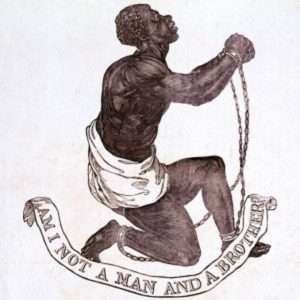
Josiah Wedgewood's famous 1787 image created for the antislavery movement.
It is no accident that the antislavery movement was also accompanied by what historian Kate Masur calls "America's First Civil Rights Movement," which sought equal rights for blacks that went beyond simply abolishing slavery.
While the hypocrisy and contradictions were very real, so too is the fact that Revolution and Founding made abolition possible, in part by giving a boost to universalistic Enlightenment liberalism on both sides of the Atlantic. Among other things, the Revolution inspired the First Emancipation in the US (the abolition of slavery in the North that became the first large-scale emancipation of slaves in modern history). Without the First Emancipation, we could not have achieved the second and greater one.
Those principles are at the root of most of America's achievements, of which the abolition of slavery was among the most important. They are also what enabled America, at its best, to offer freedom and opportunity to people from a wide range of racial and ethnic backgrounds from all over the world.
But the Juneteenth holiday is nonetheless meant to commemorate the end of slavery as a whole, and that is in fact how it has been understood for many decades, long before it became a federal holiday. June 19 is the traditional date for commemoration of abolition, even if it is not the anniversary of the day on which the last vestiges of slavery were actually banned. Similarly, we celebrate Independence Day on July 4, even though July 2, 1776 was the date when the Continental Congress actually voted for independence, and independence was not fully achieved until the Treaty of Paris ended the Revolutionary War in 1783. Until that latter date, large parts of the US remained under British control.
Ultimately, the holiday commemorates a great achievement, even if that achievement was not fully completed on any one day, and in some ways remains incomplete even now. The struggle for freedom is ongoing, and never fully won. But there can still be great milestones along the way, of which the abolition of slavery was likely the most important.
Abraham Lincoln, the president who issued the Emancipation Proclamation whose belated enforcement Juneteenth celebrates, put it best in his famous speech on the Declaration of Independence and its implications for slavery:
I think the authors of that notable instrument intended to include all men, but they did not mean to declare all men equal in all respects…. They did not mean to assert the obvious untruth, that all were then actually enjoying that equality, or yet, that they were about to confer it immediately upon them…
They meant simply to declare the right, so that the enforcement of it might follow as fast as circumstances should permit.
They meant to set up a standard maxim for free society which should be familiar to all: constantly looked to, constantly labored for, and even, though never perfectly attained, constantly approximated, and thereby constantly spreading and deepening its influence and augmenting the happiness and value of life to all people, of all colors, every where.
The success of the antislavery movement's appeal to liberal universalism has been a model for later expansions of freedom, as well - including equal rights for women, the Civil Rights Movement of the twentieth century, and the struggle for same-sex marriage. It is a model that advocates of migration rights would do well to emulate today.
The work of fully living up to the ideals of the Founding wasn't completed in Lincoln's time, and it remains seriously incomplete even now. But Juneteenth commemorates perhaps our greatest step in the right direction. And it reminds us that further progress towards liberty and equal rights depends on applying the same principles that made abolition possible.
As noted in earlier posts here, here, and here, I represent some of the families who lost loved ones in the crashes of two Boeing 737 MAX aircraft. This short post provides a quick update on the latest developments, as in the next few weeks the Justice Department will make important decisions about Boeing's prosecution. My families seek aggressive prosecution of what has properly been described as the deadliest corporate crime in U.S. history.
Here's a quick recap of the current situation: Following a criminal investigation by the Justice Department, in January 2021, Boeing admitted that it concealed safety issues with the aircraft from the FAA—and negotiated a secret deferred prosecution agreement (DPA) apparently resolving its criminal liability for its deadly conspiracy to defraud the FAA. In the DPA, Boeing committed to undertaking efforts to improve its corporate compliance with regulatory and safety obligations.
But since then, in October 2022, the district judge handling the case (Judge Reed O'Connor in the Northern District of Texas) has concluded that the 346 families who lost family members in the crashes represent "crime victims" and that their Crime Victims' Rights Act (CVRA) rights were violated by the Department secretly negotiating the DPA.
And then last month, the Justice Department concluded that Boeing had breached its commitment in the DPA to improve safety at the company—a conclusion that seems supported by an almost daily barrage of news about safety concerns at Boeing and with its aircraft. The Department is currently considering how to move forward with prosecuting Boeing and has asked the victims' families for their views.
Notably, a criminal charge has already been filed against Boeing in the Fort Worth Division of the Northern District of Texas. That pending charge alleges that Boeing conspired to defraud the FAA about safety issues associated with the 737 MAX. Under the DPA, the criminal prosecution of Boeing was deferred. But now that Boeing has breached its DPA obligations, the pending criminal charge against it needs to move forward through the ordinary criminal justice process.
Under the DPA, the Speedy Trial clock for proceeding with the conspiracy charge against Boeing was tolled until July 7, 2024. So it seems likely that the Justice Department—and Judge O'Connor—will want to have a schedule in place for moving forward with the case before that date.
Earlier today, I sent the linked 32-page letter to the Department, outlining the position of my families as to how the Department's prosecution of Boeing should proceed. Here are some of the opening paragraphs from the letter, which seeks aggressive prosecution of Boeing:
As explained in more detail below, Boeing's crime produced losses in excess of $12,390,000,000, meaning the maximum possible fine is $24,780,000,000. Because Boeing's crime is the deadliest corporate crime in U.S. history, a maximum fine of more than $24 billion is legally justified and clearly appropriate, although it might be partially suspended if funds that would otherwise be paid are devoted to appropriate quality control and safety measures. This letter explains the calculations underlying this conclusion and further sets out the families' views more broadly on how Boeing and responsible corporate executives should be prosecuted.
In overview, as explained in greater detail in my letter to you of June 4, the families continue to believe the appropriate action now is an aggressive criminal prosecution of The Boeing Company. The Justice Department should promptly ask Judge O'Connor to schedule a date for a jury trial within seventy days of July 7, 2024—as required by the Speedy Trial Act. In requesting a quick jury trial, the Department should note the families' right, as embodied in the Crime Victims' Rights Act (CVRA), to proceedings free from unreasonable delay. If Boeing requests plea negotiations, the
Department should not offer Boeing any concessions. If the Department seems likely to reach a tentative agreement with Boeing on plea concessions, the families request an opportunity to exercise their right under the CVRA to confer with the Department about any possible concessions. See 18 U.S.C. § 3771(a)(5) & (9).
Once Boeing is convicted at trial (or by pleading guilty "straight up" to the pending conspiracy charge), then it should receive a sentence reflecting its guilt for the deadliest corporate crime in U.S. history. It should be fined the maximum—$24,780,000,000—with perhaps $14,000,000,000 to $22,000,0000,000 of the fine suspended on the condition that Boeing devote those suspended funds to an independent corporate monitor and related improvements in compliance and safety programs as identified below. And Boeing's Board of Directors should be ordered to meet with the families.
The families also believe that the Department should launch criminal prosecutions of the responsible corporate officials at Boeing at the time of the two crashes, including in particular former Boeing CEO Dennis Muilenburg. Because time is of the essence to avoid any statute of limitations from running, the Department should begin these prosecutions promptly.
My letter today to DOJ follows on the heels of yesterday's high-publicized hearing by the Senate Permanent Subcommittee on Investigations. During the hearing, Boeing's CEO Dave Calhoun apologized to the families who lost loved one in the crashes. Calhoun was grilled by Senator Blumenthal (D-CT) and Senator Josh Hawley (R-MO). Senator Blumenthal called for prosecution of the Boeing executives who were responsible for the conspiracy, while Senator Hawley called for current CEO Calhoun's resignation. The video of the hearing is well worth watching, as it demonstrates bipartisan concensus that something is terribly wrong at Boeing.
I hope that the Justice Department will read my letter carefully and follow the steps that I recommend. Right now, Boeing's safety problems are harming its status as one of America's (formerly) great companies. A criminal prosecution that sets Boeing on a new and improved course is an important reform—for Boeing to restore its reputation.
Not because it's "scandalous" or "immoral," since the Supreme Court struck down that trademark restriction on First Amendment grounds in Iancu v. Brunetti(2019); rather, because it is so "commonplace" that people would just view it as the common phrase instead of an indicator of who is manufacturing the products (here, clothing).
We find, on the basis of the record as a whole, that FUCKSHITUP "does not create
the commercial impression of a source indicator, and does not function as a trademark
to distinguish Applicant's goods … and indicate their source." "Consequently, Applicant cannot appropriate the term exclusively to [himself], denying others the ability to use it freely," including as the three-word phrase FUCK SHIT UP.
The (heavily illustrated) case is In re Gatsby, decided by the Trademark Trial and Appeal Board on June 7, in an opinion by an Administrative Trademark Judge Christopher Larkin, joined by Judge Robert Coggins. The Urban Dictionary is cited heavily, though with a cautionary note:
From U.S. ex rel. Oberg & Camoin v. Nelnet, Inc., decided yesterday by the Fourth Circuit, in an opinion by Judge Julius Richardson, joined by Judge Barbara Milano Keenan and District Judge Elizabeth Dillon (W.D. Va.):
In 2007, Jon Oberg filed a lawsuit under the False Claims Act against various student-loan companies, including Nelnet, Inc., Nelnet Education Loan Funding, Inc., Brazos Higher Education Services Corporation, and Brazos Higher Education Authority, Inc. (together, Nelnet and Brazos). Oberg alleged that the companies submitted false claims to the Department of Education to inflate their loan portfolios eligible for interest subsidies. The parties consented to a magistrate judge deciding the case….
The parties filed various documents under seal, and he case ultimately settled while summary judgment motions were pending. Then, "[o]n March 31, 2023, Michael Camoin—a documentary filmmaker who covers the student-loan industry—filed a pro se letter in the district court requesting access to the materials that Oberg filed under seal in connection to his opposition to summary judgment." The Fourth Circuit ruled that the First Amendment provided a presumptive right of access to the documents:
So holds a federal court, also concluding that earlier sexual discussions could likewise justify restriction in the open public comment period (treated by the law as a “limited public forum,” in which reasonable and viewpoint-neutral restrictions are constitutional).
This case arises from a disruption at a Las Vegas City Council meeting. Stein, a Texas resident, traveled to Las Vegas and attended a City Council meeting on August 17, 2022. The complaint provides that Stein frequently speaks at municipal meetings and is known for using "humor to bring attention to serious social and political issues."
Stein alleges that he planned to bring attention to the exploitative practices of Las Vegas casinos and that he incorporated a humorous anecdote while speaking to City Council members. Before Stein's allotted time had expired, Mayor Goodman interrupted Stein, whose microphone was subsequently cut off. Fiore then ordered the marshals to remove Stein from chambers….
Nevada law allows for the ejection of a speaker from a public meeting if he "willfully disrupts a meeting to the extent that its orderly conduct is made impractical." …
Although the question of whether a person's actions are disruptive appears inherently subjective on the surface, Stein's conduct, combined with the totality of the circumstances, was in violation of both Nevada law and the City Council Code of Conduct.
Defendants points to Stein's language as disruptive. Stein stated the following before his microphone was muted: "I end up meeting a nice Filipino girl. I take her back to my hotel room … I ended up having a good time. We started kissing. We take off our clothes. She has male genitalia. She's a transgender." Subsequently, Mayor Goodman interrupted Stein and reminded him "[w]e're in a public venue" and asked if he could remain calm.
…I see a duck-billed platypus. Cf. Garland v. Cargill (Sotomayor, J., dissenting) ("When I see a bird that walks like a duck, swims like a duck, and quacks like a duck, I call that bird a duck."). Alas, a platypus does not quack.
But it is not pleasant when a duck meets the single function of a trigger.
Eugene has raised a fascinating subject with respect to unpublished memorandum opinions that cannot be cited. It is not clear to me that the Article III federal courts have the power, as an original matter, to issue opinions that cannot be cited, are not binding precedent, and that are therefore somewhat unconstrained by the rule of law.
When I clerked on the Second Circuit and the D.C. Circuit from 1983 to 1985, memorandum opinions accounted for only 20% of the docket. Today, in 2024, memorandum opinions account for a stunning 90% of almost all 12 of the Federal Circuit Courts of Appeal. When I was a law clerk, memorandum opinions were drafted by law clerks, received cursory review form an Article III judge, and were an exception to the norm. The fact that 90% of the Federal Circuit Courts of Appeals are now memorandum opinions means that those courts have only a discretionary docket, like the U.S. Supreme Court, and can pick and choose which cases they want to make law with.
All of this reflects the fact that there has not been an increase in the number of lower court judges since 1993, and, since then, the docket of the lower federal courts has tripled. Partisan fights over the appointment of new judges explain the failure to get a new judgeship bill passed by a 60 vote margin by obtaining cloture in the Senate. Moreover, the current sitting 179 Circuit Court of Appeals judges on active duty do not want new federal judgeships created because it would diminish their status to triple the size of the lower federal court judges to match the tripling in caseload of the lower federal courts.
I fear that we are stuck with this phenomenon, but the evils it produces ought not go unnoticed. A judge who can issue an opinion in a case that is not citable is not bound by precedent or the expectations of the parties in deciding each case on its own facts, unbound by the rule of law, and probably unlikely to be reversed by a Supreme Court that only heard 60 cases this year out of the 40,061 cases in 2023.
This issue arose in the Adams v. Gulleythread ("California Judge Orders Removal of Reddit Criticism of Scientist/Consultant Who Publicly Criticized English Lucy Letby Murder Trial"), but I've also seen confusion about it in other places as well, so I thought I'd write briefly about it.
In federal appellate courts and many state appellate courts, many court opinions are labeled "unpublished" or "not for publication." This essentially means that they are not binding precedent, and are not to be published in the official reporters where binding precedent is published. The opinions are often "published" in the lay sense of the term: They are made public on pay services like Westlaw and Lexis, and on many free sites, generally including the sites of the very courts that label them "unpublished." Indeed, some are published in print volumes (such as the Federal Appendix, where federal appellate unpublished decisions are printed).
There is no legal prohibition on writing about them, quoting them, or reproducing them online or elsewhere. They are just not binding precedent.
Now some courts, such as the California Court of Appeal, go further and make the opinions noncitable even as persuasive precedent. California Rule of Court 8.1115(a), for instance, provides that
There is a growing movement to let churches and other religious organizations build housing on their property that would otherwise be banned by zoning regulations.
America has a serious shortage of housing in many parts of the country, and the main cause of the probem is exclusionary zoning: regulations that severely restrict the amount and types of housing that can be built in many areas. One increasingly popular proposal for addressing the housing crisis is "Yes in God's Backyard": giving religious organizations like churches, synagogues, and mosques exemptions from zoning rules and other restrictions that would otherwise prevent them from building housing on their land. Rachel Cohen of Vox has a helpful summary of this idea and the growing support for it:
About five years ago, Harvey Vaughn, the senior pastor at Bethel AME, the oldest Black church in San Diego, heard a radio report about rising homelessness in his city. He wondered if his congregation, which owned a roughly 7,000-square-foot lot around the corner, could help.
Today, the lot is a construction site for a new housing complex that will offer 25 one-bedroom apartments for low-income seniors and veterans. It's the first of what advocates hope will be many such projects in San Diego, led by a group called YIGBY, which stands for Yes in God's Backyard, a spin on the pro-housing Yes in My Backyard movement.
In a country with a shortage of affordable homes and a surplus of religious institutions grappling with rising costs and declining memberships, developers are looking to partner with churches, temples, and synagogues to build new housing. And amid a thicket of local land-use regulations that complicate the construction, some elected officials are looking for ways to nudge these efforts along.
The YIGBY idea — working with faith-based groups to help address the housing crisis — originated from local advocates who knew homeless people eager to move from the streets into housing but unable to find any. The San Diego Association of Governments estimates San Diego County has a shortage of roughly 100,000 homes.
Local funders dedicated to solving homelessness helped bring the YIGBY concept to life, and new zoning laws approved in 2019 helped streamline the process further, removing requirements that developers first seek approval from local planning agencies or elected boards to build….
Now this model is poised to spread across California, helping to address the state's severe housing shortage.
Last year California's legislature passed the Affordable Housing on Faith Lands Act that, like in San Diego, streamlines approval for new projects on land owned by churches, so housing can no longer be blocked by zoning or environmental objections. This first-of-its-kind YIGBY law took effect in January.
The Terner Center for Housing Innovation at UC Berkeley estimates that, across California, there are more than 47,00 acres of land owned by faith-based organizations that could potentially be developed into affordable housing.
State Sen. Scott Wiener, a Democrat from San Francisco who spearheaded the statewide YIGBY law, said California doesn't yet have data on how the new law is being utilized, but he often hears from interested people who say their congregation is preparing to do it.
"Even if just 10 percent of the plots of land identified by Terner did it, that could lead to a massive increase in housing," Wiener told Vox. "Overall it's very, very popular and you can really build a huge diverse political coalition around it."
This policy could potentially spread to other states. Letting religious organizations build housing on their property is likely to prove popular. Surveys suggest that much opposition to "YIMBY" housing policies may be driven by a combination of economic ignorance and fear and suspicion of for-profit developers. By contrast, most people have more positive attitudes towards religious organizations.
But, as Cohen also notes, even relatively ambitious YIGBY policies are unlikely to make more than a modest dent in housing shortages, especially in areas where there are severe zoning restrictions and high demand. Religious institutions own only a small proportion of land in areas with serious housing shortages.
Ultimately, the most compelling arguments for letting religious organizations build new housing on their property also apply to conventional secular property owners. And, despite suspicion of the profit motive, there is little reason to think religious entities will necessary build better or more affordable housing than commercial developers would.
Indeed, where allowed to do so, the latter have strong incentives to build affordable housing precisely because they are motivated by profit. To paraphrase Adam Smith's famous statement about butchers, brewers and bakers: "It is not from the benevolence of the builder and the developer, that we expect our housing, but from their regard to their own interest."
Other things equal, if I were a tenant (as I was in my younger days), I would probably rather rent from a randomly selected for-profit landlord than from a randomly selected religious institution. As a general rule, a commercial landlord is likely to be better at managing and maintaining the property, in part because of superior expertise - and because the landlord knows that a reputation for poor management is likely to result in lower profit.
Obviously, religious institutions could potentially hire professional developers and management firms to build and operate their new housing complexes. But that means bringing in the profit motive, at least to some extent. The developers and managers probably won't do the work just to earn the church's or synagogue's good will, or even that of the Almighty.
President Joe Biden. (Samuel Corum/Pool via CNP/Polaris/Newscom)
Today, President Biden announced a policy granting "parole in place" to undocumented immigrant spouses of US citizens who have been in the US for at least 10 years, and meet some other criteria. Those eligible can apply for parole status. If they get it, they will then have a three-year period during which they will have work permits and can apply for "green card" permanent residency (that status will eventually also enable them to apply for citizenship). Currently spouses of US citizens are already eligible to apply for green cards. But if they entered the US illegally, they are required to meet onerous conditions, such as first leaving the United States, and staying away for up to ten years. About 500,000 people could potentially benefit from the program.
The grant of parole will enable them to dispense with these requirements. Under Section 245 of the Immigration and Nationality Act, undocumented immigrants who have been granted parole may have their status adjusted to that of temporary legal residents. That adjustment would dispense with various penalties for unlawful entry, including the requirement to leave the US for a long period of time before applying for a green card.
The moral and policy case for this step is obvious. Granting legal residency to spouses of US citizens keeps families intact, and enables these people to work legally. The latter will benefit both their families and the broader US economy. And letting them get green cards without having to leave the country for many years also helps prevent cruel family separations. That has obvious benefits for the immigrants, themselves, their US-citizen spouses, and their children (who are also US citizens). Don't take my word for it! Take that of the social conservatives who have (rightly) insisted for decades that intact families are good for children, and for the broader community. If you believe in "family values," you have every reason to support the administration's new policy here.
Some will argue we must always enforce every law to the hilt, and thus that it is wrong to give illegal migrants any reprieve. But if you really believe all law-breakers should be punished, then you must also insist it's wrong to let off the hook the millions of Americans who routinely engage in minor traffic law violations or transgress a variety of other laws that are rarely enforced against most violators, such as the federal ban on marijuana possession. A "just enforce the law" approach would require authorities to punish a majority of adult Americans, as most of us have violated federal criminal law at one point or another (to say nothing of state and local laws and regulations).
If, on other hand, you think it's justifiable to forego punishment in cases where inflicting it would cause great harm or injustice, or where doing so diverts law enforcement resources from more important priorities, then there is a strong case for granting reprieves to undocumented migrants who fled horrible poverty and oppression. Their case for forbearance is actually stronger than that of those who engaged in minor speeding, marijuana possession, or other crimes that most Americans are happy to see go unpunished, in most situations. That reasoning applies with even greater force in a situation where a reprieve for the migrants would greatly benefit their US-citizen spouses and children.
The legal issues raised by Biden's new policy are more complicated than the moral ones. The relevant statute gives the president the power to grant parole entitling non-citizens to temporary legal residence, "on a case-by-case basis for urgent humanitarian reasons or significant public benefit."
As in the CNVH case, there is a strong argument that parole for spouses of US citizens is backed by "urgent humanitarian reasons." Deporting such people (or requiring them to leave the country for many years to become eligible for legal residency) inflicts serious harm on their families, including many children. There is also a strong case that this grant of parole creates "significant public benefit." As already noted, keeping families intact benefits the larger community, as well as the families themselves. Again, don't take my word for it! Take that of pro-family social conservatives (as well as many social scientists across the political spectrum).
If, as is likely, conservative red states challenge the new policy in court, they will probably focus on the requirement that parole only be granted on a "case-by-case basis," and claim that the administration's rules are too categorical. This issue has come up in the CNVH case, and I addressed it in some detail in my amicus brief in that case (filed on behalf of the Cato Institute and MedGlobal, as well as myself) (pp. 11-20). I think most of the points made there apply to parole for spouses of citizens, as well. I summarize the most important points in a September 2023 article in the Hill:
[A]ny case-by-case decision-making must be guided by rules and presumptions, if it is not to be completely random and arbitrary. And it is entirely reasonable to presume that migrants from nations with horrifically oppressive governments, widespread violence and economic crisis, have urgent humanitarian needs.
The same goes for the presumption that paroling people from these countries will reduce pressure on the southern border, as it actually has [thereby creating a significant public benefit]….
Similarly, it is reasonable to presume that families have an "urgent humanitarian need" to stay together, and that keeping them together is a significant public benefit.
It is worth noting that parole in place has been used since 2007 to protect spouses of US military servicemembers from deportation (a policy begun by administration of Republican President George W. Bush). That policy, too, relies on general rules and presumptions: that keeping servicemembers' families intact is a humanitarian imperative, and that it creates significant public benefits.
As in the CNVH case, a legal challenge to Biden's new parole-in-place policy will raise standing issues. State standing issues in the two cases have some obvious similarities, but there may also be some differences. My own view is that states should have broad standing rights to challenge a variety of federal policies, including those that - like this one - I think should be upheld on the merits. But, in recent years, the Supreme Court and some lower federal courts have taken a harder line on state standing, including in some challenges to immigration policies. I may have more to say about standing questions later, once cases challenging the policy have actually been filed.
In sum, this is a good policy, and it is authorized by the parole power granted to the executive by Congress. But it will almost certainly be challenged in court, in what may turn out to be a prolonged legal battle.
The New York Times has a lengthy article about Professor William English, who has written articles and briefs about gun ownership. Buried towards the bottom of the article is some new reporting on the deliberations in Bruen:
The draft opinion that Justice Clarence Thomas circulated to his colleagues in February 2022 was sweeping, with the potential to outlaw many common gun-control measures. The majority was slow to sign on. Chief Justice John Roberts and Justice Kavanaugh requested modifications, according to people familiar with the deliberations, who requested anonymity because that process is intended to be secret.
By May, Justice Thomas still had not mustered the five votes needed. Mass shootings that month in Buffalo and Uvalde galvanized public attention anew on gun violence. It was not until June that his opinion prevailed, when Justice Kavanaugh signed on but wrote his own more moderate concurrence, joined by the chief.
The authors, Mike McIntire and Jodi Kantor, do not provide any more details on their sourcing. I've heard that Kantor, whom I blogged about recently, spent some time researching the OT 2021 Term, and the Dobbs leak in particular, so I wouldn't be surprised if she gained some information about Bruen. Like with Joan Biskupic's reporting, I will remain skeptical, though presume it is true for purposes of the analysis.
Bruen was argued in November. If Kantor is right, then as late as May, there was still not a majority opinion. It is completely plausible that Justice Thomas wrote a sweeping opinion. It seems, at least that Justice Barrett signed on in full--perhaps ironic since she is the one who most likely has misgivings about Thomas's jurisprudential approach. But Chief Justice Roberts and Justice Kavanaugh were unwilling to join. For Heller, it was long assumed that Justice Kennedy requested modifications to water down the opinion--you know the lines about "sensitive places" and "dangerous" people. Here, it seems that Roberts and Kavanaugh both made the requests. And, apparently, Justice Thomas was willing to water things down to assuage Roberts and Kavanaugh.
Kantor also hints that the mass killings in Uvalde and Buffalo may have impacted the deliberations. I'll add one more data point. The attempted assassination of Justice Kavanaugh occurred on June 8. It is not clear if the majority coalesced before or after that crime. At the time, I wrote that Kavanaugh's concurrence that referenced "mental health reference checks" was likely influenced by his experience. That post was not well received, but I firmly suspect these sorts of external events have to affect the Justices.
May and June of 2022 were such chaotic times, especially with the leak and the assassination attempt. It is still nothing short of a miracle that in the span of a few days, the Court released Dobbs, Bruen, and Kennedy.
Sign up here to receive all of the new Volokh Conspiracy posts in a daily e-mail.
The All-Argentina Issue is Here
New from Reason: a look into what Javier Milei
has accomplished and what it will take to make the most of Argentina’s window for real change. Out now
for subscribers.