Each fall, I teach a seminar called Recent Books on the Constitution. I initially designed this course when I visited Georgetown in 2005. At that time, because I tend to read what relates directly to my current projects, I felt that I was not keeping up with the literature. By assigning recent books on the Constitution to read as part of my teaching, I would actually read them. This has really worked for me. I have now read a lot of books on the Constitution. The complete list of all the books I have assigned is below.
Since 2005, I have assigned 95 books by 87 authors, with James Fleming, Sandy Levinson, Gerard Magliocca, Eric Segall, Dan Farber, Philip Hamburger, Kim Roosevelt, and David Bernstein each making more than 1 appearances. Four books were assigned in manuscript before publication. This fall, I am assigning a portion of my book Our Republican Constitution: Securing the Liberty and Sovereignty of We the People, which is not as recent as The Original Meaning of the Fourteenth Amendment: Its Letter and Spirit but relates more closely to the other books the students will read. Here are this year's 5 "recent books on the Constitution":
I select books I think I ought to read–either because of the subject or the author. I then hold off reading them myself so I can read them at the same time as the students. This enables me to react to the books along with them, and for me to remember the nuances of the books for class discussion.
The seminar format is to read 6 books, taking 2 weeks on each book, with the author coming to the class during the second week to discuss the book. The first book is now always one of mine to use as a trial run and to give the students an idea of where I am coming from when we discuss the other books. When books are longer than 250 pages, I ask the author to tell me which 250 pages I should assign. If I assign much more than 125 pages per week, I fear the students won't read them, or won't read them carefully enough. To help assure that they do, students submit one-page summaries of each half of the book (graded pass-fail). On the day before the author's visit, they submit a 5500 character critique of the book, which I send to the author electronically the day before class. (They all read them.) When the class ends, there is no exam or paper for the students to write or for me to grade. We are done!
Students consistently tell me that the course is extremely enriching, and helps them develop their critical skills. It is also empowering for them to see how well they are able to find the holes in a professor's book-length presentation. I find that, collectively, the students are able to nail the weaknesses of every book (except mine, of course).
[Note to law professors: I have a budget to pay for the authors' travel expenses. But now that we all have access to Zoom teaching, this seminar format can be replicated anywhere at zero cost. Wouldn't it be great if there were a dozen or more such book seminars around the country? Try it. I promise you will love it.]
If you click on READ MORE you will see why teaching this class has been enormously rewarding for me. Offer my heartfelt thanks to all these authors for trekking to DC to discuss their books with my students. Read More
The Declaration of Independence used to be read aloud at public gatherings every Fourth of July. Today, while all Americans have heard of it, all too few have read more than its second sentence. Yet the Declaration shows the natural rights foundation of the American Revolution, and provides important information about what the founders believed makes a constitution or government legitimate. It also raises the question of how these fundamental rights are reconciled with the idea of "the consent of the governed," another idea for which the Declaration is famous.
The adoption of the Declaration, and the public affirmation of its principles, led directly to the phased in abolition of slavery in half of the United States by the time the Constitution was drafted—as well as the abolition of slavery in the Northwest Territory. The Rhode Island gradual abolition law of 1784 read:
All men are entitled to Life, Liberty, and the Pursuit of Happiness, and the holding Mankind in a State of Slavery, as private property, which has gradually obtained by unrestrained Custom and the Permission of the Law, is repugnant to this Principle, and subversive of the Happiness of Mankind.
Later, the Declaration also assumed increasing importance in the struggle to abolish slavery. It became a lynchpin of the moral and constitutional arguments of the nineteenth-century abolitionists. As one New Yorker opposed to slavery wrote in 1797:
The right of property which every man has to his personal liberty is paramount to all the laws of property…. All I contend for at present is, that no claims of property can ever justly interfere with, or be suffered to impede the operation of that noble and eternal principle, that "all men are endowed by their Creator with certain unalienable rights—and that among these are life, liberty, and the pursuit of happiness.
The Declaration was much relied upon by Abraham Lincoln and many others before him:
In the latest episode of our podcast, Divided Argument, Dan Epps and I discuss at length the Court's immunity ruling in Trump v. United States. We end up substantially less divided on this one, with both of us generally agreeing that the consequences of the opinion are quite uncertain and not necessarily bad, but the legal basis and craft of the opinion is much worse -- and much more. You can listen to the whole episode, "Back on the Island," here:
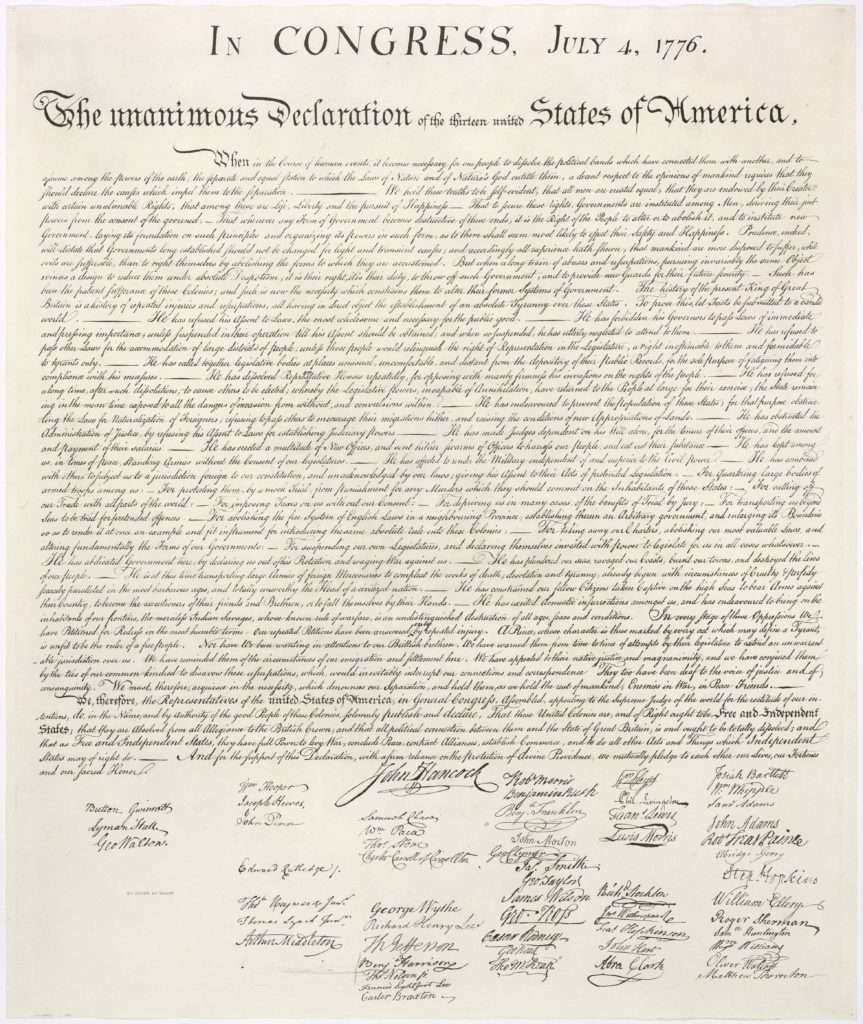
The Declaration of Independence. (National Archives.)
Over the years, I have written a number of posts and articles on the American Revolution and the ideals of the Declaration of Independence.. Some have obvious continuing relevance to such issues as identity politics, nationalism, immigration, the role of slavery in American history, and others.
This post is an expansion of last year's similar compendium. This year, I am spending July 4 in Britain, which is simultaneously appropriate and heretical. Appropriate because the Enlightenment liberal ideals underlying the Declaration came to us in large part from the British; heretical because the American Revolution was, of course, a rebellion against British rule.
I hope the links are useful, and stir reflection on the principles of the Declaration. Unless otherwise noted, all of these pieces were published as posts on the Volokh Conspiracy blog.
"The Case Against Nationalism," National Affairs, Winter 2024 (with Alex Nowrasteh). This article is a more general critique of nationalism. But it includes a section explaining why nationalism is inimical to the ideals of the Declaration and the Founding.
Nixon v. Fitzgerald established broad presidential immunity for civil lawsuits. Clinton v. Jones permitted the sitting President to be sued for conduct that occurred before his time in office. But neither case addressed presidential immunity from a criminal prosecution.
During the Mueller investigation, I wrote a series of articles contending that a federal criminal prosecution posed a far greater risk to the presidency than a civil lawsuit. Mueller's defenders disagreed. They contended that since anyone could file a civil lawsuit, while only a responsible federal prosecutor could bring an indictment, the former posed a greater risk. I never found this argument persuasive. Now, Trump v. United States squarely rejected this distinction.
Chief Justice Roberts stated the issue plainly:
Criminally prosecuting a President for official conduct undoubtedly poses a far greater threat of intrusion on the authority and functions of the Executive Branch than simply seeking evidence in his possession, as in Burr and Nixon. The danger is akin to, indeed greater than, what led us to recognize absolute Presidential immunity from civil damages liability—that the President would be chilled from taking the "bold and unhesitating action" required of an independent Executive. Fitzgerald. Although the President might be exposed to fewer criminal prosecutions than the range of civil damages suits that might be brought by various plaintiffs, the threat of trial, judgment, and imprisonment is a far greater deterrent. Potential criminal liability, and the peculiar public opprobrium that attaches to criminal proceedings, are plainly more likely to distort Presidential decisionmaking than the potential payment of civil damages.
Robert is absolutely correct (not a sentence I write often).
In dissent, Justice Sotomayor articulated the alternate view. First, she wrote that the "threat of criminal liability is much smaller." There are countless potential civil litigants, but only one Department of Justice. Sotomayor wrote, "The majority's bare assertion that the burden of exposure to federal criminal prosecution is more limiting to a President than the burden of exposure to civil suits does not make it true, and it is not persuasive." I'm not so sure. Compare the impact of Jack Smith and Robert Mueller to the impact of Paula Jones and E. Jean Carroll. Not even in the same ballpark.
Second, Justice Sotomayor pointed to "robust procedural safeguards" that federal criminal prosecution have that civil suits lack. She cites the "scrupulous and impartial" standards that DOJ lawyers follow, in addition to procedural protections under the Bill of Rights. I'm not sure this argument sticks. The procedural protections exist because the potential punishment is far more severe. At most, a civil lawsuit can yield a damages award, and maybe some injunctions. Civil suits can also be quietly settled. By contrast, a criminal prosecution is public, and can result in incarceration and forfeiture of various rights.
Third, Sotomayor acknowledges that "a private civil action may be brought based on little more than "'intense feelings.'" By contrast, "a federal criminal prosecution is made of firmer stuff." Historically, she writes, prosecutors have exercised "restraint" to not prosecute a former President. But the "grave" allegations against Trump were different.
A recurring theme in the Trump dissent is an abiding faith in the fairness of a federal prosecutions against the President--especially by a special counsel. Indeed, Justice Sotomayor insisted that the special prosecutor acts on behalf of the United States:
The public's interest in prosecution is transparent: a federal prosecutor herself acts on behalf of the United States
That is true only in the most technical sense. In reality, Jack Smith works for Jack Smith, and there is no evidence that Attorney General Garland actually exercises any control over this prosecutor. During oral argument in Florida, counsel for the special counsel refused to address whether the Attorney General was even consulted before Trump was indicted. Moreover, Reports suggest that Smith would continue prosecuting Trump even up till inauguration day--something no accountable prosecutor would even countenance.
Color me (and the Chief Justice) skeptical about Jack Smith faithfully representing the United States. As Justice Scalia explained in his Morrison dissent, a prosecutor focused on one person, and one person alone, will stop at nothing to get his man. These dynamics are all the more troubling when the guy is the former, and (likely) future President.
Roberts responds:
The prosaic tools on which the Government would have courts rely are an inadequate safeguard against the peculiar constitutional concerns implicated in the prosecution of a former President. Although such tools may suffice to protect the constitutional rights of individual criminal defendants, the interests that underlie Presidential immunity seek to protect not the President himself, but the institution of the Presidency.
Roberts used a nearly identical line in Trump v. Hawaii, though he did not dare cite it:
In doing so, we must consider not only the statements of a particular President, but also the authority of the Presidency itself.
This issue also recurred during oral argument inTrump v. Mazars. In that case, Justice Gorsuch "we have to write a rule that's presumptively of some value going forward and isn't just about one President but it's about the presidency." Gorsuch made a similar comment in the immunity argument, noting they were writing a "rule for the ages." Gorsuch was mocked for this statement, but he is exactly right. With a separation of powers cases, it's not just about Trump.
Throughout the four years of the Trump presidency, I repeated this refrain over and over again: whatever rules are adopted for this President would invariably weaken the presidency in the future.
I suspect lurking in Roberts's mind is a reasonable concern that a Trump administration will try to indict President Biden on a whole range of offenses. This passage speaks to that risk directly:
Virtually every President is criticized for insufficiently enforcing some aspect of federal law (such as drug, gun, immigration, or environmental laws). An enterprising prosecutor in a new administration may assert that a previous President violated that broad statute. Without immunity, such types of prosecutions of ex-Presidents could quickly become routine.
As much as Roberts was trying to insulate Trump from criminal prosecution, he was also throwing a life-preserve to former-President Biden, and all future former-presidents.
Still, even so, the Trump DOJ may seek to indict Biden for his retention of classified documents. This conduct by the former Vice President occurred before he was President. Special Counsel Robert Hur's argument that Biden is an "elderly man with a poor memory" will be belied with Biden's own insistence that he has the mental acuity to be the leader of the free world. I'm not sure what the statute of limitations is on that offense, but it would probably be tolled while Biden is in office. And given that Biden would no longer pose any sort of political threat to Trump, there is no conflict of interest, so I don't even think a special counsel would be called for. I suppose Biden could pardon himself on the way out the door.
In 2017, President Trump was sued for violating the Foreign and Domestic Emoluments Clauses. Each complaint was brought against the President in his "official capacity." In a series of amicus briefs, Seth Barrett Tillman and I contended that these "official capacity" suits were not proper. Not everything the President does during his tenure is, ipso facto, an "official act." Rather, under settled case law, a government officer violates the Constitution in his official capacity if—and only if—a government policy or custom must have played a part in the violation of federal law. Hafer v. Melo (1991). Still, the plaintiffs never alleged that President Trump acted pursuant to any government policy or custom. Nor did the plaintiffs allege that Trump acted "under the color of law"—a precondition for pleading an individual-capacity claim. Rather, these cases concerned alleged conduct that President Trump took personally.
As we explained in a 2022 article, the President has three bodies: [1] an official-capacity claim involves a government policy or custom; [2] an individual capacity claim involves action taken by a government officer under the color of law; and [3] a personal claim involves private conduct, absent state action.
Trump v. United States provides some support for our position, and also has some symmetry with the presidential immunity trichotomy.
Chief Justice Roberts recognized that not everything the President does is official, and there are some unofficial acts.
The President enjoys no immunity for his unofficial acts, and not everything the President does is official.
To be sure, this standard concerns presidential immunity, but a similar framework may extend to the capacity analysis for civil lawsuits.
The Court observed that it is often difficult to disentangle the President-as-President and the President-as-a-politician.
Trump v. United States is one of the Supreme Court's most significant separation of powers cases. While Roberts is often described as a minimalist, he was just the opposite here. Justice Sotomayor aptly observes in dissent, "In reaching out to shield some conduct as official while refusing to recognize any conduct as unofficial, the majority engages in judicial activism, not judicial restraint."
The Court could have simply resolved whether the particular allegations in the indictment warranted immunity. But Chief Justice Roberts did not stop there. The opinion is quite sweeping. Chief Justice Roberts developed a framework to address all facets of presidential power. He put forward a presidential immunity trichotomy.
Supreme Court Justices have often laid out three-level tests. Perhaps the most famous was Justice Jackson's triptych in Youngstown. Gone, but not forgotten, was the trimester framework from Roe. And now the Trump trichotomy.
First, "at least with respect to the President's exercise of his core constitutional powers, this immunity must be absolute." These powers are described as "conclusive and preclusive," "exclusive," and an "exclusive sphere of constitutional authority."
Second, for other "official actions" that are outside the "core constitutional powers," there is at least "presumptive immunity." The Court explains, there is "at least a presumptive immunity from criminal prosecution for a President's acts within the outer perimeter of his official responsibility." The Court affords immunity "unless the Government can show that applying a criminal prohibition to that act would pose no 'dangers of intrusion on the authority and functions of the Executive Branch.'"
Third, for all other "private" or "unofficial" actions, there is no immunity.
Why did Roberts write this opinion so broadly? I think Chief Justice was troubled by years of Lawfare against President Trump. From the moment Trump was inaugurated, there was the Emoluments Clauses litigation. Early on in the presidency, Special Counsel Robert Mueller was appointed to investigate Trump's removal of the FBI Director--a power that the Court expressly recognized could not be criminalized. And Mueller's investigation routinely sought to probe Trump's motivations, and scrutinize his interactions with senior advisors--more conduct that the Court recognized could not be criminalized. The first Trump impeachment, for which Roberts had a front-row seat, was premised on the President's exercise of foreign policy powers--again more "core" presidential activity. (I'll revisit the Mueller investigation and Impeachment 1.0 in another post.) And now Special Counsel Smith, rather than bringing a targeted indictment on clearly private acts, chose to bring a blunderbuss indictment that swept in many official acts based on a stretched reading of federal law.
Roberts has seen what happened before, and could anticipate what would happen in the future. So he put his foot down. To prevent future Lawfare, the Chief established broad boundaries of where presidential powers begin and end.
Update: Will Baude makes a similar point in the Times about why the Court ruled the way it did:
What is more likely is that in these cases, the court sees itself as trying to save the country from other institutions' disproportionate responses to Mr. Trump. It believes that lower courts and the Justice Department have succumbed to a version of Trump derangement syndrome, which is said to afflict so many liberal elites and even Never-Trump conservatives.
Indeed, in Trump v. United States, the court aristocratically insisted that "unlike the political branches and the public at large," the Supreme Court was taking the long view, not thinking about Mr. Trump's situation in particular.
The court is motivated by statesmanship, which the country sorely needs today. The problem is that this statesmanship is a form of the kind of outcome-oriented policymaking that the court disparages in other contexts. It trusts states to handle the homelessness crisis but not ballot access for insurrectionists, even though the Constitution trusts states with both. It trusts juries to handle fines for securities fraud but not punishment for abuse of the presidency, even though the Constitution trusts juries with both.
When dealing with Mr. Trump in particular, the court is so sure that our other institutions cannot be trusted that it fails to look in the mirror.
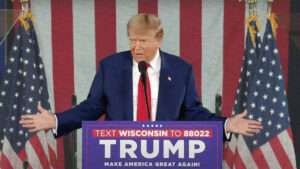
Former President Donald Trump is seen giving a speech at a May rally in Wisconsin. (Screenshot, YouTube)
Trump v. United States, Monday's Supreme Court decision on presidential immunity from criminal prosecution, has many flaws. Others, beginning with the dissenting justices, have pointed out most of them already. But I want to highlight two major problems: the majority's neglect of originalism, and the extremely fuzzy nature of the standards it adopts. If the decision has a saving grace, it's that the vagueness might turn out to make it less harmful than it seems at first sight, depending on how lower courts and possible future Supreme Court decisions interpret it.
Perhaps there is a better defense for the majority's approach than what they themselves offer. But the weakness of the Court's reasoning is still significant.
Chief Justice John Roberts' majority opinion holds that the president enjoys absolute immunity from criminal prosecution for the exercise of "core constitutional powers," that there is at least some degree of presidential immunity (either absolute or merely presumptive) for other "official acts," and that there is no immunity for purely "private acts." The most striking aspect of the decision is that it offers virtually no originalist or textualist support for any of this.
The liberal living-constitutionalist dissenting justices pay much more attention to originalist considerations here than the conservative originalist majority. As Justice Sonia Sotomayor's dissent point outs, nothing in the text or original meaning of the Constitution gives the president anything like this degree of immunity. In fact, text and original meaning cut the other way:
The Constitution's text contains no provision for immunity from criminal prosecution for former Presidents. Of course, "the silence of the Constitution on this score is not dispositive." United States v. Nixon, 418 U. S. 683, 706,n. 16 (1974)… The omission in the text of the Constitution is worth noting, however, for at least three reasons.
First, the Framers clearly knew how to provide for immunity from prosecution. They did provide a narrow immunity for legislators in the Speech or Debate Clause. See Art. I, §6, cl. 1 ("Senators and Representatives . . . shall in all Cases, except Treason, Felony and Breach of the Peace, be privileged from Arrest during their Attendance at the Session of their respective Houses, and in going to and returning from the same; and for any Speech or Debate in either House, they shall not be questioned in any other Place"). They did not extend the same or similar immunity to Presidents.
Second, "some state constitutions at the time of the Framing specifically provided 'express criminal immunities' to sitting governors." Brief for Scholars of Constitutional Law as Amici Curiae 4…. The Framers chose not to include similar language in the Constitution to immunize the President. If the Framers "had wanted to create some constitutional privilege to shield the President . . . from criminal indictment," they could have done so… They did not.
Third, insofar as the Constitution does speak to this question, it actually contemplates some form of criminal liability for former Presidents. The majority correctly rejects Trump's argument that a former President cannot be prosecuted unless he has been impeached by the House and convicted by the Senate for the same conduct…. The majority ignores, however, that the Impeachment Judgment Clause cuts against its own position. That Clause presumes the availability of criminal process as a backstop by establishing that an official impeached and convicted by the Senate "shall nevertheless be liable and subject to Indictment, Trial, Judgment and Punishment, according to Law." Art. I, §3, cl. 7 (emphasis added). That Clause clearly contemplates that a former President may be subject to criminal prosecution for the same conduct that resulted (or could have resulted) in an impeachment judgment—including conduct such as "Bribery," Art. II, §4, which implicates official acts almost by definition.
Aware of its lack of textual support, the majority points out that this Court has "recognized Presidential immunities and privileges 'rooted in the constitutional tradition of the separation of powers and supported by our history….' " That is true, as far as it goes. Nothing in our history, however, supports the majority's entirely novel immunity from criminal prosecution for official acts.
The historical evidence that exists on Presidential immunity from criminal prosecution cuts decisively against it. For instance, Alexander Hamilton wrote that former Presidents would be "liable to prosecution and punishment in the ordinary course of law." The Federalist No. 69…. For Hamilton, that was an important distinction between "the king of Great Britain," who was "sacred and inviolable," and the "President of the United States," who "would be amenable to personal punishment and disgrace." Id., at 458. In contrast to the king, the President should be subject to "personal responsibility" for his actions, "stand[ing] upon no better ground than a governor of New York, and upon worse ground than the governors of Maryland and Delaware," whose State Constitutions gave them some immunity…
At the Constitutional Convention, James Madison, who was aware that some state constitutions provided governors immunity, proposed that the Convention "conside[r] what privileges ought to be allowed to the Executive…." There is no record of any such discussion…. Delegate Charles Pinckney later explained that "[t]he Convention which formed the Constitution well knew" that "no subject had been more abused than privilege," and so it "determined to . . . limi[t] privilege to what was necessary, and no more." 3 id., at 385. "No privilege . . . was intended for [the] Executive." Ibid…. Other commentators around the time of the Founding observed that federal officials had no immunity from prosecution, drawing no exception for the President…
The majority has no meaningful rebuttal to any of this. Their neglect of text and original meaning might be more defensible if there was strong precedent on the subject. But there is no such precedent, because the courts have never before considered the issue of presidential immunity from criminal prosecution.
The majority mainly relies on the consequentialist policy argument that the president must have extensive immunity so he won't be deterred from carrying out his duties with "bold and unhesitating action." They fail to explain why this consideration should outweigh the danger that sweeping immunity would incentivize presidents to commit horrific crimes and abuses of power - such as, for example, trying to use force and fraud to stay in power after losing a presidential election!
I would suggest that curbing such dangers is more than worth some reduction in "bold and unhesitating action." Indeed, there are many areas where the nation would better off if the executive were less bold, and took less action. Regardless, at least from an originalist point of view, the tradeoff here was made by the framers and ratifiers, and should not be second-guessed by the courts, at least not without a vastly more compelling reason than the majority gives us.
The majority does rely on modern precedent restricting civil liability for the president, such as Nixon v. Fitzgerald (1982). They note that criminal liability might have an even bigger chilling effect on presidential action. But they neglect the fact that presidential criminality might be a bigger menace to the republic and cause more harm than civil wrongdoing.
The majority in Nixon v. Fitzgerald recognized that "there is a lesser public interest in actions for civil damages than, for example, in criminal prosecutions." Thus, it offers little support for extending immunity to the criminal context. I think the dissenting justices in that close 5-4 case were right to argue that civil immunity should also be severely limited. As Justice Byron White wrote in his dissent, "I do not agree that, if the Office of President is to operate effectively, the holder of that Office must be permitted, without fear of liability and regardless of the function he is performing, deliberately to inflict injury on others by conduct that he knows violates the law." Regardless, the decision has little relevance to criminal liability, and cannot outweigh the text and original meaning.
In addition to being poorly grounded in the text and original meaning, the majority's ruling is also extremely vague and unclear on key points. It gives us very little guidance on how to tell the difference between "core powers" (subject to absolute immunity), and other "official acts" (which may not be). That seems like a crucial issue on which the justices should have given more guidance to lower courts.
Similarly, the Court refuses to tell us whether presidents get absolute immunity for non-core official acts, or merely presumptive immunity. Another whopper of an omission! If immunity in such cases is just presumptive, it is hard to tell what would be enough to overcome the presumption. The majority does suggest, at one point, that the president must "be immune from prosecution for an official act unless the Government can show that applying a criminal prohibition to that act would pose no dangers of intrusion on the authority and functions of the Executive Branch." Taken literally, this would preclude prosecution for any acts even remotely connected to anything official, a there might always be at least some small danger of "intrusion" on executive power in such situations. But maybe a small or indirect danger isn't enough.
The crucial distinction between "official acts" and "private acts" is also poorly explained, though the court does indicate (wrongly, I think) that presidential motives cannot be considered in distinguishing between the two, and that official acts cannot be used as evidence in prosecuting private acts. The majority also holds (for no good reason, in my view) that various types of communications between the president and Department of Justice officials are automatically official and not subject to prosecution.
The majority's vagueness on key points might lead the decision to be less harmful than it initially seems. Lower courts and possible future Supreme Court rulings might decide on a narrow definition of "core powers," rule that other official acts get only presumptive immunity, and that the presumption can be overcome fairly easily. They could also potentially settle on a relatively narrow definition of what counts as an "official" act, as opposed to a "private one." If that happens, the majority might have some justification for claiming the dissenters are overly alarmist, and that they haven't placed the president "above the law" when it comes to criminal liability.
Justice Amy Coney Barrett's concurring opinion does indeed make some of these moves. As a result, she concludes that "the President's constitutional protection from prosecution is narrow," extending only to areas where he has "conclusive and preclusive authority," but not to those where "Congress has concurrent authority over many Government functions, and it may sometimes use that authority to regulate the President's official conduct, including by criminal statute."
If Justice Barrett's approach prevails, this would allow prosecution of much of Trump's post-election conduct in 2020-21. It would also dispose of a variety of dangerous scenarios, such as the now-famous "SEAL Team 6" hypothetical, where the president orders the military to assassinate political rivals. While the president is the Commander-in-Chief of the armed forces, Congress, under Article I of the Constitution, has "concurrent authority" to makes "rules for the government and regulation of the land and naval forces." It can and does use that power to criminalize war crimes and other improper uses of the military. The Seal Team 6 assassination scenario surely qualifies.
But it's far from clear the other five majority justices are with Barrett on this, and some reason to think they may not be, give their emphasis on the need to shield the president from prosecutions that might keep him from being "bold and unhesitating."
Barrett also rightly breaks with the majority on the issue of evidentiary use of official acts. Her argument on that score strikes me as compelling.
One can argue we don't need criminal liability to control presidential abuses of power. After all, it has never been used prior to Trump. But past presidents did commit some horrible acts that might have been prevented by fear of criminal prosecution. The Japanese internments in World War II are a notable example. The same goes for a slew of horrific civil liberties violations committed by Woodrow Wilson, among others. If Trump is the first president to be subject to criminal prosecution for acts committed while in office, it is in large part because some previous presidents have gotten away with crimes they should not have been allowed to commit with impunity. The Court should not elevate this indefensible neglect of presidential criminality to a binding constitutional principle.
To be sure, there is a genuine danger that political opponents would go after former presidents for petty offenses, in our world where the range of federal crimes has grown to vast proportions, and most adult Americans have probably committed a federal crime of some kind in the course of their lives. But that problem shoud be addressed by Congress passing legislation giving presidents targeted immunity for various minor offenses. Better still, it can eliminate many of these offenses from the books entirely. This is not an issue that should be resolved by judicial policymaking in defiance of the text and original meaning of the Constitution.
The headline result of Loper Bright Enterprise v. Raimando is that the Supreme Court has overturned Chevron v. NRDC and ended the practice of Chevron deference. While this is significant, count me among those who think the effects of the decision will be more modest than some portend. It may be that Loper Bright "places a tombstone on Chevron no one can miss," but the most important aspects of the decision lie in the weeds. As I suggested in February, the extent to which a given rule constrains agencies is more a function of what it does than how it is labeled.
The Chief's decision in Loper Bright reaffirms that judges must interpret statutes in the first instance and that courts are not obliged to follow an agency's interpretation of a statute unless that interpretation is convincing. In effect, a rule of deference is replaced with a rule of respect. That is, as was the case prior to Chevron, reviewing courts are required to listen to what agencies have to say, but must still exercise their independent judgment on what a statute means. As the Chief puts it repeatedly, the rule is that courts are to give agencies "due respect" rather than deference.
As the Chief Justice explains, the basic understanding, as explained by Alexander Hamilton in Federalist 78, was that "'the interpretation of the laws' would be 'the proper and peculiar province of the courts." At the same time, "the Court also recognized from the outset . . . that exercising independent judgment often included according due respect to Executive Branch interpretations of federal statutes." This formulation -- the exercise of independent judgment while according "due respect" to the executive branch is repeated throughout the opinion.
The Chief Justice also explains that "respect" is a far cry from deference.
"Respect," though, was just that. The views of the Executive Branch could inform the judgment of the Judiciary, but did not supersede it. Whatever respect an Executive Branch interpretation was due, a judge "certainly would not be bound to adopt the construction given by the head of a department." . . . Otherwise, judicial judgment would not be independent at all. As Justice Story put it, "in cases where [a court's] own judgment . . . differ[ed] from that of other high functionaries," the court was "not at liberty to surrender, or to waive it."
In explaining what this means in practice, the Chief points to the Skidmore formulation, which includes consideration of an agency's expertise and experience, and the thoroughness of the agency's consideration. So agency expertise still matters, but it does not offer agencies a trump card when statutory language is difficult to parse or somewhat unclear.
delegating ultimate interpretive authority to agencies is simply not necessary to ensure that the resolution of statutory ambiguities is well informed by subject matter expertise. The better presumption is therefore that Congress expects courts to do their ordinary job of interpreting statutes, with due respect for the views of the Executive Branch.
(And note there's that "due respect" formulation again.)
The opinion also notes that a longstanding agency interpretation, or one offered contemporaneous with a statute's adoption, is likely deserving of more weight than one arrived at much later. This should not surprise given the Chief Justice's repeated concern for what I've characterized as "pouring new wine out of old bottles." Agencies fulfill their obligation as part of the executive branch by carrying out Congress's instructions, not by deciding on a preferred (or White-House-dictated) course of action and only then scouring statutes for potential sources of legal authority.
This emphasis on giving agencies "due respect" rather than deference effectively restores judicial review of agency action to what it was prior to Chevron, with one important caveat. From the enactment of the Administrative Procedure Act through the creation of the Chevron doctrine (which, to be clear, occurred well after the decision), agencies had ample authority to implement federal regulatory statutes and were not particularly hampered by judicial review. This shows that deference is not necessary for agencies to be able to regulate. What will be different after Loper Bright will not be the lack of deference so much as the background approach to statutory interpretation adopted by federal courts. Pre-Chevron courts often embraced broad purposivist interpretations of federal statutes. These days, not so much. Statutory interpretation is more textualist, and more constrained, in the 2020s than it was in the 1970s and 1980s.
The Loper Bright opinion also evinces a concern about the nature and scope of delegation that was often absent in late-20th century judicial review of agency action. As the Chief Justice writes: "At best, our intricate Chevron doctrine has been nothing more than a distraction from the question that matters: Does the statute authorize the challenged agency action?" In this sense, the decision is consistent with what I've called the Delegation Doctrine.
Courts must respect Congress's decision to delegate authority to regulatory agencies, the Chief Justice notes, while stressing that it is also for courts to "fix the boundaries of [the]delegated authority." Further, unlike under more permissive applications of Chevron, such delegations are not to be presumed. Ambiguities and gaps, standing alone, are not to be presumed to delegate much of anything. Congress delegates what it delegates, and the failure to delegate is just that, a failure delegate. (In effect, the rest is silence.) Likewise, while it is possible a statutory gap or ambiguity was meant to leave room for an agency to operate, it may also be nothing more than poor drafting. While the former may entail some element of delegation, the latter does not.
Going forward, courts will continue to uphold reasonable agency interpretations of regulatory statutes, particularly when the subject matter is technical or complex, and agencies will still exercise broad swaths of policy discretion, as the Loper Bright opinion expressly contemplates. Yet agencies will have to spend more time considering and showing how their desired approach to a given statute best conforms to the relevant text and will be less able to alter or reverse long-standing statutory interpretations without going back to Congress. Where statutes have been on the books for decades without meaningful amendment or revision, this will make it more difficult for agencies to adjust to changing circumstances. The big question will thus be whether Congress gets the message and responds with more frequent legislating (something about which Chris Walker and I have some thoughts).
My bottom line on Loper Bright is that the shift from deference to respect is less a revolution than a modest course correction. This decision, standing alone, will not tame the administrative state, but it may give Congress greater incentive to revisit existing statutory authorities and ensure that agencies have the authority they need to do the things Congress would like them to do.
It seems the primary driver behind many of President Biden's judicial nominees has been concerns for diversity. (We'll see if a similar factor governs who replaces Biden if he does not seek a second term.) But for at least two of Biden's circuit court nominees, a credential has been to lose a landmark Supreme Court case.
Today, President Biden nominated Ryan Park, the North Carolina Solicitor General, to the Fourth Circuit. Park argued Students for Fair Admission v. UNC.
An Article III confirmation is something of a consolation prize.
Park graduated from Harvard Law School in 2010. He clerked for three years:
He served as a law clerk to Justice Ruth Bader Ginsburg and Justice David H. Souter on the U.S. Supreme Court from 2013 to 2014, for Judge Robert A. Katzmann on the U.S. Court of Appeals for the Second Circuit from 2011 to 2012, and for Judge Jed S. Rakoff on the U.S. District Court for the Southern District of New York from 2010 to 2011.
One would think that he was hired by Justice Ginsburg, but that is not accurate. He was hired by retired Justice David Souter, and was detailed to Justice Ginsburg. I think it is misleading for Park to list Ginsburg first, and Souter second. For example, Justice Gorsuch was a White clerk, detailed to Kennedy, and Judge Sutton was a Powell clerk, detailed to Scalia.
This is not the first time I've offered this criticism of Park. Way back in January 2015, Park was profiled in The Atlantic. He wrote all about his experience with RBG, but never actually mentioned he was a Souter clerk. At the time, I observed:
Is this bad etiquette to slight the Justice you work for, and only mention him in passing in the author bio? I have no doubt Park did extensive work for RBG, and worked closely with her, but the standard practice is to focus on the judge who hired you. This is almost as bad as some people who say they clerked for Justices Breyer or Alito, when they actually clerked for Judges Breyer or Alito (you know who you are!).
Ditto for people who clerked for "Justice Breyer" before his elevation to the Supreme Court.
Poor Justice Souter. Not even his former clerks give him his due.
One final note. Does Park have the twelve years of experience that the ABA requires? If we exclude the three years of clerking, Park would be right at eleven years. But who cares what the ABA thinks!
McConnell: "Dismantling the administrative state and empowering people who are actually elected to make decisions has been the motivating force" for nearly every "Federalist Society-type lawyer."
The New York Times published a revealing, but not surprising, survey of how the three Trump appointees to the Supreme Court came to be. The article makes crystal clear that the priority of Don McGahn, the White House Counsel, and Senator Mitch McConnell, was always the administrative state, and not social issues like abortion.
While much of the attention to the conservative-dominated court has been about the sweeping decisions it has made to roll back abortion rights and now greatly expand presidential immunity, that was never the main goal for the architects of the effort to pull the judiciary to the right.
For those who led the drive to place Justice Gorsuch and two other conservatives on the court during the Trump administration, a sweeping series of rulings by the Supreme Court this year that shrank the power of federal agencies was the true victory. Their longtime target, the so-called administrative state, has been beaten back with the overturning of the 40-year-old Chevron doctrine and a flurry of other decisions aimed at reining in federal government reach — just as they envisioned it.
McGahn acknowledges that Chevron was always the primary objective:
"None of this was an accident," Mr. McGahn, a partner at Jones Day, said in an interview about the court's landmark rulings on administrative law — an arcane area but one that was a cornerstone of his campaign to place jurists skeptical of federal power on the bench. "It was a way to corral the runaway bureaucracy to get judges in place who were actually going to read the law as it was written."
And McConnell adds that these administrative law cases were the primary motivation for FedSoc lawyers, and not social cases:
Limiting the power of federal officials was a longstanding goal of members of the Federalist Society, the conservative group seen as an incubator for the type of judges that Mr. McGahn and others sought when they moved to quickly populate the courts with conservative jurists after Mr. Trump's election.
"Dismantling the administrative state and empowering people who are actually elected to make decisions has been the motivating force" for nearly every "Federalist Society-type lawyer," Senator Mitch McConnell, the Kentucky Republican and minority leader, said in an interview. . . .
"I think the left thought that all we ever talked about was Roe v. Wade," Mr. McConnell said. "Frankly, I can't even remember it coming up. This was the unifying issue," he said of the attempt to rein in federal agencies.
McConnell is largely correct. After the 2021 Federalist Society Lawyer's Convention, I wrote about the split among members with regard to abortion. The old guard were fixated on issues like Chevron, while the younger members realized that overruling Roe was on the horizon. In hindsight, Dobbs has been an unmitigated disaster for Republican politicians--no wonder McConnell and others did not pursue that cause. They knew what would happen when the dog finally caught its tail. But McConnell is correct that Gorsuch and Kavanaugh were not selected for their views on abortion.
How did McGahn look for potential justices? Well, for at least two of the nominees, he looked to their records:
Mr. McGahn had first grown leery of the extent of agency regulatory power during his own stint as a member of the Federal Election Commission. When he became White House counsel for Mr. Trump, he played a central role in vetting candidates for the Supreme Court and recommending them to the new president.
He searched for potential nominees who had demonstrated a zeal for challenging the reach of federal agencies and backed it up with strong legal arguments and decisions.
"It's not enough to say the right things in public speeches," Mr. McGahn said in November 2017 remarks to the Federalist Society, as he laid out his strategy for what had come to be known as deconstructing the administrative state. "Judges must apply those principles in concrete cases."
In 2015, Randy Barnett and I wrote a guide for picking Supreme Court justices in the Weekly Standard (obm). We explained that "paper trails are an asset, not a disqualification." It is not enough for a friend to say that "she is solid." Show me.
Let's start with Justice Gorsuch. I've noted several times over the years that Gorsuch did not make it onto the first Trump list. Before the 2016, I knew very little about Judge Gorsuch. I recall that he was in the majority in the Hobby Lobby decision, but I don't remember meeting him until the 2016 Federalist Society National Lawyers Convention, which followed the presidential election. Around that same time, Gorsuch suddenly jumped to the lead in my FantasySCOTUS prediction market.
Justice Barrett's concurring opinion in Trump v. United States is more satisfying than the majority on several counts. On the issues upon which Barrett and the Court's majority disagree, she has the better of the argument.
Given the lack of any explicit textual basis for presidential immunity, I also believe her formulation of how to think about presidential "immunity" as a consequence of the nature of executive power to be more helpful than that offered by the majority (though, to be fair, prior Court decisions had relied upon a more traditional immunity formulation).
In short, Barrett explains that if there are some exercises of executive power that are beyond Congress's reach (other than through impeachment), then those exercises of executive power cannot be criminalized. From her opinion:
the Constitution prohibits Congress from criminalizing a President's exercise of core Article II powers and closely related conduct. . . . The Court describes the President's constitutional protection from certain prosecutions as an "immunity." As I see it, that term is shorthand for two propositions: The President can challenge the constitutionality of a criminal statute as applied to official acts alleged in the indictment, and he can obtain interlocutory review of the trial court's ruling.
There appears to be substantial agreement on the first point. Like the Court, the dissenting Justices and the Special Counsel all accept that some prosecutions of a President's official conduct may be unconstitutional. . . . As for interlocutory review, our precedent recognizes that resolving certain legal issues before trial is necessary to safeguard important constitutional interests—here, Executive Branch independence on matters that Article II assigns to the President's discretion.
Properly conceived, the President's constitutional protection from prosecution is narrow. The Court leaves open the President for any official conduct, instructing the lower courts to address that question in the first instance. . . . I would have answered it now. Though I agree that a President cannot be held criminally liable for conduct within his "conclusive and preclusive" authority and closely related acts, . . . the Constitution does not vest every exercise of executive power in the President's sole discretion, Youngstown Sheet & Tube Co. v. Sawyer, 343 U. S. 579, 637 (1952) (Jackson, J., concurring). Congress has concurrent authority over many Government functions, and it may sometimes use that authority to regulate the President's official conduct, including by criminal statute. Article II poses no barrier to prosecution in such cases.
I would thus assess the validity of criminal charges predicated on most official acts—i.e., those falling outside of the President's core executive power—in two steps. The first question is whether the relevant criminal statute reaches the President's official conduct. Not every broadly worded statute does. For example, §956 covers conspiracy to murder in a foreign country and does not expressly exclude the President's decision to, say, order a hostage rescue mission abroad. 18 U. S. C. §956(a). The underlying murder statute, however, covers only "unlawful" killings. §1111. The Office of Legal Counsel has interpreted that phrase to reflect a public-authority exception for official acts involving the military and law enforcement. Memorandum from D. Barron, Acting Assistant Atty. Gen., to E. Holder, Atty. Gen., Re: Applicability of Federal Criminal Laws and the Constitution to Contemplated Lethal Operations Against Shaykh Anwar al-Aulaqi 12–19 (July 16, 2010); . . . I express no view about the merits of that interpretation, but it shows that the threshold question of statutory interpretation is a nontrivial step. . . .
This two-step analysis—considering first whether the statute applies and then whether its application to the particular facts is constitutional—is similar to the approach that the Special Counsel presses in this Court. . . . It is also our usual approach to considering the validity of statutes in situations raising a constitutional question. See, e.g., Seila Law LLC v. Consumer Financial Protection Bureau, 591 U. S. 197, 213, 229 (2020). An important difference in this context is that the President is entitled to an interlocutory appeal of the trial court's ruling. . . . A criminal defendant in federal court normally must wait until after trial to seek review of the trial court's refusal to dismiss charges. . . . But where trial itself threatens certain constitutional interests, we have treated the trial court's resolution of the issue as a "final decision" for purposes of appellate jurisdiction. . . .
Her opinion concludes:
The Constitution does not insulate Presidents from criminal liability for official acts. But any statute regulating the exercise of executive power is subject to a constitutional challenge. . . . A criminal statute is no exception. Thus, a President facing prosecution may challenge the constitutionality of a criminal statute as applied to official acts alleged in the indictment. If that challenge fails, however, he must stand trial.
I would have preferred it had the Chief Justice followed Justice Barrett's lead (and had it agreed with her on the evidentiary question addressed in part III-C of the majority opinion), but that was not to be. I suspect the Chief was working hard to hold a majority together, but was unable to make concessions to Barrett while keeping the other conservatives aboard, and if there was no prospect of building a clear majority to his left, the Chief wrote the opinion that could hold five votes throughout.
Over at the Lawfare Blog, Jack Goldsmith offers some initial thoughts on the Supreme Court's decision in Trump v. United States. As with just-about everything Goldsmith writes on executive power and executive branch accountability, it is worth a read. [Readers may also recall that Goldsmith was one of the first to explain why the Supreme Court should review the D.C. Circuit's decision rejecting any claim of presidential immunity.]
Here's a taste of his latest piece:
The Court faced a slew of novel questions about the scope of presidential power. Many people seem to have a strong opinion about whether the Court's recognition of fairly broad presidential immunity was "right" or "wrong." But the standard sources of constitutional law do not permit a definitive answer to that question. And on the ultimate question of whether the Court's decision was wise, only time will tell.
The case involves a tension at the heart of the U.S. Constitution. Article II vests the president of the United States with the "executive Power" and gives the president a duty to "take Care that the Laws be faithfully executed." These phrases give the president power to interpret the law for the executive branch, to enforce the law (including prosecutorial decisions), to supervise the running of the government (including firing subordinate executive branch officials), and to direct government policy.
These same phrases—especially the "take Care" Clause—also ensure that the president is not above the law. The great paradox of the American presidency is that the same constitutional provisions that render the president beholden to law also endow the presidency with extraordinary power and discretion to interpret and enforce the law, and thus give an unscrupulous president tools to abuse the law.
The paradox is on palpable display in the Biden administration's prosecution of former President Trump. The case raises many difficult questions about what it means for the president to carry out the great functions of the office under law, but they can largely be reduced to two. First, did Trump commit crimes in his postelection intrigues? And second, did Special Counsel Jack Smith unduly threaten the presidency when he charged the former president with these crimes?
As Goldsmith observes, the attorneys in the Office of Special Counsel acknowledged that the case presented far more difficult questions, and required a more nuanced answer, than most of the legal commentariat appearing on cable news. At oral argument the special counsel made numerous concessions that one was unlikely to hear on MSNBC.
It is fair (indeed, important) to note that there is no explicit textual basis for any form of presidential immunity. There are multiple, non-textualist precedents that point the other way, however (Nixon v. Fitzgerald in particular), and few were calling for the Court to sweep those precedents away. Further, as Justice Barrett noted in her concurrence. there are structural reasons why some form of immunity is inevitable. If Congress cannot regulate or control certain exercises of executive power (that power which falls in the first box of Justice Robert Jackson's Youngstown Steel concurrence), then it follows that such exercises of executive power cannot be criminalized.
The Constitution was not written to constrain an unfit occupant of the White House. That is ultimately the job of Congress and the electorate.
On April 24, 2021, Samuel Johnson sat down for dinner at a hotel in Franklin, Tennessee. Shortly after, a group of forty to fifty teenagers began taking prom pictures nearby. The boisterous teenagers apparently disturbed Johnson and other customers, prompting him to ask the chaperone to settle them down. One of the teens, who was wearing a red prom dress, overheard the request and confronted Johnson, all while his boyfriend filmed the interaction. The video is not a picture (or record) of clarity. But at a minimum, it captures Johnson saying that the student in the red dress "look[s] like an idiot."
And here's the decision from this Monday denying the motion to dismiss, by Chief Judge William Campbell (M.D. Tenn.) in Johnson v. Griffin:
One of the teenagers … posted [the video] to their personal TikTok account. TikTok removed the video from its site, but before it was removed, the video was downloaded and posted on other social media platforms, including Twitter, Reddit, and LinkedIn.
On April 26, 2021, Griffin republished the video on Twitter and stated "If this is Sam Johnson in Nashville, Tennessee, the CEO of @VisuWell, healthcare-tech-growth strategist, married to Jill Johnson where they may reside in Franklin, Tennessee, it seems like he's dying to be online famous." Plaintiffs allege that Griffin's tweet republishing the video caused it to go viral. After Griffin published her first tweet, Griffin responded to a comment posted by the teenager who videoed the incident and stated that she was "proud to be any [sic] ally" and "[l]et me know if there's anything I can do to help."
Later that day, Griffin published another tweet attaching two images of Mr. Johnson's face and writing: "Who is? THIS [sic] Sam Johnson of Franklin Tennessee [sic]?"
On April 26, 2021, VisuWell published the following statements, among others:
We unequivocally condemn the behavior exhibited by Sam Johnson in a recent video widely circulated on social media.
After investigating the matter and speaking to individuals involved, the VisuWell BOD has chosen to terminate Mr. Johnson from his position as CEO, effective immediately.
Later that same day, Griffin published another statement that "the nation will remain vigilant" and asked VisuWell if Mr. Johnson had been removed from his position on the Board of Directors. VisuWell replied to Griffin's post and stated "terminated." The next day, on April 27, 2021, VisuWell published another post that stated "Mr. Johnson is no longer employed by VisuWell in any capacity." Plaintiffs contend that VisuWell officially terminated Mr. Johnson's employment contract on April 26, 2021.
Plaintiffs allege that after Griffin posted the video, they received "countless online threats—including threats of rape and death—as a foreseeable and proximate result of Ms. Griffin's call-to-action to make Mr. and Mrs. Johnson 'online famous'."
The court allowed plaintiff's tort claims for tortious interference with contract/business relationship, intentional infliction of emotional distress, intrusion upon seclusion, prima facie tort, and negligence per se to proceed, concluding that the First Amendment didn't preclude such liability:
From Ohio Court of Appeals Judge Robert Hendrickson's opinion Monday in Ehlers v. Thomas, joined by Judges Stephen Powell and Matthew Byrne:
Ehlers is the director of the Montgomery County Coroner's Office ("MCCO"). In August of 2022, Appellants made public records requests to the MCCO regarding the deaths of, among other individuals, Casey Pitzer and Marvin Napier. Appellants believe those deaths were part of a coverup by the MCCO and other government entities. Pitzer and Napier were autopsied at the MCCO.
Appellants largely communicated with Ehlers via her work email. Over time, the emails sent to Ehlers grew more numerous and confrontational. Some emails contained threats of criminal charges, "legal war," and internet smear campaigns if the records Appellants desired were not turned over to them. However, one email from Petry also contained autopsy photos as well as pictures of Ehlers' family taken from social media. The email asked, "[W]hat if it was your daughter?" The email continued:
If we don't get the records immediately. I'm [sic] putting you and every photo I can find of you all over the internet as one of the MURDER COVER UP doctors * * * Your family will be crushed and embarrassed. * * *
It's not going to be right of you to allow your family to be put out there like that. But the fact is, the more you ignore us, the angrier we get. As any parent would. I hope to hear from you by the end of the day. If not, I'll start sending you the TRUE internet posts I create about you. * * *
Thomas, in turn, stated in one email that because of the alleged actions of Ehlers and others, the entire world, "WILL KNOW WHY PEOPLE BURN OUR FYCKING [sic] CITIES AND HAVE NO RESPECT FOR LAW ENFORCEMENT!! THEY'RE LIARS AND AID IN MURDERS." At one point, Thomas attempted to "friend" Ehlers on Facebook and sent her a message which stated, "I see you're a hometown Clinton County Resident!! * * * this could be good or bad. I hope good, I really do, FYI my friend is employed by NCIS. I served with him in the Marines. We will catch Casey's killer!!" The above are just some of the many communications that Appellants sent to Ehlers.